 Pollarding and coppicing are proper pruning techniques. If you think you are an arborist who believes otherwise, do not waste my time arguing about it. More than likely, you are neither as educated nor as experienced as I am with such matters, or you work exclusively with trees for which such procedures would be very inappropriate.
Well, yes, pollarding and coppicing are very inappropriate for the vast majority of trees and shrubs out there. Furthermore, even for those trees and shrubs that they are appropriate for, such procedures are very rarely done properly here in California. Most attempts at pollarding and coppicing are really horrid!
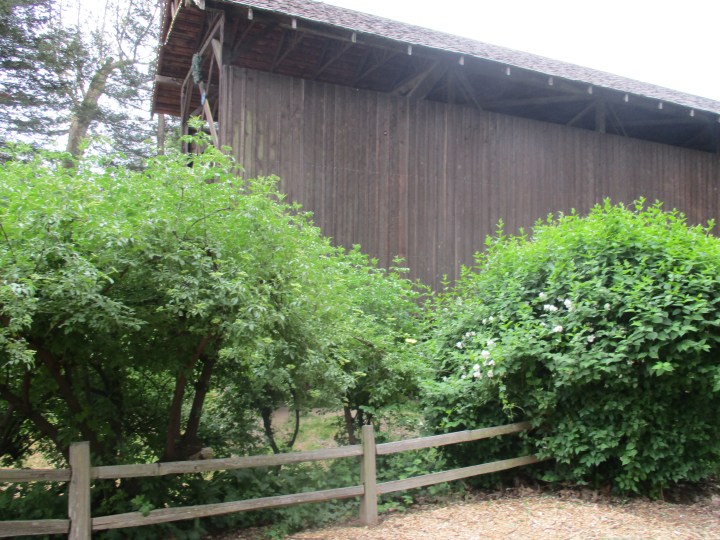
Take these blue elderberries and mock oranges for examples. They were mutilated last summer to improve the view of the historic Felton Covered Bridge. It sort of accomplished that objective, although the improved view of the Bridge was then cluttered with the disfigured and mostly bare trunks and limbs of the brutalized shrubbery below. Because they were chopped back too late in summer to grow much, they stayed that way until now.
So it is spring, and the shrubbery is growing from the tops of the mutilated but tall trunks and limbs, right back to obstructing the view of the Bridge. They will likely get chopped when they get to be too overwhelming, which again, will be in late summer, repeating the process. It would be better to just remove the shrubbery not only because it would be less work, but also because the shrubbery is so unsightly when it gets chopped!
OR; the shrubbery could get coppiced. Both blue elderberry and mock orange respond favorably to the procedure. If coppiced, or in other words, if pruned back to the ground annually each winter, they could regenerate fresh new growth each spring, but not get big enough to crowd the view of the Bridge by the following winter, when they get coppiced again. The elderberry would not bloom or fruit; but that is not important here anyway.
Coppicing takes advantage of the natural dormancy and regenerative processes of the plants. Starting over fresh each spring and growing uninterrupted through summer is more natural for them than trying to recover from getting brutalized while they are actively growing in summer. Since they start the process at ground level, they have room to grow without interruption. If cut back only as much as necessary, they have no room to grow.
Redwoods Are So Tall . . .
 Redwoods are SO TALL!
How tall are they?
They are so tall that you can see for yourself if you look in this direction . . . from anywhere in North America.
They are so tall that if you need firewood, I can aim one in your direction as I cut it down.
They are so tall that while they drop foliar debris on the Ford and Chevrolet parked below, they also drop foliar debris on Mercury and Saturn in their respective orbits.
They are so tall that while other trees collect kites and Frisbees, they collect airplanes and satellites.
They are so tall that only a few of their seed survive. Most burn up in the atmosphere on their way down.
They are SO BIG too!
How big are they?
They are so big that some have tunnels cut through them so cars don’t run out of gasoline while driving around.
Okay enough of that for now.
Most of the biggest redwoods here were harvested, leaving only stumps to remind us of how big they were. The few trees that were big enough for harvest a century ago, but were not harvested when those around them were, probably exhibited some sort of defect that made their lumber undesirable.
The tree in this picture happens to be one of the few that is big enough now to suggest that it was likely big enough for harvest when those around it were harvested. The trunk is more that six feet wide. Yet, except for the severe lean, no obvious defects were observed. (The vertical edge of the doorway to the left was included in the picture for comparison with the lean of the tree.)
The tree started to lean only recently. If it had taken several years to develop this lean, the top several feet of the trunk would be curved upward, as it would have continued to grow vertically away from gravity while the trunk below it moved. If it moved suddenly but only once several years ago, there would be a kink near the top of the otherwise leaning trunk, from which, subsequent growth would be vertical.
This tree instead leans with a straight trunk from bottom to top, which means that it grew vertically, and then moved into this diagonal position too recently for new vertical growth to develop. Lateral branches are also diagonal, as they maintained their position perpendicular to the trunk. Although redwoods rarely destabilize, this one really seems as if it is about to fall.
Is this destabilization relative to some sort of deficiency that prevented the tree from getting harvested a century ago? I really should investigate.
Knucklehead
 This is the beginning of one of several new knuckles on a pollarded crape myrtle tree that was pollareded for the first time just this past winter. It was quite a mess of thicket growth that was too congested to bloom well. It is also located in a confined situation where it could not just be groomed, pruned up for clearance, and then just left to develop a larger canopy higher up. Pollarding will both contain it, as well as invigorate healthier growth.
New shoot growth now emerging from the ends of limbs that were pruned back last winter will elongate and eventually bloom through spring and summer. Next winter, after all the colorful autumn foliage has defoliated, the tree will get pruned back to these same knuckles to repeat the process. Stems will get cut back as neatly as possible, leaving no stubs, but such pruning causes knuckles to become slightly more distended as the develop.
Minor shoot growth that develops elsewhere on the mature stems below the developing knuckles should be removed as it appears. It is easy to knock off now, before it gets big enough to need to be pruned off. Knocking it off or ‘peeling’ it off, as drastic as it sounds, is actually better than pruning it off. It removes more of the callus growth that is likely to develop more stem growth later. New growth should be concentrated into the knuckles.
Pollarded crape myrtles bloom later than those that are not pollarded, but they bloom more profusely. They are also more resistant to mildew, and develop better foliar color in autumn.
The picture below shows the same crape myrtle that I got the picture of the single knuckle above from, shortly after it was pollarded. This picture was used another article at:
https://tonytomeo.com/2019/03/16/six-on-saturday-picture-dump/
Six on Saturday: Spring Flowering Trees – With Problems
You probably do not notice the problems while distracted by the profuse bloom. That is just swell. It is gratifying that the trees that I work with are appealing to those who see them. Since I work with them, I notice their problems. I would have posted just close up pictures of the flowering cherries and flowering crabapples, but because they are blooming at different times this year, I got only these three.
1. The shade of the big redwood trees is a bit too dark for this flowering cherry tree. It is always this sparse. What is worse is that the upper layer of bloom is suspended on a single horizontal limb that extends from the right, out the backside, back in toward the center and off to the left as it is seen here in the picture. What looks like supporting limbs is actually trunks of birch trees in the background. I would prefer to cut the awkward limb off, but you can see how flat topped the remaining portion of the tree would be without it.
2. This is the main reason the tree remains. These double white flowers are the whitest of the trees here.
3. My absence at a previous work day at the Presbyterian Church was the problem with this ‘Prairie Fire’ flowering crabapple. I had worked with this tree for a few years to thin out the thicket growth, and repair structural damage. Then, because I was not there, someone else pruned it indiscriminately with hedge shears and loppers! What a mess! It is best that you can not see the damage within the canopy. I don’t know why this was done. The tree only needed minor trimming for clearance above parked cars. After bloom, I will start the process of structural repair all over again.
4. These rosy pink flowers make it all worth it though.
5. This flowering cherry actually looks better than I expected it to this year. I pruned out so much necrosis last years that I figured that the tree was deteriorating. I expected a bit more new necrosis to develop this years. As you can see, that did not happen so much. I am not disappointed. Actually, I am impressed that there is no necrosis worth noticing. The worst problem with the tree right now is that it is disfigured by the unexplained necrosis. Well, that will not prevent us from appreciating the bloom.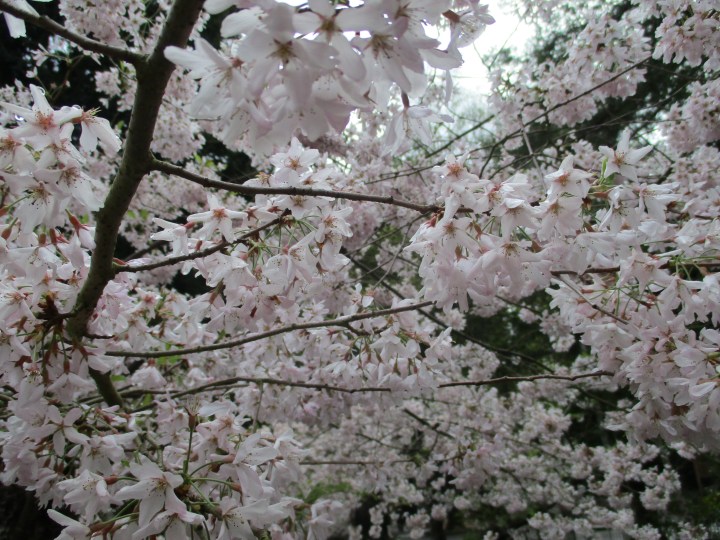
6. This is the bloom close up. It is very similar to the other two old cherry trees that I will be cutting down this year. I wrote an article, and perhaps others, about them earlier. https://tonytomeo.com/2019/03/31/the-end-of-the-cherry-blossom-festival/
This is the link for Six on Saturday, for anyone else who would like to participate:
https://thepropagatorblog.wordpress.com/2017/09/18/six-on-saturday-a-participant-guide/
Horridculture – Weed Eaters
 The most destructive tools that so-called ‘gardeners’ have access to are hedge shears. They use them on just about anything within their reach. If a tree is not beyond their reach, they are likely to shear it into a nondescript glob of a shrub, complete with lodgepole stakes and straps that never get removed. Yet, in all their enthusiasm, they will not properly shear hedges that are actually intended to be shorn. Well, I have ranted on that enough.
The second most destructive tools that so-called ‘gardeners’ have access to are weed eaters, which are also known as weed whackers or edgers. Although not actually related to real edgers, they are known as such just because they are so commonly used for the same purpose. Weed eaters are designed to cut weeds indiscriminately, and are quite efficient at doing so. The problem is that they cut or try to cut anything else they encounter.
So-called ‘gardeners’ often gouge the paint off of the bottoms of walls and fences, just because it is easier to cut the weeds there with a weed eater than it is to pull them. What is worse is that they also often cut off the tops of perennials that are trying to regenerate in spring after winter dormancy. Spring or summer bulbs might never get a chance to bloom. Perennials, groundcover plants and shrubbery are not safe from the blatant indiscretion.
The sad little Memorial Tree in Felton Covered Bridge Park gets gouged more than annually by a weed eater. Every time it happens, I am assured that it will not happen again; but if the weeds get cut before I pull them from around the trunk, it does . . . very regularly. I was also assured that the tree would be outfitted with a tree-guard, but as you can see, it has not yet happened. I am told that I can not put my own guard on the trunk.
Those causing this damage are non-horticulturally oriented people who are assigned community service for some sort of infraction, so should not really be expected to know how to use weed eaters properly; not that this is any consolation for the damage. What is worse is that such damage is so commonly caused by so-called ‘gardeners’ who really should know better, and charge good money to take care of the trees they damage and kill
The most recent article about the Memorial Tree, with a link to a previous article that links to previous articles . . . and so on, can be found at: https://tonytomeo.com/2018/10/14/memorial-memorial/
The End Of The Cherry Blossom Festival
 After decades of spectacular spring bloom, this pair of flowering cherry trees in the picture above must be removed. They have been deteriorating for a very long time. Below the limber blooming branches of the tree on the right, there is not much more than a bulky rotten trunk, one rotting limb, and a short stub of a limb that was cut back to a bit of viable twiggy growth last year. The tree to the left has only a few more viable but rotten limbs.
Through this last winter, it was finally decided that we would allow them to bloom one last time, and then replace them with a new pair of trees of the same cultivar. I will cut them down myself. I do not want anyone else to perform this unpleasant task. Nor do I want such dignified and admired trees to be cut down by anyone else. Like I do for other prominent trees, I will write the obituary; a joint obituary for two who were always together.
Since the new trees will be of the same cultivar, they will bloom with the same profuse pale pink spring bloom, and will hopefully last for more than half a century like the originals did. Because the originals had been pruned back so severely as they deteriorated over the past many years, the new trees should grow to be as large within only a few years. They will not be the same though. There will be no adequate replacement for the originals.
The cherry blossoms below are of another pair of trees a bit farther up the road. They are not nearly as old, so could be there for a few more decades. There are a few others, of various ages and different cultivars, scattered about the neighborhood.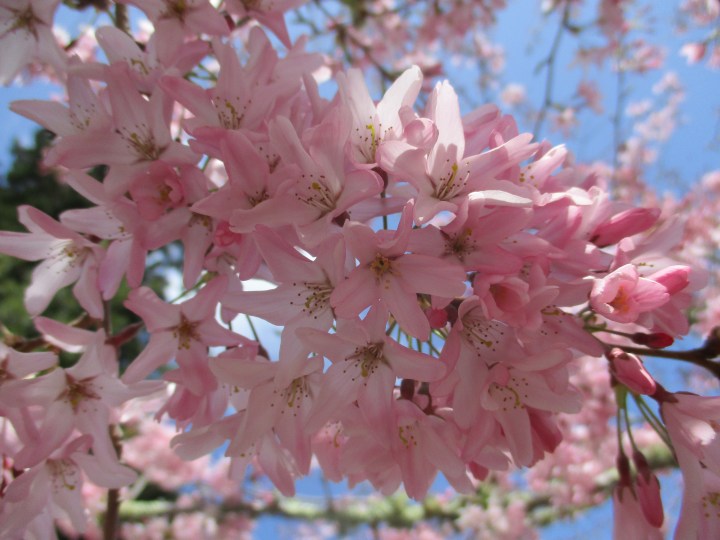

The Davey Tree
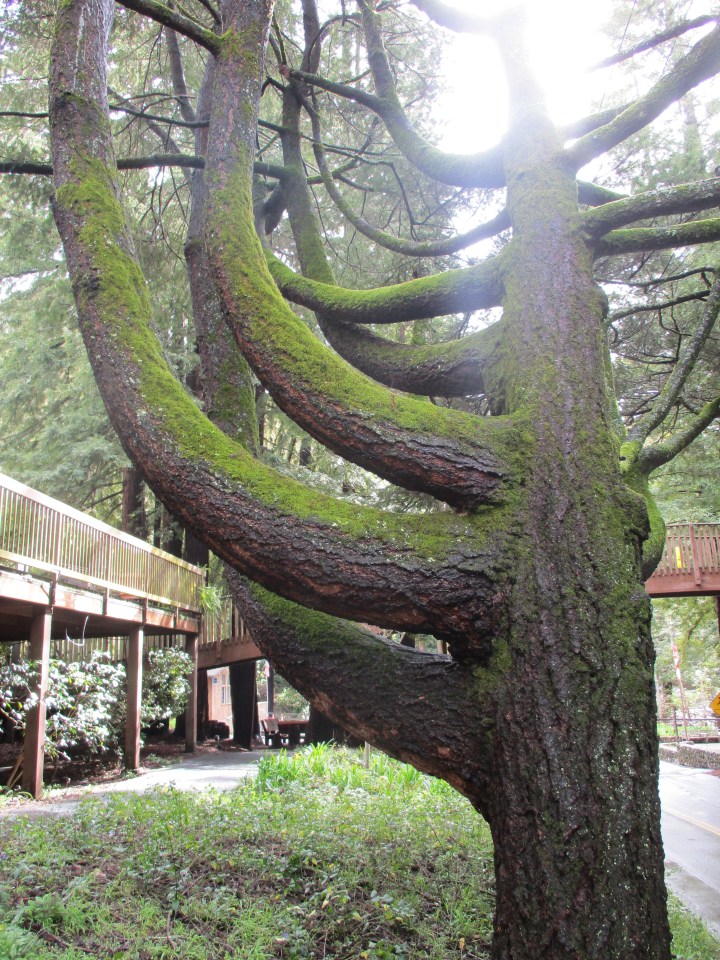 This is no common Douglas fir. It is the ‘Davey Tree’, named after the tree service that so diligently prunes it for clearance from the utility cables above. Yes, I can see as easily as you can how disfigured it is. The plan is to cut it down before it falls apart. At least that is the excuse for cutting it down. It is relatively short an stout, so is likely quite able to support its own weight, regardless of this disfigurement. We really just want it gone because it is so unsightly.
Most who see the Davey Tree are quick to blame the disfigurement on those who prune it for clearance. They do not consider that without such pruning, the utility cables would eventually be ruined and unable to deliver the electricity that so many of us use. Those who prune the trees do what they must to keep the electricity and other utility cables operational. Unfortunately, such work sometimes ruins trees.
As an arborist who sometimes works with other arborists who must perform clearance pruning, I am more likely to blame other landscape professionals. Some landscape designers design landscapes with trees that get too tall or broad within utility easements. Heck, many designers do not even designate where such easements are on the drafts of their landscape plans. Some so-called ‘gardeners’ plant such trees in utility easements with no plan at all. For what they all charge for their services, landscape professionals should know better than to put inappropriate trees into situations where they will eventually need to be mutilated or removed. Not many think that far ahead, or even care.
Anyway, the inappropriate location and disfigurement of the Davey Tree really can not be blamed on anyone. It is a wild tree that grew there from seed.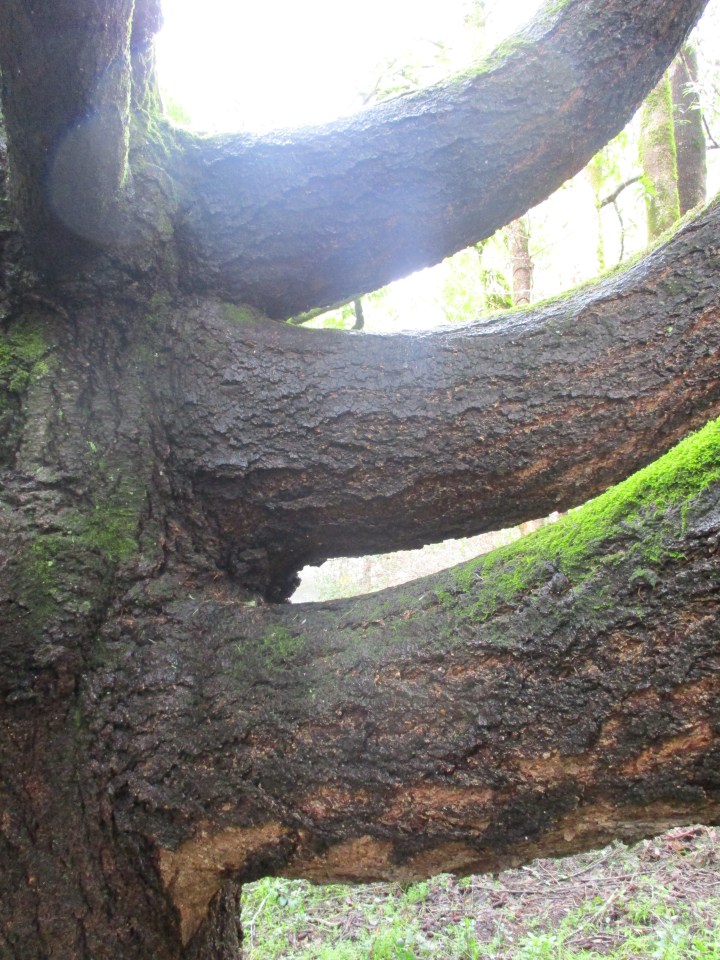
Sugaring Season
 There is no sugaring season here. Spring comes on too suddenly. By the time sap starts to flow, buds are already swelling.
Bigleaf maple, Acer macrophyllum, happens to be native here, although it is not common. It is the sugaring maple of the Pacific Northwest. A tree next to my driveway gave me enough sap to boil about four ounces of maple syrup a few years ago. That was all I needed to make the point to my colleagues who insisted that it could not be done that it really could be done.
Box elder, Acer negundo, is also native, and in riparian zones, is much more common than bigleaf maples is. I am told that is provides sap for sugaring just like any other maple does. Some say the sap is of inferior quality, or boils to cloudy syrup. Others say that it is comparable to that of any other maple.
Now that I made my point about getting a tiny bit of syrup from a bigleaf maple tree, I have no intention of sugaring again. However, sugaring season is still something that I need to be aware of. It is when I can not prune the maple trees. I can prune them earlier in winter or later in summer, but not while they are most vascularly active during sugaring season. Otherwise, they don’t stop bleeding. Even if the bleeding is harmless, it is unsightly if it stains the trunks and becomes infested with sooty mold as the weather warms.
The same rule applies to birch trees.
I pruned a few of the European white birch, Betula pendula, at work last week, believing that it was still too early for them to be too active. It was not much at all, and involved only a few small upper limbs and two significant lower limbs that had been disfigured by pruning for clearance from adjacent utility cables. I did not notice bleeding from the small stubbed limbs that I pruned from high in the canopy with a pole saw. Yet, the sap started to pour from the pruning wounds before I finished cutting away the two larger lower limbs that happened to be on the same tree. They are still bleeding now. In fact, they are bleeding so much that I feel badly that the tree is losing so much sap. If I had known how much sap would bleed, I could have put a bucket under each of the two wounds to catch the sap to make a small bit of syrup as is done in Alaska.
Trees Need Clearance From Utilities
 Palm trunks grow in only one direction; upward, toward sunlight and away from gravity. Each trunk is equipped with only a single terminal bud. If that bud encounters an obstacle, it can not be pruned around it. Palm trunks that get get too close to high voltage cables, or that might sway too close with a breeze, must therefore be removed to maintain minimal clearance from the cables.
Queen palms are notorious for getting planted under high voltage cables because they are so often impulse purchases that get planted without much planning. They are popularly planted along rear fences, exactly where high voltage cables are often located. Mexican fan palms often grow along rear fences as well because that is where birds and rodents are likely to drop the seeds.
Trees with single central leaders, like redwoods, spruces and certain pines, will be disfigured if their main trunks need to be topped for clearance from cables. Removal of such trees is often more practical than this sort of disfigurement. More extensively branched trees like sycamores, ashes, oaks and elms, are more adaptable to clearance pruning if it is not too severely disfiguring.
It is much simpler to not plant trees that get too large under high voltage cables. Elsewhere in the garden, where there is enough lateral (side) clearance, vertical clearance is not such a problem for larger trees. Small trees like redbud, purple leaf plum, photinia and various pittosporums, either do not get tall enough to reach upper cables, or will require only minimal pruning for clearance.
Below high voltage cables, the lower cables are for lower voltage, telephone and television. ‘House-drops’ are the cables that extend from utility poles to houses and other buildings. Although clearance is not so important for these lower risk cables, limbs that lean on them and blow around in wind can be abrasive. Sagging limbs can cause utility cables to sag more than they should.
Unfortunately, those who prune trees for utility clearance are efficient, but rarely arboriculturally correct.
Sci-Fi
 There are thousands of them, these weird motionless caterpillar like ‘things’, in big herds under all the cottonwood trees. They make a squishy mess in the rain, and stain concrete. They may not look like much from a distance, and are merely ignored as a minor nuisance that must be swept from pavement, but on closer inspection, they really look unworldly, like something from another planet, or a bad Japanese science fiction movie.
They are just male catkins of the native cottonwoods. At least I believe they are. If there are female flowers mixed in, I would not know it. Nor would I know if they really are from another planet. I know that the cottonwoods will later make quite a mess with their cottony fluff that carries their seed away on the wind, so they must do what it takes to generate seed, which generally involves flowers of both genders. I just never look that closely. Their privacy should be respected in such matters, even if they choose to do it out in the open. Those that dropped this . . . whatever it is . . . were doing . . . whatever they were doing . . . right out in the big lawn of Felton Covered Bridge Park!
Why must cottonwood trees bloom so profusely? They must know what they are doing. Maybe they expect most of their tiny seed to get eaten by small seed eating birds. Perhaps all but a few of their seed stay in the same riparian situations from which they came, or blow far enough away to land in other equally hospitable riparian situations. Otherwise, almost all land in situations that are too dry for them to survive long after spring. It is difficult to know what their potentially nefarious motives are.
 Tony Tomeo