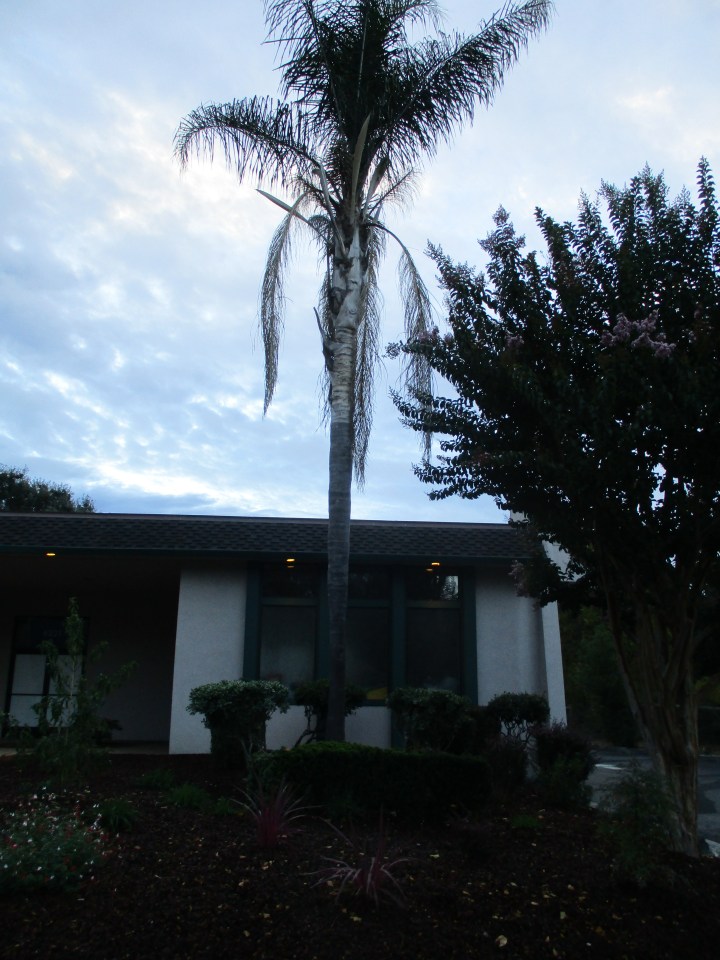
 There are too many different types of horticultural professionals to count. There are nurserymen who grow horticultural commodities. There are landscape architects and landscape designers who design the landscapes into which some of these horticultural commodities will go. There are landscapers who install such landscapes. Of course, there are gardeners who maintain the landscapes after they are installed. These are just a few of the more familiar horticultural professionals.
I will refrain from my typical ranting about the extreme lack of professionalism among almost all horticultural professionals who are not nurserymen or arborists (okay, and one landscape designer), but must point out something in the picture above. Do you see it?
It is not the fact that this once very well designed landscape was dismantled and mostly replaced with a cheap slapped together assemblage of cliché plants by someone who just needed work.
Nor is it the pointlessly disfigured shrubbery from the original landscape that was salvaged while the best features that could have been salvaged were removed.
Nor is it the fact that this process has been repeated a few times since the building was originally landscaped back in the 1980s, leaving a nicely maturing but weirdly non conforming crape myrtle in front of the queen palm that should be the focal point, as well as a new dogwood that will compete with both focal points.
It is the fact that despite all the effort that went into the installation of this garage sale style landscape, no one bothered to procure the services of an arborist to groom the queen palm. Do you see it now; all those dead fronds hanging from the canopy of the queen palm? It is like taking a pick up through a car wash while it is loaded with garbage.
Evergreen Pear
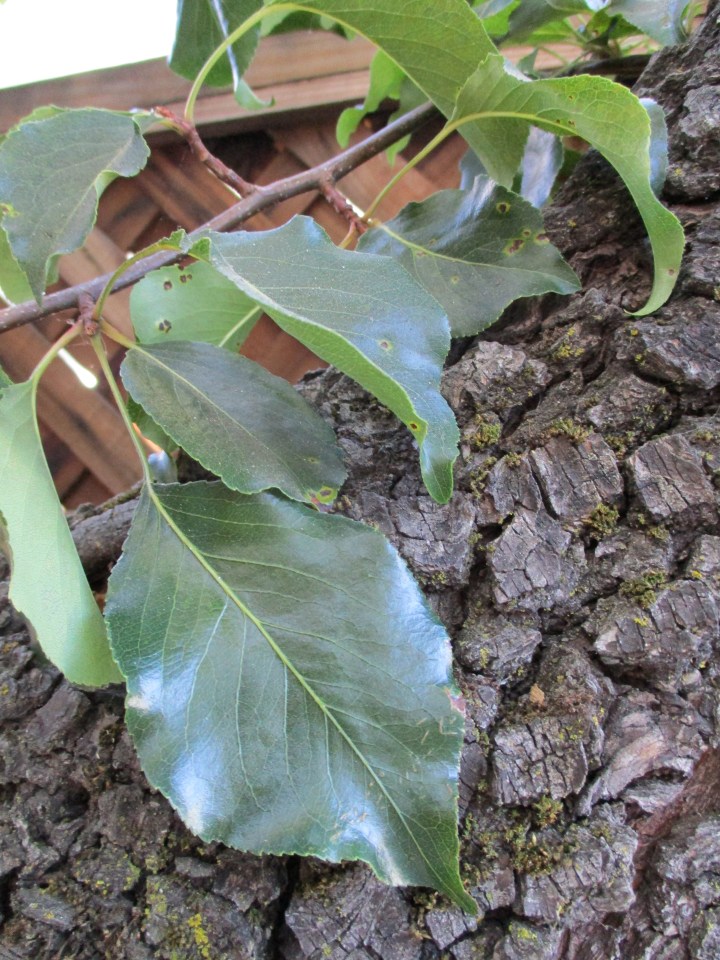 If it were not so seriously susceptible to fireblight, the evergreen pear, Pyrus kawakamii, would be a practical evergreen shade tree for small garden spaces. Mature trees do not often get much taller or wider than twenty five feet. Aggressively pruned trees that do not bloom much are less susceptible to fireblight. Regularly groomed trees can live with fireblight for many years or decades.
The nicely furrowed bark and irregular branch structure give evergreen pear trees the distinction of larger trees. Lower limbs will probably sag low enough to need pruning for clearance. Clusters of small white flowers, like those of other pears, bloom in spring, but are partly obscured by the evergreen foliage. Distressed trees bloom more profusely and are not so densely foliated in bloom.
Horridculture – Think Outside The Box
 Straight out of college, I worked briefly for a wholesale nursery that grew landscape stock, which included boxed trees. We also recycled a few trees, particularly from the abandoned homes in the neighborhood around the nursery. (The neighborhood, including the nursery, were in the easement of the Norman Mineta Freeway, which in the process of being constructed at the time.) I had believed that the boxed and recycled trees were for ‘instant’ landscapes, the sort that were for clients who did not want to wait for things to grow. It made sense, particularly in our region where so few stay in the same home long enough for trees to mature.
Many trees were good candidates for growing in boxes. Some were naturally small trees. Others had fibrous root systems that did not mind the confinement. Japanese maple, crape myrtle, purple leaf plum, flowering cherry, flowering crabapple, magnolia and various specie of podocarpus all grew well for us, and probably adapted well to their new landscape homes.
Other trees were not such good candidates. We also grew a few specie of oak, pine and eucalyptus that did not want their roots to be confined to boxes. They wanted to disperse their roots as soon as they could. They had no problem doing so while young. However, mature boxed trees needed so many years to recover from their confinement that by the time they recovered, if they ever recovered at all, small trees that were planted at the same time had grown larger. Yet, people paid tens of thousands of dollars for some of the larger boxed trees.
Some clients did not care if the trees died. Some just wanted them to live long enough for their home to sell. Those who purchased the homes often did not care either. Many purchasers just demolished such homes and landscapes to build new monster homes on the sites. Many landscapers only needed such trees to live long enough for their client’s cheque to clear.
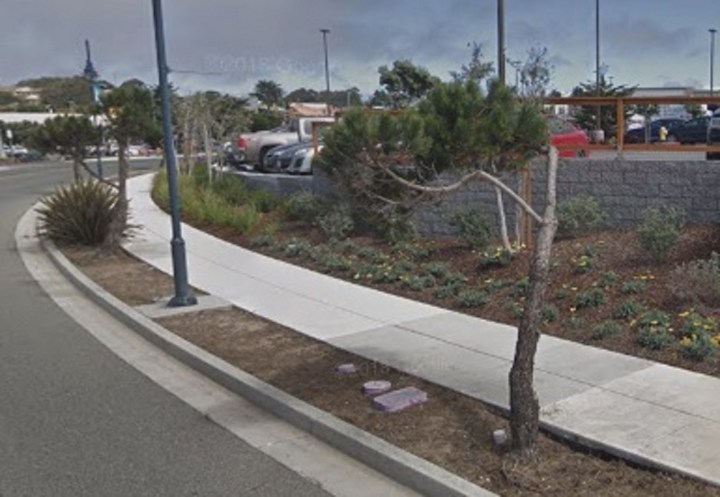
For example, the same ‘landscape company’ that was involved with the ‘Shady’ incident ( https://tonytomeo.com/2018/03/18/shady/ ) installed several boxed Italian stone pines nearby, on General Stillwell Drive, also in Marina. The client presented us with a picture of a very mature Italian Stone pine, and instructed us to install the exact same ‘native’ pines. I tried to explain that ‘Italian’ meant that they were not native. I tried to explain that they would take at least half a century to look like the old tree in the picture. I tried to explain that after only twenty years, the trunks of the trees could be wider than the two foot wide parkstrips that they were to be installed into. The client was an idiot; a demeaning and spoiled rotten idiot. We should have walked off the job (after giving him a good spanking and sending him to his room) when he insisted that we “do it”.
We did not walk off the job of course. There was too much money involved. However, I was conveniently not invited to subsequent meeting, and did not return to the site until after the trees had been installed and were developing some very serious problems.
The biggest trees that were available in 36” boxes were procured. No grower wanted to be liable for larger pines. Because of the innately shrubby structure of the species, the trees were not very tall at all, but were quite plump. They were a special cultivar of Italian stone pine that is native to the central coast of California. (?!)
You can imagine what needed to be done to get each 36” wide root system into a 24” wide parkstrip. Yes, the ‘landscapers’ sliced about half a foot off of opposite sides of the already distressed and unhappily confined root systems of each tree. Because the fluffy canopies obstructed the sidewalks and extended out over the curbs, each tree was severely disfigured by clearance pruning that removed about a third of the branch structure and foliage. In the end, only about two thirds of each of the trees that cost $500 each remained, and the client was furious that they were not as big as that half century old tree in the picture that he found online.
Each tree was outfitted with a pair of root barriers, one for the curb and one for the sidewalk, not to prevent the roots from elevating the pavement, but because the ‘landscaper company’ could earn a bit more money by adding them to the bill. If the trees were to survive, their big trunks would push the curb and sidewalk laterally before the roots elevated them vertically.
That was in about 2008, about ten years ago. Miraculously, several of the trees survived! I found their pictures online. (These two pictures look the same, but are actually in two different locations.) The trees have not yet damaged the curbs or sidewalks, but only because they are not much bigger than they were ten years ago.
General Sherman Tree

The biggest, tallest and oldest trees in the World are all native to California. The biggest trees are the giant redwood, Sequoiadendron giganteum. The tallest trees are the coastal redwood, Sequoia sempervirens. The oldest trees are the bristlecone pines, Pinus longaeva. The biggest and the tallest are two of only three specie of redwood in the World, and except for a few coastal redwood that live barely north of the Oregon border, both are endemic only to California. Most of us know that the coastal redwood is the state tree of California. However, some believe that California is the only state with two state trees, which are the two native specie of redwood.
This gives arborists from California serious bragging rights.
Most of the arborists whom I work with are very familiar with the coastal redwood. Not only is it the most prominent tree in the Santa Cruz Mountains, but it is also a common tree in landscapes of the Santa Clara Valley.
The other two specie are not nearly so common. Neither perform well in landscape situations, and certainly not locally. Even if they did, the giant redwood gets much too bulky to fit into urban landscapes, and the bristlecone pine is a bit too irregular for refined landscapes. Because they both live in somewhat remote regions within California, some very experienced arborists have never seen either of them in the wild. Of course, it is not something we talk about much.
I still have not seen bristlecone pine in the wild. The only specimens I have ever seen were bonsai stock that had not yet been cultivated as bonsai specimens.
In the late 1990s, I had not seen giant redwood in the wild either. I had only seen the unhappy specimens that were planted on the sides of roads between San Jose and nearby towns during the Victorian Period before the urban landscape had become so inhospitable to them. One of my respected colleagues who had seen many of the more interesting trees of California in his travels had not seen them either.
Fortunately, it was nothing that a good old fashioned road trip could not fix. Without much planning at all, we drove out to Sequoia National Park and met with the General Sherman Tree. There was too much snow to get very far, so we did not get similarly acquainted with the General Grant Tree farther up the road. It was one of the most compelling horticultural trips of my lifetime, right up there with going to see the native California fan palm, Washingtonia filifera, outside of Palm Springs, or the Joshua tree, Yucca brevifolia, outside of Palmdale. I know that the picture above is not a good picture of my colleague with the General Sherman Tree. It is from a time when cameras still used film. Getting pictures transferred to a compact disc was merely an option back then. The sepia toned picture below is even older, but it is not mine.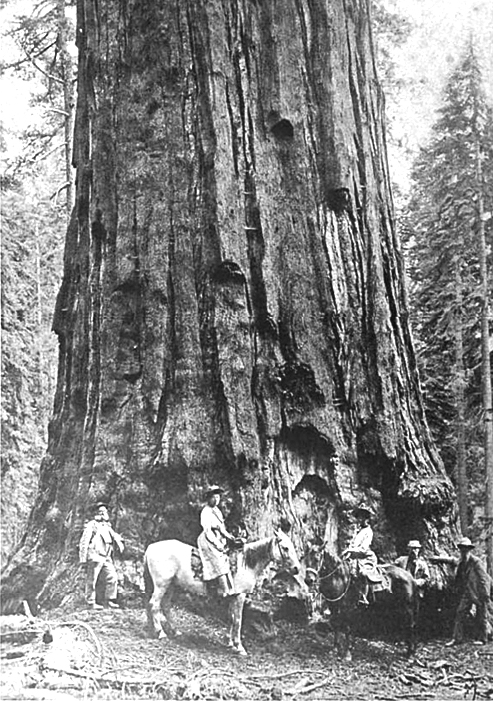
Horridculture – Bullwinkle
 This rant may not go in the direction you expect it to. The pictures suggest that this would be about the bad vegetation management crews who severely disfigure trees that get too close to utility cables. It is not.
This is about horticultural ‘professionals’ who plant trees where they will encroach into utility cables, with no regard to what might eventually be done to them in order to keep electrical service reliable and safe. The native oak in these pictures likely grew from seed, so unless someone knows the squirrel who buried the acorn, there is no one to blame. Many of us who enjoy home gardening are sometimes not aware of how tall and wide particular trees can get when we plant them. Horticultural ‘professionals’ should know better! That is what they charge so much money for when they design a landscape.
Palm trees are the worst! They grow only upward, with only a single terminal bud. Once that terminal bud encroaches into a utility easement, there is no option to prune back to another branch that might direct growth around the easement. ‘Pruning’ the only terminal bud back kills the entire tree. Yet, some landscape ‘designers’ continue to prescribe the all too trendy queen palm for the backsides of urban landscapes, even if utility cables are back there like they so typically are.
The oak in these pictures got a Bullwinkle cut, with big ‘antlers’ reaching upward and to the left and right of cables that are directly above. The lower picture sort of shows a ‘step back’ cut into the top for clearance from other perpendicular cables that pass over that edge rather than directly above. The tree is in surprisingly good condition, and gets pruned as properly as possible for the difficult circumstances. This brief article from a few days ago discusses a few more details about easements. https://tonytomeo.com/2018/08/02/easements-really-should-be-easier/
Knees
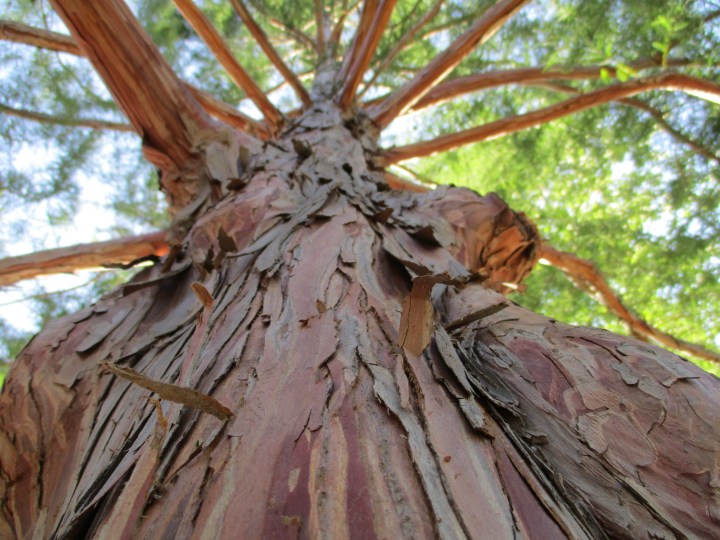 When a plant that should be compact or shrubby gets too lanky with exposed lower stems, it is described as ‘leggy’. We do not hear much about plants that develop ‘knees’. Perhaps that is because there is only one species that does so. That one species happens to be very rare here. If there are other specie that develop knees, I do not know what they are.
‘Knees’ are weird appendages that grow upward like stalagmites from the roots of bald cypress Taxodium distichum, particularly where the trees grow wild in swampy conditions. Knees can get quite tall. One of our professors used to tell us that they could do some serious damage to a canoe. Perhaps knees are why bald cypress is locally unpopular in landscapes.
However, I happened to notice that bald cypress is a common street tree in downtown Oklahoma City. Just like most other street trees, they are installed into small tree wells, but otherwise surrounded by pavement. They were remarkably healthy and well structured specimens that were too young to have damaged the pavement. Yet, I could not help but wonder what they will do as they mature. Even before the trunks grow as big around as the small tree wells that they are in, what would happen if knees develop?
There happens to be not one, but two bald cypress at work. The smaller is alongside a small stream. The larger is adjacent to a lawn where the soil is seemingly dry on the surface, but quite soggy just below the surface. This larger specimen is already developing distended burls that seem to be rudimentary knees. Although there is no pavement to break, the tree happens to be shading a picnic area where knees, if they develop, would be quite an obtrusive problem.
Easements Really Should Be Easier
 Like Michael Jackson said, “You got an easement on down the road.”. . . or something like that. In older neighborhoods, that is where the utility easements are usually located. These are zones for utility poles that suspend electrical, telephone and television cables. When electricity first became available, that was the easiest place to put the cables, and the practice continued for decades.
Utility easements in middle aged neighborhoods are usually at the rear boundaries of back yards. They were put there to get out of the way of shade trees in front yards, particularly street trees. Where there are alleys in back, easements are on one side of the alley or the other. The same applies to narrow streets with easements. More modern neighborhoods have subterranean utilities.
Those of us who must contend with easements know how difficult they can be. Trees that encroach too closely to the high voltage cables on top of the poles must be pruned for clearance, even if such pruning disfigures or kills them. Lower cables for telephone and cable television sometimes get tangled with vines or big shrubbery because clearance from vegetation is not such a priority.
Utility providers have access to easements to maintain their systems. So do the tree services that have the grim task of pruning encroaching vegetation for clearance from high voltage cables. They do what they must to maintain reliable service; which is unfortunately not always compatible with what we want for our trees. Clearance pruning is too often unsightly, but it is very necessary.
The only way to avoid unsightly and disfiguring clearance pruning to to only plant trees that will not encroach into high voltage cables. Of course, in small gardens with big easements, the choices of trees that stay proportionate to available space are very limited. Except for Mediterranean fan palm or palms that stay very short, palms should never be planted below utility cables. They grow only upward, and can not be pruned around cables, so must be removed when they get too close.
Coppice
 Coppiced trees and shrubs are just like pollarded trees, but without the trunk and main limbs. Instead of getting cut back to the same distended knuckles at the ends of disproportionately stout limbs, they get cut back to the same stump just above grade over winter. Some get coppiced annually. Others get coppiced only when they get too big. The coppiced California sycamore in this picture may never get coppiced again.
It was not intentionally coppiced. It had merely been cut down. The trunk was in the middle of where this thicket of secondary growth is now, but all of the canopy was over the adjacent parking lot from which the picture was taken. The tree was so severely and asymmetrically disfigured and leaning that it was unsightly and unmanageable. It really looked ridiculous. Removing the tree and replacing it with a new one would have been more practical than attempting to repair the disfigurement with corrective pruning over many years. Besides, such severe pruning to repair the disfigurement would have caused other disfigurement, and in the end, the tree would still be leaning.
Others California sycamores nearby had been cut down years ago because they were crowded. As the remaining trees continued to grow, those that had been cut down regenerated from their stumps with multiple trunks, and are now getting almost as tall as the others that were not cut down. Some of their smaller trunks will get cut down next winter, leaving them with single, double or triple trunks, but they will not be cut down completely as they were before. Instead, they will be allowed to adapt to their crowded conditions naturally. They are all becoming such appealing trees.
The coppiced but technically cut down California sycamore in the picture will be given the same sort of second chance. While bare in winter, the secondary growth will be pruned to leave only one, two or three trunks to hopefully develop into a new tree on the same spot.
Nature Is Messy
 This sort of weather pattern does not happen very often. Late spring is normally pleasantly warm, and the weather gets progressively warmer through summer, which typically includes a few unpleasantly warm days. It rarely gets too hot here, and when it does, it does not last for more than a few days, and tends to cool off at least somewhat at night. The air is normally arid. Humidity is uncommon in a chaparral climate.
While so many in the Northern Hemisphere were experiencing unseasonable warmth, the weather here was unusually mild. When the weather became warm, it did so suddenly. There was nothing unusual about the warmth. It was well withing the normal range for this time of year. The suddenness of the change was what made it unusual.
Humidity complicated matters. Again there is nothing too strange about humidity. Although rare, it does sometimes happen. The problem was that it happened at the same time that the weather suddenly changed from pleasantly mild to somewhat warm.
This combination of the weather changing so suddenly from mild and arid to warm and humid caused an outbreak of spontaneous limb failure. It was very evident in Felton Covered Bridge Park, where several trees that experienced it could be observed in the same place.
The most recent victim was the biggest old California sycamore in the area. Half of the top of the canopy broke away and got hung up on an adjacent trunk, but started a cascade of other limbs that broke off more major limbs all the way to the ground. A large cavity that contained a very established beehive was exposed. A car parked below was clobbered (but somehow sustained only minimal damage!). The remaining trunks and limbs of the old sycamore are now even more scarred and disfigured than they were before this happened. The biggest gash is about fifteen feet long! What a mess!
Spontaneous limb failure is technically very damaging to the trees who experience it, but not all of them see it that way. Many of the riparian trees that are so inordinately susceptible to it might use it to their advantage. Fractured limbs that remain attached to the original tree while they sag onto the ground can develop roots where they touch the soil, and develop into new trees. These new trees are more stable at first, but eventually develop structural inadequacies like their parents did, and repeat the process. Willows excel at this technique. Cottonwoods and box elders do it too. Sycamore do it only rarely, but sometimes destabilize and fall over so that some of their limbs can grow into new trees as the original trunks decay. It may not be the sort of behavior that we want in our home gardens or parks, but as far as the trees are concerned, it works.
More Spontaneous Limb Failure

 (This was copied and modified from the Facebook page of Felton League.)
Warm and humid weather is an uncomfortable change for an otherwise mild summer. It also causes spontaneous limb failure among trees, particular those in riparian areas or irrigated landscapes. What sounded like muffled firecrackers was the (slow but steady) fracturing of another cottonwood limb in Felton Covered Bridge Park. (Another incident of spontaneous limb failure was mentioned a few days ago.) (https://tonytomeo.wordpress.com/2018/07/01/spontaneous-limb-failure/) This one was over the picnic area adjacent to the playground. The fallen portion of the limb was less than a foot in diameter, although it was slighter wider than a foot wide where the fracture originated. It fell onto the middle of a group of picnic tables, with the fractured proximal end remaining suspended and attached to the originating tree. Because it remained attached and fractured slowly, the limb did not fall with enough inertia to damage the picnic tables. It was removed very efficiently. (continued)
Cottonwood, sweetgum, coast live oak, valley oak, Chinese elm, California bay, California sycamore, willow and various eucalypti are particularly susceptible to spontaneous limb failure. The oaks and eucalypti are particularly dangerous. Oak limbs are extremely heavy, and tend to break away cleanly and suddenly rather than fall slowly while still attached. Eucalypti limbs likewise break away cleanly, and then fall from great heights without many lower limbs to slow them down. As they start to fracture, Chinese elm and willow limbs might stay attached to the main trunks or the larger limbs from which they originate, which might slow them down somewhat.
Sadly, spontaneous limb failure does more than damage whatever the falling limbs land on. It can also disfigure the affected trees so severely that they must be removed rather than salvaged.
 Tony Tomeo