Autumn Foliar Color

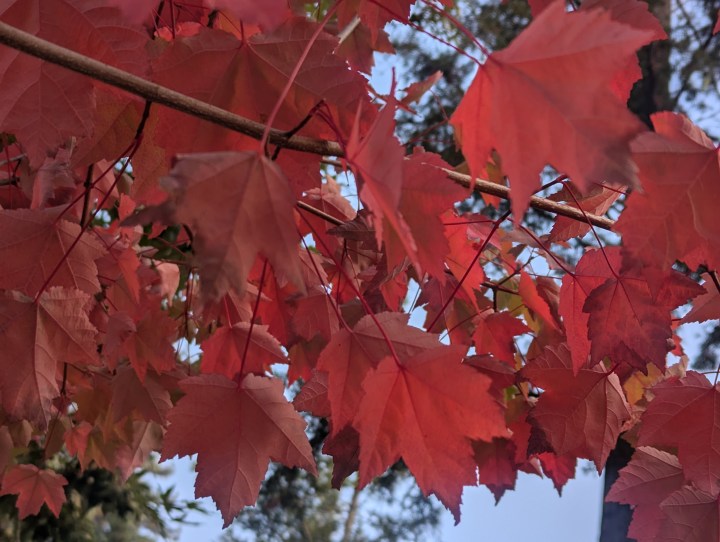
Red maple colors nicely, but the color does not last for long.

Spray paint is no way to get good autumn color in the garden. The healthy rich green king palm out front would look ridiculous and be very embarrassed, not to mention unable to breath, if it were painted yellow, orange and red, like the sweetgum trees that will soon be getting so colorful in the neighborhood now that the weather is getting cool.

Just like every other feature in the garden, autumn foliar color takes proper planning. Most of the plants with the most impressive autumn color happen to be substantial trees, so are not as easy to accommodate in as many situations as flowering annuals are. There are a few smaller shrubby plants and perennials that provide autumn foliar color, but almost all are deciduous, so defoliate to leave bare branches through winter.

Boston ivy (which is not really ivy) is probably the most colorful of climbing vines. It is a bit too aggressive for small spaces though, and damages painted surfaces and just about anything that it gets a hold of. It is best on concrete walls, which is why it is so prominent on freeway soundwalls and overpasses. Grapevine and wisteria are only moderately colorful.

Currant, crape myrtle, pomegranate, smoke tree and redbud are a few of the shrubby plants that provide good color in autumn. Crape myrtle and Eastern redbud are actually more commonly small trees. Many of the Japanese maples with good autumn color are small trees that stay smaller than most shrubbery.

Sweetgum, Chinese pistache, flowering pear and maidenhair tree are the best trees for autumn color, though maidenhair tree turns only bright yellow without the oranges and reds that the others get. Where well exposed, Japanese persimmon is comparable to Chinese pistache. Fruiting pear, apple, apricot, plum, prune and almond trees are not quite as colorful.

Several of the North American and European maples are remarkably colorful, but do not hold their foliage as long as sweetgum does. Silver maple and box elder (maple) happen to be less colorful than the other maples. Various poplars and locusts, as well as tulip tree and black walnut can almost get as bright yellow as maidenhair tree does.

Autumn Foliar Color Takes Planning

Some Norway maples are colorful through summer, and then turn yellow for autumn.

Spray paint is no way to get good autumn color in the garden. The healthy rich green king palm out front would look ridiculous and be very embarrassed, not to mention unable to breath, if it were painted yellow, orange and red, like the sweetgum trees that will soon be getting so colorful in the neighborhood now that the weather is getting cool.

Just like every other feature in the garden, autumn foliar color takes proper planning. Most of the plants with the most impressive autumn color happen to be substantial trees, so are not as easy to accommodate in as many situations as flowering annuals are. There are a few smaller shrubby plants and perennials that provide autumn foliar color, but almost all are deciduous, so defoliate to leave bare branches through winter.

Boston ivy (which is not really ivy) is probably the most colorful of climbing vines. It is a bit too aggressive for small spaces though, and damages painted surfaces and just about anything that it gets a hold of. It is best on concrete walls, which is why it is so prominent on freeway soundwalls and overpasses. Grapevine and wisteria are only moderately colorful.

Currant, crape myrtle, pomegranate, smoke tree and redbud are a few of the shrubby plants that provide good color in autumn. Crape myrtle and Eastern redbud are actually more commonly small trees. Many of the Japanese maples with good autumn color are small trees that stay smaller than most shrubbery.

Sweetgum, Chinese pistache, flowering pear and maidenhair tree are the best trees for autumn color, though maidenhair tree turns only bright yellow without the oranges and reds that the others get. Where well exposed, Japanese persimmon is comparable to Chinese pistache. Fruiting pear, apple, apricot, plum, prune and almond trees are not quite as colorful.

Several of the North American and European maples are remarkably colorful, but do not hold their foliage as long as sweetgum does. Silver maple and box elder (maple) happen to be less colorful than the other maples. Various poplars and locusts, as well as tulip tree and black walnut can almost get as bright yellow as maidenhair tree does.

Autumn Foliage In Mild Climates

Minor chill initiates autumn foliar color.

Colorful foliage is always present. After all, green is a color, even without any other color or variegation. Defoliation of deciduous foliage during autumn reveals evergreen foliage beyond, even if fading through winter. Immediately prior to defoliation though, deciduous foliage of quite a few species temporarily becomes spectacularly colorful autumn foliage.

Whether deciduous or evergreen, foliage that is most colorful during spring and summer contains chlorophyll. Regardless of how variegated, reddish, purplish, yellowish or other color it might be, it is also green to some degree. It could not be photosynthetically active otherwise. Colorful autumn foliage exhibits brighter color as its chlorophyll decomposes.

Autumn foliage is most spectacular where it is native, such as New England. Much more of it inhabits forests than home gardens. It is not spectacular within forests here because only a few sparsely dispersed native species produce impressive foliar color for autumn. Its naturally local scarcity likely contributes to its limited popularity within home gardens.

Locally mild weather also limits the popularity as well as the potential of autumn foliage. Many of the most colorful maples of New England merely turn blandly pallid yellow prior to hastily premature defoliation here. However, several other species develop exemplary foliar color in response to minor chill, and seem to be as happy here as in New England.

Chinese pistache, sweetgum, flowering pear and ginkgo are four trees that most reliably provide autumn foliage here. Crape myrtle is a smaller tree that is almost as reliable, and blooms splendidly for summer. Persimmon gets as colorful as Chinese pistache, with an abundance of fruit. Boston ivy is a vine with color that is comparable to that of sweetgum.

Of course, even the most appealing of plants are not perfect. Their innate characteristics are relevant to selection. For examples, trees occupy significant space. Ginkgo becomes bright yellow, but without any other color. Sweetgum produces obnoxiously prickly fruits. Flowering pear is susceptible to fireblight. Boston ivy clings to surfaces and ruins siding, paint and fences.

Maidenhair Tree

Maidenhair tree leaves look rather ‘fishy’.

There are not many trees that are as reliable for strikingly bright and clear yellow autumn foliar color as the maidenhair tree, Gingko biloba, is, even in mild coastal climates. The distinctive leaves flare out like fish tails, each with a prominent cleft that divides it into two wide lobes. (The species name ‘biloba’ means ‘two lobed’.) Some cultivars lack foliar clefts, have narrower leaves, or even develop milder yellow color in autumn. Those developed for home gardens exhibit relatively symmetrical branch structure, and are exclusively male, so can not produce the stinky fruit that some older female trees drop. (Trees grown from seed can be either male or female. Female cultivars are grown for fruit production and bonsai.) Some ancient trees in Japan, Korea and China are more than a hundred feet tall. Fortunately, maidenhair tree grows slowly enough to stay proportionate to compact urban gardens for many decades.

Maidenhair trees develop the best yellow fall color.

‘Green’: The ‘Other’ Autumn Color

The color is better this year than it was when this was written three years ago. Nonetheless, foliar color here is not as impressive as it is where weather is already cooler.

tonytomeo's avatarTony Tomeo

P71202After reading so much about the exquisite foliar color that most everyone else in the Northern Hemisphere gets this time of year, I must admit, I can get rather envious of those who experience four seasons instead of just two. The abundance of spring in the Southern Hemisphere does not help. Why have I not found a garden blog from Ecuador or Indonesia so that I have something to point and laugh at? It just isn’t fair.

Well, now I have something to brag about.

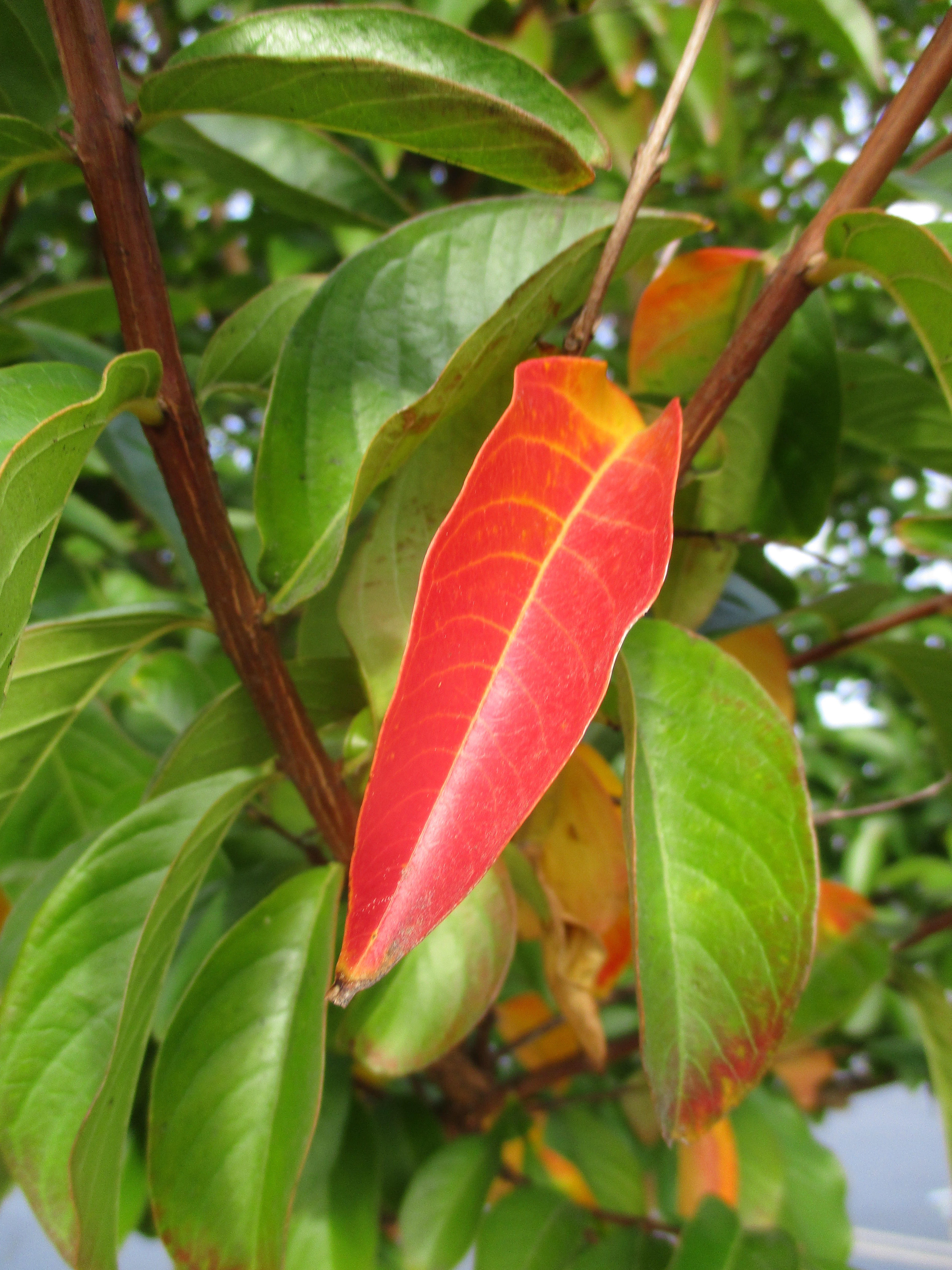
I found this bright red leaf on a crepe myrtle in town. Isn’t it pretty? Go ahead, you can tell me. It is gorgeous, RIGHT? Go on; say it! Say it NOW! LOUDER!

Soon, all the foliage behind it will be turning red and orange with maybe a bit of yellow. Can you see it? I think some of those leaves are starting to consider…

View original post 155 more words

Persimmon

41126A mature persimmon tree, Diospyros kaki, is often too much of a good thing. The fruit is both big and abundant as it ripens this time of year. Much of the fruit in taller trees is out of reach. Nearly ripened but somewhat firm fruit can be picked and shared with neighbors for a while, but must be picked immediately once completely ripe. Otherwise, it falls and makes a squishy mess that can not be raked up! Nearly ripe fruit ripens easily off the tree. Individual fruits only need to be spread out in a single layer to limit molding.

‘Fuyu’ is probably the most popular variety because the ripe fruit can be eaten while still firm, or after it has gotten soft. ‘Hachiya’ produces the largest fruit, sometimes bigger than a softball; but the fruit is too astringent to eat until completely ripe. It is actually best after it is so overly ripe that it is too squishy to handle. Persimmon fruits are very bright orange. ‘Hachiya’ fruit can be slightly reddish. The foliage gets just as colorful. Typically, the foliage colors first, and then falls to reveal the fruit. This year, the fruit seems to be coloring first.

Slow Color

P91110Autumn is not much to brag about here. It supposedly got just cool enough at night for the minimal requirement of frost, at 32 degrees, but no one noticed. It has been getting to the low 80s during the day. There has been no rain yet, and none is in the forecast. As bland as such weather seems, it is not at all out of the ordinary. Autumn often arrives later than it does elsewhere.
Consequently, autumn foliar color is not much to brag about either. There are only a few trees that reliably develop good color, such as sweetgum, pistache, flowering pear, crape myrtle and maidenhair tree (ginkgo). As reliable as it is, maidenhair tree provides only bright yellow, without the oranges and reds that the others exhibit. None are exhibiting significant color just yet.

There are several other trees that have potential to develop good color, but are not as reliable about doing so. Birch can get almost as brilliant yellow as maidenhair tree does, but does not do it every year. Red oak may turn brilliant orange with a bit of brownish red mixed in, but only every few years or so. On rare occasion, even London plane (sycamore) shows off burnt orange.

Every species has a distinct personality. They each respond differently to different variables. Weather conditions that stimulate good color among flowering cherries may not stimulate good color for bigleaf maples. Dogwoods that colored so well at about the same time last year as the tulip trees, are already nearly bare after minimal color, while the tulip trees are mostly green.

Every few years, if mildly but suddenly chilled, these cottonwood develop a brighter yellow, with less blotching. With slower and drier chill this year, they are deteriorating and falling without much yellow at all.P91110+

First Color Of Autumn

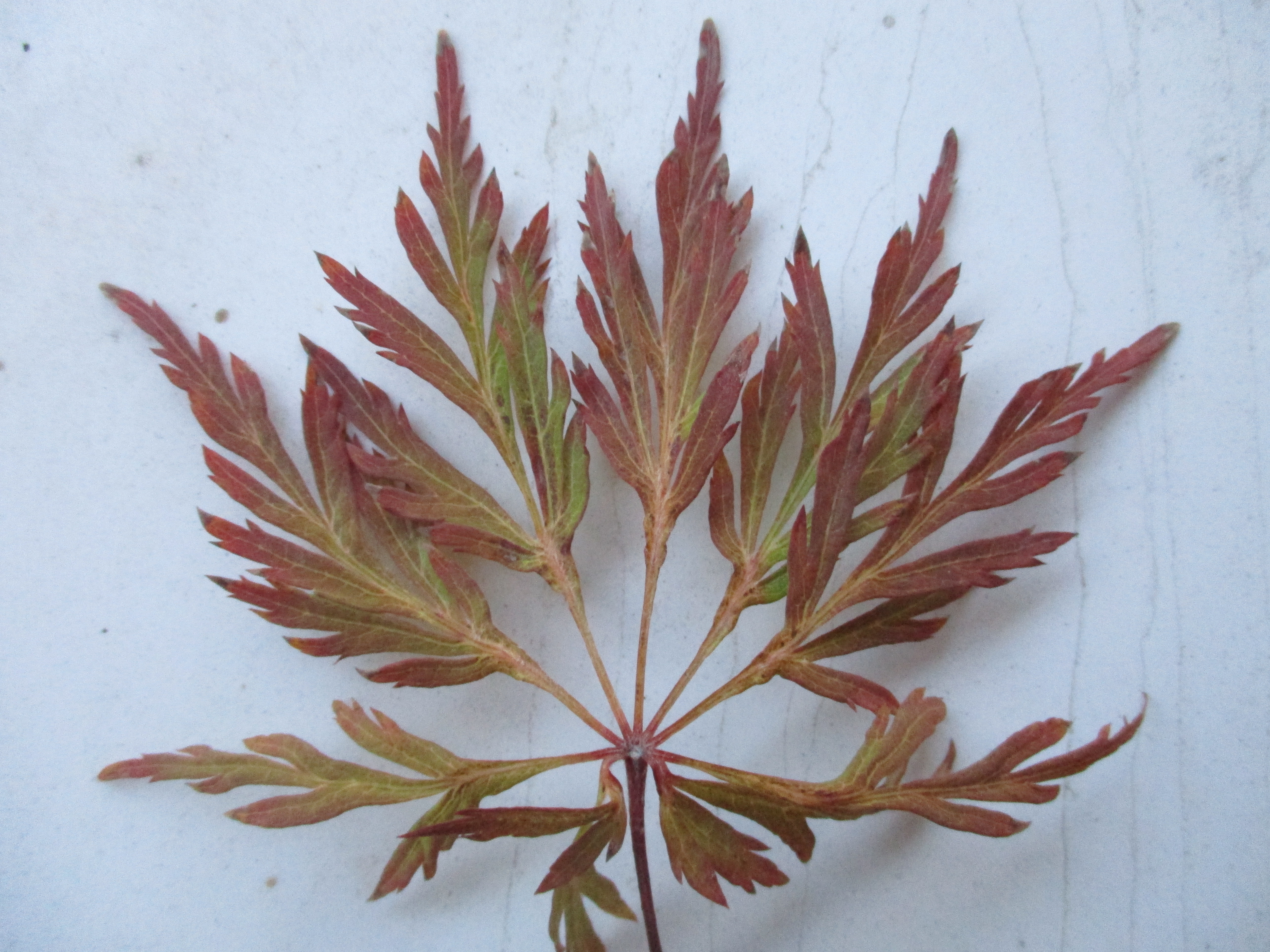
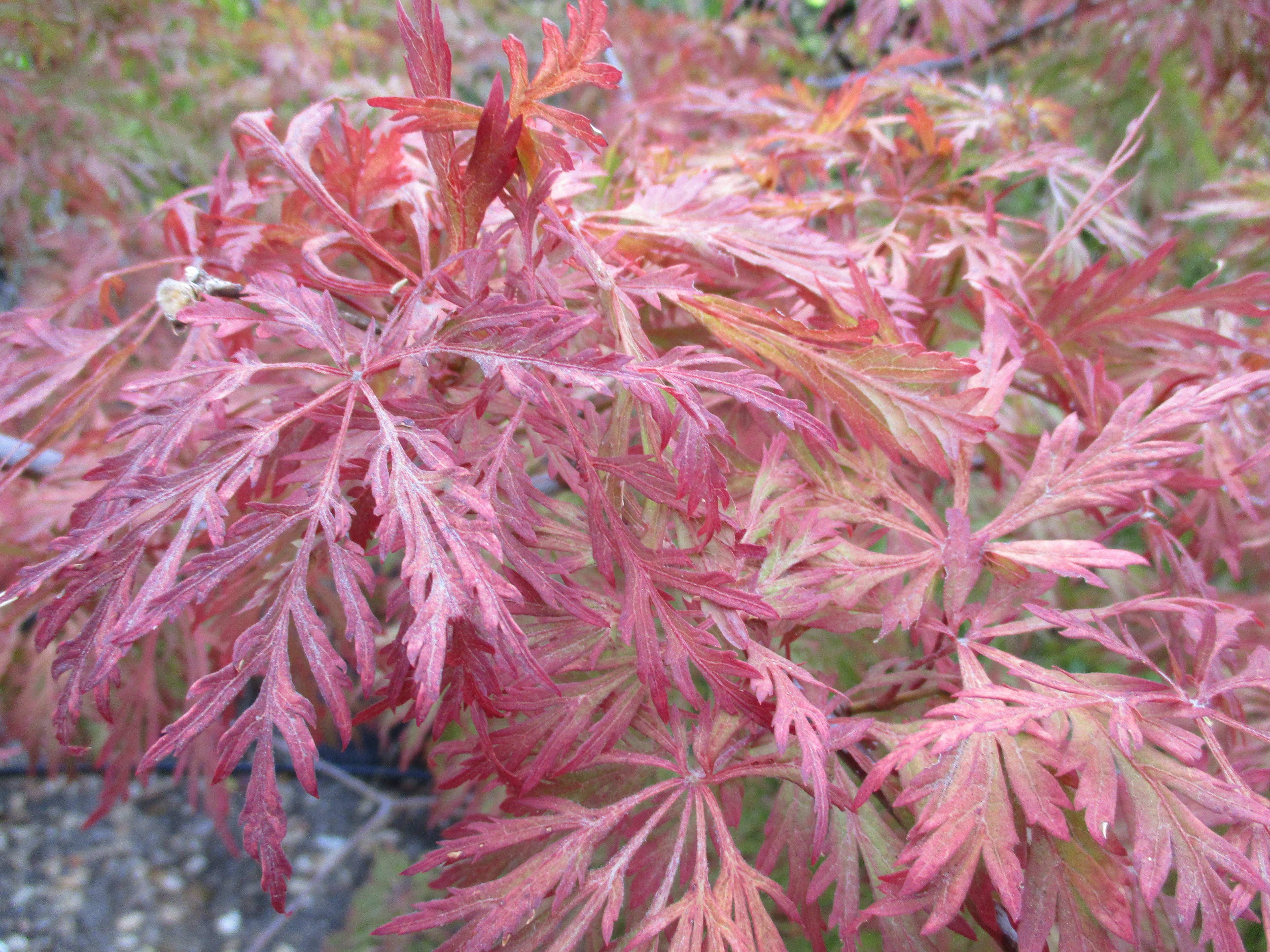
P91013Okay; so this is neither the first, nor real autumn foliar color. It just happened to be convenient for me to get a picture of. Someone left this unfortunate Japanese maple right outside on the driveway a few years ago. It colors early from uncomfortable exposure to late summer warmth. The picture below is even more colorful, and was from even earlier in the year, last August.
Foliage that is starting to color here is nothing to brag about. Some of the older dogwoods leaves just shrivel and turn brown. I can only hope that enough newer foliage lingers to color as well as it did last year. Cottonwoods start to drop foliage while it is still green, but should eventually color to a subdued yellow before the last foliage falls. Sycamores are bland no matter how late.

There are only a few trees that reliably develop vibrant foliar color in such mild autumn weather, and only a few of such trees happen to be in our landscapes here. We lack Chinese pistache, flowering pear and ginkgo. The few sweetgum that are scattered about provide most of the foliar color here in autumn. It is still too early for them to color though. They need a bit more chill.

Flowering cherry and dogwood, which are uncommon just a short distance farther inland, happen do do quite well for us, and mostly color remarkably well in autumn. They only need a bit more time and chill. Birches are not as colorful, but are bigger and bolder, and eventually cover the ground below with delightfully yellow foliage. Boston ivy was added only earlier this year.

Native flora does not contribute much color. Bigleaf maple turns only a soft yellow. Poison oak turns rich deep red, but there is not much of it.P80819

Crape Myrtle Finale

P81201KIt is certainly not my favorite small tree. Actually, in most situations, I rather dislike it, which is why I sometimes accidentally spell it without the first ‘e’. It is a cop out; a micro tree that too often ends up where a larger and more respectable tree would be more appropriate. They are not shade trees. They are not not big enough for freeway landscapes or to be street trees on wide boulevards. They are not immune to diseases and insect infestations; and they commonly drop honeydew from aphid or scale infestation, and lose their bloom to powdery mildew. They are not ‘low-maintenance’, and really should be pruned more than they are, but will get you in trouble with the neighbors if you prune them as aggressively as they should be pruned.
They are popular because of their potential for remarkably flashy bloom, and because they do not get big enough to damage the sidewalks and curbs that they are so often planted next to. ‘Gardeners’ like them because they survive their neglect. That is no long list of attributes; but there is one more.
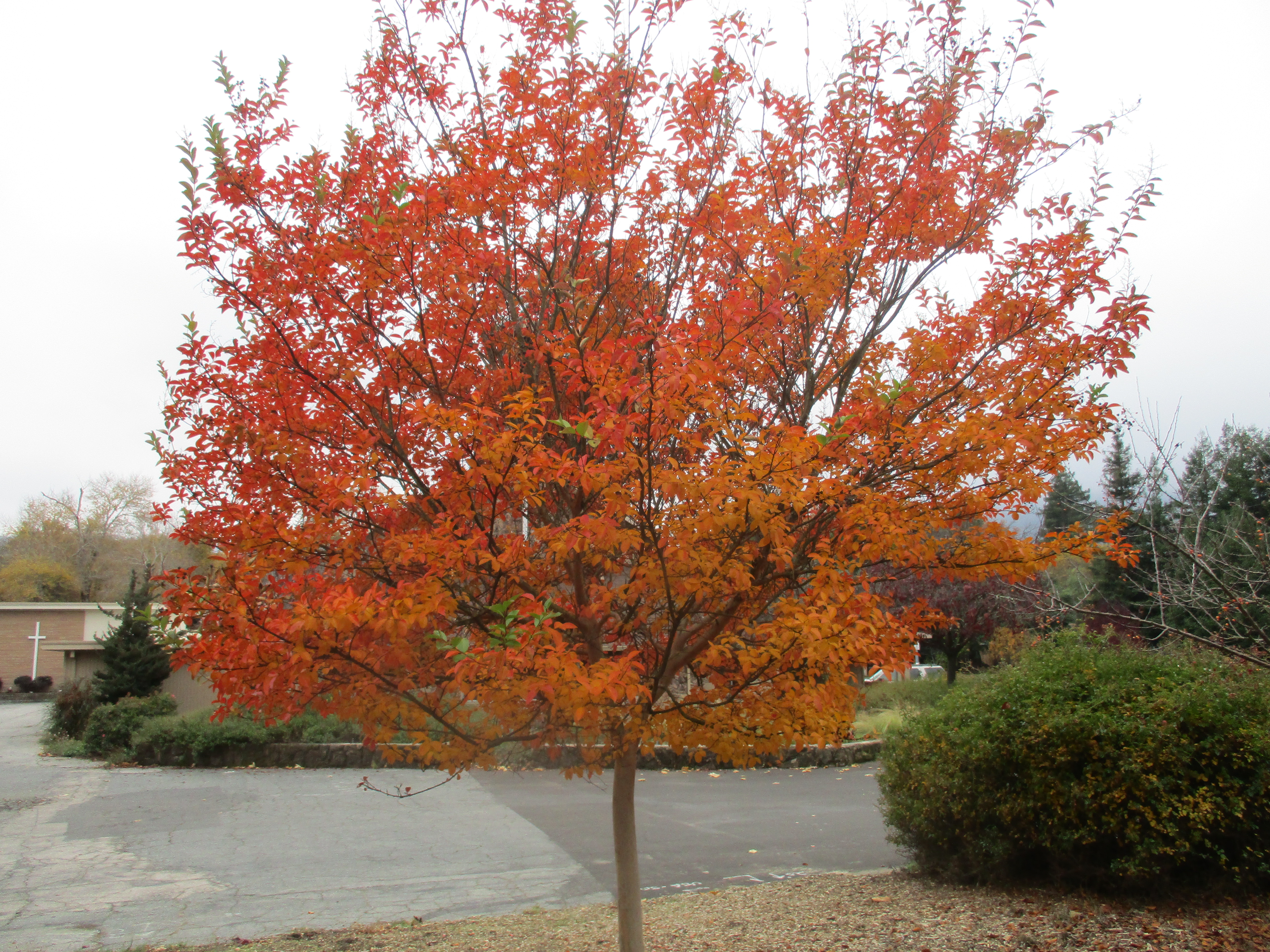
FALL COLOR! On a bad year, they merely turn bright yellow. This year, some are this exquisitely bright orange with a slight red blush. The various cultivars display various colors, so some are more colorful than others. They are also on different schedules, so the most colorful are not necessarily the most colorful every year. Those that colored early are already bare, but could be the most colorful next year if the weather turns cold early. A bunch in town that are also defoliating as fast as they color because of the recent rain, could be the most colorful next year if rain is delayed later than it was this year.P81201K+

Ornamental Grape

51202Boston ivy is not really ivy at all; but is more closely related to grape. Along with creeping fig, it is one of the two best vines for freeway sound-walls. It protects the walls from graffiti and muffles sound. Unlike creeping fig, which is evergreen, Boston ivy is surprisingly colorful through autumn. Unfortunately, it clings to whatever it climbs with holdfast discs, so ruins paint, stucco, and any other surface it gets a hold of.

Then there is ornamental grape, Vitis vinifera. It is about as colorful as Boston ivy, and can climb almost as aggressively to thirty feet, but lacks the damaging holdfast discs. It is nearly fruitless, which may seem like a waste of an otherwise perfectly good grape vine; but it will not make much of a mess until it defoliates. If any of the tiny fruit actually matures, it will almost certainly get eaten by birds before anyone notices.

Since it does not grip so tightly to what it climbs, ornamental grape can get rather shrubby. Outer growth can overwhelm and shade out inner growth, and can eventually produce a thicket of dead canes. Pruning back superfluous shrubby growth while bare in winter promotes more vigorous new growth the following spring and summer. Ornamental grape likes full sun exposure.