 Bare root fruit trees will be available in about a month. It is probably my favorite time of year for going to nurseries. (Since I grow just about everything I want from bits of landscape debris, I do not often go to retail nurseries.) It is also rather frustrating to see what sorts of bare root material are popular nowadays, and what sorts are not. Horticulture has gotten so ridiculous!
Most of the formerly common cultivars of fruit trees that I remember are no longer available. They were common for a reason. They perform well here. Retailers used to select cultivars for their respective regions, instead of pimping out weird new but unproven cultivars, or just taking the same faddish cultivars that get sent to other stores within a vast chain of big box stores.
One of the weirdest of fads are multi-grafted fruit trees and roses.
Multi-grafts are certainly not new technology. Back when horticulture was taken more seriously, fruit trees for home gardens (which might be the only ones of their kind in their respective gardens) were sometimes, if needed, outfitted with a secondary scion of a pollinating cultivar. The pollinator could be pruned low and subordinated, as long as it bloomed with a few flowers.
Most of us preferred to simply plant two separate trees that could pollinate each other. If one was less desirable than the other, it was just maintained as a smaller tree so that it would not occupy so much space that could be utilized by more desirable types. Each tree had its own uncrowded area. If one succumbed to disease, it did not necessarily affect those associated with it.
Multi-graft trees are not so easy. If the trunk of a multi-graft pear tree gets infested with fire blight, all the scions grafted to it succumb. Because almost no one prunes them properly, the most vigorous cultivars dominate and crowd the less vigorous. Even well pruned trees are always asymmetrical because each cultivar exhibits a different growth rate and branch structure.
Multi-graft rose standards (trees) just look weird and freakishly unnatural. Pruning must ensure that one cultivar does not crowd out the other, just like for fruit trees. The multi-graft rose in the picture above was planted with three others just like it. Two of them crowded out one of their two scions. It would have been easier to simply plant two in white and two in burgundy.
Multi-graft plants are useful only if ground space is very limited, but air space is not. For example, such a tree planted in a hole in a deck can extend limbs over the deck where other trees can not live. If maintained properly and separately, each part can produce its share of fruit in season. I once did this with a pear tree that was espaliered on a fence over a concrete driveway.
 Compared to canned (potted) nursery stock, bare root plants have a few advantages. They are less expensive, easier to handle, more conducive to pruning into a desired form, and they disperse roots and get established more efficiently. One more advantage that is not often considered is that they are easier to install into the garden. For some, it is as simple as poking a stick in the mud.
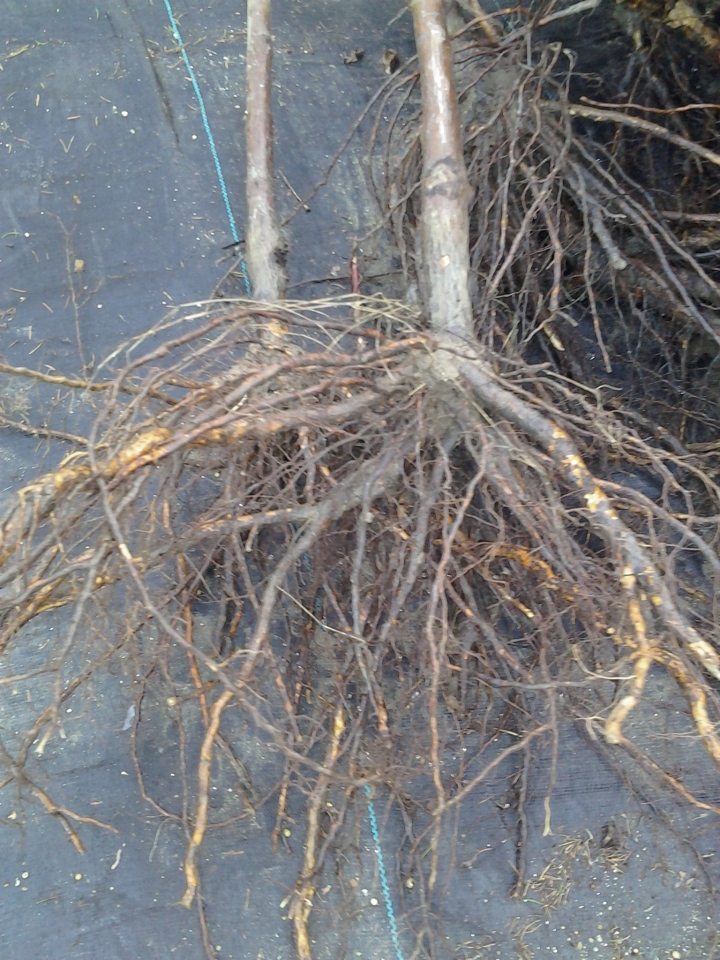 Autumn really is the season for planting. That is the general rule. One generalization about general rules is that they generally do not apply to all of the specifics. In other words, there are likely certain exceptions. In this case, there are some types of plants that should not be planted in autumn. The next best season for planting is probably winter, which happens to be ‘bare root season’.
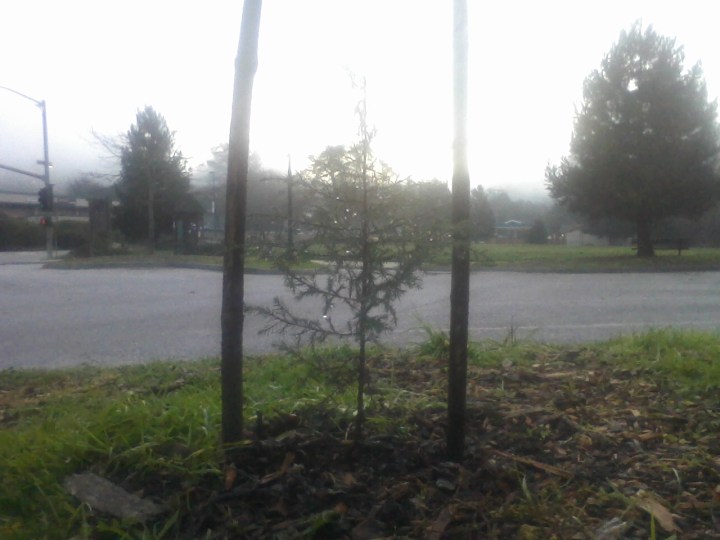 The little Memorial Tree in Felton Covered Bridge park that I so frequently write about is not the first to be planted there in its parking lot island. It is actually the fourth! The first was a California black oak like the other four in the other islands. They were all planted with the original landscape. It did not live there long before getting run over by a car. The island was empty for many years.

 Christmas tree lots at nurseries come and go at a good time. Cut and live Christmas trees become marketable just as retail sales of other items is declining. Although autumn is the best season to plant many things, not many of us want to be out in the garden as the weather gets cooler. As Christmas trees get sold and relinquish their space, bare root nursery stock becomes available.
 Anyone who has had undergone surgery knows the advantages of unconsciousness. Any frat boy who woke up after a night of overly indulgent inebriation, with his face adorned with objectionable graffiti, knows the disadvantages. A lot can happen while one is unaware that it is happening. This is exactly why so many bare root plants become available while they are dormant through winter.
 Tony Tomeo