Angelonia is one of those warm season annuals that can actually survive through winter as a pernnial to bloom again next spring. It may even want to continue to bloom untill frost. The flowers can be blue, purple, red, pink or white, and look something like small snapdragon flowers. Most have spots or stripes of an alternate color or two in their throats. Some modern varieties have fragrant flowers. Plants can get a foot or two tall, and almost as wide. In sheltered spots, angelonia can be cut back as soon as it starts to look tired in autumn. Exposed plants might be happier if cut back significantly later, as winter ends. Old growth may be unsightly for a while, but can protect interior stems and roots from frost. Besides, pruning stimulates new growth that will be more susceptible to subsequent frost.
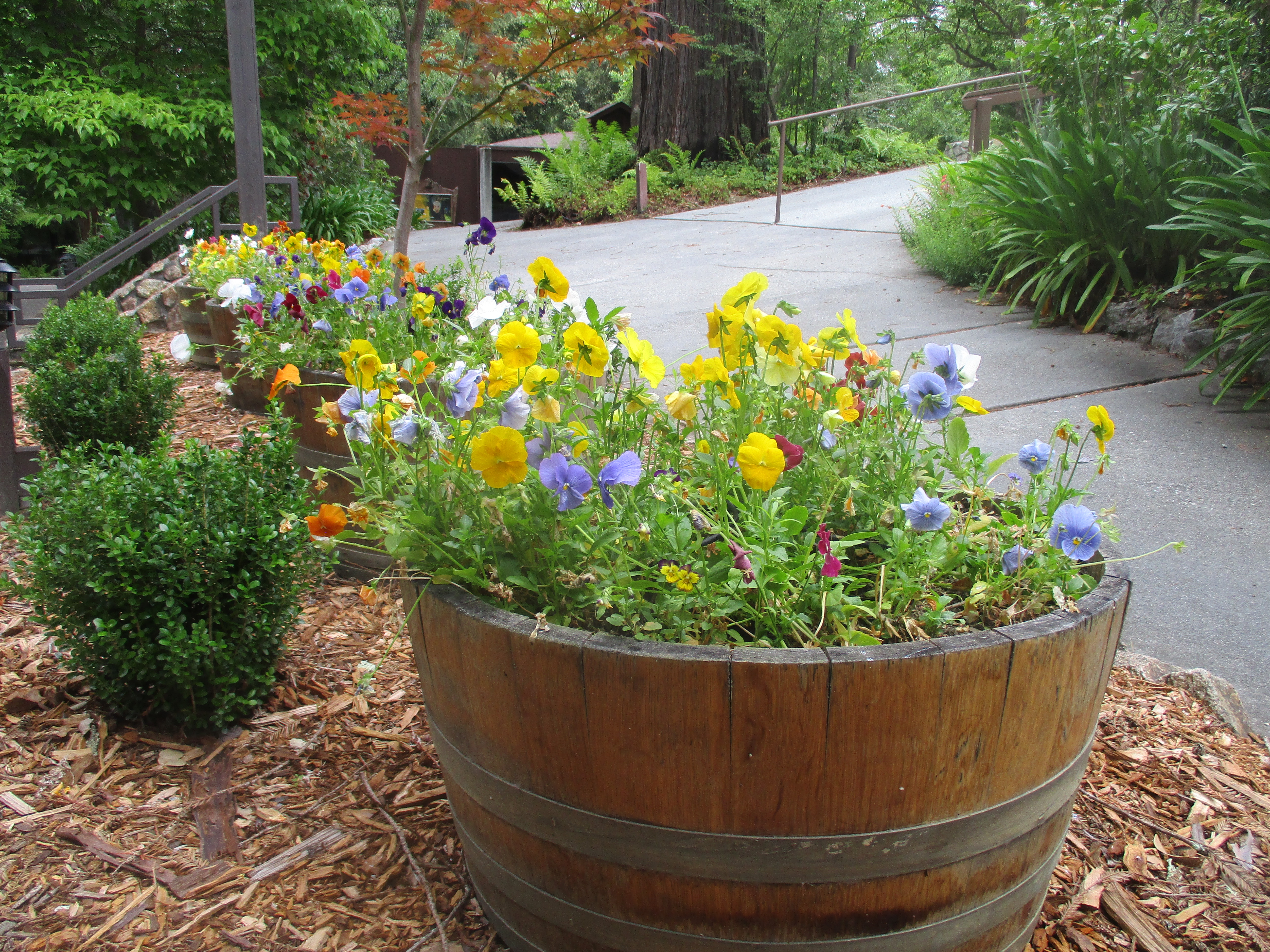
Half barrels are a bit elevated, and seem to show off their flowers better.
With conservation of water being so important right now, annuals are not a priority. Many of us are trying to use as little water as possible, and only to keep the more significant trees, shrubbery and perennials alive until winter. Lawn and annuals are usually the first to succumb, mainly because they use more water than anything else.
They are also somewhat expendable. Lawn is certainly expensive, but realistically, can be replaced as soon as water becomes available. Hopefully, new lawns will be more conservative with water, like they should have been since the last “drought” (and the one before that). Annuals are planted annually (duh), so they get replaced anyway.
Annuals as bedding plants over large areas were already somewhat passé before the last few dry winters. Even the more indulgent landscapes used annuals merely as relatively modest borders around or in front of more substantial, but less consumptive, perennials and shrubbery. Pots and planters are already more appropriate.
Some of the trendiest big pots are so ornate that they do not need flowers to provide more color. Besides, with a few striking perennials for colorful foliage or form, there is not much space left for annuals. What matters with annuals is that fewer in a pot can be flashier than more in the ground. Fewer annuals mean less water is required.
Elevated planters may not be as ornate, but display flashy annuals just as effectively. Petunia, million bells, lobelia and alyssum can cascade over the edges, to be colorful both on top and on the sides. Marigold, zinnia, celosia and any interesting foliar or sculptural perennials get a bit more height. It all helps to get a bit more out of less.
Pots and planters are not necessarily less work. They just need less water than larger beds, because they are smaller. Relative to their area, they actually need more water, and must be watered very regularly to sustain the confined roots within. Hanging pots need the most water. All confined plants benefit from fertilizer.
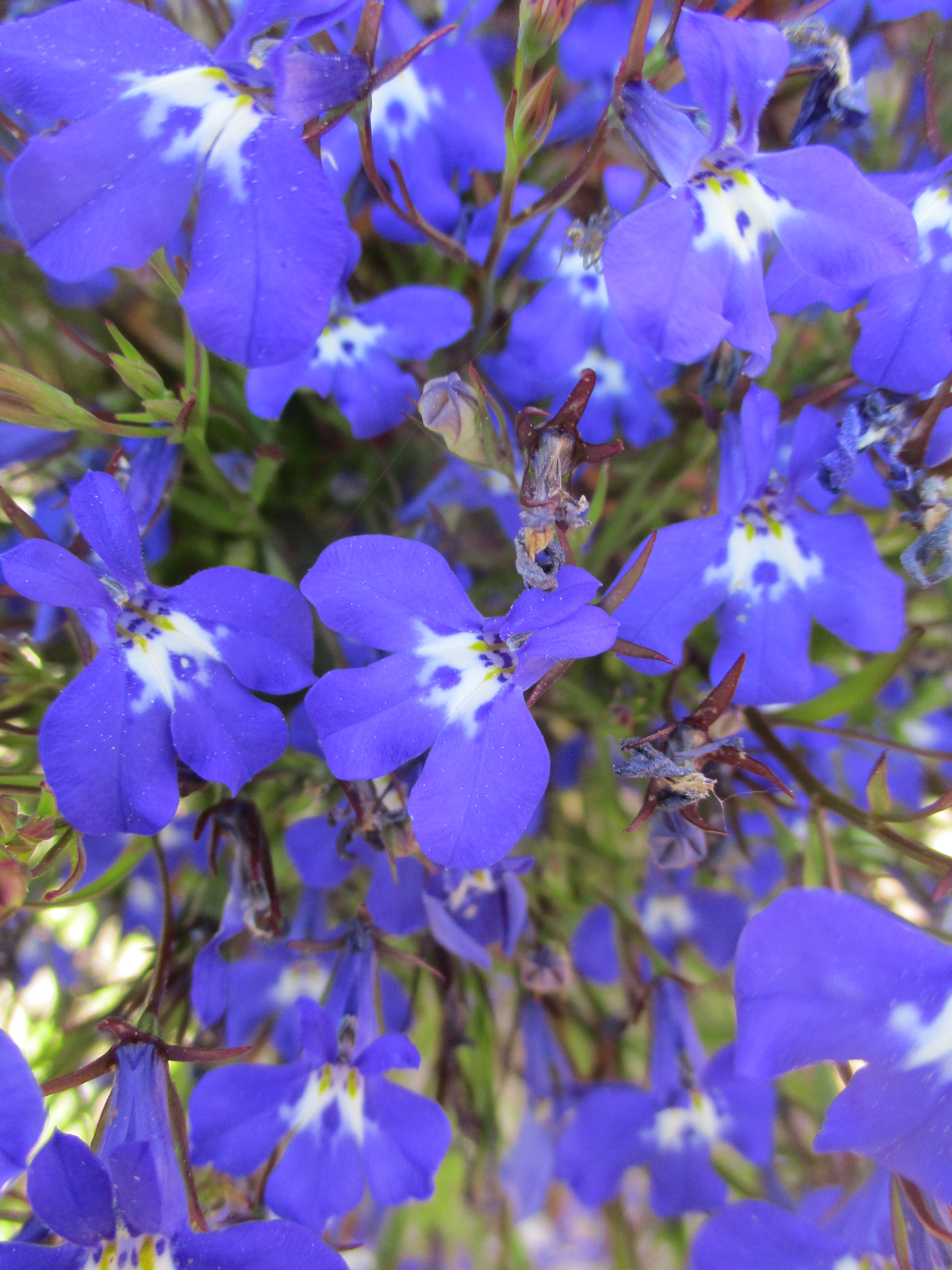
No other bedding plants exhibit such rich blue as trailing lobelia, Lobelia erinus. Cultivars with white, purplish pink, purple or sky blue bloom are still not quite as popular as the favorite cobalt blue bloom. Individual flowers are tiny but very profuse and uniform. Some have white centers. The narrow leaves are tiny as well, and finely textured. Some cultivars have dark purplish bronzed foliage.
Individual plants are only about three to six inches high and wide. Cultivars that are more rounded and densely foliated are excellent for edging. They are very popularly planted in single rows, and alternating with alyssum. Trailing types exhibit wispier growth that stays a bit lower and spreads a bit wider. They do not trail far, but cascades nicely from urns and hanging pots of mixed annuals.
Although grown as a warm season annual, trailing lobelia can survive as a short term perennial where winters are mild. Fresh new growth develops out of the centers of overwintered plants about now. If pressed gently into the soil just before they are replaced by new growth, scraggly outer stems can develop roots. They just might grow into new plants before the originals eventually die off.
Bedding plants that go into the garden in spring are generally warm season or summer annuals. They should perform through summer until the weather gets too cool for them the following autumn. Bedding plants that go into the garden in autumn are generally cool season or winter annuals. They should perform through winter until the weather gets too warm for them late the following spring.
That sounds simple enough. Each type of bedding plant performs best within a specified season. Since they are annuals, they complete their life cycles within a single season within a single year. Of course, it is not so simple here where seasons are as unique as they are. Winter is mild. Summer is arid. Some bedding plants that are annuals in harsher climates may survive as perennials.
For example, busy Lizzie and wax begonia are warm season annuals in most climates. They succumb to frost as weather cools in autumn. Locally, they can survive through winter if sheltered from mild frost. Any that survived through last winter can regenerate now. As bedding plants, they will not be as uniform as they were last year. However, their variability would be fine for mixed bedding.
If sheltered and warm enough, wax begonias may actually continue to perform right through winter. If they dislike the aridity of summer, they can even perform slightly better through winter than they do through summer. Their best performance is often about now and again in autumn, between the two extremes of summer and winter. They challenge their designation as a warm season annual.
Even some of the bedding plants that really are annuals may not behave as such. Alyssum and nasturtium can disperse seed to replace themselves before they finish. They are not true to type, so their progeny eventually revert. Nonetheless, simple yellow and orange nasturtium and white alyssum are splendid for many relaxed gardens. Nasturtium might perform better in summer or winter.
Bedding plants usually know more about what they should be doing than those who are managing and manipulating them.
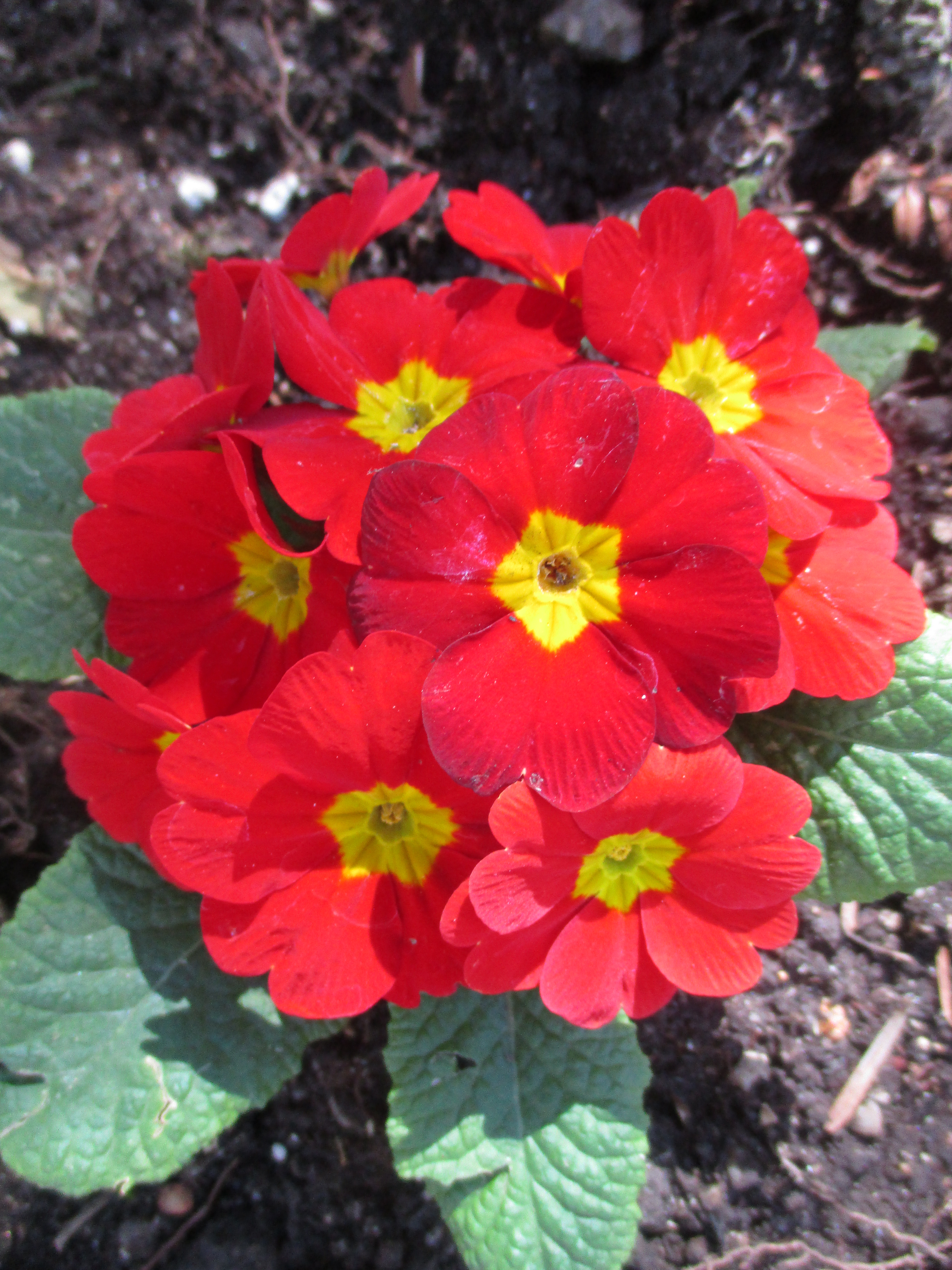
These primrose look as good as they did last year.
Among cattle, a cow is a female who has calved. Prior to that, she was a heifer. A bull is an adult male. A bullock is a juvenile male or castrated bull. Most cattle are males who were castrated while young, and are known as steers. Yet, cattle are commonly known collectively as ‘cows’.
Similarly, bedding plants are commonly known collectively as ‘annuals’. Many really are annuals. However, some are biennials; an even more are, to some degree, perennials.
Replacing annuals annually make sense. They grow, bloom and die within one year. Some sow seed to regenerate if and when they get the chance. In the prominent spots of our gardens, not many are likely to get such a chance before they are replaced by other annuals for more immediate gratification within the next season.
The same applies to bedding plants that have potential to perform as perennials. They too get replaced during their off season. Since most are inexpensive, their untimely collective demise is not considered to be too terribly wasteful.
There are a few that are not so easy to part with. Cyclamen will be a topic for next week because it is a cool season perennial that is too expensive to be deprived of its potential to regenerate and bloom next autumn and winter.
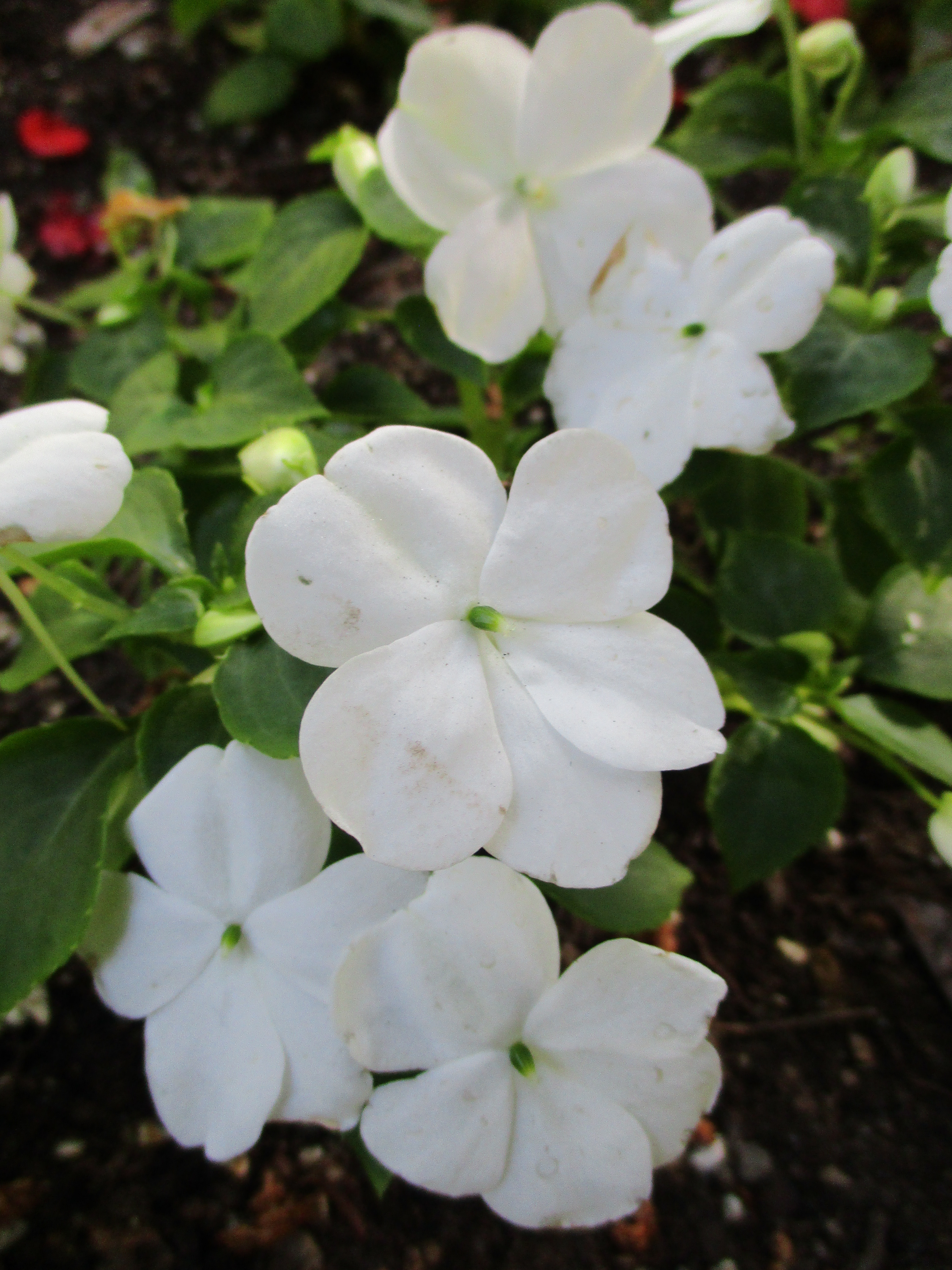
These English primrose from last winter were afforded an opportunity to stay in their landscape while they were somewhat dormant through the warmth of last summer, so that they could regenerate last autumn and bloom through this winter. A few from around the edges were moved inward to replace a few that did not survive. Impatiens were planted in front for summer.
The results are not exemplary only because of the shade, but are worth the effort of not putting effort into replacement.
The simple pink and white of ‘good & plenty’ candy is what fairy primrose, Primula malacoides, is known for. Pastel purple is also popular. Rosy reddish pink and deeper pinkish purple are somewhat rare. The small flowers are arranged in circular trusses that stand as tall as one foot, just above the softly mounding light green foliage. The rounded leaves are slightly fuzzy. All parts of fairy primrose are toxic, and to those who happen to be allergic to it, can be as severely irritating to the skin as poison oak!
Because they take quite a while to mature and bloom if grown from seed, fairy primrose are typically purchased as cool season bedding plants that are already blooming. Bloom continues through winter and into early spring. If not replaced by warm season annuals, some of the healthier plants can survive through summer to bloom again the following winter as short term perennials. When they do not get enough water from rain, they want to be watered regularly. Fairy primrose can tolerate significant shade.
Cyclamen are everywhere! Some nurseries have more cyclamen than all other cool season annuals combined. Not all cyclamen are represented though. Almost all are white or simple red. Pink, salmon and other shades of red are noticeable scarce because they are not traditional colors of Christmas. The plants are mostly of impeccable quality, and outfitted with abundant flowers. While there is not much else blooming, the popularity of cyclamen is impossible to ignore.
The problem with cyclamen is the expense. Relative to other cool season annuals, they are large plants that are only available in four inch and larger pots, so naturally cost more. They can not be purchased in less expensive cell packs. Even though they are perennials that can last for many years, they are almost always used as disposable cool season annuals that get replaced when warm season annuals come into season. It can be difficult to justify such an expense for something that lasts only a few months.
The advantage to cyclamen is that they look good instantly, even if they do not perform as reliably during the next few months. This is something that the other cool season annuals have difficulty with. Only larger and more expensive annuals in four inch pots are so immediately colorful, and even they need some time to fluff out and get established in the garden. They just do not grow as fast now as they did earlier in autumn. The weather is now cooler. The days are now shorter.
This is why it was important to replace warm season annuals with cool season annuals earlier instead of later, even if some of the warm season annuals had still been blooming somewhat well. It gave the cool season annuals some time to mature before winter really slowed everything down. Even though they do not grow as actively now, they are already big enough to bloom impressively.
Pansy, viola, stock, Iceland poppy, nemesia, various primroses and ornamental cabbage and kale can certainly get planted now, but will grow a bit slower than they would have if they had been planted earlier in autumn. If necessary, it might be worth planting them a bit more densely than typical, or planting larger plants from four inch pots.
It is unfortunate that most florists’ cyclamen, Cyclamen persicum, are enjoyed as cool season annuals only through winter, and then discarded as they are replaced by spring annuals. They can actually survive as perennials for several years, with white, red, pink or magenta flowers hovering above their marbled rubbery foliage each winter. Foliage typically stay less than six inches deep.
Florists’ cyclamen are probably typically discarded seasonally because, after blooming through winter, they take some time to redirect their resources to adapt to their landscape situations as the weather warms through spring. During that time, they can look rather tired. Shortly after they recover, they defoliate for dormancy through the warmth of summer. Some do not survive the process.
When they regenerate through the following autumn, they are not as uniform as they were when first installed. This is probably not a problem where a few florists’ cyclamen are planted with mixed annuals or perennials that compensate for their irregularities as well as their dormancy through summer. However, it does not work well for the uniform flower beds that they are often installed into.
The recent unseasonably warm weather was no problem for any remaining moss rose, Portulaca grandiflora. They usually start to look rather tired as the weather gets cooler this time of year, and eventually succumb to the first frost. Where allowed to do so, they can regenerate next year from seed. I like to collect their seed during the summer or autumn so that I can sow them after the last frost of the following winter. Through spring and summer, I find that additional plants are easy to grow from cuttings.
The inch wide flowers are white, pink, red, orange or yellow, with only a few ruffled petals. Modern varieties that have rufflier ‘double’ flowers and richer colors still seem to be less popular than the more delicate traditional types. The cylindrical and succulent leaves are only about an inch long. The small plants can get more than six inches deep where they are happy or crowded. Moss rose likes good exposure and decent soil, but does not need the rich soil that most other annuals demand. Nor does it necessarily need such regular watering.
All that unpleasant annual business of removing warm season vegetable plants to relinquish space for cool season vegetables applies to annual bedding plants too. Those of us who do not grow vegetables were spared the agony of pulling up tomato plants that might have still been producing a few tomatoes, just to make room for broccoli. Now, it is time to replace petunias with pansies.
There is a reason why annuals get removed this time of year. It is the same reason why those that get planted now to replace them will be removed later. Annuals are annual. They are expected to perform for only part of one year. True annuals naturally complete their entire life cycles in about a year. Those that have potential to be perennial are too unappealing to salvage through dormancy.
Removal of aging warm season annual bedding plants should be less distressing if they are already deteriorating. By now, most of them are. They tend to wear out faster than some of the warm season vegetable plants. Impatiens can be potted for next year, or, for mixed beds, cut down and overplanted. Most cool season annual bedding plants are already blooming when newly planted.
Because the weather gradually gets cooler through autumn, cool season annual bedding plants appreciate an early start. It is easier to disperse roots before the soil gets cool. Only those that are sensitive to warmth, such as cyclamen, get planted later. Ornamental cabbage and kale might bolt and bloom early at the end of their season if they get too warm at the beginning of their season.
Marigold and chrysanthemum are short term autumn annuals that work very nicely until it is time to plant cyclamen or ornamental cabbage and kale.
Pansy, viola (including Johnny-jump-up), stock, sweet William, Iceland poppy and various primroses are now in season. Some could have been started from seed earlier. Otherwise, it is most practical to plant these cool season annual bedding plants from cell packs. Cyclamen and ornamental cabbage and kale that get planted later are best as more expensive four inch potted plants.


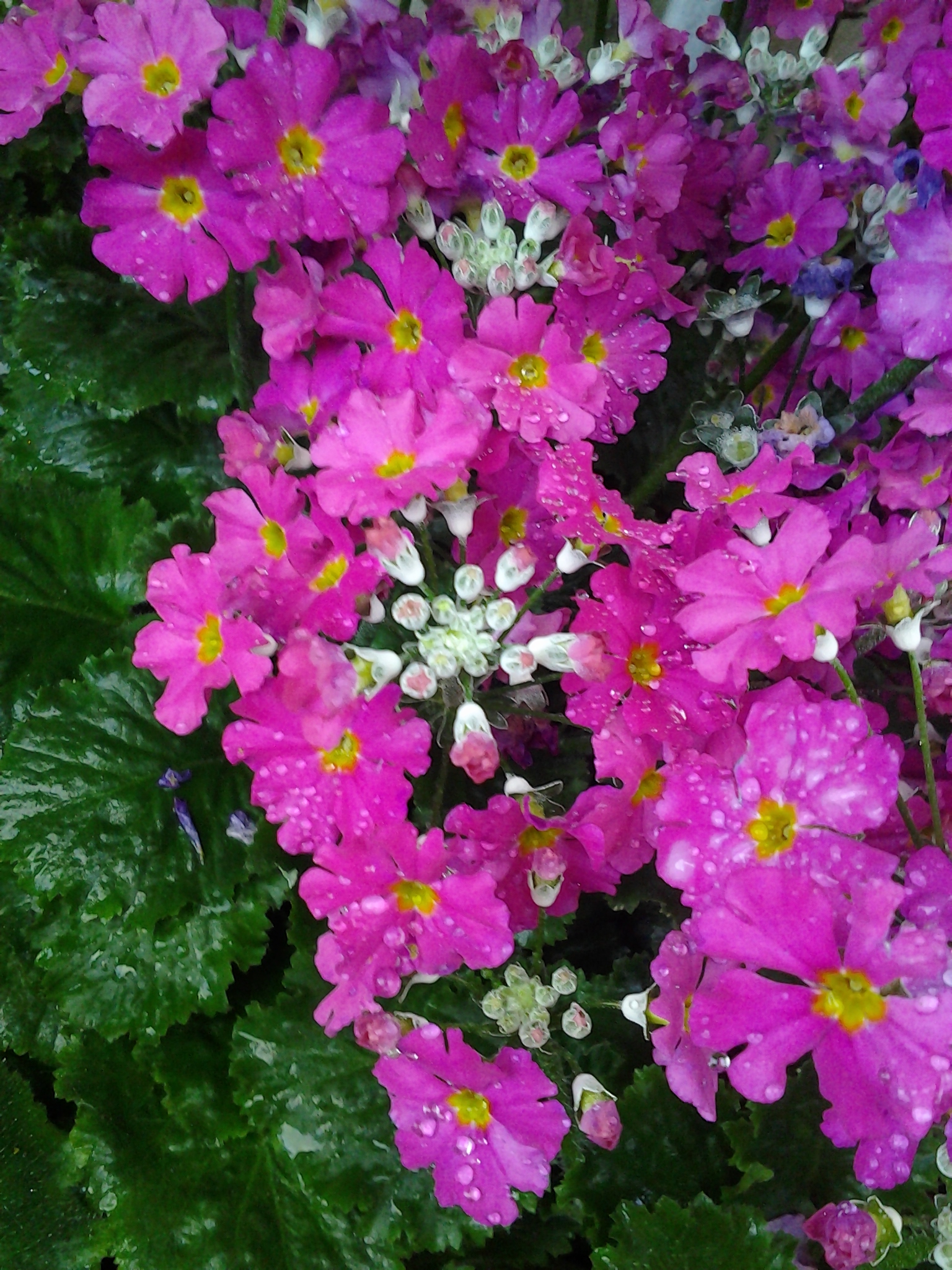 The simple pink and white of ‘good & plenty’ candy is what fairy primrose, Primula malacoides, is known for. Pastel purple is also popular. Rosy reddish pink and deeper pinkish purple are somewhat rare. The small flowers are arranged in circular trusses that stand as tall as one foot, just above the softly mounding light green foliage. The rounded leaves are slightly fuzzy. All parts of fairy primrose are toxic, and to those who happen to be allergic to it, can be as severely irritating to the skin as poison oak!
 Cyclamen are everywhere! Some nurseries have more cyclamen than all other cool season annuals combined. Not all cyclamen are represented though. Almost all are white or simple red. Pink, salmon and other shades of red are noticeable scarce because they are not traditional colors of Christmas. The plants are mostly of impeccable quality, and outfitted with abundant flowers. While there is not much else blooming, the popularity of cyclamen is impossible to ignore.
 It is unfortunate that most florists’ cyclamen, Cyclamen persicum, are enjoyed as cool season annuals only through winter, and then discarded as they are replaced by spring annuals. They can actually survive as perennials for several years, with white, red, pink or magenta flowers hovering above their marbled rubbery foliage each winter. Foliage typically stay less than six inches deep.
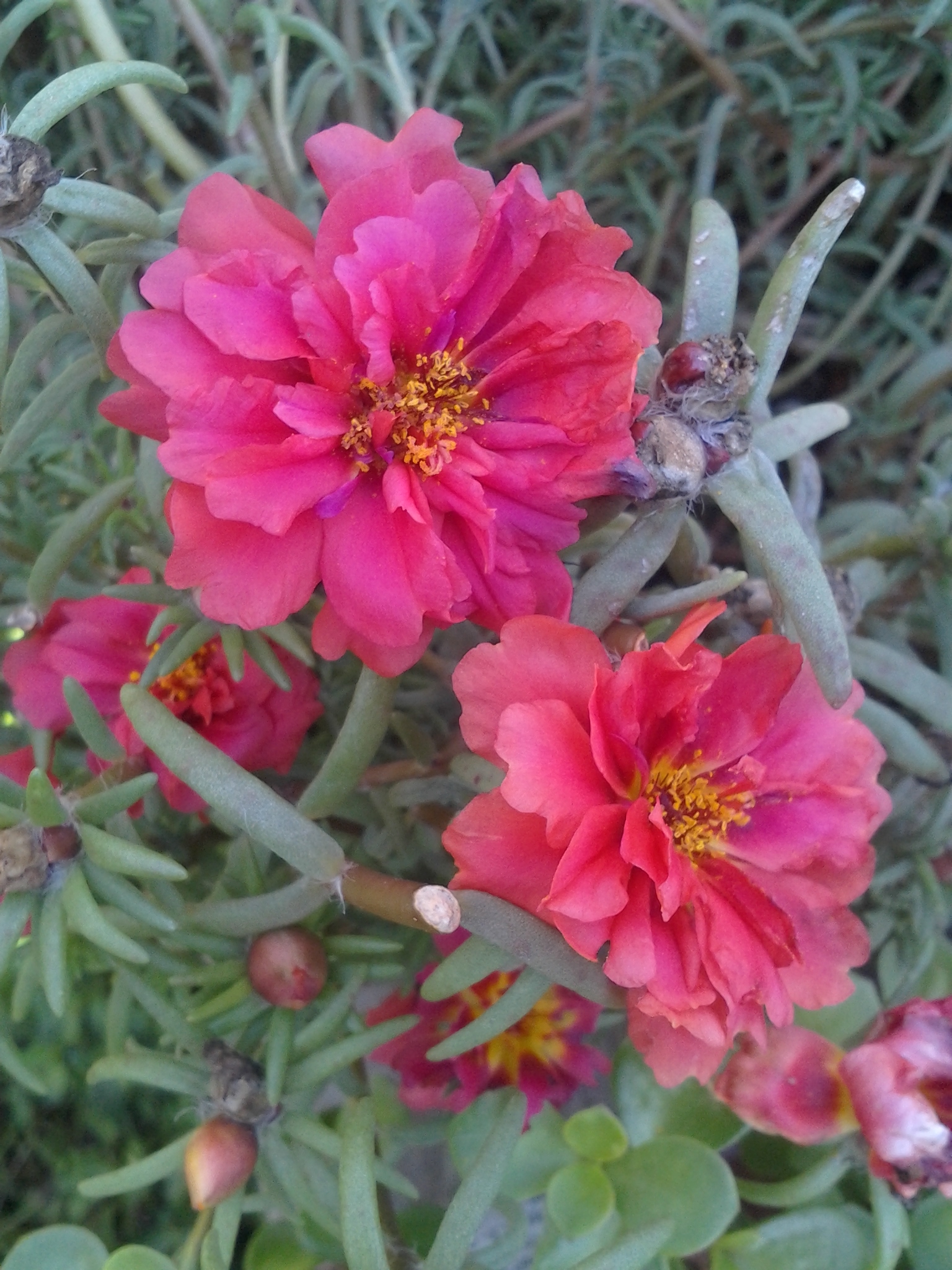 The recent unseasonably warm weather was no problem for any remaining moss rose, Portulaca grandiflora. They usually start to look rather tired as the weather gets cooler this time of year, and eventually succumb to the first frost. Where allowed to do so, they can regenerate next year from seed. I like to collect their seed during the summer or autumn so that I can sow them after the last frost of the following winter. Through spring and summer, I find that additional plants are easy to grow from cuttings.
 All that unpleasant annual business of removing warm season vegetable plants to relinquish space for cool season vegetables applies to annual bedding plants too. Those of us who do not grow vegetables were spared the agony of pulling up tomato plants that might have still been producing a few tomatoes, just to make room for broccoli. Now, it is time to replace petunias with pansies.
 Tony Tomeo