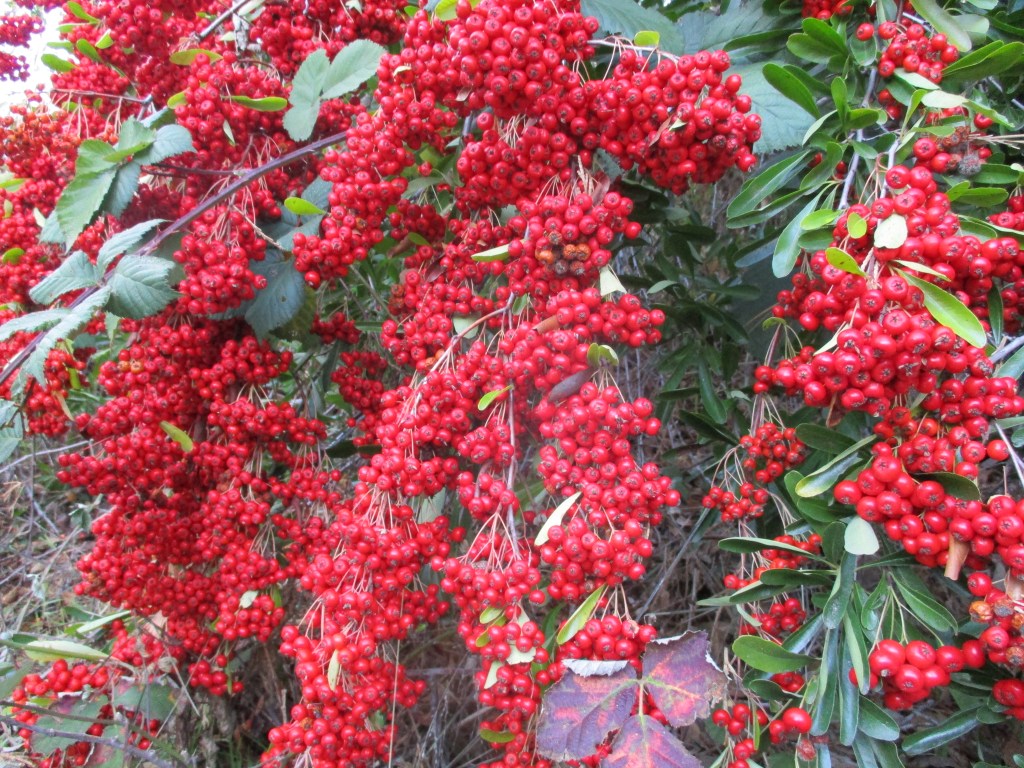
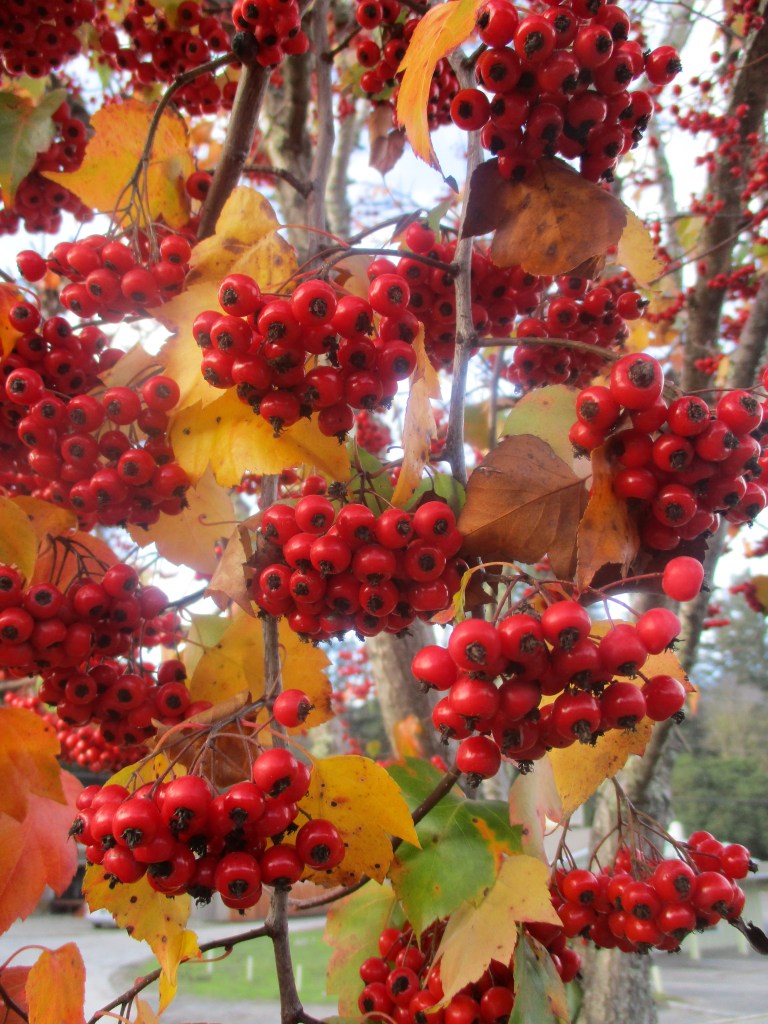
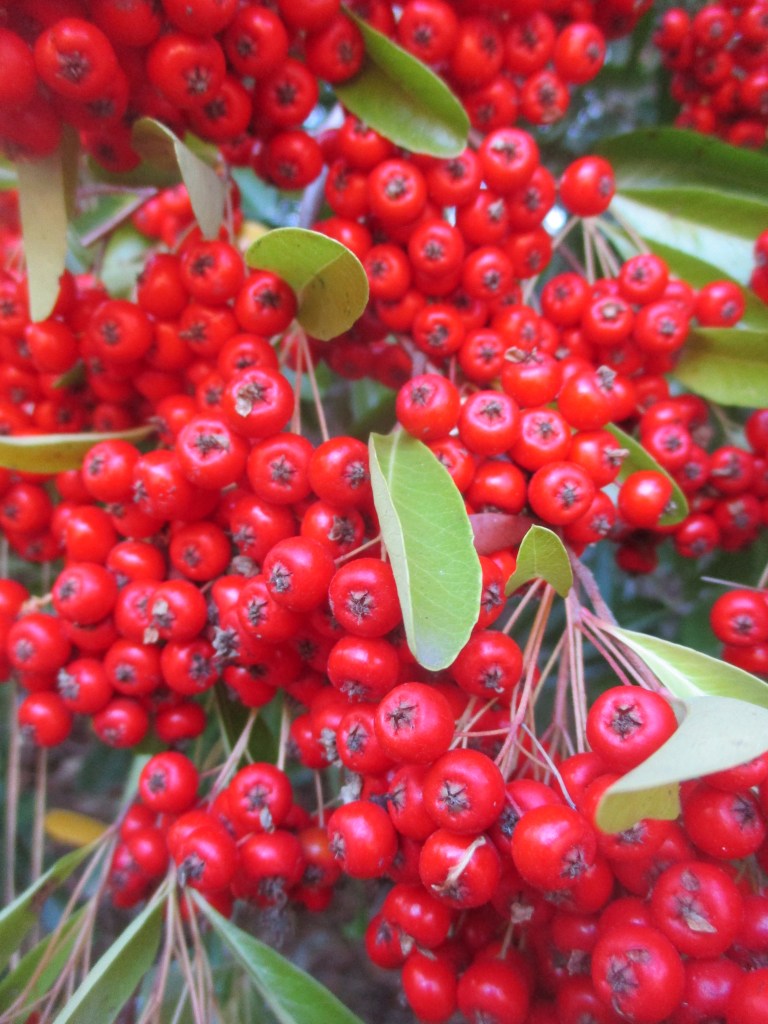
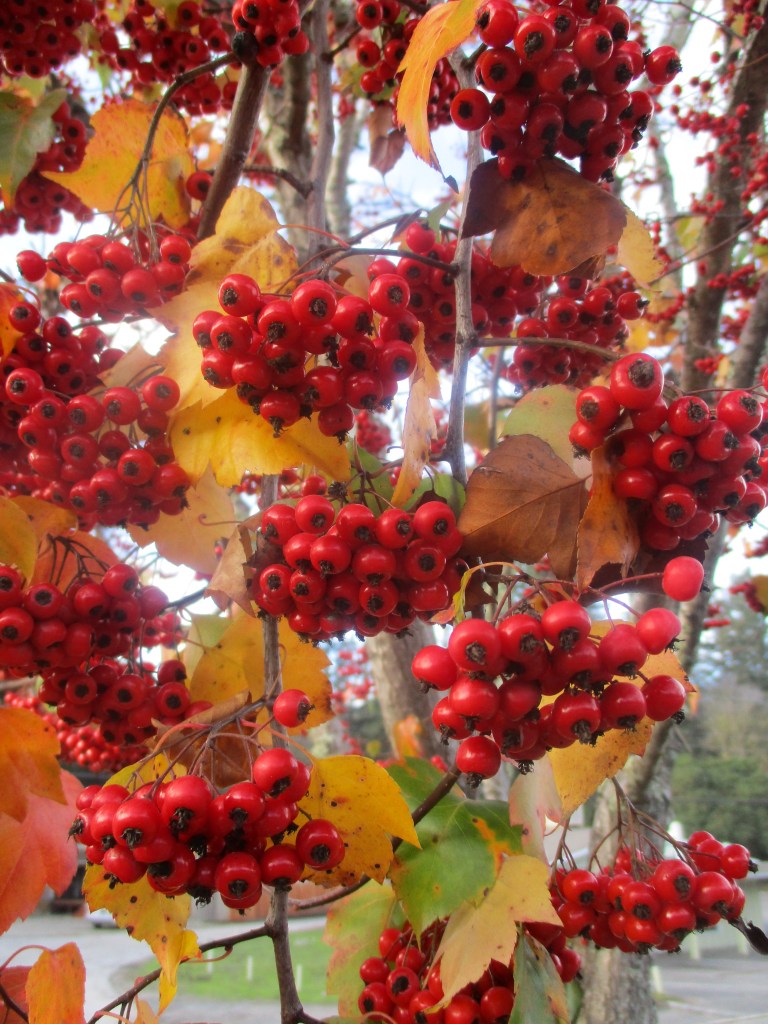
Winter berries provide more color as autumn foliar color finishes.

Pyracantha, although inedible, is likely the most colorful of the winter berries here.

Seasonal color is as variable as the weather. Just as the many different spring flowers bloom differently every spring, and the autumn foliage color is different every autumn, the colorful berries and fruits that linger on many plants through winter respond to the weather. Then, the various birds and other animals that devour them do so at different times, and at different rates every year.

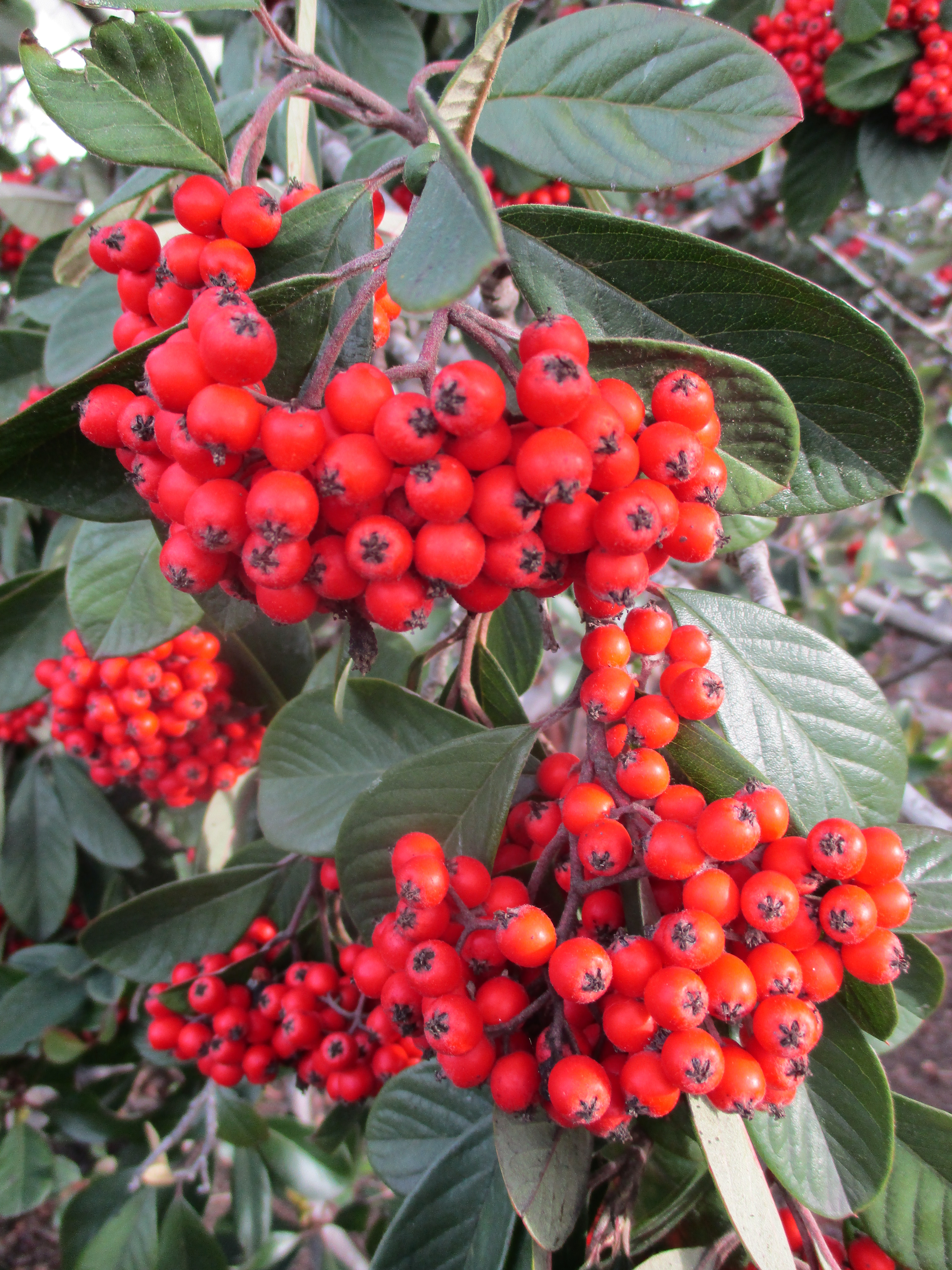
Pyracantha (or firethorn) is probably the most reliable for an abundance of brightly colored red berries. Old varieties with orange or even yellow berries are very rare, perhaps because they are comparably wimpy. Unfortunately, because they are so colorful, and also because they ripen before many of the migratory birds have gone, the berries often get eaten by birds soon after they ripen.

Berries of the various cotoneasters are not quite as colorful, and many ripen slightly later, so they are not so efficiently stripped by birds. Cotoneasters are now more popular than related pyracantha because there are so many varieties with so many different growth habits. Larger types grow into large shrubbery while prostrate types grow as ground cover. Cotoneaster also has the advantage of lacking thorns.

The native toyon can provide large clusters of similar red berries, but only if it is allowed to grow somewhat wildly. It is unable to bloom and subsequently produce berries if regularly shorn. Yet, even in the wild, toyon is unpredictable. Because damp weather can cause berries to rot before they ripen, toyon may be unproductive for many years, and then produce remarkably colorful displays of berries when least expected.

Hollies are the most familiar of colorful winter berries, but are not as colorful as pyracantha or the various cotoneasters because they are almost never provided with male pollinators that they require to develop fruit. Fortunately, their remarkably glossy and prickly foliage is appealing alone.

Flowering crabapples are grown for their impressively colorful pink, white or nearly red spring bloom, but some types also produce sparse and minute red, orange or even yellow crabapples that stay after the foliage turns yellow and falls. English hawthorn lacks the flower color of flowering crabapples, but has more abundant and colorful red or orange berries that linger into early winter after the foliage is gone, or at least until birds find them.

English Hawthorn

English hawthorn is small but distinguished.

Most red berries that provide color and attract birds through late autumn and winter grow on shrubbery. Berries of English hawthorn, Crataegus laevigata, grow on trees. They are not big trees, but they are distinguished. Mature trees might get no taller than twenty feet, but their furrowed trunks with weathered bark resemble those of older and statelier trees. 

Trusses of small white flowers that bloom in spring are comparable to those of pear. Like pear bloom, they emit a potentially objectionable musky fragrance. Modern cultivars that bloom with pink, double pink or double red flowers are less fragrant. English hawthorn is uncommon locally. The few cultivars that produce yellow or orange berries might be rare. 

The deciduous leaves of English hawthorn are only about an inch or two long and wide. They are deeply lobed, with a handsomely coarse texture. Foliage can turn rusty orange or brownish yellow for autumn. Defoliation exposes any remaining berries, at least until the birds finish with them too. Thorns are unfortunately unavoidable.

Red Berries For Migrating Birds

Firethorn berries are the most colorful.

Red berries that ripen through autumn and into winter are becoming prominent. They are too brightly colorful and profuse to hide. Those that do not attract too much attention from wildlife may linger after floral color is finished. Some may last longer than the earliest fall color. Otherwise, if wildlife consumes all of the red berries, that is what they are there for.

Plants are naturally exploitative. Since they are inanimate, they exploit that which is not. Those that do not rely on wind for dispersion of their pollen and seed expect insects and animals to do it instead. Their flowers appeal to preferred pollinators, using color, texture, form, fragrance and flavor. Their fruit, which contains their seed, uses similar techniques. 

Red berries mature at this time of year for two primary reasons. Plants that produce them prefer their seed to disperse during autumn or early winter. Also, they know that they can rely on birds or other wildlife to eat the red berries, and subsequently ‘disperse’ the seed within. Overwintering wildlife and migratory birds are particularly hungry as berries ripen. 

Red berries are popular in home gardens for two primary reasons. Some people like the birds and squirrels who come to eat the fruit. Most people simply appreciate the red color while floral color is potentially scarce. Unfortunately, it is impossible to predict how birds will behave. They may prematurely consume berries that should provide color for winter.

Although various hollies provide delightfully glossy and densely evergreen foliage, their red berries are scarce or absent without male pollinators. (Hollies are dioecious, so their genders are distinct.) Male cultivars, which had been rare for several decades, have only recently become more available. Yet, even with pollinators, holly berries are not the best. 

Firethorn (Pyracantha), toyon and a few cultivars of cotoneaster are more prolific with red berries. Toyon, or California holly, is native, and is the namesake for Hollywood. It is best in wild landscapes where it needs no pruning. Firethorn produces the most berries but is also very thorny. Some cultivars of cotoneaster are both thornless and pleasantly prolific. 

Firethorn

Overwintering birds can not miss firethorn.

The most abundant bright red berries of autumn are those of firethorn, Pyracantha coccinea. They resemble English hawthorn, cotoneaster and toyon berries, but are shinier and more abundant. Their weight causes their limbs to sag. Most are either rich deep red, or brighter slightly orangy red. Orange berries are uncommon locally. Cultivars with yellow berries are less vigorous and rare.

Berry production may seem to be more variable than it actually is. Healthy plants typically produce a profusion of berries. They only seem to be more profuse if they ripen late, after migratory birds fly south. Such birds are voracious with early berries. Overwintering birds are less numerous, and consume berries slower. Regardless, few berries last long enough to deteriorate and get messy.

Firethorn is thorny enough to function as an impenetrable hedge. However, it is unpleasant to prune with all those thorns. Also, pruning without removing the stems that bloom and produce berries takes effort. Upright cultivars can get higher than downstairs eaves. Some cultivars get only a few feet tall as they sprawl over the ground. Even without berries, the evergreen foliage is appealing.

Colorful Berries Brighten Wintry Gardens

Bright red attracts hungry overwintering birds.

It is no coincidence that so many colorful berries ripen in autumn as migratory birds migrate south for winter. Such colorful berries are intended for both migratory and overwintering birds. Rodents and other wildlife are welcome to take what they want as well. Most colorful berries are bright red, to get the attention of birds and wildlife. They are a convenient ‘grab and go’ size, and abundant.

Plants who produce colorful berries are pleased to provide in exchange for the dispersion of their seed. It is an ingenious system. Everyone involved does what they do best. Plants produce their colorful berries to exploit wildlife. Wildlife exploits the berries. Seed within the berries survives digestion, and gets ‘deposited’ elsewhere. Most types of berry seed germinate best after digestion.

Colorful berries are popular in home gardens either to attract birds, or because they are delightfully colorful for autumn and winter. Of course, many that should remain colorful attract birds instead. Fortunately, birds are good sports, and often leave colorful berries long enough to blet (age). Then, polite birds consume the berries before they get messy, and ideally take their mess elsewhere.

Various hollies are famous for their colorful berries. However, not many hollies reliably produce many berries here. Because they are dioecious (of separate genders), commonly available female plants are fruitless without rare male pollinators. Fortunately, modern hollies are becoming available in conjunction with pollinators. Otherwise, the best colorful berries are of the Rosaceae family.

Firethorn is the most profuse and most familiar of the colorful berries through autumn and winter. A few species and cultivars of Cotoneaster can be almost as prolific, but with more subdued color and stature. Toyon is a related native species that performs well in unrefined landscapes. English hawthorn produces similar colorful berries, but develops into a small and gnarled deciduous tree.

Unfortunately, none of these colorful berries are notably edible. In fact, some are mildly toxic.

New Canes Replace Old Canes

50916thumb
Well groomed canes are not overgrown.

Heavenly bamboo, or simply ‘nandina’, is one of those many plants that almost never performs like it should. The intricately lacy foliage is so appealing while plants are young, and changes color with the seasons. The red berries can be comparable to those of holly. Unfortunately, healthy plants grow, and then ultimately get shorn into globs of disfigured leaves and stems.

The same abuse afflicts Oregon grape (mahonia), mock orange (philadelphus), forsythia, lilac, abelia and all sorts of shrubby plants that really should be pruned with more discretion. Their deteriorating older stems should be pruned to the ground as new stems grow up from the roots to replace them. It is actually not as complicated as it seems.

This pruning process, known as ‘alternating canes’, prunes the plants from below. It is a standard pruning technique for maximizing production of blackberries, raspberries and elderberries. It is similar to grooming old stalks from bamboo and giant reed, even if it does not prevent them from spreading laterally.

The deteriorating older stems, or ‘canes’, are easy to distinguish from newer growth. Old canes of Heavenly bamboo and Oregon grape become heavy on top, and flop away from the rest of the foliage. Old canes of mock orange and lilac get gnarled and less prolific with bloom. Aging abelia and forsythia canes become thickets of crowded twigs.

The newer stems are likely a bit lower, but are not so overgrown. Since the foliage is not so crowded, it is displayed on the stems better. Their blooms or berries are more abundant. By the time new growth becomes old growth, there will be more newer growth right below it. In fact, the regular removal of aging canes stimulates growth of new canes.

This is the time to prune Heavenly bamboo and Oregon grape, just because the oldest foliage is as bad as it will get after the warmth of summer. Mock orange, forsythia and lilac should get pruned while dormant through winter, but are commonly pruned just after they finish bloom early in spring. Abelia should probably wait until spring because new growth can look sad through winter.

Jellin’ Like A Melon

50826thumb
This is one way to make the fruits of summer last.

Jelly and jam made from garden grown fruit affords more prestigious bragging rights than merely growing the fruit. Using unusual or disregarded fruit makes it even more interesting. It is not too much work, but involves a different kind of creativity. So many of us who are proficient in the garden are not so proficient in the kitchen.

Apricot, peach, plum, grape, blackberry and raspberry are the most familiar choices for jelly and jam. Nectarine can substitute for peach. Prune works like plum. Strawberry is rare only because not many gardens produce enough for a batch of jam. Sweet cherry is not as tasty as tart types, but is sometimes made into jam because it is relatively common.

Apple and pear are not often made into jelly because they have such mild flavor. However, they are sometimes mixed with other fruit to blend flavors, and because they can provide pectin. Quince has a richer flavor, and makes a traditional jam known as membrillo. Crabapple likewise makes a classic jelly. Apple can be made into apple butter.

Pectin is what puts the jell in jelly. Many fruits are naturally equipped with it. Apricot, peach and cane berries do not have enough. Plum, prune and grape initially have enough, but it breaks down as the fruit ripens, which is why jelly recipes without added pectin often designate that fruit must be firm or just ripening. Otherwise, pectin must be added to get jelly or jam to jell.

With added pectin, pomegranate, fig and rhubarb (which is actually a vegetable) can be made into jelly and jam. Orange and lemon marmalades do not need to be cooked as much with extra pectin. Sweet oranges (which is what almost all oranges are) lose flavor with cooking. (Sour oranges for marmalade are very rare here.)

Pectin also makes it possible to make jelly and jam from some rather unconventional fruit that may not be useful for much else. Elderberry, hawthorn, thimbleberry, rose hips (some varieties), Hottentot fig (the larger fruited type of freeway iceplant) and even coffeeberry and manzanita are all worth trying. Indian hawthorn and Catalina cherry have enough pectin to jell on their own.

Deck the Halls

P91215-1English holly is politely naturalized here. This means that, although naturalized, it is not aggressively invasive, and does not seem to be too detrimental to the ecosystem. It is only annoying to see out in forests, far from the landscapes that the seed escaped from, and wonder if it has potential to significantly compete with native vegetation. It would be better if it were not there.
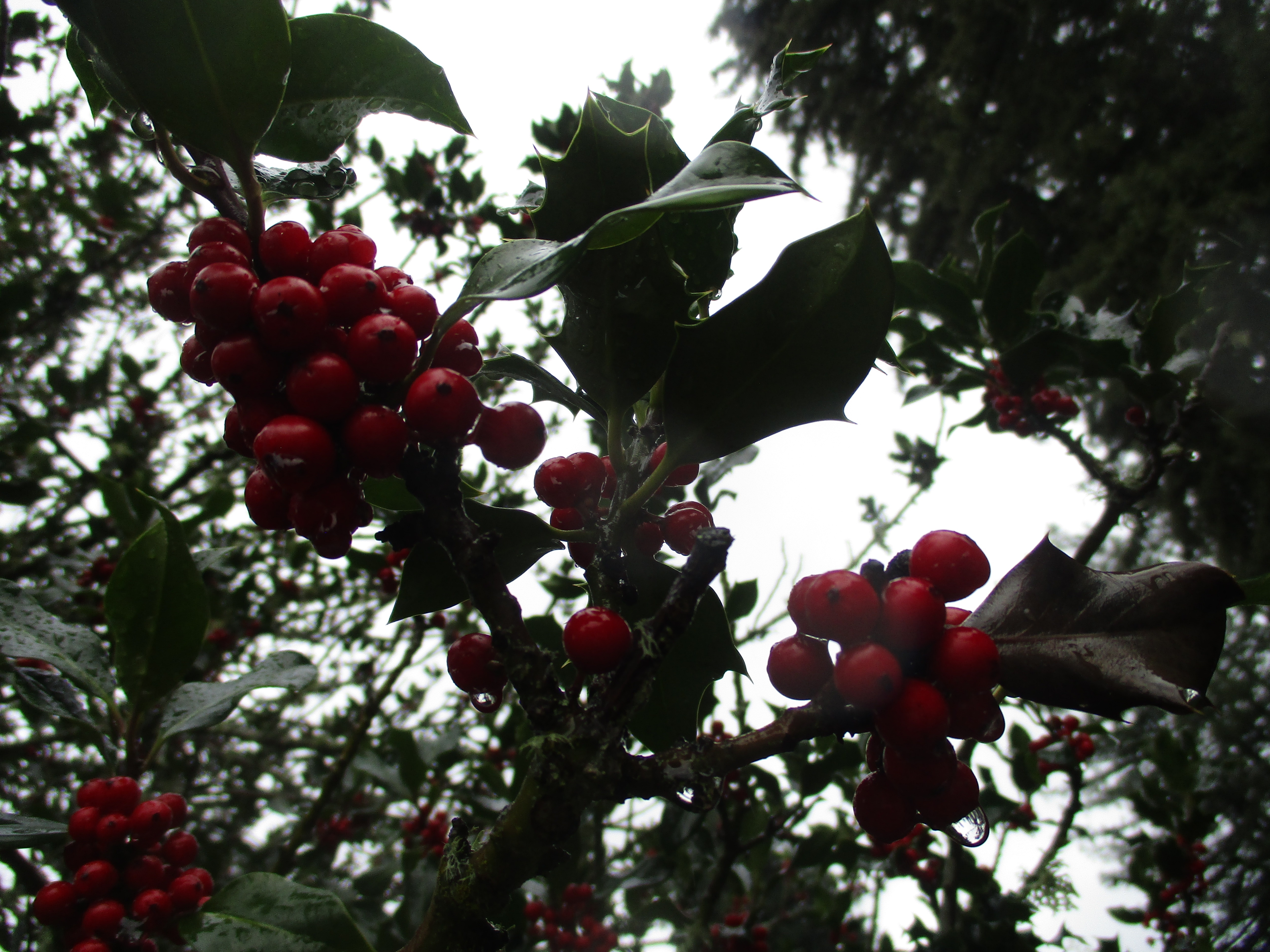
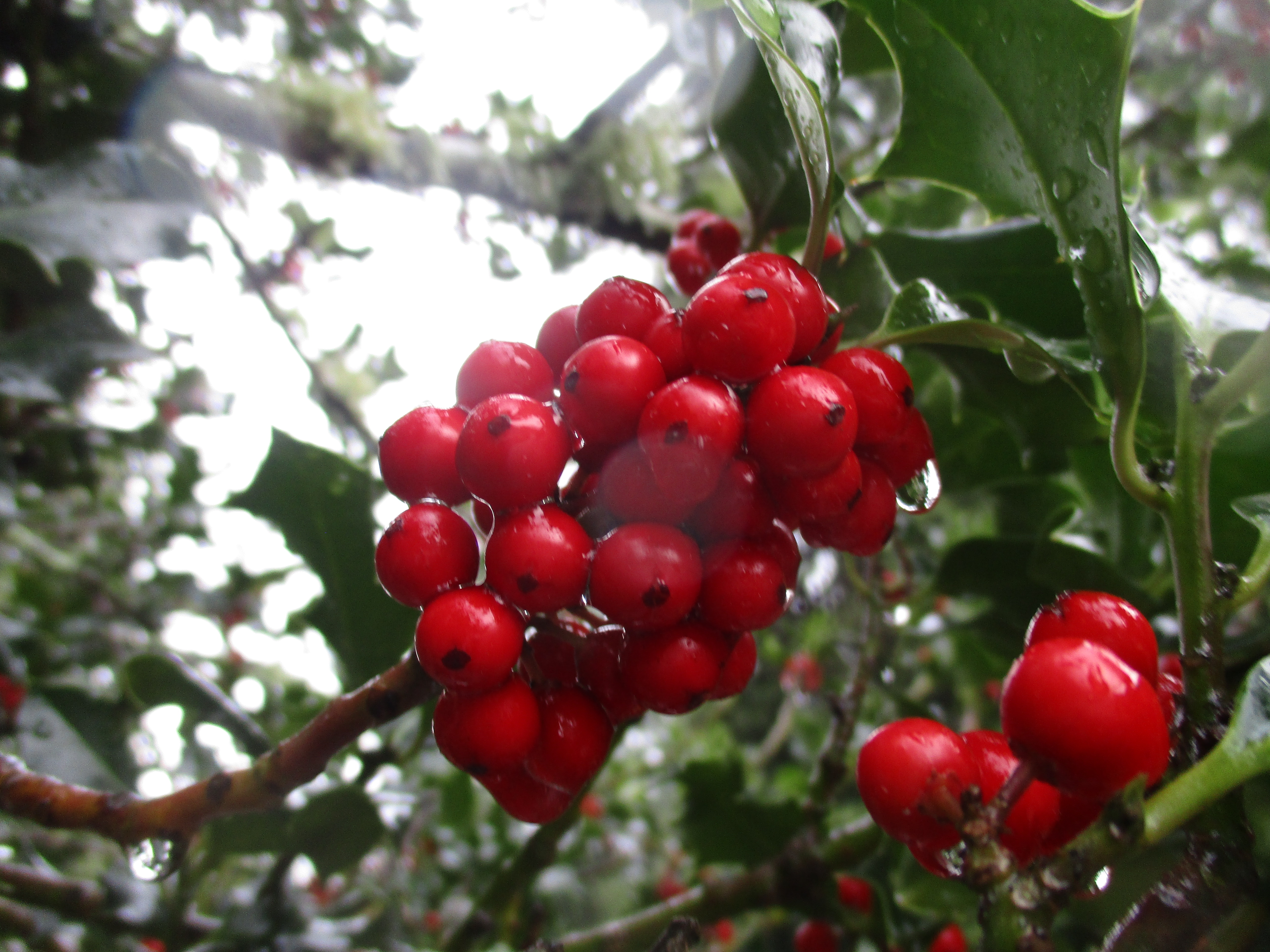
At least it is pretty. In refined landscapes, it happens to be one of my favorites for distinctively glossy and prickly foliage. There is nothing else like it. Variegated cultivars are just as striking, with a bit of color for situations where there is already plenty of rich dark green. Female plants produce a few bright red berries. Older or distressed plants might produce more than others.

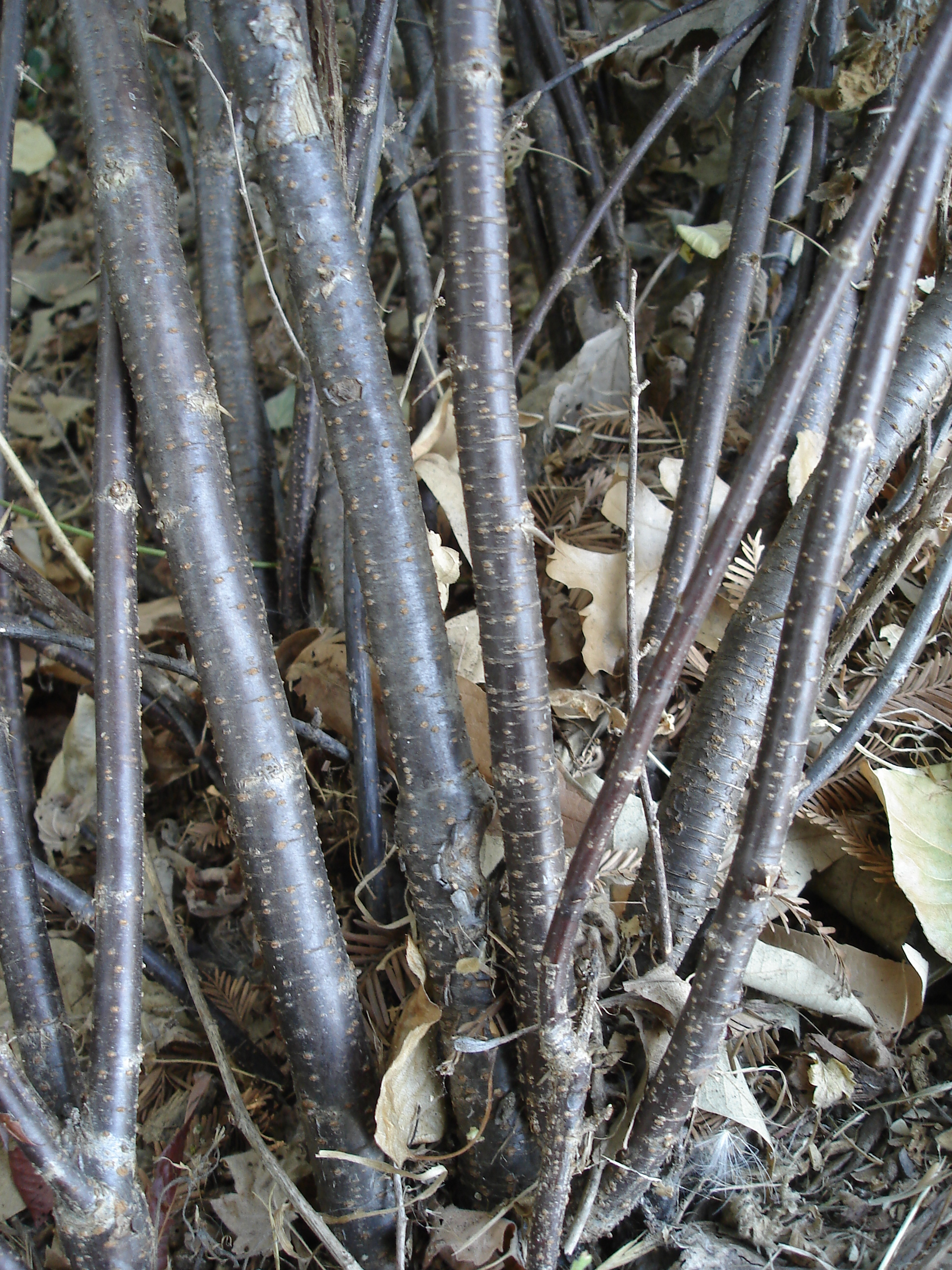
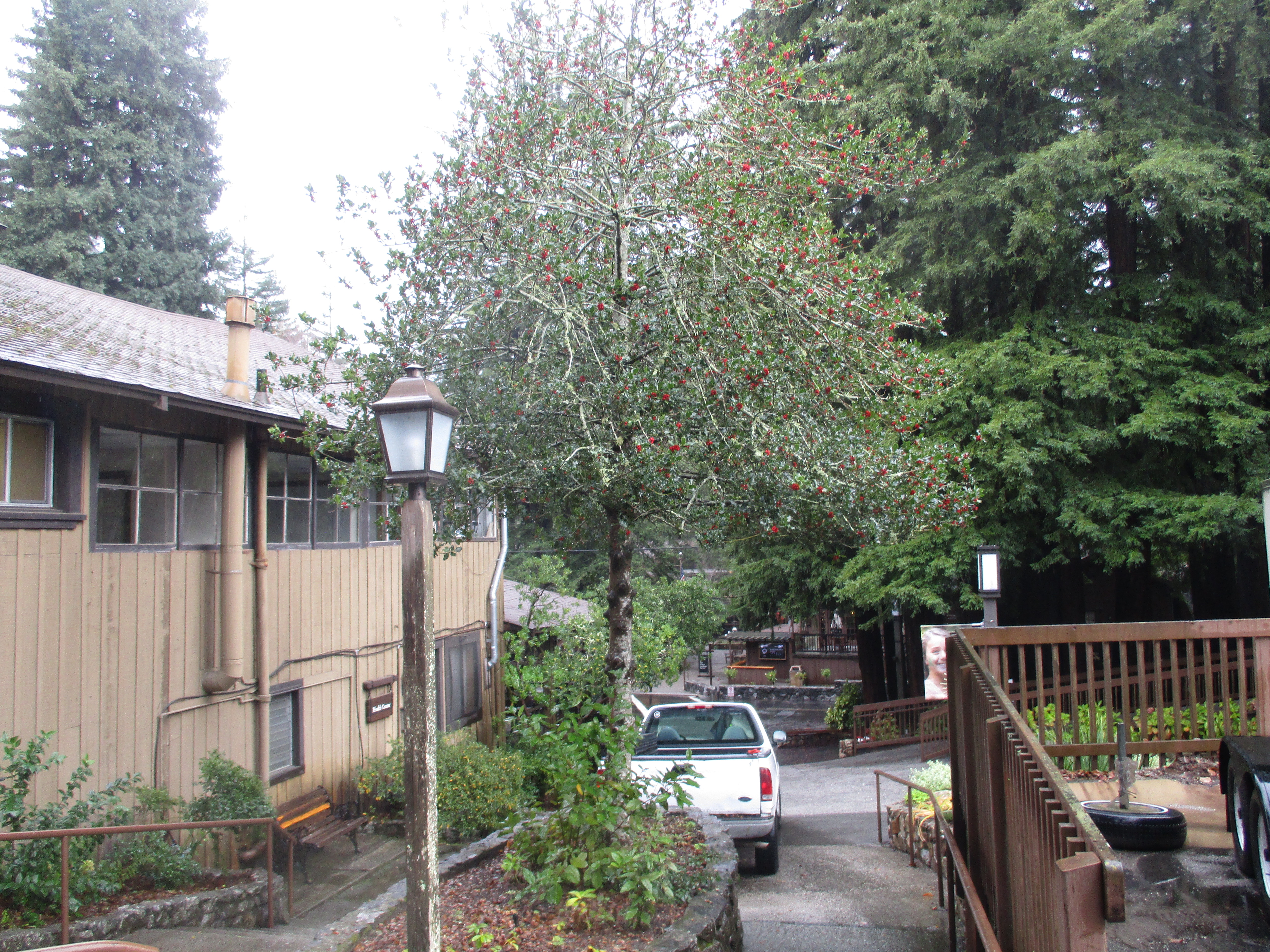
So, I have mixed feelings about this overgrown English holly tree that I must eventually cut down. In the picture above, it is evident that it is not the prettiest. It is a sparsely foliated thicket of tangled inner stems on an uninterestingly straight and bare trunk. It occupies a prominent position where there should be something of a friendlier disposition. It doesn’t contribute much.

However, it does produce an abundance of delightfully bright red berries. I got these pictures while collecting berries to decorate the buffets and tables of the big dining room across the road.

If it were in my garden, I would probably pollard it back to the bare trunk or perhaps just a short stump, and allow it to regenerate with fresh new foliage. Such a procedure would eliminate the tangled thicket of bare interior stems, but would unfortunately inhibit berry production for at least a few years while new growth matures. I just do not want to give up on it completely.P91215-2P91215-3

Winter Berries Are Showing Color

91211thumbNothing lasts forever. Spring flowers fade. Summer fruit gets eaten. Fall color falls from the trees and gets raked away. Berries and other small fruits that ripen to provide a bit of color through late autumn get eaten by birds and squirrels through winter. Every type of berry and every season is unique. It is impossible to predict how long particular berries will last through any particular season.

It would be presumptuous to believe that colorful berries should remain uneaten in our gardens until they decay. After all, they are produced specially for the birds and rodents who consume them. Their visually appealing bright colors are more culinarily appealing to overwintering wildlife. It is no free lunch though. Well fed wildlife is expected to disperse the seed within the berries they eat.

It is an ingenious system. Wildlife might think that they exploit the inanimate flora who produces the berries and small fruit for them. The associated flora could think that they exploit the mobility of the wildlife who eats their seed laden fruit. Those of us who grow plants who utilize this technique get to enjoy the color of the fruit while it lasts. Some of us prefer to enjoy the wildlife attracted to it.

Firethorn (pyracantha), toyon, cotoneaster and English hawthorn are the best for colorful red berries in late autumn and winter. All are of the family Rosaceae, and produce similar clusters of small bright red or maybe reddish orange berries. Yellow firethorn is rare here. Cotoneaster can be tall shrubbery, sprawling shrubbery, or groundcover. Only English hawthorn is a deciduous small tree.

The many species and cultivars of holly are unrelated to the family Rosaceae. In other regions, some are famous for producing seemingly similar berries. However, those that are the most prolific with berries are unpopular here. Those that are somewhat popular produce only a few berries due to a lack of pollinators. (They are dioecious, so female plants must be pollinated by rare males.)

This is the time of year to appreciate the colorful berries while they last.

Colorful Autumn And Winter Berries

41126thumbBefore the colorful foliage of autumn falls and gets raked away, a few types of berries and fruit start to provide a bit of color to last into winter, or at least until birds and other wildlife eat them. Technically, the most colorful berries are actually intended for the birds, both those that overwinter and those that migrate south for the winter. The berries are designed by the plants that produce them to both entice birds, and to reward them for dispersing the seeds within.

Pyracantha (or firethorn) is the most colorful of the berries. Cotoneaster is similar, but not quite so prolific. Toyon and English hawthorn, which can grow as small trees, produce open clusters of similar bright red berries. Of these, only English hawthorn is deciduous, and can defoliate before the berries disappear. Although such fruit is abundant, it is not often messy because it gets devoured before it reaches the ground. However, the birds can be messy.

English holly really should produce more berries than it does, but there are not enough pollinators out there. (Hollies are dioecious, which means that plants are either male or female. Female plants need male pollinators to produce fruit.) Decades ago, when horticulture was taken more seriously, male pollinator plants were marketed with female plants. Some other types of holly somehow make a few more berries, especially as they get older.

Loquat, mahonia, pomegranate and some flowering crabapples try to produce colorful fruit, but are not quite as colorful. Pomegranate fruit can be impressive in its own way, but are just rusty reddish brown on the outside. Strawberry tree produces a few red berries throughout most of the year. Many types of pittosporum develop fruit, but most are about as green as their foliage. The sticky amber seeds are ‘interesting’ when the fruit splits open, if anyone happens to look that closely.

Oranges, lemons, grapefruits, mandarins and other citrus will be colorful later in winter, even though they do not care if they attract any birds. For now, persimmons are the biggest and most colorful fruits out in the garden.