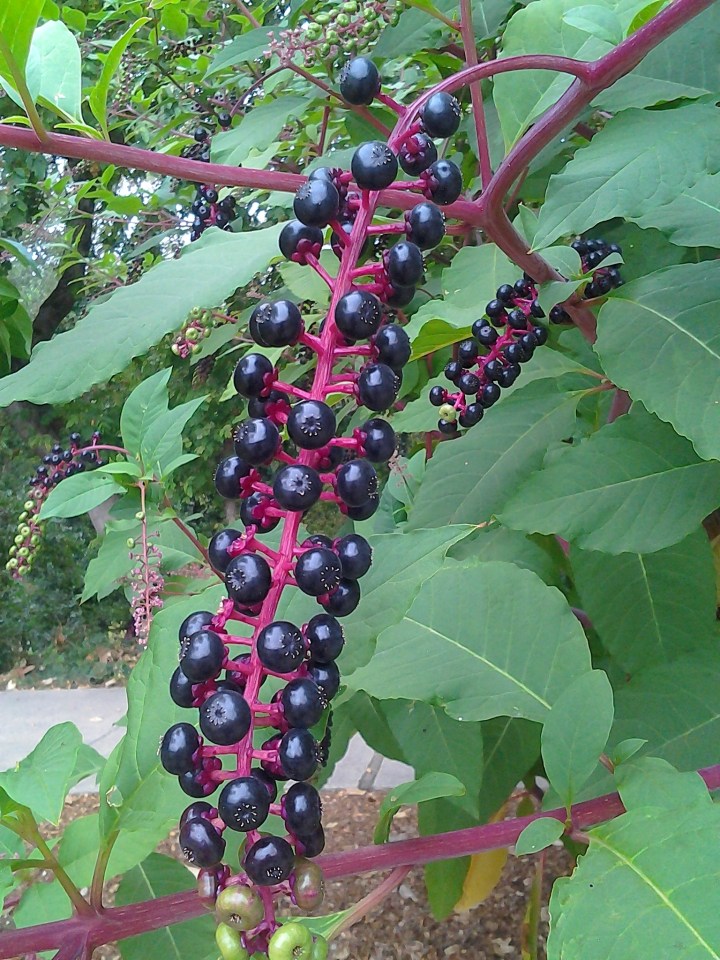
 Before the colorful foliage of autumn falls and gets raked away, a few types of berries and fruit start to provide a bit of color to last into winter, or at least until birds and other wildlife eat them. Technically, the most colorful berries are actually intended for the birds, both those that overwinter and those that migrate south for the winter. The berries are designed by the plants that produce them to both entice birds, and to reward them for dispersing the seeds within.
Pyracantha (or firethorn) is the most colorful of the berries. Cotoneaster is similar, but not quite so prolific. Toyon and English hawthorn, which can grow as small trees, produce open clusters of similar bright red berries. Of these, only English hawthorn is deciduous, and can defoliate before the berries disappear. Although such fruit is abundant, it is not often messy because it gets devoured before it reaches the ground. However, the birds can be messy.
English holly really should produce more berries than it does, but there are not enough pollinators out there. (Hollies are dioecious, which means that plants are either male or female. Female plants need male pollinators to produce fruit.) Decades ago, when horticulture was taken more seriously, male pollinator plants were marketed with female plants. Some other types of holly somehow make a few more berries, especially as they get older.
Loquat, mahonia, pomegranate and some flowering crabapples try to produce colorful fruit, but are not quite as colorful. Pomegranate fruit can be impressive in its own way, but are just rusty reddish brown on the outside. Strawberry tree produces a few red berries throughout most of the year. Many types of pittosporum develop fruit, but most are about as green as their foliage. The sticky amber seeds are ‘interesting’ when the fruit splits open, if anyone happens to look that closely.
Oranges, lemons, grapefruits, mandarins and other citrus will be colorful later in winter, even though they do not care if they attract any birds. For now, persimmons are the biggest and most colorful fruits out in the garden.
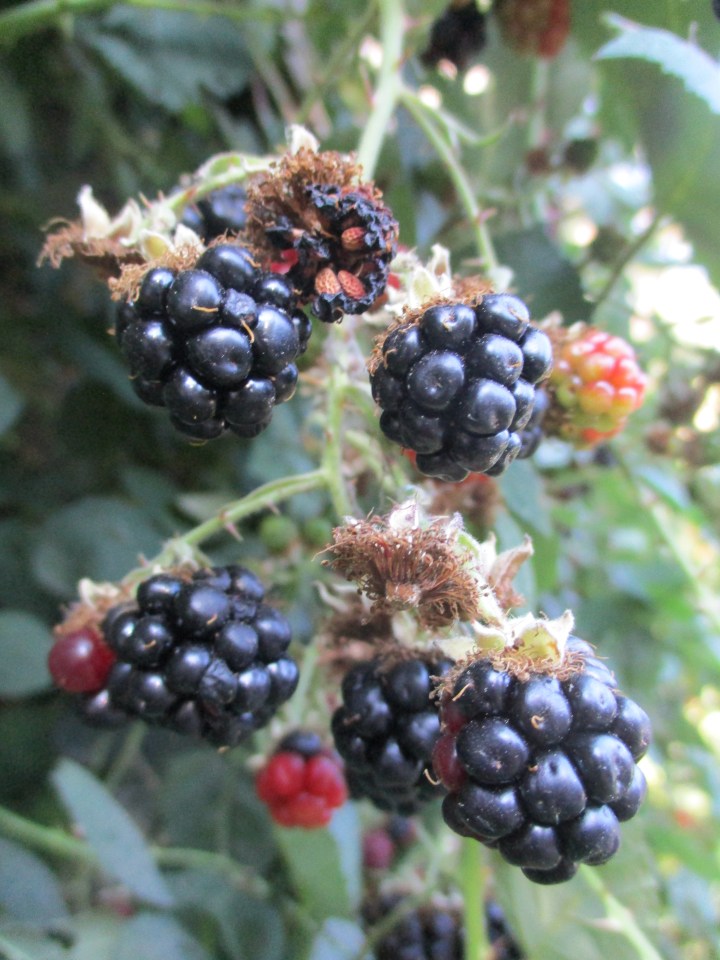 Of all the aggressively invasive exotic species on the West Coast, Himalayan blackberry, Rubus armeniacus, could be the nastiest! It seems to be impossible to kill. It forms dense thickets of wickedly thorny canes that develop roots where they touch the ground. Even if canes are cut to the ground, and the roots are pulled out, new plants regenerate quickly from remaining bits of roots.
 Himalayan blackberry is to cane berries what blue gum is to eucalypti. It is what gives all cane berries a bad reputation, and is why so few of us want to grow them. Himalayan blackberry grows as an extremely vigorous weeds, extending sharply thorny canes over anything within reach. When the canes are removed, the tough roots are extremely difficult to remove and kill.
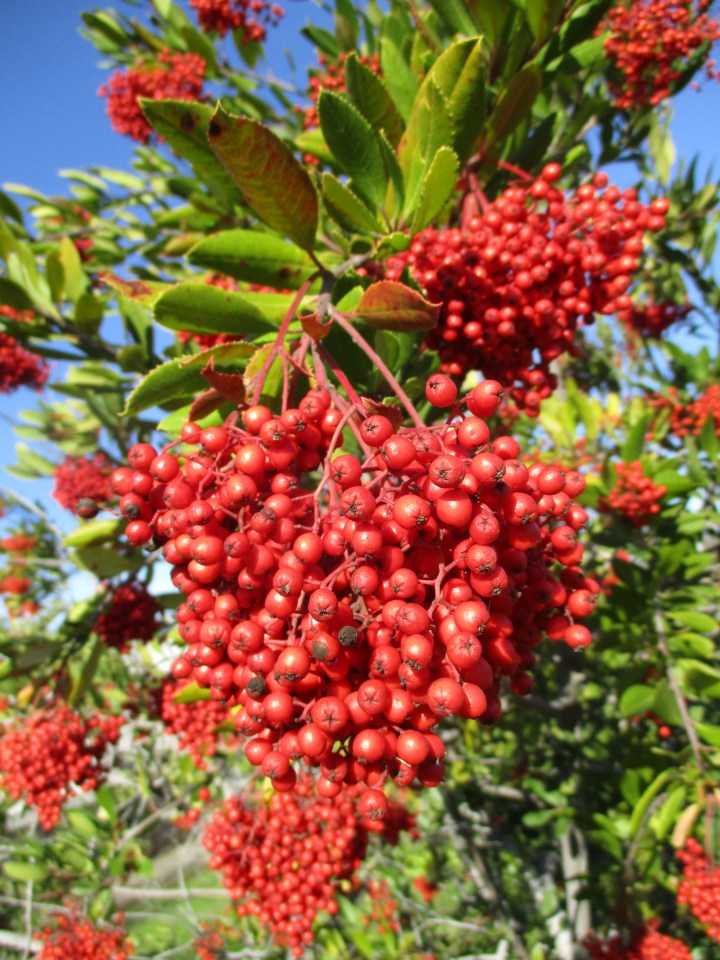 Botanists took a while to contrive an identity for toyon, which is also known as Christmas berry and California holly. It was classified as a species of Crataegus, two different specie of Photinia and two other specie of Heteromeles before it was finally identified as Heteromeles arbutifolia. Meanwhile, the town named after it changed its name only once from Hollywoodland to Hollywood.
 There is much more to the landscapes at work that I wrote about earlier this morning at
  We all know that holly is famous for holly berries, but in modern gardening, English holly, Ilex aquifolium, is appreciated, or despised, for its distinctively glossy but very prickly evergreen foliage. Like countless tiny thorns, the foliage is too prickly to handle for those who despise it. Those who appreciate it know there is no substitute for the elegantly polished sheen and handsome texture.
 The first specie to be imported to North America from Europe were utilitarian plants that produced fruits, vegetables or other horticultural products. English hawthorn, Crataegus laevigata, was likely one of the first ornamental specie to be imported merely because those who were familiar with it appreciated the delightful white spring bloom and the rich red berries in autumn and winter.
 In milder climates of California, where many of us expect at least a few flowers to bloom right through winter, autumn foliar color and colorful winter berries are not appreciated quite as much as they are where autumn and winter arrive earlier, and are cool enough to prevent lingering bloom. Coincidentally, the same mild weather that allows winter bloom here also limits autumn foliar color.
 Just last Saturday, in the first of my two ‘Six on Saturday’ posts, I mentioned that I had never before seen the berries of barberry.
  Of all the colorful berries that ripen in autumn, firethorn, Pyracantha coccinea, is the most colorful, and also the most familiar. The berries are almost always bright red, deep red or reddish orange. Cultivars with orange berries have become rare. Those with yellow berries are even more rare, and are weaker plants anyway. The berries can linger through winter, but typically get eaten by birds half way through.
 Tony Tomeo