 There are a few consequences to all this excellent rain. Gutters are flooding. Trees are falling. Mud is sliding. As much as we should be grateful for what we are getting while we are getting it, it is getting rather old. Clear and sunny weather that is forecast after today will be a welcome relief from all this muddy sogginess.
Almost all of the flowering cherries have somehow postponed bloom. It has not been unusually cold. It is as if the trees somehow know better than to bloom while so much unusually heavy rain is falling. Otherwise, they might have bloomed only briefly before the blossoms got knocked off. The buds are so fat that I expect they will begin to bloom by the middle of the week.
Only one flowering cherry that always blooms significantly earlier than the others bloomed on time, and is already finished. Considering how heavy the rain was during that time, the light duty bloom actually lasted impressively well.
Daffodils tried to delay their bloom as well; but some could wait no longer. Many were not bothered by the heavy rain. Others were knocked flat, and needed to be propped with small hoop stakes. Only some of those that were planted late in the planting season kept their buds closed this late.
I should be pleased that these hyacinth bloomed at all this year. They are the sort of bulbs that bloom only once in their first year, but then do not get sufficient chill in winter to bloom again. They must be in a cold spot. Unfortunately, it is also a shady spot. The floral stems stretched so much in the shade that they were easily knocked down by the heavy rain. Now they lay there like they have fallen and can’t get up.
Bloom Is Earlier If Forced
 Properly pruned deciduous fruit trees probably do not have too many extra stems to spare now. Neglected trees would have more to offer. Believe it or not, a few of us who prune deciduous fruit trees diligently and meticulously in winter sometimes leave a few unwanted stems to prune out and take into the home now that the flower buds are beginning to swell and are about to bloom.
Bloom accelerates once the bare twigs are inside where the nights are warmer than outside. If the buds are plump enough, they can bloom in a day or a few. (If not plump enough, the buds may desiccate before they bloom.) Twigs that are already blooming can be brought in as well, but do not last quite as long. Blossoms are a bit messy as they later drop petals, but are worth the bother.
The technique is simply known as ‘forcing’, which works something like forcing bulbs to bloom prematurely. Timing is critical. If a few blossoms are already blooming elsewhere on the tree, the fattest unblooming buds that are already showing color are ready to be cut and brought in. They only need to be put in a vase with water like any other cut flower, and can mix with other flowers.
Stone fruits (of the genus Prunus) like almond, apricot, plum, prune, peach, nectarine and cherry, start to bloom about now, although not in this order. Apple and pear bloom later. All their fruitless counterparts, known simply as flowering plum, flowering cherry, flowering crabapple and so on, are even more colorful, and some types bloom with ruffled double flowers. All bloom without foliage.
Flowering quince and forsythia have already bloomed, but would have been the most spectacular bare twigs to force into bloom. Pussywillow is probably the most familiar forced bloom twig. Hawthorn (Crataegus spp.) blooms something like pear, but the aroma may be objectionable to some. More adventurous garden enthusiasts force witch hazel (winter), redbud and star magnolia.
Warm Weather Confuses Dormant Plants
 Climate is what makes gardening so excellent here. It is just warm enough in summer for plants that like a bit of heat, but not too unbearably hot for too long. It is just cool enough in winter for plants that like a chill, but not cold enough for hard frost or heavy snow. The climate is also comfortable for us while out in the garden! Yet, even local climate is neither perfect nor predictable.
El Nino is still out there, and likely to deliver an abundance of rain. The rain last month was great while it lasted. This presently dry and warm weather in between has been excellent, but is likely to cause serious consequences. Some deciduous plants that are normally bare through winter are being deprived of adequate dormancy. Some are blooming prematurely, and may foliate soon.
When the rain resumes, it will ruin some of the premature bloom. This is generally harmless for most fruitless flowering trees like the various acacias, flowering plums and saucer magnolias, but compromises their most alluring feature. It can be more dangerous to flowering pears (including evergreen pear) and flowering crabapples, because wet blossoms can be infected with fire blight.
The more serious problem is that rain ruins blossoms and juvenile fruit of various deciduous fruit trees. Stone fruits such as almonds, apricots, cherries, plums, prunes, peaches and nectarines bloom first, and do so with delicate blossoms. If the blossoms do not get knocked off by rain, the juvenile fruit will rot if it stays damp too long. Many fruit trees are likely to lose all fruit this year.
Apple and pear trees should be safer because they bloom later, and bloom with more substantial flowers. (However, like their fruitless relatives, their wet blossoms are very susceptible to fire blight.) Persimmons and pomegranates bloom even later, and with even tougher flowers, so should be safe. Figs are in a league of their own, and should be fine if summer is warm.
Fortunately, destruction of bloom and fruit, although disappointing to us, is harmless to the affected trees.
Fringe Flower
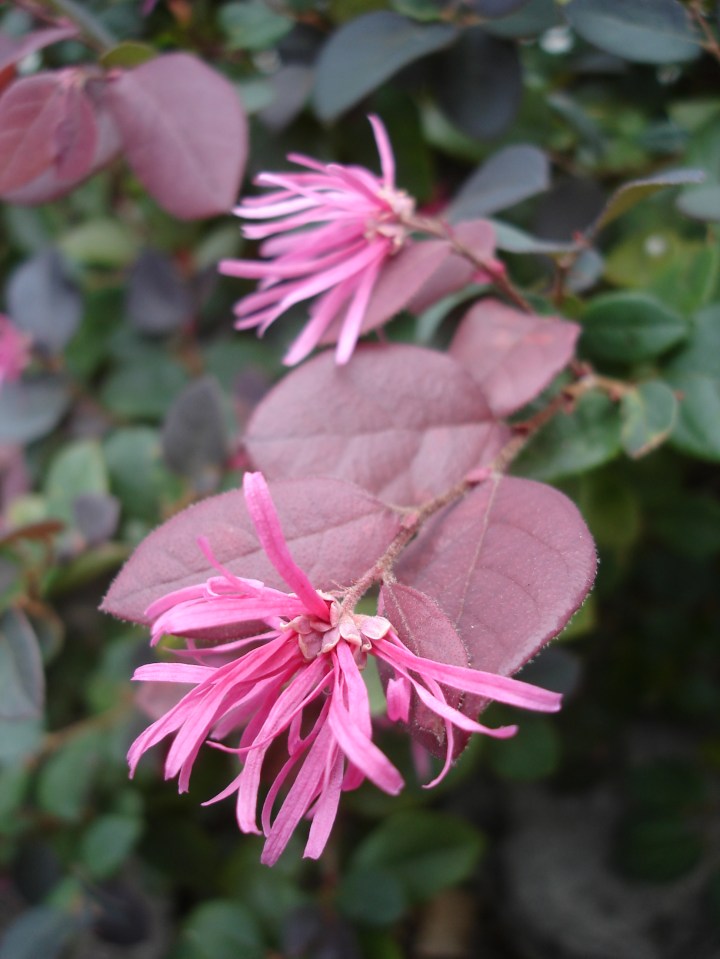 Since modern cultivars became trendy several years ago, the old fashioned ‘common’ fringe flower, Loropetalum chinense, has become even more uncommon than it already was. It does not grow fast enough to function as large scale shrubbery, but slowly gets too big to work as small shrubbery. Without pruning, old plants take many years to get to fifteen feet tall.
The gracefully arching stems are outfitted with light green evergreen foliage. The simple leaves are about an inch or two long. The small white blooms have very narrow petals that hang downward like limp bits of ramen. Each bloom is actually a tuft of a few individual flowers. Bloom is most abundant in spring, and then continues sporadically through most of the year.
Modern cultivars of fringe flower are more compact, so rarely get more than five feet tall. Flowers can be white, pink, red or rosy pink. The most popular cultivars have purplish bronze foliage. Fringe flower does well as an understory plant, in the partial shade of trees. It should not be shorn, so should instead be pruned selectively to maintain its natural form.
Flowers Might Be Getting Scarce
 It makes sense for flowers to bloom in spring. Winter is too cool, windy and damp for both flowers and the insects that pollinate many of them. By summer, successfully pollinated flowers have faded, are busy making seed to disperse in autumn. Some plants produce fruit to get birds and other animals to disperse their seed. There are certain advantages to blooming early in the spring.
Native plants that are endemic to chaparral climates are quicker with bloom, so that they finish before the air gets too arid. Desert plants might bloom for less than a week. Some tropical plants might bloom whenever they want to because they do not understand the concept of seasons, but they are not the prominent plants in our gardens. Therefore, flowers get scarce this time of year.
Besides the few perennials and annuals that bloom as long as the weather stays warm, there are not many plants that bloom reliably so late in summer. Belladonna lily, which is also known as naked lady, might be one of the flashiest, as its bright pink flowers bloom on top of bare stalks before the low basal foliage develops. It was actually dormant through the warmest part of summer.
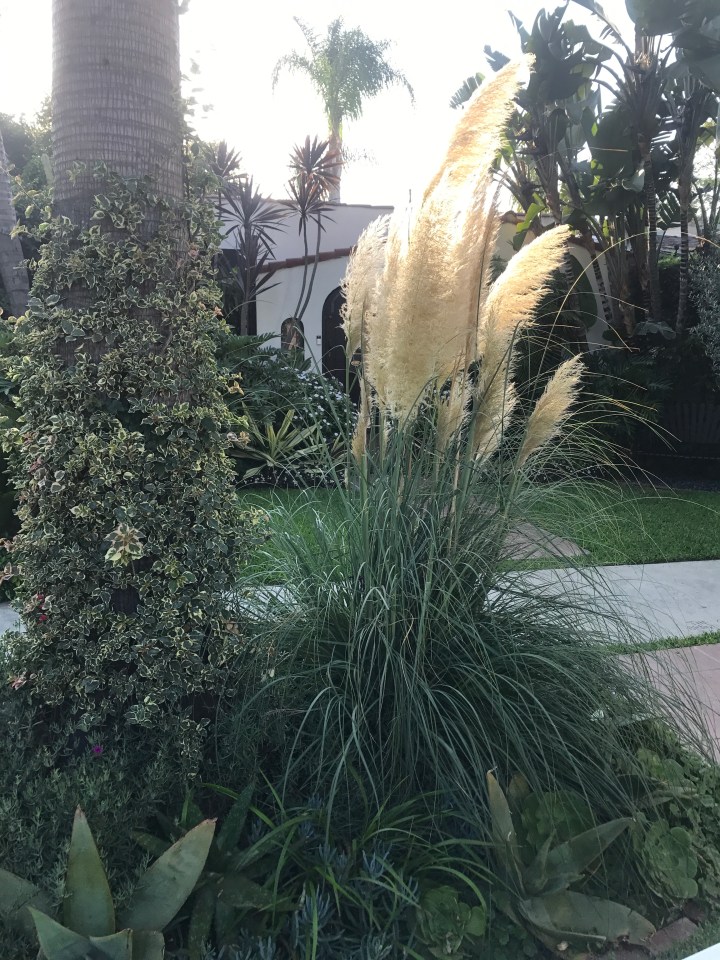
Billowy and bold pampas grass flowers bloom this time of year, but are uncommon. The boldest type of pampas grass is too big and difficult to manage for home gardens. The smaller type has dingy tan flowers, and is so invasive and weedy that it is unavailable in nurseries. Those of us who have it in our gardens did not plant it. Other grasses with nice late flowers are not very colorful.
Russian sage has become one of the more popular late blooming perennials. More traditional Japanese anemone, goldenrod, lion’s tail and showy stonecrop all seem to have lost popularity over the years. Mexican blue sage should bloom best late in summer, but often finishes sooner than expected. Yarrow often blooms later than expected, until summer ends. Marigold, blanket flower and some sunflowers bloom until frost. Chrysanthemums, whether grown as annuals or perennials, are just beginning late in summer.
Flowers For Late Summer Bloom
 No mater how much work we put into our roses to sustain bloom all through the season, and not matter how successful we are with that endeavor, the first spring bloom is always the best. Some roses continue to bloom in floriferous phases afterward, while others bloom sporadically but continually; but there is nothing like the first bloom phase. The last blooms are just waiting for autumn.
Of course, concentrating resources into early bloom is very sensible. That is why so many plants bloom only once in spring. It gives them time to get pollinated, develop seed and fruit structures, and finally disperse their seed or fruit structures, all before winter. Plants that bloom in summer or autumn are either from regions where winters are not too harsh, or where summers are harsher.
Because summer weather in most regions tends to be warmer and drier than spring weather, flowers that prefer to bloom in summer tend to be more prolific but smaller and less colorful. By this time of year, they are more reliant on wind for pollination rather than insects anyway. Therefore, they do not need to be big and colorful to attract pollinators, although some are fragrant just in case.
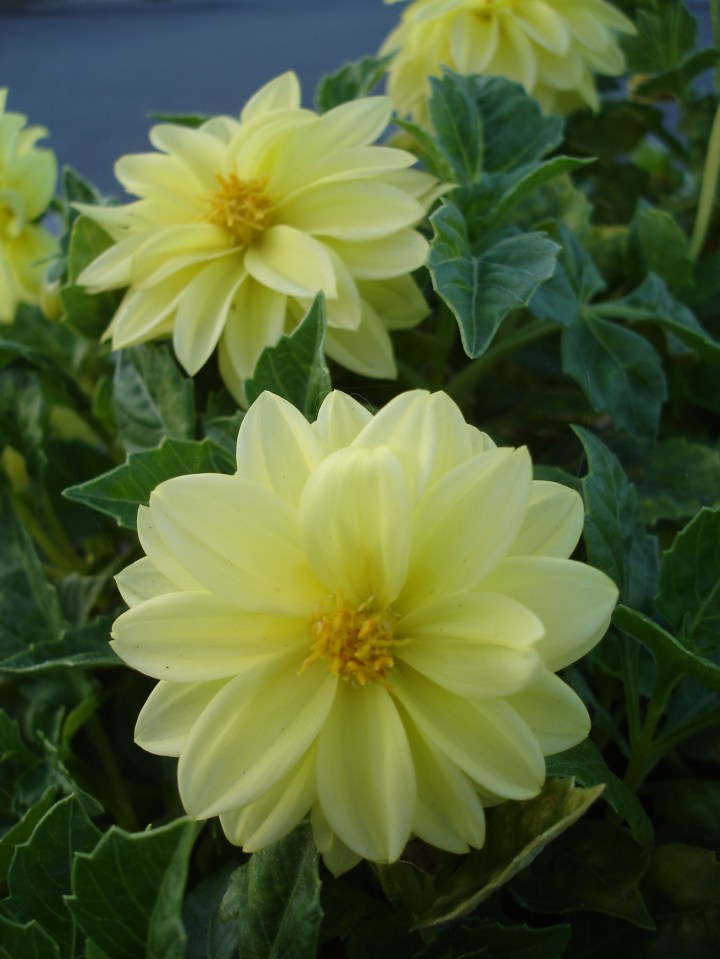
Sunflower, blanket flower, cone flower, zinnia, cosmos, delphinium, dahlia and of course rose, are some of the favorite flowers in the garden as well as for cutting in late summer and into autumn. Cut dahlia flowers should get their water changed daily so that they do not rot and smell bad so soon. Canna blooms about now, but does not last so well as cut flowers. Lily-of-the-Nile is finished.
Believe it or not, lemon bottlebrush is a delightful cut flower for those who are not allergic to it or repelled by the aromatic foliage. So are some of the showier eucalyptus, such as the red flowering gum, Eucalyptus ficifolia. Mexican blue sage that was cut back to the ground over winter blooms a bit in spring, takes a bit of time off through summer, and then starts to bloom as summer ends, ultimately blooming spectacularly early in autumn. A few other sages bloom as late, but few are good for cutting.
The Bad Seed
 This salvia would probably look badder without it. Yes, that’s badder and not better. I mean, if all these slightly unsightly seeded stems were cut back, then the even more unsightly deteriorating foliage below would be more prominent. When one looks at it that way, the bad seed suspended above does not seem all that bad.
It is doubtful that the ‘gardeners’ who ‘maintain’ this site put that much thought into it. They are, after all, the same who ‘maintain’ the firethorn that is pictured in this article from June 27 (The Wrong Plant In The Wrong Place https://tonytomeo.com/2018/06/27/horridculture-the-wrong-plant-in-the-wrong-place/ ). There were probably too busy botching something else to notice that this salvia is in need of botching as well.
There is some unpruned black sage nearby that displays similar but smaller seeded structures on more irregular and arching stems, rather than vertical stems that stand upright. They too are somewhat appealing in a weirdly sculptural sort of way. They might stay like that until winter, when they will likely get pruned back as they deteriorate in the weather.
Sunflowers are commonly left after bloom just because finches and other seed eating birds like them so much. They do not get cut down until the birds are finished with them. To many, this is the main reason for growing sunflowers.
Another excuse to be lazy about deadheading spent blooms is that many will provide seed that can be collected for the next season, or merely allowed to self sow and naturalize. Leaving open pollinated vegetables out to go to seed is a common practice. For example, the last few radishes to be pulled might just be left to bolt, bloom and go to seed. Cosmos tends to throw its seed whether we want it to or not.
Garden Bloggers’ Bloom Day August 15 – Summer Weather Continues . . . Mostly
We were fortunate to have missed out on the unpleasant warmth that most everyone in the Northern Hemisphere experienced. It was warm here, but no warmer than is normal for summer. The only difficulty is that it got so warm so suddenly after such mild weather early in summer. Some of the flowers that were blooming at that time finished a bit earlier as a result of the weather.
Flowers that are blooming now are somewhat on schedule. Chrysanthemum does not see to have much of schedule, but that should be expected. Although I would guess that they are early, those who know better tell me that naked lady is right on time.
Those in other climates have no problem talking about the end of summer or even the incoming autumn already. I am not ready to give up on summer. I will likely be talking about it still in September. I can talk about autumn in October.
These pictures were taken on the Santa Cruz County side of the Santa Cruz Mountains above Los Gatos, closer to Felton. The climate is more coastal than the chaparral climate of the Santa Clara Valley, although both are within USDA Zone 9.
Naked lady started blooming about a week ago, just long enough for the first of the bloomed flowers to start deteriorating in the background. I thought this was somewhat early, but a colleague, who is incidentally not at all horticulturally oriented, informed me that this is exactly the right time for them. When I was a kid getting ready to go back to school, I remember them blooming in September in Montara, but that was many miles away, and in a somewhat different and more coastal climate.
Chrysanthemum is another flower that I think of as blooming later, and even into autumn. Yet, these have been blooming since late spring. There are different cultivars that bloomed at different times. These are the latest, but are already starting to deteriorate. Perhaps those that already finished will bloom for another phase in autumn. It is difficult to say. I think that they bloom whenever they want to here.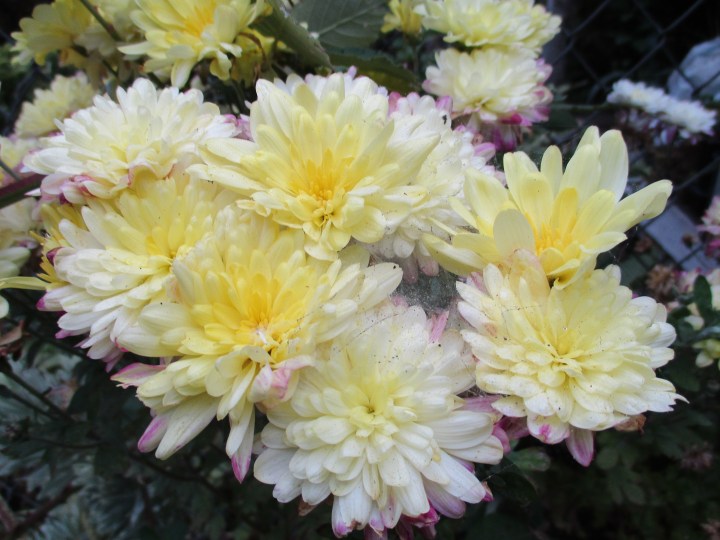
Peruvian lily is blooming for a second phase, which really is right on schedule. The main and most prolific bloom phase was in late spring. After those flowers finished and deteriorated, the finished stalks got plucked, leaving only a bit of vegetative stems sprawling on the ground, and a few unbloomed stalks that are blooming now. After bloom, the finished stalks will probably get cut in half, but not plucked. That technique removes the seed capsules and keeps the tall and lanky stalks from falling over, but also leaves a bit of foliage to help the lower vegetative growth recharge the system for bloom next year.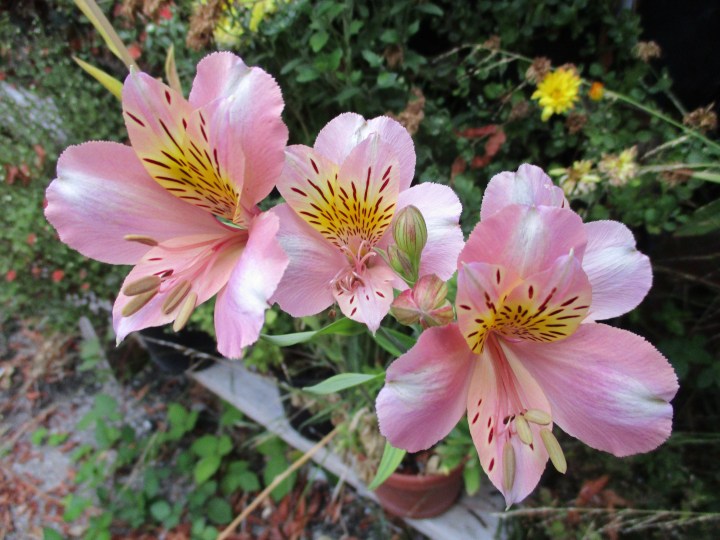
Rose blooms all summer. Some of the hybrid tea roses bloom in more obvious phases after their most prolific first phase. Floribunda roses like this one bloom so steadily that there is not much separation between phases. This particular rose is in a pot that was not likely watered enough through the earlier warm weather, so subsequent bloom was not expected. Some of the petals are a bit roasted around the edges.
Zonal geranium blooms about as steadily as floribunda roses do. They would bloom right through winter if there did not need to be cut back before spring. Some zonal geraniums put out quite a bit of new growth recently. It will be awkward to cut them back at the end of next winter. The stems that are fresh and new now will still be in good condition right through winter, so I will not want to cut them back like I should. The flower of this zonal geranium is the same color as the rose above.
San Marzano tomato is NOT what this tomato is. It was labeled as such, but looks more like common ‘Roma’. No one is complaining. There is certainly nothing wrong with it, except that it is not what was expected. Hey, this unknown tomato is the same color as the zonal geranium above, which is the same color as the rose above. All the other flowers above are from plants that are in the storage nursery at work. These tomatoes are in a colleague’s garden adjacent to the nursery.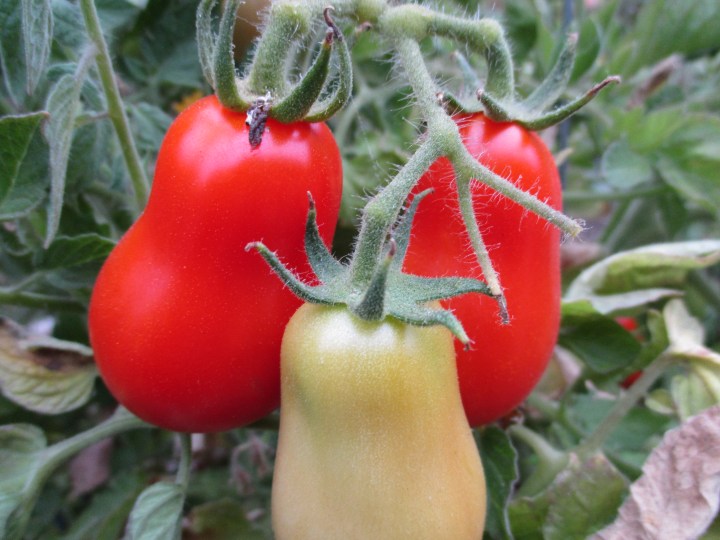
Garden Bloggers all over America and in other countries can share what is blooming in their gardens on the fifteenth of each month on “Garden Bloggers’ Bloom Day”, hosted by Carol Micheal’s May Dreams Garden at http://www.maydreamsgardens.com
Garden Bloggers’ Bloom Day July 15 – Summer Weather Has Arrived
While so many of us in the Northern Hemisphere were contending with unusually warm weather, our weather here had been unusually mild. The weather only recently became warm for the past two weeks or so. It did not get unusually hot here like it did in so many other regions, but the warmth developed suddenly enough to damage many of the flowers that were blooming at the time. This included many of the new perennials that we happened to be installing at the time. Consequently, there were not nearly as many flowers to get pictures of as there had been in May, and some of the flowers in these pictures show damage from the sudden change in the weather. I am sorry that I neglected to participate in Bloom Day in June.
These pictures were taken at work, on the Santa Cruz County side of the Santa Cruz Mountains above Los Gatos, closer to Felton. The climate is more coastal than the chaparral climate of the Santa Clara Valley, although both are within USDA Zone 9.
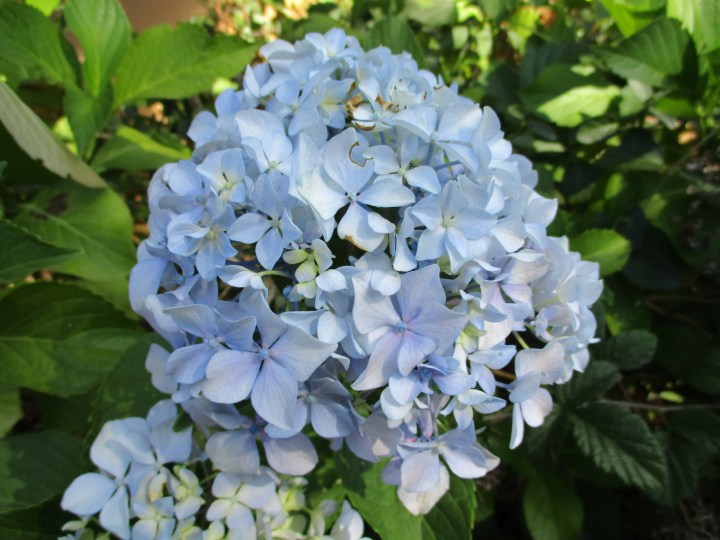
Carpet Roses are the lowliest of all roses, but they happen to be more functional for more landscape applications than other roses are. These got pruned back to a few canes over winter, and will get trimmed for confinement about now, but really do not need any more work than that. They bloom profusely in a few phases. They are only looking tired now because of the weather.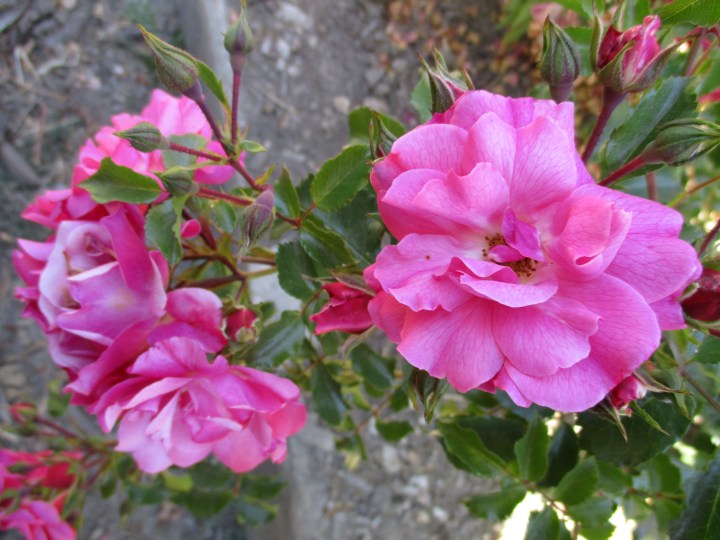 Hydrangea are finishing in most other areas here. These are odd ones. They are more exposed to harsh weather conditions than others, but are somehow lasting later than those that are more sheltered. They are blue instead of pink, but are not in what would be considered acidic conditions within redwood forests. Nor were they fertilized to be blue. No one is complaining.
 Yarrow was planted just before the weather changed. Once established, it does remarkably well in the endemic soil and climate.
 Yarrow unfortunately got roasted by the sudden warmth. These yellow (or ‘golden’) flowers are getting quite crispy already.
 Coneflower was likewise planted just before the weather changed, and likewise got roasted. These happen to be some of the best at the moment.
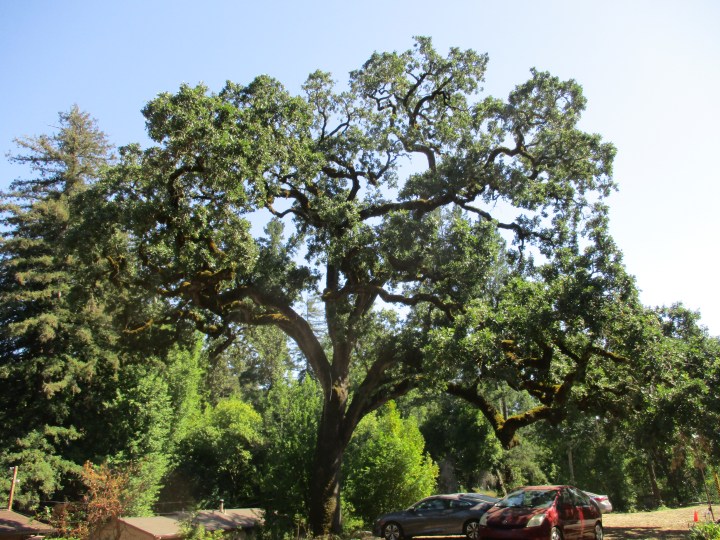
 Valley Oak probably qualifies as appropriate for Bloom Day because it really is blooming right now. You just can not see it. The dust is everywhere. I really like this grand and sculptural tree. The valley oak happens to be the biggest oak in North America, and it also happens to live here, on the outskirts of groves of coastal redwoods, which are the tallest trees in the World.
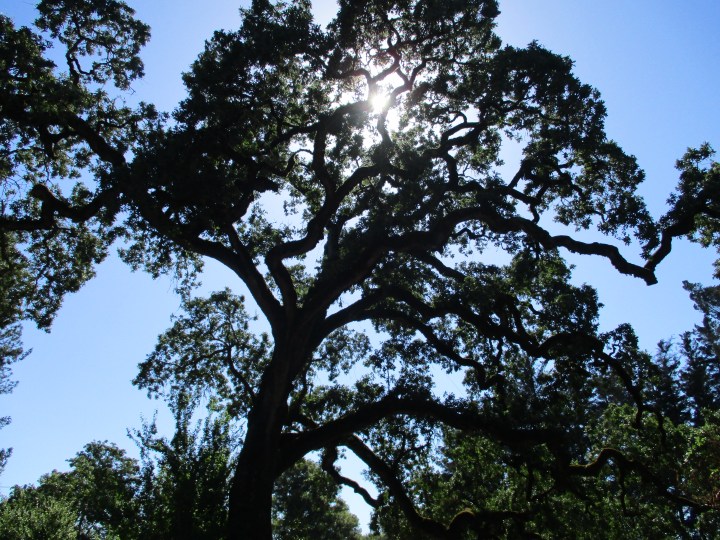 Valley Oak is so excellent that I had to get another picture of it from another angle. The first picture was looking about south toward the midday sun. This is looking almost to the east, perpendicularly to the other picture. The cars in the foreground are much closer than they seem to be. The trunk of the tree is significantly wider than it seems to be in relation to the cars.
 Garden Bloggers all over America and in other countries can share what is blooming in their gardens on the fifteenth of each month on “Garden Bloggers’ Bloom Day”, hosted by Carol Micheal’s May Dreams Garden at http://www.maydreamsgardens.com
Grapes And Vines Of Wrath
 Anyone can plant a grapevine. With a bit of work, almost anyone can make a grapevine grow. Most who put forth the effort can figure out how to prune and cultivate a grapevine. Yet, grapevines so often get very out of control. They easily escape confinement, overwhelm nearby plants, climb into trees and overburden their trellises or arbors. It is easy to forget how aggressive they can be.
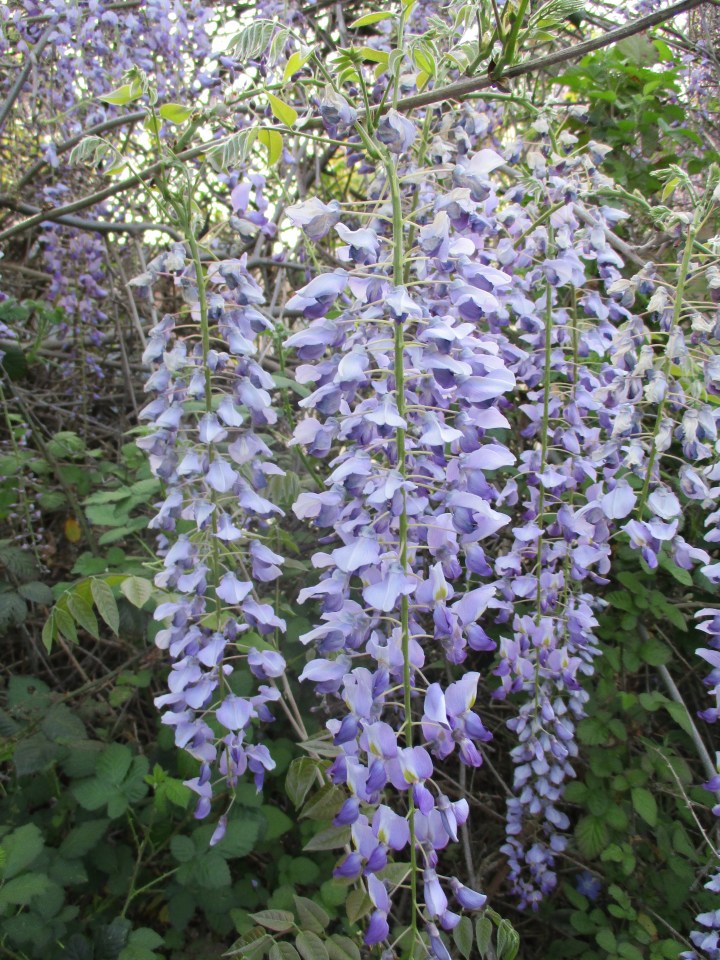
The primary problem with aggressive vines is that they require pruning for confinement. The most aggressive vines need the most aggressive pruning. Grapevines can actually be quite docile if pruned properly. Chinese wisteria and red trumpet vine need even more aggressive pruning, and will never be completely tamed. It is important to know the personality of each vine in the garden.
The secondary problem with aggressive vines is they are expected to conform to unrealistic confinement. Small trellises that are lower than about eight feet, including common gate arbors, spires and obelisks, are really only big enough to accommodate docile small vines like clematis (hybrid), American wisteria, well pruned mandevilla and vining annuals like morning glory and pole bean.
Chinese wisteria, large types of bougainvillea and other big and heavy vines need big and stout trellises or arbors. Lattice will not do. Chinese wisteria becomes entangled with lattice, and then crushes it as the vines expand. Bougainvillea does the same to a lesser extent, but then pulls the lattice apart as the intertwined vines sag from the increasing weight of foliage and growing vines.
Clinging vines like creeping fig and Boston ivy present another problem. They are not interested in trellises or arbors. They do not grab onto support by twining stems or tendrils. They instead cling directly to surfaces with specialized aerial roots that damage paint, stucco or even bare wood fences. Clinging vines should therefore only be allowed to climb surfaces that they will not ruin, such as concrete walls. They are better vines for freeway soundwalls than for home gardens.
 Tony Tomeo