
The majority of common pollinators are not impressed with blue. Otherwise, more flowers would be blue. After all, floral color appeals to pollinators. Each type of pollinator prefers specific colors. Plants customize their floral color to their preferred pollinators. If more flowers could attract more pollinators with blue, they would do so. Instead, they rely on colors that have worked well for them.
Green is actually the most common floral color. It is not obviously common because green flowers are generally ignored. They are the sort that rely on wind for pollination, so make little or no effort to draw attention. They are also the sort that produce the most and worst pollen, which gets carried farthest by the wind. Flowers that rely on pollinators produce coarser pollen that clings to things.
Of the many other colors that appeal to pollinators, most are significantly more complex than they appear. For example, what appears to be simple orange may appeal to pollinators that perceive it to be yellow, as well as those that are drawn to red, even if none are interested in orange. Different pollinators perceive different color ranges. Insects do not perceive red; but hummingbirds do.
That certainly could not explain why blue is such an uncommon color for flowers. It surely has more of a following than red, which is more common among flowers. Since most pollinators perceive blue, more flowers should utilize it. They could even add some ultraviolet or infrared to it, if that would make it more appealing. Nonetheless, true blue, without the influence of purple, is quite rare.
Lily-of-the-Nile and blue dawn flower are some of the more substantial species that provide exquisitely blue bloom. A few cultivars of butterfly bush bloom true blue too, but the color is not so clear and bright. Delphinium, bellflower, squill and grape hyacinth are smaller, but worthy perennials for the richest blues. Petunias, lobelia, nigella, cornflower and columbine are blue blooming annuals.
Many iris, sage and lupine provide exquisitely true blue bloom as well.
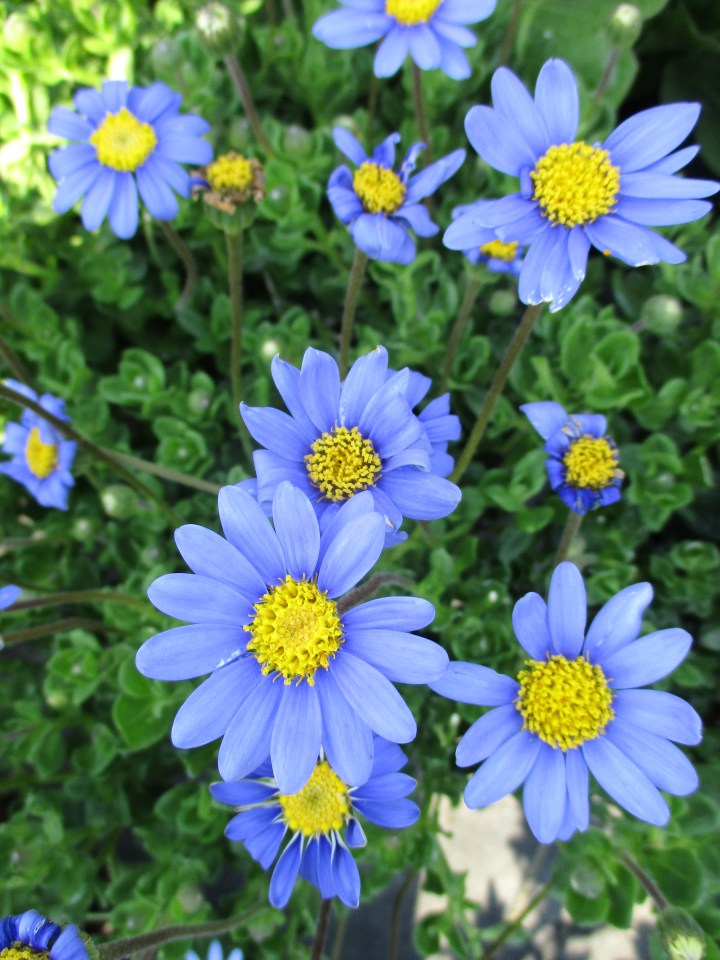 Most blue flowers are blushed with purple to some degree. Except for lily of the Nile, true blue flowers are quite uncommon. Even with their yellow centers, the tiny daisy flowers of blue marguerite, Felicia amelloides, seem to be too blue to be real. They are almost expected to fade to lavender. Bloom may not be as full as it was a month ago, but continues as long as the weather is warm.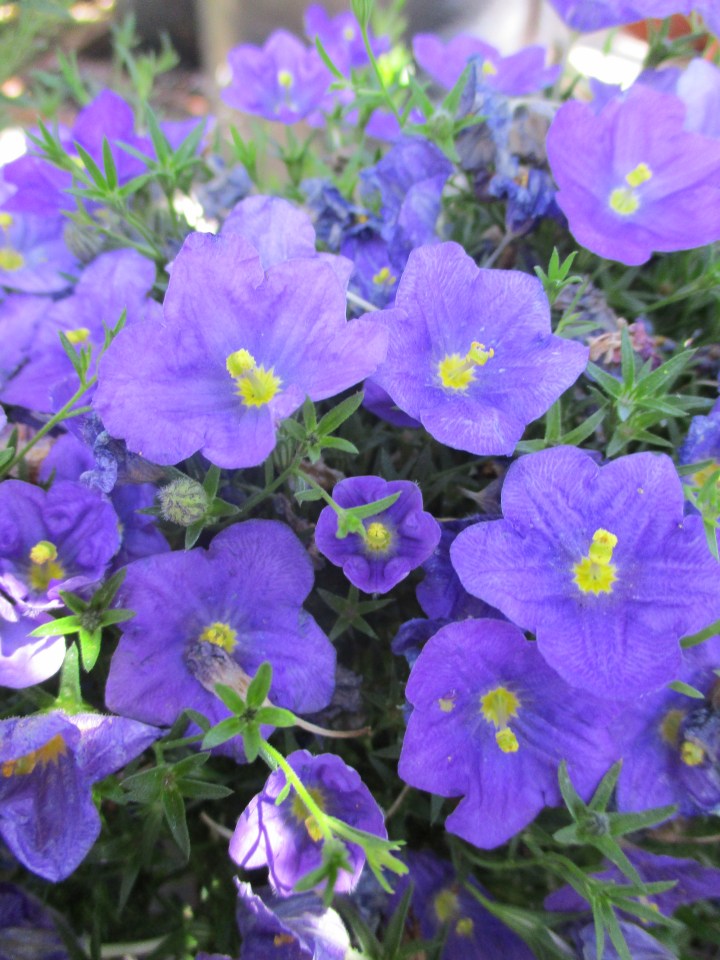
 This one is no fun to handle. It is just as prickly as it looks. Yet, it is the spiny foliage and blooms that make ‘Big Blue’ sea holly, Eryngium X zabelii ‘Big Blue’, so appealing. The knobby blue thistle flowers are centered on prominently flaring grayish blue bracts that look like metallic snowflakes. The intricately lobed grayish foliage contrasts splendidly with just about any darker green foliage.
 The delightfully clear sky blue flowers of blue plumbago, Plumbago auriculata, seem like they belong with colorful annuals or in a tailored border of colorfully blooming perennials. However, the rampant canes of mature plants are really best in the background where they have room to grow wild. The canes do not climb like vines, but can flop over other shrubbery as high as fifteen feet.
 Most of the brachyscome found in nurseries nowadays are the annual Brachyscome iberidifolia. Perennial species are rare. The name is still often spelled as ‘brachycome’, without the ‘s’, as it had been spelled for decades. Although it is a warm season annual, brachyscome is also popular now because it can bloom better through the locally mild winters than the warmth of mid summer.
 Like euryops daisy, sweet pea shrub and New Zealand tea tree, the blue hibiscus, Alyogyne huegelii, blooms whenever it wants to, even if it wants to bloom sporadically through winter. It should bloom more abundantly in phases though spring and summer, but even that is difficult to predict. The three inch wide flowers are lavender blue, but can be rich purple or white. Pink is very rare.
 Tony Tomeo