Hybrids Of The Botanical Nature

Fancy gladiolus are products of hybridization.

Botanical nomenclature has gotten sloppy. So has breeding. Hybrids of different species are now common. Their botanical names often lack proper species designation. Instead, their names include only their genus names with their variety or cultivar names. This can seem simpler. However, it complicates the simplicity of binomial botanical nomenclature.

Interspecific hybrids involved different species of the same genus. Therefore, any genus name is the same as that of both parents. An “X” precedes its species name to indicate it as an interspecific hybrid. Its species name is as new and unique as the new hybrid. Any cultivar or variety name follows its species name in single quotes. it is all quite sensible.

Intergeneric hybrids involved different genera. Therefore, an “X” precedes a genus name of an intergeneric hybrid to designate it as such. Its entire name is as new and unique as the hybrid. Like for all botanical names, both its genus and species names are italicized. This designates them as ‘Latin’ names. Variety and cultivar names lack such italicization.

Many hybrids are naturally sterile. Most that can produce viable seed are not true to type. In other words, their progeny is very different from them, and commonly of inferior quality. Most hybrids are therefore cultivars, or cultivated varieties. They are reliant on unnatural cultivation for perpetuation. However, some naturally perpetuate vegetatively, like canna.

Tree ivy, X Fatshedera lizei, is an example of an intergeneric hybrid. The “X” in its name precedes its genus name. London plane, Platanus X acerifolia, is an interspecific hybrid. The “X” precedes its species name. Platanus X acerifolia ‘Liberty’ is a cultivar of London plane. Its species name remains, which is proper with botanical nomenclature of hybrids.

Rhododendron and rose hybrids violate nomenclature rules because of their breeding. It is too extensive for their species to be identifiable. For them, the abbreviation “spp.” may substitute for a species name. It is for “species pluralis”, which means “multiple species”. Although it is Latin, it is not italicized. Nor are their more important cultivar names after it.
Undoing of Fragrance

Extensive breeding can compromise floral fragrance.

As I enjoy good friends and cheap coffee out on the deck, I am also savoring the sweet fragrance of the abundant white bloom of the black locust off in the distance. I know that black locust is a noxious weed that invades riparian environments; but they smell so good on such pleasantly warm spring days. Modern varieties are certainly better behaved and more colorful with their pink to purplish flowers, but their fragrance does not compare so well.

Earlier here on the deck, one of my friends and I discussed how modern Buicks are much safer than old classic Buicks are, but are not quite as elegant and stylish. It made me think of how decades ago, modern roses were developed for flower size, form, color and stem length, but in the process, were deprived of, among other qualities, their fragrance. Perhaps I would have been more attentive to my friend if the coffee were as potent as the fragrance of the black locust.

Modern varieties of many classic flowers are less fragrant than their ancestors were. This is because decades (and centuries) ago, fragrance generally had not been prioritized in breeding as much as were other physical characteristics, such as flower size, form, color and so on. The plants that were consequently used for breeding typically had the most visually appealing flowers, but lacked fragrance. Such disparity is actually quite natural among plants with variable flowers.

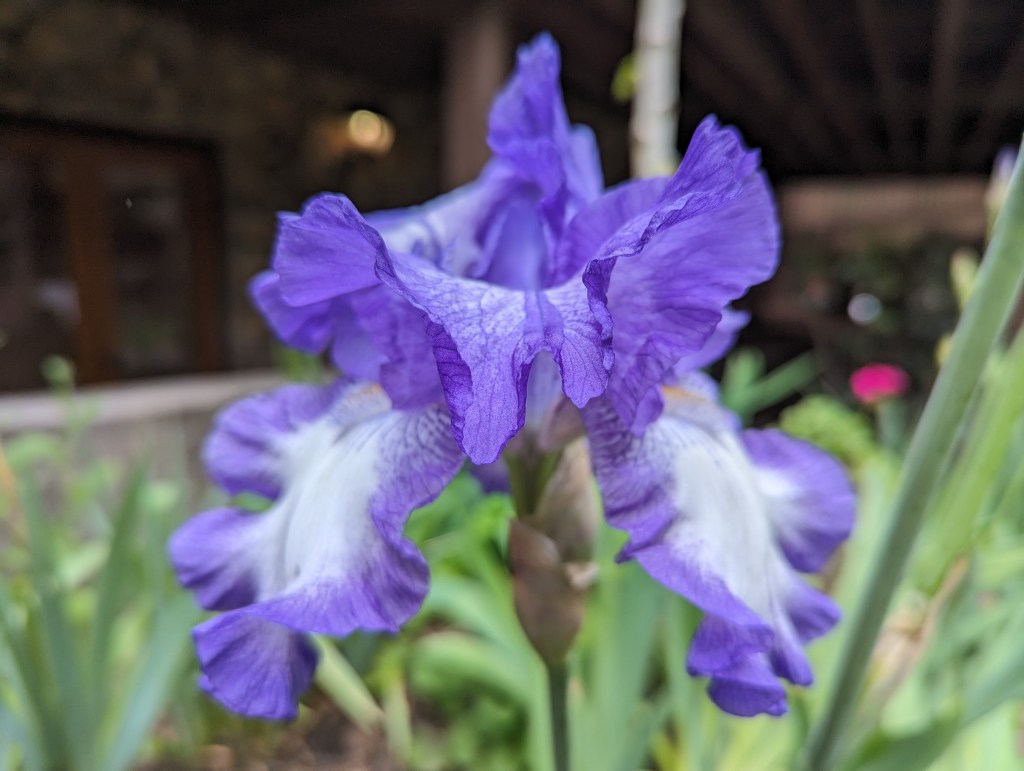
For example, most bearded iris that naturally have the biggest, fanciest and most brightly colored flowers are also the least fragrant. Their progeny that have become the modern varieties are just as flashy, and also, just as deficient of fragrance. Conversely, the relatively small and simple pale purple flowers of my favorite ‘Grandma Sheppard’ bearded iris are remarkably fragrant.

To the iris, this is all quite sensible. Their fragrance is not designed to impress us, but is merely intended to attract pollinators. If they are fragrant enough to entice the insects that bring them pollen, they do not need to waste any more effort on visual appeal. Without fragrance though, they can alternatively use color (including infrared and ultraviolet) to direct insect traffic where they need it to go in order to accomplish pollination. Almost all of the many varieties of iris prefer to specialize in one or the other; either fragrance or visual characteristics, but not both.

So many of the old classics seem to have lost some or most of their fragrance as they have ‘improved’ over the years because visual appeal has been prioritized more than fragrance. Besides flowering locusts, roses and iris, some types of honeysuckle, mock orange, sweet pea, violet, hyacinth, lily and even narcissus are less fragrant than their ancestors were. However, traditional as well as modern fragrant roses and iris seem to be gaining popularity. Fortunately, gardenia, lilac, wisteria, stock and the fragrant types of angel’s trumpet and jasmine are probably as potent as they have ever been because they have not been tampered with as much.

Dual Citizenship

As brightly colorful as Persian buttercup is, I still prefer white.

French peony Persian buttercup was added to one of our landscapes last year. They are not two different perennials, such as French peony and Persian buttercup. They are a group of cultivars of one species, Ranunculus asiaticus ‘French Peony’. Ranunculus asiaticus is the species of Persian buttercup. ‘French Peony’ is its cultivar.

So, is it French or Persian? Well, yes.

Ranunculus asiaticus, Persian buttercup is native to Southwestern Asia, Southeastern Europe, Northeastern Africa and elsewhere within the Mediterranean Region. This range could potentially include the Southern Coast of France within the Mediterranean Region, but much more likely includes Persia within Southwestern Asia. My guess would be that Persian buttercup is as Persian as its name says it is.

‘French Peony’ is a group of cultivars that could have been developed anywhere and given an appealing name that promotes its marketability, but was most likely developed in France, where most breeding of this particular species was done. My guess would be that ‘French Peony’ is as French as its name says it is.

Of course, French peony Persian buttercup could have been developed anywhere, even Persia, and merely given its appealing French name without actually being French. Alternatively, it could have been developed completely in France, from Ranunculus asiaticus from the Southern Coast of France, without actually being Persian. For that matter, it could have been developed in Greece from Greek stock.

To me, French peony Persian buttercup seems to be chicly cosmopolitan. I remember it as popular for urban window boxes within the greatest cities of the World, such as San Jose, Oakland and San Francisco. If I had not seen that it is also popular in Reno and Portland, I would consider it to be as Californian as so many other exotic species and varieties that are popular here.

These would be nice for Ronald McDonald’s garden.

Daylily

Each flower lasts about a day.

Each flower lasts for only a day. That is why the common name of Hemerocallis is simply daylily. Each floral stalk provides several flowers that bloom continually for several days. As one flower deteriorates, another replaces it. Because floral stalks shed so continually, they are not very practical as cut flowers. They are splendidly colorful in gardens though.

Most popular daylily cultivars are products of breeding that is too extensive to document. That is why almost all lack species names. Their cultivars names generally suffice. Most daylilies bloom for a month or so. Also, most bloom best for early summer. A few bloom a bit earlier. Some bloom as late as autumn. Some can bloom randomly or twice annually.

Daylily bloom can be yellow, orange, red, pink, almost purplish or combinations of these. Yellow or pink can be so pale that it seems to be almost white. Flowers can stand as tall as three feet, on bare stem. Their arching grassy foliage stays somewhat lower, in dense mounds. Most cultivars are evergreen. Some are deciduous. They propagate by division. Some migrate by vigorous stolons.

Horridculture – Half-Breed

70726thumbCher explained a long time ago that a half-breed is nothing to brag about. Some of us just don’t get it. A few clients still introduce me to their weirdly bred stone fruit trees as if they are both justification for great pride, as well as something that a professional horticulturist of the Santa Clara Valley has not already encountered a few thousand times. I at least try to act impressed.

The stone fruits that grew in the orchards of the Santa Clara Valley half a century ago were the best. That is why they were grown here. The climate and soil were ideal for their production. Traditional cultivars produced so abundantly and reliably that there was no need to breed new cultivars. The quality was exemplary. Consequently, only a few were actually developed here.

Half-breeds, or weird breeds of any unnatural ratio, started to be developed more than a century ago. A few happened incidentally where different species of the same genus of Prunus grew. They were enjoyed as novelties for home gardens, but were not sufficiently productive or reliable for orchard production. Their fruit was for fresh eating only, since it did not dry or can well.

Now that the orchards are gone, and the only stone fruits in the Santa Clara Valley are in home gardens, these weird half-breeds and others are becoming more popular. Nurseries will soon be stocking several along with their incoming bare root stock. There is certainly nothing wrong with them. However, they are not necessarily any better than their well bred ancestors either.

Apricot, cherry, nectarine, peach, plum and prune, as well as almond, are the traditional stone fruits, of the genus Prunus. (Almonds are the seeds or ‘stones’ of a stone fruit that does not get eaten, but instead gets discarded as a hull.) There are many cultivars of each. Some can be canned. Prunes and some apricots can be dried. There is no need for more, or for ‘improvement’.

Pluot, plumcot, aprium, apriplum, nectaplum, peacotum, pluerry and others like them are the weird interspecific hybrids (which are hybrids of two or more species within the same genus, which for these examples is ‘Prunus‘). Some are half-breeds. Some are breeds of different ratios, such as a half-breed with a half-breed parent, or a half-breed grandparent. It is confusing!

It is also an unjustifiable fad. There are more disadvantages to these weirdly bred stone-fruits than there are advantages. They really don’t get the best of both parents, but might get half of each. Again, there is certainly nothing wrong with that. There are those who legitimately prefer such hybrids. The point is that fads are not necessarily good, and many are just plain weird.

Horridculture – Fruity Fads

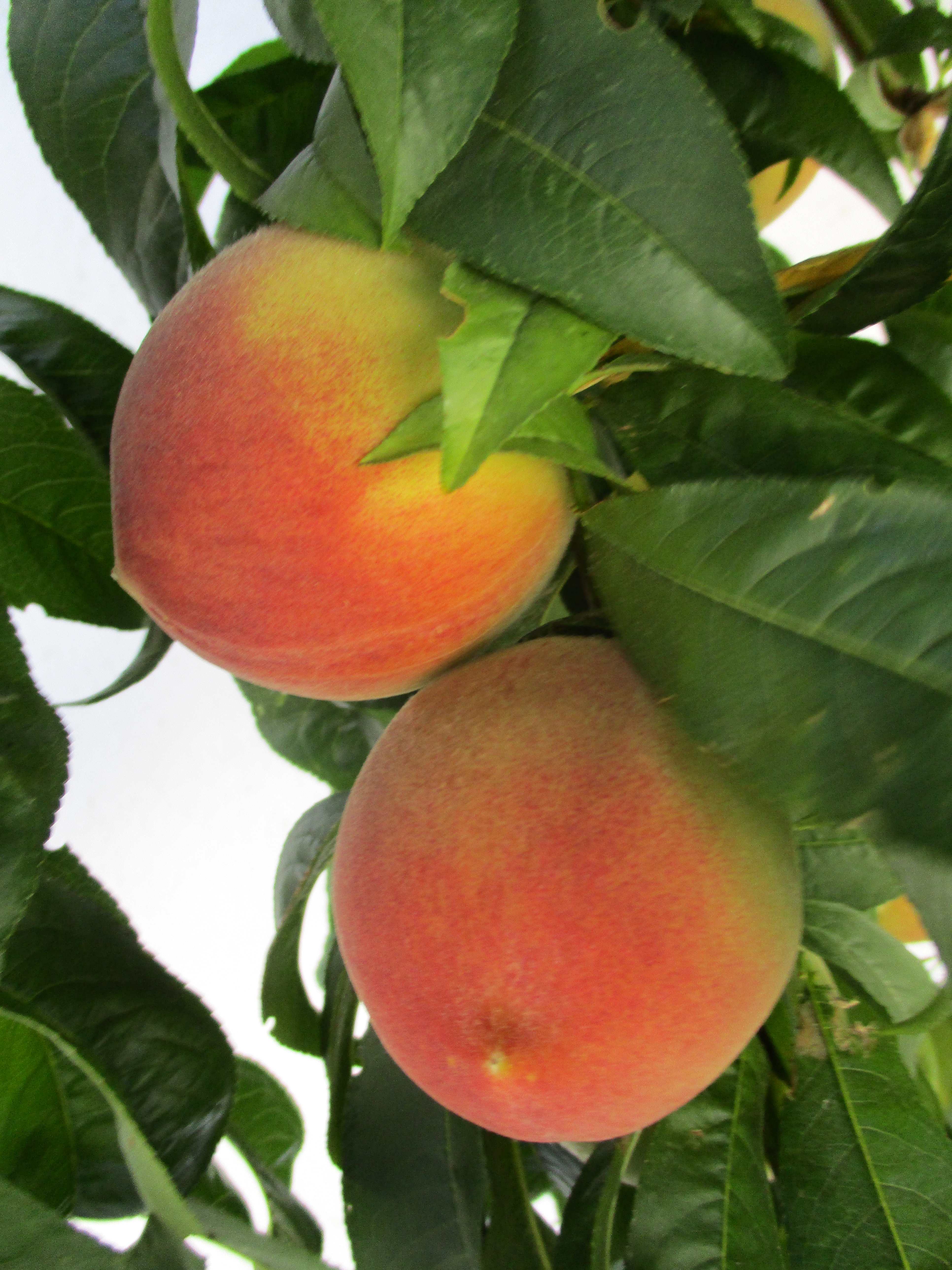
90417Pluots, plumcots, apriums and peacharines! Who comes up with this stuff?! Aren’t good old fashioned plums, apricots, peaches and nectarines good enough? Who decides that these weird hybrids are somehow better than their parents? Some of them are actually quite weird, or downright ugly. Several do not even look like they would taste good. It may be an acquired taste; but I have all the good taste that I need without acquiring any more.
Some old classic cultivars (cultivated varieties) of fruit were develop centuries ago. More have been evolving from those ancestors since then. Some were intentionally bred from parents with desirable qualities. Others just grew incidentally where their seed fell, and were found to be somehow better than their parents. Some were merely discovered as natural occurring mutants, and perpetuated for their superior qualities. It is a slow process.
So, putting two different kinds of fruits together, or finding an aberration of a single type of fruit, is nothing new. Tangelos were created by hybridizing Mandarin oranges with pomelos or grapefruits. Ever-bearing ‘Eureka’ lemon was perpetuated from a mutant of the seasonally bearing ‘Lisbon’ lemon. This is how cultivars evolve and develop. Generally, newer cultivars become popular because they are somehow superior to their ancestors.
Yes, somehow ‘superior’ to their ancestors. Who decided that a hideous hybrid of a plum and an apricot was somehow better than either a perfectly good plum or apricot? Furthermore, what evidence was there for such a weird claim? Even farthermore (if that is a word) how and why do so many people believe this evidence?
I was still growing citrus (trees not fruit) back in the early 1990s when the ‘Cara Cara’ pink orange was popularized. Yeah, a ‘pink’ ‘orange’. It is really just a pink mutant of the formerly more popular ‘Washington’ navel orange. We could not grow enough of it. It was just too popular. Some people really seem to believe that it is somehow better than ‘Washington’ and other navel oranges. I can’t argue. They certainly know what they like.
To me, it has a milder flavor than ‘Washington’. Yes, it tastes about as bland as it looks; pink.90320thumb

Horridculture – Bad Seed

P80317+California poppies are like no other wildflower. They are so perfectly bright orange, and look almost synthetically uniform in profusion, as if painted onto coastal plains and hillsides. They may be a bit more yellowish in some regions, or a bit deeper orange in others, but they are always bright and strikingly uniform.
Genetic variation is naturally very rare. I can remember hiking with my Pa up to the (lesser known) Portola Monument in the hills behind Montara, and finding a few pale white poppies, and even fewer pale purple poppies. It was like finding four leaf clovers! Genetic variants among California poppies are not quite as rare as four leaf clovers are, but finding a few of both white and purple was really strange. I never found a pink one though.
Nowadays, poppies can bloom in all sorts of shades and hues or orange, yellow, red, pink and soft purple, as well as creamy white. Some bloom with fluffy double flowers. Of course, all this variety is not natural. California poppies were bred to do this.
The potential problem with such breeding is that California poppy is naturally very prolific with seed. Any of these weirdly bred varieties could escape into the wild and interbreed with wild poppies, causing them to be more variable, and interfere with the ecosystem.
The problem is not just with California poppies. Many plants get bred extensively enough to interfere with how they behave in the wild if they happen to escape cultivation.
Fortunately for California poppies, the weird new varieties do not really get very far in the wild. The are not true-to-type, so revert back to their original bright orange in just a few generations, even without outside influence. If pollinators do not recognize their unfamiliar color and form, they are less likely to get pollinated to continue to tamper with the ecology. In fact, wild California poppies still have the advantage in that regard.
This yellow California poppy with an orange center is a second generation seedling, and is already halfway between the original yellow variety, and the wild orange.

Horridculture – Promiscuity


71206Nomenclature of the botanical sort was so much simpler back when we studied it back in the 1980s. It was intended to be like that. It was how the various specie of plants were identified and classified. There were certain rules that simply made sense. After ‘family’, plants were classified into general ‘genera’, and then further classified into specific ‘specie’. Some specie were further classified into ‘varieties’ and ‘cultivars’. (Cultivars are simply ‘cultivated varieties’ that need to be perpetuated by cloning because they are too genetically unstable to be true-to-type from seed.)

The genus name is always first. The species name is always second. Because they are Latin, they should be italicized. Any variety or cultivar names are last, not italicized, and in semi-quotations.

Back in the 1980s, there were a few specie that did not quite fit into such neat classification. Intergeneric hybrids (between two parents of different genera) were designated by an ‘X’ before the genus name, such as X Fatshedera lizei, which is a hybrid between Fatsia japonica and Hedera helix. Interspecific hybrids (between twp parents of different specie) were designated by an ‘X’ before the species name, such as Platanus X acerifolia, which is a hybrid between two different specie of the same genus of Platanus. Then there are different species that hybridize freely, but are still designated as separate specie, such as Washingtonia robusta and Washingtonia filifera, but that is another story.

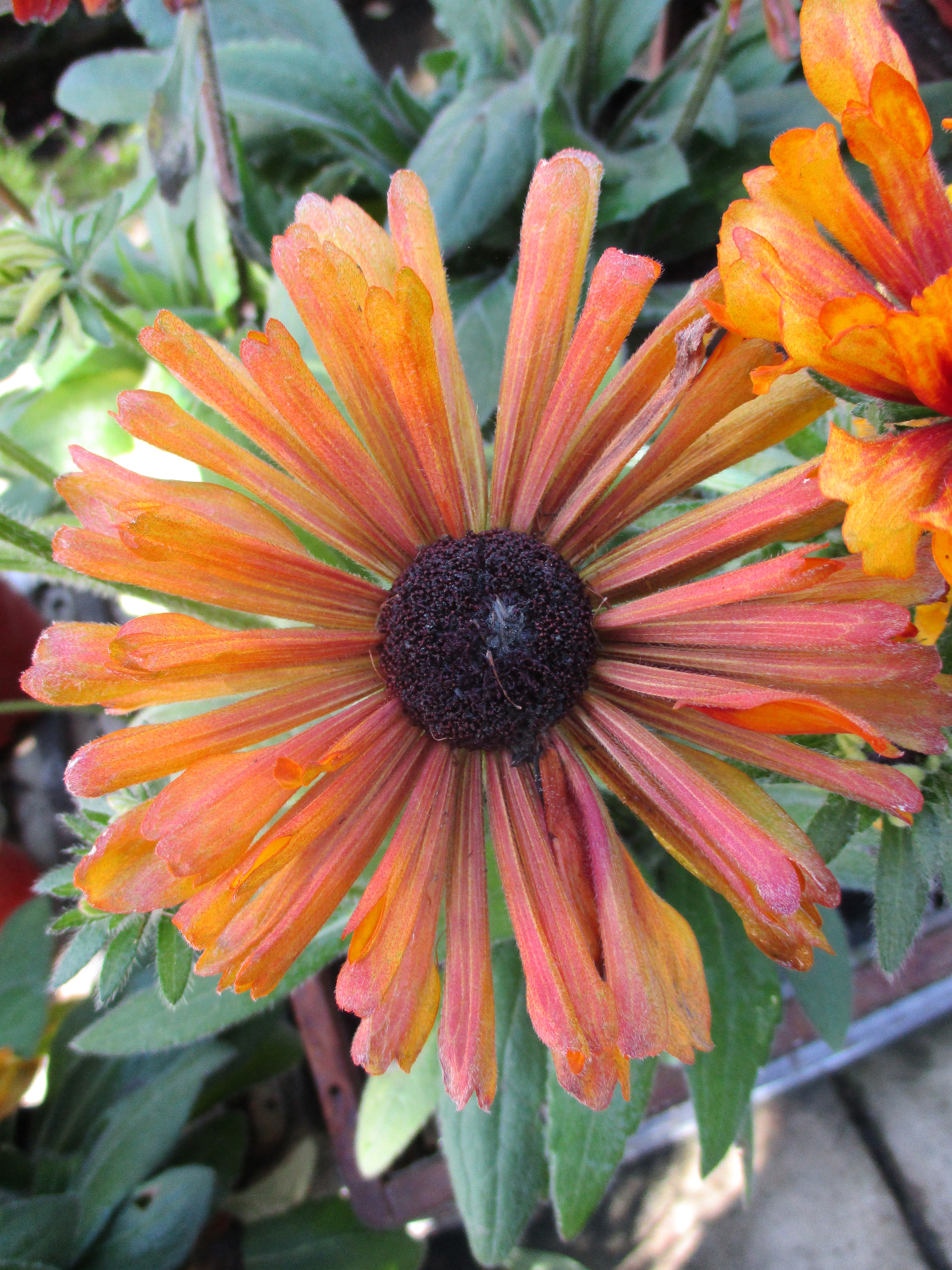
Nowadays, with so much weirdly promiscuous breeding, it is difficult to know what specie or even genera some of the modern varieties and cultivars fit into. Consequently, species names are often omitted, and genus names are sometimes changed. It is getting difficult to know the differences between the two formerly distinct genera of Gaillardia and Rudbekia.

What is even sillier is that all this is happening while ‘sustainability’ and gardening for ‘bees’ are such fads. Weirdly bred specie . . . or whatever they are, are likely unable produce viable seed, so are just the opposite of sustainable. They only sustain their own marketability by ensuring the need for replacement. Some make no pollen for the bees that visit the flowers expecting to find some. Some make pollen of questionable nutritional value, or serve it in complicated flowers that might be difficult for bees to navigate.

There certainly are advantages to simplicity.71129

Apologies for the delay of posting ‘Horridculture’, which is normally posted on Wednesday. I was unable to write, so advanced the article that was intended for today to Wednesday, and finished writing this rant for today.