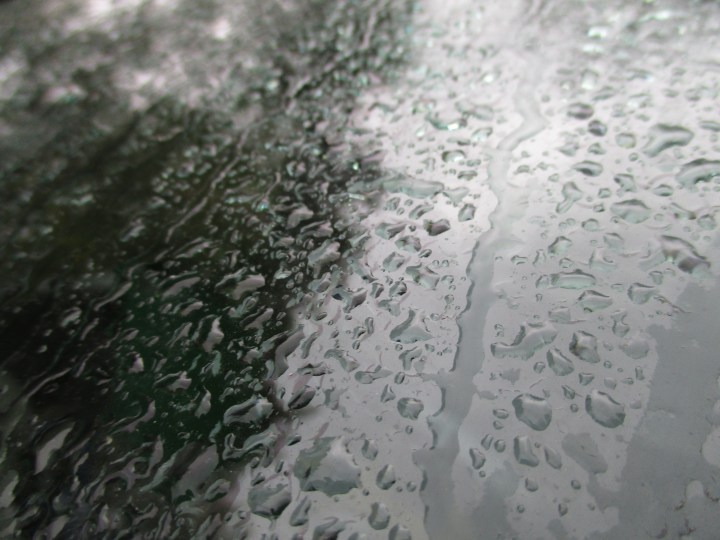
 Most of us here agree that the minimal bit of precipitation that fell from the sky on Thursday was not real rain. There are a few different theories about what it actually was though. It could be considered to have been drizzle. It alternatively could have been heavy fog or mist. Some of us make up silly names for what it was, such as fine rain, dusting, spritzes, sprinkles or mizzle.
Is it just me, or do those last three sound like inane kitten names? ‘Dusting’, sounds dirty and dry, which it was not.
Whatever it was, it was the second occurrence of such precipitation since the rainy season ended last spring. Something similar happened on the last day of September. I wrote about it in my other blog, with a picture of it on the hood of a parked car, rather than the windshield. I think it was more of a surprise then because it was earlier, and the chance of precipitation was slim.
This weather pattern is still within what would be considered normal here. The rainy season typically starts a bit earlier, even if with just a single primary storm passing through, followed by a long pause before more follow. There is no strict schedule though. We know that the rain will eventually start, and that rainy seasons that start late tend to provide significantly more rain.
Rain is likely just as uncomfortable here as it is everywhere else. Perhaps it is even dirtier, because it rinses off dust and crud that has been accumulating since spring. No one wants to work in their garden while it is wet. Nonetheless, because there is no rain for nearly half the year, the first storm of a season is something to be celebrated. The forecast predicts no celebration yet.
 The climate here is pretty cool, at least in winter. Right now, it is pleasantly warm. It does not often get uncomfortably cold or hot, and when it does, it does not stay like that for too long. In between the warmest days of summer, the nights typically cool off nicely. In between the coolest nights of winter, the days typically warm up nicely. Humidity is normally minimal. Rain is adequate in season.
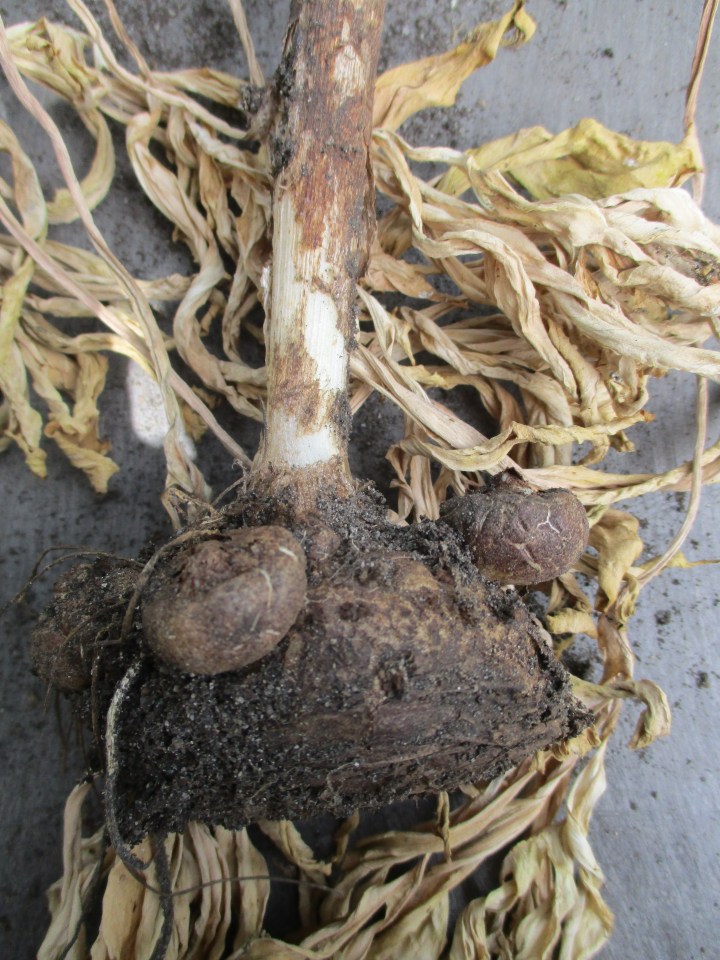 California buckeye, Aesculus californica, is an enigma. How does it survive while defoliated for so much of the year? Not all are so mysterious. Those that live in sheltered or forested situations behave like normal deciduous trees, by defoliating in autumn, and refoliating in spring, after a brief winter dormancy. Those that are more exposed in warm and windy situations make us wonder.

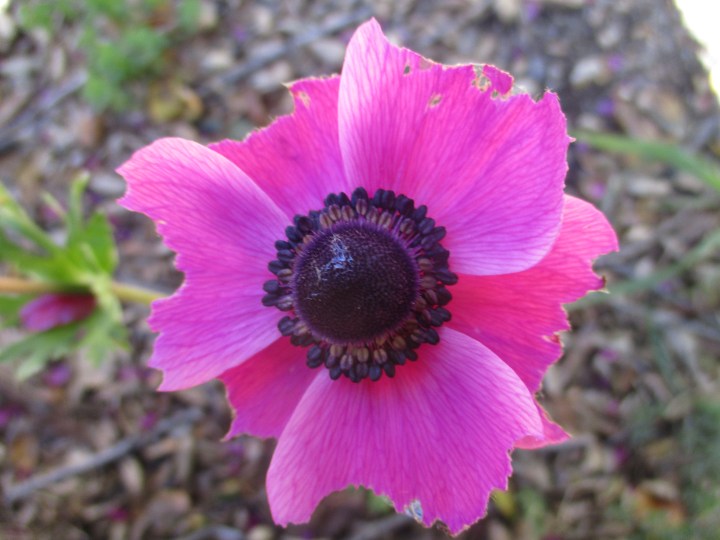 This really is something that I did not expect to see. It may not look like much. It is just a raspy anemone with bites taken out of it, blooming later than it should. What is so impressive about it is that it was not planted here last year. It was planted during the previous year, then bloomed on time last year, and then died back like anemones normally do. I did not plant it, of course. It is in a planter where volunteers contribute whatever they like.
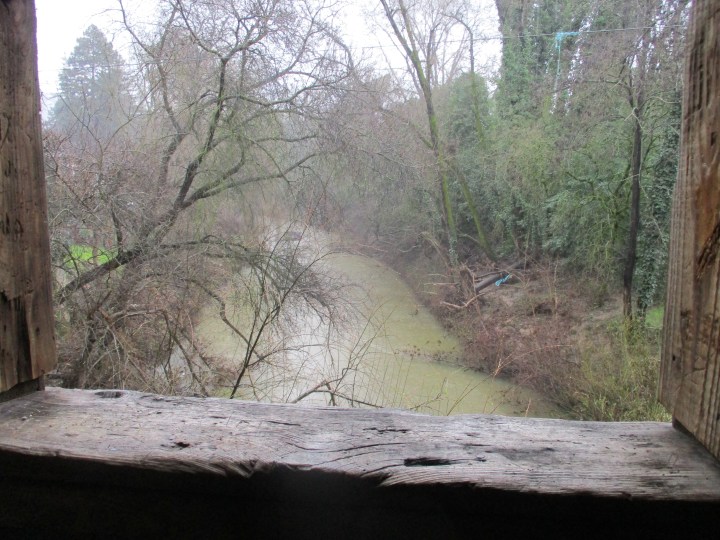 It may not look like much, but before all the rain started, the San Lorenzo river was shallow enough here to walk across. The water was clear and barely flowing. It is impossible to guess how deep it is now. It looks like cafe au lait, and is certainly flowing better than it had been. The watershed is less than a hundred and fifty square miles, so all this water is not coming from very far away.
 What is this? It looks more like hail now. It was softer and squishier when it fell out of the sky only an hour or so before this picture was taken. There was a slight bit of snow up on Summit above Los Gatos. It will probably melt as quickly as the clouds clear to let the sunlight through. Snow sometimes appears on the higher peaks around the region, but is rare in lower elevations. Forty three years ago from today, on February 5 in 1976, snow fell in the Santa Clara Valley. It was about half an inch deep in some areas, an inch and a half in others, and was the last snow to fall there.
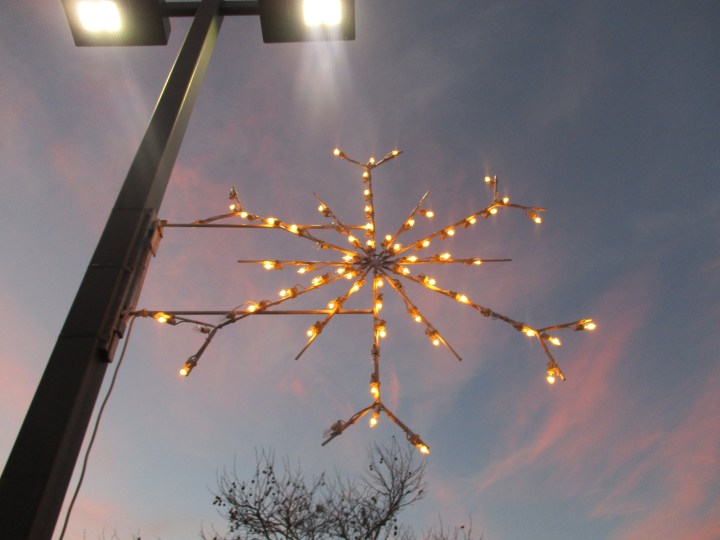 It was one of the more common types of snow in the Santa Clara Valley in the early 1970s.
 We are now two days into it. Is it any different than three days ago, the last day of autumn? Not really. Even in harsher climates, the changes from one season to the next are gradual. Like the phases of the moon, the seasons are constantly phasing out of the previous, and into the next. The dates of the first and last days of each season, which are determined by the position of the Earth within its orbit around the sun, are technicalities.
 Red sky at morning; sailor take warning. Stormy weather is to be expected.
 Tony Tomeo