 We do not get much frost here. This picture of the view through the windshield of one of the work vehicles was taken more than a week ago, while the humidity and the temperatures were still quite low. The sparse and angular pattern of the frost on the windshield is a result of the minimal humidity. There will be more frost later in winter, although there will not be nearly as much as most other climates get.
After a cool Monday morning last week, the weather got a bit warmer, or really just less cool. Rain started about midnight between Tuesday and Wednesday, and continued through the day and into the night. More rain is predicted to start after noon next Tuesday, and continue through Thursday. There will be no frost during this weather pattern. Frost happens here only between rainy weather. One might think that since we do not get much rain, there would be plenty of time in between for frost. Really though, much of our winter weather is simply quite pleasant, neither rainy nor frosty.
As appealing as this might be to those in harsher climates, it has certain disadvantages.
So far, there was just enough chill to start defoliation of the black locusts and box elders in the background of the picture, and just enough rain to almost finish it. Trees that need more of a chill to start this process are not so impressed with the weather. Many of the crape myrtles have not even started to color yet. Cottonwoods are starting to defoliate, but are doing so while still only dingy greenish yellow because they did not get enough chill for better color.
Spring bulbs that got planted earlier or are being planted about now will bloom next spring because they were so optimal and primed to do so before they were planted. However, many will not get enough chill in their second winter to bloom again. Consequently, many of the bulbs that would be perennial in other climates are grown as expensive annuals here. Likewise, seed of certain specie that self sow may not get enough chill through winter to germinate next spring.
So again, what is comfortable for us is not so ideal for everything in the garden.
Neither Here Nor There
 Is it coming or going? Autumn that is. It normally gets here last. We are typically only beginning to see the first foliar color of autumn while other parts of America get their first snow. We typically get a few more tomatoes out of our vegetable gardens long after most everyone else has pulled out their frosted tomato plants.
Well, we still got it. Tomatoes that is. The plant that produces these bright orange cherry tomatoes is looking a bit tired and pale, but the tomatoes are as good as ever. It probably will not last until frost. The plant might get pulled out when the tomatoes run out. Without bloom, that could be pretty soon. Frost does not happen until well into winter. Regardless, tired tomato plants say that autumn is coming.
We got foliar color too. This Japanese maple turned this nice garnet red quite some time ago. Sweetgum trees all over town are also well colored. They seem to be ahead of schedule, as if winter is on the way. Defoliating black oak trees say that autumn is going.
While the days are still pleasantly warm, with temperatures into the 80s, the nights get cool enough to color deciduous foliage. Warm days are quite normal for this time of year. So are cool nights. However, the two typically do not happen together for more than a few days. Warm days typically alternate with mild nights. Cool nights typically alternate with cool days.
Well, even in our mild climate, the weather is always full of surprises. We will enjoy it while it lasts. Autumn has always been a mere in-between season anyway. In the chaparral and desert climates of California, winter and the rain that comes with it will be welcome when they arrive.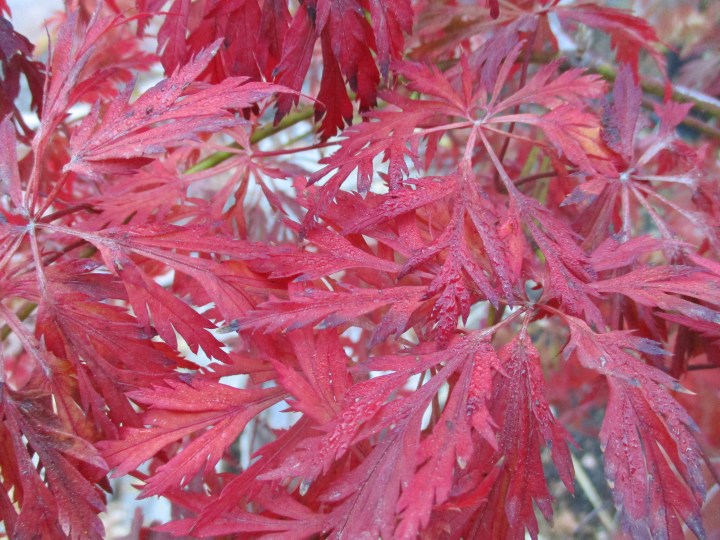
Indian Summer Is The Norm
 The popular definition of ‘Indian summer’ suggests that it is unseasonably warm and dry weather in spring or autumn, and that it typically happens after frost. Well, that definition just does not work here. It makes about as much sense as our so-called drought, which is actually the normal weather for our chaparral climate. Weather that repeats annually is neither unseasonable nor abnormal.
There are certainly years with more or less rain, and years with warmer or cooler weather in late summer and early autumn. Weather is naturally variable. It does not work like the thermostats in our homes, or the automated irrigation systems in our gardens. It is impossible to predict precisely how this summer will end, but it will likely have some characteristics of a normal Indian summer.
The one characteristic of the popular definition of Indian summer that will be notably absent is frost. That will not happen until after autumn. Locally, Indian summer can either be what seems to be a continuation of summer weather, or a resumption of warm summery weather after a bit of cooler weather. The main difference from earlier warm weather is that the nights are significantly cooler.
That is more important than it sounds. We do not notice the cooler nights as much as the plants that are outside all night do. While the days are as warm as they had been, some deciduous plants will begin to defoliate. Eventually, those that get colorful in autumn will begin to do so. Roses can be fertilized one last time, but even as they continue to bloom, they should not be fertilized again.
Indian summer prolongs the summer growing season significantly, but also has the potential to interfere with the winter growing season. Warm days keep warm season vegetables and flowering annuals performing so nicely that we do not want to remove them to relinquish their space for the cool season plants that will be needing it soon! In other climates, frost ends the summer season for us, and necessitates the transition to cool season crops. Indian summer can be too much of a good thing.
Horridculture – Drought
 It is a way of life in much of California. Many of us grew up with it, or at least believing in it. Many of us never heard the end of it. That is how it lost its meaning.
Drought is a weather condition. It might last one year or a few. Drought can even continue for several years. For us, it entails less than normal rainfall through winter, only because winter is when rain is supposed to fall here.
As a weather condition, drought is not permanent. There have been a many during the past few centuries of recorded history here, and a few of those have been in just the last half century that I can remember. They happen frequently enough that I can not remember the exact years that were drought years, although I can remember a significant drought in the middle of the 1970s. No drought lasts forever.
If drought lasts forever, or at least as long as anyone can remember, then it is not a weather condition, so is therefore not really a drought. It is ‘climate’.
The climate of much of California is naturally arid. San Jose and the entire Santa Clara Valley have a ‘chaparral’ climate, which is classified as ‘semi-arid’. Some areas near the base of the Santa Cruz Mountains get only about a foot of rainfall annually. Los Angles and the region around it in Southern California have a ‘desert’ climate, which is ‘arid’. Parts of the Mojave Desert get less annual rainfall than other climates get from a single storm.
Although droughts happen here, the limited availability of water is due to the natural climate, not weather. Those who came to California a long time ago knew how to use what was available. The problem now is that there are simply too many people wanting too much of a naturally limited supply of water. Way too many expect way too much.
Horridculture – DEATH
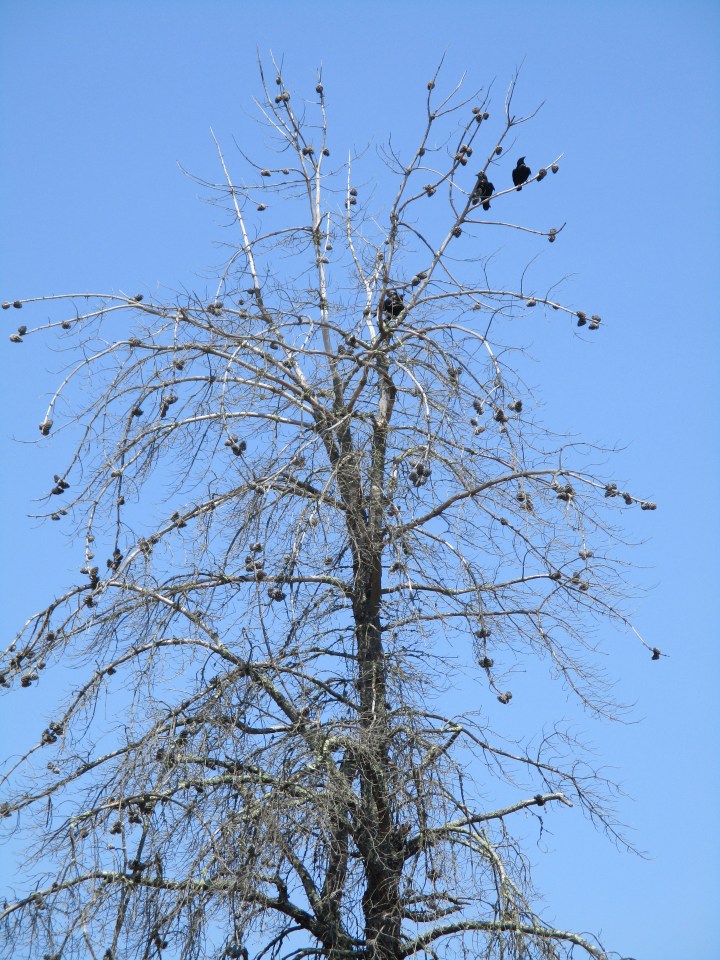 It is quite natural. Death, I mean. Every living thing does it at one time or another. Even the oldest bristlecone pines that live for thousands of years eventually do it. The Monterey pine in this picture did it quite efficiently. The three crows perched on top make it look extra dead. You know, not merely dead, but very dead. If this tree were in my own garden, I would be totally saddened by its death, but there is nothing that I could do about it.
The smaller dark objects suspended in the now dead limbs are pine cones. Monterey pine starts to produce pine cones at a young age, and of course, produces more with age and increasing size. As mature trees begin to deteriorate, they produce even more cones as they concentrate their resources into seed production for the next generation. This elderly tree knew that death was imminent. After all, death is natural.
Compared to other trees that are native to the neighborhood, such as valley oaks that live for centuries, and coastal redwoods that live for thousands of years, Monterey pines are ‘short-lived’. They live only a century or so, and may not live half that long in urban situations, particularly in more arid climates. They are endemic to the Monterey Peninsula, where they live within an ecosystem that, prior to urban development, naturally burned at least every century or so, before they got to be too old. In fact, their natural life cycle was directly relevant to how combustible the forests were, and how efficiently fires spread through them; but that is another topic.
The main concern here is that death is natural. The tree in this picture died a natural death. It can not be blamed on global warming, climate change, big industry, the President that we all seem to hate even though enough of us voted for him to become president, or my old car that, after almost half a century, is still not a hybrid. We can complain about death all we want, but we can never stop it.
Upgrade Today
 This is it; the big day. I will delay it no longer. I said that I would upgrade quite some time ago, but had not yet done so. https://tonytomeo.wordpress.com/2018/06/24/upgrade/
Will this upgrade improve anything? I really do not know. I tried to do a bit of research in regard to the advantages of an upgrade, and could find very little of the information that I was looking for. It seems to me that upgrading will initiate more work for me, but will not necessarily make my articles more accessible or appealing. I will need to make improvements to the presentation of my articles on my own. Upgrading makes these improvements possible, but does not execute improvements without my efforts and direction. Nor does it change the content to improve accuracy for a broader audience. My articles will still be half a year late-or-early for Australia and all other places in the Southern Hemisphere. Harsh summer heat and winter cold will still be topics that will be lacking merely because the climate here lacks such variables. Upgrading can do only so much.
After my minimal research, I determined that the most efficient means by which to determine if an upgrade would be beneficial is to try it.
Something should be done. The newspaper group that I started writing for nearly twenty years ago no longer features my gardening column. Other newspapers that feature it only do so occasionally. Some do it monthly. Some do it when space is available. One of the larger newspapers features it weekly, but only for their online version. It is not easy to justify writing my articles if they are not being distributed like they had been.
By the time you read this, the upgrade will have been initiated. We will see what happens.

Krispy Kritter
 This really is the best climate here. Winters are just cool enough for many plants that require a bit of a chill, but not unpleasantly cold. Summers are just warm enough for most plants that need warmth, but the weather does not stay too unpleasantly hot for too long. Warm weather here typically lasts no more than a week, and is accompanied by light evening breezes and cooler nights. Minimal humidity typically makes the worst of the heat a bit more tolerable.
While much of North America and parts of Europe were experiencing abnormally and uncomfortably warm weather earlier in summer, our weather somehow stayed relatively mild. For a while, it was significantly warmer in Portland than here. It certainly was nothing to complain about. Vegetable plants that crave warmth were not too inhibited by the mild weather. Flowers that typically deteriorate in warm and arid summer weather lasted a bit longer than expected.
Then the weather changed. It did not get too unseasonable warm. In fact, the weather merely did what is typical for this time of year. The problem was that it happened so suddenly. The weather went from pleasantly mild and somewhat humid, to more seasonably warm and arid overnight. Flowers faded and warm season annuals wanted for more water.
The worst of it was that exposed foliage of some plants got roasted. English laurel and rhododendron were particularly susceptible Because we had no way of anticipating the sudden change of weather, we had just shorn a large hedge of English laurel, just in time for the warm weather to cook the freshly exposed inner foliage.
At about the same time, new plants were being installed into a small newly landscaped area. The transition from the cool and comfortable nursery on the coast to the warm and arid landscape where they were surrounded by black groundcloth (prior to the installation of chips) was too much of a shock for some of them. We could not water them enough to prevent some of the foliage from desiccating.
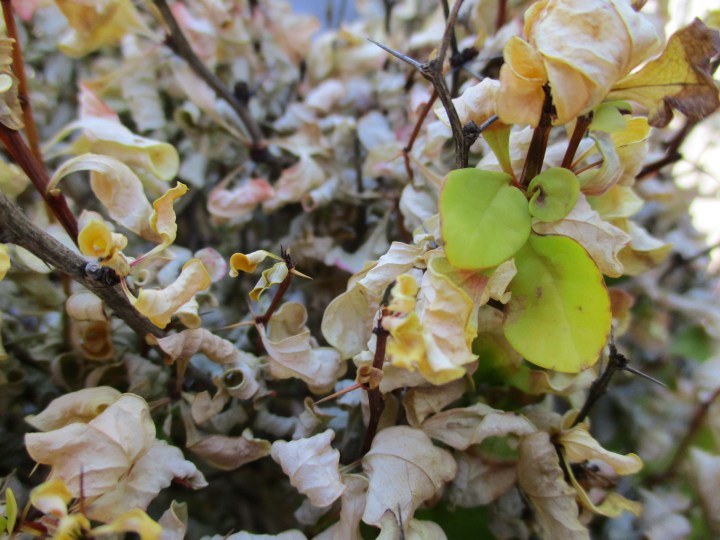
This crispy barberry is fortunately not as dead as it seems to be. Only the outer foliage is roasted. The stems and buds do not seem to be damaged. It will probably foliate again before defoliating in autumn. Even if it induces premature dormancy, it should recover as next winter ends.
Nonetheless, such damage on new plants is disconcerting.
Things Heat Up In Summer
 This does not seem like such a mild climate when it is difficult to distinguish between the time and the temperature on a local bank clock tower. You know; when punctuation is the only difference between four minutes past one, and one hundred four degrees. Fortunately, like mild frost in winter, hot weather does not happen too often, which is why this climate really is milder than most.
Most of us know what to do for the garden when the weather gets warmer. Obviously, many plants want more water. What we do not often consider is that there a few things that we should ‘not’ do. Unlike us, the plants in the garden can not find shade when the weather gets warm. Those that are exposed find creative ways to provide their own shade. We really do not want to mess with that.
By this time of year, outer foliage of exposed plants is mature enough to tolerate heat. Only foliage of plants that prefer to be partly shaded is likely to be damaged. However, inner foliage of even the toughest plants is not as resilient as outer foliage is. Simply shearing a hedge exposes inner foliage that can be scorched by overexposure. Sunlight enhances the effects of heat and aridity.
If possible, it is best to delay such pruning and shearing until after unusually hot weather. No one wants to be out working in the garden on a hot day anyway. More typical seasonable weather may not seem to be much cooler, but a few degrees can be a big difference to plants. Once exposed, inner foliage should adapt, and hopefully be resilient to heat before the weather gets hot again.
While young and thin, formerly shaded bark that suddenly becomes exposed can be damaged by sun scald. (Deciduous trees do not get scalded while defoliated in winter because the intensity of sunlight is diminished at that time of year.) Sun scald of bark is much more serious than foliar scorch because it kills bark, leaving open wounds on main limbs and trunks. Decay within these wounds compromises structural integrity, and can ruin otherwise healthy trees.
Although rare, spontaneous limb failure can occur in some trees during warm weather, particularly if humidity increases and breezes remain minimal. It sounds silly, but warmth accelerates vascular activity, possibly until foliage becomes too heavy for the limbs that support it. If limbs break, they can cause major disfigurement, and detrimentally expose bark of inner limbs and trunks.
Fiercely Local
There are two terms that I avoid using within the context of my writing:
1. SILICON VALLEY – The name of the main newspaper group that I had been writing for since 1998, almost twenty years ago, is the Silicon Valley Community Newspapers. As much as I enjoyed writing for the small local newspapers of the group, I hate the name. I find the term ‘Silicon Valley’ to be offensive. It exemplifies that which destroyed the idyllic culture and lifestyle of the Santa Clara Valley, which is also known as the Valley of Heart’s Delight. I have never written the term until now.
2. BLOG – It is the contraction of ‘web log’. The ‘log’ in ‘blog’ is not what bother me. It implies a chronological journal, perhaps documenting experiences that are relevant to a designated topic. It is the ‘b’, or more specifically, the ‘web’ in ‘blog’ that is the problem. It implies that information posted on a ‘blog’ gets shared on the World Wide Web. The reason that I avoided sharing my gardening article on the World Wide Web for so long is that they are written very specifically for the Santa Clara Valley. Although some of them are rather universal to gardening, and some are relevant to regions with similar climates and soils, some are not relevant and perhaps inaccurate for other regions.
My gardening column started with the Silicon Valley Community Newspapers, which at that time was ‘fiercely local’. I always thought that was an odd term, but it makes sense. It means that each of the local newspapers features news that is relevant to their specified local communities. Los Gatos Weekly Times was for the news of Los Gatos. Saratoga News was for the news of Saratoga, and so on. When I started writing my gardening column, I wrote about gardening within our local climate and local soils. I could write about local gardening events and even the weather it it happened to be particularly relevant to gardening at the time.
As the gardening column was added to other newspapers in other regions, I was no longer able to write about local events or weather. I was very fortunate early on that all of the newspapers that used the column happened to be within the same climate zones. However, when it was added to the Canyon News of Beverly Hills (in the region of Los Angeles), and a bit later to the related San Francisco News, it became necessary to modify some of the articles to accommodate for differences of climate. Articles that were universally applicable needed no modification. However, those that were too specific to our local climate needed to be edited for the other two climates. For example, when writing about bare root fruit trees, I deleted discussion of apple and pear trees from the copy of the article that was sent to the Canyon News, and replaced it with discussion of bare root plants that are popular and appropriate in that particular region.
Over the years, I realized that my articles became too available online. Not only were they posted within the context of the online versions of the newspapers that had access to it, but they could be inadvertently opened from other related online newspaper . . . or just about anywhere. Someone in Oklahoma, Pennsylvania, Australia or anywhere in the World could click onto one of my articles just as easily as a local article, and could do so without knowing that it was written for a completely different climate or hemisphere!
I explain in my ‘About’ section that the articles are written for the Santa Clara Valley, but I doubt that means much to those who find the articled without seeing that explanation. I will continue to write my article for the newspapers that still use them, and will continue to post those articles, as well as ‘elaborations’ articles on my ‘blog’. Like so many other gardening articles that are out there nowadays, they will be inaccurate for some regions. Those reading them will need to use their own discretion.
What is sad about all this is that I started writing my garden column precisely because I was so frustrated with what was being published in the San Jose Mercury News at the time. It was typically written quite well, and by professional writers, but was very often very inaccurate because those writing it were either writing for other regions, or simply knew nothing about horticulture. I was so pleased with the opportunity to write accurate information about gardening for our region. Yet, after all these years, I feel like I am now doing exactly what I found to be so frustrating twenty years ago.
Na2CO3•NaHCO3•2H2O
 Trona
Trona
That is what this seemingly disorganized jumble of letters and numbers represents; the chemical formula for the mineral known as trona. It is what a certain small town in the very northwestern corner of San Bernardino County is named for. Trona is one of a few minerals mined and refined there. Apparently, not much else happens there.
Trona the town is about as out of the way as one can get in the contiguous United States of American. Death Valley to the northeast at least gets tourists. Not much flora survives in the hellish summer heat and caustically saline soil. The athletic field at Trona High School is famous for being grassless dirt. Even the now defunct golf course was dirt. Roofs are more important for providing shade than for keeping the four inches of annual rainfall out. A leaky house is more likely to petrify before it rots. The inertly arid air, roasting heat and acrid drifting minerals seems to sterilize and embalm even abandoned houses. The Google Satellite image shows how boringly uniform the factory tract houses are. Many are now abandoned. Some are missing.
Why am I mentioning Trona here? Because horticulture is so limited in Trona. There might not be many better places in America for a horticulturist who lives amongst dense forests of the tallest trees in the world to go on vacation! There are so few distractions! The vast desert extends for miles in every direction, with only a few plants surviving in home gardens in town. The satellite image shows how empty the gardens are. A single lawn can not be found. Even artificial turf is notably absent, perhaps because no one wants to go outside in such horrid weather.
I suppose that I will never know until I go there.
 Tony Tomeo