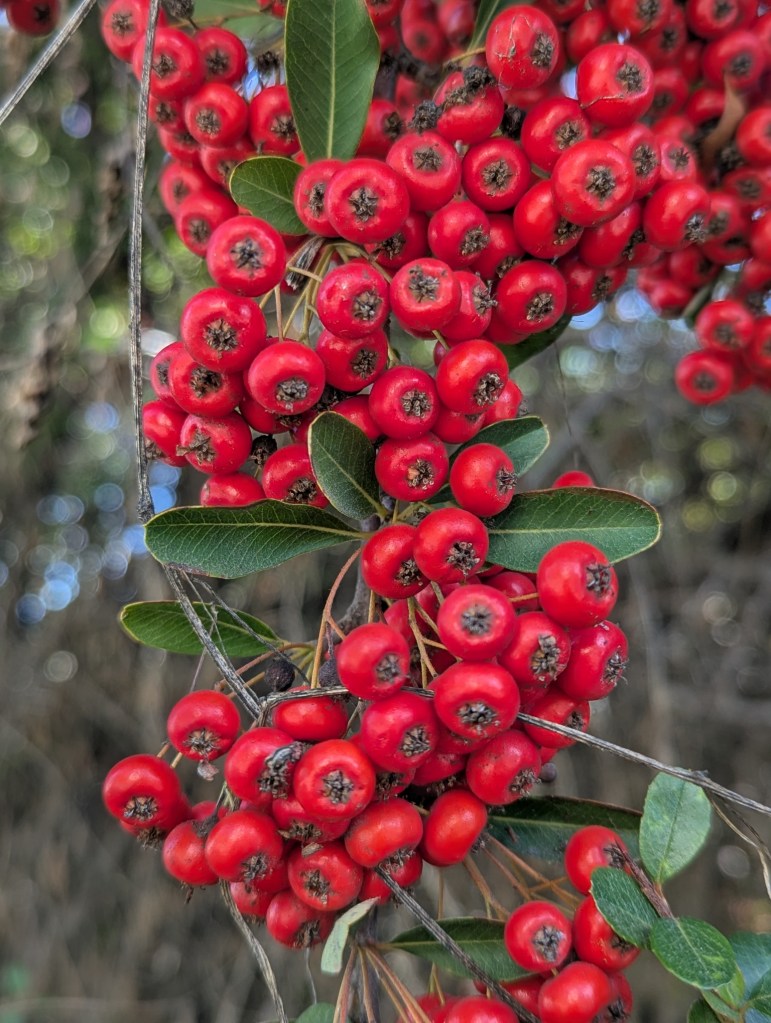
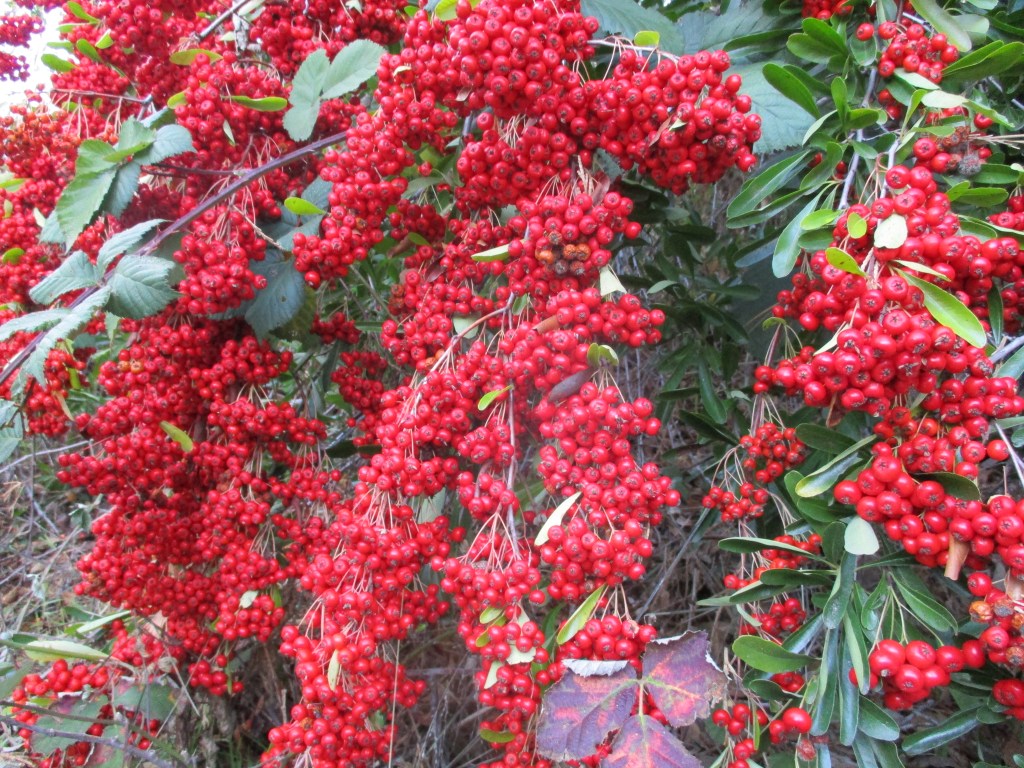
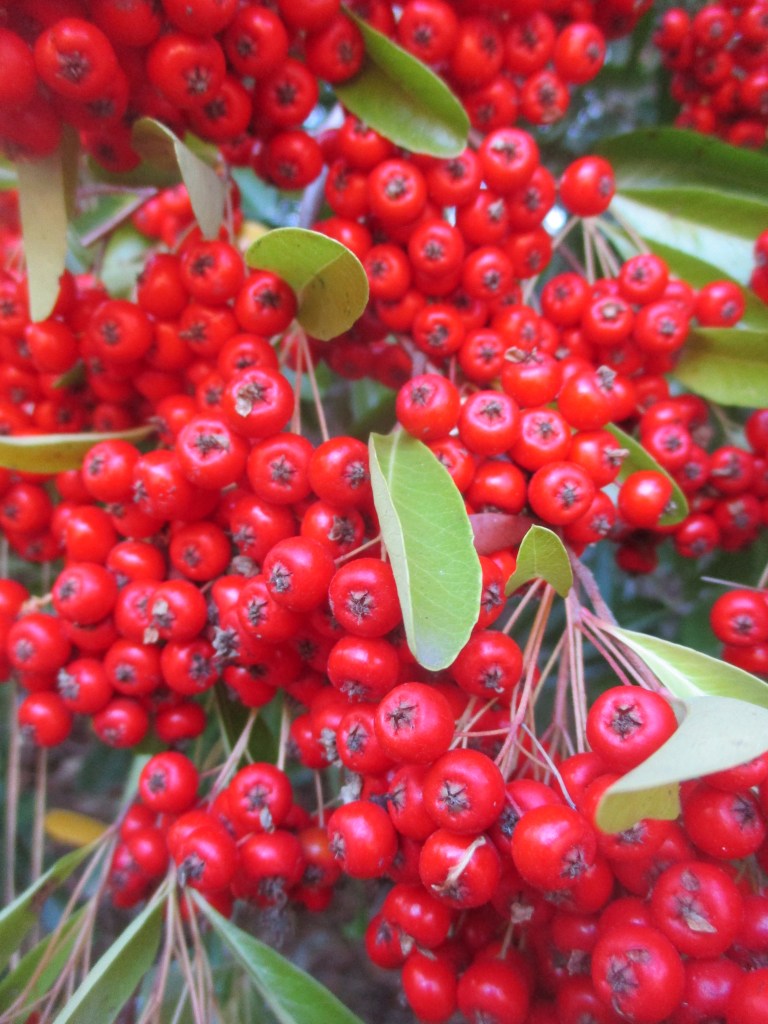
Nothing is lost in translation. The botanical name of Pyracantha coccinea literally means “Firethorn red”. Firethorn is its common name. It produces bright red berries on wickedly thorny stems. Some old-fashioned cultivars produce bright orange berries. Cultivars that produce bright yellow berries are now rare. Fruit ripens for migrating birds about autumn.
The thorns of firethorn are difficult to work with. However, they make a hedge of firethorn impenetrable. Frequent shearing deprives hedges of their natural form and some of their fruit. Selective pruning is tedious and likely painful, but retains more berries. Pyracantha needs sunny exposure, but is otherwise quite undemanding. It is susceptible to fireblight.
The most popular cultivars of firethorn can grow taller than eight feet. Taller cultivars that can grow twice as tall are uncommon. Sprawling types initially stay quite low, but without adequate pruning, form thickets. These same sprawling types are conducive to espaliers on fences and walls. Because pyracantha is difficult to work with, it should not be left to get unruly.
Six on Saturday is, as should be obvious, limited to six. Therefore, I omitted a few of the pictures of colorful berries that I took last week. The first of these three of the omissions is likely the most important, but was omitted because its berries are not quite as colorful as they will be as they ripen a bit later. The other two were omitted because they actually justify omission. I mean that they are nothing to brag about. However, I did not want to delete their pictures that they were polite enough to pose for without sharing them here.
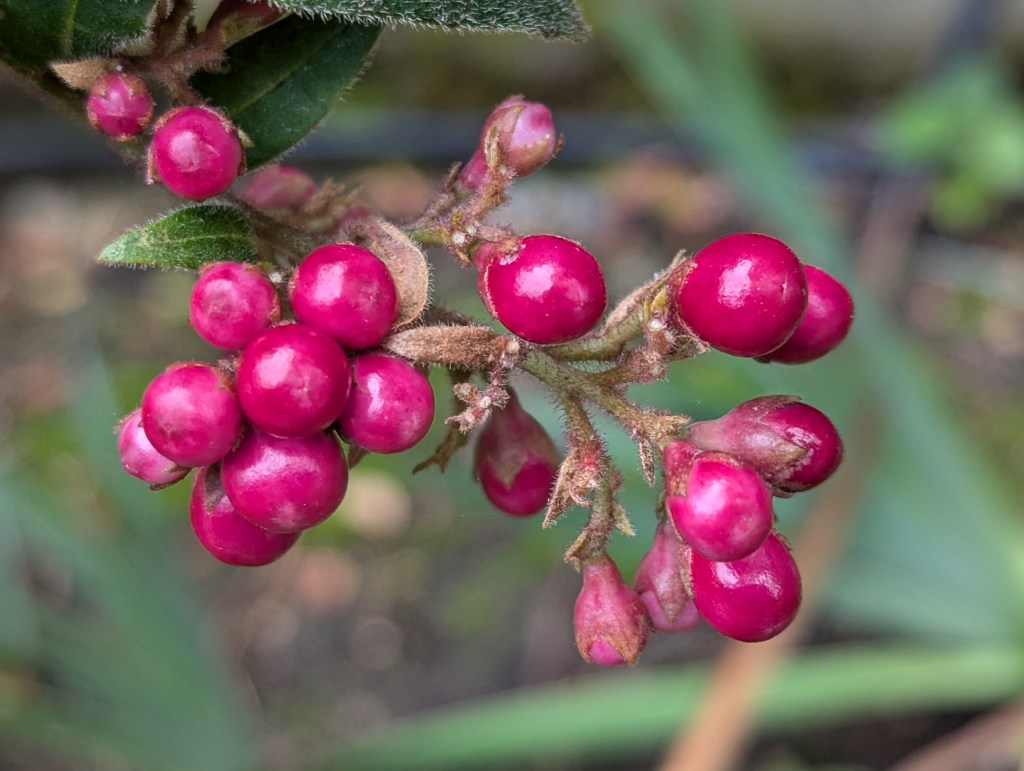
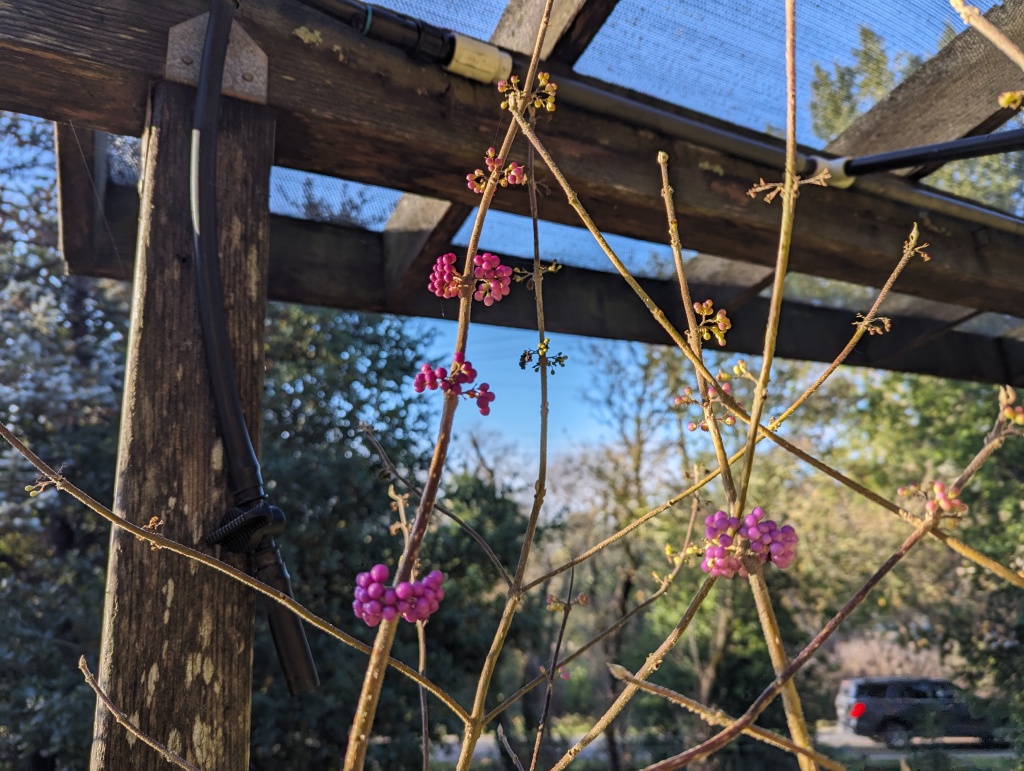
7. Callicarpa americana, American beautyberry was one of several gifts from Woodland Gnome of Our Forest Garden. I had never encountered it prior to its arrival, but wanted to grow it for years! These berries will soon ripen to a slightly purplish but bright bubble gum pink. Although I am typically not so keen on such bright color, I find their oddness to be very appealing. There is a white cultivar, and I do typically prefer white, but I want to grow the typical sort that grows wild within its natural range, rather than any cultivar.
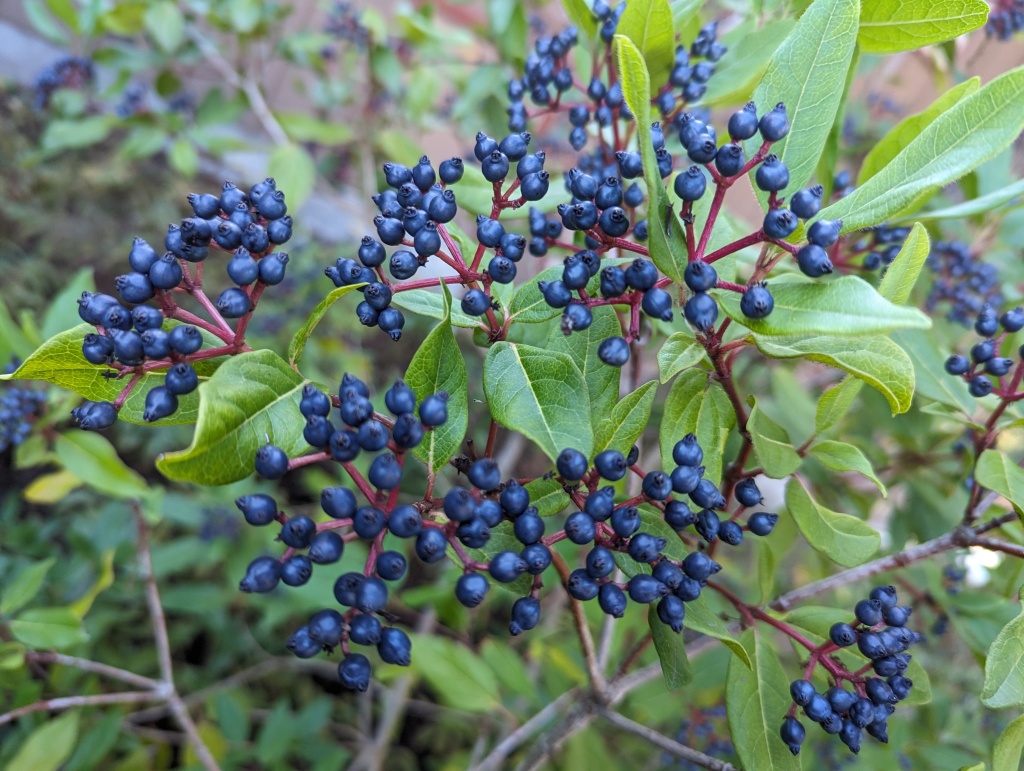
8. Viburnum tinus, laurustinus fails to impress me. I realize that it is popular elsewhere, and that I should learn to appreciate it, but nonetheless, its allure somehow escapes me.
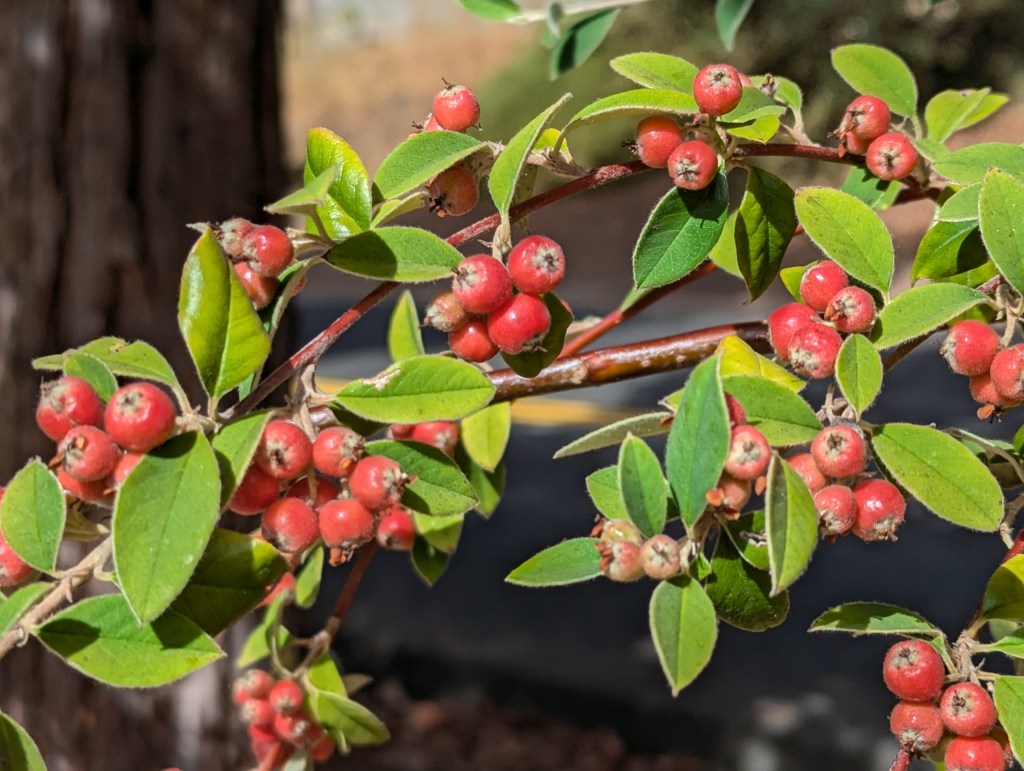
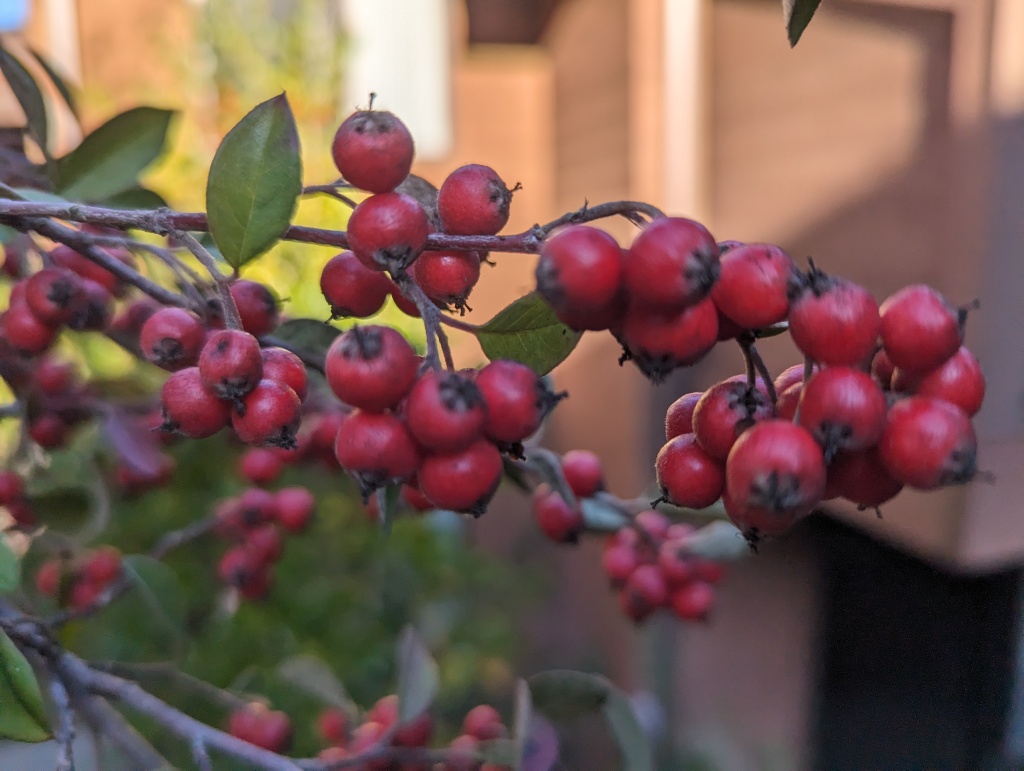
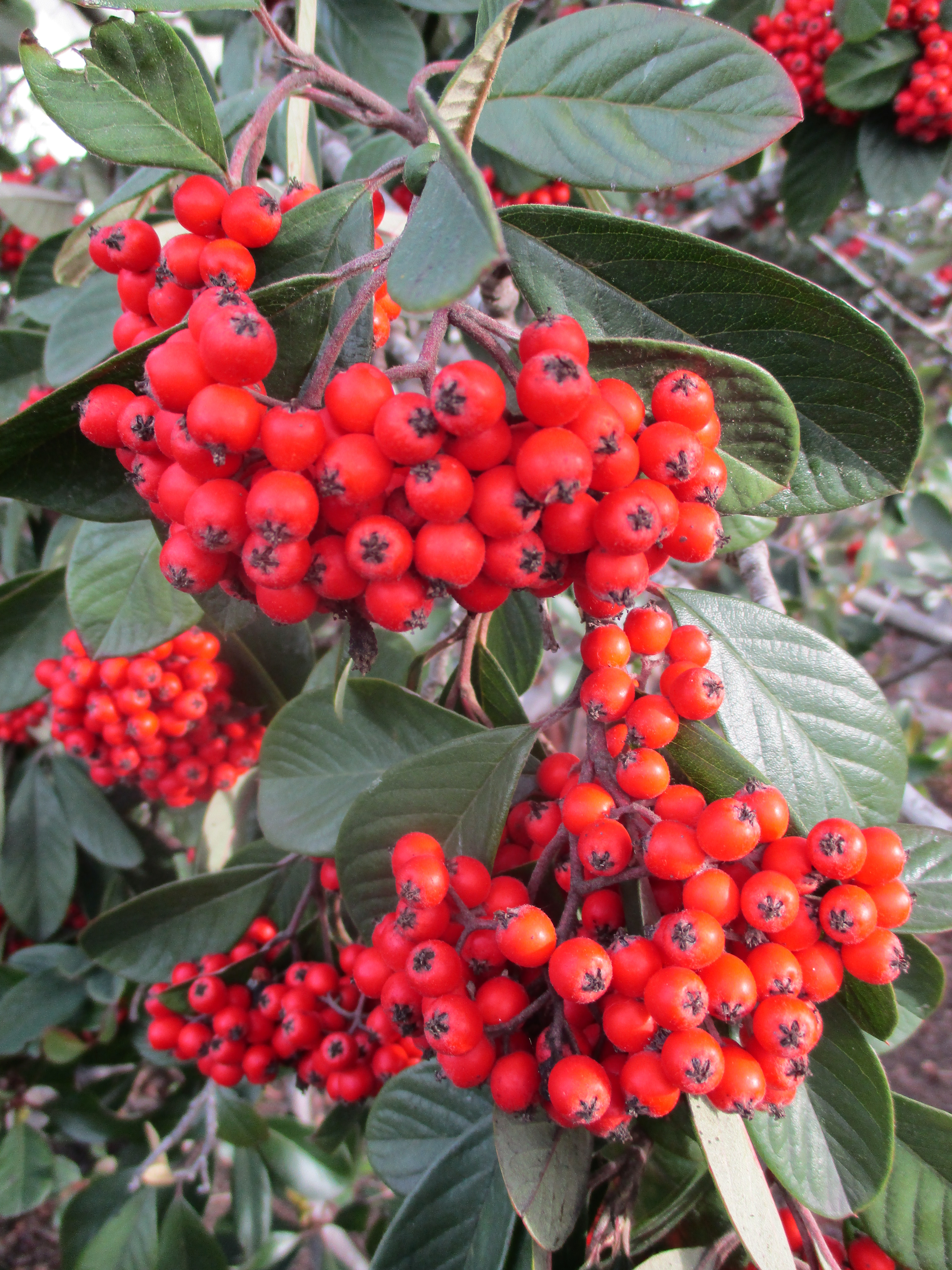
9. Cotoneaster pannosus, silver cotoneaster, to me, is even more unimpressive, perhaps because it is a weed locally. Berries are not colorful for long before turkeys destroy them. What is worse is that turkeys do not seem to eat the berries. They just shake them off the stems, and just leave them to decay on the ground. Berries that manage to ripen are not as vibrant red as firethorn berries, but are a somewhat grungy brownish or orangish red.
Brightly colored berries are ripening for both migrating and overwintering birds who are enjoying the abundance.
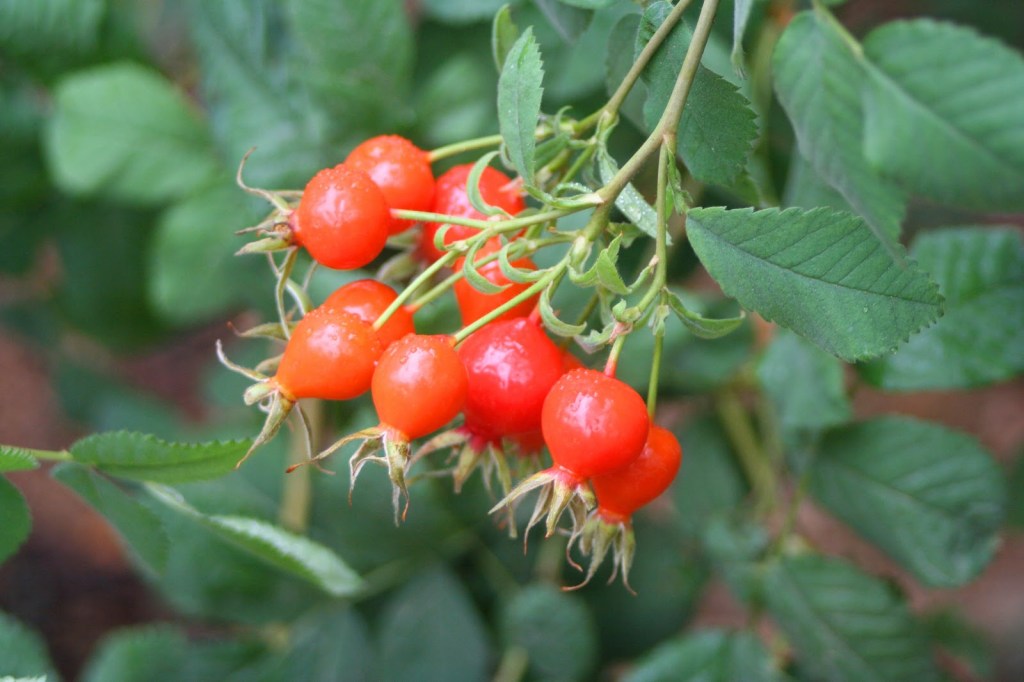
1. Rosa californica, California wild rose produces nice small hips, but then defends them within a thicket of very thorny canes. Birds have no problem flying in from above to take all they want. I get only what is left when it is time to cut the thicket down during winter.
2. Sambucus cerulea, blue elderberry is one of only two of these six that is designated as a berry by its common name, but is the only one of these six that is not a berry. Its fruits are drupes. Its jelly wins ribbons every time I bring it to compete at the Harvest Festival.
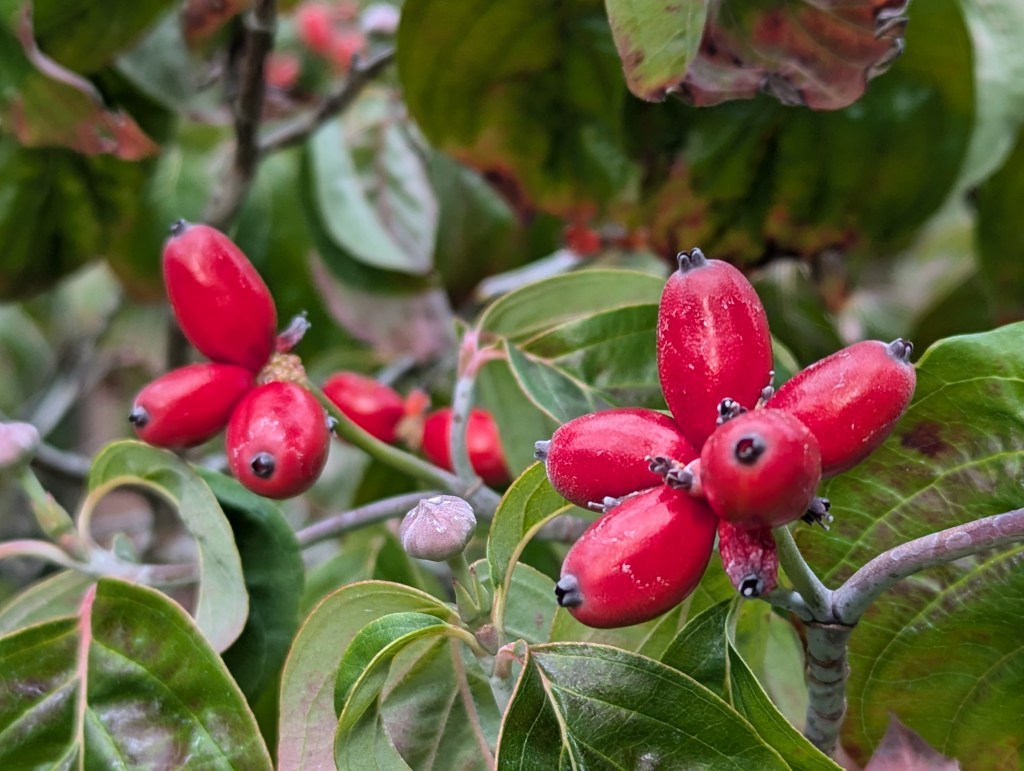
3. Cornus florida, flowering dogwood should stay almost fruitless. Yet, it produces more berries than the red flowering currant produces. It and the red cestrum are the only two of these six that are not native here. Rhody says it is dogwood because the ‘bark’ is ‘ruff’.
4. Ribes sanguineum, red flowering currant should produce more berries than flowering dogwood, but this is about as abundant as it gets. The berries do not even look appealing enough to collect. Their flavor is no more impressive than their oddly grayish blue color.
5. Cestrum fasciculatum ‘Newellii’ red cestrum berries are toxic, like those of snowberry and flowering dogwood. However, they are not toxic to birds who sometimes eat them as soon as they become colorful enough to be pretty. Birds can be pretty in the garden also.
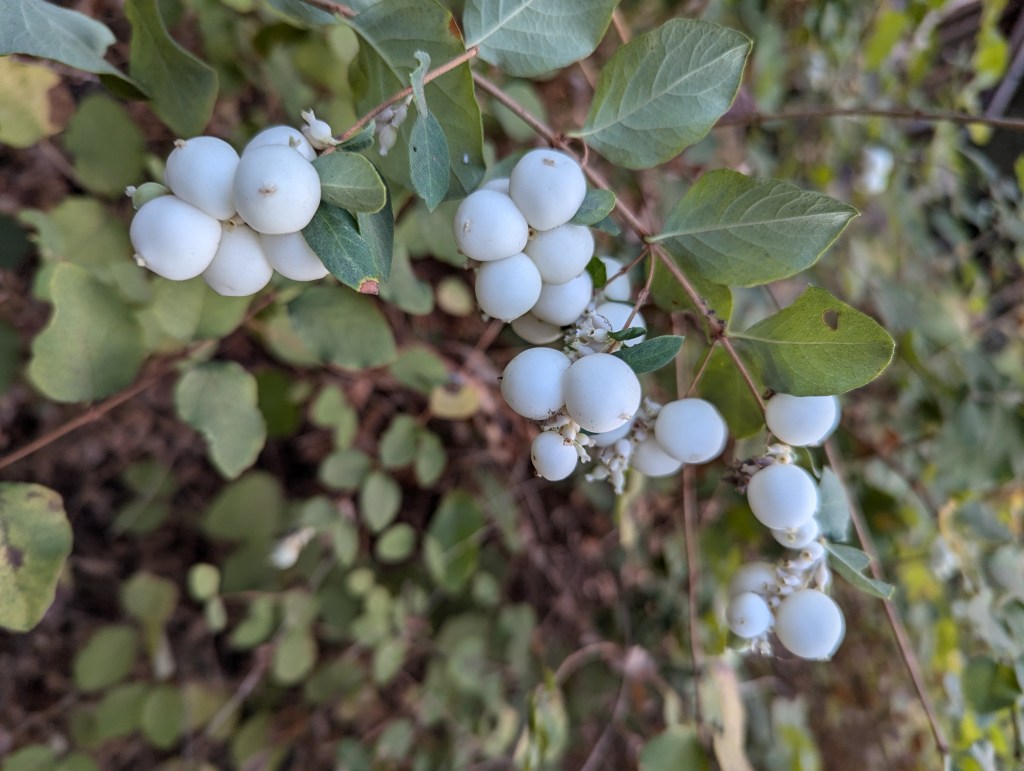
6. Symphoricarpos albus, snowberry is a rather skimpy species. Its thin and wiry stems form low and sparsely foliated thickets. It only stays because it produces these unusually white berries. It might be prettier and more prolific if coppiced during winter dormancy.
Snowberry is native here. I have been wanting to grow it because I like its white berries. I just found a seedling where it could not stay, so brought it back here. I am very pleased with it, but did not want to share pictures of it as scrawny canned bare twigs. I got these pictures instead.
1. Callicarpa americana, American beautyberry is what compelled me to get pictures of berries for this week. I shared a closeup picture of the first of these berries as they began to ripen more than a month ago, which was about two months later than elsewhere. I do not mind. These are my first, and there are more of them now. Perhaps their berries will ripen on time when they are established within the landscapes. The seedlings, as well as white butterfly ginger and, recently, American holly, were gifts from Our Forest Garden.
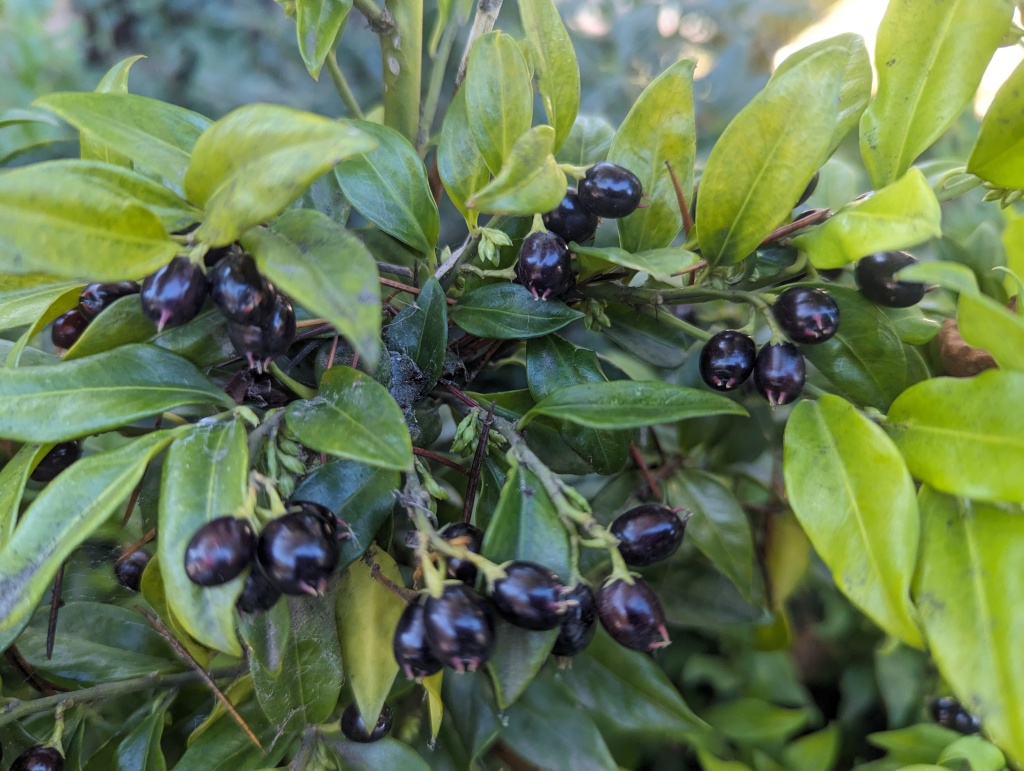
2. Sarcococca ruscifolia, sweet box typically produces very few red berries that typically fall off before turning black. They are both atypically abundant and atypically black now.
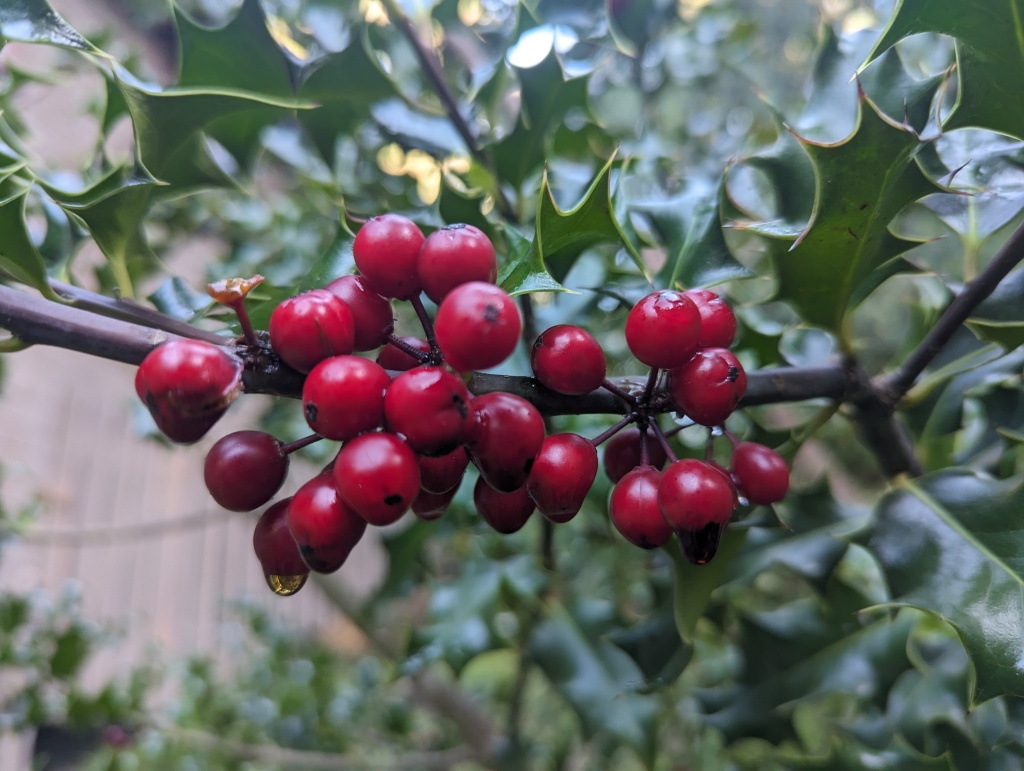
3. Ilex aquifolium, English holly self sows, but most feral specimens seem to be male, or produce only a few berries, in a few sparse clusters. Very few produce clusters like these.
4. Viburnum tinus, laurustinus also self sows. I am not as impressed with it as I am with English holly, but have been learning to appreciate it more, as those in other regions do.
5. Cotoneaster pannosus, silverleaf cotoneaster is naturalized a bit more vigorously. It is not as pretty as I like to think it is. I should retain a few specimens but eradicate the rest.
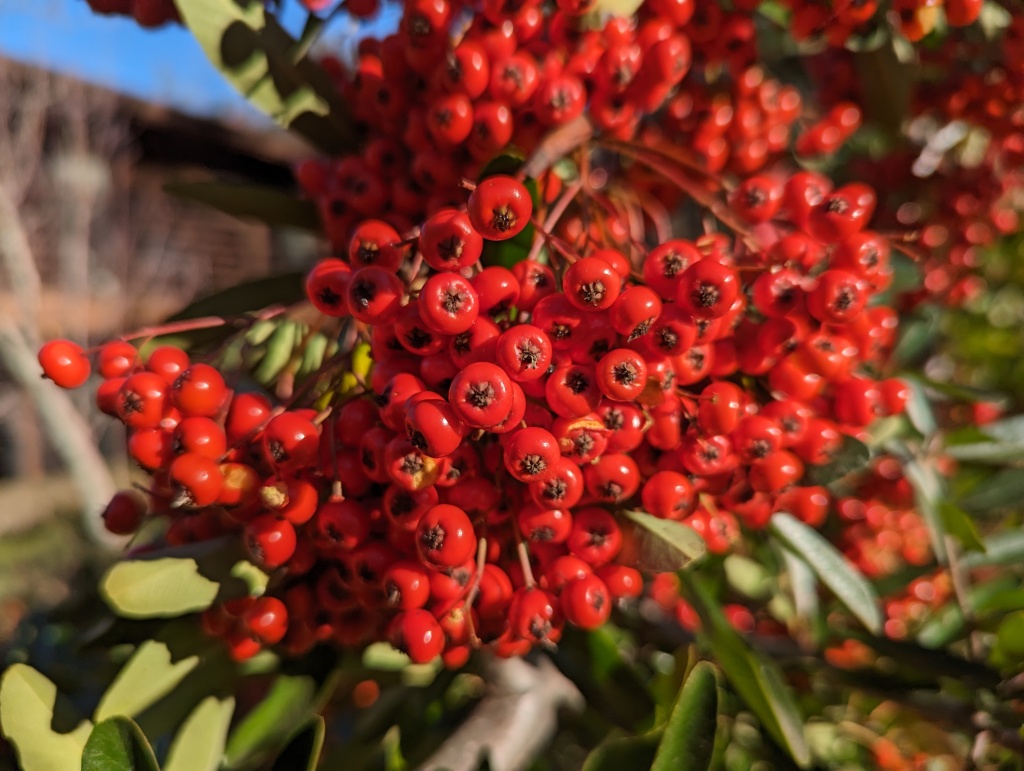
6. Pyracantha coccinea, firethorn is more colorful with similar but with more abundant and glossier berries. Unfortunately, it is also much thornier, so it is no fun to work with.
California wild rose hips remain long after bloom, as well as foliage, is gone.
Prickly thickets of California wild rose, Rosa californica, are not often much to look at, even while adorned with small and sparse pink roses in spring and summer. The fragrant flowers can actually range in color from white to rich pink, and may have more petals, but are not abundant enough to be very impressive at any one time. In autumn though, all the flowers that bloomed in the previous few months leave bright orange or red fruiting structures known as ‘hips’, that linger on the bare canes through winter.
The rose hips of California wild roses had historically been used to make herbal tea because they contain so much vitamin C and have a pleasant flavor. (California wild rose is a ‘tea’ rose but not a hybrid ‘T’ rose.) They can also be made into jelly or sauce. The only problem is that birds like them too, so often take them before anyone else has a chance to.
Pyracantha, although inedible, is likely the most colorful of the winter berries here.
Seasonal color is as variable as the weather. Just as the many different spring flowers bloom differently every spring, and the autumn foliage color is different every autumn, the colorful berries and fruits that linger on many plants through winter respond to the weather. Then, the various birds and other animals that devour them do so at different times, and at different rates every year.
Pyracantha (or firethorn) is probably the most reliable for an abundance of brightly colored red berries. Old varieties with orange or even yellow berries are very rare, perhaps because they are comparably wimpy. Unfortunately, because they are so colorful, and also because they ripen before many of the migratory birds have gone, the berries often get eaten by birds soon after they ripen.
Berries of the various cotoneasters are not quite as colorful, and many ripen slightly later, so they are not so efficiently stripped by birds. Cotoneasters are now more popular than related pyracantha because there are so many varieties with so many different growth habits. Larger types grow into large shrubbery while prostrate types grow as ground cover. Cotoneaster also has the advantage of lacking thorns.
The native toyon can provide large clusters of similar red berries, but only if it is allowed to grow somewhat wildly. It is unable to bloom and subsequently produce berries if regularly shorn. Yet, even in the wild, toyon is unpredictable. Because damp weather can cause berries to rot before they ripen, toyon may be unproductive for many years, and then produce remarkably colorful displays of berries when least expected.
Hollies are the most familiar of colorful winter berries, but are not as colorful as pyracantha or the various cotoneasters because they are almost never provided with male pollinators that they require to develop fruit. Fortunately, their remarkably glossy and prickly foliage is appealing alone.
Flowering crabapples are grown for their impressively colorful pink, white or nearly red spring bloom, but some types also produce sparse and minute red, orange or even yellow crabapples that stay after the foliage turns yellow and falls. English hawthorn lacks the flower color of flowering crabapples, but has more abundant and colorful red or orange berries that linger into early winter after the foliage is gone, or at least until birds find them.
Red berries that ripen through autumn and into winter are becoming prominent. They are too brightly colorful and profuse to hide. Those that do not attract too much attention from wildlife may linger after floral color is finished. Some may last longer than the earliest fall color. Otherwise, if wildlife consumes all of the red berries, that is what they are there for.
Plants are naturally exploitative. Since they are inanimate, they exploit that which is not. Those that do not rely on wind for dispersion of their pollen and seed expect insects and animals to do it instead. Their flowers appeal to preferred pollinators, using color, texture, form, fragrance and flavor. Their fruit, which contains their seed, uses similar techniques.
Red berries mature at this time of year for two primary reasons. Plants that produce them prefer their seed to disperse during autumn or early winter. Also, they know that they can rely on birds or other wildlife to eat the red berries, and subsequently ‘disperse’ the seed within. Overwintering wildlife and migratory birds are particularly hungry as berries ripen.
Red berries are popular in home gardens for two primary reasons. Some people like the birds and squirrels who come to eat the fruit. Most people simply appreciate the red color while floral color is potentially scarce. Unfortunately, it is impossible to predict how birds will behave. They may prematurely consume berries that should provide color for winter.
Although various hollies provide delightfully glossy and densely evergreen foliage, their red berries are scarce or absent without male pollinators. (Hollies are dioecious, so their genders are distinct.) Male cultivars, which had been rare for several decades, have only recently become more available. Yet, even with pollinators, holly berries are not the best.
Firethorn (Pyracantha), toyon and a few cultivars of cotoneaster are more prolific with red berries. Toyon, or California holly, is native, and is the namesake for Hollywood. It is best in wild landscapes where it needs no pruning. Firethorn produces the most berries but is also very thorny. Some cultivars of cotoneaster are both thornless and pleasantly prolific.
The most abundant bright red berries of autumn are those of firethorn, Pyracantha coccinea. They resemble English hawthorn, cotoneaster and toyon berries, but are shinier and more abundant. Their weight causes their limbs to sag. Most are either rich deep red, or brighter slightly orangy red. Orange berries are uncommon locally. Cultivars with yellow berries are less vigorous and rare.
Berry production may seem to be more variable than it actually is. Healthy plants typically produce a profusion of berries. They only seem to be more profuse if they ripen late, after migratory birds fly south. Such birds are voracious with early berries. Overwintering birds are less numerous, and consume berries slower. Regardless, few berries last long enough to deteriorate and get messy.
Firethorn is thorny enough to function as an impenetrable hedge. However, it is unpleasant to prune with all those thorns. Also, pruning without removing the stems that bloom and produce berries takes effort. Upright cultivars can get higher than downstairs eaves. Some cultivars get only a few feet tall as they sprawl over the ground. Even without berries, the evergreen foliage is appealing.
The red, orange, yellow, purple, white or almost black fruit of ornamental pepper that naturally develops in summer can be seen at any time of year because the plants are grown in artificial greenhouse environments. The peppers are usually small and narrow, and stand upright above their glossy rich green foliage. Some are narrower. Others are a plumper. Technically, the fruit is edible, but it is not as flavorful as peppers grown for culinary purposes.
Because the plants are sensitive to frost, they are more often grown as houseplants than out in the garden. In the garden, they need shelter to survive as perennials. As houseplants, they need warm and sunny exposure in order to bloom and develop fruit. They should be watered regularly, but only as their potting soil is starting to get dry.
Nothing lasts forever. Spring flowers fade. Summer fruit gets eaten. Fall color falls from the trees and gets raked away. Berries and other small fruits that ripen to provide a bit of color through late autumn get eaten by birds and squirrels through winter. Every type of berry and every season is unique. It is impossible to predict how long particular berries will last through any particular season.
It would be presumptuous to believe that colorful berries should remain uneaten in our gardens until they decay. After all, they are produced specially for the birds and rodents who consume them. Their visually appealing bright colors are more culinarily appealing to overwintering wildlife. It is no free lunch though. Well fed wildlife is expected to disperse the seed within the berries they eat.
It is an ingenious system. Wildlife might think that they exploit the inanimate flora who produces the berries and small fruit for them. The associated flora could think that they exploit the mobility of the wildlife who eats their seed laden fruit. Those of us who grow plants who utilize this technique get to enjoy the color of the fruit while it lasts. Some of us prefer to enjoy the wildlife attracted to it.
Firethorn (pyracantha), toyon, cotoneaster and English hawthorn are the best for colorful red berries in late autumn and winter. All are of the family Rosaceae, and produce similar clusters of small bright red or maybe reddish orange berries. Yellow firethorn is rare here. Cotoneaster can be tall shrubbery, sprawling shrubbery, or groundcover. Only English hawthorn is a deciduous small tree.
The many species and cultivars of holly are unrelated to the family Rosaceae. In other regions, some are famous for producing seemingly similar berries. However, those that are the most prolific with berries are unpopular here. Those that are somewhat popular produce only a few berries due to a lack of pollinators. (They are dioecious, so female plants must be pollinated by rare males.)
This is the time of year to appreciate the colorful berries while they last.








 Nothing lasts forever. Spring flowers fade. Summer fruit gets eaten. Fall color falls from the trees and gets raked away. Berries and other small fruits that ripen to provide a bit of color through late autumn get eaten by birds and squirrels through winter. Every type of berry and every season is unique. It is impossible to predict how long particular berries will last through any particular season.
 Tony Tomeo