‘Big Blue’ Sea Holly

70719This one is no fun to handle. It is just as prickly as it looks. Yet, it is the spiny foliage and blooms that make ‘Big Blue’ sea holly, Eryngium X zabelii ‘Big Blue’, so appealing. The knobby blue thistle flowers are centered on prominently flaring grayish blue bracts that look like metallic snowflakes. The intricately lobed grayish foliage contrasts splendidly with just about any darker green foliage.

Bloom begins with summer and continues almost to autumn. The first flowers are solitary on strong stems. As they fade, sideshoots from these original stems continue to bloom with smaller but more abundant flowers. They are excellent cut flowers, fresh or dried. However, cutting the first solitary flowers with long stems removes some of the sideshoots that would otherwise bloom later.

Mature plants can get three feet tall and half as wide. Shade, even part shade, causes irregular growth that can be quite weedy. Although perennial, ‘Big Blue’ sea holly might live only a few years.

Contrary to the appearance of the bristly thistle like foliage and flowers, sea holly is in the Umbelliferae family, which means that it is more closely related to celery and carrot than it is to artichoke!

Coneflower

80704The native American coneflower, Echinacea purpurea, of the Midwestern prairies has been popular within its native range longer than anyone can remember, and has become more popular in the West as extracts of echinacea became a fad in herbal medicine several years ago. Modern garden varieties and cultivars have been bred and hybridized for larger and more colorful flowers.
Coneflower has developed from a sturdy but relatively simple prairie wildflower into a flashy and potentially garish perennial, with white, pink, red, orange, yellow, purplish pink or pale green daisy (composite) flowers as wide as three or even four inches. The fat and bristly rust-colored centers become more prominent as the outer petals (ray florets) fold downward to form a domed cone.

The sturdy upright stems can get taller than three feet and wider than two feet, although some garden varieties are more compact. The somewhat raspy basal foliage is full and fluffy, but becomes progressively sparser higher up the stems. Some rare cultivars bloom with double flowers. New growth replaces the old annually, and with plenty of sunlight, blooms through the warmth of summer.

Souvenir

P80609KNurseries are full of plants for sale. That is their business. They sell plants, and whatever plants need. With a bit of money, it is easy to purchase plants to compose an exquisite landscape. That is important to landscape professionals who make a business of composing landscapes to beautify the environments in which they work.
Those of us who enjoy home gardening might also purchase plants that we want for our garden. Yet, our home gardens are more than mere landscapes that are designed to simply beautify. The might also produce flowers for cutting, fruits and vegetables. Some might produce firewood. Gardens are usable spaces for active lifestyles. They are spaces for us to grow whatever we want to grow.

I buy almost nothing for my garden. The last item I purchased was a ‘John F. Kennedy’ rose, and I only did so because it was easier than growing one from scratch, and it is my favorite hybrid tea rose. Almost everything else was grown from seed, cutting, division or even as entire plants taken from somewhere else. They all have stories. My figs and quince are from trees that have been producing fruit in the Santa Clara Valley for generations. My great grandfather gave me my first rhubarb before I was in kindergarten. I found one of my pelargoniums in a neighbor’s trash heap when I was in junior high school. I found another in a creek where I grew citrus in Gilroy in the early 1990s.

My iris are from all over. My favorite are still those from the garden of my great grandmother https://tonytomeo.wordpress.com/2017/09/10/roots/. Two others came from and ‘incident’ back in college https://tonytomeo.wordpress.com/2017/09/12/the-colors-of-karma/ . I may grow as many a four white iris, not only because they are my favorite color, but because they came from important origins. The short white iris that I do not like much must stay because it came from my grandmother’s garden in Saint Helens. There is another tall iris that is not a pure white, but seems to be somewhat grayish, but it must stay too because it is the only iris I got from the historic home of a friend’s mother in Monterey. One of my favorite whites was supposed to be red, but must stay because it came from a friend’s home in Lompico . . . and because it is one of the prettiest. I have a purplish burgundy iris that I only recently learned was brought from the garden of a colleague’s grandmother in Placentia, a town in Orange County that really should change it’s name. It proliferated and was shared with the Felton Presbyterian Church, where it proliferated again, which is how I found some on a trash heap. They are a keeper now.

When they were all together in the same garden, I grew as many as fourteen bearded iris, with a few other types. Some of the redundant white bearded iris have been relocated to the garden parcel in Brookdale, just to keep the separate from similar cultivars. Not many have been added, although there does happen to be a group of mixed iris from the garden of a former client in Ben Lomond. I think I will keep them mixed because they are easier to keep track of as a single mixed group rahter than as several separate cultivars.

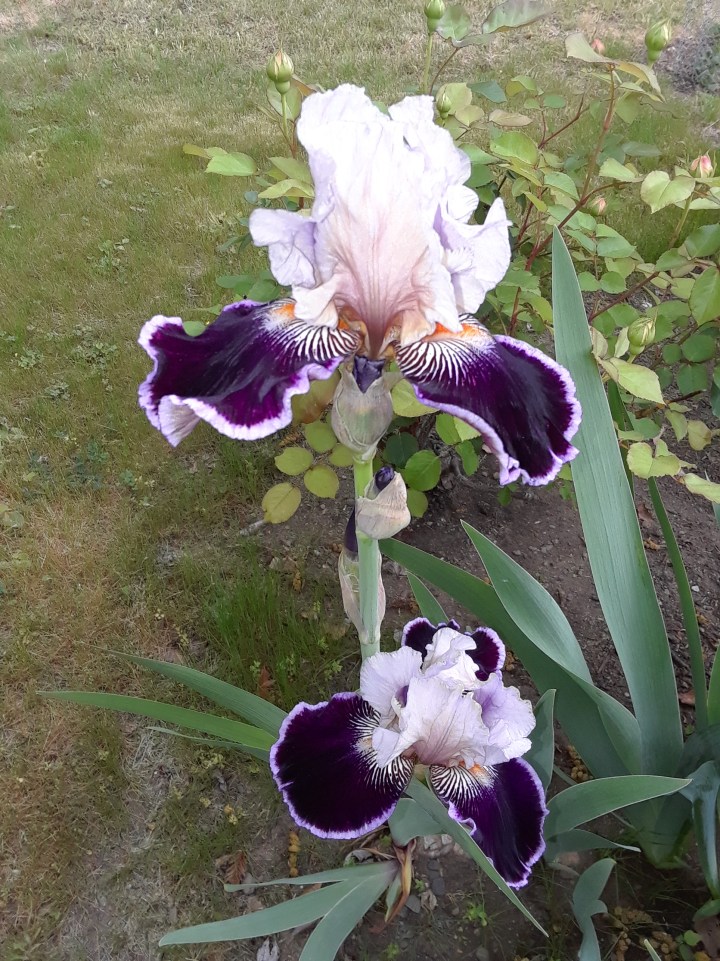
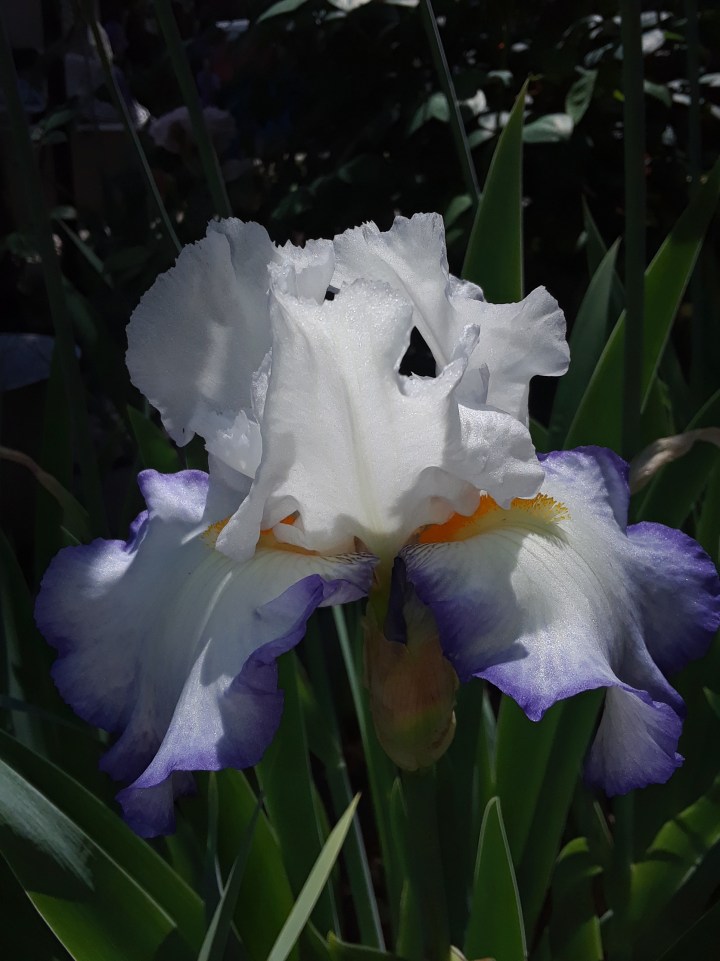
These pictures are a few weeks old, from when the iris were still blooming. The iris in the picture above came from the garden of a friend in the East Hills above San Jose. The flowers are the biggest of all the iris I grow. You can see how distinctive they are. The iris in the picture below, which is not a good picture, is ‘Blueberry Ice’. It was a gift from the Clara B. Rees Iris Society. It has stout stems to support the very wide flowers that are mostly white with a variable blue edge.P80609K+

Flowers For Home And Garden

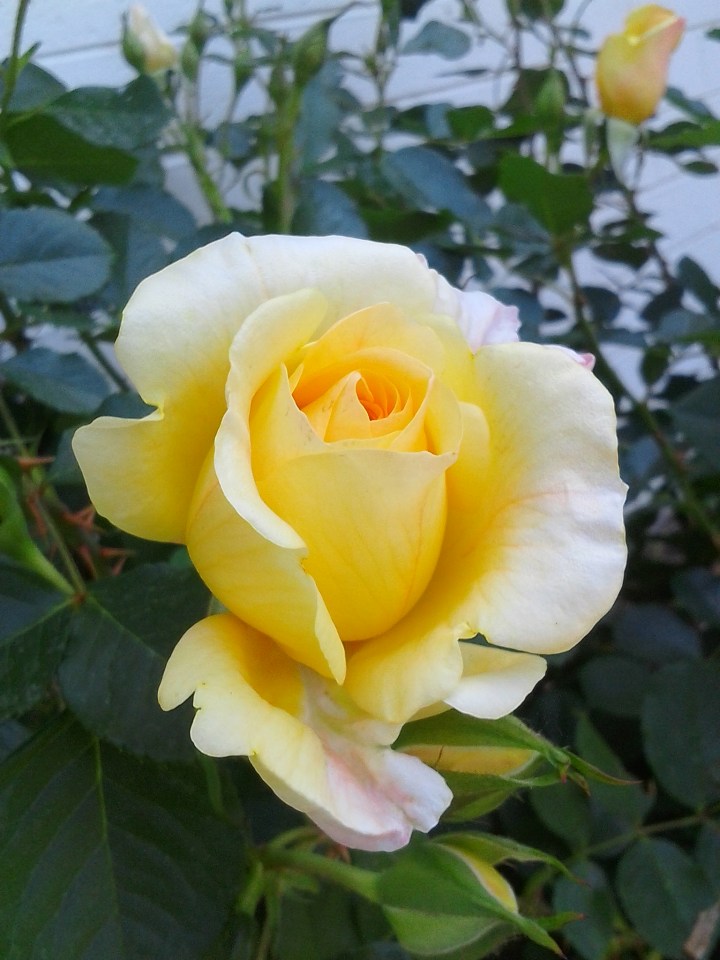
70524thumbThere is a difference. Hybrid tea and grandiflora roses were bred to be excellent cut flowers for the home. They bloom on long stems, and last well once cut. However, the rigid and thorny plants that produce these excellent blooms are realistically not much to look at. Floribunda, polyantha and climbing roses are more of a compromise with less ideal (perhaps) flowers on friendlier plants.
Conversely, bearded iris are spectacular while blooming out in the garden, but do not last so well as cut flowers. As colorful as they are, they perform best while still attached to the plants that produced them. Fading flowers might be groomed away from flowers that continue to bloom later, but are not a serious problem if allowed to linger. The garden is more forgiving than the home.

Where space allows, rose gardens or cutting gardens are areas devoted to the production of flowers for cutting and bringing into the home. Like vegetable gardens, cutting gardens might be hedged, fenced or partly concealed from the rest of the landscape. No one minds if the utilitarian plants within get deprived of their flowers, or need to be staked or caged like big tomato plants.

Taller and bulkier varieties of dahlia, delphinium, lily, Peruvian lily (alstroemeria) or sunflower that might be to big and awkward elsewhere in the garden can be right at home in a cutting garden. Compact and more prolific varieties of the same flowers work better in more prominent parts of the garden, and if prolific enough, can also provide flowers (although less spectacular) for cutting.

There are very few rules in regard to cut flowers. Many of us bring in bearded iris or daylily, even though they may not last more than a day. The buds below the flowers might bloom afterward. Blooming clematis vine, nasturtium (on or off stem), lily-of-the-Nile, zonal geranium, bougainvillea, bottlebrush, crape myrtle and even flower stalks of New Zealand flax, are all worthy cut flowers for anyone wanting to try them, especially if the garden provides enough to spare.70524thumb+

Baby’s Breath

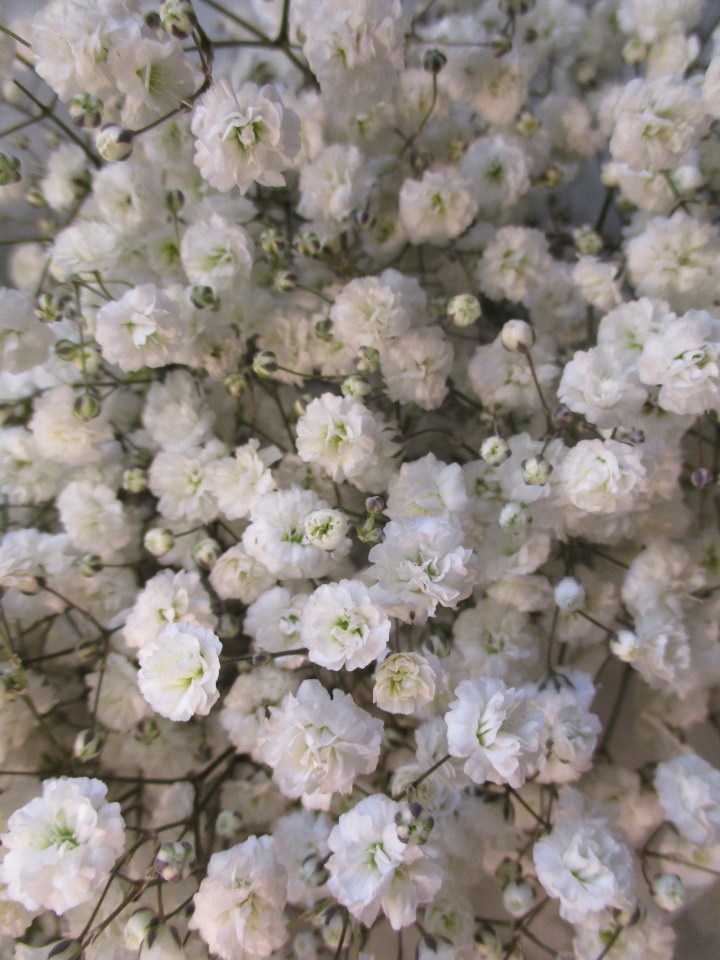
80328You might think that such a popular flower would be easy to get a picture of. Baby’s breath, Gypsophila paniculata, is everywhere, and almost a standard component of the mixed bouquets found in supermarkets. However, the flowers are so small and so sparsely arranged on thin stems, that they do not look like much in pictures. This picture is a closeup of a tightly bound bundle of bloom.
As common is it is with other cut flowers, baby’s breath is quite uncommon in home gardens. It is not often available in nurseries. Seed should have been sown by about now. Baby’s breath grows something like a tumbleweed about three or even four feet high and wide. The stems look too delicate to stand so tall. The minute flowers are usually white but can be pale pink and slightly fluffier.

While blooming in summer, baby’s breath is so handsome that no one wants to cut the flowers. It is difficult to take just a few good stems to add to other cut flowers without ruining the symmetry of a well rounded plant. Some people who grow it prefer to put it out of the way, or grow it amongst other flowers to hide the disfigurement of harvest. Baby’s breath blooms better if crowded anyway.

Spring Blossoms Precede Summer Fruit

00407

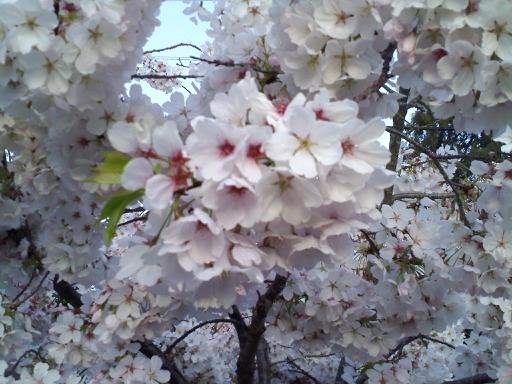
Cherry blossoms are such an excellent tradition in Washington D.C., as well as in Japanese neighborhoods of the West Coast. ‘Kwanzan’ and ‘Akebono’ flowering cherries in Japantown of San Jose are glorious when they bloom early in spring. They are less common but just as spectacular in Los Angeles. More varieties grow in the cooler climates of Sacramento, Portland and Seattle.

Yet, after all the work the trees put into bloom, they produce no fruit. These prettiest of the cherry blossoms are sterile. They are known as ‘flowering’ cherries, which is a polite way of saying that they are ‘fruitless’. Cherry trees that produce fruit are very similar and bloom about as profusely, but do so with somewhat more subdued utilitarian flowers. After all, they have to work for a living.

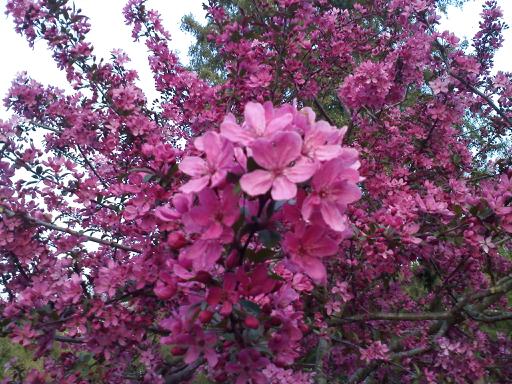
Many of the deciduous fruit trees have ‘flowering’ counterparts that are grown for their showy flowers. Purple leaf plums, which are really flowering plums that happen to have purplish or bronze foliage, are the most popular because the foliage is so colorful after bloom. Flowering nectarines and flowering peaches are rare, but not as rare as flowering apricots and flowering almonds are.

Flowering crabapples are the counterparts to the entire fruiting apple group. They are not really sterile, so produce tiny fruits that mostly get eaten by birds. Flowering pears, which are commonly known as ‘ornamental’ pears, are grown more for their impressive autumn foliar color than for their potentially modest bloom. They also produce tiny fruits. The evergreen pear lacks autumn color. Flowering quince is an odd one. It is not even the same genus as fruiting quince.

Fruit trees bloom too. They may not be as colorful, but their simpler and paler blossoms are about as profuse as those of their flowering counterparts. Their stems are usually straighter and more vigorous because they are pruned for fruit production instead of allowed to develop naturally. A few stems can be left unpruned to be cut and brought in as cut flowers when they eventually bloom.

Whether flowering or fruiting, almonds and plums should bloom before pears and apples. There is no guarantee though. Weather can delay early bloomers, or accelerate late bloomers. Earlier frost promoted healthy bloom, but the subsequent abundance of rain is unfortunately ruining flowers that are blooming now. For fruiting trees, this means that much or all of the fruit will be ruined.00414

Transvaal Daisy

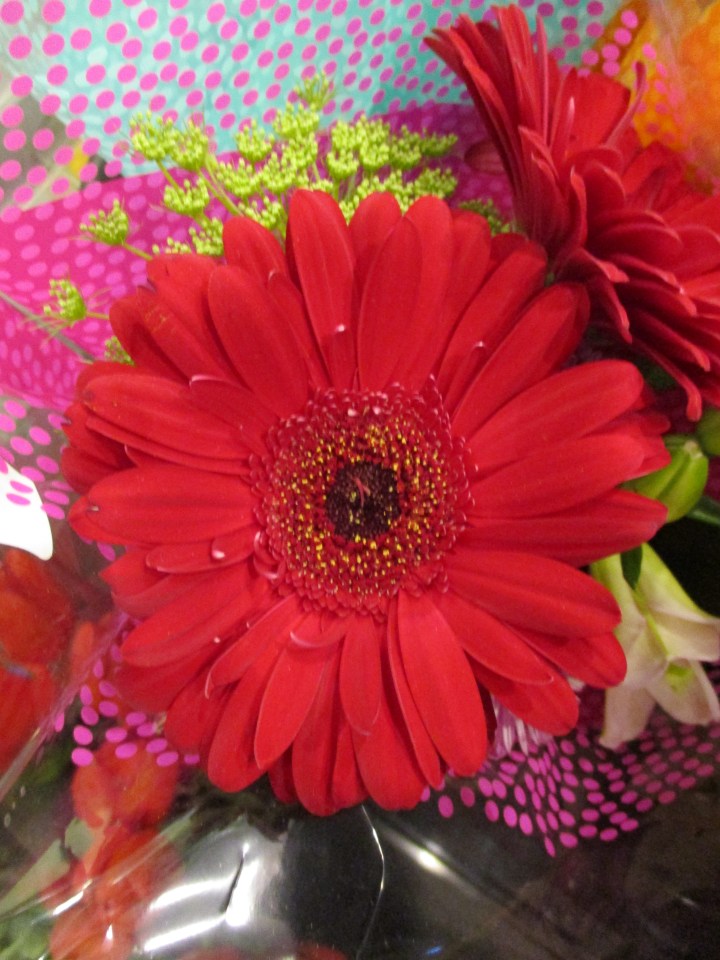
80307There is some controversy about the identity of the flowers that Micky Mouse picks at the porch to present to Minnie Mouse when she answers the door. Some insist that they are Transvaal daisy, Gerbera hybrida. When they are not in black and white, the substantial daisy flowers are cartoon hues of yellow, orange, red, pink and white, sometimes with chocolatey brown or black centers.

Transvaal daisies are always available as cut flowers, but bloom best in cool spring and autumn weather in home gardens. Most garden varieties have single flowers on bare stems. Most cut flowers are semi-double. Double flowers that resemble zinnias, and spider flowers that resemble spider mums, are rare. Coarse basal foliage gets almost a foot high and a foot and a half wide.

Because the foliage is so vulnerable to snails, Transvaal daisy is usually grown in pots rather than in the ground or immobile planters. Besides, potted plants can be brought into the home or put in prominent spots while blooming, and then put out of sight between bloom. Transvaal daisy wants partial shade, regular watering and occasional feeding. It can take full sun exposure if not too hot.

Year of the DOG!

P71019

Tet, Vietnamese New Year’s Day, is today! This is the first day of the Year of the Dog! Tet is celebrated for at least three days, and besides all the popularly known traditions that go along with it, a few horticulturally oriented traditions are also observed.

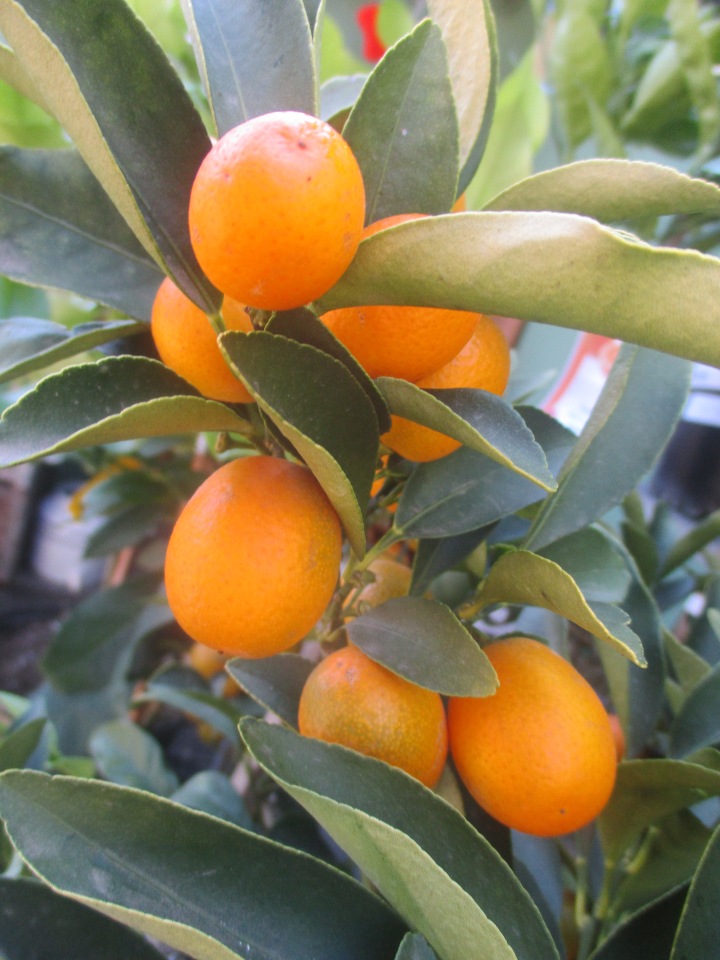
When I grew citrus back in the early 1990s, I can remember than we sold every kumquat and calamondin tree that had fruit on it prior to Tet. When those ran out, we sold every fruited mandarin orange and tangerine tree, and then every fruited orange and lemon tree. Eventually, just about every fruited tree we could supply was gone. Citrus trees with colorful ripe fruit are traditional decoration for Tet, and might even be a gift for someone lacking such a tree. Kumquat trees are the favorite, but others will do if necessary.

Fruit baskets containing primarily citrus fruits are also very popular and traditional. Bananas, pineapple and any colorful fruit are fair game as well. Shaddock fruit is popular if available. Shaddock is the dwarfing understock for other dwarf citrus trees, but is not commonly grown for fruit production.

Blooming stems of apricot, peach and plum, as well as Saint John’s wort flowers, are the favorite traditional cut flowers for Tet. Each type of flower corresponds to the region of Vietnam from which the family displaying it originated. In the Santa Clara Valley years ago, there were plenty of fruit blossoms to go around. The stems were sometimes cut early and forced to bloom on time for Tet. Nowadays, such blooming stems can be purchased from florists, along with the other traditional flowers; chrysanthemums, narcissus, marigolds, pansies and cockscombs. Families who own a bonsai or more display them prominently for Tet.

Happy Tet and Year of the Dog!80131

Geraldton Waxflower

70104What is it about Australian plants that makes them bloom in winter? Perhaps they think they are still in Australia where it is summer. Whatever the deal is, Geraldton waxflower, Chamaelaucium uncinatum, provides a scattering of small white, pale pink or lavender pink flowers from now until spring. It is no mistake that their bloom resembles that of New Zealand tea tree. They are related.

Geraldton waxflower is pretty serious about drought tolerance. It can rot and fall over it stays too damp for too long. It likes a warm exposure and well drained soil. It is normal for the tiny evergreen leaves to be somewhat sparse. Unfortunately, it is also normal for healthy specimens in ideal situations to die out within ten years or so. Mature plants can get a bit more than six feet tall and wide.

Torch Lily In Fire Season

61214Okay, so this is not really the time of year that they should be blooming. Torch lily, Kniphofia uvaria, should bloom in the middle of summer. However, without watering, naturalized plants bloom when the weather prompts them to. Some wait out the warm and dry summer weather to bloom as soon as they get dampened by the first rains. Others bloom in spring, before things get too dry.

Flower stalks can get almost five feet tall, but are more typically about three feet tall. Small tubular flowers are arranged in dense conical trusses on top of these stalks. From the bottom to the top, red flower buds bloom orange, and then fade to yellow, and fold downward against the stalk. Different varieties bloom with more or less of these three colors, and at different times of the year.

The grassy foliage is not much to look at without bloom. By the end of winter, it can look rather grungy. It fluffs back nicely in spring, sort of like overgrown daylily foliage. Overgrown plants, or maybe just a few rhizomes, can be divided anytime. However, they should probably be divided just before the end of winter so that they can enjoy late rain, just before their spring growing season.