Giant Reed

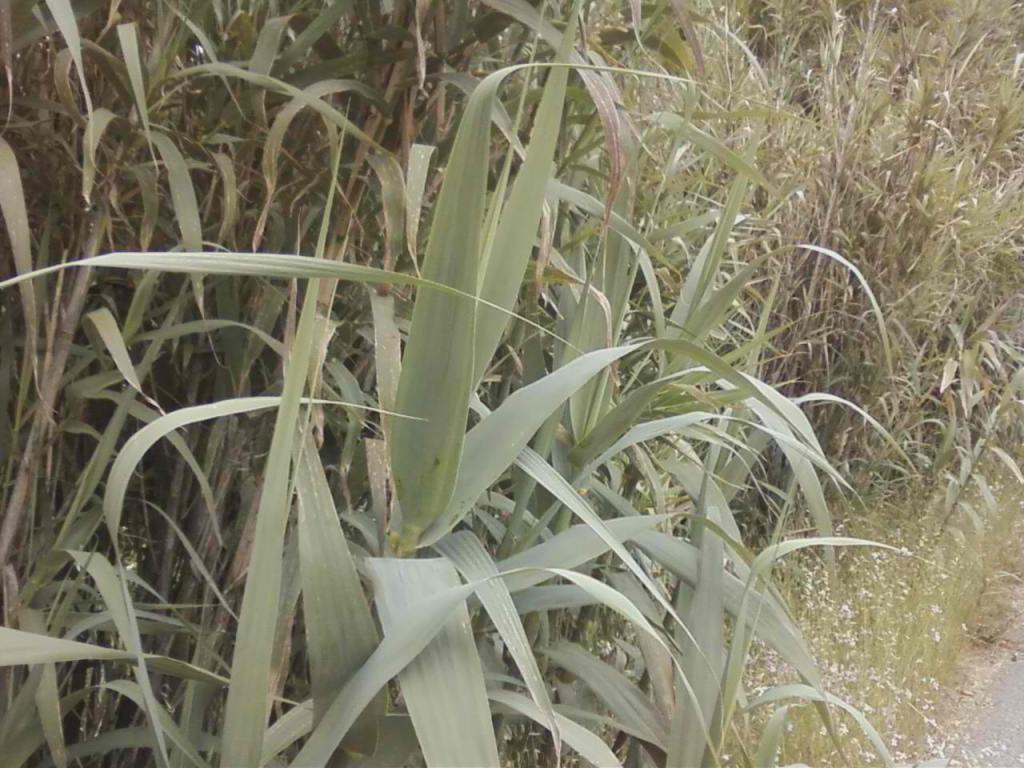
Giant reed is a horrid weed within many ecosystems.

The earliest infestations of giant reed, Arundo donax, that clogged tributaries of the San Joaquin and Sacramento Rivers supposedly grew from pieces used as packing materiel for cargo from China. It was simply dumped into the rivers as cargo was unloaded in port cities like Stockton and Sacramento. How it got to China from its native range in the Mediterranean is unclear.

Because it is so aggressive and invasive, giant reed is almost never found in nurseries. In many rural areas, particularly near waterways, it is listed on the ‘DO NOT PLANT’ list. However, giant reed can sometimes be found in old landscapes where it was planted before it became so unpopular. It can also grow from seed in unexpected places.

Once established, giant reed can be difficult to eradicate or even divide. It spreads by thick rhizomes that resemble the stolons of bamboo, but not quite as tough. It is often mistaken for bamboo. Where it gets enough water, it can get nearly thirty feet tall, with leaves about two feet long.

Where it can be contained and will not become an invasive weed by seeding into surrounding areas, giant reed can provide bold foliage that blows softly in the breeze. ‘Versicolor’ (or ‘Variegata’) has pale yellow or white variegation, and does not get much more than half as tall as the more common green (unvariegated) giant reed. Incidentally, the canes of giant reed are used to make reeds for musical instruments.
Oem Update

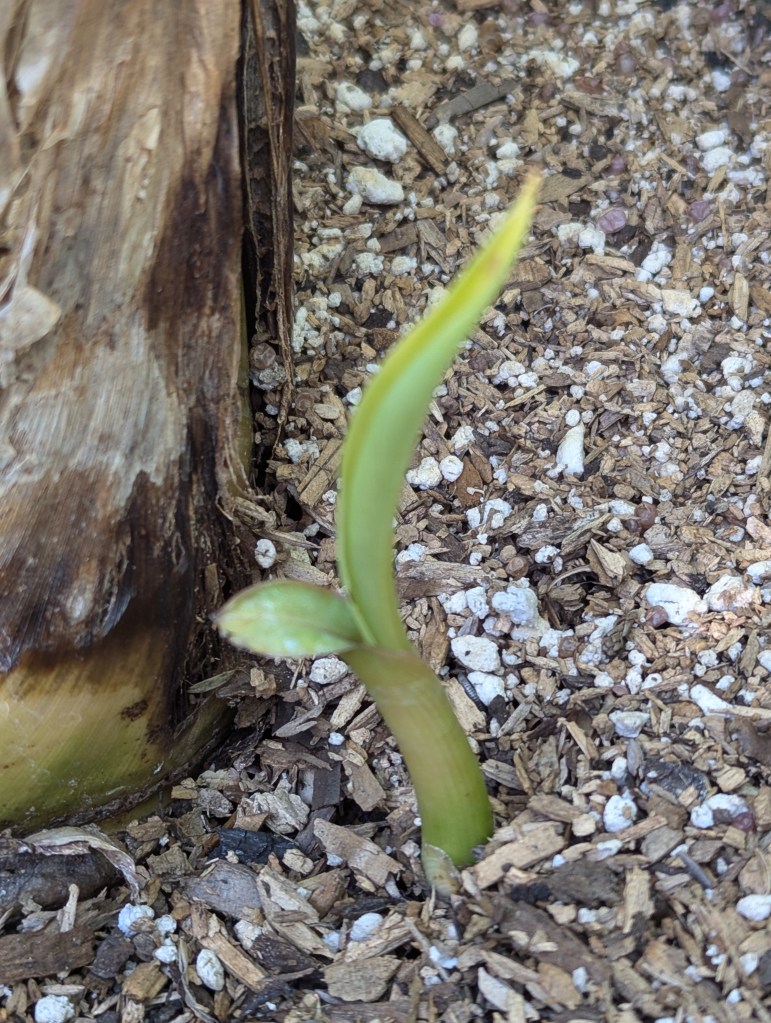
This is the larger of two oem pups.

Oem is beginning its third spring here. Fortunately, it has not yet grown too big to stay. That could change soon now that the weather is warming. I still do not know what to do with it as it grows. It is the largest species of banana in the World, Musa ingens. The foliage of the original pseudostem was frosted enough last winter to get trimmed away, leaving only an unsightly bare trunk. It is only beginning to replace its foliage for this season. Just as readily though, it produced two pups, which will likely grow faster than the original pseudostem did during the last two seasons. They are growing from a larger rootbase. Meanwhile, there are several other cultivars of banana growing here also. There were about fourteen last year. There are about two dozen this year! Only a few will remain compact enough to inhabit the landscapes at work, but even fewer will be appropriate there. Banana trees are not exactly comparable with the style of a redwood forest. Most, including the oem, will likely inhabit a riparian area of my home garden, which is also in a redwood forest. Goodness! I really should have planned this better.

Going Bananas!

‘Double Mahoi’ is not even a fraction of a single yet, but can grow fast.

This is not banana territory. The soil is good, and water is readily available; but the climate is a limiting factor. The weather does not get very warm for very long. When it rarely gets almost unpleasantly warm during the day, it generally gets tolerably cooler overnight. Bananas are none too keen on such comfortable weather. They want sustained warmth, with less fluctuation of temperature between night and day.

This is precisely why I should not have acquired as many as fourteen cultivars of banana. Some may never do more than generate appealingly lush foliage here. Those that produce fruit will unlikely produce fruit that is much more than marginally palatable. One of the cultivars is the oem, which is the largest banana ‘tree’ in the World. I have NO idea of how to manage it. ‘Mekong Giant’ also grows quite large and heavy. Two cultivars are unidentified, so could possibly be copies of others. ‘Kokopo Patupi’ may not have survived last winter, as it has not begun to regenerate yet. Four other cultivars were given away, but then generated pups that are now returning! I do not remember how many cultivars are here now, but I know that there are too many.

Oem is resuming growth faster than the others, but with small leaves from within pseudostems that produced larger leaves last year. ‘Double Mahoi’ is likewise regenerating dinky and pale leaves that are actually dinkier than those that emerged earlier from a shriveled carcass of a dinky pup that got frosted last winter.

I want all of the cultivars of banana to survive and thrive, but I should have planned for them better. Now, I should plan to find homes for most of them instead. Even if I could manage them all, I can not justify doing so.

Oem is the biggest banana ‘tree’ in the World!

Blood-Red Trumpet Vine

Blood red trumpet vine provides more lush foliage than bloom.

Abundant lush foliage is actually the main asset of blood-red trumpet vine, Distictis buccinatoria, with the sporadic clusters of three inch long tubular flowers blooming as an added benefit during warm weather. Bloom can certainly be impressive when least expected though; and has a sneaky way of getting a late blast of color out during Indian summer weather patterns, when the weather gets warm after a cool phase in autumn. Contrary to the name, the flowers are more ruddy orange with yellow throats than blood red. The rich green leaves are compound, with a pair of three inch long leaflets and a three fingered tendril reaching out from between.

The vines are somewhat aggressive and can climb more than twenty feet, so need adequate support. They should not be allowed to overwhelm smaller or slower plants, or escape out of reach into adjacent trees. The tendrils can grab onto and damage shingles and light fences, but are an advantage for covering chain link fences. Given the opportunity, blood-red trumpet vine can even climb rough cinder block or stucco walls.

Wisteria

70426The popular wisterias that bloom so profusely before their new foliage appears in spring are Chinese wisteria, Wisteria sinensis. Others specie are rare. The impressively longer floral trusses of Japanese wisteria are not as abundant, and bloom late amongst developing foliage. American and Kentucky wisteria are more docile small vines, but their floral trusses are both short and late.
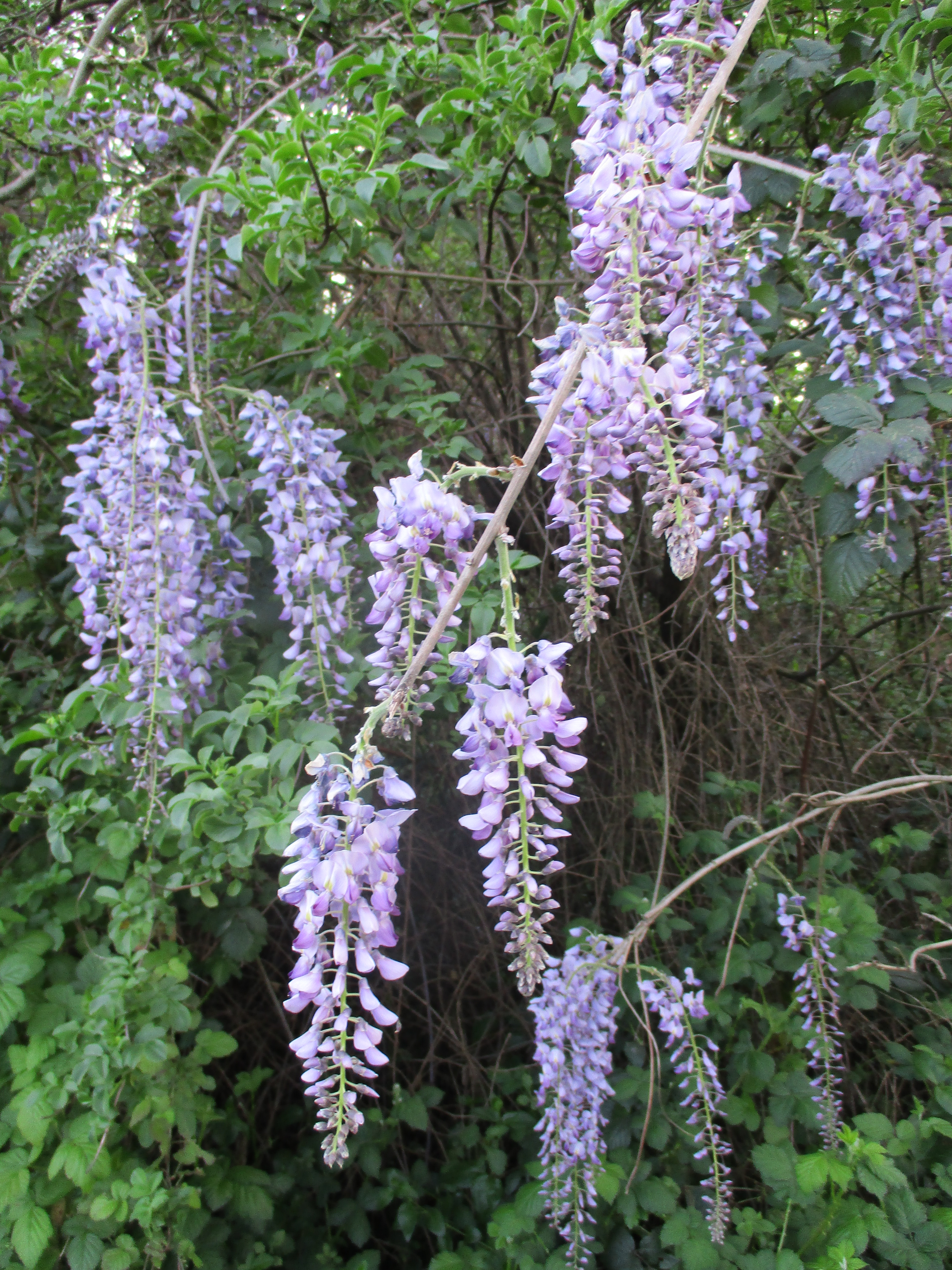
Chinese wisteria is also the most fragrant and the most colorful of the wisterias. Lavender is still the most popular and traditional color. White, pink, sky blue and darker almost purplish lavender are also available. The floral trusses, known as racemes, get from half a foot to two feet long. Double flowered cultivars never became too popular because the fluffier blooms are not as elegant. The aggressive vines can reach the tops of tall trees. They rarely strangle limbs or young tree trunks, but have the potential to do so. They are more likely to crush fences and lattice. Wisteria really needs sturdy trellises and specialized pruning for confinement. Vines that grow from seed may take many years to bloom. The pinnately compound leaves turn pale yellow before falling in autumn.

Dwarf Bluegum

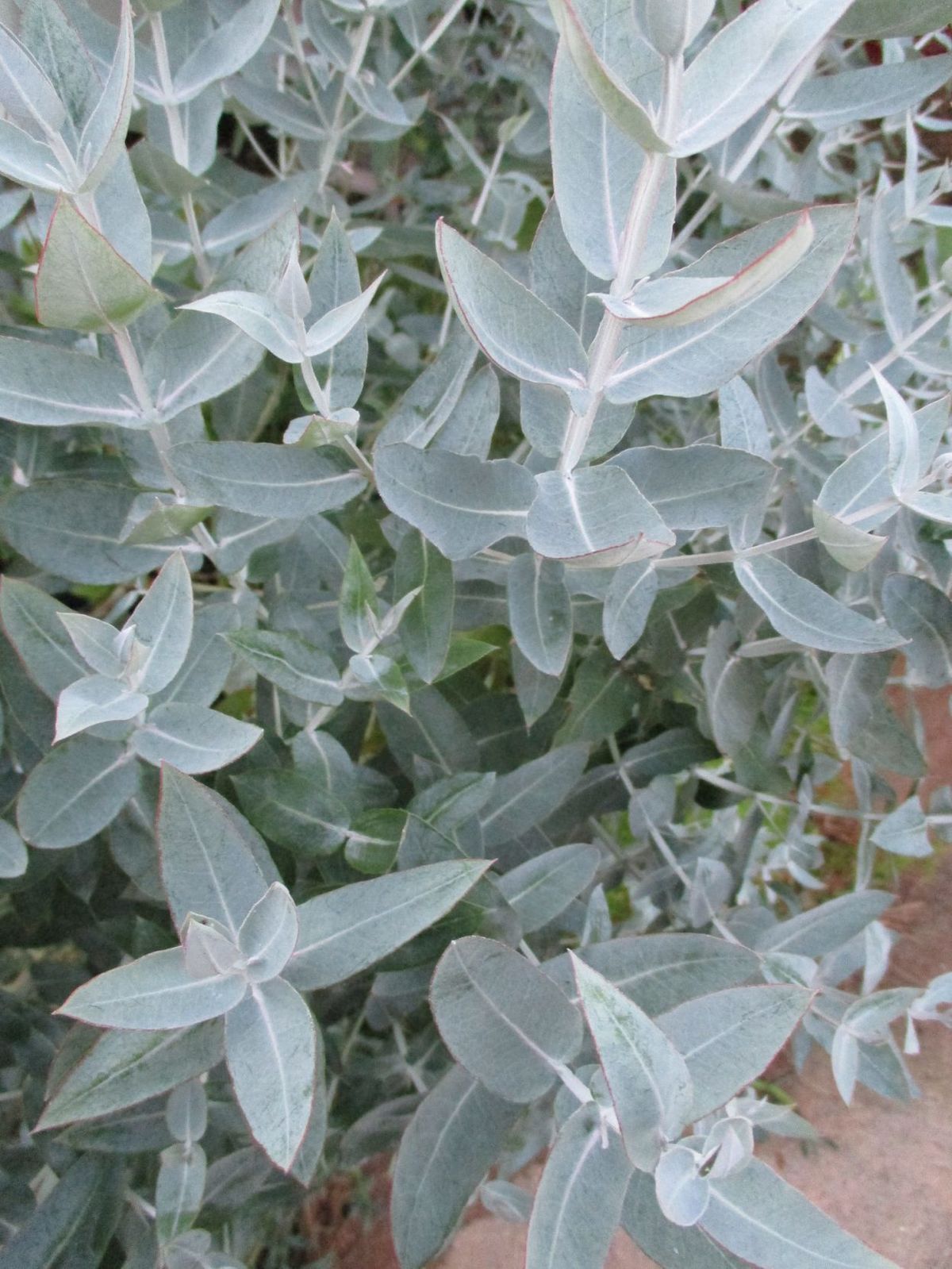
P71103Bluegum is famously problematic. It is too big, too invasive, too messy, too structurally deficient, and as demonstrated in the Oakland fire, too combustible. Dwarf bluegum, Eucalyptus globulus ‘Compacta’, is a completely different animal that does not even look related. It gets only about fifty feet tall, with a dense and somewhat symmetrically rounded canopy. The mess and falling limbs do not affect such a large area.

Dwarf bluegum is not a particularly appealing tree for home gardens, but happens to be practical on freeways or for quick shade in areas that are not landscaped. Once it gets going, it needs no irrigation. Too much water compromises stability. The distinctively curved lanceolate leaves resemble those of common bluegum, but are more densely arranged on shorter stems. Self sown seedlings grow as normal bluegums.

Planned Obsolescence

P71028For my exquisite 1979 Electra, planned obsolescence did not work out so well. It was probably a grand Buick for that time, and one of the last with tail fins! It was elegant. It was big. It was steel. It was made to last ten years or 100,000 miles . . . and that was it. Seriously, as much as I enjoyed that car, it did not want go to much farther than it was designed to go. It limped along for almost 20,000 miles more, but was not happy about it, and was really tired and worn out by the time it went to Buick Heaven.

Planned obsolescence used to mean something completely different in landscaping. Yes, we all know what it means now; that many of the so called ‘sustainable’ modern cultivars last only a few years so that they need to be replaced sooner than older cultivars. What it used to mean is that fast growing plants were used to get a landscape established quickly, while more desirable but slower plants took their time growing. As the more desirable plants matured, the fast growing plants could be removed.

For example, a large condominium complex was landscaped primarily with Norway maples and flowering pears. These trees would eventually grow to be proportionate to the buildings and the spaces that they shade. To provide shade sooner, and to help the landscape look established by the second summer, common cottonwoods were incorporated into larger areas. Their placement was not as important as it was to the maples and pears, but was strategic enough to avoid the other trees and buildings as long as possible. The intention was to allow the cottonwoods to be the prominent trees in the landscape only temporarily, but to remove them as the maples and pears matured. It was a practical technique used by landscape designers for as long as anyone can remember.

Sadly, few modern ‘gardeners’ understand this concept. The cottonwoods did not get removed when they should have been. They overwhelmed and crowded the other trees, and caused them to be disfigured as they grew. The cottonwood roots broke pavement and ruined lawns. Then, after all the damage and destruction, . . . the cottonwoods died, like cottonwoods do. Now the landscape is shaded by healthy but distorted maples and pears. The plan did not work very well.

Now, such planned obsolescence is simply impractical for trees. Even if those maintaining landscapes were reliable enough to follow through with such plans, modern tree preservation ordinances would prevent them from getting permits to remove temporary trees. Planned obsolescence can work with smaller shrubbery and perennials in home gardens, but those of us who use the technique must follow through with our plans so that things do not get too crowded.