Lemon Bottlebrush

Lemon bottlebrush is popular among hummingbirds.

Like oleander and junipers, lemon bottlebrush, Callistemon citrinus, has become passe. It was a victim of its own practicality. It was so popular that it became overly common. Yet it is just as practical now as it was then. It is resilient enough to survive within medians of freeways with minimal irrigation. In less exposed situations, it might require no irrigation.

As a small tree, lemon bottlebrush can grow more than fifteen feet tall. With pruning from below, some grow about twenty feet tall with sculptural trunks. Their canopies eventually become messy though, and require aggressive pruning. Most lemon bottlebrush grow as big flowering shrubbery or high hedges. Shearing can compromise bloom if too frequent.

Bright red bloom should be most abundant for summer, but may be sporadic at any time. It is very popular with pollinators, including hummingbirds. Many small staminate flowers bloom in compact cylindrical trusses, like bottlebrushes. Each truss is about two or three inches long and nearly as wide. The aromatic and evergreen leaves are almost as long. Dark brown bark is handsomely shaggy and furrowed.

Mock Orange

Official State Flower of Idaho

Meriwether Lewis of the Lewis and Clark Expedition encountered the western native mock orange, Philadelphus lewisii, in 1806, and gave it his own name. It inhabits an extensive range that reaches from the northern Sierra Nevada to southern British Columbia to western Montana, but is somewhat sporadic within its natural range. It is the state flower of Idaho, and is commonly planted in state, national and even some county parks within its range and throughout the rest of California.

Partial shade is not a problem for mock orange, but full sun exposure promotes more abundant bloom. The simple, strikingly white flowers that bloom in spring are less than two inches wide with only four petals. However, their remarkably rich orange fragrance is unexpectedly powerful. The two inch long, forest green, deciduous leaves on arching limber stems are a nice backdrop. ‘Goose Creek’ has double flowers.

Because regular pruning or shearing of outer growth inhibits bloom and compromises natural form, mock orange is best where it has plenty of space to grow wild, or at least where the upper canopy can spread out naturally if the lower canopy gets pruned away to form a small tree with multiple trunks.  After bloom, older deteriorating stems can be pruned out, to favor newer stems emerging from the base. Overgrown plants can be cut to the ground in winter, and will regenerate over the following summer to bloom in the second spring. Mature mock orange gets nearly ten feet tall and broad.

Orchid Rockrose

Orchid rockrose, as well as other rockrose, are remarkably resilient.

Out in the most remote islands in the vast parking lots of Westgate Mall, the three inch wide, bright pink flowers of orchid rockrose, Cistus X purpureus, defy the harsh exposure and sun baked soil. They begin to bloom somewhat abundantly about now after winter rains, and continue until the beginning of summer. Sporadic flowers can occasionally bloom out of season. The center of each flower looks like a starfish wearing a fuzzy sweater, because each of the five petals has a brownish red spot at the base, surrounding the bright yellow stamens.

Mature orchid rockrose plants are typically less than four feet tall and broad, with somewhat grayish green, aromatic foliage. Individual leaves are about one or two inches long. Older stems can be pruned out as they start to deteriorate and drop leaves, in order to promote new growth that lasts longer. Otherwise, plants look tired after a few years, and eventually die out. Orchid rockrose does not want much water once established, and can only tolerate frequent watering with good drainage.

Bridal Wreath Spiraea

Bridal wreath spiraea resembles baby’s breath.

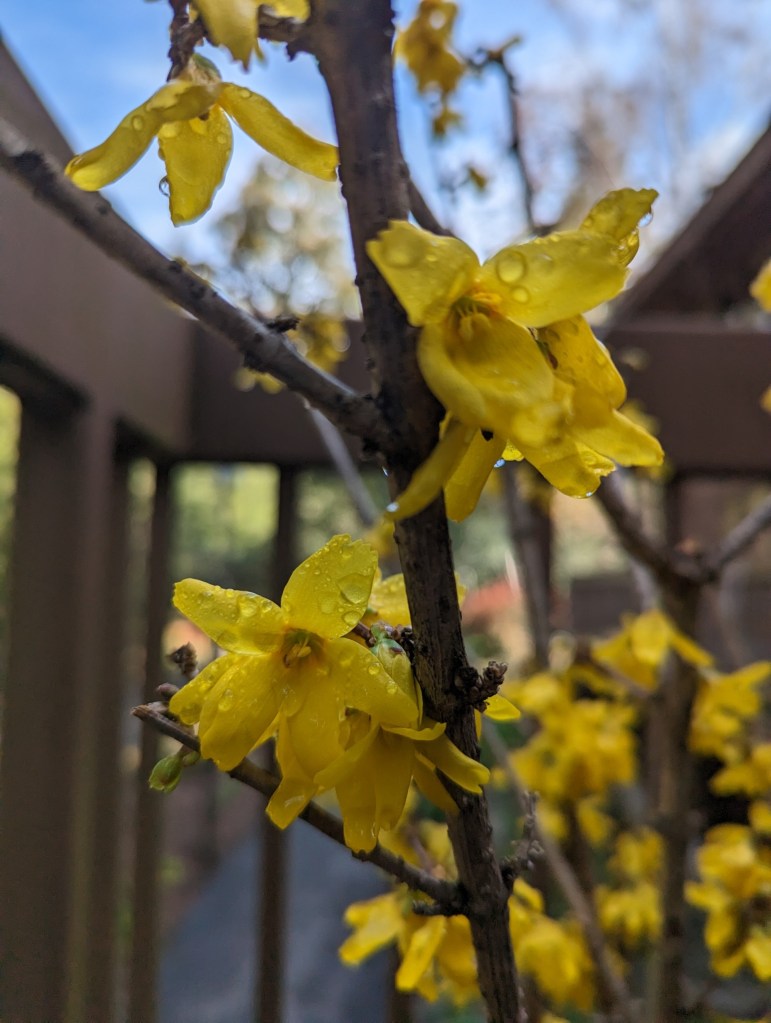
Flowering quince and forsythia set a precedent. Bridal wreath spiraea, Spirea prunifolia, somehow became old fashioned too. All three are only beginning to regain popularity. All are deciduous, so defoliate for autumn and remain bare through winter. They then bloom spectacularly on bare stems for late winter or early spring. Foliage develops after bloom.

Bridal wreath spiraea, like forsythia, develops many upright and arching basal stems. Its stems can grow taller than eight feet, although they are typically a bit shorter. Removal of old stems after bloom promotes growth of new stems, which bloom better. Indiscriminate pruning ruins their naturally upwardly flaring form. A slight bit of partial shade is tolerable.

Almost all bridal wreath spiraea are of the cultivar ‘Plena’. Their double flowers are fluffy but tiny, between just a quarter and a half inch wide. The simple species, and the variety ‘simpliciflora‘ with single flowers, are rare. Regardless of floral form, floral color is limited to white. Foliage might develop yellow color for autumn where autumn weather is cooler.

Blue Marguerite

Not many flowers are as blue as blue marguerite is.

            Like all sorts of daisies, gazanias, ice plants and so many of the familiar flowers in the Compositae family, blue marguerite, Felicia amelloides, is endemic to South Africa. Their flowers are the colors of the flag of Sweden though, with clear blue petals around bright yellow centers. These inch wide or slightly wider flowers bloom on well groomed plants most of the time, except during cool weather. Plants that do not get dead headed (groomed of deteriorating flowers) take breaks between bloom phases. The simple inch long leaves seem to be glossy, but almost have the texture of a cat’s tongue.    

            Mature plants may be taller than a foot and broader than four feet. Their somewhat woody stems are not as substantial as they should be, so can break easily, leaving awkward holes in otherwise well rounded shrubs. Unfortunately, the healthiest plants may live for only a few years. Distressed plants actually last a bit longer. Aggressive pruning at the end of summer or just before spring can restore old deteriorating plants for a while.

            Blue marguerite likes well drained soil, good sun exposure and somewhat regular watering. It is most often used as a colorful and shapely perennial, but is colorful enough for pots and urns of mixed perennials or annuals.

Saint John’s Wort

Saint John’s wort is a survivor.

Saint John’s wort is the common name of a few species of Hypericum. Hypericum beanii sometimes gets the distinction of Bean’s Saint John’s wort. That sounds more like carob, Ceratonia siliqua, though. Carob is the locust bean that sustained Saint John the Baptist in the desert. Mr. Bean was actually a respected botanist of the Royal Botanical Garden.

This Saint John’s wort is not as invasive as naturalized sorts, but is as resilient. Although rarely available from nurseries, it survives in old and neglected landscapes. Established specimens need no irrigation, but perform better with it. This species is likely rare merely because of its resemblance to invasive sorts. It propagates quite efficiently from cuttings.

Hypericum beanii is a shrubby species, unlike more familiar ground cover types. It grows about two or three feet tall and wide. Its bright yellow flowers are about two inches wide, and bloom through summer. Foliage is deciduous where winter is cooler. Here, it is likely to linger until spring foliage replaces it. Partial shade is tolerable, but might inhibit bloom.

Lilac

Lilac is splendidly fragrant!

‘French Hybrids’ are not fuel efficient European cars. (However, if there were a French equivalent to the old Japanese Datsun ‘Z’ that was instead named the ‘S’, we could really see the ‘S car go!’) ‘French Hybrids’ are varieties of lilac with single or double flowers in various shades of lavender, pink, pale blue, pinkish red, purple and white. Some have flowers that are two-toned. ‘Primrose’ is an interesting shade of pale yellow. All are strongly but elegantly fragrant. 

Even though ‘French Hybrids’ have the advantage of being better adapted to mild winters, the original species of common lilac, Syringa vulgaris, and its older varieties seem to do just fine locally, and actually seem to be more fragrant. The only disadvantage is that almost all bloom with lavender flowers. ‘Alba’, with white flower, is rare. ‘Descanso Hybrids’ were developed for even milder winters.  

The individual tubular flowers are actually very small, but bloom in dense conical trusses that are typically about three or four inches long, and possibly twice as long. Trusses develop on year old stems, so pruning should be done right after bloom only, although dead-heading (removing deteriorating trusses) without pruning can be done at any time. The soft and sometimes light green leaves are about three inches long. Mature plants are often eight feet tall and nearly as broad, and can get twice as large.

Unlike most plants that get suckers that need to be removed, most lilacs should instead be pruned to remove older canes and to promote healthier growth of suckers. This process of ‘alternating canes’ continually replaces less productive deteriorating stems with vigorous new stems. Old fashioned grafted plants are the only lilacs that should have their suckers removed; but they are uncommon, and do not sucker as much anyway.

Azalea

Azalea bloom can almost obscure foliage.

Azaleas, which are species of Rhododendron, have been in cultivation for centuries. At least ten thousand cultivars are documentable. Most are interspecific hybrids. Only a few are selections or breeds of simple species. Most of their ancestral species are native to Asia, Europe or North America. Almost all cultivars that are available here are evergreen.

Azaleas can bloom profusely enough during April or May to almost obscure their foliage. Bloom may last for more than two weeks. Floral color ranges between white and red with many tints of pink, salmon and magenta. The most profuse flowers are as narrow as half an inch. Larger flowers may be three inches wide. Rare deciduous azaleas are fragrant.

Azaleas do not grow fast, but can eventually sprawl more than five feet wide. Some can grow nearly twice as wide. Although most do not grow much taller than three feet, some can grow twice as tall. Azaleas are naturally understory species, so can tolerate a bit of partial shade. They should not crave fertilizer. If they do, they prefer acidifying fertilizer.