Six on Saturday: Not My Garden


My garden really is not much to talk about. Really. It is just a bunch of redwoods with a bit of other native vegetation dominating the few items that I added into the mix. There are fourteen stock fig trees, but they are very small and mostly obscured by the underbrush. The elderberries, currants and huckleberries are the same as what grows wild, so they do not look like much either. Even the cane berries look very similar to the native blackberries. There is a quince tree, some rhubarb, and some small prickly pear, but they are barely visible amongst the other vegetation. Well, that is enough talk about why my garden is not much to talk about.

These pictures are from one of the gardens that one of my colleagues maintains.

1. Hibiscus is probably the flashiest bloom in this garden now. I have no idea what cultivar this hibiscus is; and I am not even certain about the species. It sure is impressive though. This flower is more than six inches wide!P80901

2. Red honeysuckle is something that I really want to grow, but can not justify it. I mean, it does not exactly ‘do’ anything more than look good. It is not fragrant like Japanese honeysuckle is. This one took a while to bloom.P80901+

3. Zonal geranium happens to be one of my favorite perennials, even if others consider it to be too cheap and common. I do not know if this one is pink, peach, salmon . . . or one of those odd colors that only girls can see.P80901++

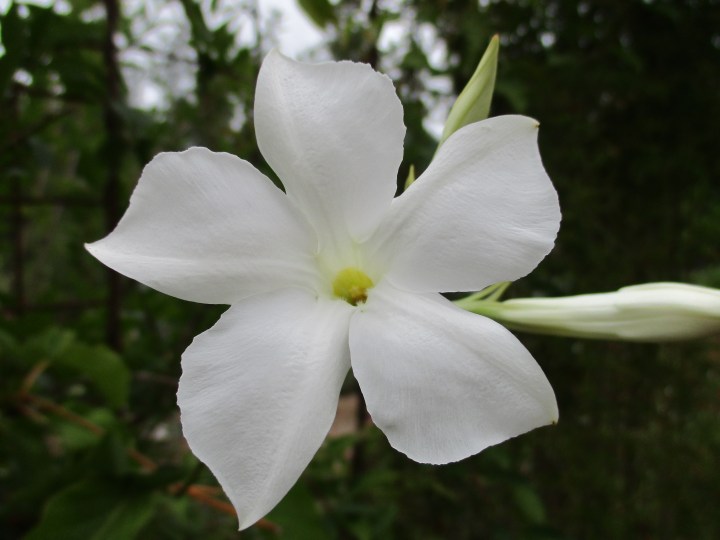
4. Mandevilla is my best guess. Again, I do not know the species. Did I mention that this is not my garden? I do happen to like this one though, because it is so perfectly white. Otherwise, I am none too keen on mandevilla.P80901+++
5. Morning glory is quite happy here. This one is annual of course. There was a perennial white morning glory known as a moonflower nearby, but it succumbed to frost last winter. Hope for its recovery ran out months ago.P80901++++

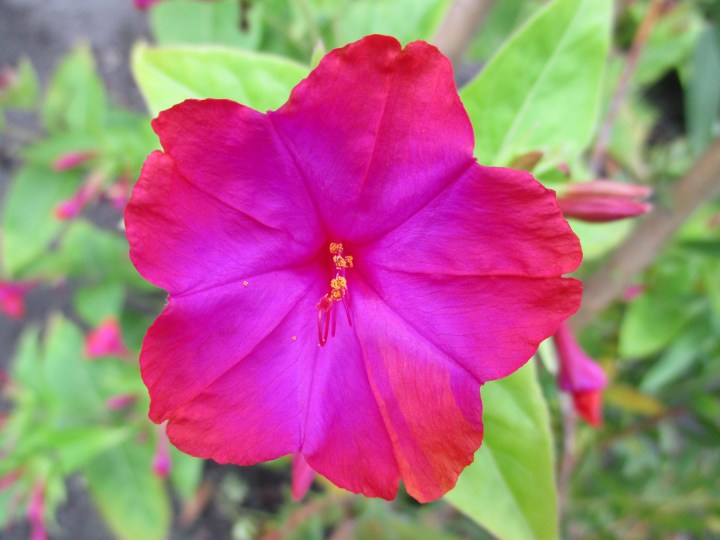
6. 4:00 (four o’clock) is a prolific naturalized exotic species. I would not say that it is invasive, but merely prolific. I do not know if this one is 4:00 a.m. or 4:00 p.m., but I do know it will not be the last. More on that later.P80901+++++
This is the link for Six on Saturday, for anyone else who would like to participate:

https://thepropagatorblog.wordpress.com/2017/09/18/six-on-saturday-a-participant-guide/


Fernleaf Yarrow

70830‘Moonshine’ is probably the epitome of fernleaf yarrow, Achillea filipendulina, even though it is technically a hybrid. From the middle to the end of summer, its three inch wide corymbs (flat-topped trusses) of tiny bright yellow flowers stand as high as three feet above ferny and gray basal foliage. Bloom is best in full sun and warm exposure. Established plants do not need too much water.
Most varieties of fernleaf yarrow also bloom with bright yellow or gold flowers. Some might bloom with pale yellow, rosy pink, pale pink, reddish, white or pink and white flowers. All are good cut flowers, and can be dried. Some varieties are more compact. The most compact varieties work nicely in planters of mixed perennials. Butterflies and hummingbirds find them wherever they are.

Pruning out deteriorating blooms may promote sporadic subsequent bloom until autumn. However, some plants may bloom all at once, and then not bloom again until the following summer. Large blooms on the most vigorous plants may need to be staked. New plants can be propagated by division from mature plants. ‘Moonshine’ and many other cultivars are sterile. Others might self sow.

Flowers Might Be Getting Scarce

70830thumbIt makes sense for flowers to bloom in spring. Winter is too cool, windy and damp for both flowers and the insects that pollinate many of them. By summer, successfully pollinated flowers have faded, are busy making seed to disperse in autumn. Some plants produce fruit to get birds and other animals to disperse their seed. There are certain advantages to blooming early in the spring.

Native plants that are endemic to chaparral climates are quicker with bloom, so that they finish before the air gets too arid. Desert plants might bloom for less than a week. Some tropical plants might bloom whenever they want to because they do not understand the concept of seasons, but they are not the prominent plants in our gardens. Therefore, flowers get scarce this time of year.

Besides the few perennials and annuals that bloom as long as the weather stays warm, there are not many plants that bloom reliably so late in summer. Belladonna lily, which is also known as naked lady, might be one of the flashiest, as its bright pink flowers bloom on top of bare stalks before the low basal foliage develops. It was actually dormant through the warmest part of summer.

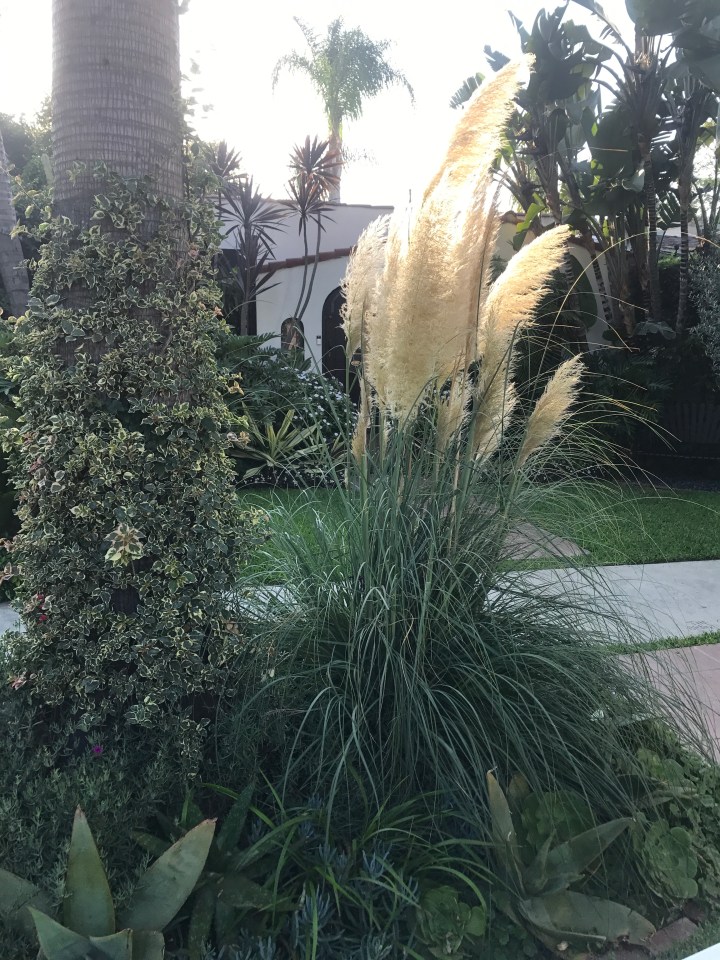
Billowy and bold pampas grass flowers bloom this time of year, but are uncommon. The boldest type of pampas grass is too big and difficult to manage for home gardens. The smaller type has dingy tan flowers, and is so invasive and weedy that it is unavailable in nurseries. Those of us who have it in our gardens did not plant it. Other grasses with nice late flowers are not very colorful.

Russian sage has become one of the more popular late blooming perennials. More traditional Japanese anemone, goldenrod, lion’s tail and showy stonecrop all seem to have lost popularity over the years. Mexican blue sage should bloom best late in summer, but often finishes sooner than expected. Yarrow often blooms later than expected, until summer ends. Marigold, blanket flower and some sunflowers bloom until frost. Chrysanthemums, whether grown as annuals or perennials, are just beginning late in summer.

Cosmos

80905Their pastel hues and blends of pink, lavender, near red and white are so perfect for the middle of spring when cosmos, Cosmos bipinnatus, begin to bloom. They are just as perfect as bloom continues right through summer and almost to autumn, when the tall and airy plants finally begin to wear themselves out. If they continue through autumn, they eventually succumb to frost in winter.
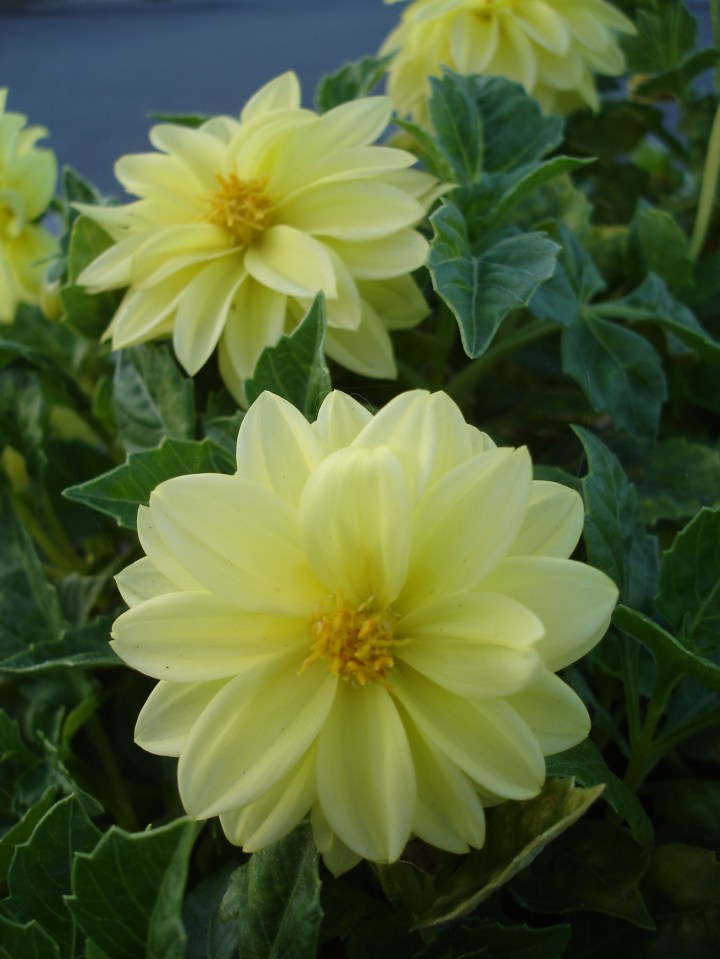
Individual flowers are as delicate as they look, but are prolific. New flowers replace older flowers a quickly as they fade. Deadheading promotes even better bloom. A few of the last flowers to bloom can be left as the season ends to sow seed for next year. However, fancy cultivars are not true to type, so subsequent generations will be more like the basic specie, with simpler flowers.

Cosmos likes full sun exposure, rich soil and regular watering. Mature plants are about two or three, or even four feet tall, although the most popular varieties stay shorter and more compact. The species name of ‘bipinnatus‘ refers to the pinnate leaves that are divided into very narrow lobes that are also divided into even narrower lobes. The collective foliage is very delicate, lacy and airy.

Flowers For Late Summer Bloom

80905thumbNo mater how much work we put into our roses to sustain bloom all through the season, and not matter how successful we are with that endeavor, the first spring bloom is always the best. Some roses continue to bloom in floriferous phases afterward, while others bloom sporadically but continually; but there is nothing like the first bloom phase. The last blooms are just waiting for autumn.
Of course, concentrating resources into early bloom is very sensible. That is why so many plants bloom only once in spring. It gives them time to get pollinated, develop seed and fruit structures, and finally disperse their seed or fruit structures, all before winter. Plants that bloom in summer or autumn are either from regions where winters are not too harsh, or where summers are harsher.

Because summer weather in most regions tends to be warmer and drier than spring weather, flowers that prefer to bloom in summer tend to be more prolific but smaller and less colorful. By this time of year, they are more reliant on wind for pollination rather than insects anyway. Therefore, they do not need to be big and colorful to attract pollinators, although some are fragrant just in case.

Sunflower, blanket flower, cone flower, zinnia, cosmos, delphinium, dahlia and of course rose, are some of the favorite flowers in the garden as well as for cutting in late summer and into autumn. Cut dahlia flowers should get their water changed daily so that they do not rot and smell bad so soon. Canna blooms about now, but does not last so well as cut flowers. Lily-of-the-Nile is finished.

Believe it or not, lemon bottlebrush is a delightful cut flower for those who are not allergic to it or repelled by the aromatic foliage. So are some of the showier eucalyptus, such as the red flowering gum, Eucalyptus ficifolia. Mexican blue sage that was cut back to the ground over winter blooms a bit in spring, takes a bit of time off through summer, and then starts to bloom as summer ends, ultimately blooming spectacularly early in autumn. A few other sages bloom as late, but few are good for cutting.

Garden Bloggers’ Bloom Day August 15 – Summer Weather Continues . . . Mostly


We were fortunate to have missed out on the unpleasant warmth that most everyone in the Northern Hemisphere experienced. It was warm here, but no warmer than is normal for summer. The only difficulty is that it got so warm so suddenly after such mild weather early in summer. Some of the flowers that were blooming at that time finished a bit earlier as a result of the weather.

Flowers that are blooming now are somewhat on schedule. Chrysanthemum does not see to have much of schedule, but that should be expected. Although I would guess that they are early, those who know better tell me that naked lady is right on time.

Those in other climates have no problem talking about the end of summer or even the incoming autumn already. I am not ready to give up on summer. I will likely be talking about it still in September. I can talk about autumn in October.

These pictures were taken on the Santa Cruz County side of the Santa Cruz Mountains above Los Gatos, closer to Felton. The climate is more coastal than the chaparral climate of the Santa Clara Valley, although both are within USDA Zone 9.

Naked lady started blooming about a week ago, just long enough for the first of the bloomed flowers to start deteriorating in the background. I thought this was somewhat early, but a colleague, who is incidentally not at all horticulturally oriented, informed me that this is exactly the right time for them. When I was a kid getting ready to go back to school, I remember them blooming in September in Montara, but that was many miles away, and in a somewhat different and more coastal climate.8bd1

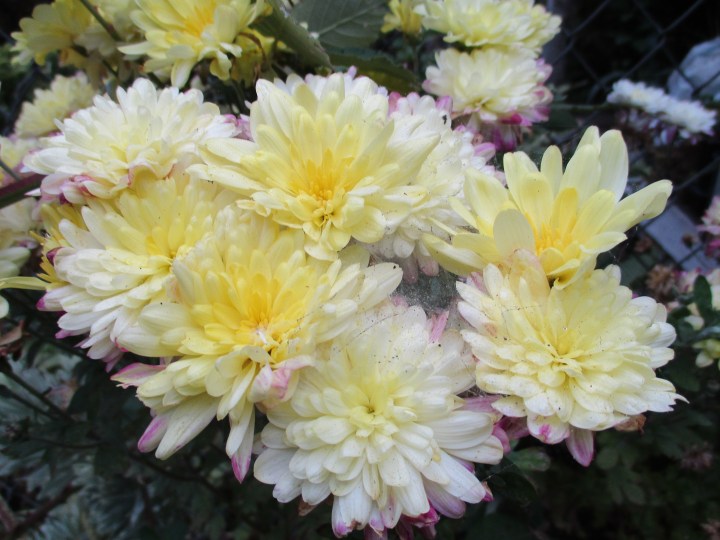
Chrysanthemum is another flower that I think of as blooming later, and even into autumn. Yet, these have been blooming since late spring. There are different cultivars that bloomed at different times. These are the latest, but are already starting to deteriorate. Perhaps those that already finished will bloom for another phase in autumn. It is difficult to say. I think that they bloom whenever they want to here.8bd2

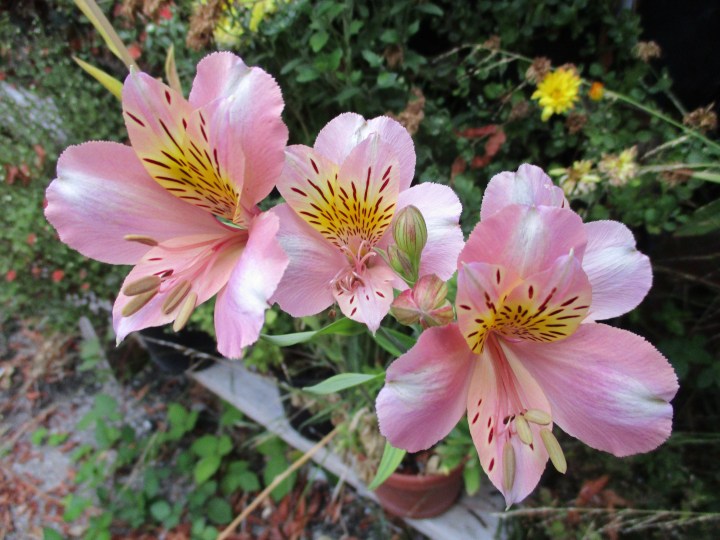
Peruvian lily is blooming for a second phase, which really is right on schedule. The main and most prolific bloom phase was in late spring. After those flowers finished and deteriorated, the finished stalks got plucked, leaving only a bit of vegetative stems sprawling on the ground, and a few unbloomed stalks that are blooming now. After bloom, the finished stalks will probably get cut in half, but not plucked. That technique removes the seed capsules and keeps the tall and lanky stalks from falling over, but also leaves a bit of foliage to help the lower vegetative growth recharge the system for bloom next year.8bd3

Rose blooms all summer. Some of the hybrid tea roses bloom in more obvious phases after their most prolific first phase. Floribunda roses like this one bloom so steadily that there is not much separation between phases. This particular rose is in a pot that was not likely watered enough through the earlier warm weather, so subsequent bloom was not expected. Some of the petals are a bit roasted around the edges.8bd4

Zonal geranium blooms about as steadily as floribunda roses do. They would bloom right through winter if there did not need to be cut back before spring. Some zonal geraniums put out quite a bit of new growth recently. It will be awkward to cut them back at the end of next winter. The stems that are fresh and new now will still be in good condition right through winter, so I will not want to cut them back like I should. The flower of this zonal geranium is the same color as the rose above.8bd5

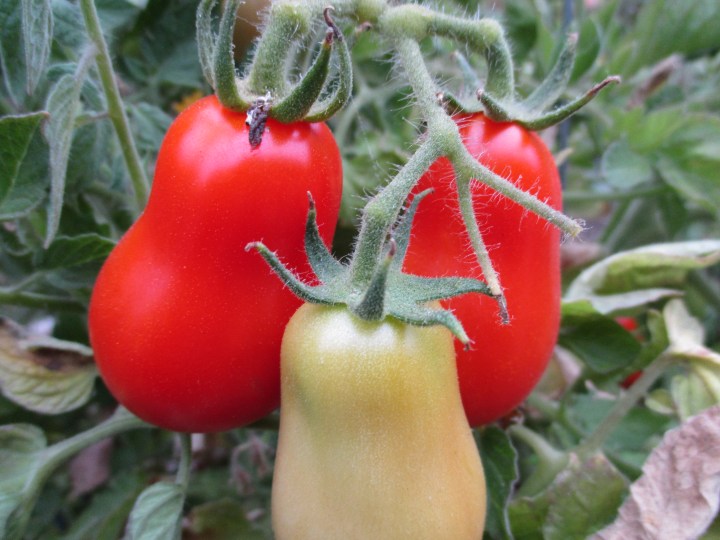
San Marzano tomato is NOT what this tomato is. It was labeled as such, but looks more like common ‘Roma’. No one is complaining. There is certainly nothing wrong with it, except that it is not what was expected. Hey, this unknown tomato is the same color as the zonal geranium above, which is the same color as the rose above. All the other flowers above are from plants that are in the storage nursery at work. These tomatoes are in a colleague’s garden adjacent to the nursery.8bd6

Garden Bloggers all over America and in other countries can share what is blooming in their gardens on the fifteenth of each month on “Garden Bloggers’ Bloom Day”, hosted by Carol Micheal’s May Dreams Garden at http://www.maydreamsgardens.com

Cockscomb

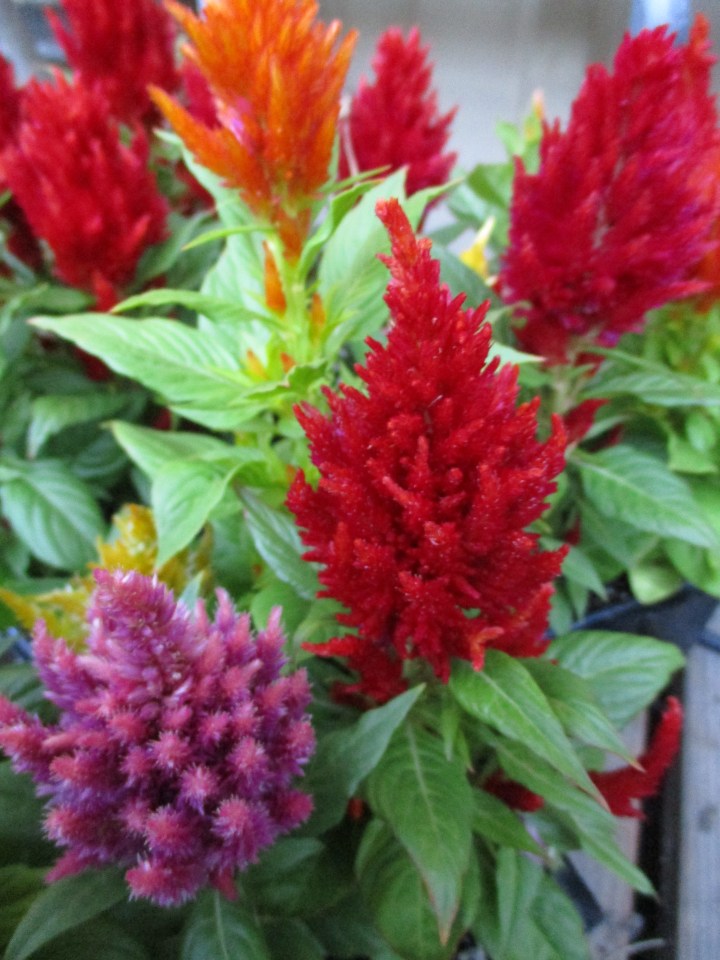
80822Not all annuals last as long as petunias do through summer, or pansies do through winter. Some fill in for the in between seasons, or if longer term annuals do not last quite as long as they should. Cockscomb, Celosia plumosa, blooms best now that it is about halfway through summer, and then finishes as weather gets too cool for it in late autumn, not so much more than two months later.

The common name of cockscomb is actually derived from another species, Celosia cristata, which blooms with oddly stunted and flared blooms that supposedly resemble the combs of roosters, but the most popular varieties are so stunted that they actually look more like little fuzzy brains. Celosia plumosa blooms are more feathery, like those of pampas grass, but only three inches long.

The red, orange, yellow and pink blooms are as brightly colored as a pinata. Mixed colors, which might include softer pink, are the most popular for six packs and seed. White is notably lacking from popular mixes, and is only rarely available separately. Some varieties have bronzed foliage. Cockscomb lasts more than a week as a cut flower, but blooms on rather short and stout stems.

Phlox

80815Those outside California sometimes envy our ideal climates and soils. More of a variety of plants can be grown here than in most other places in America. There are not many plants that can be grown elsewhere that will not grow here. However, phlox, Phlox paniculata, is an example of a plant that can do well here, but for some reason or another, is much more popular everywhere else.
Phlox is native to much of the eastern half of North America, and has naturalized in other areas where it escaped cultivation in home gardens. Locally, it needs to be watered regularly to bloom on time in late summer. It is quite happy out in the open but might prefer a bit of partial shade in the afternoon here where summers are warm and dry. Powdery mildew can sometimes be a problem.

Bloom can be various hues of pink, purplish pink, red or white. The inch wide flowers are neatly arranged on conical terminal panicles about four to six inches wide. Blooming stems stand almost three feet tall and spread almost as wide. The somewhat narrow leaves are about four inches long. Phlox is mostly grown from seed, and can be propagated by division of perennial basal growth.

Six on Saturday: Bits and Pieces

There were no major projects this week that were interesting enough to get six pictures of. The best that I could do was get six random pictures of random features of the landscapes. I do not actually do much to cultivate flowers, but they happen to be components of the landscapes. Most are perennials that bloom on their own. Of course, I do not mind taking credit for them.

Some blooms started late while the weather was mild, but were then accelerated as the weather suddenly warmed. It seemed that several different types of flowers needed to be deadheaded at the same time. Zonal geraniums and lily-of-the-Nile are two of the most reliable perennials that bloom on schedule no matter what. Zonal geraniums bloom sporadically most of the time, and only bloom more while the weather is warm. Lily-of-the-Nile may start a bit early or a bit late, but is always in full bloom on the fourth of July. The blooms even look like exploding fireworks. More than two weeks later, their flowers are still in full color but will slowly start to fade. Phlox was a surprise for us.

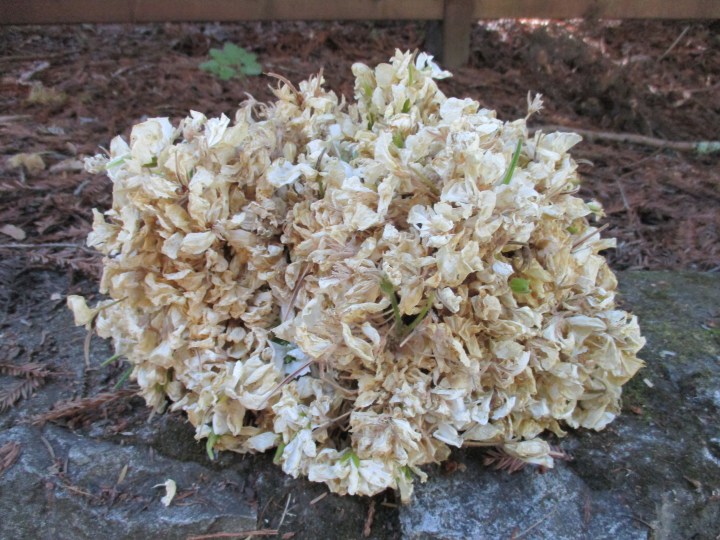
1. Can you guess what this bloom is?P80728

2. You can probably guess that this is phlox. It sure had my colleagues and I perplexed. We had never seen anything like it. Phlox is uncommon here. I would even say it is rare. No one knows why. It just is. I got a picture of it a few years ago only because I was intrigued by it in a neighboring landscape. It took a bit of effort to identify it, although I sort of suspected that it was phlox. It did not look quite like this phlox, and was lower to the ground. No one knows how this one got into the landscape. We suspect it arrived with the ‘fertilizer’ that the horses make for us.P80728+

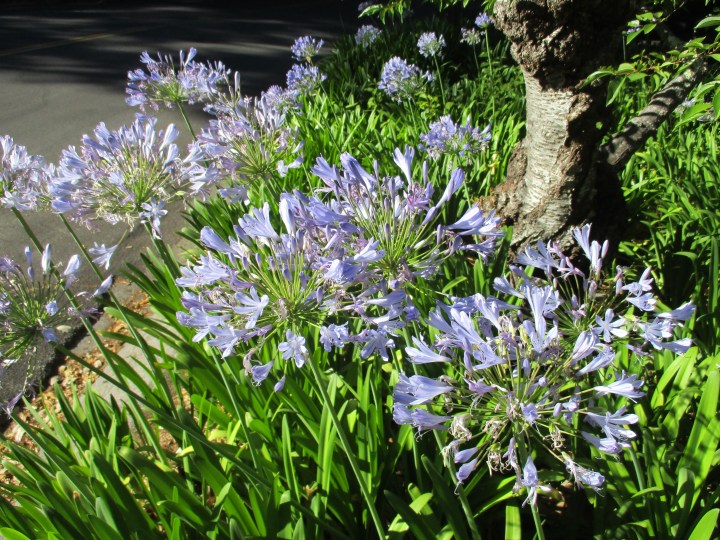
3. Lily-of-the-Nile is still one of my all time favorite summer blooming perennials. I do not care how cheap and common it is. It is one of the first perennials I divided while I was in junior high school. I grew more than eighty new plants from a single old plant that needed to be removed. It was the old fashioned sort, with big blue flowers and big flabby leaves, perhaps bigger than these. I also like the white ones with the same big flowers and leaves, of course, because they are white. All the fancy modern cultivars are nice too, but not as excellent as the originals. I do like seeing the very pale blue ones in other gardens.P80728++

4. This zonal geranium has these small but cheery cherry red flowers, but it is really grown for the weirdly variegated foliage that is blurry in the background. I think that these flowers would look better against simple green foliage. There is another zonal geranium in another part of the landscape, with small peachy pink flowers and foliage that is variegated only with white. I am none too keen on the flower color, and I am not often too keen on variegation, but the foliage of that particular zonal geranium really looks sharp.P80728+++

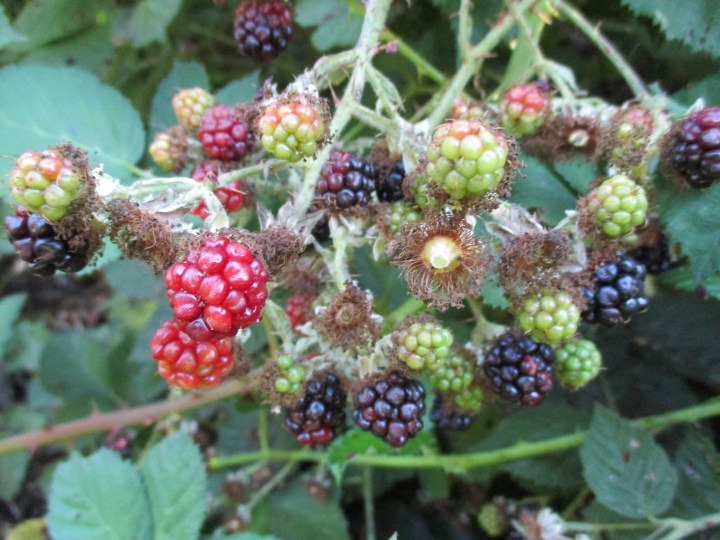
5. Himalayan blackberry is one of the worst and most invasive of the exotics weeds here. It develops huge canes that arch over and drop on top of other plants in the landscape. The wickedly sharp prickles (technical term for their thorns) are tortuous when trying to remove the canes. Even picking their berries is nasty business! There are a few berries ripening now, and they happen to be pretty good, but they are sooooooo not worth it.P80728++++

6. Chips needed to be dispersed into the newly landscaped areas that are partially visible in the background of this picture. These chips were free. They are made of recycled wood waste. For our purposes, they are sufficient. However, they include a few large chunks of wood and bits of metal. The chunk of metal in this picture is a short section of rebar. Some of the chips have paint on them. Some seem to be bits of old furniture. It makes one wonder where some of this material came from.P80728+++++

By the way, the bloom in the first picture #1 is merely a fist full of deadheaded white zonal geranium flowers all pressed together. White zonal geraniums do not readily drop their faded blooms like other zonal geraniums do, so they need to be deadheaded.

This is the link for Six on Saturday, for anyone else who would like to participate:

https://thepropagatorblog.wordpress.com/2017/09/18/six-on-saturday-a-participant-guide/

Six on Saturday: New Landscape


Yes, we have another new landscape. It is not much bigger than the last one, and is not very far away. In fact, although it is associated with two different buildings, it is located adjacent to the opposite corner of the same building that the last landscape was constructed for. https://tonytomeo.wordpress.com/2018/04/07/six-on-saturday-rock-concert/

These six pictures were taken prior to the installation of wood chip mulch, so ground cloth is visible below. It was quite dry and dusty at the time. All of these six plants were newly installed after being procured from nurseries, so none were relocated from other landscapes, or from our storage nursery. They were blooming nicely when installed, but are actually not blooming so nicely now, and some were damaged by the sudden warmth immediately after installation. They would have been fine if only the warmth did not arrive so suddenly, or if it had arrived a few days later. Well, we can not control the weather.

Large stones and bare soil prior to the installation of the landscape were shown in this previous Six on Saturday post, https://tonytomeo.wordpress.com/2018/06/16/six-on-saturday-rock-on/

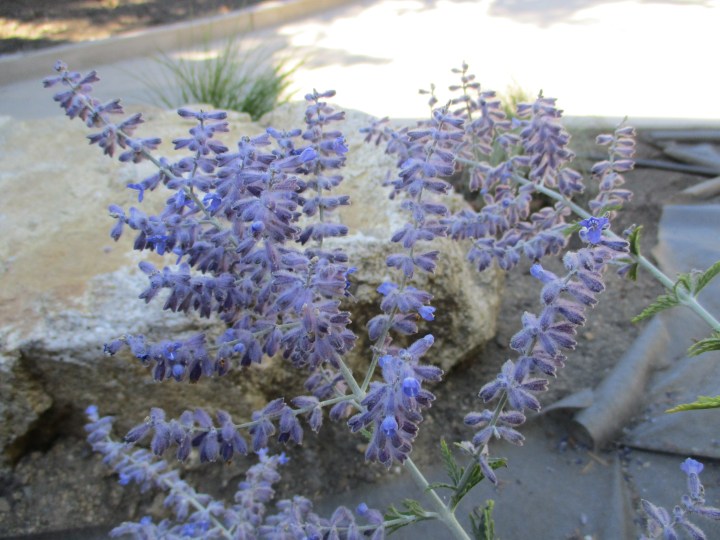
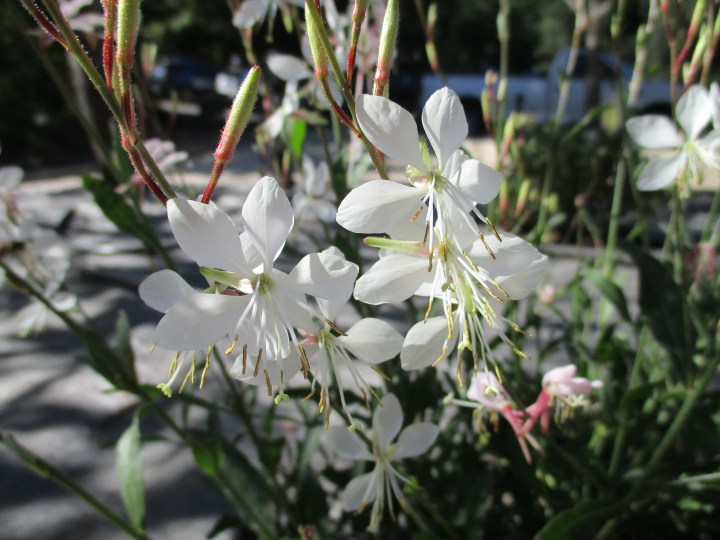
1. fernleaf yarrow, Achillea filipendulina, Most of these are white. A few are rusty red. A few are yellow like this one, which might be ‘Moonshine’. These did not show symptoms of heat stress right away, but have since gotten rather crispy. I could not find a picture like this one now. Fernleaf yarrow has been popular here for as long as I can remember because it supposedly does not need much water, although most get watered regularly.P805212. Russian sage, Perovskia atriplicifolia, That sounds like ‘piroshki’. These and the rockrose #4 were 5 gallon plants, so are somewhat bigger than most other plants in the new landscape. They were not bothered by the change of the weather. Their faded denim blue flowers continue to bloom nicely. This is a plant that has been popular for a while, but that I have never grown. I tend to avoid trendy plants. However, my colleagues do not.P80521+3. gaura, Gaura lindheimeri, The common name is ‘white gaura’, but some are pink and some are darker pink that is almost red. I do not know if they are merely cultivars of ‘white’ gaura, or different specie. It seemed appropriate to omit ‘white’ from the name. Besides, that is how I learned it. This one can self sow enough to be an annoyance. Individual plants do not live very long, so a few feral seedlings can be selected to replace them.P80521++4. rockrose, Cistus cretisus, When I learned about rockrose back in the 1980s, we learned only two specie. One was white rockrose. The other was pink rockrose; and the pink rockrose did not look like this one. Now, there are too many to remember. Most do not have species name, but merely cultivar names. I really do not know if this really is Cistus cretisus. It just happens to look like it. I suppose I should have looked at the label.P80521+++5. chocolate coreopsis, Coreopsis ‘Chocolate’, As I implied for #4, nomenclature is not what it used to be. It was standardized to simplify things, but is difficult to keep track of now with all the breeding and hybridizing, and botanists wanting to make a name for themselves by changing a name to something supposedly more accurate. I really do not know the species name of the chocolate coreopsis. It is known merely by the cultivar name.P80521++++6. milkweed, Asclepias tuberosa, This one wilted rather badly in the warmth, but did not get roasted too much. The shriveled flowers in this picture are the worst of the damage. It is blooming more profusely now, and is developing strange seed pods. Milkweed is another trendy plant that caters to the butterfly gardening fad. I am not certain if I like the idea of planting something that is expected to get munched. It sure is colorful for now.P80521+++++This is the link for Six on Saturday, for anyone else who would like to participate:
https://thepropagatorblog.wordpress.com/2017/09/18/six-on-saturday-a-participant-guide/