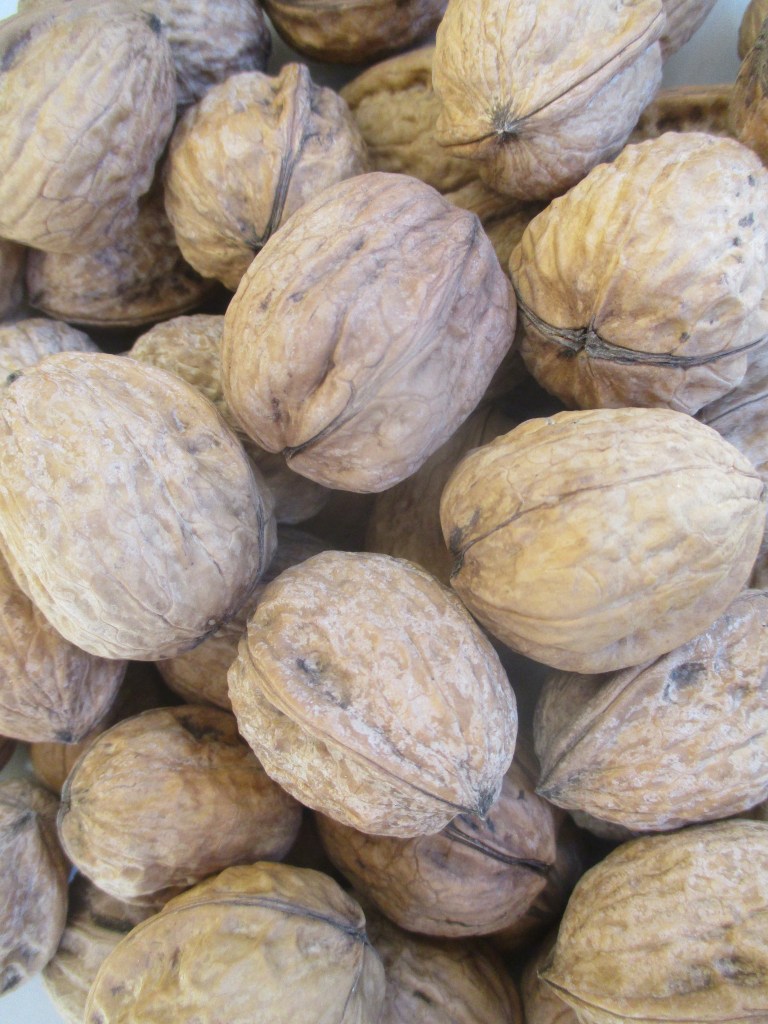
It has been in cultivation for several thousands of years. Throughout that time, it escaped cultivation to naturalize in many regions between the Balkans and the Himalayas. It most likely originated from a much smaller natural range within Persia. An interesting certainty of its dubious original range is that English walnut, Juglans regia, is not actually English.
English walnut likely arrived at Spanish Missions of California prior to 1800. It became a major agricultural commodity of both the Sacramento Valley and the San Joaquin Valley. A few old trees survive within urban areas that were formerly orchards of the Santa Clara Valley. Newer trees are unfortunately rare within home gardens because they get messy.
English walnut trees rarely grow more than forty feet high and wide here. Their abundant foliar, floral and fruit debris is toxic to young plants though, and stains hardscapes. Each type of debris sheds during a different season. Squirrels might claim most or all nuts, but drop shredded hulls. The deciduous and pinnately compound leaves can be a foot long.
Spring is overrated. It is obviously the best season for planting warm season vegetables and bedding plants. It is the most colorful season with more flowers in bloom. There is so much more to gardening though. Most plants prefer autumn planting. Some prefer winter planting. That is why this present bare-root season will be so relevant all through winter.
Dormancy is an advantage to stressful procedures such as planting. Spring bulbs prefer autumn or early winter planting while they are most dormant. For the same reason and to avoid late frost, summer bulbs prefer later winter planting. It should be no surprise that so many deciduous woody plants likewise prefer dormant planting during bare-root season.
Bare-root season is simply when bare-root stock becomes available for planting through winter. Unlike more familiar canned (potted) stock, bare-root stock lacks the medium that it grew in. Their roots are literally bare. Most bare-root stock awaits purchase at nurseries with its roots resting within damp sand. Roots of some are bagged within damp sawdust.
Bare-root stock is innately more practical than typical canned stock. It is significantly less expensive. It is much less cumbersome, and therefore easier to transport from nurseries. Planting is easier within much smaller planting holes. Formerly bare roots disperse new roots into their garden soils more efficiently than crowded formerly canned root systems.
Deciduous fruit trees and roses are the most popular of bare-root stock. Most of such fruit trees are stone fruits and pomme fruits. Stone fruits include almond, apricot, cherry, plum, prune, peach and nectarine, as well as their unusual hybrids. All stone fruits are species of the genus, Prunus. Pomme fruits include apple, pear, Asian pear and perhaps quince.
Fig, pomegranate and persimmon trees should also be available. So should grapevines, currants, gooseberries, blueberries and various cane berries. Strawberries, rhubarb and asparagus are perennials that are available bare-root. Except for almond, most nut trees, including English walnut, pecan, filbert or chestnut, may be available only by mail order. Most mail order catalogs are online now.
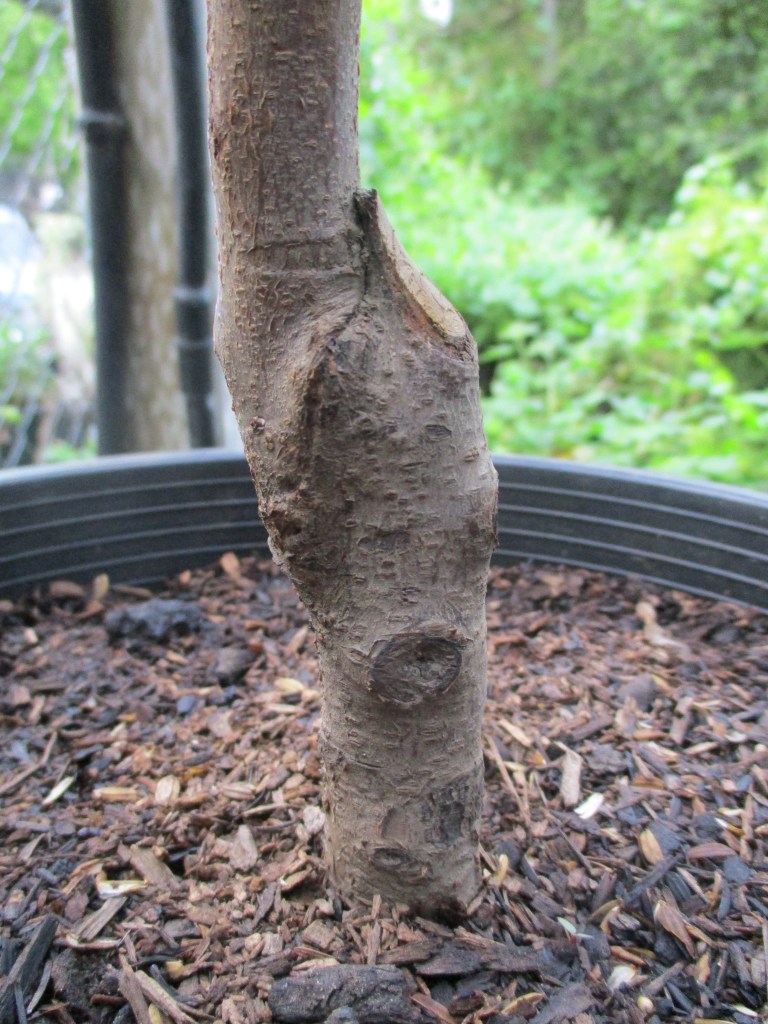
The scion is above this graft union. The rootstock is below.
There are not many Californians of my generation who do not remember growing avocado trees from seeds when we were kids. We simply impaled the big seeds around the middle with three evenly spaced toothpicks to suspend them from the rims of Dixie cups partly full of water. If just the bottoms of these seeds remained properly submerged, they grew roots and a stem with a few leaves, all they needed to grow into trees that were producing too many avocados by the time we got to high school.
Yet, I and others of my generation have always heard that avocado trees need to be grafted to produce fruit. (Grafting is the union of two or more compatible but different plants. The ‘scion’ is the upper portion that forms a trunk, branches and foliage. The ‘rootstock’ is the lower portion that provides roots.) Well, this is obviously not true, but does make us wonder about the advantages of grafted trees.
They myth of seed grown trees being unproductive probably originates from the tendency for seed grown avocado trees to be unproductive for the first few years during the juvenile stage. Scions of grafted trees are taken from adult growth that is ready to bloom and fruit immediately; although even grafted trees need a few years to grow large enough to produce more than just a few avocados.
Many plants are juvenile while young, in order to better compete in the wild. While juvenile, avocado tree seedlings grow vigorously enough to compete with other trees. Adult habits of blooming and fruiting would only slow them down. Besides being fruitless for many years, citrus seedlings are very thorny through their juvenile phase, to avoid getting eaten by grazing animals. Scions of grafted citrus trees are from relatively thornless adult growth that is immediately ready to produce fruit.
The primary advantage of grafting fruit trees though, is keeping the many different cultivars (cultivated varieties) ‘true to type’, since many seed grown plants exhibit at least some degree of genetic variation from their parents. For example, avocados from seed grown (ungrafted) trees tend to be much larger, but often less flavorful than the fruit that the original seed came from. No one really knows what the fruit will be like until it actually develops. Some seed grown peaches are indistinguishable from their parents, but most are very different. However, most pecans and chestnuts are actually produced from ungrafted seed grown trees.
The secondary advantage of grafting fruit trees is the ability to graft onto dwarfing rootstock. Although few avocado trees are dwarf trees, almost all citrus trees for home gardens are grafted onto dwarfing rootstock that keeps them more compact and proportionate to home gardens. Most deciduous fruit trees are similarly grafted onto semi-dwarf rootstock.
Without specialized pruning, fruit trees become sloppy and unable to sustain all of their fruit.
As long as it gets done well before buds begin to swell late in winter, the meticulous and specialized pruning that deciduous fruit trees and roses require during winter dormancy does not need to be done immediately. Here where the climate is so mild, some roses may still be blooming. The main advantage to getting an early start is that those of us who have many fruit trees and roses in need of pruning have more time to get them all done within the proper time.
If it helps to start pruning early, it is best to prune fruit trees and roses in the same order that they go dormant and defoliate. The ‘stone’ fruits (those of the genus Prunus, that have large pits known as ‘stones’), like apricots, cherries, nectarines and peaches typically defoliate earlier than the ‘pomme’ fruits, like apples, pears and quinces. Modern ‘carpet’ roses may not defoliate completely, so can be delayed until after all the bare roses get pruned, but may eventually need to get pruned while still partially foliated.
The specialized pruning that deciduous fruit trees and roses need is serious business. Those who do not know how to do it properly should learn about it before actually doing it. Improper pruning of fruit trees can inhibit production and damage the trees. Roses are not so easily damaged, but will get overgrown and not bloom as well if not pruned aggressively enough. (This sort of pruning will be a topic later in the season.)
Like fruit trees and roses, other trees and shrubs that need pruning prefer to be pruned while dormant through autumn and winter. Deciduous trees and shrubs are obviously dormant while bare, but realistically, are ready to be pruned when their foliage is no longer green.
Evergreen plants are not so obviously dormant, but will be as dormant as they get through winter. This would therefore be a good time to prune to eliminate pine limbs that are too low. If pruned a bit early, the pruning wounds will get weathered more through winter and consequently bleed less through spring.
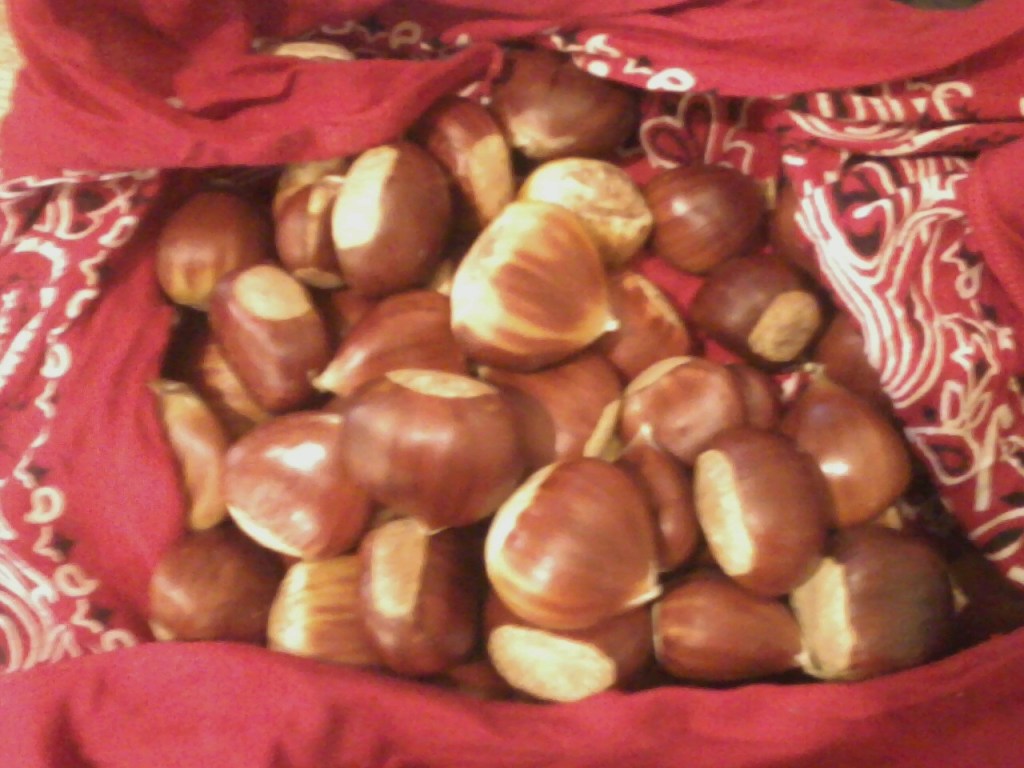
These chestnuts that may later be ‘roasting on an open fire’ are now falling from the trees that produced them over summer.
Of all the nut trees that are actually quite easy to grow, the chestnut, Castanea (various specie and hybrids), has somehow become the most obscure. It probably lost popularity while native forests in eastern North America were being annihilated by rampant disease (which never became such a threat in the west), but may be unpopular simply because it can get so big. Mature trees are regularly more than seventy feet tall and nearly as broad.
Chestnut trees are productive for those who like the nuts, but simply very messy for those who do not. The smooth meaty nuts are contained within offensively spiny husks known as ‘burrs’. A few varieties of chestnuts fall freely from the burrs. Most need to be separated from their burrs even after they fall to the ground. The evenly serrate leaves will soon be turning amber gold or brown for autumn.
For gardening, this is one of those in between times of year, when summer chores are under control, but it is a bit too early for much of the work that will need to be done in autumn. Automated watering systems have already been adjusted for the longest and warmest days of summer, so will only need to be adjusted the other way as days eventually get cooler and shorter. Growth of most plants slows; and some of the plants that will later be the earliest to show fall color begin to fade from bright green to paler green.
The last of the summer fruits should be gone, leaving the trees that produced them looking somewhat tired. The weight of large fruit, particularly peaches, might have pulled stems downward where they may now be obtrusive. Pruning a few minor stems should not be a problem. However, trees are still too vascularly active for major pruning. That needs to wait for dormant pruning while trees are bare in winter.
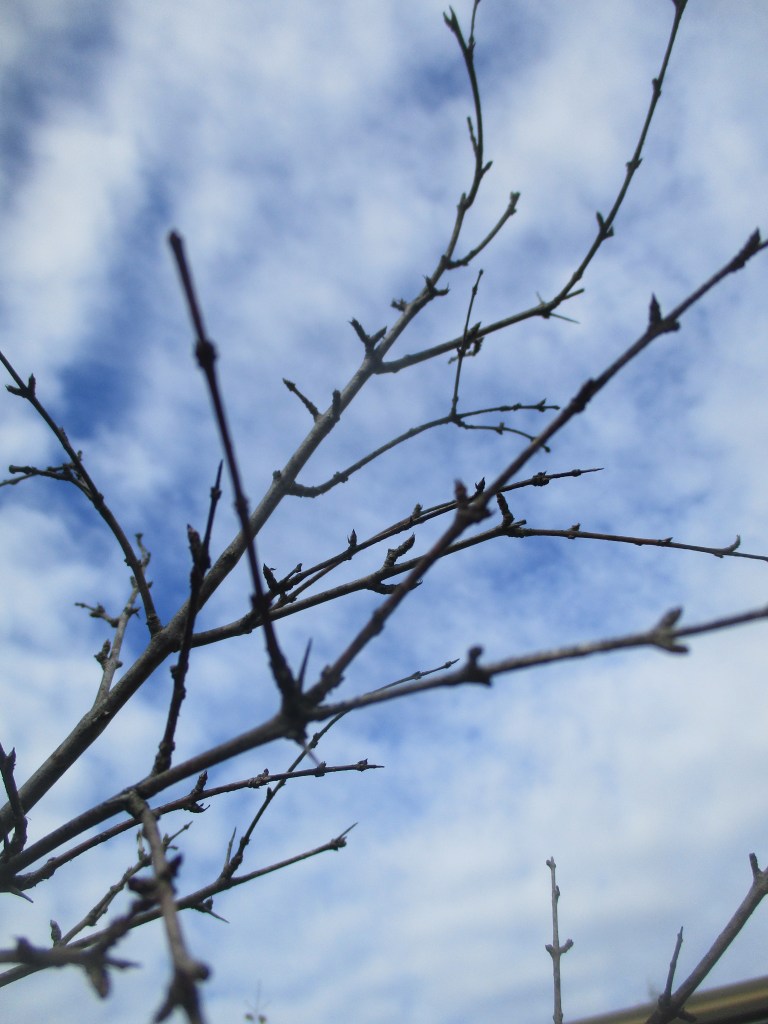
A few plants with sensitive bark are susceptible to sun scald if pruned to expose too much bark on interior stems while the sun is still high and warm. This is not so likely to be a problem if pruned during winter because the sun is lower and cooler, and foliage grows back before the following summer. Actually, that is why English walnut and various maples are able to defoliate during winter, even though their smooth bark needs to be shaded.
Pruning of plants that are potentially sensitive to frost should likewise be delayed. Otherwise, pruning is likely to stimulate development of tender new growth that will be even more sensitive to frost during winter. Besides, new growth develops slower this time of year, so plants look freshly pruned for a longer time than if pruned late in winter, just prior to spring.
Some types of pittosporum are more susceptible to disease if pruned in late summer or autumn because their open pruning wounds heal slowly and stay open to infection during rainy winter weather. However, slow recovery from pruning can be an advantage to formally shorn hedges that are not so sensitive to frost or disease, such as the various boxwoods, or glossy or wax privets. If shorn now, they might stay trim until spring.
The dried foliar remains of any summer bulbs that are finished blooming can now be plucked and disposed of. Gladiolus and montbretias that are still green can be deadheaded (pruned to remove deteriorated flower stalks), but should be allowed to turn completely brown before getting plucked. Watsonias are not so easy to pluck without also pulling up the bulbs, so should instead get their dried foliage pruned off.
Weeds outside of landscaped areas may not seem to be a problem, but many are now producing seed that gets blown into the garden. Even if such weeds do not need to be pulled, their flowers and seeding stalks should still be cut off and removed if possible.
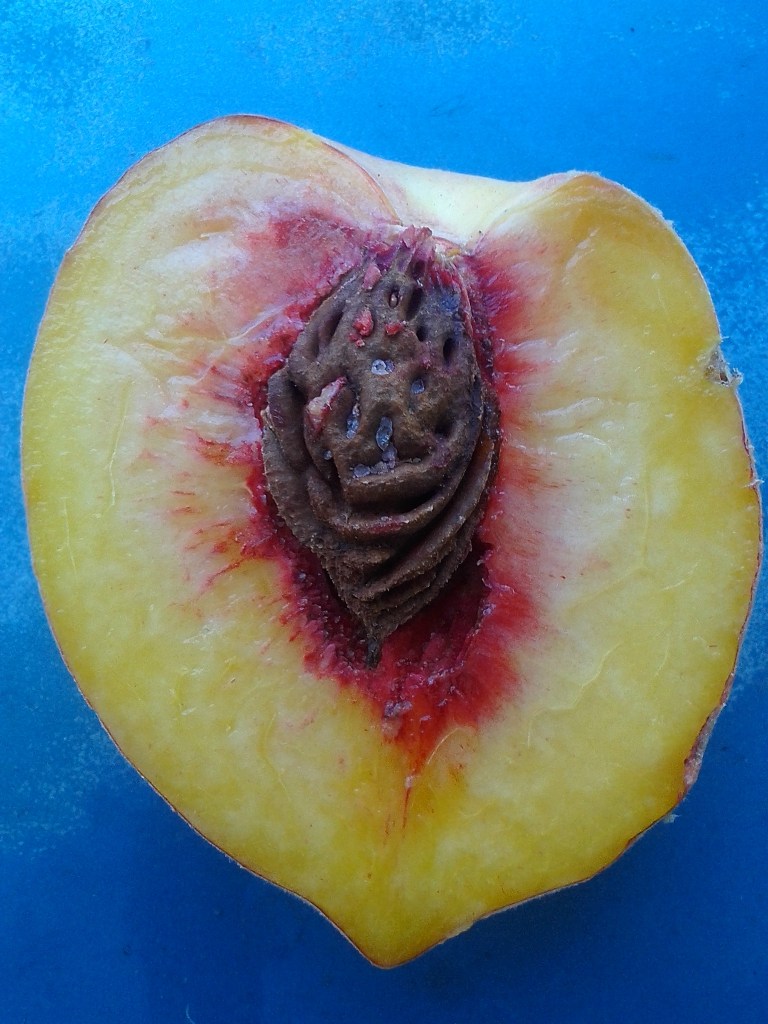
Of all the stone fruit trees like apricot, plum and cherry, none need more aggressive and specialized pruning while dormant in winter than peach, Prunus persica. The distinctively fuzzy fruit is so big and heavy that the weight of too much fruit tears limbs down. Pruning not only limits fruit production, but improves structural integrity, fruit weight distribution, fruit quality, and tree health. Mature trees should be kept less than ten feet tall, but often get twice as tall with much of the fruit out of reach.
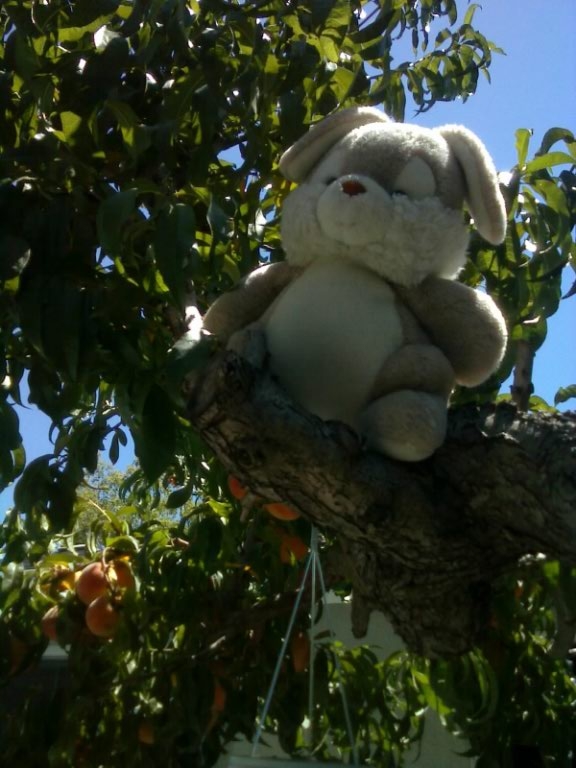
Pierre Francois dutifully protects ripening fruit.
It is embarrassing when my mother teaches me a practical gardening technique that I should have known about, especially if the particular technique is as simple and downright silly as what my mother does to protect ripening fruit from squirrels. A friend of hers suggested it; and it seems to be significantly more effective than the few fancier ideas that I recommended.
I should first mention that there is nothing new about repelling animal pests with effigies of other animals that they are afraid of. Scarecrows and stuffed snakes and owls have been around for centuries. As the name implies, scarecrows scare crows who perceive them to be potentially troublesome people. Rats and terrestrial rodents avoid snakes. Squirrels and some birds are afraid of owls.
When I was in about the fourth grade, I remember that National Geographic World magazine (which is now National Geographic Kids) featured a silhouette of a predatory bird that could be cut out and taped to windows to deter birds that might otherwise break their necks as they tried to fly through the clear glass. The associated article explained that the cut-out silhouette was effective because birds instinctively knew what to fear. A silhouette of a harmless seagull would not have been as effective.
However, some deterrents are not so specific, but instead rely on the fear of the unknown. Beach balls outfitted with decals of huge eyes look weird in the garden, but work because so many birds have bird brains that think such contraptions are big, scary and possibly predatory animals. Flash tape and old compact discs work simply because birds do not know what the reflected flashes are.
Scarecrows and other inanimate effigies should be relocated occasionally so they seem to be alive. They should stay near what they are in the garden to protect, and not loiter when it is gone. For example, if protecting ripening fruit, they should leave after the last of the fruit is gone. Otherwise, the target pest animals realize that they are fake or dead. Beach balls, flash tape and compact discs are more animated, so need not be moved so much, if at all, but are too tacky to stay all year.
All this may seem complicated, but can be simple enough for my mother to master with . . . well, allow me to explain.
Pierre Francois is a cute, fuzzy and seemingly French plush toy bunny made in China, who knows all about protecting ripening fruit from squirrels. (‘Stuffed animal’ is no longer politically correct.) After seeing how expensive a fake owl would be, my mother put Mr. Francois in the peach tree. He and his sort are free if borrowed (stolen) from the grandchildren, or very cheap at garage sales or thrift stores. Although cute and soft to us, Mr. Francois is big, intimidating and unfamiliar to squirrels. Before the squirrels get acquainted with him, the peaches will have been harvested, and Pierre Francois will have been reassigned to an apple tree.
For millennia, olive, Olea europaea, dutifully produced oil and edible fruit for civilizations of the Mediterranean region. During the last several centuries, it migrated to do the same in other regions of similar climate throughout the World. At least two centuries ago, it got to California, and became a major agricultural commodity. Now, it lives in home gardens.
The abundant and oily fruit that justified cultivation of olive trees for thousands of years is ironically a potential nuisance for home gardens. Few people harvest and process them. Olive fruit can stain pavement and attract rodents. Fruitless or mostly fruitless cultivars of olive, and dwarf cultivars, have been increasingly popular for only the past few decades.
Olive trees are not big, but slowly develop grandly sculptural trunks. Some might be little more than twenty feet tall when mature. Few get more than forty feet tall. Most have a few leaning trunks, which become furrowed and distended with age. The narrow and grayish evergreen leaves are about two or three inches long. Olive fruits are about an inch wide.
Of all the cultivars of citrus that are popular for home gardens, the ‘Meyer’ lemon is likely the most popular. However, it is not overly common in markets. That may be an incentive for growing it at home. Technically, it is not totally lemon. It is an odd hybrid of lemon and orange. Hence, its fruit has a distinctly rich flavor, but a bit less acidity than other lemons.
‘Meyer’ lemon is distinct among citrus trees. It grows more like rigid shrubbery, with a few irregular trunks. Because it naturally develops compact form, it does not require dwarfing understock. Most old trees therefore grew from cuttings on their own roots. Modern trees commonly grow on understock though, so can develop suckers below their graft unions.
‘Meyer’ lemon fruit is abundant during autumn and winter. Minor quantities ripen through spring and summer also. All ‘Meyer’ lemon trees from nurseries nowadays are ‘Improved Meyer’, whether or not their labels say so. Their improvement was selection of stock that lacks a particular tristeza virus that was inherent to the original cultivar prior to the 1940s.



 Tony Tomeo