Oregon grape, Mahonia aquifolium, is the Official State Flower of Oregon. Fruit such as this develops after its bright yellow bloom. It is nothing like grapes, though. It is edible, but unimpressive alone and fresh. Locally, it is not abundant enough to bother with collecting for culinary application, such as jelly. Wild plants are both rare and scarcely productive. Landscape plants are not much better. That justifies growing it in a garden where fruit production can be promoted. Perhaps it requires specialized pruning, like other species that are grown for fruit. Perhaps, like cane berries, it would be more productive if its old canes get pruned out annually. I really do not know, and am therefore receptive to suggestion. I already intend to grow it, although it will take a few years to get enough fruit to do anything with. Not so long ago, I was similarly intrigued by the native but ignored blue elderberry, which I found to be as useful as black elderberry of the East. My blue elderberry jelly won more ribbons than I can remember at the annual Jelly Competition of the Boulder Creek Harvest Festival. A blue ribbon for Oregon grape jelly would be excellent!
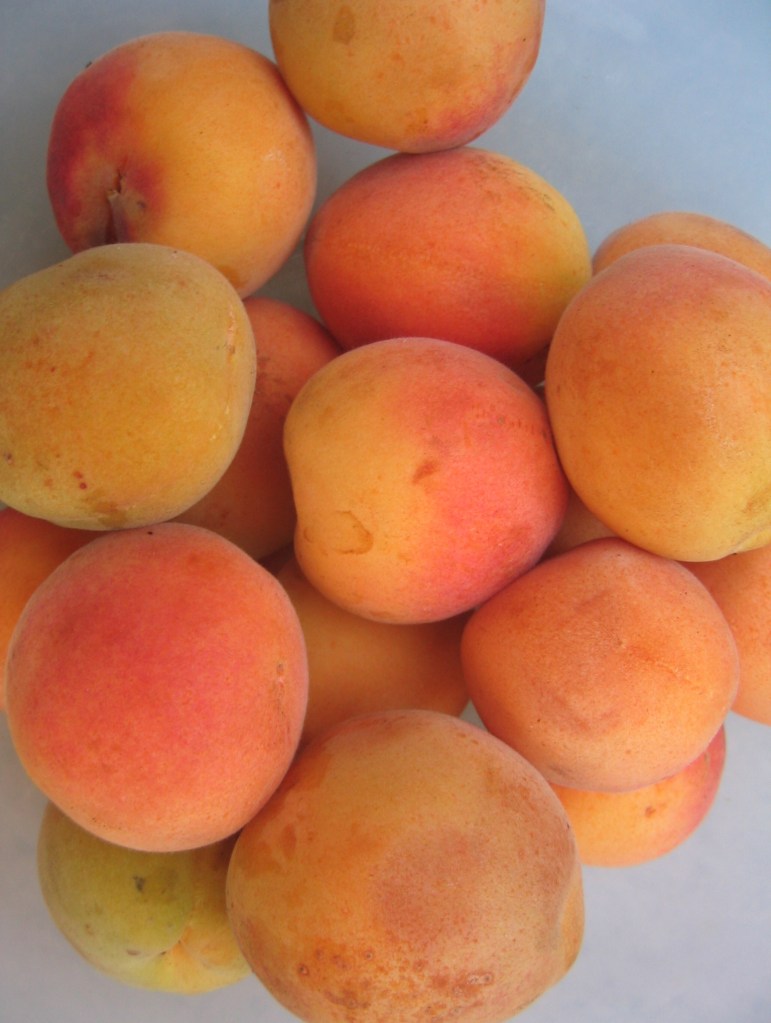
Apricot trees, which are mostly of the species Prunus armeniaca, have history here. Vast apricot orchards formerly inhabited the Santa Clara Valley. Many remain as a significant industry of the San Joaquin Valley. Apricot trees are both famously reliable and famously productive here. If they can not inhabit orchards, they can be as happy in home gardens.
Home garden apricot trees are not quite the same as orchard trees. Most are grafted onto dwarfing rootstock to stay more compact than orchard trees. More cultivars are popular in home gardens than in orchards. Regardless, even relatively compact home garden trees need dormant pruning in winter. Otherwise, they provide more fruit than they can support.
Apricot trees change with the seasons. They are strikingly bare while dormant for winter. Their profuse white bloom is spectacular for early spring. Their rich green foliage mostly obscures their fruit as it ripens through early summer. It then turns cheery yellow before it defoliates in autumn. Home garden trees should be about ten feet tall with good pruning. Fruit is difficult to reach in overgrown trees.
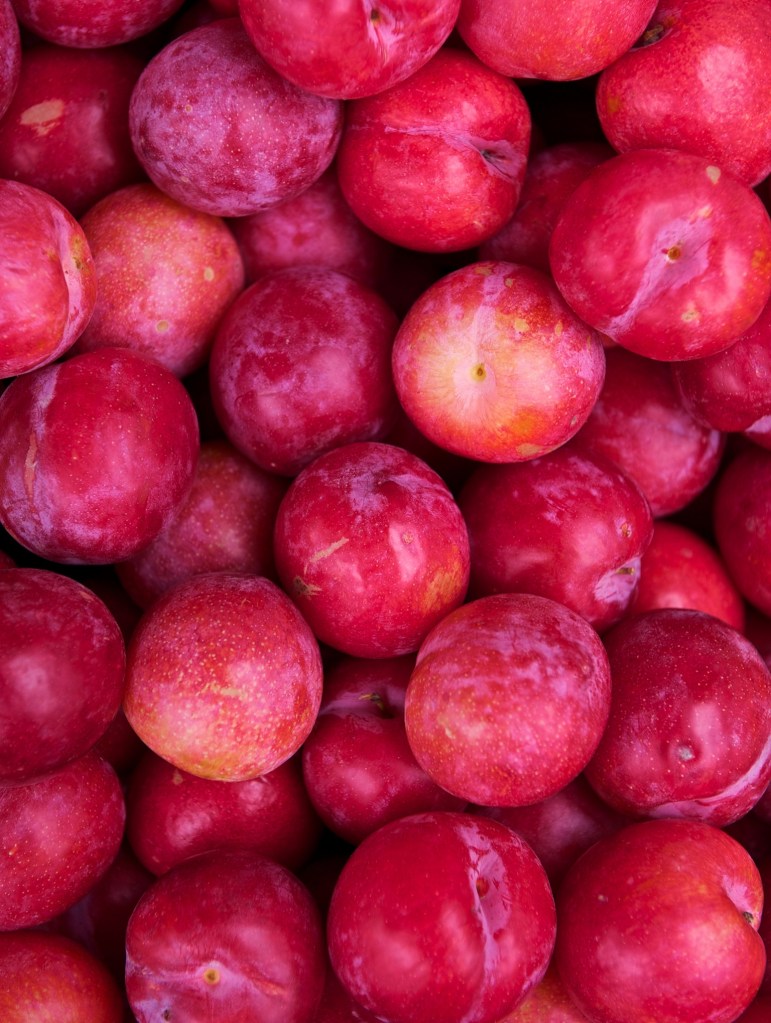
Prunes are not merely dried plums. They are European fruits which, although very edible fresh, are also popular for drying. Their significant sugar content inhibits mold during the drying process. Plums, Prunus domestica, are of the same species, but are of Japanese origin. They are quite popular fresh, but are more likely to mold than dry like prunes can.
Besides their lower sugar content, plums are a bit bigger and rounder than most prunes. Prunes are ‘freestone’, so their flesh separates from their seeds when ripe. Old fashioned plums are ‘clingstone’, so their flesh adheres to their seeds when ripe. The most popular plums are maroon or purple. Others are red, yellow, orange, green, blue or almost black.
Almost all plum trees within home gardens are semi dwarf. Although they do not grow as big as orchard trees, they can grow twenty feet tall. They require specialized aggressive dormant pruning during winter. Otherwise, they become shabbily overgrown with most of their fruit out of reach. Their prolific and bright white bloom is spectacular for early spring.
Dormant pruning of deciduous fruit trees last winter should finally be proving its benefits. Such pruning enhances tree vigor and resilience to disease. As importantly, it enhances fruit and nut quality. Birds, squirrels and perhaps other wildlife are unfortunately noticing. Protecting fruit as it ripens may seem to be impossible. Sharing might not be acceptable.
The problem with sharing is that most wildlife is greedy. Wildlife that is not greedy can be too generous by inviting their friends over to indulge. They may not consume everything, but might damage all that they can not consume. Protecting fruit does not deprive wildlife of sustenance that they require for survival. It merely diverts their exploitation elsewhere.
The problem with protecting fruit is that it can seem futile. Even if wildlife could read, they would not comply with signs telling them to keep out. Cats and dogs can not chase them all away, and can not be there to try all the time. Techniques that are somewhat effective for some wildlife are not effective for all wildlife. However, some techniques are effective.
Protecting fruit requires some degree of familiarity with whomever wants to exploit it. Not many deterrents are effective for all of them. Netting is only effective for marauding birds, but not rodents, who can chew through it. Because it is so difficult to install, and worse to remove, other options are better anyway. Flash tape repels some birds rather effectively.
Protecting fruit from squirrels is more challenging. Tree trunk baffles can only be effective if there is no other access to the subject trees. They are useless if squirrels can jump into low limbs from the ground or adjacent trees. Growing rosemary, lavender or mint around fruit trees is supposedly a mild deterrent. However, it obstructs maintenance of the trees.
Plastic snakes or owls might be effective for protecting fruit from both squirrels and birds. Plush toys might be as effective since squirrels and birds do not recognize them as safe. However, such effigies eventually become uselessly familiar without frequent relocation. Squirrels and birds may not seem to be very intelligent, but they are not too stupid either.
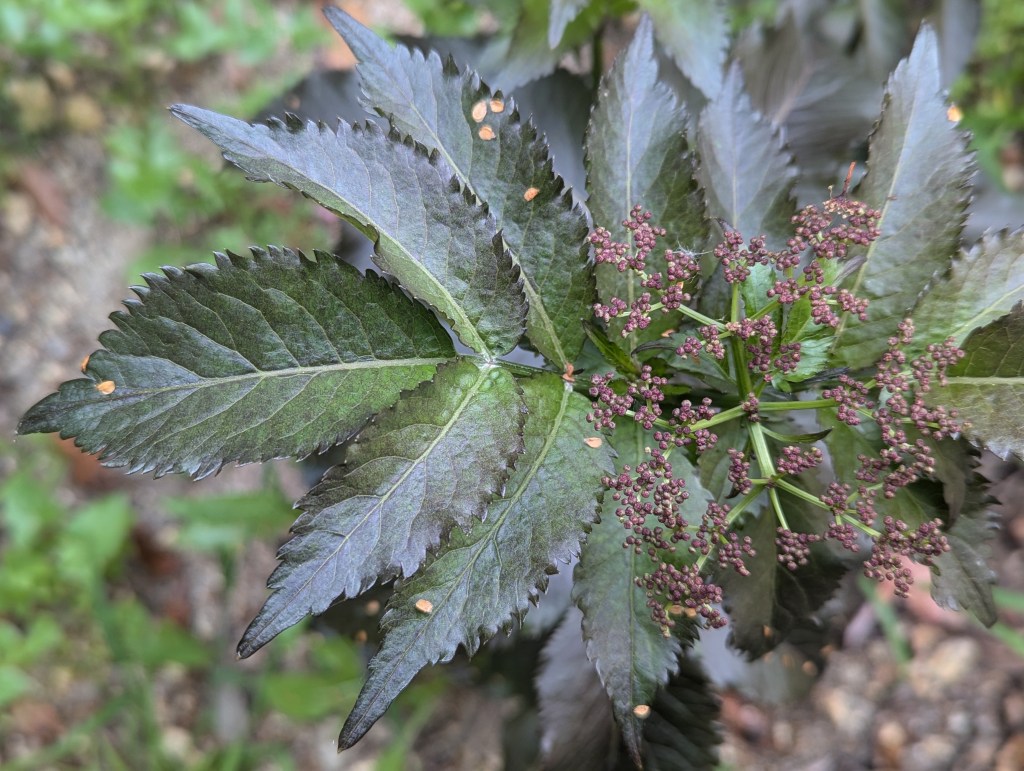
‘Black Tower’ European black elderberry is not very black yet.
Perhaps my explanation of the elderberry glut here was a bit brief last Saturday. Allow me to explain.
Sambucus caerulea, blue elderberry is native and grows wild here, so was innately the first on the scene.
Sambucus nigra ‘Black Lace’ European black elderberry arrived next. I do not know who procured it or why, but it was left here in a can before my time. I put it into a landscape just to get it out of the storage nursery. In other words, I was none too keen on it, so I just wanted to make it go away. Instead, because it was so popular with those who saw it in the landscape, I learned to appreciate it. Then, I figured that it would be even more appealing if it produces berries for birds, so I sought a mate for it.
Sambucus nigra ‘Madonna’ European black elderberry was almost the perfect mate. I would have preferred ‘Albomarginata’, but did not want to pay for it. ‘Madonna’ in a #1 can was available for only a few dollars because it looked so shabby two winters ago.
Sambucus racemosa, red elderberry was a gift from Tangly Cottage Gardening shortly afterward. They were a group of four seedlings, so needed no mate for pollination. Although they are supposedly native here, I had never seen them before, but want to grow them.
Sambucus nigra ‘Albomarginata’, ‘Atropurpurea’ and ‘Black Tower’ European black elderberry, and Sambucus racemosa ‘Lemony Lace’ red elderberry unexpectedly became available for a few dollars each just last winter because, like ‘Madonna’ European black elderberry two years prior, they were shabby while dormant. Without a plan, I procured all of them. ‘Lemony Lace’ red elderberry, the only red elderberry of the four, could be pollinated by the red elderberries that already came from Tangly Cottage Gardening. As I mentioned, ‘Albomarginata’ was the cultivar that I would have preferred to ‘Madonna’ that I procured earlier.
Sambucus canadensis ‘Nova’ and ‘York’ American black elderberry were the last acquisitions at the end of bare root season last winter. They are for fruit production in my home garden.
I would have been pleased with only ‘Black Lace’ and one other pollinator cultivar for it within the landscapes at work. For my home garden, I wanted only blue elderberry, red elderberry and American black elderberry. I would have preferred wild American black elderberry, but can not complain about the cultivars that I got. Collectively, we got much more than we bargained for.
‘Meyer’ lemon was never my favorite lemon. However, when I grew citrus trees in the early 1990s, it was the most popular of forty or so cultivars. There really is nothing else like it. Relative to other lemons, its fruit is distinctively less acidic, more richly flavored, and sometimes ridiculously abundant. All other lemons are more sour but less flavorful. Besides ‘Meyer’ we grew ‘Lisbon’, ‘Eureka’, ‘Variegated Pink’ and ‘Ponderosa’. Of these four others, only ‘Ponderosa’ is not a mutant of ‘Lisbon’, although its comparably mild flavor and robust acidity suggest that it is. All four grow as small but upright trees. Only ‘Meyer’ naturally grows broader than tall, sort of like shrubbery.
‘Eureka’ lemon inhabits one of the landscapes at work, where it produces enough average lemons for those of us who know about them. I grew cuttings from it for my own garden, but am concerned that, since they are not grafted onto dwarfing understock, they could eventually grow quite large. I also grew an ungrafted cutting of ‘Ponderosa’ lemon for the same landscape at work that the ‘Eureka’ lemon already inhabits, because it happens to be at the Ponderosa Lodge. ‘Ponderosa’ lemon grows with an upright form, but because it naturally stays smaller than ‘Eureka’ lemon and its relatives, I am not too concerned about it growing too large.
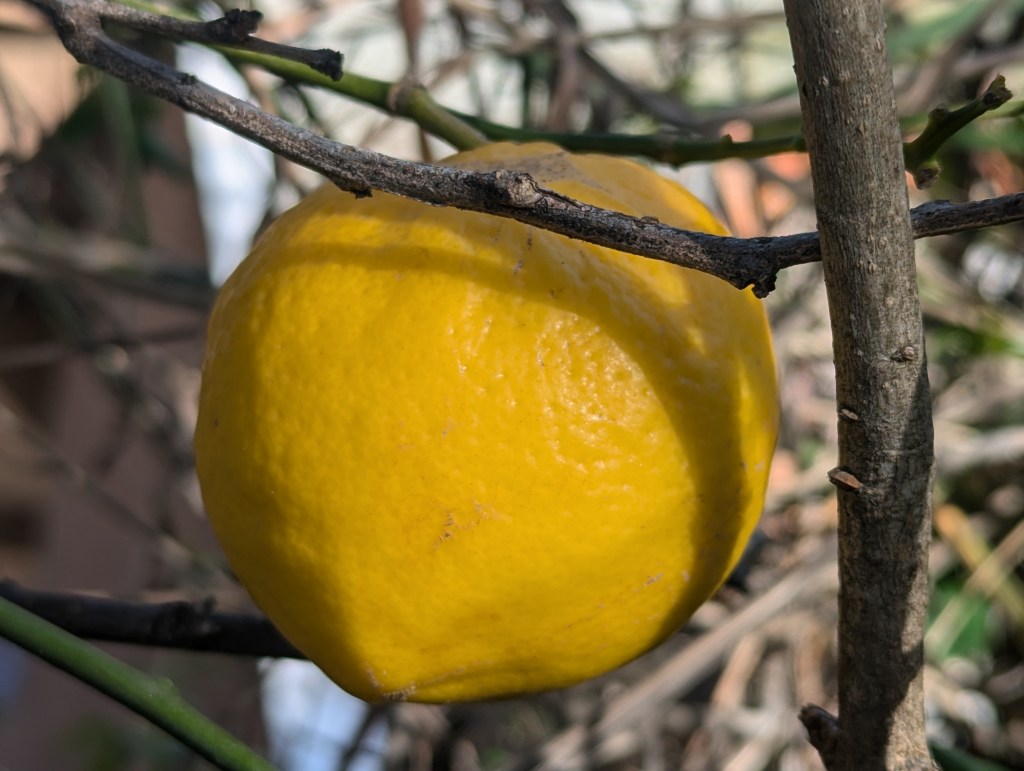
‘Meyer’ lemon came to my garden like a stray cat. Well, it is a bit more complicated than that, but it involved about as much planning. The history of how it came to its previous home is too extensive to describe here. To be brief, I installed it into a garden a few years ago because someone wanted it there after previous unsuccessful attempts to grow the same. Then, it needed to be removed prior to the sale of the home. I did not know what to do with it, so brought it here. I canned it and set it aside until space becomes available for it. I really did not expect it to do much until then. I sort of hoped that someone else would want it for their garden, but after we had been through so much together, I also sort of hoped that it would stay here. Anyway, while I was busy ignoring it in its partly shady and less than ideal situation, I noticed that it had produced this single lemon for me over winter. Well, I suppose that it will be a permanent feature of my garden now.
Their habit of overwhelming untended gardens gives blackberry canes a bad reputation. Their thicket like growth in their native habitats does not help. They are certainly not ‘low maintenance’ and need intensive specialized pruning later in the year. Yet, they become available with other bare-root plants this time of year for a reason. They make great blackberries!
New bare-root blackberry plants do not look like much when they are first planted, and do not produce berries in their first year. They will instead be busy dispersing roots and producing biennial canes that will produce berries the following year. Root barriers can prevent their aggressive roots from getting into neighbors’ gardens, particularly since south or west facing fences are just as practical for supporting trailing canes as trellises are.
‘Trailing’ types like ‘Marion’, ‘Boysen’ and ‘Olallie’ blackberries, which are also known as ‘boysenberry’, ‘marionberry’ and ‘olallieberry, are the most popular locally. ‘Erect’ types, like ‘Arapaho’, ‘Choctaw’ and ‘Navaho’ are more tolerant to frost, so are more popular where winters are colder. ‘Semierect’ types are hybrids of trailing and erect blackberries.
In their second year, trailing and semierect canes that grew during the first year should be trained onto trellises, fences or wires. As their fruit gets depleted later in summer, these canes can be cut to the ground. Some of the new canes that developed through the season need to be trained onto the same supports to replace the older canes as they get removed.
There should be more than enough new canes. About ten to fifteen of the best canes of trailing types should be selected and pruned to about six or seven feet long. Semierect types need about half as many canes, and can be pruned about a foot shorter. Extra canes should be cut to the ground. A few of the smaller extra canes can be left through summer to be separated with roots as new plants during the following winter.
Side branches that grow from the pruned canes through late summer and early autumn should get pruned to about a foot long at the end of the following winter. New growth from these stubs will produce fruit during the following summer. The process of replacing the old canes with new canes can be repeated as the fruit gets depleted. The process is similar for erect blackberries, but no support is needed. During the second year, canes should be cut to about two and a half feet tall in the middle of summer. Secondary branches from these canes should be cut to about a foot long in winter. As fruit gets depleted and replacement canes develop during the following summer, these mature canes can get cut to the ground. New canes then get pruned just like the older canes were.
The fruits of summer are still a few month away. The work necessary to produce them needs to get done now though. Just like bare root trees, bare root raspberry canes get planted while dormant in winter, and later require intensive specialized pruning to keep them in control and to promote abundant production. Canes that are already established need to get pruned now and every winter.
New plants should be planted about two or three feet apart, and then cut back so that only a single bud is visible above ground. Root barriers should keep them from venturing under fences and into neighbor’s gardens, particularly since south or west facing fences are ideal spots to grow raspberries. Alternatively, raspberries can be planted in sunken #15 cans (15 gallon nursery pots), with or without the bottoms cut off. Cans should be buried up to their rims because any exposed black vinyl collects warmth from the sun, which is uncomfortable for the roots within. Mulch should insulate the soil until new foliage provides shade.
The few new canes that should develop during the next few months should be able to support their own weight, but may be easier to work with if tied to a fence or trellis. The popular everbearing types, like ‘September’, ‘Heritage’, ‘Summit’, ‘Golden Summit’ and ‘Fallgold’ may produce fruit on top of their new canes by autumn. The tops of these canes should get cut down as low as fruit developed during the following winter. The remaining lower portions of canes that did not produce fruit in the first year should produce fruit by the second summer, and should be pruned to the ground as the fruit finishes.
As the spent canes get removed, about five to ten of the best new canes should be selected and tied in place if desired. All other canes should be cut to the ground. Like the canes of the previous year, the selected canes should develop fruit on top in autumn and get pruned as they finish in winter, and then develop more fruit down low before getting pruned out during the following summer. This process should be repeated annually.
‘Willamette’, ‘Tulameen’ and ‘Canby’ are traditional summer bearing raspberries. They do not produce in their first year, and will need to be pruned to about five feet tall during the following winter. As these canes develop fruit, many new canes emerge below. Every winter afterward, about five to ten of the new canes should be selected and pruned to about five feet as spent canes and unneeded canes get cut to the ground.
Citrus trees are not like deciduous fruit trees. They are not marketable as bare root stock. They do not need winter pruning. Actually, winter pruning might initiate premature growth that is vulnerable to frost. Deciduous fruit trees remain dormant so can only dream about fruiting for next summer. Citrus trees are happily evergreen, and fruiting abundantly now.
Citrus somehow seem to be more summery than fruit that actually ripen for summer. Iced lemonade is so traditional for warm summer weather. Oranges for Christmas might seem to be out of season when they really are not. Although Mandarin oranges are perishable, other ripe citrus last for weeks or months. Several ripen sporadically throughout the year.
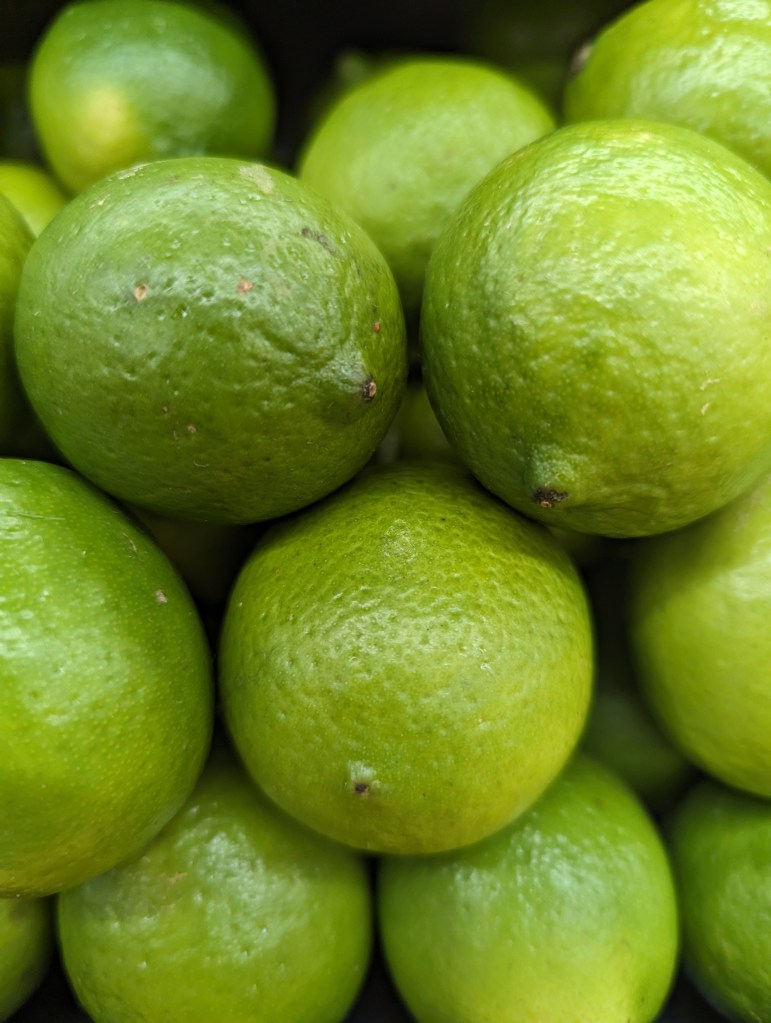
‘Valencia’ oranges, which are the traditional juicing oranges, might last through summer. They may sustain the belief that orange juice is a summery beverage. Several grapefruit cultivars can last about as long. ‘Eureka’ lemon is mostly seasonal, but also generates a few fruits throughout the year. ‘Bearss’ lime may be even more productive out of season.
With only one exception, all species and cultivars of citrus are of the same Citrus genus. Kumquats are of the Fortunella genus, but typically qualify as Citrus for simplicity. Citrus fruit is sweet, sour or bitter. Most familiar oranges are sweet. ‘Seville’ is a sour orange for marmalade. ‘Bouquet de Fleur’ is a bitter orange for infusing with Grand Marnier cognac.
Oranges, lemons, limes, grapefruits, kumquats and Mandarins are all very familiar. All of these fruits are available from grocery markets. Their trees grow in many home gardens. Tangerines are simply Mandarins or Mandarin oranges of the Americas. Pomelos, which are larger ancestors of grapefruits, are still uncommon. So are tiny and tart calamondins.
They are not the most unusual, though. Blood oranges provide tangy red juice. ‘Rangpur’ lime is a sour Mandarin orange that is as acidic as a ‘Eureka’ lemon. Tangelos combines the tartness of grapefruits with the sweetness of Mandarin oranges. Sweet limes lack the acidity of typical limes, so are for eating like oranges. These are merely a few examples.
Stone fruit classification can get confusing. All stone fruit are of the same genus, Prunus. This includes almonds, which are stones or seeds of inedible fruit. Prunes are European fruits that are conducive to juicing and drying. Plums are similar Japanese fruits for fresh consumption, but not for drying. The two are more different than peaches and nectarines.
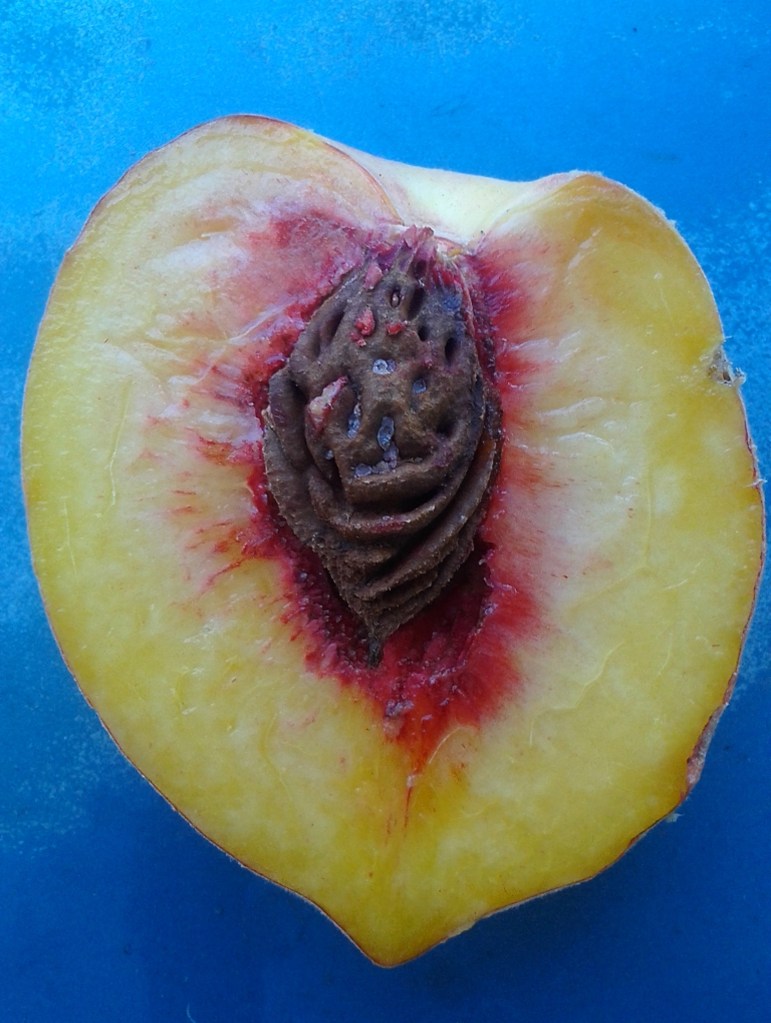
Nectarines, Prunus persicaria var. nucipersica, are simply peaches without fuzz. Cultural requirements are about the same for both. They need only very minor chill through winter to vernalize, and enjoy summery warmth. Trees are not very productive for their first year or two. Then, they may produce for only about twenty years. Thirty year old trees are old.
Both nectarine and peach trees require aggressive pruning while dormant during winter. Otherwise, they can not support the weight of their big and abundant fruit during summer. Semidwarf trees, which are the most popular, can potentially grow twenty feet high. They should stay half as high with adequate pruning. Most of their fruit should be within reach. Bare root trees initially disperse roots more readily than canned trees.

 Tony Tomeo