Horridculture – Too Busy To Write

The little windmill palm is not so little anymore, and deserves a space in the garden.

It will be a while before I resume blogging as I formerly did, if I resume. I may just continue to share my gardening column here. The situation is too complicated to explain, and too irrelevant to bother with.

So, if I do resume, I hope to write more about my own home garden. I have been negligent in that regard for a few reasons. Firstly, my home garden is not very interesting. I am a nurseryman, so am in the habit of giving away anything in the garden as it becomes appealing. Secondly, my uninteresting home garden has been neglected for too long. I have been too busy with several other obligations that I still can not keep up with. Thirdly, the landscapes where I work part time are far more interesting than what I would grow in my own uninteresting and neglected home garden if it were not so uninteresting and neglected.

In the future, I hope to renovate my home garden and make it more interesting. Seriously, all those interesting species that I bring back but do not give away from Southern California, the Pacific Northwest and even the Phoenix region deserve a comfortable garden in which they can perform as they should. Seven cultivars of banana grow fast! It would be unhealthy for them to remain canned much longer.

Because I know nothing about landscape design, I do not know how to renovate my home garden, but can figure it out as I proceed, even if most of it is as simple and utilitarian as it had formerly been. Palms do not conform to a simply utilitarian garden, so do not leave me much choice about incorporating them as aesthetic elements. It should be fun. At least that is what I continually try to remind myself.

No More Reblogs

My blogging discontinued quite a while ago. Articles from my gardening column still post in two parts on Mondays and Tuesdays, with the primary topics on Mondays, and the featured species on Tuesdays. Older articles still post in the same format on Thursdays and Fridays. These articles are not actually blog posts though. They are gardening column articles.

Originally, my only blogging had been on Saturdays, Sundays and Wednesdays. ‘Horridculture’ topics posted on Wednesdays. ‘Six on Saturday’ contributions posted on Saturday mornings. Random topics posted at noon on Saturdays and on Sunday mornings. Then, with the exception of ‘Six on Saturday’ contributions, all of these blog posts were recycled from earlier posts, so no longer qualified as actual blogging.

Now, as was inevitable, there are no more blog posts to recycle. Articles from my gardening column will continue to post on Mondays and Tuesdays. Older articles from the same column will continue to post on Thursdays and Fridays. I will likely continue to participate in the ‘Six on Saturday’ tradition on Saturday mornings. Otherwise, except for occasional random posts, regularly scheduled but recycled posts for Saturday afternoons, Sundays and Wednesdays will not continue.

In the future, recycled gardening articles may also be omitted, and new gardening articles may not be divided into two sections. If so, intact articles from my gardening column may post only weekly here. After all, the original purpose of this blog was to be another minor venue for the gardening column, . . . and obviously, pictures of Rhody.

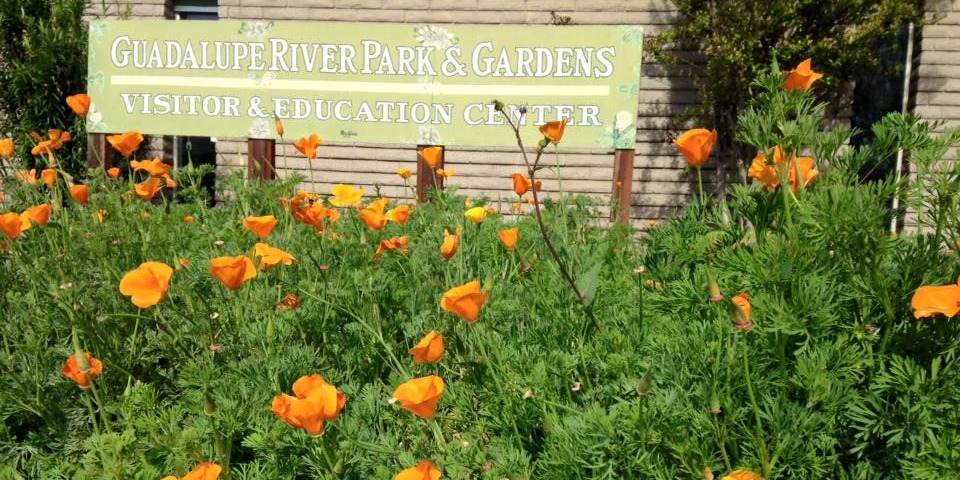
Spring in Guadalupe Gardens

(This information is now outdated.)

Spring in Guadalupe Gardens, a celebration of healthy living, gardening and the environment, will be here in little more than two weeks, on April 28! The 5 kilometer Fun Run that begins at 9:00 a.m., an hour before anything else, makes its way through the park and back to the main event, where there will be various health professionals to share information about healthy living, and for health screenings. Other exhibits will feature information about the environment and green technology, including presentations about solar energy and worm composting. Recyclable electronic waste can be dropped off free of charge. There will be all sorts of lectures, workshops, activities for children and even dancing and live bluegrass music.

But honestly, the main reason that most of us who read this column attend Spring in Guadalupe Gardens is all the gardening goodies! There will be an abundance of all kinds of plants from all kinds of specialty nurseries. Spring in Guadalupe Gardens has always been a great source of rare and unusual plants, as well as some of the more familiar plants, at reasonable prices.

Not only will there be plenty of plants to buy, but experts and some of the nurserymen who grew many of the plants will be available for advice on selection and cultivation. Representatives from the American Fuchsia Society, the John. E. Stowell Dahlia Society and the South Bay Heritage Rose Group will be there selling their plants, and sharing their expertise and information about membership. It is not too late in the season to select warm season vegetable plants, including heirloom varieties, from the extensive assortment that will be available.

Besides the shopping, Guadalupe River Park Conservancy and Greenwaste will be giving away one free bag of compost to each household. The San Jose Heritage Rose Garden, which is the most extensive public collection of old-world roses in the Western Hemisphere, will be in full bloom and open for tours.

Spring in Guadalupe Gardens will be from 10:00 a.m. to 3:30 p.m., in the Guadalupe River Park and Gardens between Taylor Street and Coleman Avenue in San Jose. There is no charge for admission or parking. More information can be found online at www.grpg.org or by telephoning 298 7657. Registration for the Fun Run, which begins an hour earlier at 9:00 a.m., can be arranged at www.grpg.org/FunRun.shtml.

Warm Season Vegetables Will Soon Replace Cool Season Vegetables.

Radishes grow nicely while the weather is still cool, but will eventually bolt and bloom as weather eventually warms through spring.

Suburban landscapes must seem like an incredible waste of space to those of us who enjoy growing vegetables. The climate and soil of the Santa Clara Valley are just as excellent for vegetables now as they as they were for the vast fruit and nut orchards that were here earlier. Not only are summers just warm enough for warm season vegetables without being too unpleasantly hot, but winters are so mild that cool season vegetables can be productive from autumn until spring.

While cool season vegetables are still productive, a few types that grow quickly can still be sown. Radishes, carrots and even small beets still have time to grow before the weather gets too warm. Peas sown now will get an early start for spring. If leafy lettuces are being exhausted, more can be sown to replace them. Only large vegetable plants, like broccoli, cauliflower and cabbage, need to wait until autumn so that they have a whole cool season to grow through.

It is still a bit early to sow seeds for warm season vegetables directly into the garden. However, seed for some vegetables can be sown in greenhouses or cold frames, to produce seedlings for the garden later. Although beans, corn, most squash and other fast growing vegetables should be sown directly into the garden during warm spring weather, tomatoes, peppers and eggplants prefer to get an early start as seedlings.

(Outdated information regarding gardening classes has been omitted from this recycled article.)

Maintenance Gardeners Often Need Help

Gardeners can rake leaves and mow lawns, but may not be qualified for some of the more specialized horticultural techniques.

Even some of the most avid of garden enthusiasts get some of the work in the garden done by maintenance gardeners. In many regards, even the common ‘mow-blow-&-go’ gardeners can be very helpful. As long as they are not expected to work with trees or shear anything (or everything), they can be remarkably efficient at the tedious and most demanding of tasks that are not much fun. For example, and as the job description implies, they can mow boring lawns and blow inert pavement. We can tend to our own meticulous chores, such as pruning roses and burying bulbs.

However, as professionals, gardeners must be as efficient with their time as possible, so rarely have the luxury of devoting the sort of attention to our gardens as those of us who enjoy gardening as a leisure activity. Consequently, they tend to be more generous with automated irrigation than they need to be. The immediate symptoms of insufficiency are more apparent than the symptoms of excess; so too much seems to be better than not enough. To make matters worse, the driest area of a lawn or bed is the limiting factor for automated irrigation, since everything else that gets watered along with the particular dry spot gets the same frequency and duration (volume) of irrigation.

At a time when many of us are already trying to use significantly less water, it is frustrating to notice any waste. In most gardens, lawn uses more water than everything else combined, but is also the part of the garden that many of us relinquish to maintenance gardeners who are not always there to notice waste. Regardless of any drought or water conservation, excessive irrigation is expensive and unhealthy to trees and many other plants.

Unfortunately, irrigation schedules can not be prescribed, but must be determined by direct experience with the lawn or landscape being irrigated. Even without rain, lawns and landscaped areas require less water through the (normally) cooler and shorter days of winter. The trick to rationing is to give the garden only as much as it needs to survive without allowing it to get too dry, which will undoubtedly cause some friction with any gardeners who may work with it.

The Great Pumpkin

P81007The Third Day of Creation was when it all started. Plant life was created just two days after Heaven and Earth, and Night and Day. It must have been a pretty big deal. Humans were not created until three whole days later!
After all this time since Creation, the flora of the World is still just as important as it has always been. Vegans can survive without the consumption of animal products, but no one can survive without the consumption of plants, or the consumption of animals who were sustained by plants. We breath oxygen generated by plants. We live in homes made of wood. We wear clothes made of cotton. Until relatively recent history, wood was the primary fuel for cooking and warmth through winter. Even modern fossil fuels that have replaced wood are derived partly from fossilized plants. There seems to be no end to the long list of what plants do for us.
As if all that were not enough, plants provide pleasure. Some are dazzling desert wildflowers. Some are majestic forest trees. Most are something in between. Many are invited to inhabit our gardens, landscapes and even our homes and offices. Some are bred to do what they do even better than they did originally.
David Paul, in the picture above, made a career of cabinetry, which involved all sorts of fancy and exotic woods. Most of these woods were derived from genetically unimproved trees that would have been found growing in the wild. Most were from eastern North America. Some were from other continents. Some of the favorite maple burls were specifically from New England and the Pacific Northwest. David Paul was no horticulturist, but he knew quite a bit about the flora that produced the fancy woods that he worked with.
The pumpkin is another story. David Paul grew giant pumpkins for several years in Colorado Springs merely because he enjoyed doing so. It required serious dedication throughout the entire long growing season. Yet, the pumpkins were grown only for the fun of competition. As huge as they were, they were not to be eaten. That is the epitome of growing something merely for the fun of it. This is such an excellent picture of that epic pumpkin that it was the illustration for the obituary of David Paul.

Saint Fiacre Day

P80901KK

Today, September 1, was the Feastday of Saint Fiacre, the Patron Saint of gardeners. I would not have known if I had not earlier seen this very thorough and informative article written by Doctor David Marsh of the Gardens Trust;

https://thegardenstrustblog.wordpress.com/2018/09/01/st-fiacre/

In all my writing, I had mentioned Saint Fiacre only once, and only in regard to garden statuary. I described how Saint Francis, who happens to be the patron saint of animals, is popularly believed to be the patron saint of gardeners because his statue is so popular in gardens, often in conjunction with statues of frolicking animals, but that statues of Saint Fiacre are very rare.

Besides the Feastday of Saint Fiacre, this September 1 also happens to be the first year anniversary of my blog. I have now been posting articles from my weekly gardening column, as well as other elaborations, for an entire year. With the exception of September 2, the day after establishing the blog, I have posted an article daily. Since participating with the Six on Saturday meme, I have been posting two articles on Saturday. There were even a few days in which three articles were posted.

Unfortunately, back in February or March, my weekly gardening column was discontinued from the Silicon Valley Community Newspapers, which was the first newspaper group that I started writing for nearly twenty years ago. Silicon Valley Community Newspapers still has access to the articles, and can use them if they choose to; but I am no longer employed with them. Because I write for several other newspaper groups, I did not want to stop writing my weekly gardening column just yet. I enjoy it too much. I will have been writing it for twenty years in October, but blogging is still new to me.

P80901KK+

Upgrade Today

P80624This is it; the big day. I will delay it no longer. I said that I would upgrade quite some time ago, but had not yet done so. https://tonytomeo.wordpress.com/2018/06/24/upgrade/

Will this upgrade improve anything? I really do not know. I tried to do a bit of research in regard to the advantages of an upgrade, and could find very little of the information that I was looking for. It seems to me that upgrading will initiate more work for me, but will not necessarily make my articles more accessible or appealing. I will need to make improvements to the presentation of my articles on my own. Upgrading makes these improvements possible, but does not execute improvements without my efforts and direction. Nor does it change the content to improve accuracy for a broader audience. My articles will still be half a year late-or-early for Australia and all other places in the Southern Hemisphere. Harsh summer heat and winter cold will still be topics that will be lacking merely because the climate here lacks such variables. Upgrading can do only so much.

After my minimal research, I determined that the most efficient means by which to determine if an upgrade would be beneficial is to try it.

Something should be done. The newspaper group that I started writing for nearly twenty years ago no longer features my gardening column. Other newspapers that feature it only do so occasionally. Some do it monthly. Some do it when space is available. One of the larger newspapers features it weekly, but only for their online version. It is not easy to justify writing my articles if they are not being distributed like they had been.

By the time you read this, the upgrade will have been initiated. We will see what happens.

25 Yrs

Upgrade

P80624.jpgThis autumn, it would have been twenty years that I have been writing my weekly gardening column for the Silicon Valley Community Newspapers, affectionately known as SVCN. It would have been excellent if it had lasted that long, but it was discontinued a few months ago. There was no warning, although we all know the direction that such media is going nowadays, and that such changes are abrupt. Nothing is like it was nearly twenty years ago.

My weekly gardening columns will continue for the other newspapers that still use it, even if they do not use it for their print versions. Again, due to the way such media operates nowadays, I have no idea of which newspapers who have access to it actually use it, or if they use it for their print versions or merely their online versions.

I could elaborate on the history of my garden column and its inclusion into the various other newspapers that continue to use it, but that can just as easily be another topic for another time. Perhaps I will merely put a bit of that information in my ‘About’ section if I ever get around to updating it. I have another topic to discuss now.

I would like to upgrade this blog. I would like to make it as fancy and user-friendly as some of the other blogs that are out there. I know that the last thing I need right now is more work, but I also want to maintain this as an venue for my weekly gardening column, particularly if other newspapers are likely to discontinue using it in the future.

Upgrading will include selling add space, or at least making add space available to advertisers who can use it. Newspapers pay very minimally for my weekly gardening column, and the newspaper group that payed the most for it no longer uses it. Advertisements might help to justify the work that goes into writing a new gardening article weekly. Hopefully, no one will be to bothered by these changes. I have enjoyed writing my weekly gardening column for almost twenty years, and would like to be able to continue doing so for a while longer.


Warm Season Vegetables Start Now

P80312The calendar does not always agree with the weather. It really is about time to start replacing aging cool season vegetable plants with fresh new warm season vegetable plants. Earlier warm and dry weather had suggested that it was getting late. More recent frosty weather followed by rain suggested otherwise. Regardless, there is no point in arguing with what the calendar determines.

The last seedlings for broccoli, cauliflower, cabbage and Brussels sprouts (for those who are able to grow them) should be well established in the garden. There should be enough cool weather for them to finish before the heat of summer causes them to go bitter. No more should be planted this late. Also, the last seed for beets should have been sown already. Peas should finish soon.

Warm season vegetables like tomato, pepper, squash, cucumber, corn and bean are the main concern now. Tomato and pepper are most easily planted as seedlings purchased in cell packs. A packet of seed costs as much as a cell pack, but must be sown and grown into seedlings, which is extra work. If necessary, varieties that are unavailable in cell packs can be grown from seed.

The other warm season vegetables grow so fast from seed that there is no advantage to planting them as seedlings here. Some would be distressed from transplant as seedlings. Besides, so many individual plants of each type are typically grown together that it would be expensive to purchase so many cell packs. Squash might be an exception if only a few plants would be enough.

Bush beans may seem like they would be easier to grow than pole beans because they do not require support. However, pole beans can grow on the sunny side of a fence in the background of a vegetable garden, utilizing otherwise useless space. If it would not damage the fence, string can be strung in a zigzag pattern (up and down) between nails pounded part way into the top and bottom of the fence. If the string is held an inch or so from the fence (at the heads of the protruding nails), bean vines would be happy to climb it.