Pair of Pears

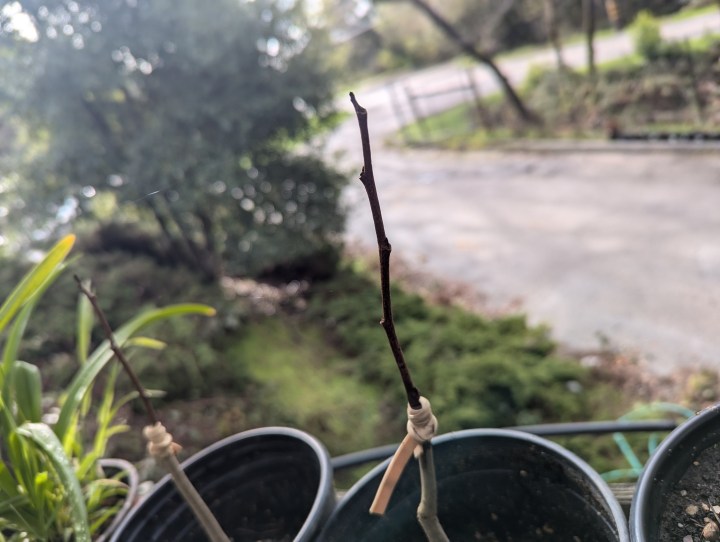
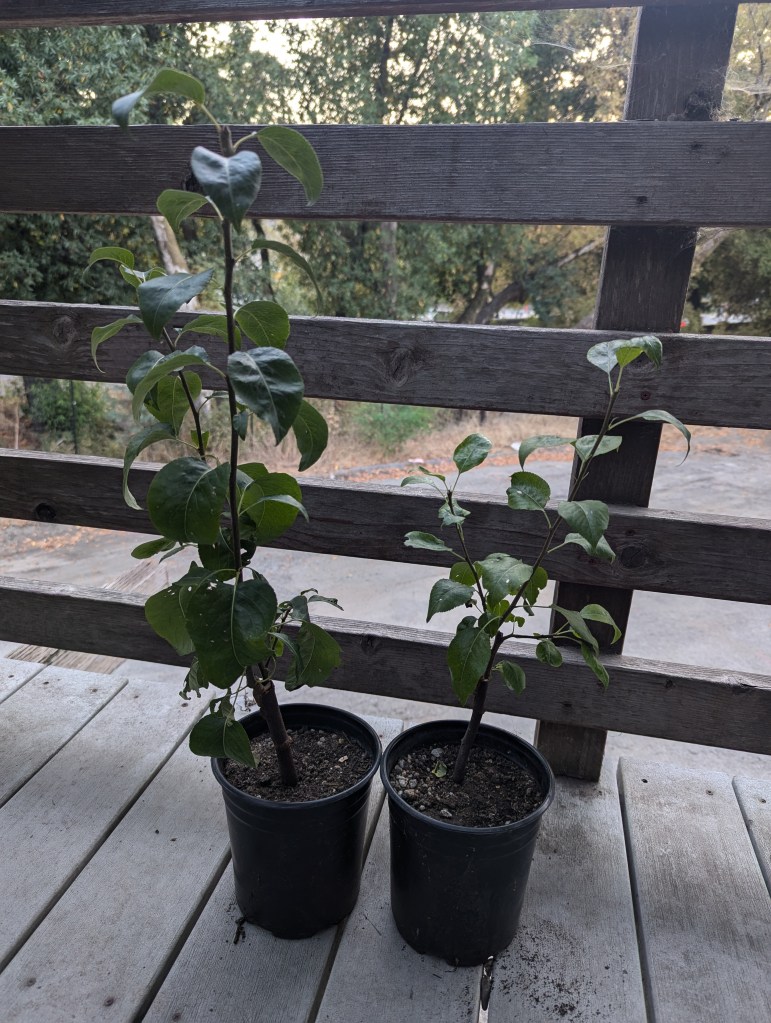
‘Beurre d’Anjou’ is to the left. ‘Seckel’ is to the right.

Two new pear trees have grown well this year after being grafted last winter.

‘Seckel’ is to the right in the picture above. I acquired its scion from the Scion Exchange of the Monterey Bay Chapter of the California Rare Fruit Growers on the first of February. It was one of only two cultivars that I wanted to graft onto one of only three quince understock trees that were available at the time.

‘Beurre d’Anjou’ is to the left in the picture above. Because it was unavailable from the Scion Exchange, and also because it was the other of only two cultivars that I wanted to graft, I purchased its scion online.

I wanted to retain one of the three quince understock trees for its fruit, and possibly for cuttings for understock for more pear trees in the future. However, more copies of it grew from cutting from the two trees that were grafted last winter. Now, I have a third quince tree to graft a pear scion onto this winter. I will most likely procure a scion of ‘Bartlett’, because, a very long time ago, that was the most common cultivar within the orchards of the Santa Clara Valley.

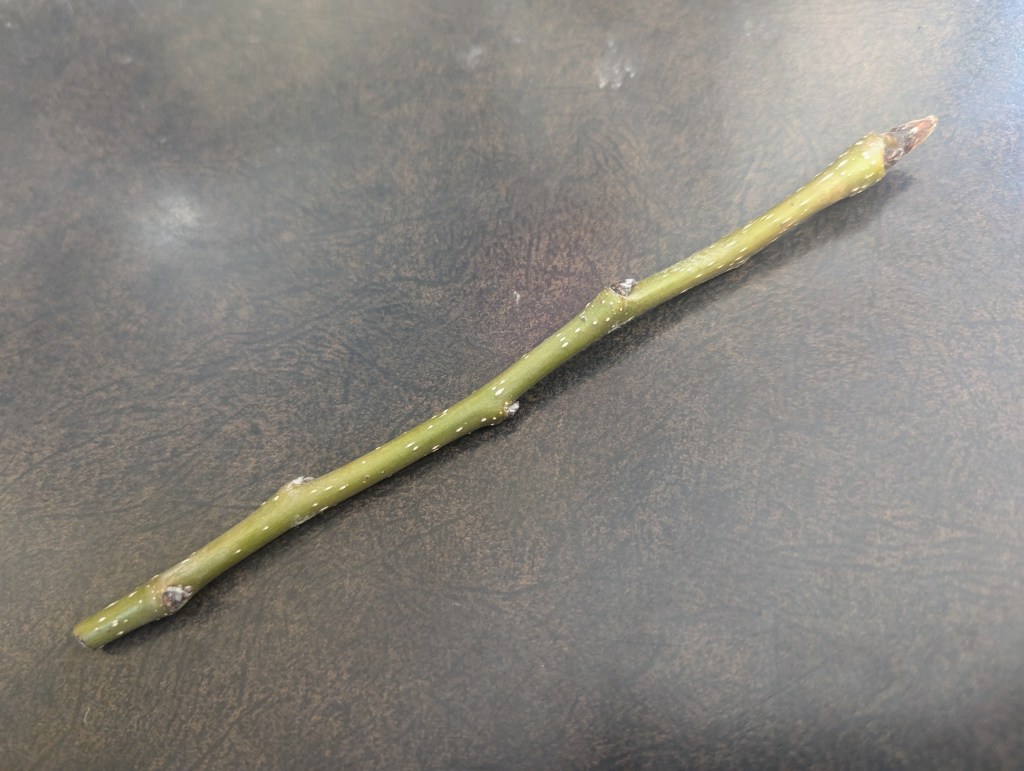
Stick

‘Beurre d’Anjou’

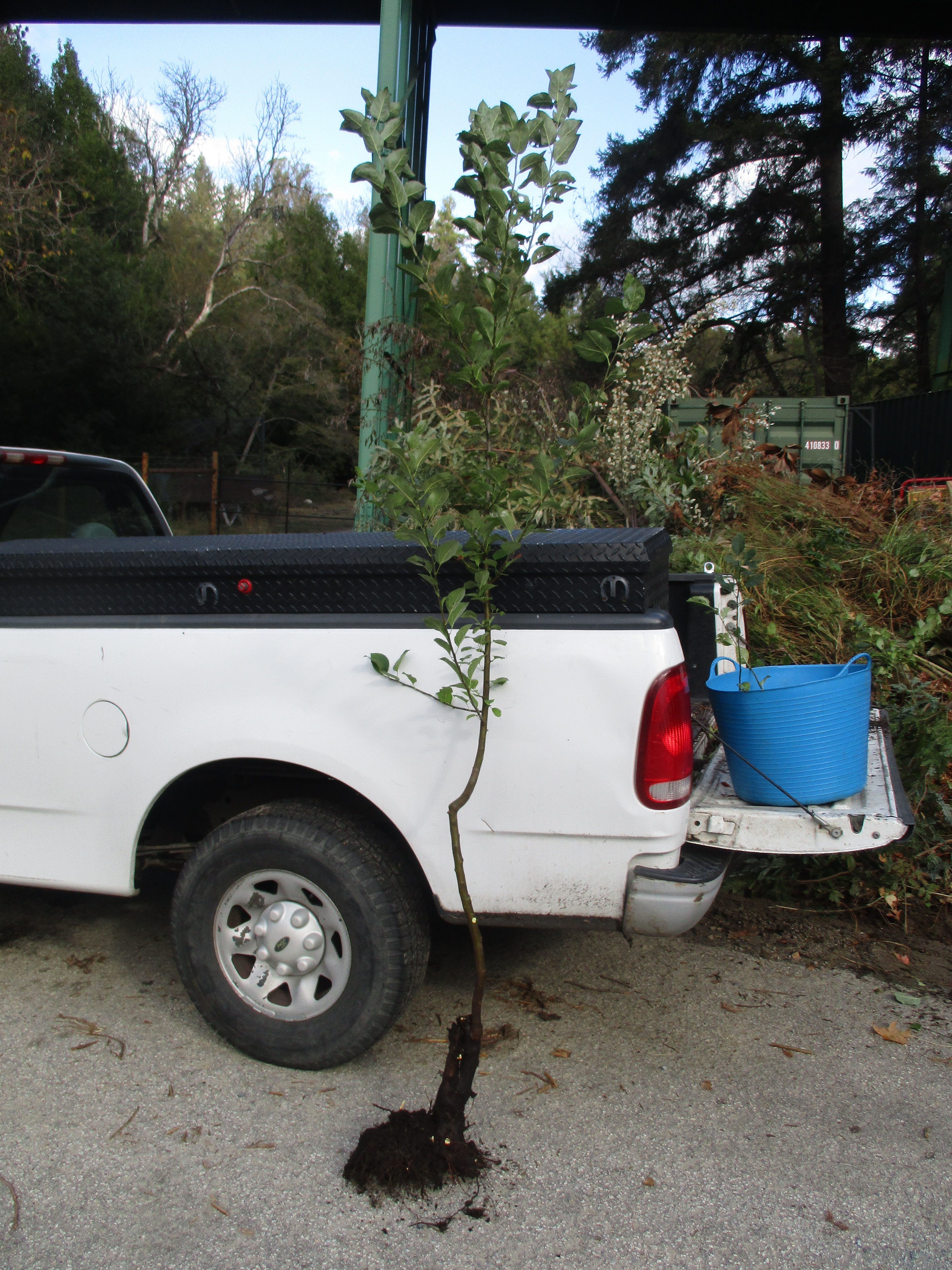
Here it is. The stick! I paid $7.79 for it with delivery from San Leandro, and waited a few days for its arrival last Wednesday. Since then, it was processed into two scions and a cutting, each with two buds. The terminal bud of one of the scions is actually accompanied by a few smaller buds. The scions were grafted, and the cutting was plugged, last Thursday, less than a day after the Stick arrived. I am very pleased with the results, and hope to be even more pleased with their favorable performance in the future. Ultimately, the finished product will be at least one pear tree. More specifically, it will be a ‘Beurre d’Anjou’ pear tree, which is more often known as ‘d’Anjou’ or ‘Anjou’. It and ‘Seckel’ were the only two cultivars of pear that I wanted to acquire this winter. After obtaining scions for ‘Seckel’ pear from the Scion Exchange of the Monterey Bay Chapter of the California Rare Fruit Growers on the first of February, ‘Beurre d’Anjou’ remained elusive. Every pear tree that I could get scions from was either another cultivar, or not identifiable by cultivar. I really thought that the process would be simpler. I could have purchased a tree from bare root stock at a nursery, but that would have been comparable to cheating, and would have cost about $40. The well rooted quince understock for grafting was already here and waiting. I grew a few specimens of it from suckers of an established pear tree, and already used one for the previously acquired ‘Seckel’ scions. Because I was so confident that I would eventually acquire the only pear cultivar that I craved more than ‘Seckel’, I retained the biggest and best of this understock for these recently acquired scions of ‘Beurre d’Anjou’.

Six on Saturday: Scion Exchange

‘Beurre d’Anjou’ pear has been elusive. I visited the Scion Exchange of the Monterey Bay Chapter of the California Rare Fruit Growers to find scions, but none were unavailable. I got the few other scions and cuttings of the first three of these Six instead. That was two weeks ago. Some other deciduous vegetation is beginning to demonstrate that there was not much time to spare. Oddly, one banana tree did not bother with dormancy this year. It seemed to be comfortably sheltered.

1. Pomegranate, persimmon, caprifig, white mulberry and black mulberry cuttings are a bit too numerous to cite with their botanical and cultivar names. Most lack labels since I can identify them as they grow. They are plugged into the same can to occupy less space.

2. ‘Allegheny’ pawpaw scion is hopefully happily grafted onto seed grown understock. It is longer, with more buds than I would have preferred, but is rather thin. ‘Mango’ to the left is even dinkier. Three other small seed grown trees remain ungrafted without scions.

3. ‘Seckel’ and ‘Beurre d’Anjou’ pear were what I came for. I did not find ‘Beurre d’Anjou’ but this is ‘Seckel’. The quince understock is big enough for a pair of cleft grafted scions. Basal scraps from the scions were plugged as cuttings. Redundancy could be useful later.

4. Sambucus racemosa, red elderberry reminds me that winter dormancy will be ending soon for most deciduous plants. Grafting, bare root planting and dormant pruning must therefore be done sooner. Norway maple might be the last deciduous species to refoliate.

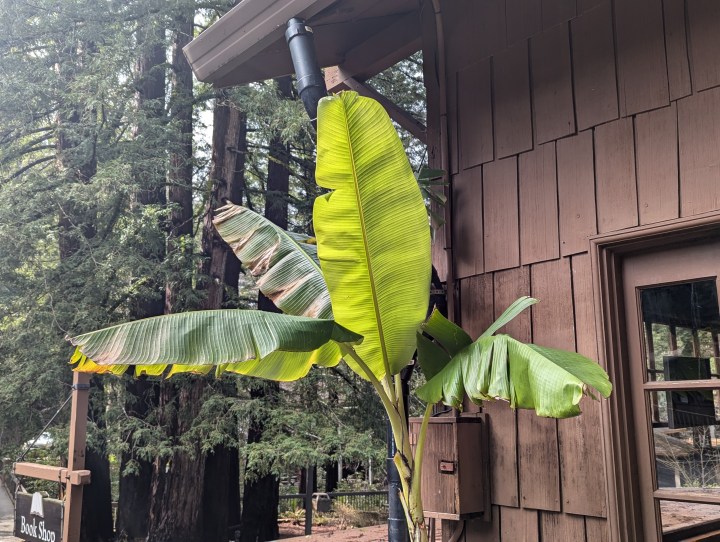
5. Musa acuminata, banana trees look so shabby after even minor frost that their foliage gets cut back. This unidentified specimen stayed nicely foliated under the eave and close to those uninsulated walls of the associated building, which happens to be a coffee shop.

6. This happens to be on the menu board of the coffee shop, which happens to be within view from where the banana tree that did not get frozen is situated. Another banana tree that is just a few feet away but unsheltered was deprived of the last of its frosted foliage.

This is the link for Six on Saturday, for anyone else who would like to participate: https://thepropagatorblog.wordpress.com/2017/09/18/six-on-saturday-a-participant-guide/

Big Lemons

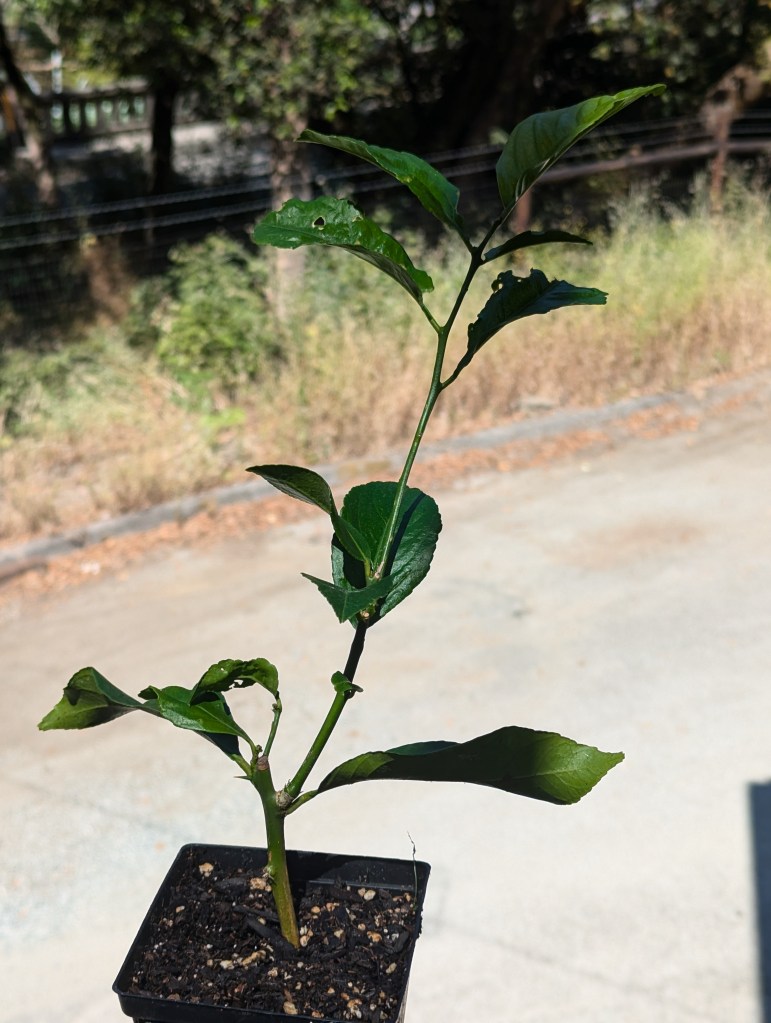
Ungrafted ‘Eureka’ lemon

All but two of the forty or so cultivars of citrus that I grew in the early 1990s were grafted onto the same dwarfing shaddock rootstock. Only ‘Meyer’ lemon and ‘Seville’ sour orange were not grafted, or ‘on their own roots’. ‘Meyer’ lemon naturally stays compact enough to not need a dwarfing rootstock. it was our most popular cultivar. ‘Seville’ sour orange supposedly grows about as large as the various dwarfed sweet orange with or without a dwarfing rootstock, as if the rootstock does nothing to limit its ultimate size. It was our least popular cultivar.

‘Eureka’ lemon, ‘Lisbon’ lemon and ‘Sanguinelli’ blood orange grow larger than any of the other grafted dwarf citrus that we grew. ‘Eureka’ lemon is actually a variant cultivar of ‘Lisbon’ that produces fruit throughout the year, which is a desirable attribute within home gardens. ‘Lisbon’ lemon may seem to be a bit more productive, but only because it produces all of its fruit within a more defined season, which can be a desirable attribute for orchard production. Otherwise, ‘Eureka’ and ‘Lisbon’ lemons are indistinguishable from each other, and grow quite tall. ‘Sanguinelli’ blood orange grows about as large, with a nearly identical upright form, but with a softer foliar texture.

Without dwarfing understock, ungrafted ‘Eureka’ and ‘Lisbon’ lemon trees can grow as big as small shade trees, and produce more fruit than they can support against gravity. Their broken limbs are a horridly thorny mess to clean up. ‘Sanguinelli’ blood orange trees can grow about as large, although they support the weight of their fruit more efficiently, and any debris that they generate, hopefully from pruning rather than breakage, is not so objectionable to handle.

So, I should have known better than to plug a bunch of ‘Eureka’ lemon cuttings. As cuttings, they lack dwarfing understock. I shared more than half with neighbors, who have been warned. About fourteen remain. One is more than enough.

Six on Saturday: Tree Circus

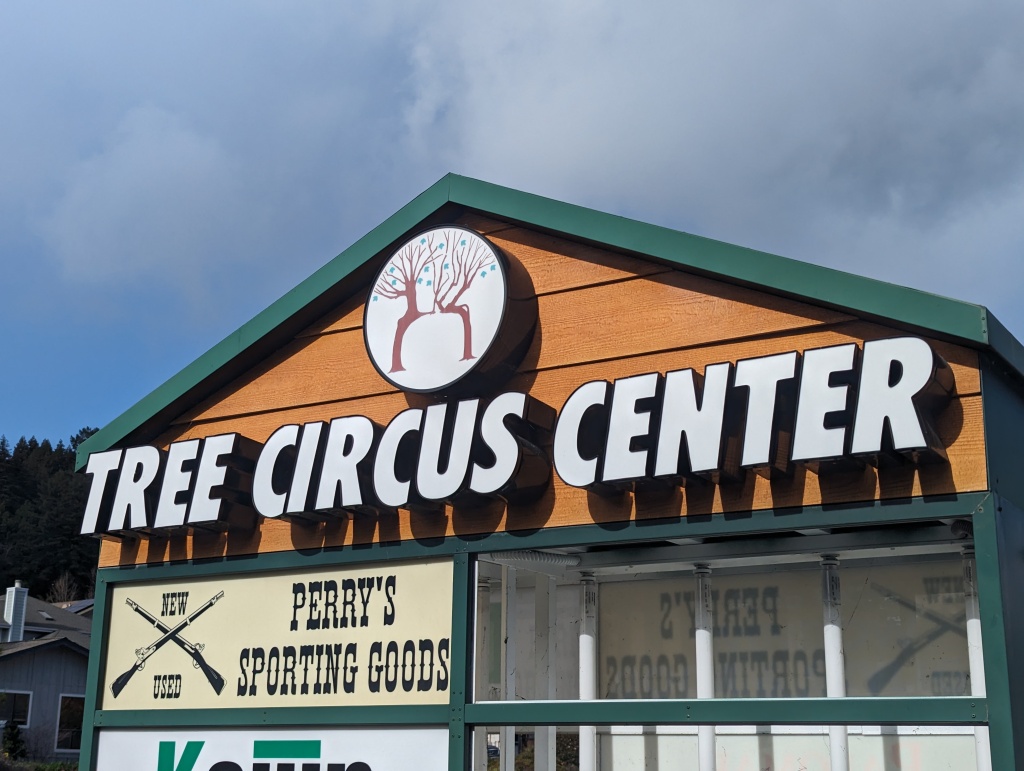
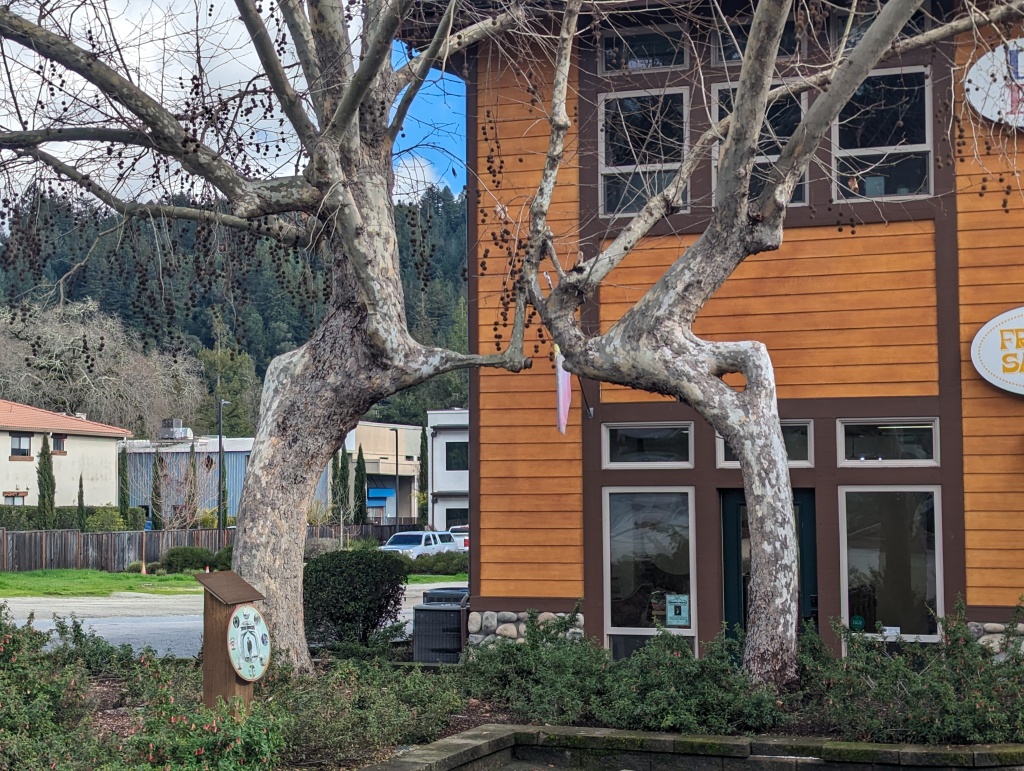
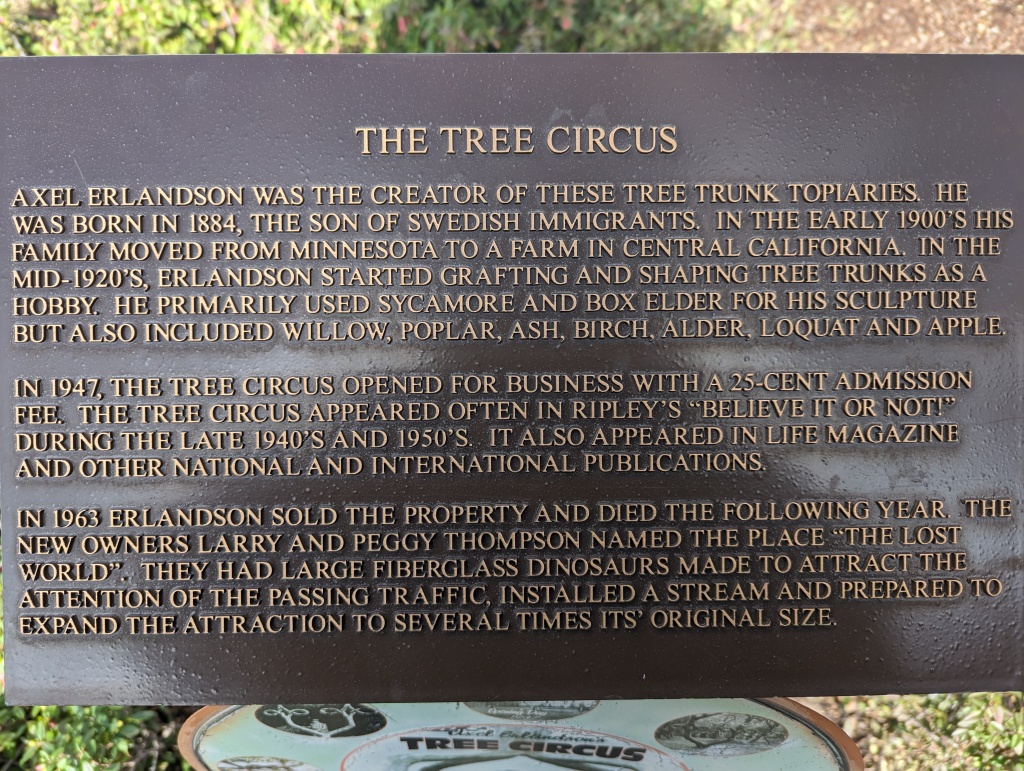
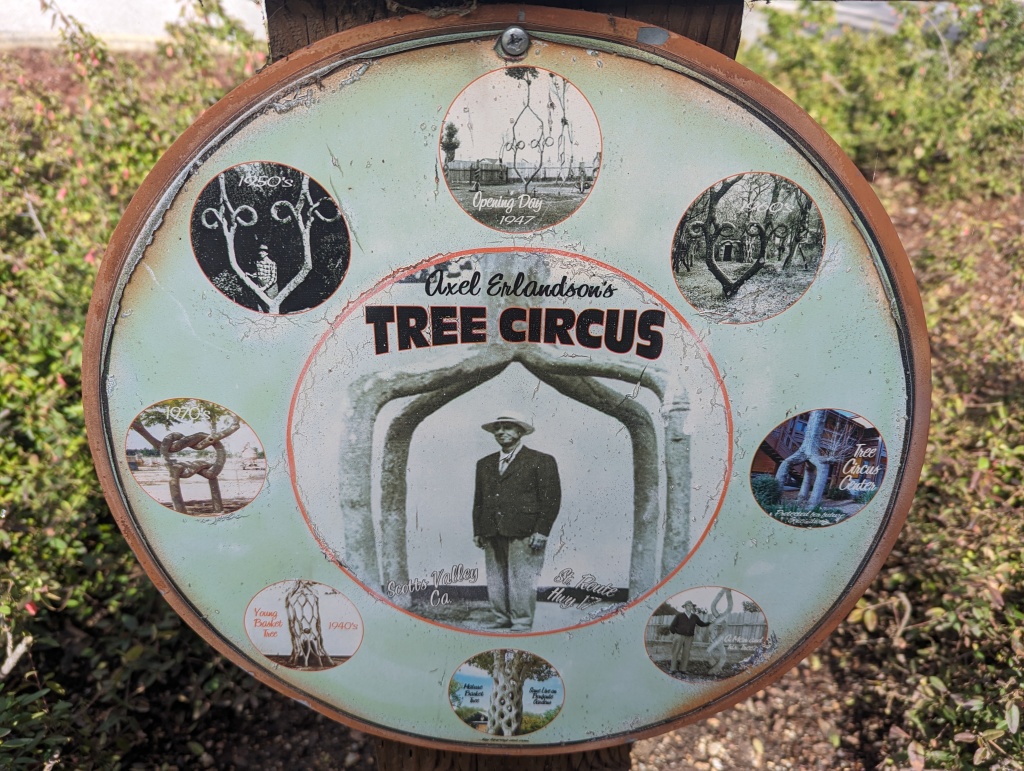
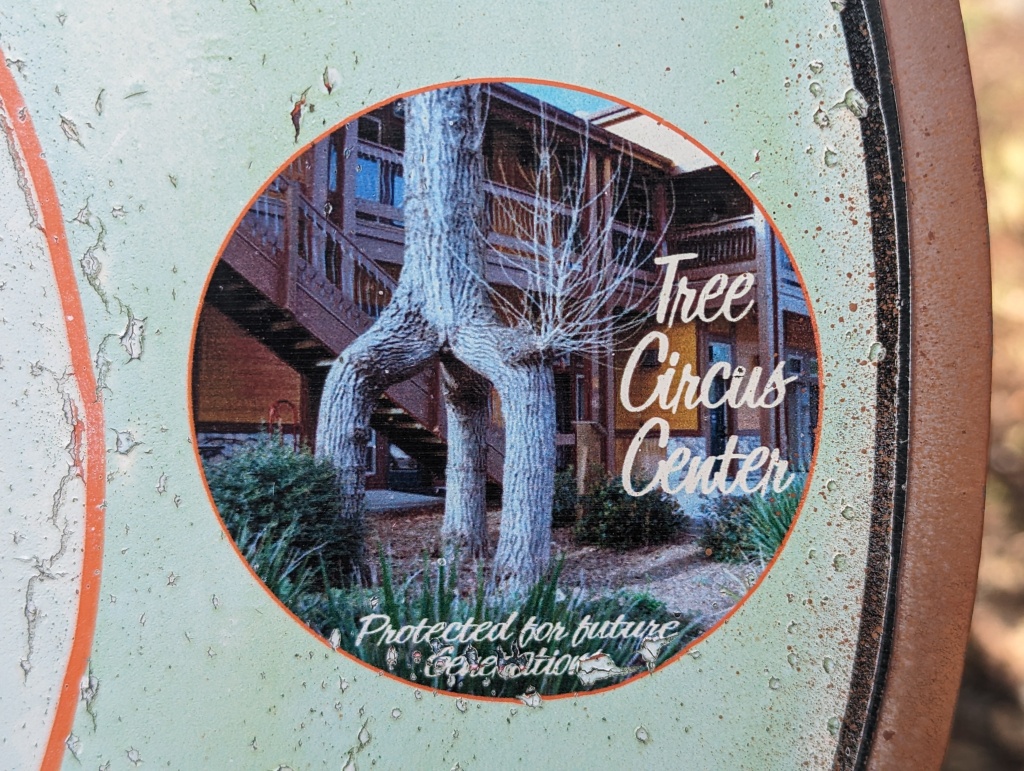
‘Crazy Great Ideas From Crazy Green Thumbs 6’ featured four sculptural tree specimens that had been relocated to Gilroy Gardens, which was formerly Bonfante Gardens, from the now defunct Lost World, which was formerly Tree Circus. While getting gasoline for Morgan in Scotts Valley, I stopped at the former site of Tree Circus for these six pictures. Not much remains to suggest that Tree Circus was ever there. Of these six pictures, only one shows real vegetation, which is a single London plane, Platanus X acerifolia, with a pair of trunks, which form an arch. (Incidentally, Crazy Green Thumbs sent me seed for poinciana and esperanza, which I featured for Six on Saturday almost two years earlier.)

1. Tree Circus Center now occupies the former location of Tree Circus, and subsequently, the Lost World. Progress can be so trivializing. Notice the emblem at the top of this sign.

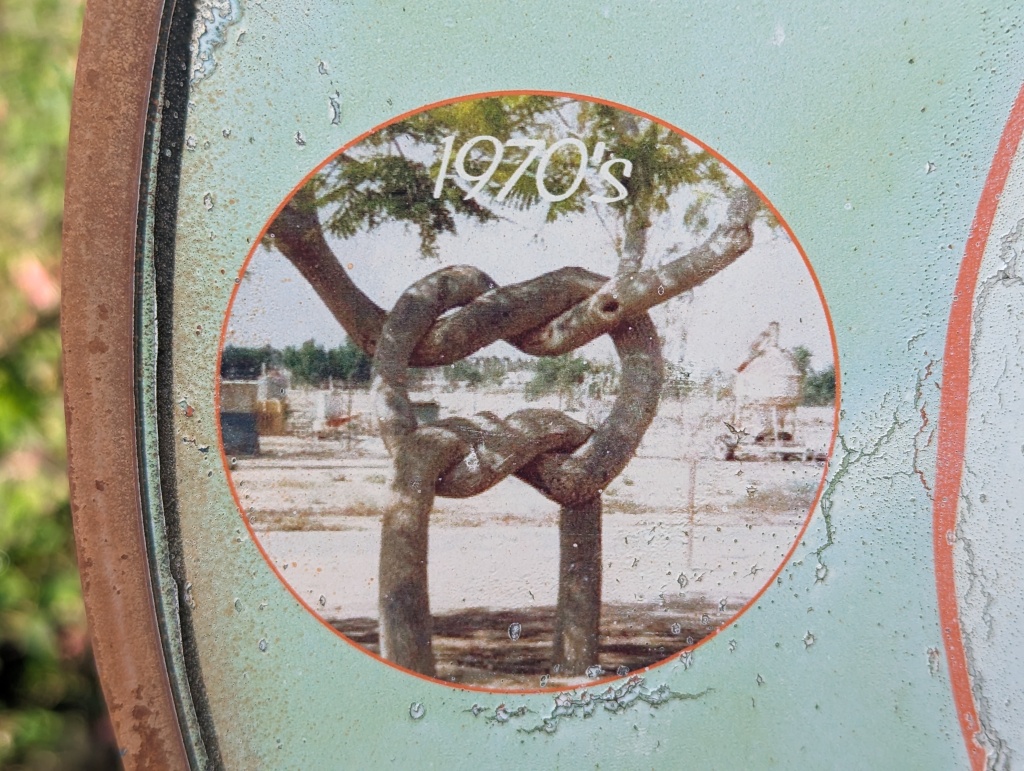
2. The emblem depicts this last tree of the Tree Circus, which was a pair of trees that got grafted together and separated and grafted together. Notice the plaques to the lower left.

3. This upper plaque very briefly explains the history of Tree Circus and the Lost World, although without mention of what happened afterwards. Notice the other plaque below.

4. This lower plaque features illustrations of a few of the many sculpted trees of the Tree Circus, although woefully weathered. Notice the illustrations to the far right and far left.

5. This illustration to the far right shows the only other tree of the Tree Circus to remain at the site, although it is now gone. Notice the caption, ‘Protected for future generations’.

6. This illustration to the far left shows one of the Tree Circus trees that was exhibited in the context of ‘Crazy Great Ideas From Crazy Green Thumbs 6’ by Crazy Green Thumbs.

This is the link for Six on Saturday, for anyone else who would like to participate: https://thepropagatorblog.wordpress.com/2017/09/18/six-on-saturday-a-participant-guide/

Grafting fact and fiction

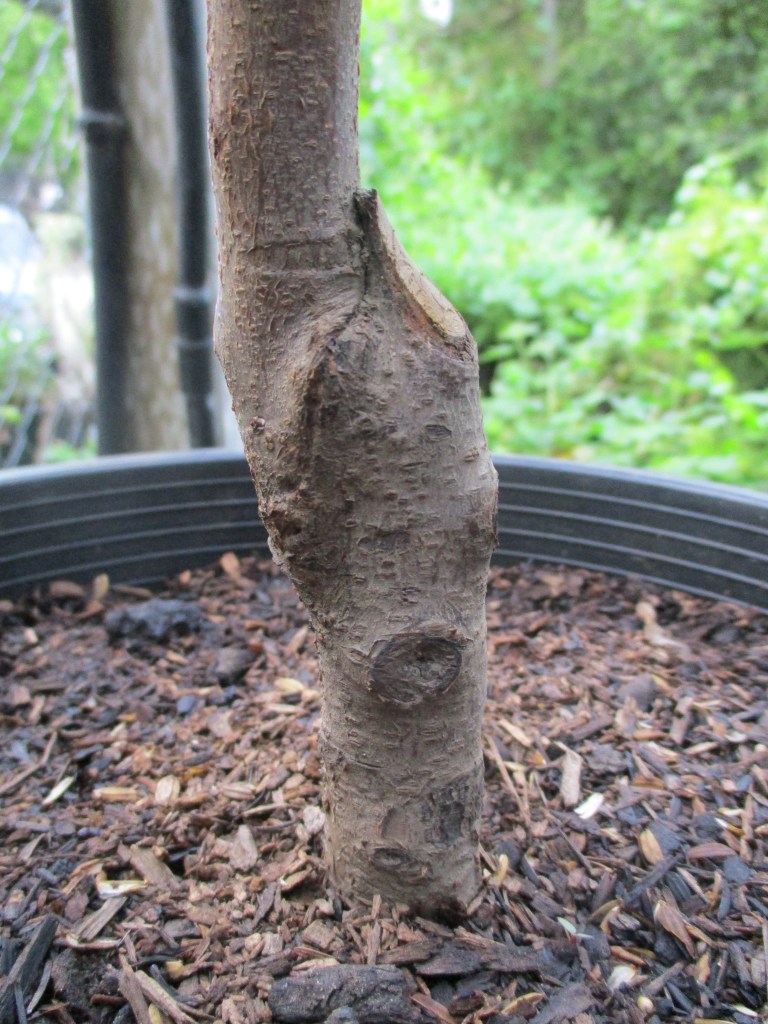
The scion is above this graft union. The rootstock is below.

There are not many Californians of my generation who do not remember growing avocado trees from seeds when we were kids. We simply impaled the big seeds around the middle with three evenly spaced toothpicks to suspend them from the rims of Dixie cups partly full of water. If just the bottoms of these seeds remained properly submerged, they grew roots and a stem with a few leaves, all they needed to grow into trees that were producing too many avocados by the time we got to high school.

Yet, I and others of my generation have always heard that avocado trees need to be grafted to produce fruit. (Grafting is the union of two or more compatible but different plants. The ‘scion’ is the upper portion that forms a trunk, branches and foliage. The ‘rootstock’ is the lower portion that provides roots.) Well, this is obviously not true, but does make us wonder about the advantages of grafted trees.

They myth of seed grown trees being unproductive probably originates from the tendency for seed grown avocado trees to be unproductive for the first few years during the juvenile stage. Scions of grafted trees are taken from adult growth that is ready to bloom and fruit immediately; although even grafted trees need a few years to grow large enough to produce more than just a few avocados.

Many plants are juvenile while young, in order to better compete in the wild. While juvenile, avocado tree seedlings grow vigorously enough to compete with other trees. Adult habits of blooming and fruiting would only slow them down. Besides being fruitless for many years, citrus seedlings are very thorny through their juvenile phase, to avoid getting eaten by grazing animals. Scions of grafted citrus trees are from relatively thornless adult growth that is immediately ready to produce fruit.

The primary advantage of grafting fruit trees though, is keeping the many different cultivars (cultivated varieties) ‘true to type’, since many seed grown plants exhibit at least some degree of genetic variation from their parents. For example, avocados from seed grown (ungrafted) trees tend to be much larger, but often less flavorful than the fruit that the original seed came from. No one really knows what the fruit will be like until it actually develops. Some seed grown peaches are indistinguishable from their parents, but most are very different. However, most pecans and chestnuts are actually produced from ungrafted seed grown trees.

The secondary advantage of grafting fruit trees is the ability to graft onto dwarfing rootstock. Although few avocado trees are dwarf trees, almost all citrus trees for home gardens are grafted onto dwarfing rootstock that keeps them more compact and proportionate to home gardens. Most deciduous fruit trees are similarly grafted onto semi-dwarf rootstock.

Six on Saturday: Schwedler Maple

Norway maple is aggressively invasive in the Pacific Northwest and the northeastern quadrant of America. It is no problem here though, and is actually rare. Schwedler maple is a cultivar of Norway maple that used to be more popular as a street tree in San Jose. I had been trying to grow copies for years. Besides propagating by cutting, I also tried grafting.

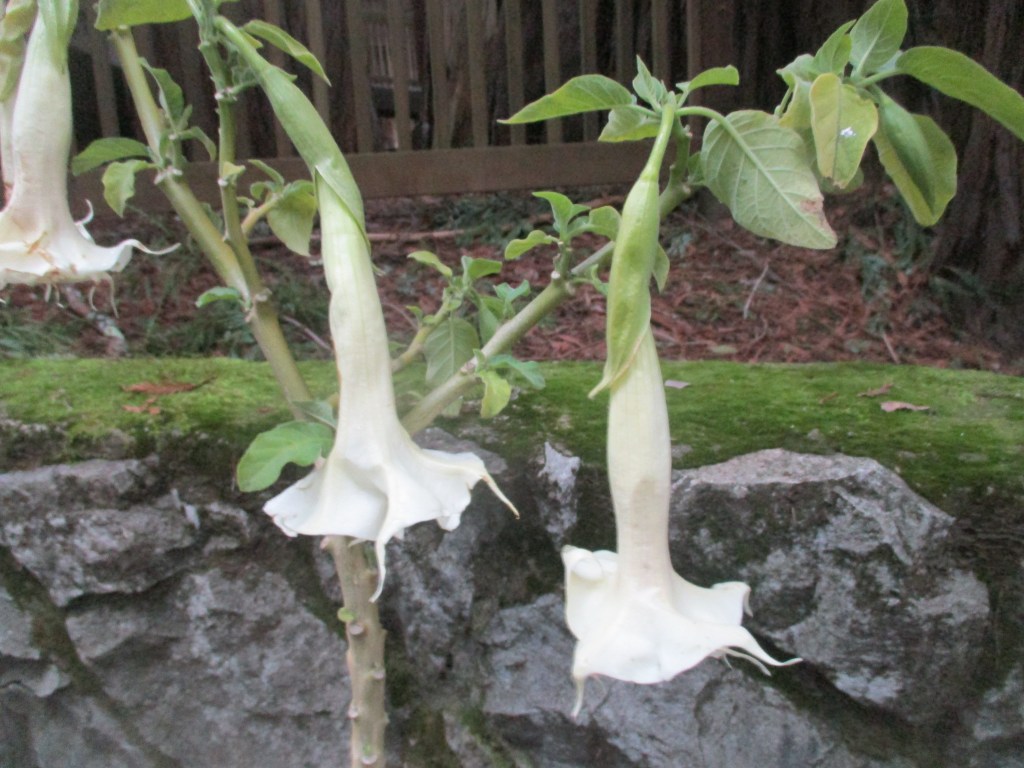
1. Double white angel’s trumpet is irrelevant to Schwedler maple. It belonged with the Six for last week, but with the addition of the picture of Rhody, did not fit. Omission of Rhody’s picture would have been unacceptable. The parent plant lives at the Santa Cruz Civic Auditorium. The piece in this picture is a pruning scrap that became more new cuttings. Bloom is very fragrant!

2. Scion wood looks like a bunch of bare twigs because that is precisely what it is. This is an important bunch of bare twigs for me. It is from an elderly tree that I met in the summer of 1976.

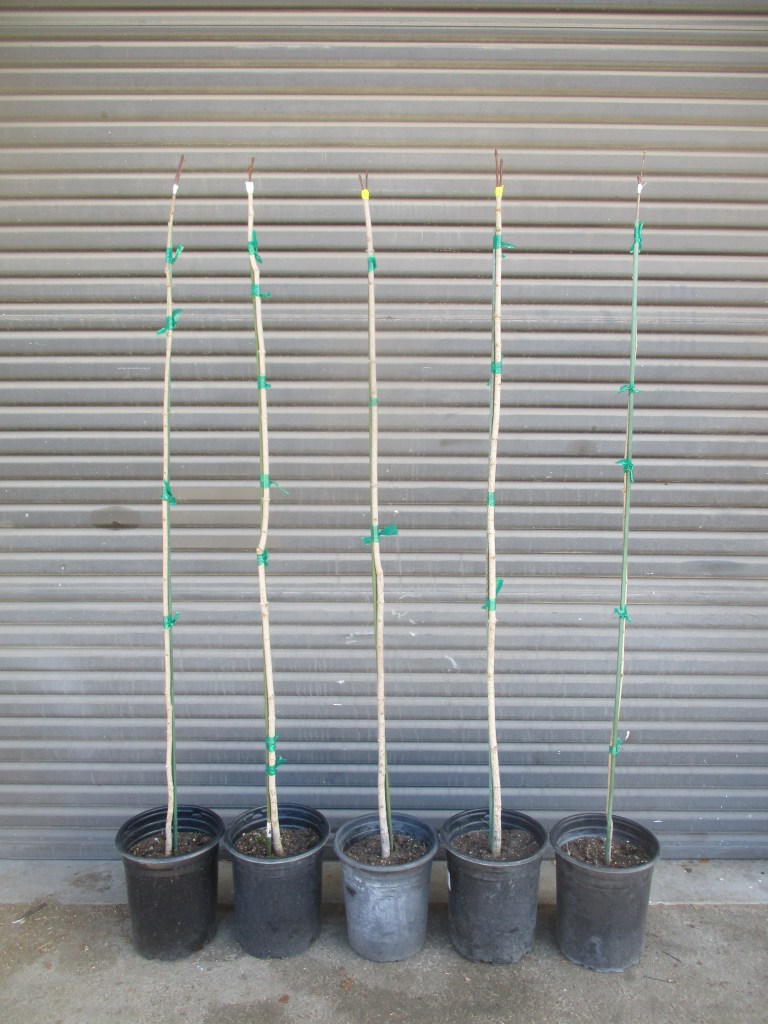
3. The usual suspects. Norway maple is notoriously invasive elsewhere. The few cultivars that live here are both rare and seemingly sterile. However, one noncultivar tree seeded these five.

4. High bud grafting is not my style, but was likely easier on the thinner portions of trunks five and a half feet up. Besides, the straight trunks were too perfect to waste. It will look silly later.

5. Cleft grafting was also an easier option to more typical budding. Besides, I do not trust budding with such fat buds and such thin bark. I could not find rubbers, so used elastic from masks.

6. Rhody is about as relevant to Schwedler maple as the double white angel’s trumpet. Nonetheless, he is always the main attraction of my Six on Saturday. He is as uncooperative as always.

This is the link for Six on Saturday, for anyone else who would like to participate:

https://thepropagatorblog.wordpress.com/2017/09/18/six-on-saturday-a-participant-guide/

No One Likes A Sucker

50318thumb
Citrus have been bred for centuries.

Citrus trees that are grown from seed take a few years to mature enough to produce fruit. As they mature, the juvenile stems are outfitted with thorns that are even nastier than thorns on adult growth! Because most citrus has been extensively bred, seed grown trees are very likely to exhibit genetic variations. This is why citrus trees are cloned from stems of stock trees.

Cloned trees are genetically identical to their parents, so will always produce the same fruit. They are cloned from adult growth, so do not need time to mature from juvenile seedlings. They can therefore bloom and produce fruit as soon as their roots are ready. Also, their thorns are less dangerous.

Cloning citrus is not as simple as rooting them from cuttings though. With few exceptions, citrus trees are grafted onto genetically different rootstock. Most citrus trees in home gardens are grafted onto dwarfing rootstock that limits the size of the trees when mature. Orchard trees are grafted onto rootstock that allows them to get significantly larger.

The graft union, where the upper part of a grafted tree is attached to the rootstock, is typically visible just above the ground. The base of the trunk below the graft union is typically a bit more stout than the relatively lean section of trunk above the graft. Trunks of old trees are often more furrowed below the graft union than above it.

Sometimes, the rootstock tries to do more than provide roots. It can produce stems from below the graft union, known as ‘suckers’ that can potentially compete with the grafted portion of the tree above. Unfortunately, understock grows more aggressively than most types of citrus, so can overwhelm and shade out the desirable parts of an otherwise healthy citrus tree.

The most common understock for citrus produces suckers that are outfitted with unusually big and wicked thorns that are not to be messed with! If fruit develops, it seems to be humongous and disfigured lemons that lack flavor. Before they overtake good citrus trees, suckers should be pruned neatly away as they develop, without leaving any stubble to regenerate more sucker.

Curb Mongrel

P91208Fruit trees, with few exceptions, have been extensively bred to produce the quality of fruit that we expect from them. Some are consequently genetically unstable, or at least less genetically stable than their wild ancestors were. Even if they never mutate or try to revert to a more stable state, they are very unlikely to produce seed that can develop into genetically similar trees.

In other words, they are not ‘true-to-type’. Their seed might grow into trees that produce fruit that resembles that of one of their ancestors, or of a pollinating parent tree. It is impossible to predict what fruit will be like until it actually develops.

That may take a while. Some seed grown fruit trees start out with juvenile growth, and take a few years to mature enough to bloom and produce fruit. Some types of avocado trees grow tall and lanky for a few years before they bloom. Most citrus are fruitless and wickedly thorny through their juvenile phase.

Grafted fruit trees or those grown from cuttings are true-to-type because they are genetically identical clones of their single parents. Cuttings and scions (for grafting) are made from adult growth, so do not need to mature through a juvenile phase.

The unpredictability of genetic variability is the main reason fruit trees are not often grown intentionally from seed. Juvenility might be the second main reason. However, neither of these two reasons prevents curb mongrels from growing wherever their seed lands, which is often next to sidewalks and curbs where cores and pits get discarded.

Curb mongrels generally get removed and disposed of, just like any other weed. It would be more practical to plant a known cultivar of fruit into a situation where such a tree is actually desired. Every once in a while, a curb mongrel appears where it is allowed to stay, and eventually produces fruit that justifies its preservation.

Well, that was not what happened with this curb mongrel apple tree that appeared adjacent to a patio used for outdoor dining. It was not compatible with the landscape, so got removed before it was able to produce any fruit. It looks like it was grafted, but only because someone tried to cut it down without removing the stump two years ago.

The problem now is that it came up with enough roots to survive relocation. It is not so easy to dispose of a tree with such potential, even though there is no way to know what its potential is until it fruits. It will get planted into a private garden and pruned back accordingly. If we had planned for it to be relocated, the process would have been delayed until it was defoliated.

If the fruit is of inferior quality, the tree can be removed and discarded. At least we tried. Alternatively, a desirable cultivar can be grafted onto it. In a home garden, no one needs to know that it is not a known understock (rootstock) cultivar. The foliage resembles that of ‘Red Delicious’, which makes sense for seed that likely originated from a commonly discarded core.
Horridculture – Multi-Grafts

P91116+++Bare root fruit trees will be available in about a month. It is probably my favorite time of year for going to nurseries. (Since I grow just about everything I want from bits of landscape debris, I do not often go to retail nurseries.) It is also rather frustrating to see what sorts of bare root material are popular nowadays, and what sorts are not. Horticulture has gotten so ridiculous!

Most of the formerly common cultivars of fruit trees that I remember are no longer available. They were common for a reason. They perform well here. Retailers used to select cultivars for their respective regions, instead of pimping out weird new but unproven cultivars, or just taking the same faddish cultivars that get sent to other stores within a vast chain of big box stores.

One of the weirdest of fads are multi-grafted fruit trees and roses.

Multi-grafts are certainly not new technology. Back when horticulture was taken more seriously, fruit trees for home gardens (which might be the only ones of their kind in their respective gardens) were sometimes, if needed, outfitted with a secondary scion of a pollinating cultivar. The pollinator could be pruned low and subordinated, as long as it bloomed with a few flowers.

Most of us preferred to simply plant two separate trees that could pollinate each other. If one was less desirable than the other, it was just maintained as a smaller tree so that it would not occupy so much space that could be utilized by more desirable types. Each tree had its own uncrowded area. If one succumbed to disease, it did not necessarily affect those associated with it.

Multi-graft trees are not so easy. If the trunk of a multi-graft pear tree gets infested with fire blight, all the scions grafted to it succumb. Because almost no one prunes them properly, the most vigorous cultivars dominate and crowd the less vigorous. Even well pruned trees are always asymmetrical because each cultivar exhibits a different growth rate and branch structure.

Multi-graft rose standards (trees) just look weird and freakishly unnatural. Pruning must ensure that one cultivar does not crowd out the other, just like for fruit trees. The multi-graft rose in the picture above was planted with three others just like it. Two of them crowded out one of their two scions. It would have been easier to simply plant two in white and two in burgundy.

Multi-graft plants are useful only if ground space is very limited, but air space is not. For example, such a tree planted in a hole in a deck can extend limbs over the deck where other trees can not live. If maintained properly and separately, each part can produce its share of fruit in season. I once did this with a pear tree that was espaliered on a fence over a concrete driveway.