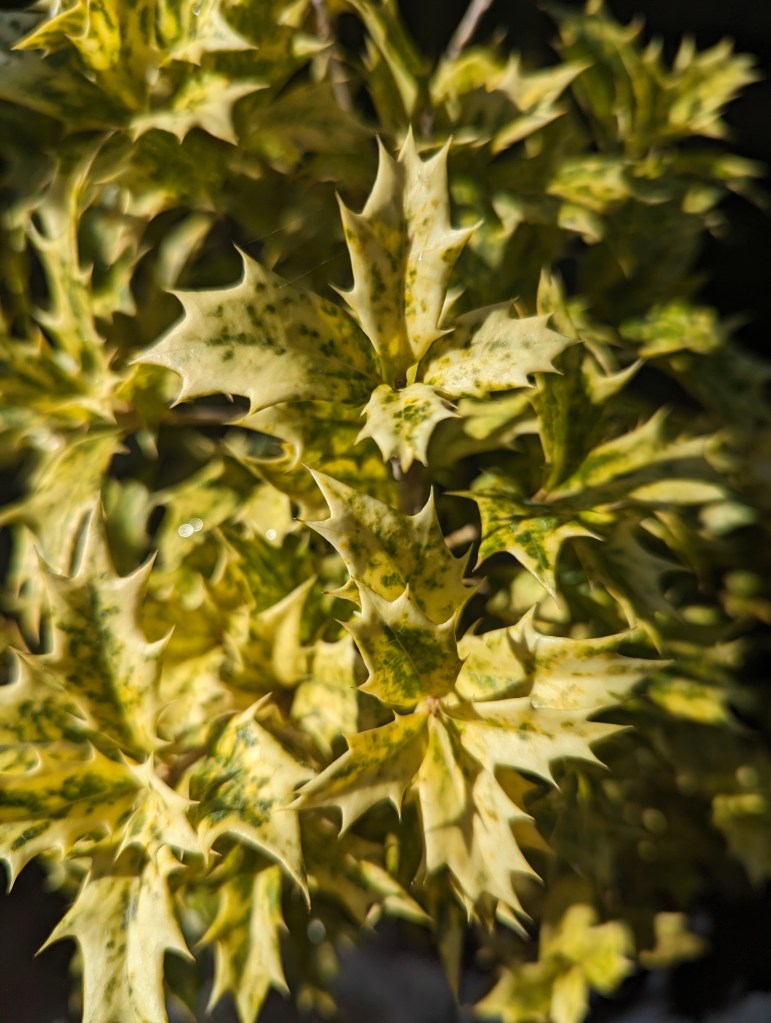
English holly provides traditional cut foliage, preferably with a few berries, for Christmas. It is annoyingly prickly, though. This is why holly olive, Osmanthus heterophyllus, is now a more docile option. Its foliar texture is very similar, but with slightly dulled foliar spines. It is gentle enough for corsages and boutonnieres. However, it generates no red berries.
Holly olive is popular as small and perhaps decorated potted plants for Christmas decor. Afterwards, it adapts to home gardens more efficiently than typical Holiday potted plants. Such potted plants should not retain any mylar wrapping for too long. It inhibits drainage. Also, any small decorations or fake berries should not remain as stems eventually grow.
Most popular cultivars of holly olive are variegated. ‘Goshiki’, with more yellow or creamy white blotches than green, is the most popular here. Unvariegated holly olive is a classic dark drab green. All cultivars work splendidly as formal hedges. Alternatively, they might slowly grow taller than fifteen feet. The evergreen foliage becomes less spiny higher up. Tiny flowers are sweetly fragrant.
It would have been easier to paint the wall green.
Foundation plantings were quite functional while eavestroughs and downspouts were prohibitively expensive prior to about the Victorian Period. They dispersed rain water as it fell from eaves above, in order to limit surface erosion and muddy splatter onto foundations, basement windows, and lower portions of walls.
Most foundation plantings were tough perennials, such as lily of the Nile, or low and densely evergreen shrubbery, such as English boxwood or Indian hawthorne. Some did not stay so low though. Long after eavestroughs and downspouts became common, some foundation plantings grew into obtrusive hedges in front of exterior walls. Some even obscured windows. Instead of dispersing moisture, they retain moisture and damp detritus that promotes rot of associated walls and infrastructure. Furthermore, they require maintenance, such as shearing. It would be more practical to paint a wall green than to leave overgrown foundation planting pressed up against it.
Vines are no better. They can be practical on reinforced concrete and cinder block, but not much more. Not only do they promote rot, but some destroy paint, siding and stucco. Vermin can get anywhere that vines provide access to.
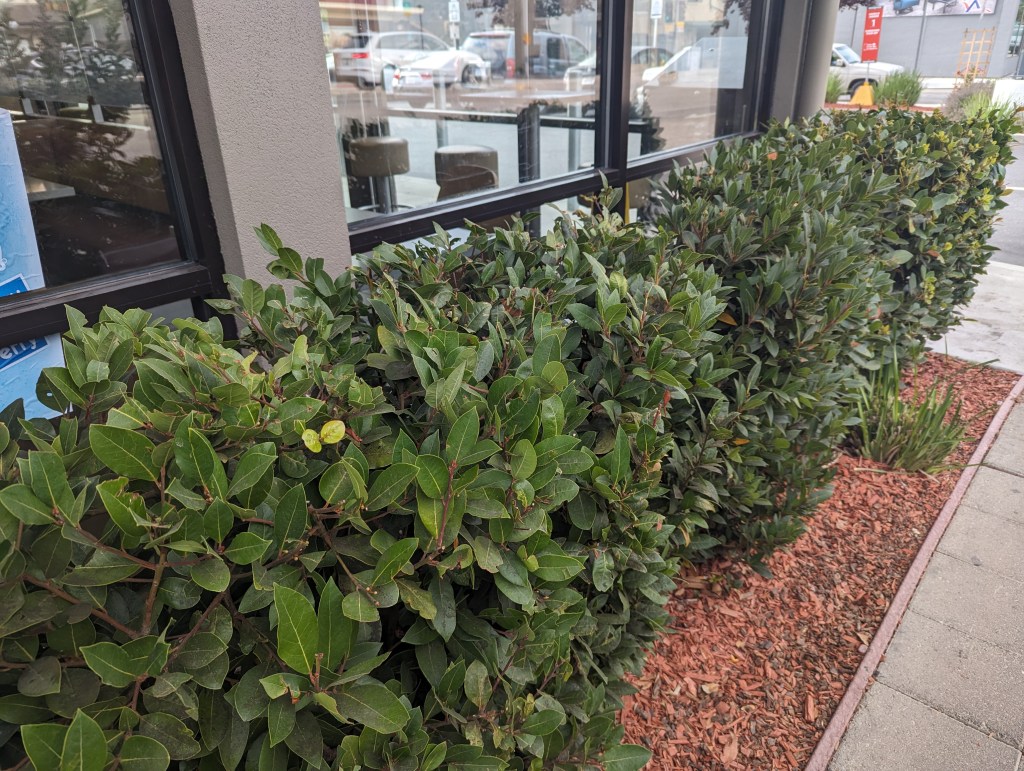
This is neither about vines nor foundation planting though. It is about this hedge in front of this glass facade. It got my attention because it did not grow slowly into this form from overgrown foundation planting, but was intentionally installed and shorn as such. Then, I realized that it is actually practical. It did not require modification of the wall. It is shorn to maintain a slight bit of clearance from the glass facade, to facilitate cleaning of the glass, and inhibit accumulation of detritus against the glass. Therefore, it does not look so bad from within. Perhaps it is comparable to painting the glass wall green, but is actually more visually appropriate.
Conformity has practical application even in casual landscapes.
A combination of modern horticultural apathy and too many choices was probably the demise of conformity in home gardens. Formal hedges or even informal screens of several of the same plants are nearly obsolete. Ironically, long and low barrier hedges and so called ‘orchards’ of identical trees planted in regimented rows or grid patterns have become common in large landscapes in public spaces
Those of us who still crave formal hedges, paired trees or any such symmetry in our home gardens must be more careful with the selection of the plants that need to conform than would have been necessary decades ago when there was less variety to complicate things. It is just too easy to get different varieties of the same plant. Only plants with matching cultivar (cultivated variety) names will necessarily match. (Yet, on rare occasion, even these are inaccurate.) For example, ‘Emerald’ arborvitaes will match other ‘Emerald’ arborvitaes, but will not match ‘Green splendor’ arborvitae, no matter how they resemble each other in the nursery.
Plants that are identified by their characteristics instead of by cultivar name are riskier. Blue lily-of-the-Nile could be any one of many different cultivars with blue flowers. It is therefore best to obtain all lily-of-the-Nile for any matching group from the same group in the same nursery at the same time. What will be available next week may actually be a different variety with a different shade of blue and different foliar characteristics. Nurseries bring stock in from so many different growers.
Adding new plants to replace those that have died within established hedges or streets flanked with the same trees can be particularly difficult, especially if the old varieties are no longer available. The old fashioned yellowish Japanese boxwood that was so common for small hedges in the 1950’s has not been common in nurseries for several decades. Replacement plants are darker green. Some are even compact cultivars or different specie like English boxwood. When lined up and shorn together, they make ‘calico’ hedges.
(This article is copied from my other discontinued blog at Felton League. It is not about horticulture, but links to another article about hedges, and features Brent’s garden.)
This is why I have never stayed at Hotel del Flores.
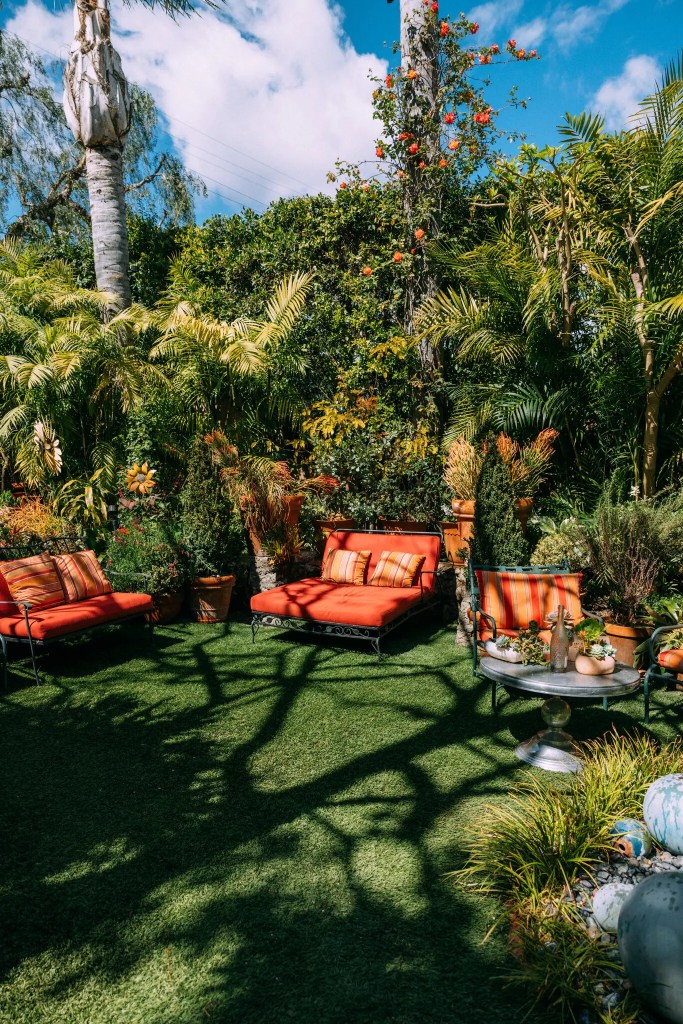
The New York Times featured a picture of my homeless camp! It is the third illustration of this article about landscape hedges. It shows where I camp while in Southern California, including the orange garden daybed where I sleep, and, as the primary topic suggests, a portion of the surrounding hedges.
This illustration should demonstrate why I enjoy being homeless in Southern California. It is quite luxurious. The weather is exemplary for camping. I wake amongst lush tropical foliage and palms, to the gentle sounds of small fountains and wild parrots. It is about as excellent as camping within one of my gardens, but very different, and special because I do it for less than three cumulative weeks annually. For many years, I have been wanting to stay at the famously eccentric Hotel del Flores nearby, but will not do so without inhospitable weather to dissuade homelessness.
Seeing this particular illustration reminds me of why this Felton League blog has been discontinued. For quite a while, there has not been much to write about that would not be intrusive to those involved. Societal difficulties as well as personal difficulties within society certainly remain, but are not as prominent as they had been. My own experience with faux homelessness, albeit within another Community, is strangely appropriate as an illustration for an unrelated article within the New York Times.
Most of those who experienced unemployment, poverty, homelessness or related difficulties here in the past are now enjoying major improvements to their personal situations. Many of those who are not yet benefiting from such improvements appreciate support from this graciously compassionate and generous Community. This has always been a good place to be in a bad situation. Perhaps, now that I no longer blog here, I should write a book about my experiences.
Since the camera died, all my pictures are taken by telephone and then sent to my email. The primary problem with this procedure is that the telephone signal here is unreliable. I actually had six timely pictures to post today, but could not get them here. Instead and again, these six are merely five random pictures that I had no other use for, as well as an illustration that I copied from a magazine. Incidentally, the illustration from a magazine is not of particularly good quality. Actually, most of what is shared on Six on Saturday is of superior quality, and more interesting.
1. My Los Angeles homeless camp made the New York Times! This is it in an illustration for an article about hedges. It is why I have never stayed at the famously eccentric Hotel del Flores, which incidentally, has less Flores. It is in the back yard of Brent’s Jungalow.
2. ‘Tropicanna Black’ Canna was ‘borrowed’ from my Los Angeles homeless camp during a previous trip late last summer. It now lives happily with five other fancy cultivars here.
3. Morea iridioides, African iris is nothing special. This and three others were split from an overgrown specimen that I planted at my mother’s garden in the early 1990s though.
4. This is where they live now. They will not look so silly as the Dodonaea viscosa grows. I should pluck bits from the biggest specimens to add to the small specimen this winter.
5. Acer platanoides, Norway maple resembles ‘Schwedleri’ Norway maple that I grew up with. I can not remember the name of this modern cultivar. I prefer the original though.
6. Rhody approves of these unplanned Six on Saturday, although this sixth older picture may have been featured earlier. He and I both know how popular any of his pictures are.
There are rules to hedging. Many hedges violate some of such rules. Formal hedges are the most egregious offenders. Their uniformity, symmetry and form require compliance to relatively strict standards. Relatively relaxed standards of informal hedges or screen are standards nonetheless. Almost every hedge eventually needs maintenance of some sort.
The primary difference between formal and informal hedges is uniformity. A formal hedge involves only a single variety of a species. Spaces between individuals of such a hedge are all the same. An informal hedge can involve more than one species. Spacing may be variable, even if for a single variety. Informal pruning is less strict than formal shearing.
Both types of hedges are generally utilitarian, as well as aesthetically appealing. Many provide privacy. Many obscure undesirable scenery. Some divide gardens into distinct spaces. Size and shape is very relevant to how effectively a hedge serves its purpose. Unfortunately, most hedges are significantly larger than necessary. Many are obtrusive.
This happens because their depth, from front to back, is easy to ignore. A healthy facade of dense foliage conceals wasted space within. It can slowly expand outwardly as each subsequent shearing procedure allows. Expansion is faster above than below, which is why so many hedges are wider on top. Distended tops shade and inhibit lower growth.
Obtrusive hedges are difficult to restore. Most require removal of their appealingly dense foliar facades. Such a procedure exposes unappealingly bare stems within. This should be temporary for most hedges. They efficiently refoliate to develop new facades with less depth. Such renovation is impractical for junipers, which can not refoliate so efficiently.
Renovation of obtrusive hedges is unpleasant and temporarily unsightly. However, it can recover formerly useless space. A hedge that was six feet wide can be as effective if only a foot wide. There is no need for it to extend over usable spaces, such as walkways and patios. Other vegetation will likely appreciate better exposure to sunlight. Mild weather delayed but did not eliminate the need for seasonal maintenance of hedges.
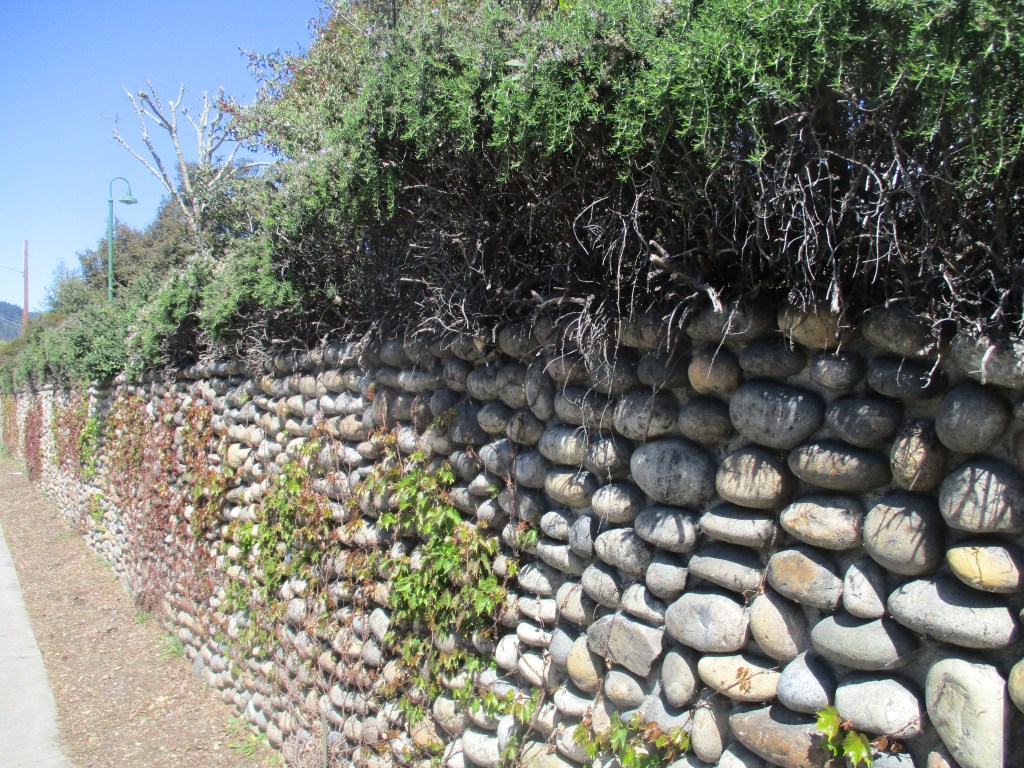
Cascading rosemary should actually cascade rather than get shorn into submission. (For this situation, it is subordinating to the climbing Boston ivy below.)
You can make fun of the decadent hair styles of the 1980s all you like; but you must admit that they were better than what came later. Back then, the assets of each particular type of hair were exploited instead of destroyed; sculpted instead of chopped into submission. Sadly, landscape maintenance evolved in a similar manner.
So many trees, shrubs and ground covers are either shorn too much to develop their naturally appealing forms, or not pruned severely enough to allow space for resulting new growth to mature and bloom like it should. Gardeners are notorious for shearing anything within reach. However, they are also notorious for allowing certain ground covers to get too deep and overgrown.
Trees that are short with multiple trunks when they first get planted are more likely than taller trees with single trunks to be shorn into nondescript shrubs. Olive, Japanese maple, tristania (laurina) and crape myrtle are commonly victims of this abuse. They are not only deprived of their form, but their grace and foliar appeal as well. Shorn crape myrtle may never be able to bloom.
Oleander, bottlebrush, arborvitae and various pittosporums that make nice informal screens in their natural forms are likewise very often shorn inappropriately and needlessly into all sorts of odd geometric shapes. Fortunately, pittosporums tend to make excellent formally shorn hedges as well as informal screens. Yet, when shorn without a plan, they more often develop into herds of noncontinuous geometric shapes. Oleander and bottlebrush, like crape myrtle, may never bloom if shorn too frequently.
Ground cover more often has the opposite problem. It does not get mown enough, or otherwise pruned down to stay shallow. This may not be a problem in most of the space covered by ground cover, but does make for hedge-like edges where the ground cover meets walkways, with all the problems of improperly shorn hedges. These edges can be softened if sloped inward and rounded off on top. However, lantana, star jasmine, acacia redolens and the ground cover forms of ceanothus do not bloom on these shorn edges unless the shearing procedure gets done at the right time to allow for enough new growth to mature in time for the blooming season.
There is certainly nothing wrong with properly planned and properly shorn formal hedges; but not everything needs to be shorn. Plants should be selected to be proportionate to their particular application without abusive shearing. Like the hair styles of the 1980s, the assets of each particular plant should be exploited instead of destroyed.
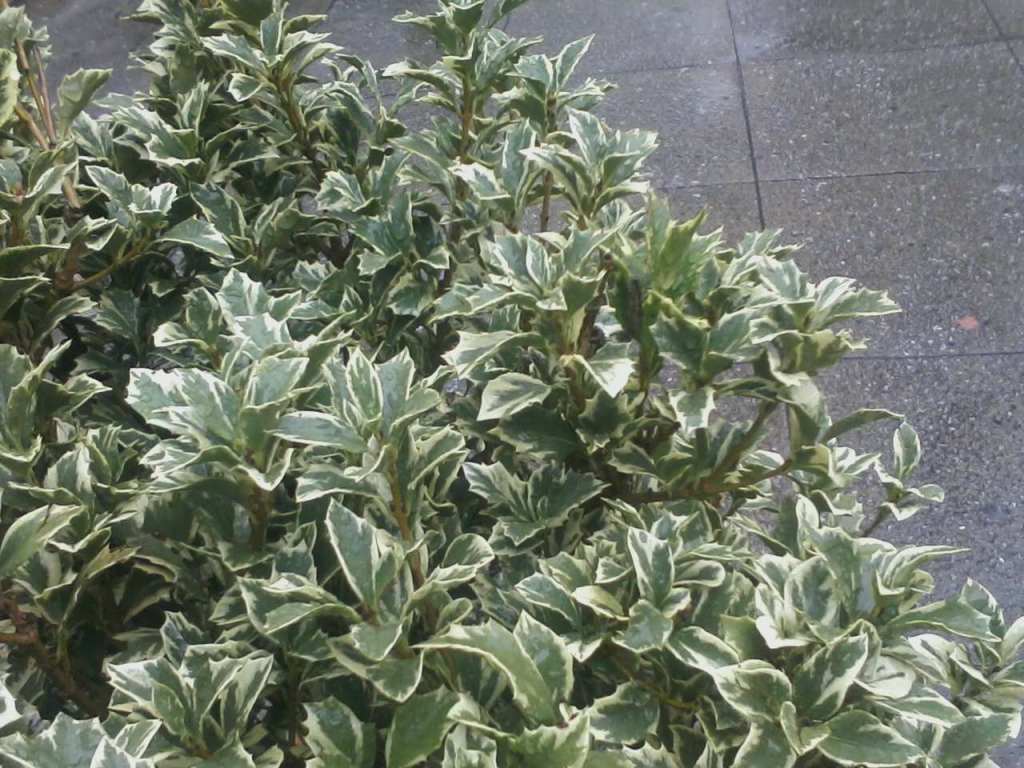
If the foliar spines (teeth on the margins of the leaves) of English holly are too nasty, holly olive, Osmanthus heterophyllus, might be a more docile option. It lacks the occasional bright red berries and the very glossy finish on the leaves, but is much easier to handle than real holly is, since the spines are not nearly as sharp. If you look closely, you can see that the one to two and a half inch long leaves have opposite arrangement (are in opposing pairs along the stems) instead of alternate arrangement (are single along the stems) like those of holly.
The more popular varieties of holly olive have some sort of variegation of white or gold. Variegation can be spots, blotches or more refined margins. Most of the modern variegated varieties prefer to stay less than six feet tall. The old fashioned unvariegated holly olive can get more than twenty feet tall when very old, but the upper foliage lacks the distinctive foliar spines of lower foliage. The tiny and mostly unnoticed flowers are pleasantly fragrant.
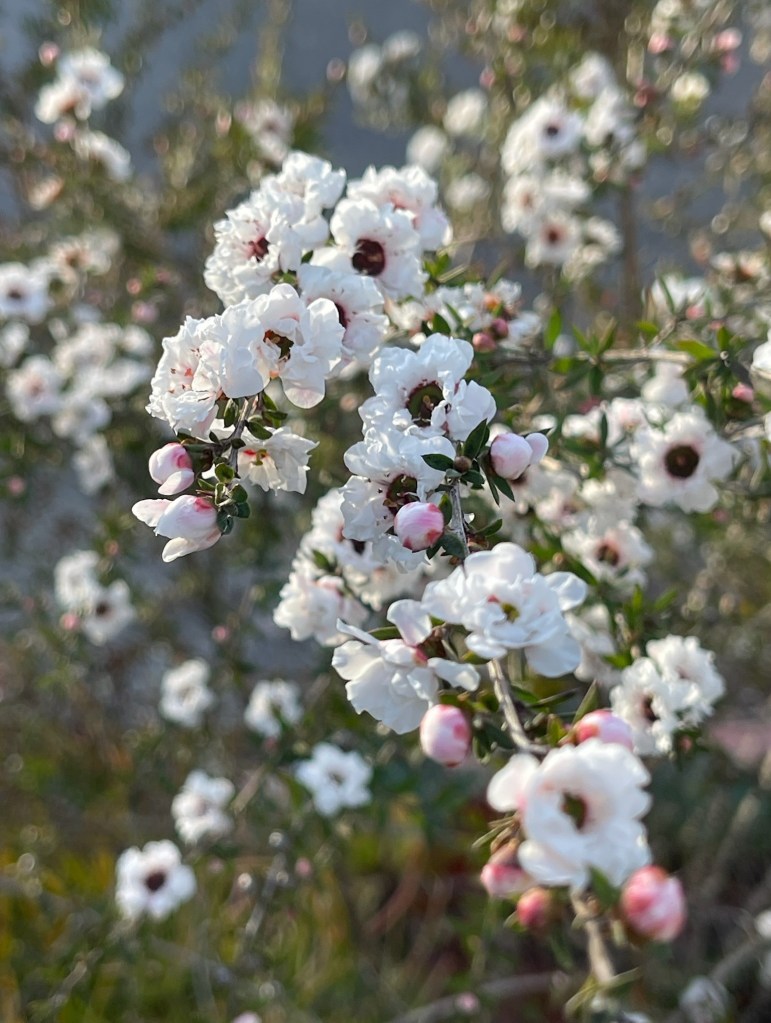
Bloom should probably be most profuse for late spring or early summer. In actuality, New Zealand tea tree, Leptospermum scoparium, blooms whenever and however it wants to. Now that it seems to be blooming prematurely, it might continue to bloom in phases until autumn. Minor bloom phases might even continue randomly through autumn and winter.
Floral color is white, pink or red, including deep ruby red. The tiny flowers are sometimes sporadic but sometimes quite profuse. A few cultivars have plump double flowers. Foliar color is olive drab green or bronze green. The finely textured evergreen foliage is slightly scratchy. Its tiny leaves have pointed tips. The fibrous brown bark is handsomely shaggy.
New Zealand tea tree works very well as a blooming informal hedge. Frequent shearing of formal hedges compromises both bloom and natural form. Elimination of lower growth exposes appealingly sculptural trunks supporting little trees. Some modern cultivars will not reach first floor eaves. Some reach second floor eaves. All demand sunny exposure.
It may not seem like much to take notice of. Sweet olive, Osmanthus fragrans, resembles glossy privet, but is neither as glossy nor quite as richly green. The dense and evergreen foliage can work about as well for a formal hedge though. It is even better as a small and billowy tree. It gets at least as high as ground floor eaves, and can reach upstairs eaves.
The primary allure of sweet olive is its delightfully pervasive and fruity floral fragrance. Its small and slender clusters of tiny pale white, yellow or gold flowers are mostly obscured by foliage. For those who are unfamiliar with it, the fragrance might be difficult to identify. Bloom is most abundant before and after summer. Sporadic bloom happens at any time.
Because sweet olive is more olfactorily appealing than visually appealing, it works quite nicely as in informal hedge behind prettier plants. It can stay narrow between windows of neighboring homes that are a bit too close together. If enough flowers are available, they might flavor tea and confectionery. A cultivar with variegated foliage is unfortunately rare.



 Tony Tomeo