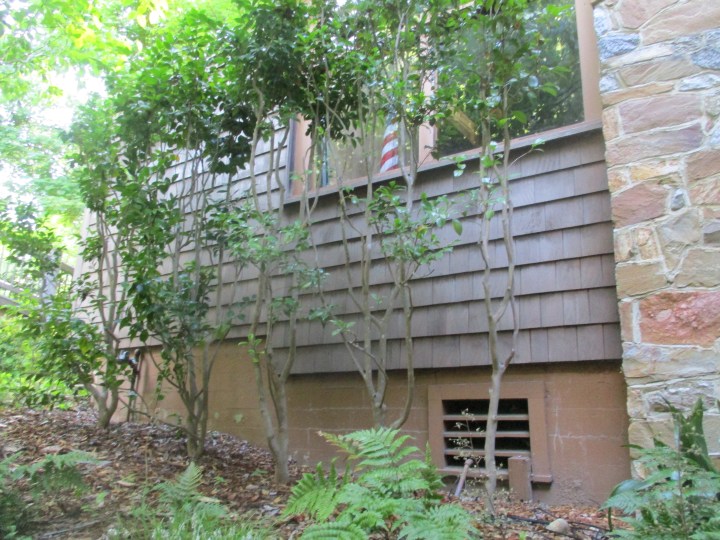
‘Foundation planting’, which most of us think of as vegetation intended to merely obscure a foundation behind lower and prettier plants, has a simple utilitarian origin. Before homes were so commonly outfitted with rain gutters like they are now, densely shrubby foundation plantings diffused water that fell from eaves, and limited splattering of mud onto foundations and walls.
Nowadays, foundation planting only needs to look good, and maybe obscure crawlspace vents or exposed undersides of decks. They might be allowed to get as high as window sills, or higher.
These camellias got more than a bit too high. They had not obscured the cinder block foundation in a very long time, and did not contribute much to the shingled wall above. What was worse was that all of their best foliage and bloom obscured the view from the window above, and obstructed sunlight to the interior. They were impressive specimens, but were not doing their job.
We tried to prune their canopies lower and thinner, in order to promote more lower growth that we could prune down to later. They responded by merely replacing what was pruned away, exactly where it was pruned away from. We considered relocating the camellias to where such big and lanky camellia trees would be desirable, but they are too old and firmly rooted in place.
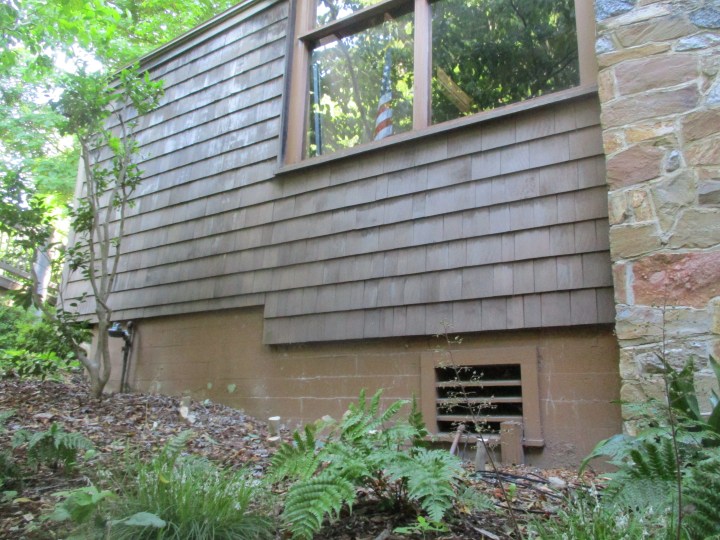
The only option was to coppice them. It was quick and easy. We cut them to the ground with the expectation that they will either regenerate from their stumps or die. If they die, we will not miss them. (Okay, I might.) The new growth will obscure the foundation well, and after a few years, should resume blooming. They will be patchy if some but not all do survive, but we tried.
The remaining sculptural specimen obscures no windows.

 Here on the West Coast, privets had traditionally functioned like hollies had in the East. They are conducive to shearing into the big formal hedges that were popular during the Victorian period. Since then, as gardening space became more limited, the common glossy privet became less popular than the more compact and complaisant waxleaf privet, Ligustrum japonicum ‘Texanum’.
 As a shorn evergreen hedge or simple shorn shrubbery, photinia, Photinia X fraseri, produces handsomely glossy bronzy red foliage without bloom. It is best if shorn as weather warms at the end of winter, and then allowed to grow out for a while. It can be shorn again through summer as bronzy foliage fades to green, but should not be shorn so often that it is always deprived of red foliage.
 There may not be exceptions to every rule, but there are a few exceptions to the rule that winter is the best time for pruning. It is generally true that most plants are the most dormant through the coolest part of winter. It is also true that while they are the most dormant, most plants are less sensitive to pruning, as well as other horticultural techniques that interfere with their normal function.
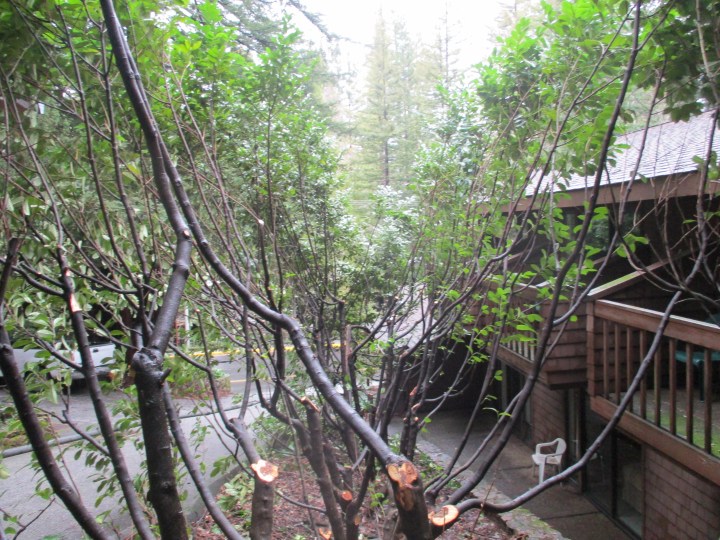 What makes this Bullwinkle worse than most is that I pruned it like this myself. What makes it worse than worse is that it did not need to be pruned in this disfiguring manner for clearance from utility cables like the last one I wrote about was.
  While flashier but typically weaker modern cultivars of so many other specie are being developed, the most popular of the many cultivars of English boxwood, Buxus sempervirens, remain the same. There is not much to improve on. Most cultivars get only a few feet tall, and are densely foliated with inch long evergreen leaves that are excellent for topiary and low formally shorn hedges.
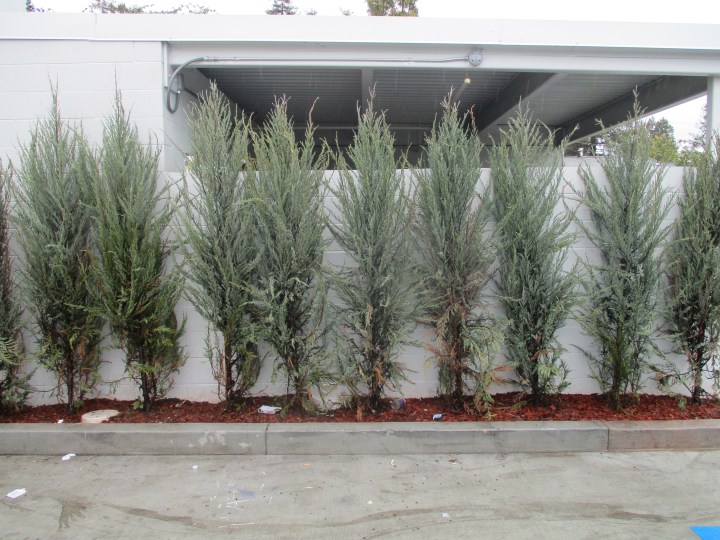 Back when horticulture was still respected, a very long time ago, dense shrubbery with finely textured foliage, such as Japanese boxwood, could be purchased already shorn into cubes that only needed to be installed in a closely set row to become an ‘instant hedge’. For some small hedges composed of small plants that recovered efficiently from transplant, it actually worked reasonably well, even if they did not look so great at first. It also worked for a few larger shrubs that happened to transplant very easily, such as glossy privet. Tall arborvitaes happen to work exceptionally well as instant hedges, although the best spacing for them leaves temporary gaps in between.
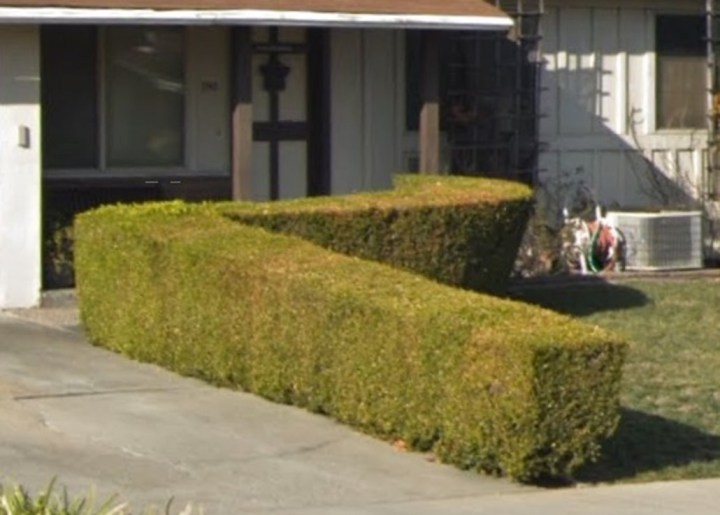 It was so long ago that I barely remember it. I was just a little tyke. My older sister tripped on the driveway and broke one of the Japanese boxwood shrubs in the hedge on the edge of the driveway and front walkway. The hedge was still young then, and not completely filled in. My Pa replaced the missing shrub shortly afterward, but not before my younger brother and I learned that the gap was a shortcut through the hedge. The puny new shrub was not enough to compel us to go around like we had done before. Of course, it did not survive for long. It too got broken off.
 Baldness was not yet cool while Brent and I were studying horticulture at Cal Poly in San Luis Obispo back in the late 1980s. Nor were hairpieces yet tacky. Consequently, some middle aged men work toupees. As these men aged and grayed, their formerly well matched topees did not.
 Tony Tomeo