Hummingbirds Enjoy Home Gardens Also

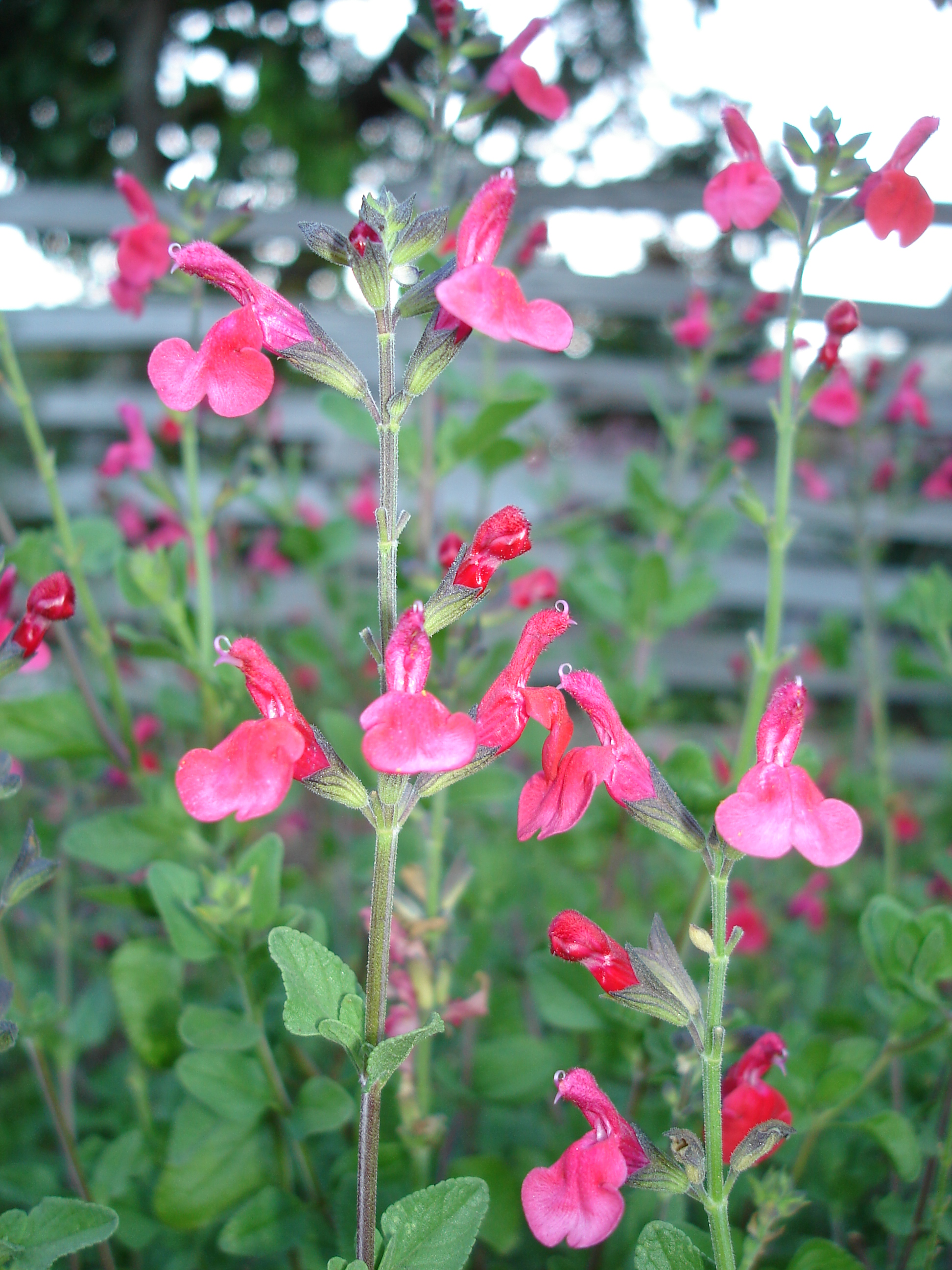
Hummingbirds are very fond of sages.

Floral color communicates to pollinators. Pollination is, after all, the priority of all flowers. Those that rely on pollinators more than breezes for pollination must therefore advertise. They effectively customize their bloom for preferable pollinators. Some incorporate floral fragrance if necessary. Most preferable pollinators are insects. Some are hummingbirds.

Seven species of hummingbird inhabit California. Some are always here. Some migrate south for winter. A few are only here while they migrate between farther south and farther north. All eat only small insects and floral nectar. Blooms which rely on hummingbirds for pollination are happy to provide. They have a mutually beneficial symbiotic relationship.

Many plant species have customized their bloom for pollination by hummingbirds. Many of these flowers are elongated, tubular and curved to fit the long beaks of hummingbirds. Most, although not all, are bright and rich colors that hummingbirds prefer. Bright red and orange are probably their favorite colors. Floral fragrances are more for other pollinators.

Many who enjoy gardening enjoy hummingbirds within their gardens. Hummingbirds are as colorful as some small flowers, but are much more dynamic. They enjoy hummingbird feeders and birdbaths or simple saucers of water. They also appreciate the various sorts of flowers that appeal specifically to them. Such flowers can appeal to everyone anyway.

Hummingbirds enjoy too many flowers to list. Those that customize their blooms for them will be expecting them. Many that customize their blooms for other pollinators can attract them anyway. Zinnia, coneflower and most composite flowers are ideal for pollination by bees. Many of their bright floral colors that attract bees entice hummingbirds incidentally.

Columbine and nasturtium are more customized for hummingbirds. Penstemon, foxglove and various trumpet vines accommodate a range of pollinators. Honeysuckle, lupine and sages do too, but seem to fit thin hummingbird beaks best. Bright floral color of hibiscus, fuchsia, canna and bottlebrush are impossible to ignore. Indiscriminate taste is an asset.
‘Little John’ Bottlebrush

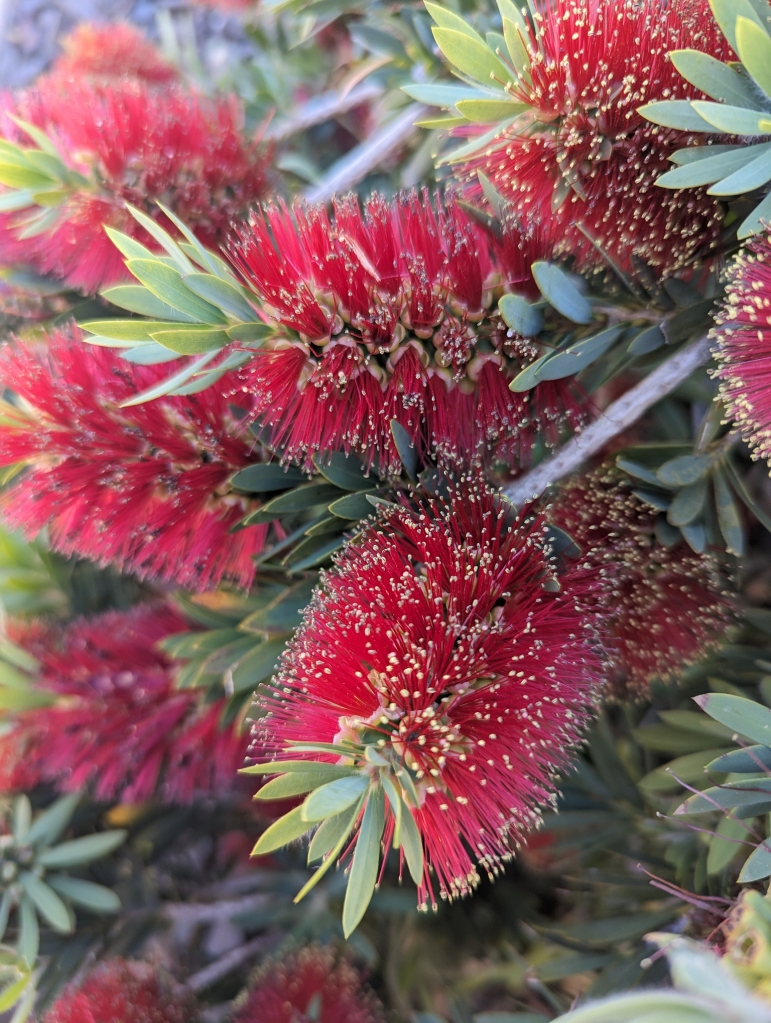
‘Little John’ bottlebrush enjoys warm weather.

Old fashioned lemon bottlebrush would be so practical, if only it did not get so bulky. It is impressively resilient. Although appreciative of occasional watering, it needs none once established. Phases of red bloom continue through warm spring and summer weather. A few sporadic blooms may continue throughout winter. Hummingbirds are very fond of it.

‘Little John’ bottlebrush, Callistemon viminalis ‘Little John’, is all that and less. It remains much more proportionate to compact home gardens. Growth is relatively slow and tame. Mature specimens may grow no bigger than three feet tall and five feet wide. They prefer to assume naturally mounding form without shearing. Any pruning should be quite minor.

More than compact form distinguishes ‘Little John’ bottlebrush from lemon bottlebrush. Its evergreen leaves are relatively small and slightly grayish. Their foliar texture is relatively tidy. Its lemony foliar aroma is relatively subdued and only evident if foliage is disturbed. The fuzzily staminate floral trusses are relatively small with relatively mellowed red color.

Columbine

Colorado has an elegant state flower.

Colorado must really like blue. Not only is the state tree the Colorado blue spruce, but the state flower is the Colorado blue columbine, Aquilegia caerulea. However, the flowers are not always blue, and in fact, are often white or various shades of pink or soft yellow, or a combination of two colors. The many other specie and hybrids of columbine add even more shades and combinations of richer shades of blue, red, yellow, orange and purple. The distinctively lacy foliage is somewhat bluish. A few varieties have chartreuse foliage.

Although potentially perennial, most columbine do not reliable regenerate after winter dormancy, so are instead grown as spring and summer annuals. Flowers are not as abundant as those of other annuals, but are interesting close up, and very attractive to hummingbirds. Mature plants stand about a foot tall, so work nicely in pots surrounded by lower and more colorful annuals like lobelia and alyssum. Columbine prefers partial shade and rich soil. Plants in full sun tend to be more compact and seem to be a bit faded. Incidentally, some parts of the plants are toxic.

Autumn Sage

50909
Salvia greggii is a modest sage.

Perhaps in the wild, it blooms in autumn. Where it gets watered in home gardens, even if watered only occasionally, autumn sage, Salvia greggii, blooms all through summer as well. If pruned back severely over winter, it starts to bloom even sooner in spring. The tiny flowers are red, rose, pink, peach, very pale yellow, lavender or white. Some poplar cultivars have bi-colored flowers.

Compact autumn sage that does not get much more than a foot tall is uncommon. Larger cultivars get four feet tall and broad, with more open growth. Most get about three feet high and a bit wider. Without severe winter pruning, stems can eventually get twiggy, with sparse foliage on the exterior. The tiny aromatic leaves are less than an inch long, and visually resemble oregano.

Even though it is not native to California, autumn sage is popular for native landscaping because it does not need much water. Just like native sages, it attracts butterflies and hummingbirds.

Lemon Bottlebrush

00916
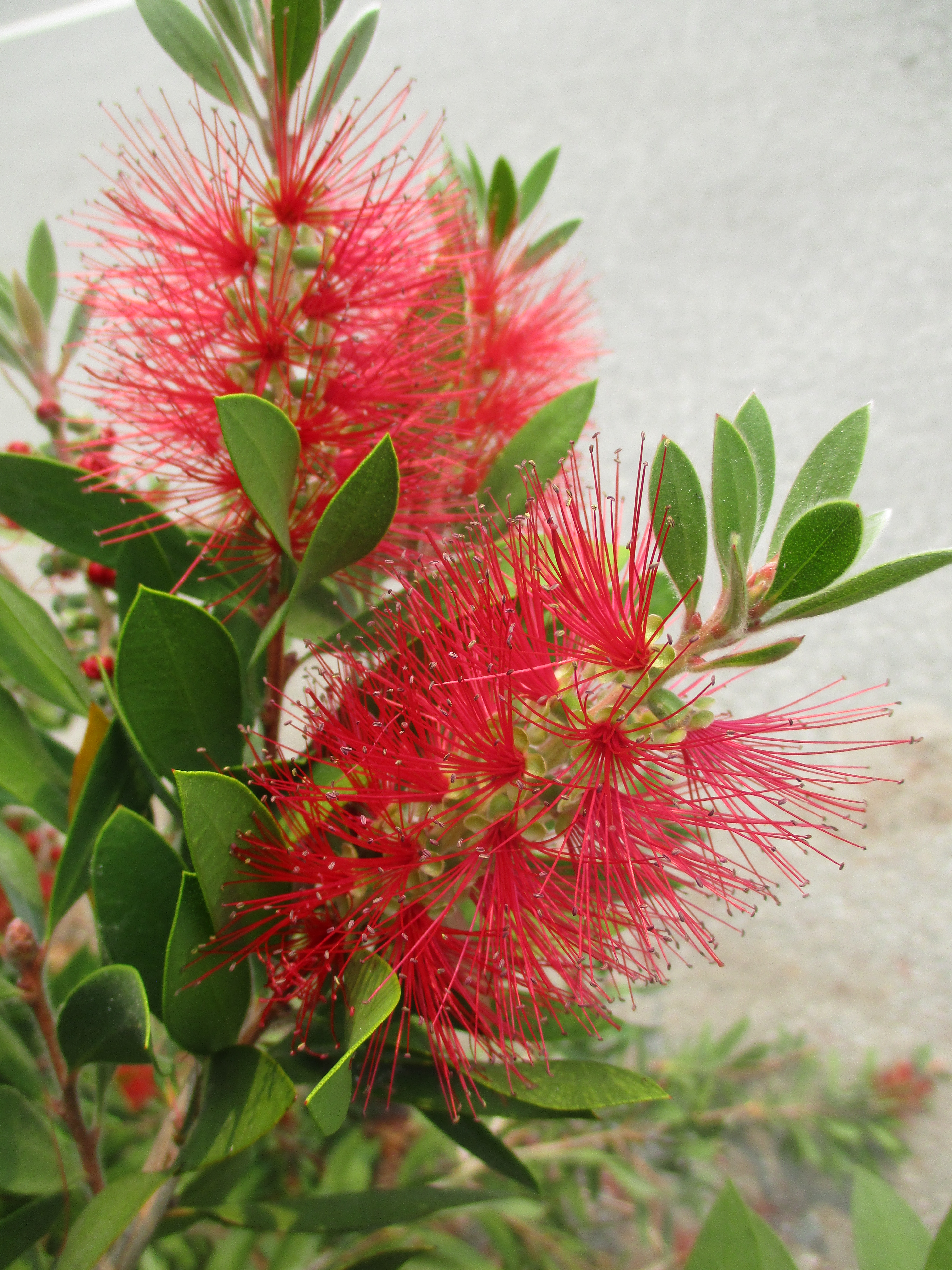
Hummingbirds enjoy red lemon bottlebrush bloom.

As its compact cultivars gained popularity over the years, the formerly common lemon bottlebrush, Callistemon citrinus, became passe. Most are mature specimens in old fashioned landscapes. It is unfortunate. Only lemon bottlebrush and weeping bottlebrush can grow as small trees. (However, lemon bottlebrush is now classified as Melaleuca citrina. Most Melaleuca get notably larger.)

If competing for sunlight, mature specimens of lemon bottlebrush can almost reach upstairs eaves. Well exposed specimens may not get much more than half as tall, with mounding form of about equal width. Removal of low growth to expose sculptural trunks and handsomely shaggy bark promotes higher growth above. Shearing of hedges should not be too frequent to allow some bloom.

Bright red bloom is sporadic through the year, and gets more abundant as summer becomes autumn. The small and staminate flowers are densely set in cylindrical ‘bottlebrush’ formation. These blooms are about two or three inches long, almost as wide, and popular with hummingbirds. Dense evergreen foliage is aromatic. Individual leaves are narrow and about two or three inches long.

Gardening For The Birds

40924thumbSome of the most convenient bird feeders in the garden are some of the many plants we grow. Since so many plants exploit the birds as much as they get exploited by the birds, they naturally produce something that the birds want, when they want it. Right now, meaty seeds cater to migratory birds that need to plump up to travel, hoping that some of the seeds get dropped elsewhere or buried for later (hence ‘sown’ if forgotten, as they often are).
Since the climate is so mild, there is always something blooming to provide nectar for both migrating and overwintering hummingbirds, which inadvertently pollinate the flowers that feed them. Later in the winter, colorful berries feed hungry overwintering birds, in exchange for the dispersion of the small seeds within. (Digestion of the seeds does not harm them, and promotes germination.) Robins do not seem to do much for the garden, but certainly do enjoy digging for worms in unraked leaf litter.

Those who enjoy birds often intentionally plant pyracantha or cotoneaster to provide berries for birds in winter. Various salvias that bloom at various times likewise make nectar for hummingbirds. Fading sunflowers can be left out this time of year until birds that eat the seeds are finished with them. Alternatively, bird feeders can actually provide more food, and extend the seasons through which such food is available. Suet feeders provide something that plants can not provide.

The problem with plants or bird feeders that attract birds is that they can also attract less desirable guests. Squirrels and rats are the worst. Some bird feeders can be protected with exclusion devices. Cats have no interest in the plants or bird feeders, but can be a serious problem for the birds, and are not so easy to dissuade. Fortunately, hawks are rarely a threat in urban gardens, especially where there are trees to inhibit their hunting from above.

Contrary to popular belief, providing food to migratory birds does not interfere with natural migration. Cooling weather and shorter days are enough to convince birds to leave. The extra food actually helps them on their way once they get going. It also helps those that naturally stay here through winter. Some birds actually migrate to here from colder regions to the north. With winters so mild, there is no need to go any further.

Mr. McNugget

P90914KWildlife is a topic that is notably lacking from my articles. I mention only that which must be ‘escorted’ out of the landscapes, like Halston Junior. Gophers, racoons, squirrels, rats, skunks, mice, opossums, rabbits, deer, mountain lions, coyotes, rattlesnakes, turkeys, geese, woodpeckers, jays, crows, bees, wasps, mosquitoes, flies and feral boars can potentially be problematic.

There are probably at least a few more. This list does not even include bad neighbors or domestic animals. Nor does it include foxes, just because they eat mice, rats and snails, and do not seem to cause any problems. Butterflies and most birds, except those listed, are quite tolerable. Insects and mites that damage plants deserve their own list. I don’t know where ticks fit in.

Most unwelcome wildlife at least tries to stay out of my way. Others seem to make sport of antagonizing me. Skunks try to be friendly; but I must pass on that. Turkeys are . . . just turkeys.

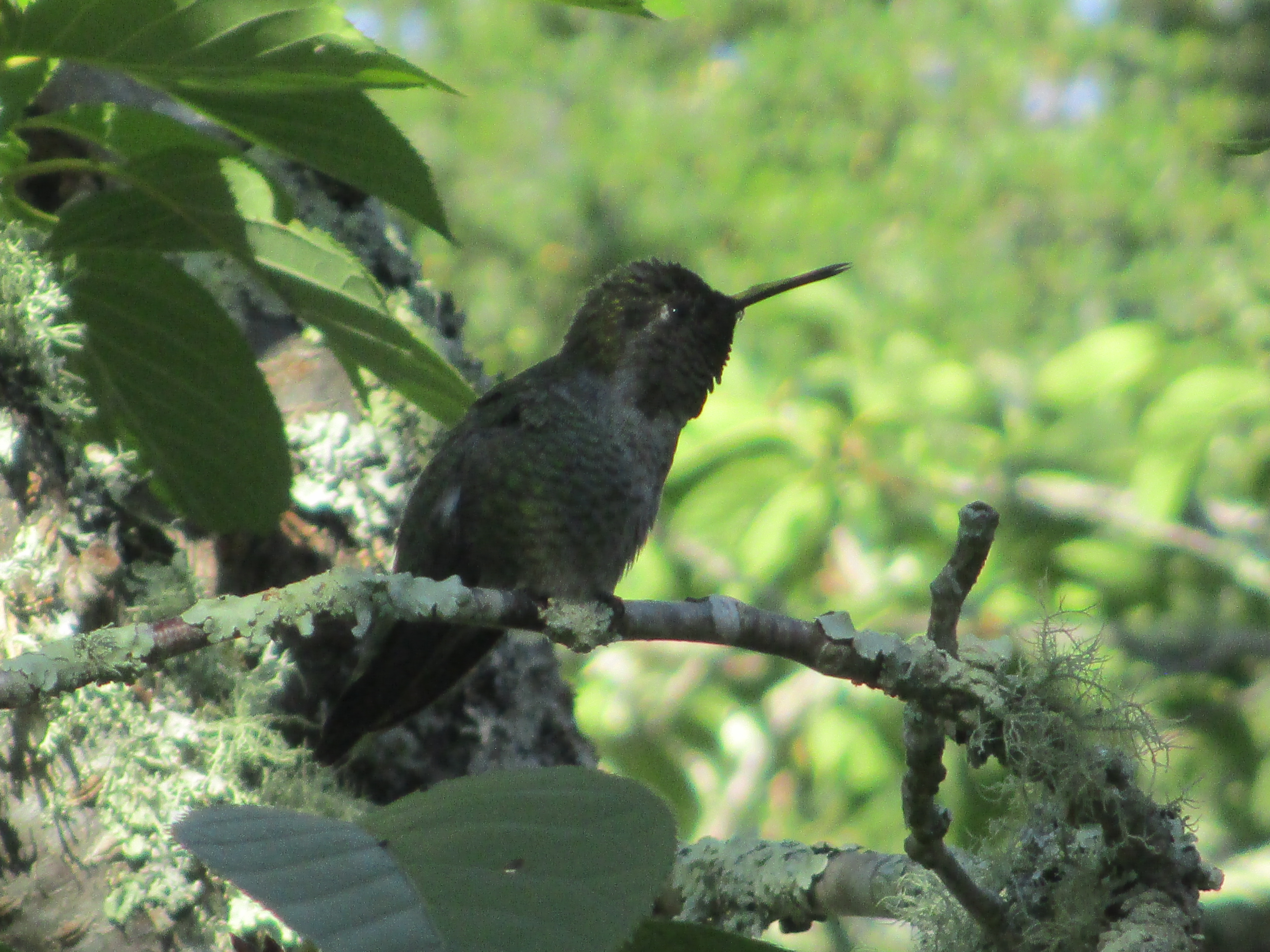
This strangely calm black-chinned hummingbird who watches me from the same spot in a flowering cherry tree is either unaware of my disdain for wildlife, or is merely unconcerned about it. He just sits there . . . silently . . . observing . . . as if plotting or scheming or . . . something. He seems to be harmless; but I really don’t know. He could have sharp talons or another weapon!

I named him Mr. McNugget.

His species is apparently rare. I had nothing to do with that. Even if I believed that he tastes like chicken, I couldn’t catch him anyway. His kind fly at supersonic speed! He might use one of those ‘transporters’ like on Star Trek. Besides, I really don’t want to mess with that. A feral boar would be easier.

‘Little John’ Bottlebrush

P81214Where it has space to grow, classic lemon bottlebrush that was so popular in the 1960’s is still a practical and resilient large shrub, and is happy to bloom with bright scarlet flowers as long as the weather is warm. It is resistant to most diseases and pests, and once established, survives on annual rainfall. Its main problem is that it simply gets too big for many situations.

Dwarf bottlebrush, Callistemon ‘Little John’, is more often a better fit, although it has a very different personality. It is short and dense, and spreads more laterally than upright. Mature plants are only about three or four feet tall, and maybe twice as wide. The smaller leaves are somewhat grayish. The distinctive bottlebrush flowers are a slightly darker shade of purplish red.

Even though established plants do not need much water at all, regular (but not necessarily generous) watering promotes bloom and growth. However, excessive watering can be lethal. Full sun exposure is best. A bit of light shade should be no problem. Dwarf bottlebrush makes a nice low informal (unshorn) hedge. Flowers attract bees and hummingbirds.