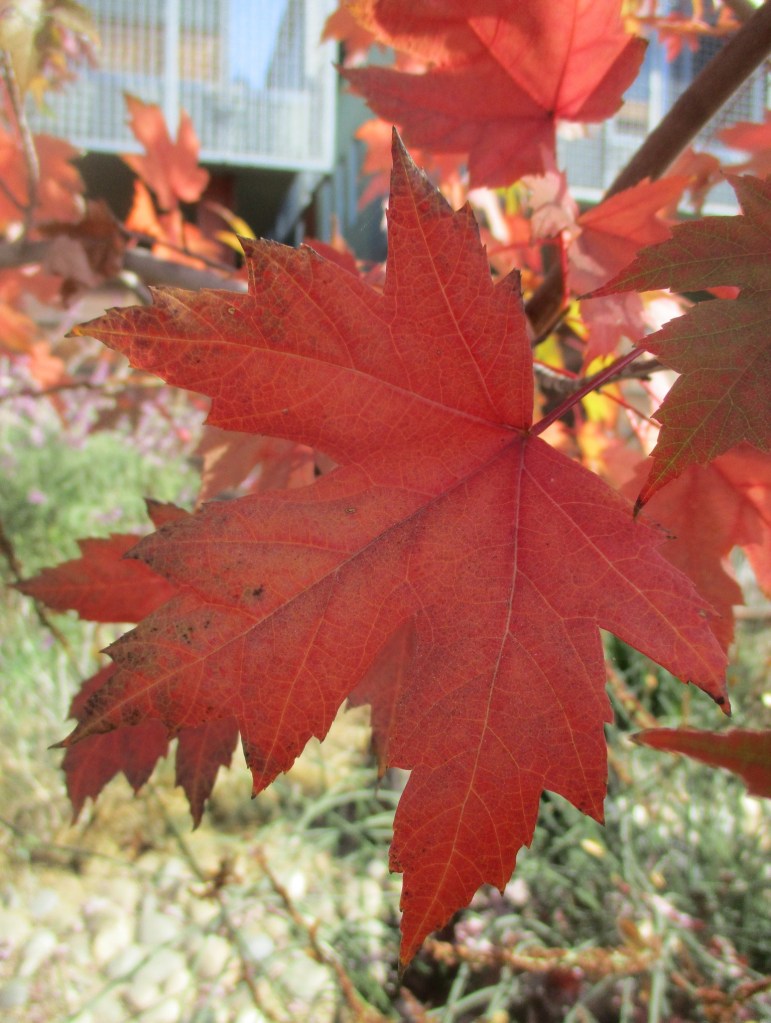
It combines the autumn foliar color of red maple with the lacier foliar form of silver maple. Freeman maple, Acer X freemanii, is a hybrid of the two. It occurs naturally where ranges of its parents overlap. However, most modern garden cultivars are products of intentional hybridization. Like silver maple, it does not need much chill to exhibit autumn foliar color.
Freeman maple inherits other attributes from both its parents. It combines rapid growth of silver maple with structural integrity of red maple. Although it gets bigger than red maple, it is not as imposing as silver maple. It develops high branches like silver maple, but also is symmetrical like red maple. Big roots are about as complaisant as those of red maple.
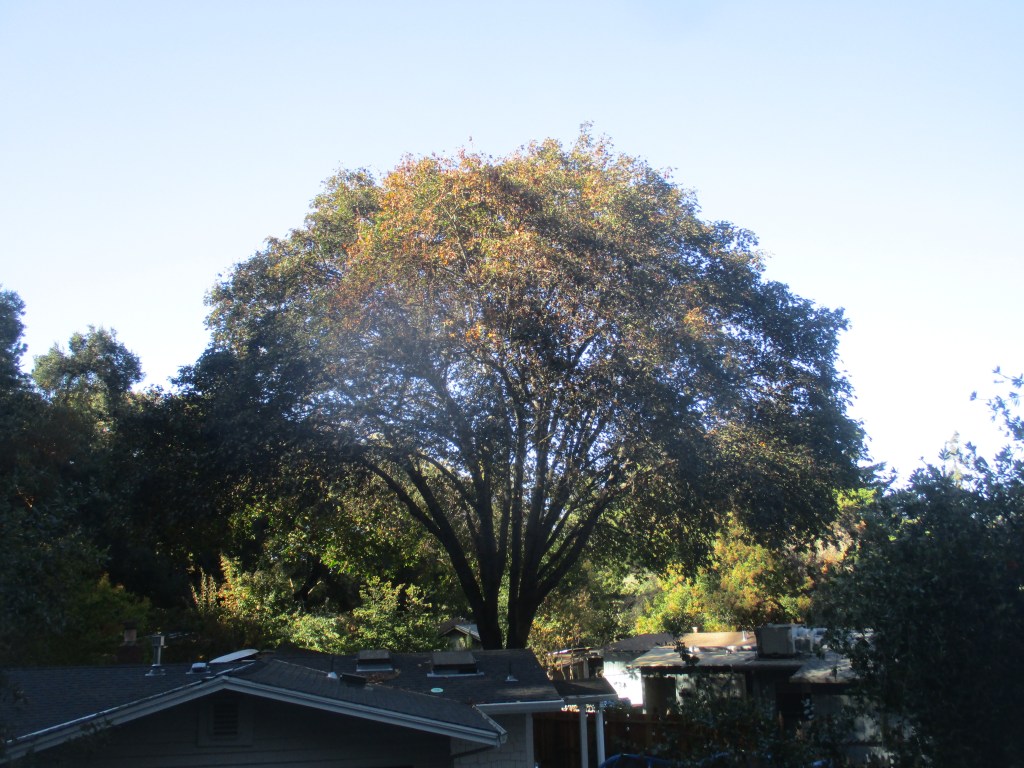
Mature Freeman maple trees can grow about forty feet tall and broad. Autumn foliar color is vivid orange and red, and lasts longer than that of red maple. Since Freeman maple is a hybrid, it is mostly sterile. It can not generate an annoying abundance of seed. Nor can it naturalize in favorable climates. It is an exemplary maple for mild climates such as this.
It is rare now, but Norway maple, Acer platanoides, was once common as a street tree. A few are prominent within neighborhoods that were developed in the 1950s and 1960s. It resembles the common London plane. In fact, its botanical name translates to ‘maple like a plane tree’. Unfortunately though, the roots are perhaps too aggressive with pavement.
Norway maple defoliates somewhat more efficiently than London plane tree. However, in spring, it refoliates significantly later. Otherwise, it is a splendid shade tree. A few modern cultivars exhibit bronzed foliage that yellows for autumn. One exhibits variegated foliage. Another has chartreuse foliage. ‘Schwedleri’ was once the most common bronze cultivar.
Very few Norway maples are taller than forty feet within the mild climates here. They can grow significantly larger in cooler climates, such as the Pacific Northwest. Their palmate leaves are about five to nine inches wide. New trees are rarely available from nurseries, so require special ordering. Norway maple is not overly discriminating in regard to soils. It prefers regular irrigation through summer warmth.
Bloom is probably the favorite component of home gardens. Foliage is likely the second favorite component. Japanese maples are popular as much for their form as for any other characteristic. The intricate textures and autumn color of their foliage is likely secondary. Coral bark Japanese maple, Acer palmatum ‘Sango Kaku’, is even a bit more distinctive.
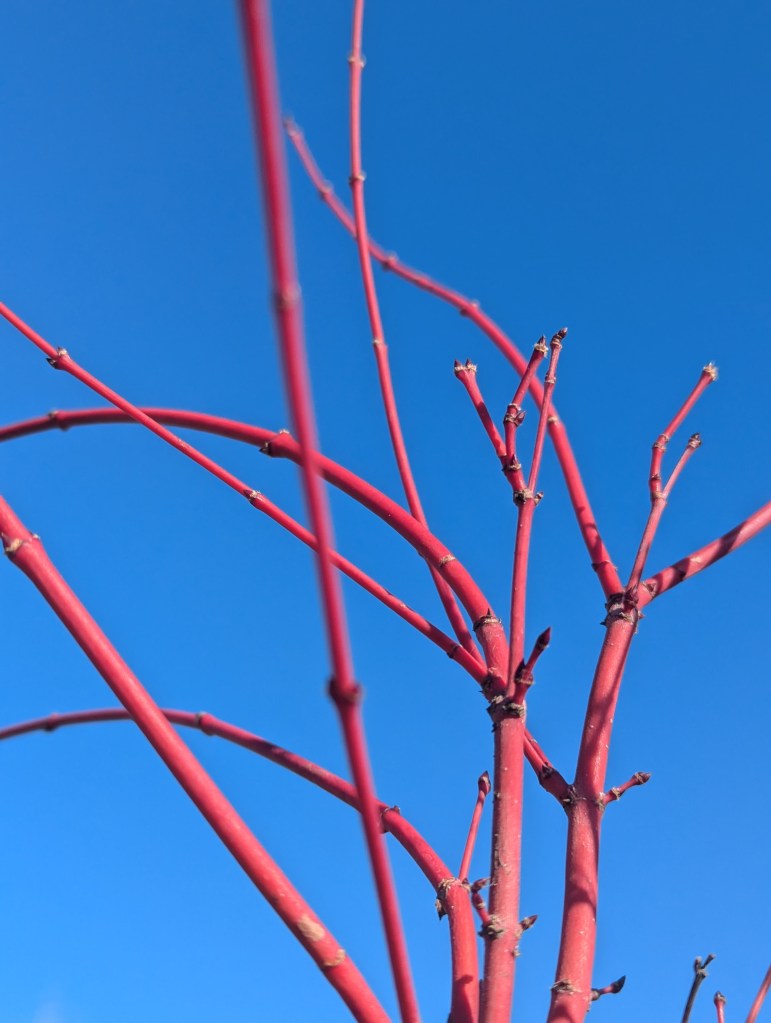
Relative to other cultivars of Japanese maples, its foliage is not remarkable. Actually, it is more vulnerable to foliar scorch with arid warmth. Its form is not overly remarkable either. For coral bark Japanese maple, the bright red bark of its young twigs is its primary allure. It is obscured by foliage for most of the year, to be revealed by defoliation through winter.
Coral bark Japanese maple is an understory tree, so can tolerate partial shade. With full sun exposure, it particularly dislikes arid wind. It can grow as tall as twenty feet, or might stay as short as ten feet. It naturally produces many long and limber stems with shiny red bark. Severe pruning to promote growth of such stems is likely to ruin its sculptural form.
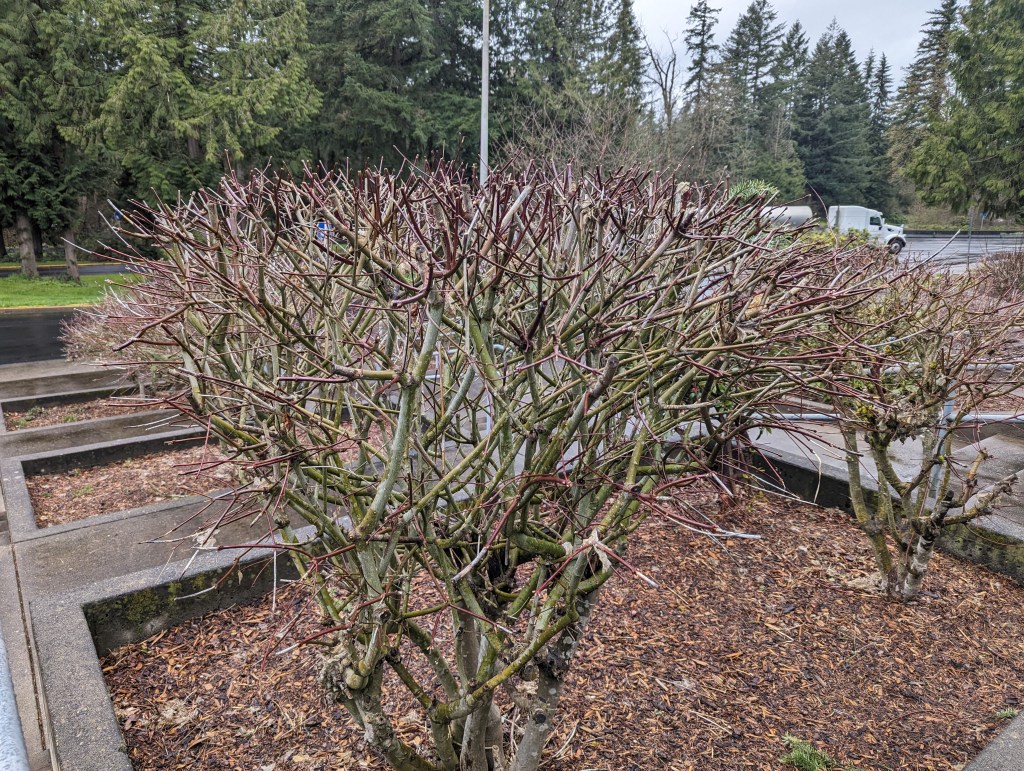
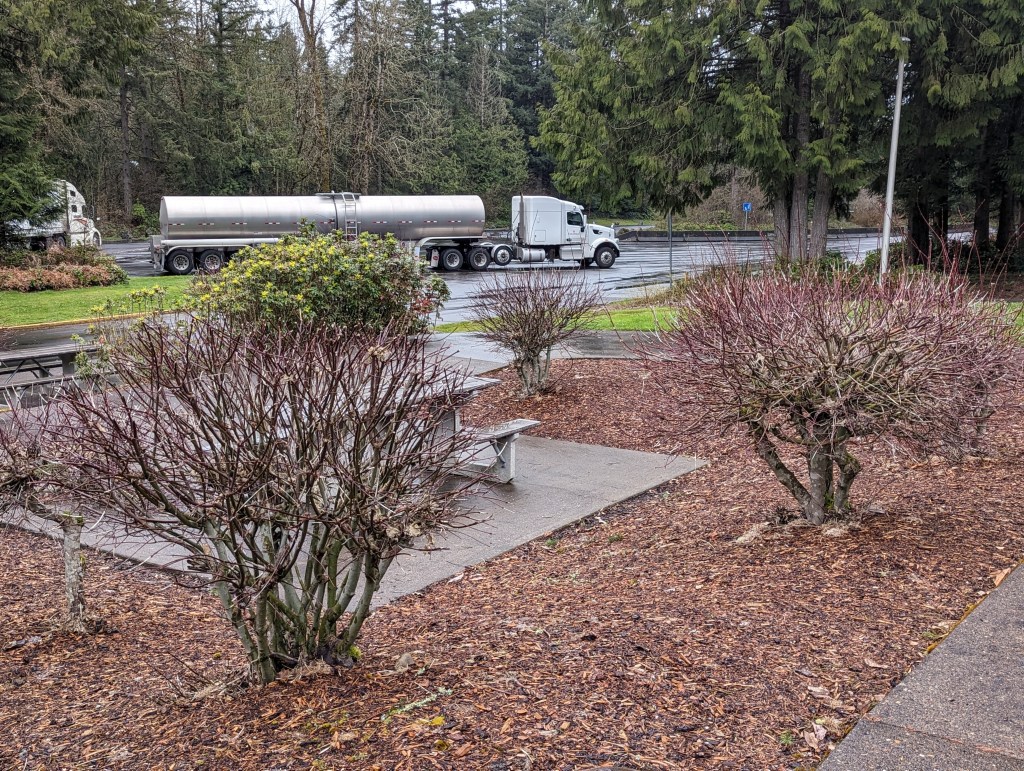
This is no simple hack job. Someone or a few someones put a great deal of effort into this very thorough hack job. This took significantly more effort than would have been needed to do it properly. Seriously, proper pruning would have been much easier, and much healthier to this victimized vegetation. In the future, this vegetation would have needed much less maintenance. Furthermore, this is more than visually unappealing. It is downright unsightly. Removal of such disfigured shrubbery would be an improvement, even without replacement. As the illustration below demonstrates, this is not merely a single specimen. It is an entire herd of brutally disfigured shrubs. How did someone determine that this was the right thing to do?!
This mangled shrubbery is vine maple, Acer circinatum, which is native to the Pacific Northwest where I got these pictures. I actually like this particular species because it can perform similarly to Japanese maple, but is not Japanese maple, which I am not at all keen on. Part of my dislike of Japanese maple is the result of working with so many that were ruined like these vine maples were. Vine maple is more tolerable to me because it is too rare here at home for me to encounter any that are ruined like these. This is a first for me. Perhaps that is why it was more difficult to ignore than the countless similarly ruined Japanese maples that I do not need to work with, but see around town.
I can not help but wonder what these vine maples would look like if they had developed somewhat natural form with only significant pruning for clearance above the adjacent pavement, perhaps with minor pruning to limit congestion within their canopies.. Would they resemble mature Japanese maples with extra trunks by now?
Many trees get too big for many situations. Trees should be proportionate to their spaces.
Japanese maples are among my least favorite of trees. There; I said it! Even though I can not think of any single species of tree that has so many distinct and fascinating cultivars, I am bothered by how Japanese maples have been denigrated by their own overuse. That which is naturally an understory tree (lives in the partial shade of larger trees), which should be thoughtfully selected for its individual form, texture and color, to function as a focal point specimen tree, has become too common and misused.
Every tree should be thoughtfully selected for its particular application. The ultimate size, shape, shade, potential mess, cultural requirements, root characteristics and foliar characteristics (evergreen or deciduous) all need to be considered. Japanese maples are certainly appropriate for certain applications, but not every application. The same goes for London plane, crape myrtle, Chinese pistache and any overused tree.
Crape myrtles and Japanese maples are popular partly because they do not get too big, and are proportionate to small spaces. However, they do not get big enough for other situations. Although a silver maple will not fit into an atrium as well as a Japanese maple would, it is a much better shade tree for a big lawn. Italian cypress can actually get taller, but its very narrow shape makes a minimal shadow. Monterey cypress gets broader, but the shade is too dark for lawn.
Unfortunately, there is no such thing as a perfect tree. Jacaranda is of moderate size, has a good shape, and makes medium shade, but is quite messy, particularly over pavement. Silk tree is both messy and has aggressive roots that can break pavement, but just like jacaranda, it looks great and is not a problem surrounded by ground cover. Both are deciduous, so allow warming sunshine through in winter. An evergreen tree that would be better to obscure an unwanted view should not get so large that it also blocks a desirable view for a neighbor.
Palm trees are very different from all other trees in that they have no branches, only leaves. As they grow out of reach, they will need to be groomed by professional arborists. Palms only grow upward, and can not be pruned around utility cables. They will need to be removed if their trunks get too close to high voltage cables.
I certainly do not intend to convince anyone to not plant any trees. I merely want people to consider the variables involved with the selection of trees that are appropriate to each particular application. Trees are long term commitments. Problems caused by improper selection can be difficult or impossible to correct later.
Maple sugar production has not always been exclusive to northeastern North America. In fact, it is not exclusive to sugar maple. Big leaf maple, Acer macrophyllum, also provides maple sugar in British Columbia. It is native from the southern extremity of Alaska to San Diego County. Most of its range is generally coastal but also includes the Sierra Nevada.
Bigleaf maple is one of merely two native maples here. It is more common within riparian ecosystems and at higher elevations. However, it is rare among home gardens because it is so vigorous and grand. Its aggressive roots eventually buttress, and are likely to ruin lawns and pavement. Autumn defoliation of big trees releases big volumes of big leaves.
Bigleaf maple can grow almost fifty feet tall and wide within sunny suburban landscapes. It can grow a hundred feet taller where it competes for sunshine within coastal forests! Its palmately lobed leaves are typically wider than six inches. They can be twice as wide on vigorous stems. Foliage turns yellow for autumn. Seedlings might be annoyingly prolific. Local climate is unfortunately not conducive to practical sugar collection and refinement.
Leaves of three, leave it be, unless one can see that it is a box elder tree, Acer negundo. This is the most common of the North American maples. It is native to all American states except for only Alaska and Hawaii. Yet, it is also unique as the only maple with pinnately compound leaves. Typical leaves have three leaflets, but might have as many as seven. A few rare maples have palmately compound leaves.
Although common in the wild, box elder is rare within refined landscapes. It grows fast to about forty feet tall, but does not live for much more than fifty years. It typically develops a few plump trunks with casually irregular form. Unfortunately though, such form becomes structurally deficient with age. Autumn foliar color is unremarkable yellow or brown here.
However, a few garden cultivars display distinctly colorful foliage for spring. ‘Flamingo’ is the most popular cultivar. Pink variegation of new spring growth fades to white. ‘Auratum’ displays bright yellow new growth. ‘Violaceum’ displays smoky blushed new foliage with purplish red floral tassels. After pollarding, such cultivars are more compact and colorful, but lack floral tassels.
The botanical name of Norway maple, Acer platanoides, means ‘maple like a sycamore’. It resembles Platanus X acerifolia, which means ‘sycamore with maple foliage’. Platanus X acerifolia is London plane (‘sycamore’), which serves similar purposes. Norway maple lacks the irritating foliar tomentum of London plane. It has more aggressive roots though.
Norway maple was likely never a fad, but was common as a street tree during the 1950s. It naturalized as in invasive exotic species in parts of the Pacific Northwest. It is not such a nuisance locally. Most domestic trees are sterile or almost sterile cultivars. If their roots were more complaisant, they could have been ideal street trees. Their shade is splendid.
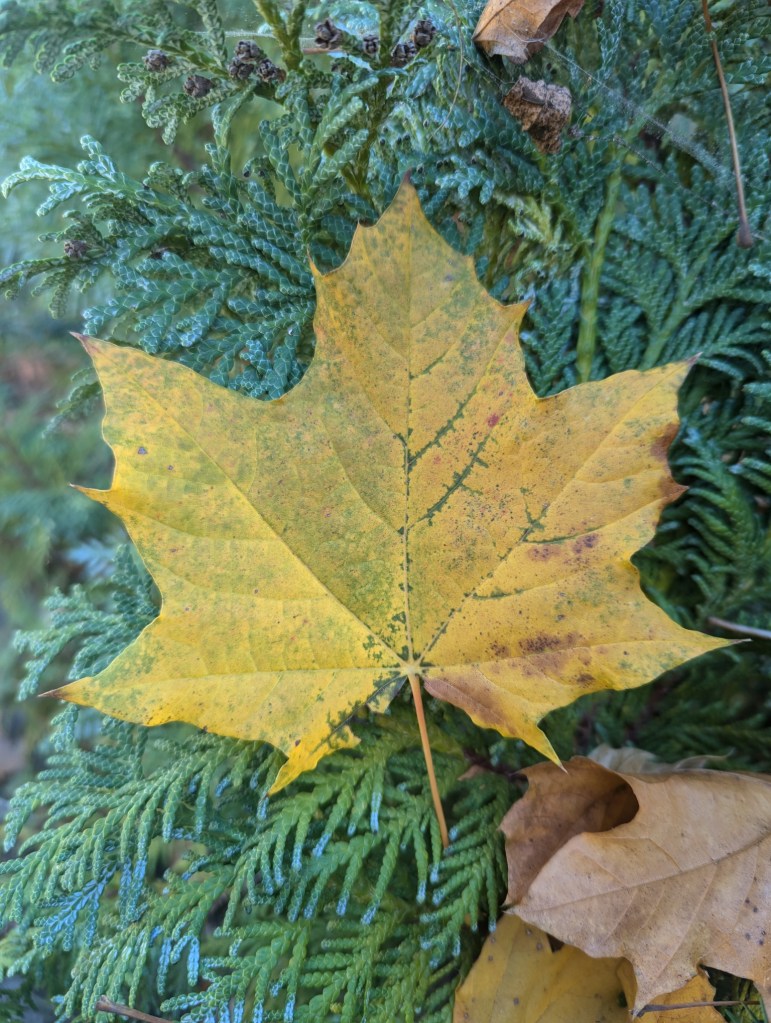
‘Schwedleri’, with bronzed foliage, was likely the most popular cultivar originally. Modern cultivars are darker bronze, golden, variegated or simple green. Their deciduous foliage is not so impressive for autumn though. It turns somewhat brownish yellow. The palmate leaves are about five to nine inches wide. Defoliation is efficient. Refoliation is quite late. Not many Norway maples get more than forty feet tall within the mild climates here.
Maples are annoyingly misrepresented here. Japanese maples are so much more popular than they should be, and imposed by just about every so-called ‘landscaper’ with something to prove, although few of them know or care how to take proper care of them. However, maples that actually develop as shade trees are still uncommon or even rare. Only two species are native locally. Of these, box elder (#5) is rather unimpressive, and bigleaf maple (#6) is potentially too big and too messy for refined home gardens. Norway maple has a bad reputation, but ‘Schwedler’ was a good street tree.
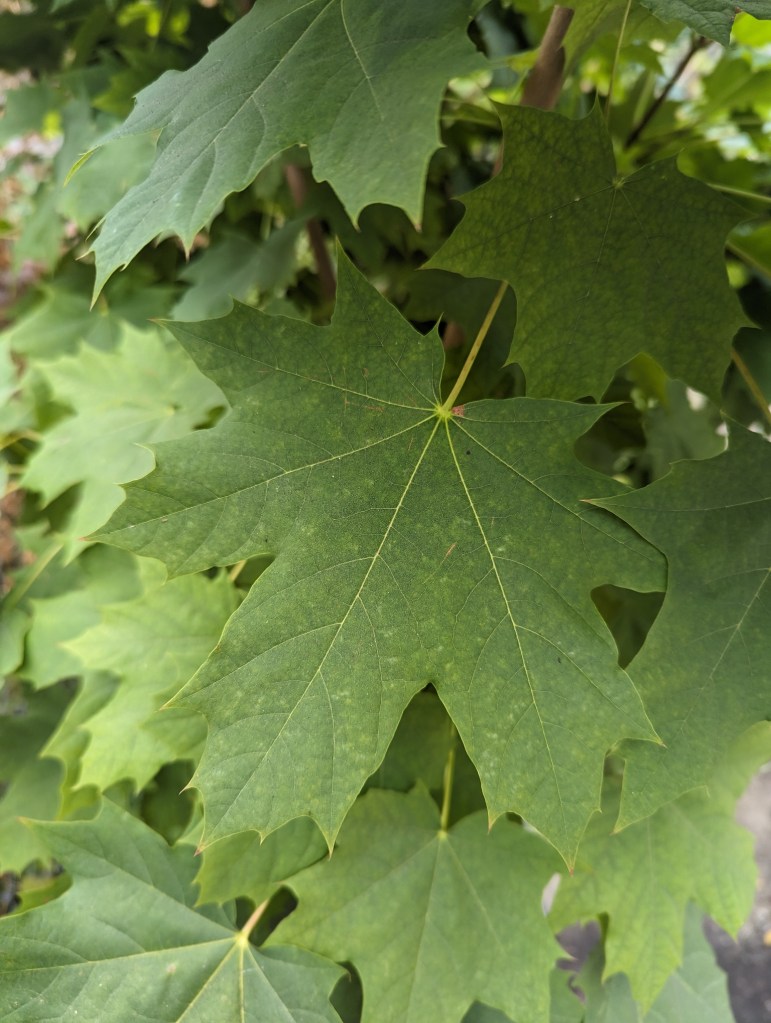
2. Acer platanoides – Norway maple should look like this. I do not remember the name of this cultivar. It supposedly has better bronzed color than ‘Schwedler’. I still prefer classic ‘Schwedler’.
3. Acer rubrum – red maple performs quite well in mild climates, and works well as a street tree with symmetrical and rather compact form. I do not remember the name of this cultivar either.
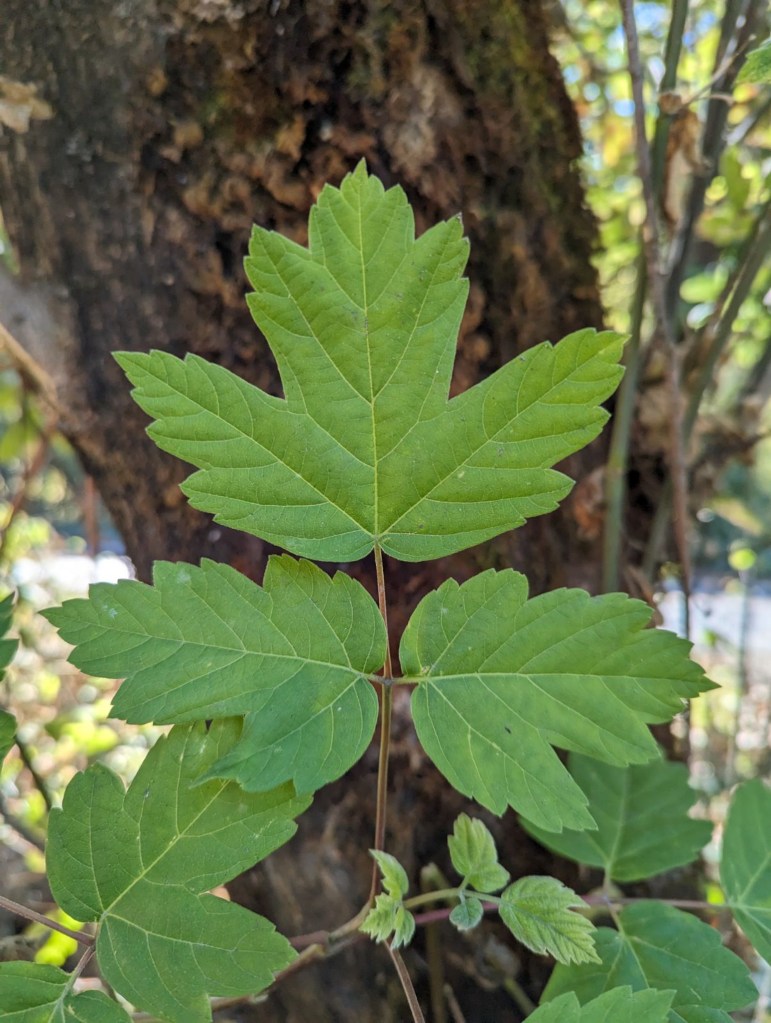
4. Acer circinatum – vine maple should be more popular here. It is a sculptural understory tree like the countless cultivars of Japanese maple, but is not a Japanese maple. That is why I like it.
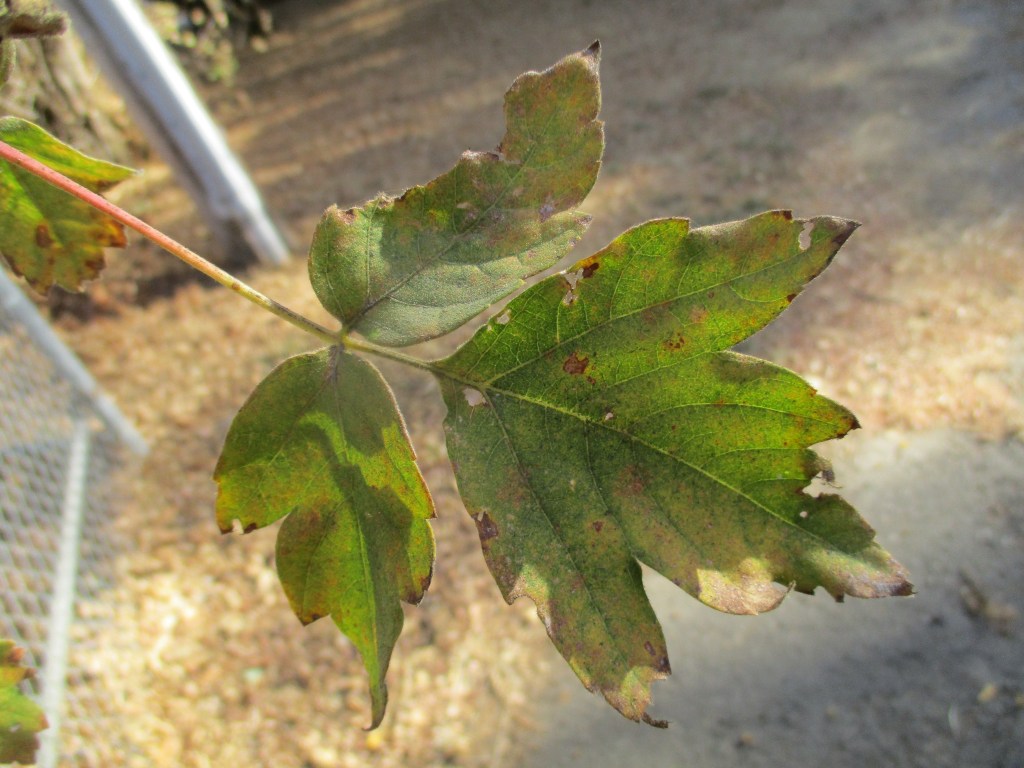
5. Acer negundo – box elder should probably be less popular than it is. It is the most common maple of North America, and is native to every state except for Alaska and Hawaii. It is wild here.
Honeysuckle can layer naturally, and will most certainly layer if a portion of stem is simply buried or weighed down under a rock.
Where they grow wild in riparian environments, box elders, willows and cottonwoods are not as clumsy as they seem to be. As the rivers and creeks that they live so close to erode the soil around them, they often become destabilized and fall. Yet, this is actually part of their plan. If their original roots remain somewhat intact, the limbs and trunks develop new roots where they touch the ground. Eventually, these rooted limbs and trunks develop into new and separate trees.
In home gardens, a similar technique known as ‘layering’ can be employed to propagate one or a few copies of many other plants. Many sprawling vines and ground covers, such as ivy, honeysuckle, blue rug juniper and trailing rosemary, are likely to develop roots where their stems touch the ground anyway. Rooted stems need only to be found, dug and separated as new plants. Shrubbier plants need a bit more help.
Azalea, rhododendron, camellia, holly and just about any plant that has low stems that can be bent downward into the soil can be propagated by layering. Redwood, elm and magnolia do not always have limbs that reach the ground, but any that do would be pleased to cooperate as well. In fact, there are only a few woody plants that do not develop roots by layering, such as some pines and most eucalypti.
A layered stem only needs to be partly buried to develop roots. The tip should protrude from the soil a few inches. A short stem may barely protrude above the soil. A layered stem of a plant that develops adventitious roots very efficiently can be as long as a few feet. A very flexible stem can easily be held down by the weight of the soil that it gets buried with. A more rigid stem may need to be held down with a rock.
Before getting buried, the stem should be cut about a third of the way through to promote development of roots. The cut should be made on the underside so that it stays open when bend downward and buried. A bit or rooting hormone powder applied to the open wound accelerates the process. It works almost like taking a cutting, but without completely separating the cutting from the parent plant right away.
Once buried, a layered stem should be watered regularly until it gets dug while dormant (or mostly dormant) the following winter. By that time, the rooted stem can be dug and pruned from the parent plant, and then planted where desired. Because it takes a few months for enough roots to develop, layering should be done in spring.





 Tony Tomeo