Six on Saturday: White Album


‘Album’ is Latin for ‘white’. That is why ‘album’ or a derivation of it is the species or varietal name for several plants. That does not apply to any of these six though. They are just incidentally . . . and coincidentally white. Even though white is my favorite color, I really did not intentionally select these because they are white. I just wanted to show off some of what is blooming now.

I would say that most are unseasonable, but our mild seasons can be rather vague.

1. Pelargonium hortorum – Two florets managed to bloom on a stunted truss that should have been plucked from rooting cuttings in the nursery. Full trusses are blooming in the landscape.P00111-1

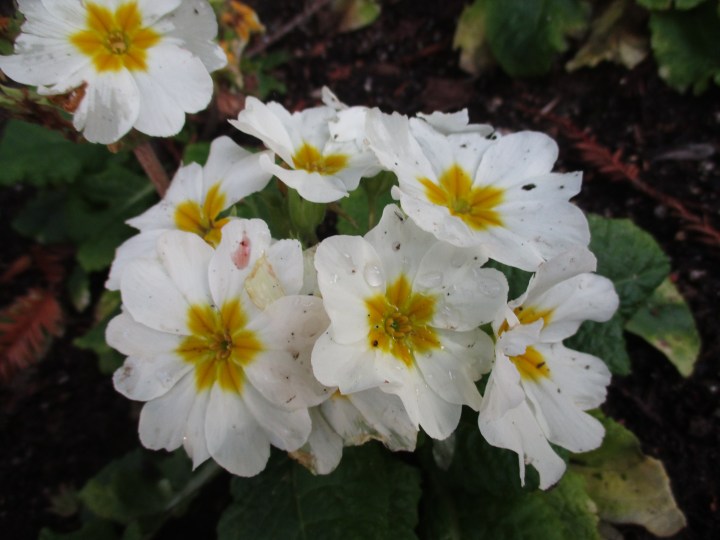
2. Primula vulgaris – Heavy rain overnight splattered a bit of the mulch onto the these and other nearby flowers that are low to the ground. A bit more drizzly rain should rinse them all off.P00111-2
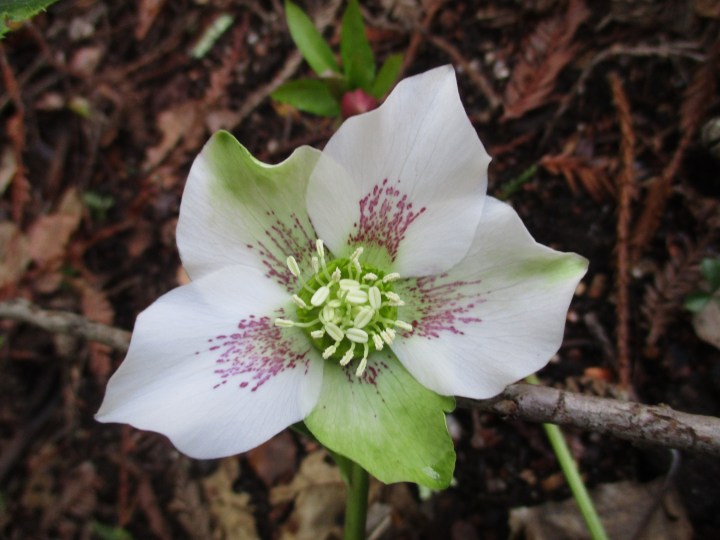
3. Helleborus X hybridus – Of these six subjects, only this and #2 above are actually in season. Their pale bloom is mediocre and faces the ground. This one is turned upward for this picture.P00111-3
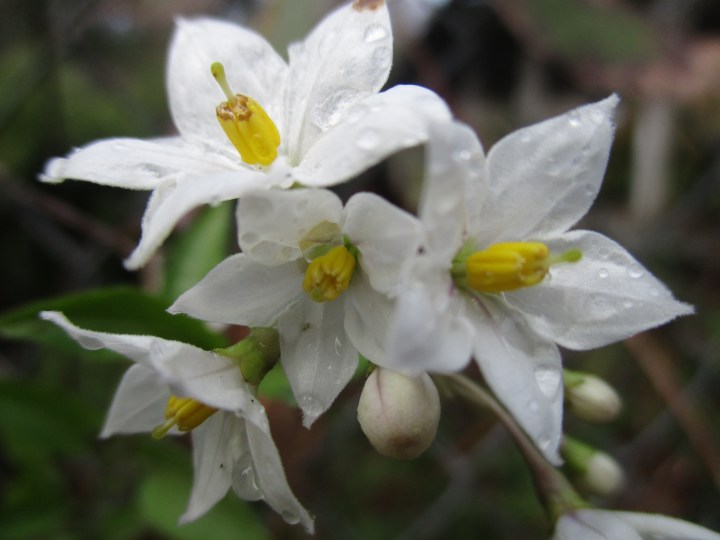
4. Solanum jasminoides – Foliage is pekid through cool winter weather. Vines will get pruned back before growth resumes in spring. Regardless, flowers bloom whenever they get a chance.P00111-4
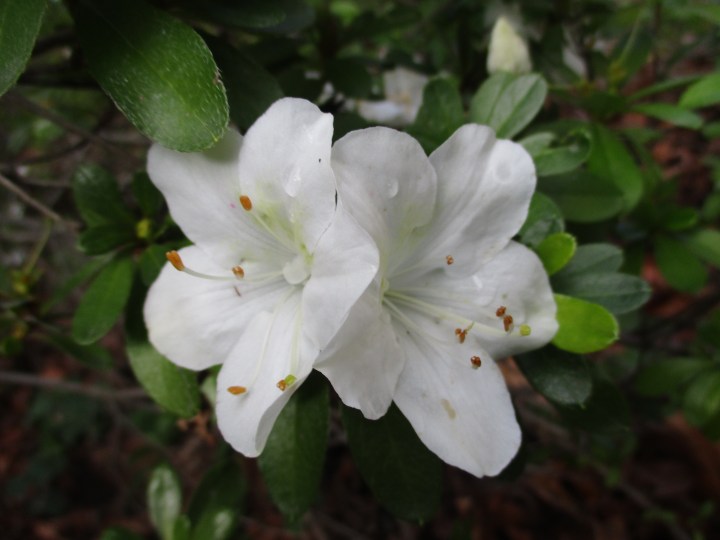
5. Rhododendron (Azalea) – As delightful as this unseasonable bloom is now, it would have been much better if it had waited until spring as expected. It will not last long in this weather.P00111-5
6. Hydrangea macrophylla – Bloom continues even as the yellowed deciduous foliage is falling to the ground. Other juvenile blooms are still developing. I will elaborate on this topic at noon.P00111-6

This is the link for Six on Saturday, for anyone else who would like to participate:

https://thepropagatorblog.wordpress.com/2017/09/18/six-on-saturday-a-participant-guide/
Six on Saturday: Two Too Many Redwoods


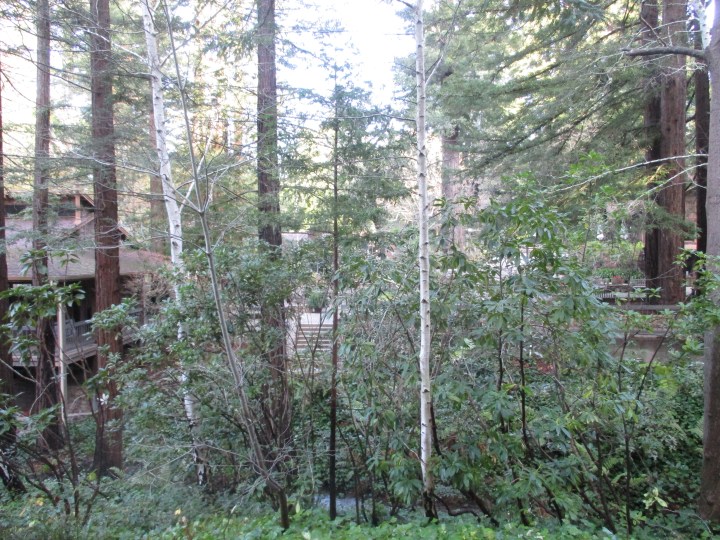
Redwoods are such admirable trees that no one wants to cut any of them down. On rare occasion, it becomes necessary to do so. Seedlings sometimes grow in situations where they can not stay. They might be too close to buildings or other infrastructure. Sometimes, they are merely in the process of crowding other important plants in the landscape. That was the problem with the young redwood pictured here, and another just like it.

1. There it is, an exemplary specimen barely left of center. The problem was that it would have crowded other trees if left to grow. The dogwood to the left is feral too, but will not get too big.P00104-1

2. This juvenile tree had been cut off at the ground, and regenerated. This meant that I expected it to be more firmly rooted than it would have been if it had not experienced such trauma.P00104-2

3. What a surprise! Roots on one side had already been severed by earlier excavation for a drainage pipe. As I cut a few more roots on other sides, this unfortunate young tree just fell over.P00104-3

4. There were enough roots remaining for this tree to survive if there had been someplace to put it where it could have been irrigated and guyed until it recovered and dispersed new roots.P00104-4

5. Guying would have been difficult though. The young and slender tree was just too tall and flimsy for any downward tension applied by guys. Sadly, this young redwood was not salvaged.P00104-5

6. This is really why I was here. Besides removing two feral redwoods, I dug two Japanese maples that had been stagnating in the landscape for years, and canned them to hopefully recover.P00104-6

This is the link for Six on Saturday, for anyone else who would like to participate:

https://thepropagatorblog.wordpress.com/2017/09/18/six-on-saturday-a-participant-guide/

Six on Saturday: Tracks


Tracking is not done for hunting here. Anyone who can hunt here would merely wait for deer or turkey to arrive as they so frequently do through the day. I only notice the tracks while they are so visible in the mud and damp soil. Most are from harmless animals. Some are from animals who control unwelcome rodents. Even notoriously destructive deer are not a problem here.

No one knows why deer avoid the landscapes here. There are no fences, so deer can come and go as they please. They are a serious problem for some of the home gardens nearby, but avoid others like they avoid our landscapes. I got these pictures outside of landscaped areas. Bobcats have never bothered anyone except the rodents who are not wanted in the landscape anyway.

I saw no tracks left by raccoons, skunks, turkeys or mountain lions, which is just fine. Mountain lions are rare, so their tracks are rarely seen around areas of human activity. The others are too lightweight to leave well defined tracks that I could get pictures of anyway. Skunks are actually beneficial to the landscapes, by eating grubs and slugs. They refrain from digging in lawns.

Turkeys are only becoming a concern because of their proliferation. The minor damage that they cause while scratching for grubs and pecking at anything colorful is likely to become a major concern when there are more of them shredding flowers, fruit and vegetation. Raccoons are more obnoxious for the messes they make with garbage than for their damage in the landscapes.

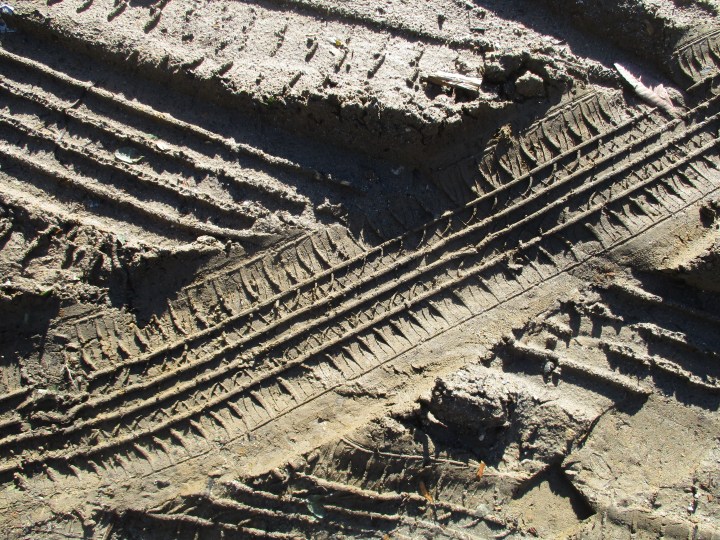
1. Deer often leave double prints, with the second set slightly back from the first. This pair seems to be single prints from different hooves that just happened to land right next to each other.00128-1

2. Bobcat prints must have appeared while the weather was still drizzly enough to mute the detail. Bobcats are common enough here for (La Rinconada de) Los Gatos to be named for them.00128-2

3. Coyote prints are fresher. They seem to be too small to be left by a coyote; but fox tracks are even smaller, and rare. Foxes are so lightweight that they leave tracks only in very soft mud.00128-3

4. Human prints are very fresh. I did not notice them on my way out, but found them on my way back. Whoever or whatever left these prints could have been dangerously close at the time!00128-4

5. Chevrolet prints over John Deere prints are also rather fresh. There are prints of Ford, Dodge and even a rare Buick in the area. It must have been quite a herd! I should track that Buick!00128-5

6. Rhody the terrier leaves no more prints than a fox, since he too is so lightweight. I tried to press his paw into the mud for this one, but he did not cooperate. This was the best we could do.00128-6

This is the link for Six on Saturday, for anyone else who would like to participate:

https://thepropagatorblog.wordpress.com/2017/09/18/six-on-saturday-a-participant-guide/

Horridculture – That Blows!

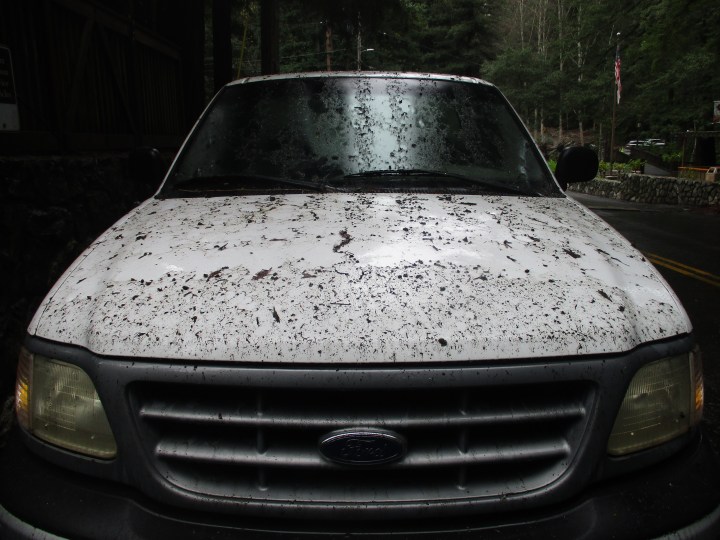
P91218-1Blowers put the ‘blow’ in ‘mow, blow and go’. They really blow! The only power tool used by so-called ‘gardeners’ that is more detestable to the rest of us is the power hedge shears, and that claim is contestable. Some consider blowers to be worse because they are so obnoxiously noisy, and generate so much dust. Some municipalities have outlawed the use of the noisiest sorts.

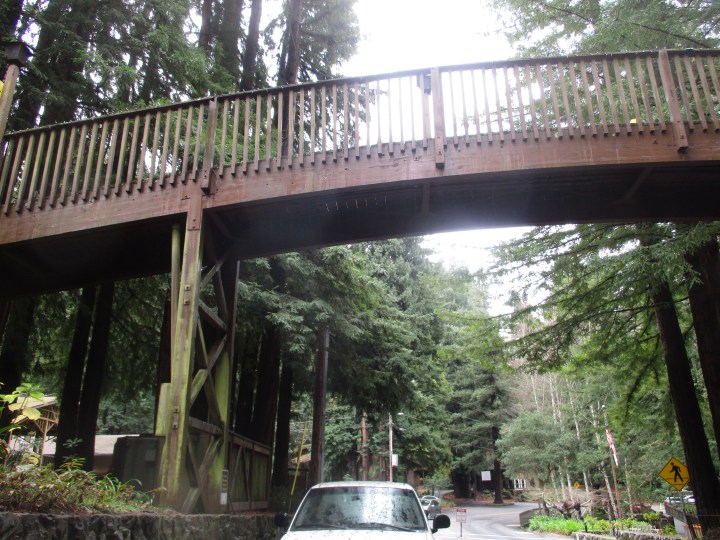
The mess on the hood and windshield in the picture above was not actually caused by blowers. The picture below shows the bridge that was power washed above. Oops. I should have been suspicious that no one wanted that parking space. Anyway, this picture was just too funny to not share; . . . and I happen to lack pictures of the sorts of dusty messes that blowers can stir up.

Where I lived in town, the so-called ‘gardeners’ who ‘maintained’ the apartment buildings on either side used blowers. There is a noise ordinance there, but we never bothered to enforce it. We did not want to interfere with what needed to be done. There was a lot of pavement, and we wanted it to be kept clean. We could not expect it all to be quietly swept like I swept mine.

To the north, the blowers were either off or on full-throttle. There was nothing in between. The cars in the carport collected all the dust that was stirred up. If the door to the washroom was left open, debris got blown in, and the pilot light for the only water heater in the building got blown out. Most of the debris got blown to the southeast corner, and under a fence into my yard.

The same happened to the south, but the water heater was less exposed, and there was much more debris. The largest valley oak around lived there, and dropped leaves for several months. I replaced the kickboard at the base of the fence in their northeast corner a few times, but it was just as regularly kicked out and removed so that debris could continue to be blown under!

In other neighborhoods, so-called ‘gardeners’ are notorious for blowing debris out into roads, where it gets dispersed by traffic. Even if they do not blow it away just to become a problem somewhere else, they are likely to blow too much of it into shrubbery, along with any mixed litter. It accumulates faster than it decomposes to benefit the soil and roots below. What a mess!P91218-2

Six on Saturday: Nursery Work


This is more like what I should be doing. My part time job here was supposed to be temporary, just until I went back to work growing things. It is not easy to leave. Actually, it is downright difficult. Well, that is another story. Yesterday, Friday, I got to pretend I was back at work, dividing perennials and plugging cuttings. It all came from what already lives in the landscapes.

These seasonal tasks had been delayed until the rainy season started.

1. African iris, Dietes bicolor, got plucked around the edges where it was getting too close to a walkway. These plucked and groomed scraps will be plugged directly where more are desired.P91214-1

2. Lily-of-the-Nile, Agapanthus africanus, got pulled a long time ago, and just left here on the floor. It can get split into many individual pups, but will more likely be planted as a full clump.P91214-2

3. Pigsqueak, Bergenia crassifolia, got pulled where it was creeping over a stone wall. Most was plugged back behind where it came from. Sixteen groups of three pups were canned for later.P91214-3

4. Boston ivy, Parthenocissus tricuspidata, provided this mess when it was relieved of its stakes and groomed. It grew so fast in the first year, that there is concern about planting more of it.P91214-4

5. 100 cuttings is too many! There are only a few concrete structures that it can climb onto. It probably would have been more practical to plug a few cuttings directly into only a few cans.P91214-5

6. Cuttings would have fit better into cans too. These cuttings are plugged diagonally, leaning back toward the top of the picture, with the front row leaning toward the bottom of the picture.P91214-6

This is the link for Six on Saturday, for anyone else who would like to participate:

https://thepropagatorblog.wordpress.com/2017/09/18/six-on-saturday-a-participant-guide/

Six on Saturday: Pet Rock Amongst Redwoods


Macabee Gopher Trap was invented in Los Gatos. So was the Bean Pesticide Sprayer. Both were very useful in the vast orchards that formerly occupied the Santa Clara Valley. Another one of the more famous invention that originated in Los Gatos was not so practical. Actually, it was weirdly impractical. What was weirder was that it became such a craze in 1975 and early 1976.

It was the Pet Rock.

1. Pigeons don’t lay eggs in December. They certainly don’t lay such big eggs, or leave them without a few twigs to keep the from rolling away. Now that I think of it, pigeons don’t live here.P91207-1

2. Oh, it is just a rock, painted by someone named Madeline. Perhaps, it is a Pet Rock named Madeline. It seems to be of impeccable breeding. Form, color and temperament are exemplary.P91207-2

3. Perhaps it was painted by someone named Joy, or it is named Joy. Well, whatever or whoever it is, it seems to be very important. It was put back in the hanging basket of zonal geranium.P91207-3

4. That’s the hanging basket with the zonal geranium in it, right there, second from the left. It is not exactly a good place for a Pet Rock to nest. Notice the plaque over the rail right below it.P91207-4

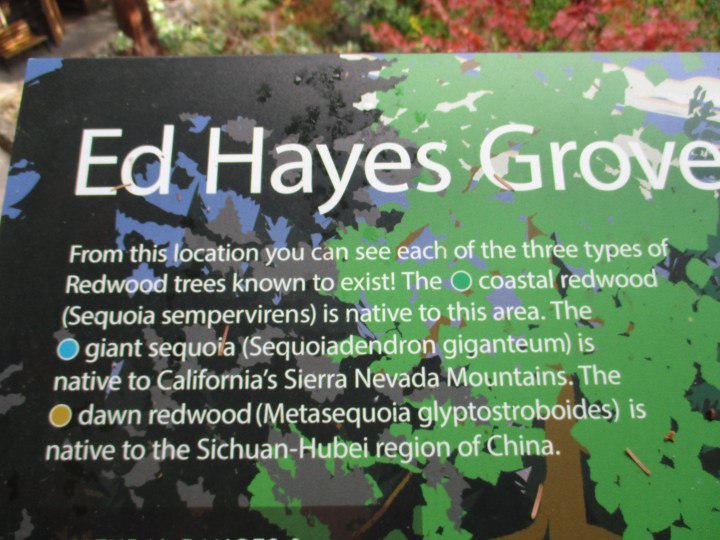
5. The plaque identifies all three species of redwood in the landscape. The green, blue and brown dots next to the names correspond to a diagram showing where each is within the landscape.P91207-5

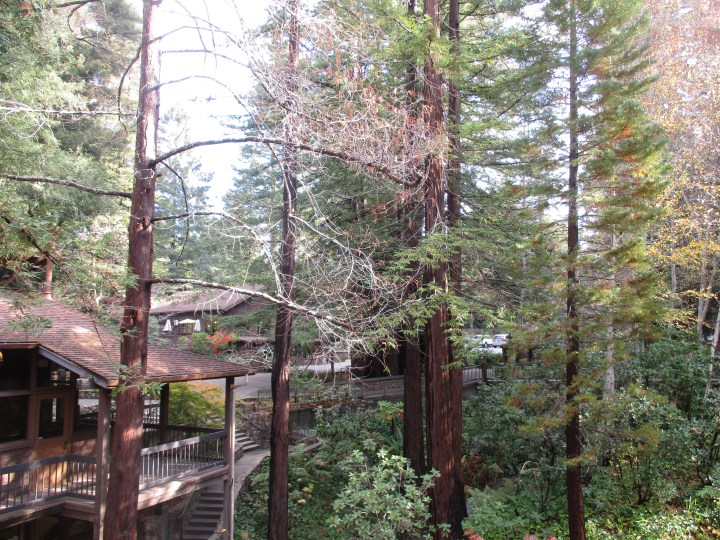
6. The defoliated dawn redwood is to the left. The small giant redwood is to the right. Those in between and in the background are the native coastal redwoods, which grow wild in the region.P91207-6

This is the link for Six on Saturday, for anyone else who would like to participate:

https://thepropagatorblog.wordpress.com/2017/09/18/six-on-saturday-a-participant-guide/
Six on Saturday: First Storm


The first storm since spring came through Tuesday night. It was cool enough for a bit of snow on the summits of the Diablo Range, including Mount Hamilton, east of the Santa Clara Valley. The fire season is now over. More storms are forecast. More will continue through the remainder of winter and into spring. Even chaparral climates eventually get a seasonal ration of rain.

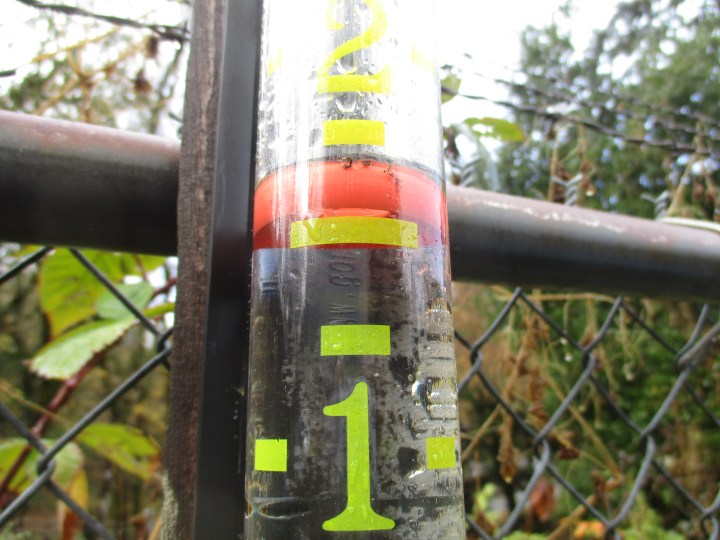
1. An inch and a half of rain is generous for a first storm. It is more than 10% of what my garden in town got annually. This side of the Santa Cruz Mountains gets about three times as much.P91130

2. My reflection in the rain caught in this ‘tote’ is not as artistic as it was in the green bucket last year. I tried. A flash would have added interest. I do not really know how the camera works.P91130+

3. Cyclamen, even the common florists’ type, deserve more than to be grown as cool season annuals, and then discarded in spring. I can rant about that later. For now, they sure are pretty.P91130++

4. After the rain, even a close up of this seriously abused juniper is pretty. It was recycled from one site into another, only to be removed again. It is now canned and waiting for a new home.P91130+++

5. Storms are messy. There was not much wind with this storm. Nonetheless, rotten limbs get heavier and softer as they get soaked by rain. This one broke apart more as I dragged it away.P91130++++

6. What is worse than runoff from the road washing away some of the yellow birch foliage dislodged by rain, is that it likely took away some of the amaryllis seed tossed out here earlier.P91130+++++

This is the link for Six on Saturday, for anyone else who would like to participate:

https://thepropagatorblog.wordpress.com/2017/09/18/six-on-saturday-a-participant-guide/

Horridculture – Multi-Grafts

P91116+++Bare root fruit trees will be available in about a month. It is probably my favorite time of year for going to nurseries. (Since I grow just about everything I want from bits of landscape debris, I do not often go to retail nurseries.) It is also rather frustrating to see what sorts of bare root material are popular nowadays, and what sorts are not. Horticulture has gotten so ridiculous!

Most of the formerly common cultivars of fruit trees that I remember are no longer available. They were common for a reason. They perform well here. Retailers used to select cultivars for their respective regions, instead of pimping out weird new but unproven cultivars, or just taking the same faddish cultivars that get sent to other stores within a vast chain of big box stores.

One of the weirdest of fads are multi-grafted fruit trees and roses.

Multi-grafts are certainly not new technology. Back when horticulture was taken more seriously, fruit trees for home gardens (which might be the only ones of their kind in their respective gardens) were sometimes, if needed, outfitted with a secondary scion of a pollinating cultivar. The pollinator could be pruned low and subordinated, as long as it bloomed with a few flowers.

Most of us preferred to simply plant two separate trees that could pollinate each other. If one was less desirable than the other, it was just maintained as a smaller tree so that it would not occupy so much space that could be utilized by more desirable types. Each tree had its own uncrowded area. If one succumbed to disease, it did not necessarily affect those associated with it.

Multi-graft trees are not so easy. If the trunk of a multi-graft pear tree gets infested with fire blight, all the scions grafted to it succumb. Because almost no one prunes them properly, the most vigorous cultivars dominate and crowd the less vigorous. Even well pruned trees are always asymmetrical because each cultivar exhibits a different growth rate and branch structure.

Multi-graft rose standards (trees) just look weird and freakishly unnatural. Pruning must ensure that one cultivar does not crowd out the other, just like for fruit trees. The multi-graft rose in the picture above was planted with three others just like it. Two of them crowded out one of their two scions. It would have been easier to simply plant two in white and two in burgundy.

Multi-graft plants are useful only if ground space is very limited, but air space is not. For example, such a tree planted in a hole in a deck can extend limbs over the deck where other trees can not live. If maintained properly and separately, each part can produce its share of fruit in season. I once did this with a pear tree that was espaliered on a fence over a concrete driveway.

Six on Saturday: Stumped


Stumps are mostly left to rot after a tree gets cut down in our unrefined landscapes. Only those that are in the way get ground out. Some that remain probably would have been ground out if they were accessible to a stump grinder, because they are so unbecoming. Burning them out in winter is impractical for those that are close to buildings, and is no longer socially acceptable.

1. This one was nearly four feet high and nearly five feet wide! No one knows why it was not cut lower to grade. It was an unappealingly prominent feature of its landscape for several years.P91123

2. Mushrooms around the base indicated that it was quite rotten. A lack of stubble or stumps from secondary growth indicated that the tree was likely dead before it was cut down years ago.P91123+

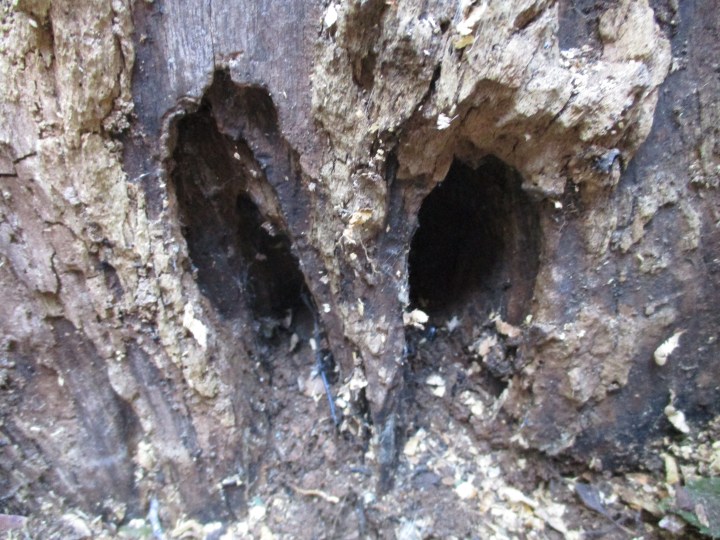
3. It was rotten enough to be inhabited by rodents. It looked like a duplex. Alternatively, the holes could have been excavated by skunks pursuing grubs. They did not seem to be very deep.P91123++

4. As big as it was, the stump was not quite big enough to become a hot tub as the rotten guts were removed. Besides, it was already an unsightly focal point without steam coming out of it.P91123+++

5. What remains is a low pile of pulverized rotten wood with leaves from nearby dogwoods and a sweetgum tossed about on top to make it look less like a low pile of pulverized rotten wood.P91123++++

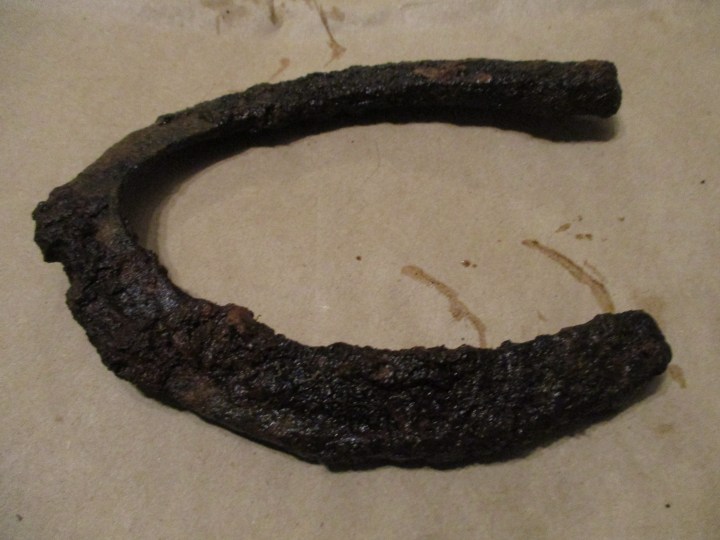
6. There was a slice part way into the stump near grade, as if someone tried to cut it properly when the tree was cut down. This old bent horseshoe was found about where the slice stopped.P91123+++++

This is the link for Six on Saturday, for anyone else who would like to participate:

https://thepropagatorblog.wordpress.com/2017/09/18/six-on-saturday-a-participant-guide/

Horridculture – “One Of These Things . . . “

P91120Remember this from Sesame Street?

One of these things is not like the others
One of these things just doesn’t belong
Can you tell which thing is not like the others
By the time I finish my song?

Identifying a blue balloon as different from three red balloons might be construed as discriminatory, but was fun back before we went into kindergarten. So was selecting the bigger bowl of Big Bird’s birdseed from three small bowls; or the beanie from three pairs of sunglasses; or the letter from three numbers. It is not so fun now, when conformity to a landscape is important.

In the picture above, one of the four prominent trees in the foreground of the walkway and rail fence, excluding the obscured middle tree, is different from the others. They are all the same age. They are all sycamores. They are all happy and healthy. They were all supposed to conform to the landscape of native vegetation in the background. Which thing is not like the others?

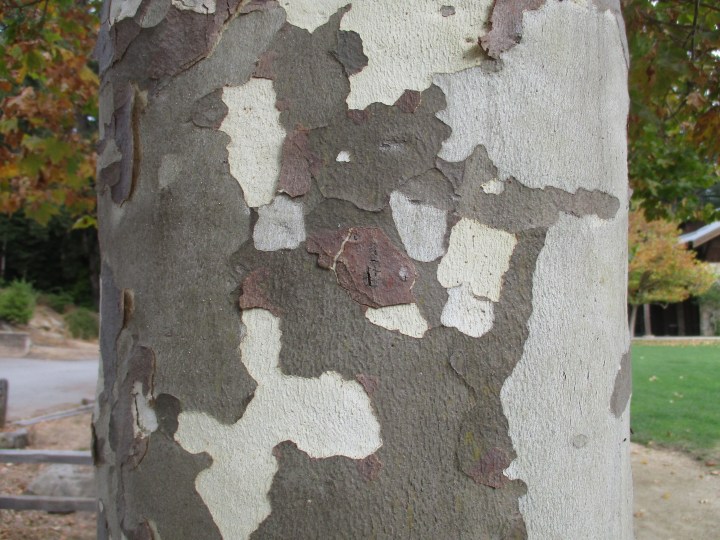
The second tree from the left is a London plane, Platanus X acerifolia. The other trees, as well as the fifth middle tree and the sycamores in the background, are native California sycamores, Platanus racemosa. Not only is the London plane not native, but it is distinctly smaller and more symmetrical, with a conspicuously straighter trunk and relatively orangish autumn foliage.

The picture below shows the bark of London plane, with a trunk of a California sycamore in the background. The second picture shows how dissimilar the bark of the California sycamore is.P91120+P91120++

Individually, there is nothing wrong with the London plane. A few could have made a nice homogenous grove in the same spot, although they would never attain the grand scale expected of California sycamore. The problem is that the London plane is similar to, but not the same as, the California sycamores. It will always look like one of the California sycamores with problems.

A completely distinct tree would have been better. If it were a redwood or a magnolia, or anything that is not so similar to California sycamore, it would not be expected to conform to them.

I see it commonly. Himalayan birch get added to groves of European white birch, even though their trunks are whiter and straighter, and their canopies are much more upright. Taller and leaner Mexican fan palms get added to otherwise formal rows of California fan palms. The formality of rows of tall and slim Lombardy poplars is similarly disrupted by fatter Theves poplar.

These bad matches are often honest mistakes. It is not easy to distinguish Theves poplar from Lombardy poplar; and Lombardy poplar is rarely available. Sometimes, so-called ‘gardeners’ or ‘landscapers’ simply do not care. An ‘Aptos Blue’ redwood was added to a grove that was exclusive to ‘Soquel’ in a nearby park, just because it was closest to the parking lot at the nursery.

So-called ‘landscapers’ sometimes ‘sub’, or substitute, a commonly available cultivar or species for something that was specified by a landscape design, but is not so readily available. It often works out just fine. However, I once inspected a landscape in which a ground cover cultivar of cotoneaster was subbed with Cotoneaster lacteus, which promptly grew higher than the eaves!