 This rant may not go in the direction you expect it to. The pictures suggest that this would be about the bad vegetation management crews who severely disfigure trees that get too close to utility cables. It is not.
This is about horticultural ‘professionals’ who plant trees where they will encroach into utility cables, with no regard to what might eventually be done to them in order to keep electrical service reliable and safe. The native oak in these pictures likely grew from seed, so unless someone knows the squirrel who buried the acorn, there is no one to blame. Many of us who enjoy home gardening are sometimes not aware of how tall and wide particular trees can get when we plant them. Horticultural ‘professionals’ should know better! That is what they charge so much money for when they design a landscape.
Palm trees are the worst! They grow only upward, with only a single terminal bud. Once that terminal bud encroaches into a utility easement, there is no option to prune back to another branch that might direct growth around the easement. ‘Pruning’ the only terminal bud back kills the entire tree. Yet, some landscape ‘designers’ continue to prescribe the all too trendy queen palm for the backsides of urban landscapes, even if utility cables are back there like they so typically are.
The oak in these pictures got a Bullwinkle cut, with big ‘antlers’ reaching upward and to the left and right of cables that are directly above. The lower picture sort of shows a ‘step back’ cut into the top for clearance from other perpendicular cables that pass over that edge rather than directly above. The tree is in surprisingly good condition, and gets pruned as properly as possible for the difficult circumstances. This brief article from a few days ago discusses a few more details about easements. https://tonytomeo.com/2018/08/02/easements-really-should-be-easier/
Six on Saturday: Bits and Pieces II
It has been a while since I posted a sequel to anything like I used to do so commonly. I am only doing it now because I do not have six pictures that fit a particular theme. There are not six different camellias or six different rhododendrons blooming at the same time. There is not a new landscape with six different newly installed plants to show off. Instead, I merely found a few amusing or silly pictures from work for this week. I sort of like #5 because it is interesting even to those of us who are familiar with it. I will actually elaborate a bit more on that later at noon.
I know these Six on Saturday posts do not fit with my other articles, but hey are fun for those us who participate. You can see other Six on Saturday posts by other writers at the link at the bottom of the page. You might even want to give it a try and participate yourself.
1. This might look like a signs at the Generic Aroboretum, or the Arboretum for the Horticulturally Disinterested, but the signs really refer to buildings that are named after trees. Almost all of the buildings in the neighborhood are names after flora of some sort.
2. Woodpecker pantries are often constructed in old coastal redwood trees with soft bark. It seems silly to me; but it must be effective. Otherwise, woodpeckers would not put so much effort into stocking them. Woodpeckers deposit single acorns into the holes bored into the bark, in order to store the acorns for later. Some of these holes are very old, so have stored several acorns over several years. At lest one woodpecker guards the pantry from squirrels while the other woodpeckers are out and about collecting acorns. Such pantries are typically in trees that are isolated from others, so that squirrels can not enter from other trees, and then raid the pantry from above. The only access to the squirrels is from the ground. This panty does not seem to be active at the moment, but discarded acorn shells at the base of the tree indicate the it was active in recent history.
3. Coastal redwood trees are very efficient at regenerating from stumps of harvested trees. This tan oak wanted to give it a try too. It did not really regenerate from the stump of course, but merely grew from an acorn in the detritus that collected on top of the stump, and rooted into the rotted wood. The fractures visible at the bottom of the stump are caused by expanding tan oak roots.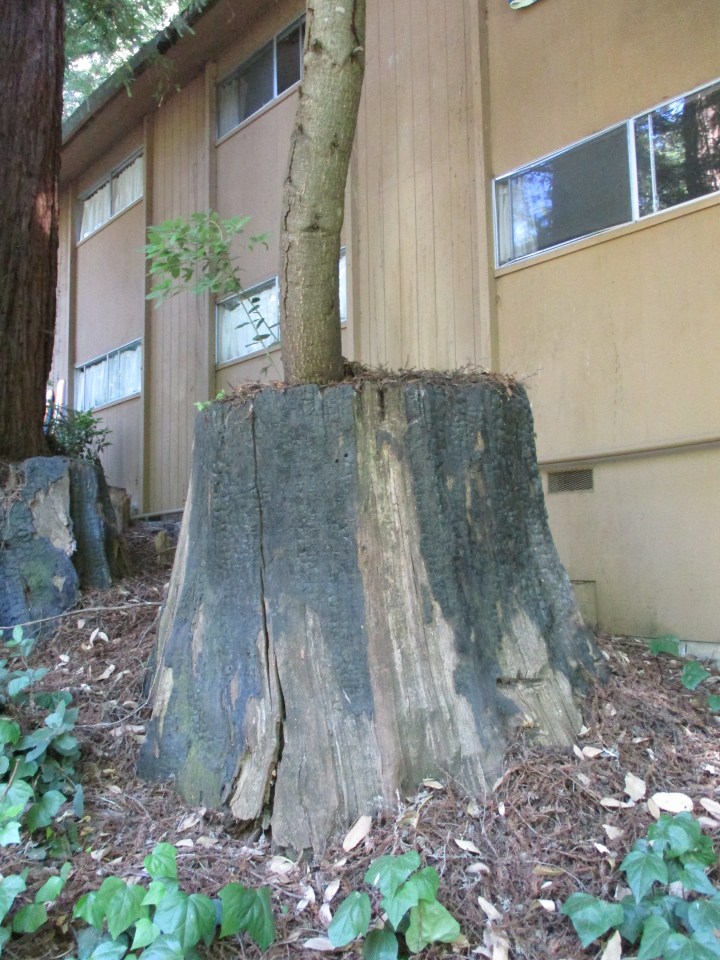
4. Which of these things does not belong here? Do you remember that from Sesame Street? Blue hydrangeas are not common here, although we have quite a few that are fertilized to be blue. I thought that these looked silly together because they are so similar in color.
5. Albino coastal redwoods are so fascinating. The white foliage can not survive without chlorophyll, so must remain attached to the original green tree that produced the white mutant growth. This takes a bit of explanation, so I will write a bit more about this about noon.
6. Finally, we have two silly looking tiny weds that grew in a crack in the big rock that I wrote about earlier in Rock Concert. https://tonytomeo.com/2018/04/07/six-on-saturday-rock-concert/ They are not much to look at, but this looks like one of those artistic pictures that other writers take.
This is the link for Six on Saturday, for anyone else who would like to participate:
https://thepropagatorblog.wordpress.com/2017/09/18/six-on-saturday-a-participant-guide/
Horridculture – Neapolitan
 Baldness was not yet cool while Brent and I were studying horticulture at Cal Poly in San Luis Obispo back in the late 1980s. Nor were hairpieces yet tacky. Consequently, some middle aged men work toupees. As these men aged and grayed, their formerly well matched topees did not.
Hedges of Pittosporum tobira ‘Variegata’ are notorious for developing green sports (unvariegated mutant growth). https://tonytomeo.com/2018/07/04/horridculture-mutants/ Because gardeners do not prune these sports out, they become prominent green blotches in otherwise nicely variegated hedges. Pruning large blotches out would only leave big bald spots. That is why such hedges, as well as similarly blotched hedges of other variegated plants, are known as ‘bad toupee’ hedges.
‘Neapolitan’ hedges are a variant of that concept. They are not composed of formerly identical plants that later challenged their respective identities. ‘Neapolitan’ hedges are actually composed of different plant material that has been shorn together. They sometimes develop as feral plants grow up and into formerly uniform hedges. They are often composed of what should have been distinct plants within a well designed landscape, that were merely shorn collectively by ‘gardeners’ who simply did not care.
This hedge in a median of a driveway into a mall in town is a classic example of the latter. The landscape designer likely intended the deep green Burford holly, Ilex cornuta, to develop naturally as dense and low mounds between the more upright variegated holly olive, Osmanthus heterophyllus ‘Variegatus’. Apparently, it is too much to expect a well paid ‘gardener’ to figure that out. Fortunately, this particular ‘Neapolitan’ hedge happens to look good in this particular application, but would look better if the ‘gardener’ would replace the variegated holly olive that has been missing for years from the gap between two Burford hollies to the left.
Six on Saturday: Bits and Pieces
There were no major projects this week that were interesting enough to get six pictures of. The best that I could do was get six random pictures of random features of the landscapes. I do not actually do much to cultivate flowers, but they happen to be components of the landscapes. Most are perennials that bloom on their own. Of course, I do not mind taking credit for them.
Some blooms started late while the weather was mild, but were then accelerated as the weather suddenly warmed. It seemed that several different types of flowers needed to be deadheaded at the same time. Zonal geraniums and lily-of-the-Nile are two of the most reliable perennials that bloom on schedule no matter what. Zonal geraniums bloom sporadically most of the time, and only bloom more while the weather is warm. Lily-of-the-Nile may start a bit early or a bit late, but is always in full bloom on the fourth of July. The blooms even look like exploding fireworks. More than two weeks later, their flowers are still in full color but will slowly start to fade. Phlox was a surprise for us.
1. Can you guess what this bloom is?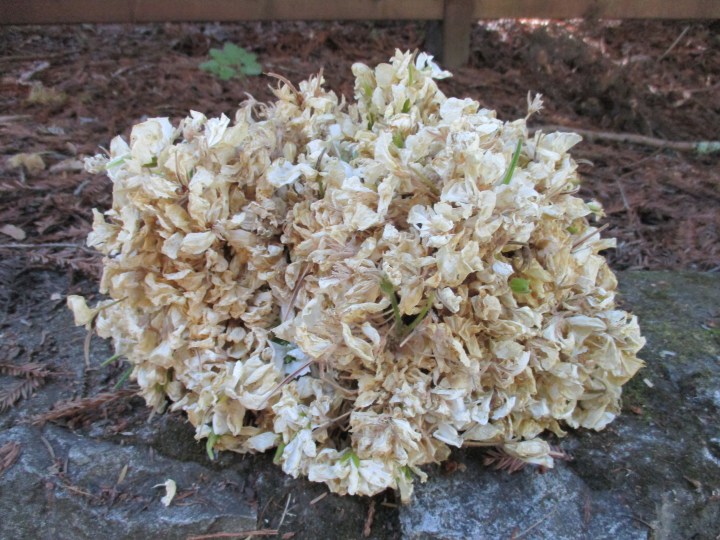
2. You can probably guess that this is phlox. It sure had my colleagues and I perplexed. We had never seen anything like it. Phlox is uncommon here. I would even say it is rare. No one knows why. It just is. I got a picture of it a few years ago only because I was intrigued by it in a neighboring landscape. It took a bit of effort to identify it, although I sort of suspected that it was phlox. It did not look quite like this phlox, and was lower to the ground. No one knows how this one got into the landscape. We suspect it arrived with the ‘fertilizer’ that the horses make for us.
3. Lily-of-the-Nile is still one of my all time favorite summer blooming perennials. I do not care how cheap and common it is. It is one of the first perennials I divided while I was in junior high school. I grew more than eighty new plants from a single old plant that needed to be removed. It was the old fashioned sort, with big blue flowers and big flabby leaves, perhaps bigger than these. I also like the white ones with the same big flowers and leaves, of course, because they are white. All the fancy modern cultivars are nice too, but not as excellent as the originals. I do like seeing the very pale blue ones in other gardens.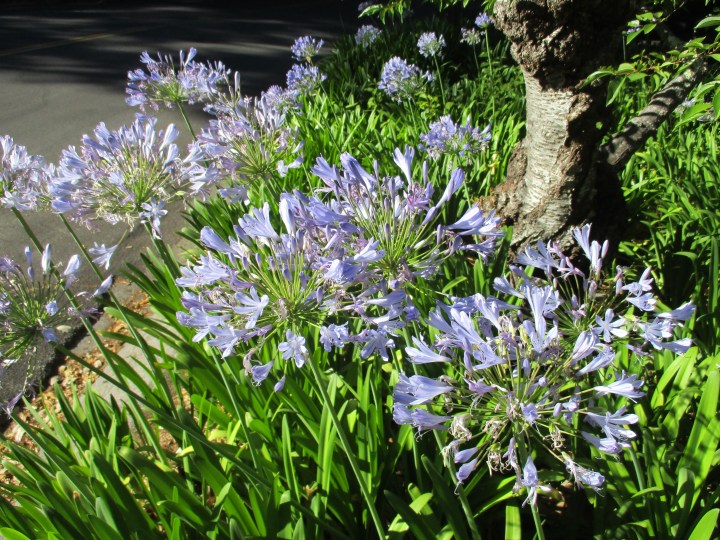
4. This zonal geranium has these small but cheery cherry red flowers, but it is really grown for the weirdly variegated foliage that is blurry in the background. I think that these flowers would look better against simple green foliage. There is another zonal geranium in another part of the landscape, with small peachy pink flowers and foliage that is variegated only with white. I am none too keen on the flower color, and I am not often too keen on variegation, but the foliage of that particular zonal geranium really looks sharp.
5. Himalayan blackberry is one of the worst and most invasive of the exotics weeds here. It develops huge canes that arch over and drop on top of other plants in the landscape. The wickedly sharp prickles (technical term for their thorns) are tortuous when trying to remove the canes. Even picking their berries is nasty business! There are a few berries ripening now, and they happen to be pretty good, but they are sooooooo not worth it.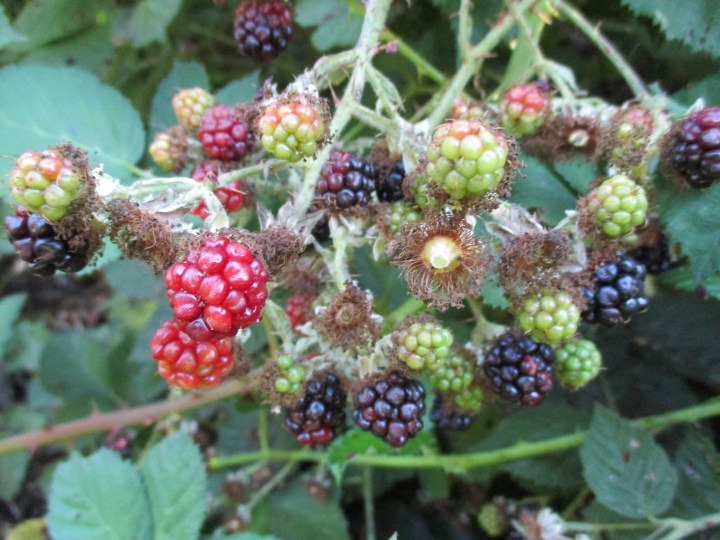
6. Chips needed to be dispersed into the newly landscaped areas that are partially visible in the background of this picture. These chips were free. They are made of recycled wood waste. For our purposes, they are sufficient. However, they include a few large chunks of wood and bits of metal. The chunk of metal in this picture is a short section of rebar. Some of the chips have paint on them. Some seem to be bits of old furniture. It makes one wonder where some of this material came from.
By the way, the bloom in the first picture #1 is merely a fist full of deadheaded white zonal geranium flowers all pressed together. White zonal geraniums do not readily drop their faded blooms like other zonal geraniums do, so they need to be deadheaded.
This is the link for Six on Saturday, for anyone else who would like to participate:
https://thepropagatorblog.wordpress.com/2017/09/18/six-on-saturday-a-participant-guide/
Horridculture – Reputation

I earned it. For several years, back when newspapers were composed of a rather ingenious combination of both news and paper, I was a respected garden columnist, as well as a respected horticulturist and arborist. Of course, I was an a horticulturist and arborist first. I later started writing my garden column because I wanted to do better than what the professional columnists who lacked practical experience with horticulture were doing.
For someone who would have preferred to simply grow horticultural commodities back on the farm, the notoriety was an odd fit. I was often asked to be a guest speaker for all sorts of garden clubs, and to write about their events. For a few years, I was a guest of honor and staffed a gardening question booth at Spring In Guadalupe Gardens in San Jose. It was awkward to walk from where I parked to the booth, past a dozen or so posters with my picture and various quotes on them.
People read my gardening column because they wanted accurate and relevant information. Although I was not proficient at writing, I managed to maintain my integrity as a horticulturist and arborist. My expertise was respected.
Then, a ‘colleague’ who wanted to capitalize on my notoriety convinced me to work for him while he established a website for me. I agreed, along with the stipulation that the website conform to my discriminating standards.
That stipulation was ignored. The website was embarrassingly flashy, with pictures of tropical plants that would not survive as more than houseplants in California. The grammar and spelling were deplorable. Articles were modified to be relevant in any season, just in case, for example, someone was worried about frost in the middle of summer. My ‘manager’ was not at all concerned with horticulture, but was instead more interested in installing advertisement for his products into the website.
About that time, I was invited to install a landscape into the 2009 San Francisco Flower and Garden Show. I would have declined, but was encouraged to compose a landscape to promote the new website. The landscape was ‘adequate’, and did happen to feature an excellent reproduction of an old windmill that my ‘manager’ happened to procure. However, the real priority was showcasing the products that my ‘manager’ was marketing, including a rainwater harvesting system. Within our limited space, we had a big black vinyl water tank! Instead of getting a vendor booth at the show, he used the landscape to pimp his products and services! It was mortifying! The fact that my modified design won awards seemed to make it even worse, as if to justify out extreme gaucheness!
It took a few years and the assistance of an attorney to get the ‘manager’ to close down and delete what was supposed to be my website, but was merely a collection of links back to websites and advertisements for what the ‘manager’ wanted to sell. Otherwise, anyone searching for me online would still be directed to products and services that I want nothing to do with, but seemingly endorse. Even now, these two images above and below would be at the top of the list of a search for images of Tony Tomeo on Google. They are from the 2009 San Francisco Flower and Garden Show, and are now associated with a website with which I have absolutely no affiliation. I want nothing to do with such unethical standards.
The picture above was taken within the landscape just before the Show opened to the public. The black vinyl tank is visible in the background. The picture below was taken during the assembly of the landscape, before I had shaven and gotten appropriately dressed.

Six on Saturday: New Landscape
Yes, we have another new landscape. It is not much bigger than the last one, and is not very far away. In fact, although it is associated with two different buildings, it is located adjacent to the opposite corner of the same building that the last landscape was constructed for. https://tonytomeo.wordpress.com/2018/04/07/six-on-saturday-rock-concert/
These six pictures were taken prior to the installation of wood chip mulch, so ground cloth is visible below. It was quite dry and dusty at the time. All of these six plants were newly installed after being procured from nurseries, so none were relocated from other landscapes, or from our storage nursery. They were blooming nicely when installed, but are actually not blooming so nicely now, and some were damaged by the sudden warmth immediately after installation. They would have been fine if only the warmth did not arrive so suddenly, or if it had arrived a few days later. Well, we can not control the weather.
Large stones and bare soil prior to the installation of the landscape were shown in this previous Six on Saturday post, https://tonytomeo.wordpress.com/2018/06/16/six-on-saturday-rock-on/
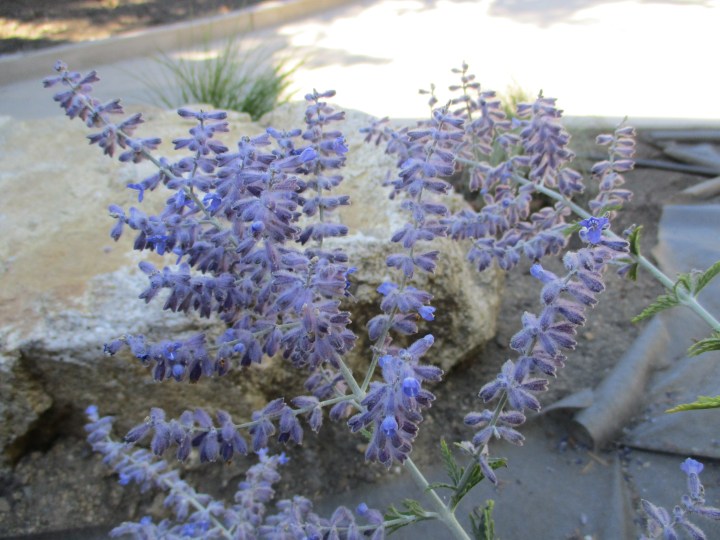
1. fernleaf yarrow, Achillea filipendulina, Most of these are white. A few are rusty red. A few are yellow like this one, which might be ‘Moonshine’. These did not show symptoms of heat stress right away, but have since gotten rather crispy. I could not find a picture like this one now. Fernleaf yarrow has been popular here for as long as I can remember because it supposedly does not need much water, although most get watered regularly. 2. Russian sage, Perovskia atriplicifolia, That sounds like ‘piroshki’. These and the rockrose #4 were 5 gallon plants, so are somewhat bigger than most other plants in the new landscape. They were not bothered by the change of the weather. Their faded denim blue flowers continue to bloom nicely. This is a plant that has been popular for a while, but that I have never grown. I tend to avoid trendy plants. However, my colleagues do not.
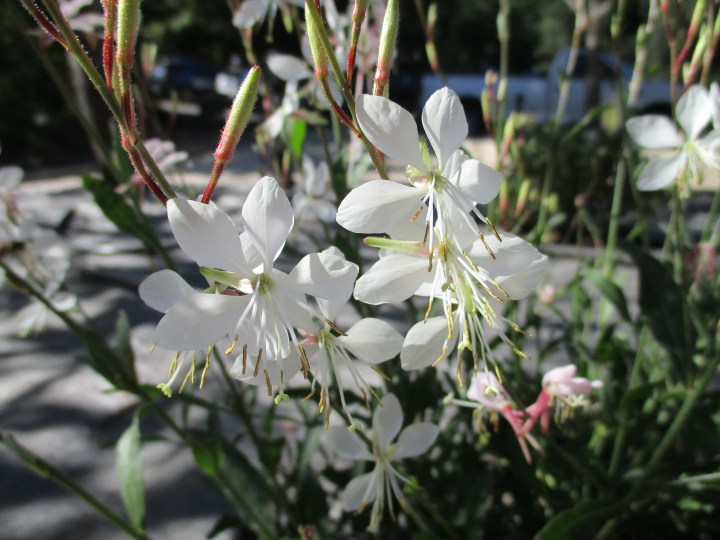
 3. gaura, Gaura lindheimeri, The common name is ‘white gaura’, but some are pink and some are darker pink that is almost red. I do not know if they are merely cultivars of ‘white’ gaura, or different specie. It seemed appropriate to omit ‘white’ from the name. Besides, that is how I learned it. This one can self sow enough to be an annoyance. Individual plants do not live very long, so a few feral seedlings can be selected to replace them.
 4. rockrose, Cistus cretisus, When I learned about rockrose back in the 1980s, we learned only two specie. One was white rockrose. The other was pink rockrose; and the pink rockrose did not look like this one. Now, there are too many to remember. Most do not have species name, but merely cultivar names. I really do not know if this really is Cistus cretisus. It just happens to look like it. I suppose I should have looked at the label.
 5. chocolate coreopsis, Coreopsis ‘Chocolate’, As I implied for #4, nomenclature is not what it used to be. It was standardized to simplify things, but is difficult to keep track of now with all the breeding and hybridizing, and botanists wanting to make a name for themselves by changing a name to something supposedly more accurate. I really do not know the species name of the chocolate coreopsis. It is known merely by the cultivar name.
 6. milkweed, Asclepias tuberosa, This one wilted rather badly in the warmth, but did not get roasted too much. The shriveled flowers in this picture are the worst of the damage. It is blooming more profusely now, and is developing strange seed pods. Milkweed is another trendy plant that caters to the butterfly gardening fad. I am not certain if I like the idea of planting something that is expected to get munched. It sure is colorful for now.
 This is the link for Six on Saturday, for anyone else who would like to participate:
https://thepropagatorblog.wordpress.com/2017/09/18/six-on-saturday-a-participant-guide/
Garden Bloggers’ Bloom Day July 15 – Summer Weather Has Arrived
While so many of us in the Northern Hemisphere were contending with unusually warm weather, our weather here had been unusually mild. The weather only recently became warm for the past two weeks or so. It did not get unusually hot here like it did in so many other regions, but the warmth developed suddenly enough to damage many of the flowers that were blooming at the time. This included many of the new perennials that we happened to be installing at the time. Consequently, there were not nearly as many flowers to get pictures of as there had been in May, and some of the flowers in these pictures show damage from the sudden change in the weather. I am sorry that I neglected to participate in Bloom Day in June.
These pictures were taken at work, on the Santa Cruz County side of the Santa Cruz Mountains above Los Gatos, closer to Felton. The climate is more coastal than the chaparral climate of the Santa Clara Valley, although both are within USDA Zone 9.
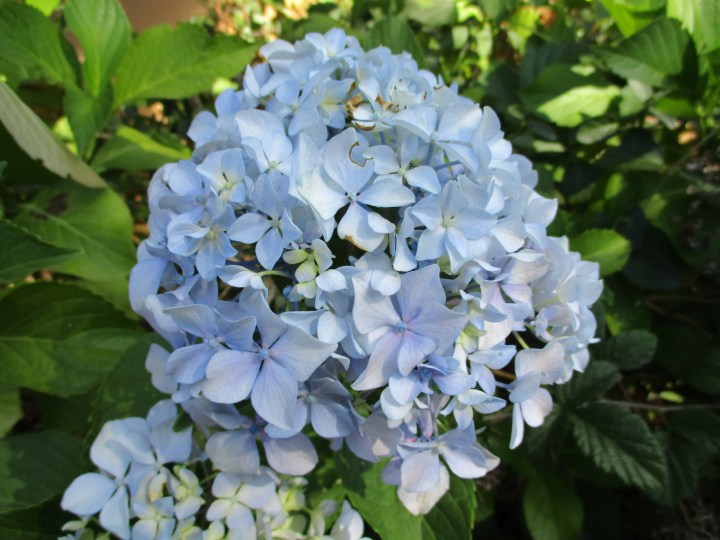
Carpet Roses are the lowliest of all roses, but they happen to be more functional for more landscape applications than other roses are. These got pruned back to a few canes over winter, and will get trimmed for confinement about now, but really do not need any more work than that. They bloom profusely in a few phases. They are only looking tired now because of the weather.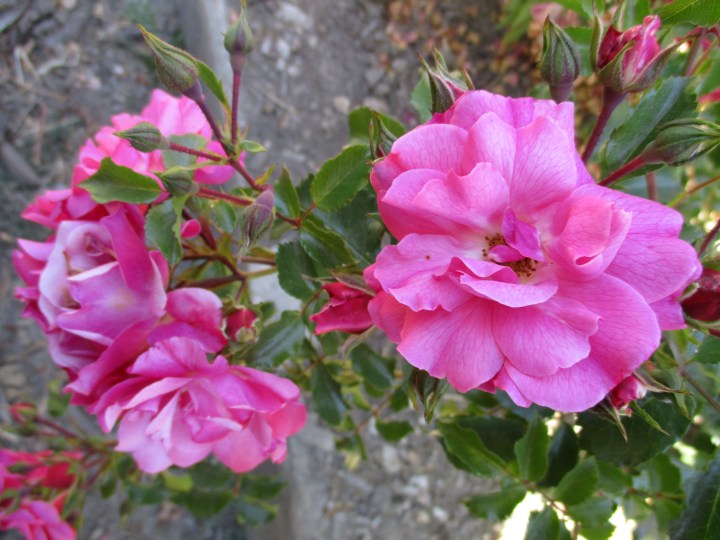 Hydrangea are finishing in most other areas here. These are odd ones. They are more exposed to harsh weather conditions than others, but are somehow lasting later than those that are more sheltered. They are blue instead of pink, but are not in what would be considered acidic conditions within redwood forests. Nor were they fertilized to be blue. No one is complaining.
 Yarrow was planted just before the weather changed. Once established, it does remarkably well in the endemic soil and climate.
 Yarrow unfortunately got roasted by the sudden warmth. These yellow (or ‘golden’) flowers are getting quite crispy already.
 Coneflower was likewise planted just before the weather changed, and likewise got roasted. These happen to be some of the best at the moment.
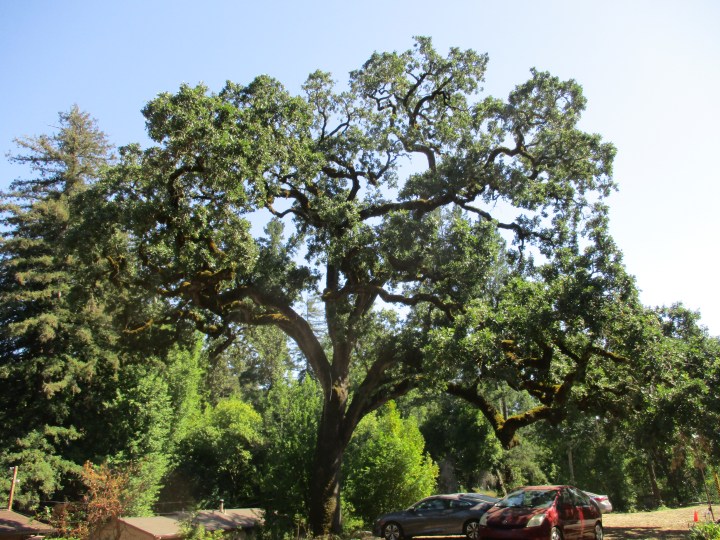
 Valley Oak probably qualifies as appropriate for Bloom Day because it really is blooming right now. You just can not see it. The dust is everywhere. I really like this grand and sculptural tree. The valley oak happens to be the biggest oak in North America, and it also happens to live here, on the outskirts of groves of coastal redwoods, which are the tallest trees in the World.
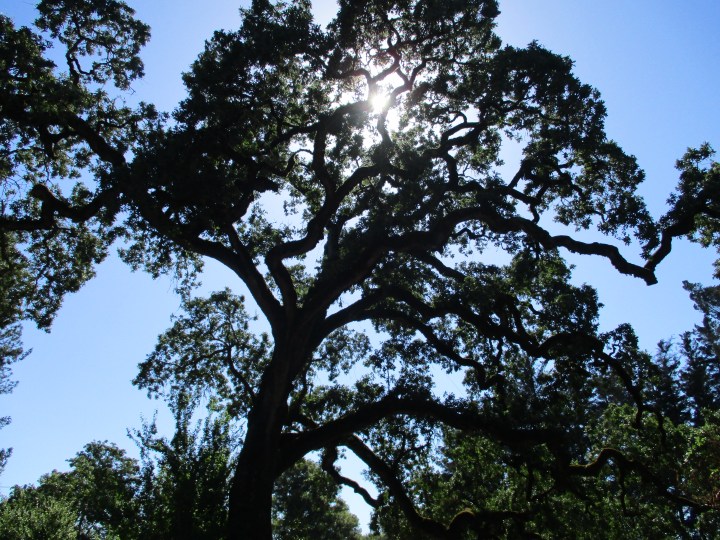 Valley Oak is so excellent that I had to get another picture of it from another angle. The first picture was looking about south toward the midday sun. This is looking almost to the east, perpendicularly to the other picture. The cars in the foreground are much closer than they seem to be. The trunk of the tree is significantly wider than it seems to be in relation to the cars.
 Garden Bloggers all over America and in other countries can share what is blooming in their gardens on the fifteenth of each month on “Garden Bloggers’ Bloom Day”, hosted by Carol Micheal’s May Dreams Garden at http://www.maydreamsgardens.com
Six on Saturday: Redwoods
Both coastal and giant redwoods, are the most excellent trees. The giant redwoods are endemic to isolated colonies in the Sierra Nevada. The coastal redwoods are endemic to the coastal region from the Oregon Border to San Luis Obispo County, which happens to include this region.
Coastal redwoods are so awesome that even the dead stumps from trees harvested a century ago are awesome. Most of the stumps in this region have been charred by forest fires. Yet, even after a century, they are still quite solid. They decay very slowly, which is why their timber is such a popular and important building material. Because the stumps are so big and would be difficult to get rid of, not many of us even try.
1. Compared to some of the tacky garden art that some people pay significant money for, this old redwood stump is strikingly sculptural. It stands so proudly out on this knoll on the edge of a small creek just above where it flows into Bean Creek. It is difficult to see in this picture, but a landscaper tried to obscure this stump with potato vine. Only a bit of twiggy growth can be seen at the top of the stump. The rest of the vine is now overwhelming the adjacent dogwood above. The trunk of the dogwood is to the right. Coastal redwood forests are innately shady. The potato vine is not very happy there. Even if it were happy, and were able to obscure the stump, would it really be an improvement? 2. These two bigger stumps are just a short distance uphill and across the small creek. Old stumps are more often single, but surrounded by multiple trunks that emerged from the roots. Because almost all of the trees here had been harvested about a century ago, there are now many more secondary trunks per area than there would naturally be. It is not much of a problem yet, but these trunks will likely become more crowded as they mature.
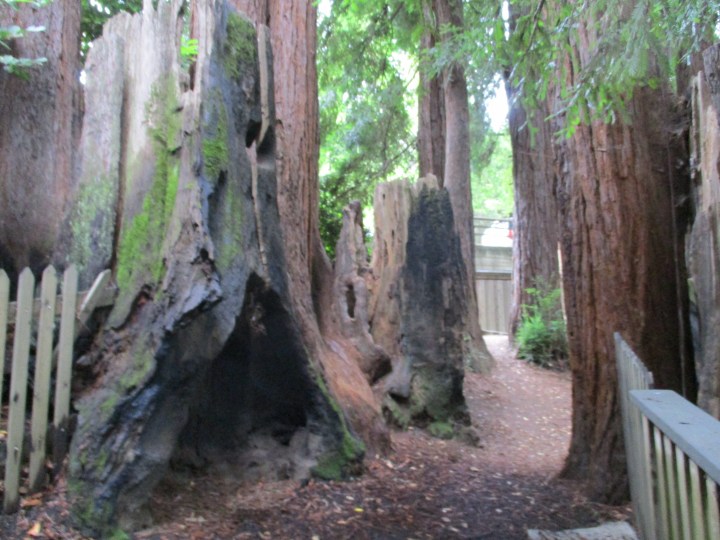 3. These are the same two stumps from the other side. This trunk coming up from within is likely from the same original root system. All trunks that develop from the same root system are genetically identical, so they look very similar from a distance. Some genetically identical groves can be quite broad, and include many trunks.
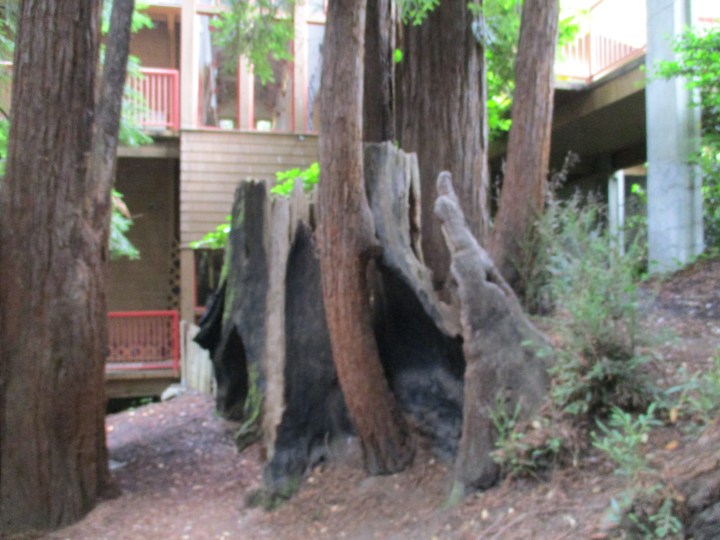 4. This small coastal redwood trunk is not happy about the fence that is nailed to it.
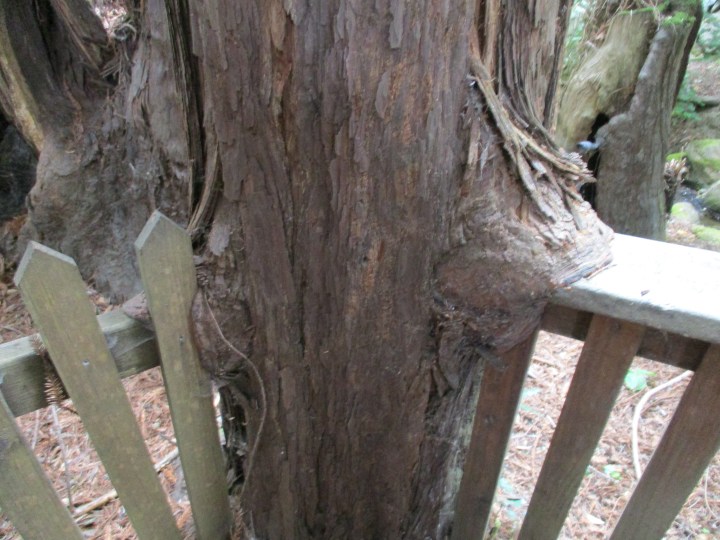 5. This is more what you expect coastal redwoods to look like. It is impossible to determine from this picture if these trunks are genetically identical secondary trees that emerged from the same root system, but their proximity to each other suggests that they likely are.
 6. This epiphyllum is the flower that I promised to those who expressed a concern than my Six on Saturday lacked adequate bloom. I shared a picture of this same epiphyllum earlier, but it has continued to bloom.
This is the link for Six on Saturday, for anyone else who would like to participate:
https://thepropagatorblog.wordpress.com/2017/09/18/six-on-saturday-a-participant-guide/
Six on Saturday: Finally Flowers
After posting so many inter pictures of soil, stone, road signs, plumbing, empty wine barrels and mockery of French culture, I suppose I should share some pictures of actual flowers for a change. I mean, this is about gardening after all. Unfortunately though, I do not work with many flowers. The landscapes are designed to be compatible with the surrounding forests, so flowers are minimal. I already shared pictures of most of the best. Some of these are from gardens that I do not work with. I just thought that they were pretty.
1. Avens finished blooming more than a week ago. I just really liked this picture because it is such a nice swirly orange color. Until I found these, I had not seen avens in many years, and did not expect to see it anytime soon. Since featuring it in the gardening column, I have found that others in other regions are quite familiar with it, and this it more popular than I would have guessed. http://www.canyon-news.com/ph-has-ups-and-downs/80473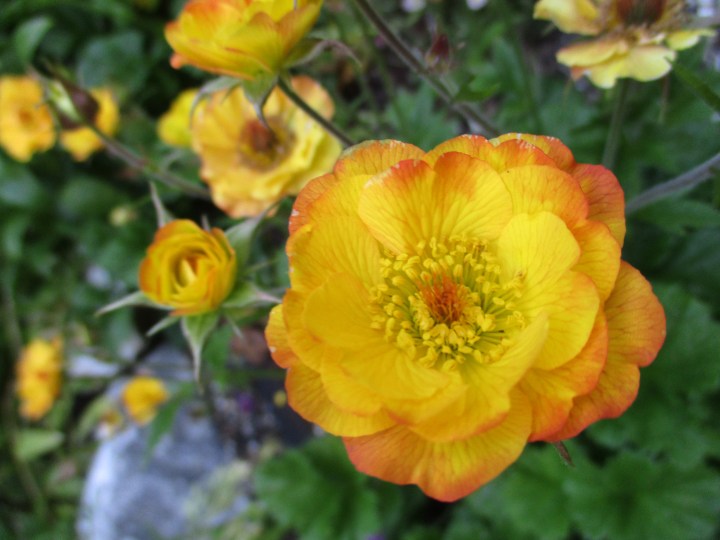
2. Lobelia is one of the more common warm season annuals. This is not from one of the landscapes that I work with, but looked good enough in a planter box in town for me to get a picture of it. I do not know what variety it is. There are many varieties nowadays that I am not familiar with anyway. Back in the 1980s, bright blue lobelia was popular alternated with white alyssum. I thought it looked rather silly at the time, but would not mind seeing it now. It was such an 80s look.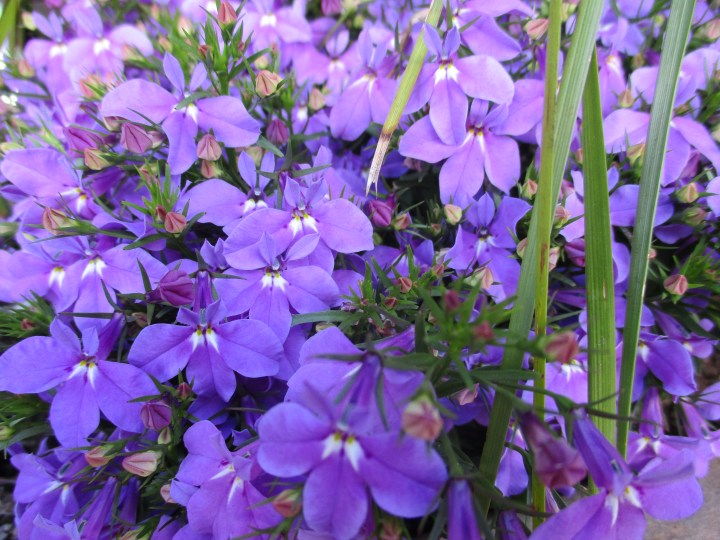
3. Pelargonium was in the same planter box as the lobelia. I know neither the species nor the cultivar. Again, it was just too pretty to pass up without getting a picture. It is more diminutive than the sorts of pelargoniums that I am familiar with. The plants are very compact. The variegated leaves and flowers are quite small.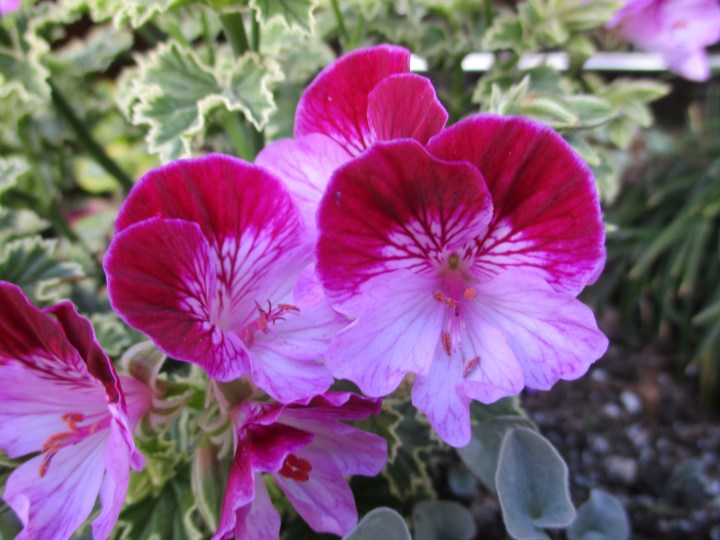
4. Zonal Geranium happens to be one of my favorite perennials because it was one of my first. Although I grew my first for only a short while when I was very young, I still grow one that I found in a trash pile when I was in junior high school, and another that I found naturalized in a creek near San Martin shortly after I graduated from college. I bring pieces of them everywhere I go. Both are the big and weedy types that are probably very closely related to the straight species. The first one is the very common bright pink with leaves that lack halos. The second is the very common bright orange red with only slight halos on the leaves. Getting back to this remarkably bright red zonal geranium; it is not one of mine. The leaves have only very light halos. The growth seems to be almost as vigorous and weedy as my bright orange red one, but not quite. It is more tame, and more prolific with bloom. The bright red color is prettier too.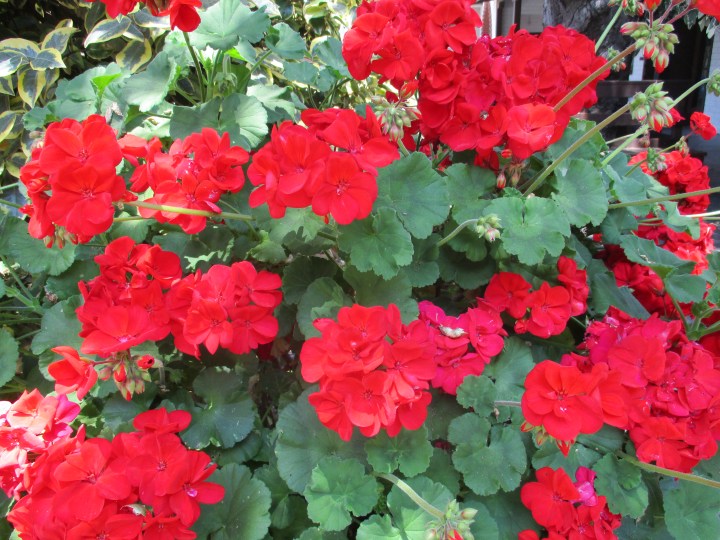
5. Lithodora looks prettier close up that it really looks in the landscape. It was planted into one of the newer small landscapes, but is not growing very well. I found the name to be amusing because it seems to mean that it smells like a rock. However, someone recently explained to me that the name means that it adores rocks, since it naturally grows in soil that is too rocky for other plants.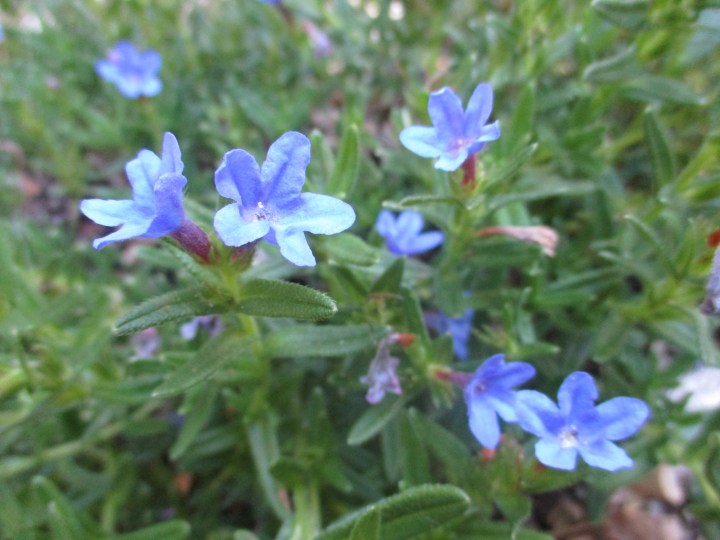
6. White Hydrangea is a nonconformist among all the hydrangeas that I fertilized to be either pink or blue. So far, the pink ones are still pink, and the blue ones are still blue. The few white ones are always white. http://www.canyon-news.com/ph-has-ups-and-downs/80473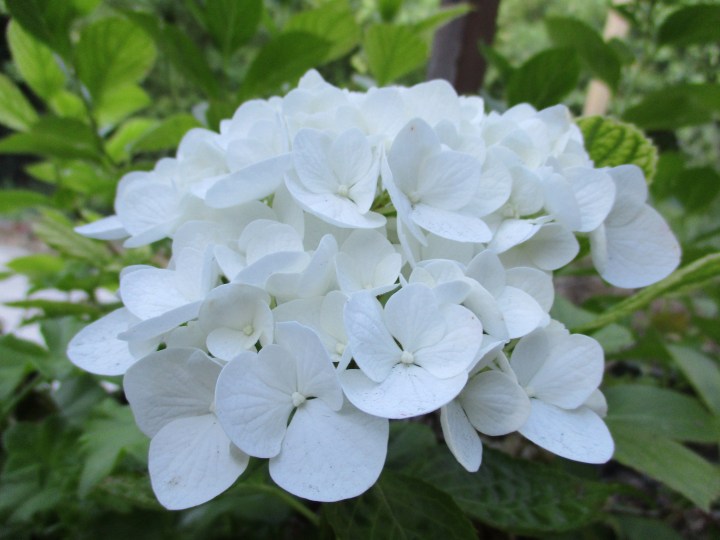
This is the link for Six on Saturday, for anyone else who would like to participate:
https://thepropagatorblog.wordpress.com/2017/09/18/six-on-saturday-a-participant-guide/
Six on Saturday: Infrastructure
There is so much more to horticulture than plant material. There is a lot of hard work, which is hard to get in pictures. There are a lot of materials. There is a lot in infrastructure.
Well, I do not have pictures from the farm to show how our horticultural commodities are grown. That would not be very interesting anyway. These pictures are merely odds and ends of what we work with in regard to landscape maintenance.
1. Incarcerated stone. Yes, it is quite obvious that this prison is overcrowded. This is where they do ‘hard’ time. Incidentally, ‘Pet Rock’ was invented in Los Gatos.
2. Half barrel. Back when there were more real wineries in the Santa Clara Valley, barrels such as this were cheap, and could sometimes be found left on the sides of roads for anyone who wanted to take them for kindling. At nurseries and lumber yards, they could be purchased already cut in half, perforated with a few drainage holes on the bottom, and painted with wax on the inside, for use as planters. They are more expensive now. This particular barrel came from France, so is not even made of local valley oak. See the fancy label at the top of the picture? The drainage hole on the left was not drilled through because the drill bit encountered something metallic in the wood. Check out the tips of my stylish boots at the bottom of the picture.
3. ErmitagE France. This metallic label on the wine barrel is so comically contradictory! The lack of an ‘H’ at the beginning, and the capitalized ‘E” at the end of ‘ErmitagE’ implies that the former contents of the barrel was something fancy, but is then followed by ‘France’.
4. NO DUMPING ALLOWED. This is a classic example of ‘Do as I say, not as I do’. We dump debris from landscape maintenance all the time. When we prune for road clearance, much of the debris gets thrown back out into the forest behind what was pruned. In some spots, it works like mulch to keep some of the weeds down. Larger bits must get taken away of course. This sign will be posted on a wide spot on one of the roadways where dumping had apparently been a problem. By the way, it is just coincidence that the two words ‘CHILD DUMPING’ lined up like that.
5. White star magnolia. This was just moved to the new landscape of a newly renovated building. https://tonytomeo.wordpress.com/2018/06/16/six-on-saturday-rock-on/ We would have preferred to wait for it to defoliate in autumn before relocating it, but it was in the way within another recently landscaped area, and we really wanted to install it here in the new landscape before other material gets installed around it. https://tonytomeo.wordpress.com/2018/04/07/six-on-saturday-rock-concert/ It does not seem to know that it has been moved. I happened to grow these along with many other magnolias back in the late 1990s, and really did not like working with them in the nursery. We just were not set up for them. However, I really like them in the landscape. This particular magnolia grows like a large shrub, so will not get big enough to drop flowers onto all that pavement. That would have been a concern with larger magnolia trees that bloom with larger flowers that can be a slipping hazard when they fall onto pavement.
6. Epiphyllum. This just happens to be in bloom at the shop. It belongs to the horticulturist who maintains all the landscapes here, so has nothing do do with the landscapes. With all the pictures of inert items and only one white star magnolia, I thought I should include something a bit more colorful. It does not get much more colorful than this.
This is the link for Six on Saturday, for anyone else who would like to participate:
https://thepropagatorblog.wordpress.com/2017/09/18/six-on-saturday-a-participant-guide/
 Tony Tomeo