Which Houseplant?

Peperomia obtusifolia?

Peperomia obtusifolia, baby rubber plant is what I suspect this to be. I can not be certain. I do not work with houseplants. I can barely remember that we studied only a few cultivars of Peperomia that happened to be popular back when we were in school during the late 1980s’. The modern cultivars that are popular now were not even developed back then. I do not remember ever getting acquainted with the simple species, which this seems to be. That makes it even more perplexing. Where did someone get this copy of the simple species that has become so rare relative to popular modern cultivars as well as formerly popular cultivars? The rarest of modern cultivars is not as rare as this original. It is an exemplary specimen, too. It is at least two feet wide and stands more than a foot tall in its wide but shallow pot. Someone has maintained it meticulously for several years. Perhaps it grew as a cutting from an even older specimen that was grown before it became so rare so long ago. Perhaps someone appreciated this original simple species as it was losing popularity to more colorful modern cultivars back then. Realistically, without any of the fancy variegation of modern cultivars, the simple green original is undoubtedly more vigorous, and perhaps significantly so. It is therefore more sustainable than cultivars, and more likely to survive and perpetuate itself by cutting for many years. Alternatively, it could have originated as a reversion from a modern cultivar. Someone may have been impressed enough by its relatively vigorous simple green foliage to grow a copy from a cutting. Perhaps relatively vigorous simple green growth merely overwhelmed and replaced original but less vigorous variegated growth. These are merely guesses about its identity, which remains a mystery.

Off Color – Very Variable Variegation

‘Stuttgart’ canna

Reversion among vegetation is the loss of an aberrative genetic characteristic, such as variegation or bronze foliar color. Because most genetic aberrations that are susceptible to reversion are disadvantages, reverted growth generally performs more efficiently, and displaces remaining genetic aberrative growth. For example, because its variegated portions lack chlorophyll, variegated foliage is less vigorous than foliage that is not variegated. Therefore, if not removed, unvariegated reverted foliage is likely to grow faster and replace variegated foliage. This ‘Stuttgart’ canna leaf seems to have done the opposite of reversion, by exhibiting such extreme variegation that all green color is lacking. Fortunately, it is not as bad as it looks. This is merely very variable variegation. Just as a few leaves may be completely green without actually reverting permanently, a few leaves are extremely variegated, and on rare occasion, a few, such as this leaf, may lack any obvious green color. Leaves that developed after and above this leaf exhibited more typical variegation with both green and white. Otherwise, this particular cane would not survive for long without chlorophyll for photosynthesis. The flowers are unaffected because they derive their floral color from pigment rather than chlorophyll. White redwood foliage can survive without chlorophyll only because it can rely on resources provided by the normal growth with green foliage that it is attached to, almost parasitically. Such growth is considered to be albino, but because it merely lacks chlorophyll rather than pigment, it is technically not albino. Furthermore, it is technically not variegated, since it is so completely white, without any green chlorophyll. Oh, this is more complicated than it should be. It is probably better to simply appreciate appealing genetic aberrations such as white, variegated or other colorful foliage. ‘Stuttgart’ canna will not refresh its variegated foliage until the end of winter.

Khartoum

‘Khartoum’ (Agapanthus orientalis ‘Khartoum’) is a blend of Blue Nile and White Nile.

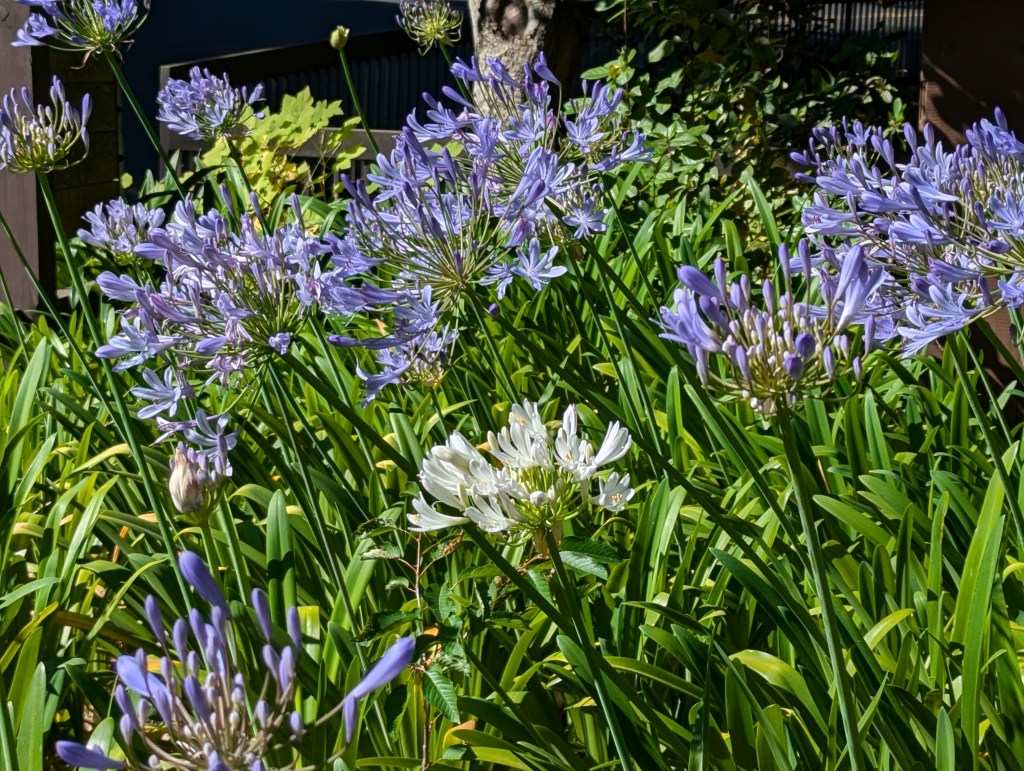
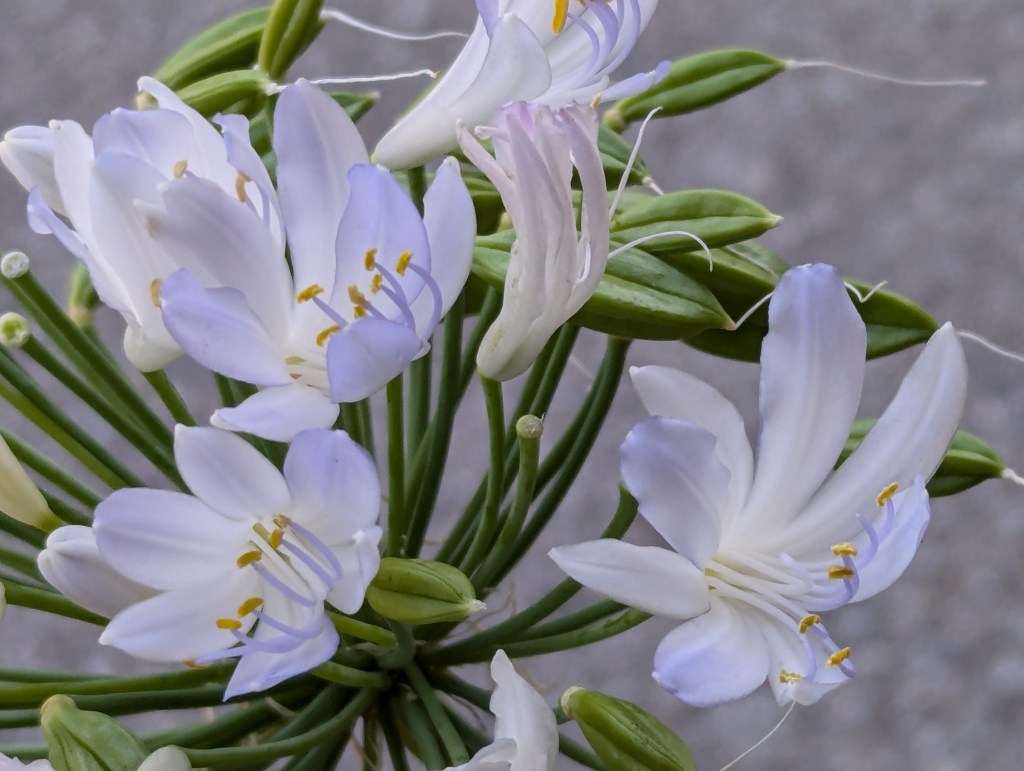
Khartoum is located where the Blue Nile River merges with the White Nile River to become the Nile River. Lily of the Nile, contrary to its name, is neither a lily nor native to any of the three Nile Rivers. It is in the Amaryllidaceae Family, and is native to Southern Africa. Coincidentally though, it naturally blooms either blue or white. It really seems like it should be native to at least two of the Nile Rivers, with those that bloom white inhabiting the floodplains of the White Nile River, and those that bloom blue inhabiting the floodplains of the Blue Nile River. Perhaps both should inhabit the floodplains of the primary Nile River. Like a few other species that bloom exclusively true blue or white, lily of the Nile sometimes exhibits sports, which are mutant growth, that bloom with the other of the two options. In other words, those that bloom blue sometimes produce a shoot that blooms white, and conversely, those that bloom white sometimes produce a shoot that blooms blue. As if genetically unstable, such sports may revert to their original floral color by the following season, and before they divide into several shoots that bloom prominently with aberrative floral color within their otherwise florally monochromatic colonies. When I noticed a single white bloom within an exclusively blue blooming colony, I did not want to wait for the following season to see what its intentions were. Then, as bloom faded and I separated it from the colony, I found that it was blushed with blue, as if already trying to revert. Because it is impossible to confirm its intentions, I canned it and set it aside to see what it does in the future. If blue, it can return to the landscapes with the random mix of blue lily of the Nile that has been accumulating as long as they have inhabited landscapes here. If white, it will be given to neighbors, because I want to maintain the genetic purity of the single white cultivar that is here. If it remains white with pale blue blush, it might get a separate but prominent position within a landscape.

Sports

This white lily of the Nile appeared this summer within this exclusively blue colony.

Horticulturally, a sport is a genetically variant growth. Although it is more common among extensively bred or genetically aberrative cultivars than simple species, the most basic of lily of the Nile can, on rare occasion, change floral color from blue to white or from white to blue, as I mentioned on the sixth of July. Unvariegated or ‘green’ sports are a more common annoyance among some cultivars with variegated foliage, such as popular cultivars of Euonymus japonica, since they grow faster with more chlorophyll, and can overwhelm the original and more desirable variegated growth. The yellow hybrid gladiola that I posted a picture of for Six on Saturday on the twenty-ninth of June could be a sport of an adjacent orange and yellow hybrid gladiola. I did not give it much consideration because I assumed it to be the first bloom that I noticed from one of a few bulbs that somehow survived for a few years longer than expected. Until last summer, the only hybrid gladiolas to survive from a mixed batch planted years earlier had been either purple or the aforementioned orange and yellow. However, now that the yellow bloom is gone, an equally unfamiliar orangish red bloom emerged from the same small colony of bulbs that had bloomed only orange and yellow. As their common name suggests, hybrid gladiolas are hybrids, so are innately genetically unpredictable, and therefore have potential to generate sports as they multiply. Although I do not know for certain that this new orangish red hybrid gladiola did not survive without blooming for the past few years, I sort of suspect that it and the new yellow hybrid gladiola are more recently developed sports of the original orange and yellow hybrid gladiola. I hope that both are as reliably perennial as the original.

This orangish red hybrid gladiola seems to be a sport of the orange and yellow hybrid gladiola.

Different Time Zones

P80901KIf the flower on the left is a four o’clock, is the flower on the right a five o’clock, or perhaps a three o’clock? Is one a.m. and the other p.m.? What about the flower of the same species that I featured twelve hours ago? What about those in another picture that I will share next Saturday?
Of course, only the colors are different; not the name . . . or the time.
What is odd about these two seemingly different flowers is that they are on the same plant. In fact, they are on the same stem, separated only by a few inches.
Four o’clocks can be odd that way. Individual plants typically bloom with exclusively pink, red, white, yellow or orange flowers. The shades and hues of these colors are variable, but are typically homogeneous throughout each entire plant.
Some plants bloom with flowers of one color that are spotted or variably striped with another. Their flowers are not as homogeneous as those that bloom with only one color, so some of their flowers might be uniformly one color or the other, without spots or stripes. Some plants bloom with a few different colors!
Distinctly bright pink (but not light pink) flowers seem to be the most fragrant and the least variable, typically devoid of spotting or striping. They may be more closely related to the wild species, as it would have been found in its natural range in the Andes, prior to breeding for more interesting colors. Perhaps, after enough generations, other four o’clocks would eventually revert to the same characteristically fragrant bright pink flowers, just like many varieties of nasturtium eventually revert to standard bright orange and yellow. It is hard to say now, while naturalized four o’clocks have yet to do so.

Albino

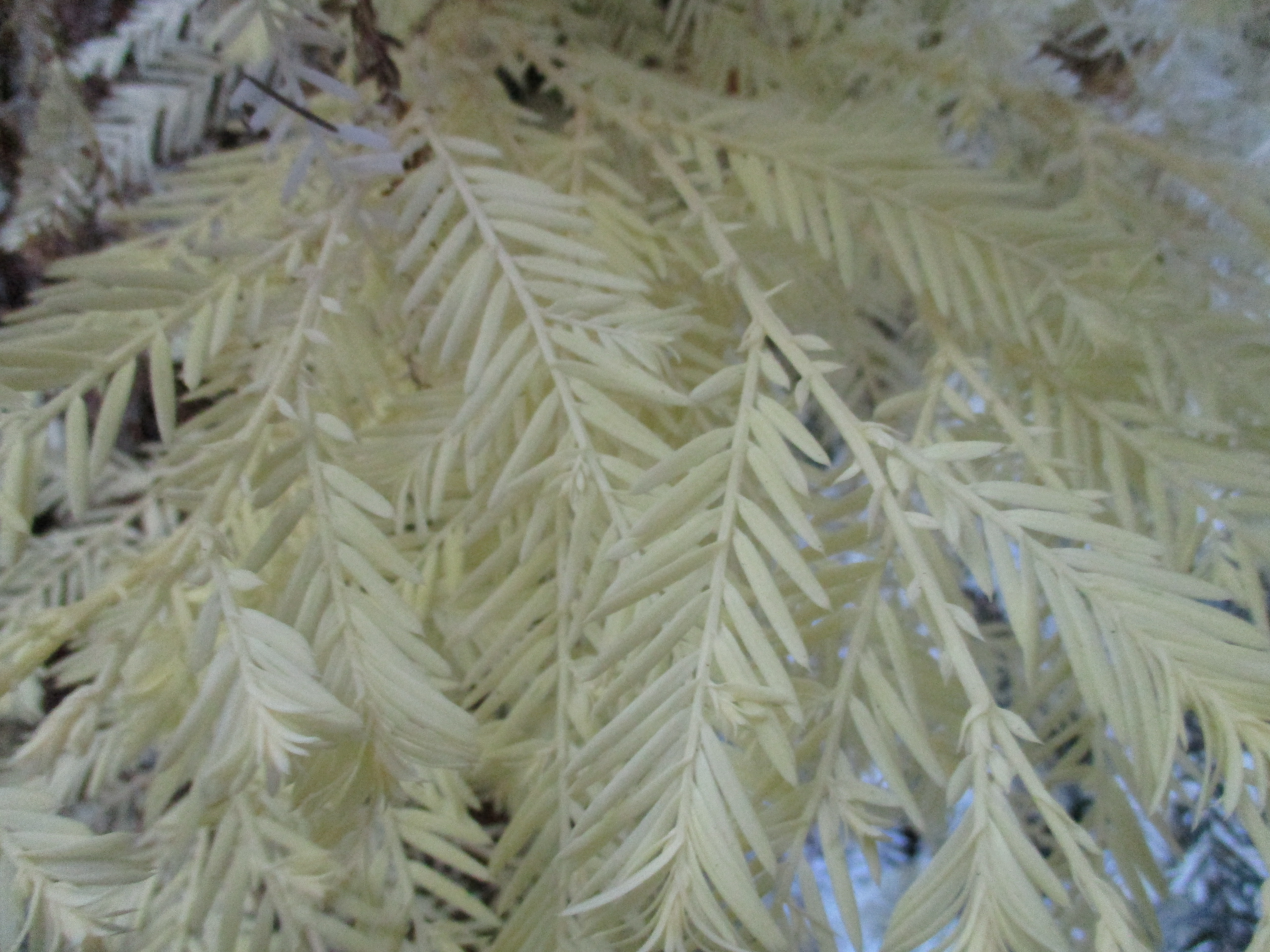
P80804KHow Italian! Red, white and green! A coastal redwood with a white albino sport (mutant growth) amongst otherwise deep green foliage. Actually, it is very Californian. Coastal redwood is endemic to California with only a a few north of the border on the extreme southern coast of Oregon.
Such sports are quite rare. Back in the late 1970s, an article in World Magazine mentioned that only five of these albino ‘trees’ where known to exist. There were actually more, even back then, but others were not documented. (They were WithOut Papers – WOP.) The specimen in the picture is at a home that is about a century old, so it was known about for a very long time, although not documented.
Albino foliage is a lethal mutation. It lacks chlorophyll, so can not sustain itself. It only survives because it originates as basal watersprouts that remain attached to the original green trees that produce and then sustain it. Attempt to graft albino grown onto other green trees has been unsuccessful.
Albino growth looks pretty in pictures, and is provides striking (although very perishable) cut foliage that is even more striking with black flowers, but does not make such a nice tree. It stays shrubby at the base of the originating tree, without developing distinct trunks or substantial branches. It does not shed old foliage as efficiently as green growth does, so always looks grungy. To make matters worse, albino foliage is more sensitive to frost, so gets killed back every few years or so, and then is slow to shed the dead foliage and stems.
Coastal redwood is one of the most fascinating trees in the World. It is the tallest, and among the biggest and oldest. It is no wonder that it is the state tree of California.

Horridculture – Mutants


P80704Mutants are the source of many of our favorite cultivars of otherwise simpler specie. Many cultivars of plants with compact, pendulous or fastigiate (strictly vertical) growth, or variegated, bronzed, golden or otherwise abnormally colored foliage, were derived from ‘sports’, which are mutant stems that appear on otherwise normal plants. Thornless blackberries were sports of thorny cultivars. Fruitless mulberry is a sport of white mulberry. There is no shortage of mutants.

https://tonytomeo.wordpress.com/2018/05/07/cultivars-are-the-real-cloned-mutants/

https://tonytomeo.wordpress.com/2018/05/06/sport/

By nature, mutants are genetically unstable. A few can easily mutate back to their original and more genetically stable characteristics. Variegated plants are notorious for developing simple green unvariegated foliage. Because it has more chlorophyll, the unvariegated foliage grows faster, and has the potential to eventually overwhelm and replace the variegated foliage. That is why green sports should get pruned out of variegated plants.

‘President Roosevelt’ is the most popular of the few variegated rhododendrons. In nursery production, it gets pruned somewhat regularly to remove green sports. Variegated specimens are rare in landscapes because almost all revert to unvariegated foliage within only a few years.

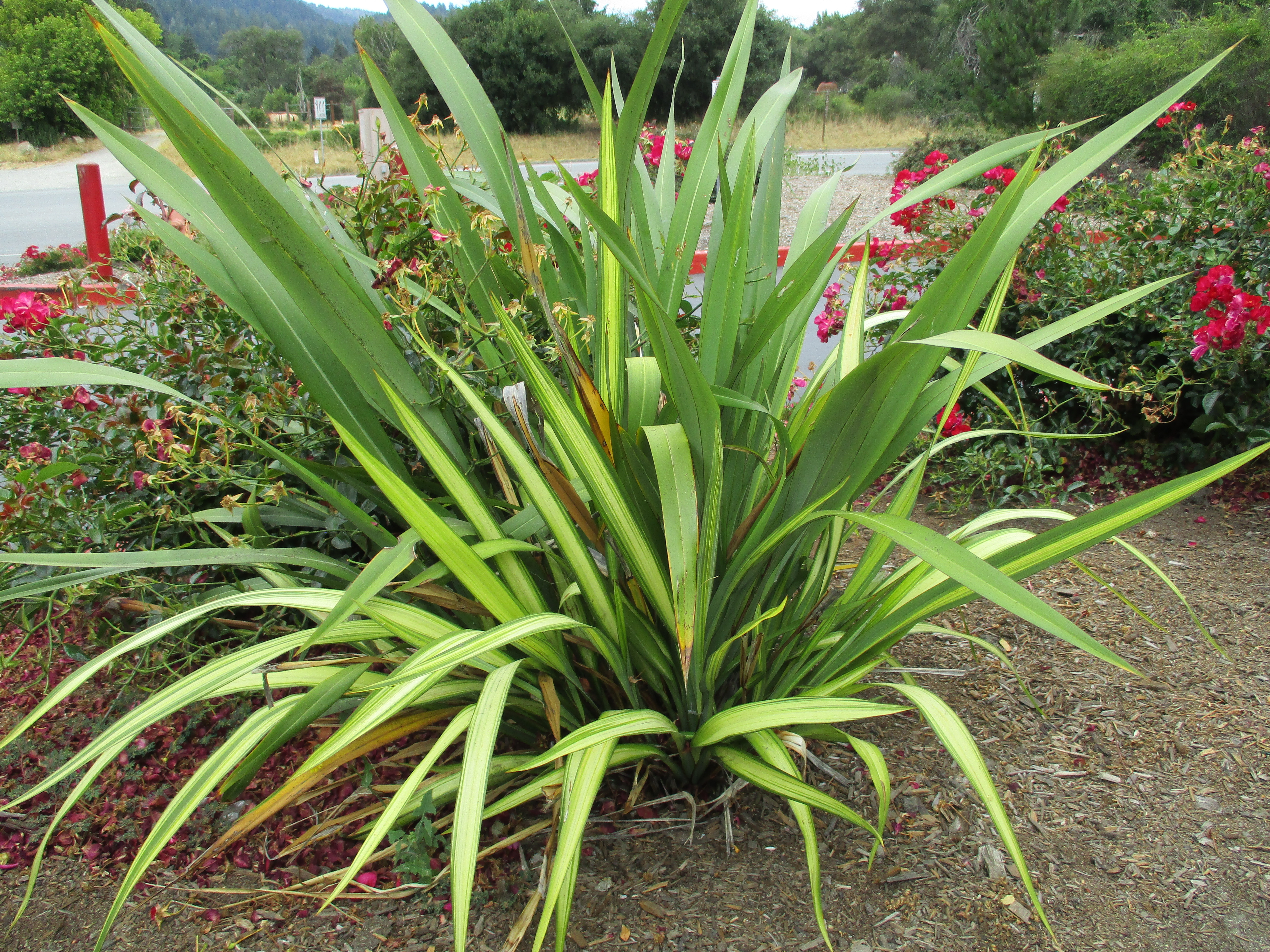
‘Yellow Wave’ is a cultivar of New Zealand flax with pendulous yellow striped foliage. It can be seen in front of the upright greener foliage in the background. These are not two separate plants stuck together. The more vigorous green foliage is a reverting sport that should have been removed by the ‘gardener’ who is supposed to be ‘maintaining’ this landscape. The green sport is now so developed that it can not be removed without damaging the rest of the ‘Yellow Wave’ growth. It will undoubtedly be left to overwhelm and replace it. Fortunately, the upright green foliage is about as appealing as the ‘Yellow Wave’, so no one will notice the inadequacy of the maintenance. No one ever does.

Cultivars Are The Real Cloned Mutants

80516thumbIt is not science fiction. It involves neither ninjas nor turtles. Cultivars really are mutant plants that can only be propagated by cloning. The word ‘cultivar’ is a portmanteau (two words combined into a single word) of ‘cultivated’ and ‘variety’. Unlike other varieties of plants that can be perpetuated by seed, cultivars must be cultivated by unnatural techniques to maintain their genetic distinction.

For example, ‘Alamo Fire’ is a variety of Texas bluebonnets with maroon flowers. The original seed were collected from a few naturally occurring variants with maroon flowers, and grown into more plants with maroon flowers, which provided more seed. No seed was collected from those that bloomed blue. By repeating this process of selection a few times, the variety was developed.

The variety ‘Alamo Fire’ is now sufficiently genetically stable to perpetuate itself, which means that subsequent generations will also bloom with maroon flowers. However, a few blue flowers might bloom in any generation; and unless they are weeded out before producing seed, they will eventually dominate until the entire colony reverts from maroon back to the more genetically stable blue.

‘Meyer’ lemon is an example of a cultivar. It must be propagated vegetatively by cuttings, or perhaps grafted onto understock. In other words, it must be cloned. It is a genetically unstable hybrid of a lemon and an orange, so plants grown from their seed would be very different from the parent. Many hybrids are so genetically unstable that they are sterile, and unable to produce viable seed.

Many variegated or dwarf cultivars of all sorts of plants are not hybrids, but are mutants. It is common for some arborvitaes to produce ‘sports’, which are simply mutant growth that is somehow different from the original growth. If a sport has a desirable characteristic, such as densely compact growth, variegation, or golden foliage, it can be cloned as a cultivar. Just like ‘Meyer’ lemon, a dwarf golden arborvitae is very unlikely to produce genetically similar seedlings.

Sport

P80506Not just any sport; a witch’s broom sport! Remember the quidditch tournament of the first Harry Potter Movie? Well, it has nothing to do with that. You should not be watching such movies anyway.

This sort of ‘sport’ is merely a genetic variant growth. This particular sport happens to be known as a ‘witch’s broom’.

There is quite a variety of other sports.

Sometimes, a plant is going along minding its own business, when all of a sudden, it produces a stem with variegated leaves. Unlike the plain green leaves on the rest of the plant, the leaves on the sport are outfitted with white margins. In the wild, such a sport would probably not last long. Since it has less chlorophyll than the unvariegated foliage, it would grow slower, so would eventually be overwhelmed and shaded out by the more vigorous greener foliage. However, if someone happens to find this variegated sport, and determines that the variegation might be an attribute, it can be propagated as a new variegated cultivar of the species.

Sometimes, a plant is going along minding its own business, when all of a sudden, it produces a stem with bronzed foliage, or gold foliage, or leaves that are shaped differently from those on the rest of the plant. Perhaps new stems are more pendulous than they normally are. Sometimes, growth is more compact. It might even be rather stunted and disfigured, branching into a tuft of densely arranged twiggy stems known as a ‘witch’s broom’.

Such growth does not look like a witch’s broom for very long. As it grows, it develops into a densely shrubby mass that eventually gets too heavy to be supported. If the dense growth is appealing, it can be propagated as a new cultivar, like the dwarf Alberta spruce was reproduced from a witch’s broom sport of the common white spruce, or the pencil point juniper was reproduced from a witch’s broom sport of the common juniper (Juniperus communis ‘Compressa’).

This massive witch’s broom happens to be on a Douglas fir. It has been here for decades. It sure is ugly, but also interesting. It could be interesting enough to be reproduced.