Mojave

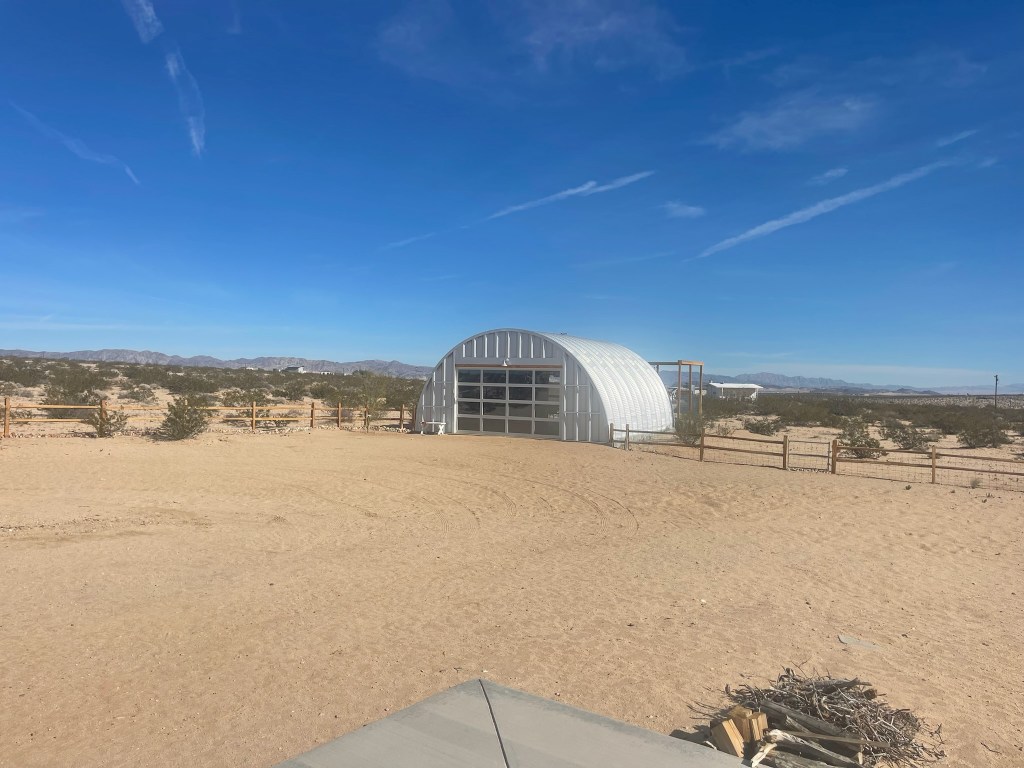
Joshua trees seem to be scarce near Joshua Tree.

About a quarter of California is desert. Most of that desert is part of the Mojave Desert. Much of it is very sparsely populated. All of it is fascinating to those who appreciate it.

Not many people live in the desert because the climate is so harsh, and because there is not much reason for many people to be there. Not far north of Los Angeles, which is the second most populous city in America, is one of the most sparsely populated regions of America within the Mojave Desert. It is unpleasantly hot and dry there all summer. It is certainly not the sort of place that should be appealing to horticulturists, although it is.

Brent sent me this picture from a place where he vacations near Joshua Tree. If there are Joshua trees near Joshua Tree, they are not visible within this picture. Actually, no trees are visible within this region where shade must be very important. The vegetation that is visible does not seem to be substantial. Vegetation is completely lacking within the fenced area. That small pile of firewood must have been brought from somewhere else. (Although nights are pleasant or warm between hot days, they can get very cold between cool days of winter.) I do not know what that building is. Without substantial vegetation, neighboring residences are visible in the distance.

Part of the allure of deserts for horticulturists is the very distinctive vegetation that lives only there. Part of the allure is the minimalism of such vegetation. Although many species live there, they are not very distinctive. Many resemble each other. In other words, much of the vegetation of the desert is easy to ignore. It is less distracting than that of other ecosystems that are more popular with those who are not horticulturists.

Yarrow

Yarrow is a popular American wildflower.

It is endemic to every Californian County except for only Imperial County. It is endemic to every American State except for only Hawaii. Yarrow, Achillea millefolium, gets around! It is also endemic to many temperate climates of Europe and Asia. Apparently, it is not very discriminating in regard to climate or soil. It is as happy at the coast as it is farther inland.

Wild yarrow mostly bloom white or with pink blush. Modern cultivars bloom various hues of yellow, orange, red, pink or pinkish lavender. A few of the most florific modern cultivars are hybrids with other species. Phases of bloom might continue from spring until autumn. Tiny flowers form dense corymbs as broad as five inches, on stems as high as three feet.

Ferny grayish or light green yarrow foliage has a softly fine texture. However, it develops compact and mounded form. Individual leaves are tomentous and as long as six inches. Foliar aroma is variable among cultivars. Some cultivars may be objectionably pungent. Propagation by division of any overgrowth is easiest prior to the end of the rainy season.

California Native Plants Grow Wild

Some natives are difficult to domesticate.

California native plants seem like they should be very appropriate for home gardens. In the wild, they require neither irrigation nor maintenance. They are quite satisfied with local climate and soil. Of course, gardening with natives is not so simple. Home gardens are very different from wild ecosystems.

Furthermore, wild ecosystems here are very different from wild ecosystems elsewhere. California is a very big place, with many different ecosystems. Some alpine species from the Sierra Nevada would be unhappy on the coast. Some coastal species from Del Norte County would be unhappy in the Mojave Desert. California native plants should be regionally appropriate.

Therefore, chaparral species are generally most appropriate for local chaparral climates. Many riparian species perform satisfactorily here as well, but expect more irrigation. However, appropriateness to a climate is not the same as appropriateness to a garden. Actually, many chaparral species are unappealing within home gardens. Some are difficult to domesticate.

A few species of California lilac are native here. Any of them are pleased to inhabit local home gardens. However, some grow quite large, and then die after only ten years or so. They may not last even that long with typical irrigation. Few respond favorably to pruning. They prefer to grow wild. Such big, awkward and temporary plants are undesirable within many compact and refined home gardens.

Combustibility might also be a concern for chaparral plants. Some chaparral ecosystems rely on fire for periodic renovation. In the wild, some such ecosystems may burn as frequently as every few decades. After burning, fuel begins to accumulate for the next fire. Even if not copious enough to be hazardous, such accumulation can be unkempt.

Only a few specialty nurseries provide wild California native plants. Most nurseries provide cultivars of such plants that are more adaptable to home gardens. ‘Carmel Creeper’ is a densely sprawling California lilac that gets only a few feet tall. It is commonly available. The original species can get more than fifteen feet tall, with open branch structure.

Coast Live Oak

Coast live oak can get massive!

Valley oak and coast live oak are the two most magnificent oaks of California. Valley oak likely receives more notoriety. It stands taller, and defoliates to expose its sculptural form through winter. Coast live oak, Quercus agrifolia, is almost as grand within its evergreen foliage. It can grow as tall and broad as seventy-five feet, with trunks wider than ten feet.

Coast live oak is notably variable in the wild. Exposed and solitary trees can grow bigger and older than grove trees. They can live for many centuries, and hang their canopies to the ground. Grove trees may not live half as long, and tend to shed shaded lower growth. Solitary trees are likely to survive fire. Grove trees within forests are less likely to survive.

Coast live oak is more appealing in the wild than within home gardens. Regularly messy debris is mildly herbicidal to some delicate plants below. It also stains hardscapes. Trees that matured without irrigation are very susceptible to rot with new irrigation. Landscapes around such trees must therefore demand very little. Roots are very sensitive to damage.

California Wild Rose

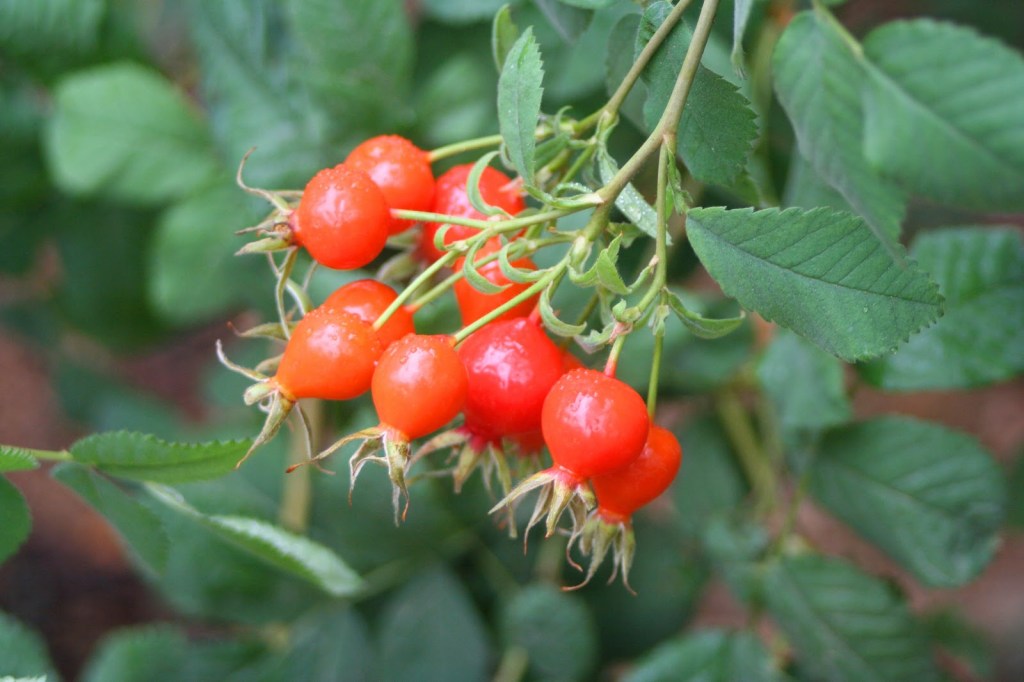
California wild rose hips remain long after bloom, as well as foliage, is gone.

Prickly thickets of California wild rose, Rosa californica, are not often much to look at, even while adorned with small and sparse pink roses in spring and summer. The fragrant flowers can actually range in color from white to rich pink, and may have more petals, but are not abundant enough to be very impressive at any one time. In autumn though, all the flowers that bloomed in the previous few months leave bright orange or red fruiting structures known as ‘hips’, that linger on the bare canes through winter.

The rose hips of California wild roses had historically been used to make herbal tea because they contain so much vitamin C and have a pleasant flavor. (California wild rose is a ‘tea’ rose but not a hybrid ‘T’ rose.) They can also be made into jelly or sauce. The only problem is that birds like them too, so often take them before anyone else has a chance to.

Red Willow

Red willow is a riparian native.

Of the few native species that share the same designation of ‘red willow’, Salix lasiandra, is likely the most common locally. However, it has a few other common names, including shining willow and Pacific willow. For those acquainted with it, recognition is easier than nomenclature. It is not a problem though, since red willow is rarely an intentional choice.

Red willows, including less common species, grow wild in local riparian situations. They sometimes sneak into home gardens, particularly if irrigation is generous. Their rampant growth is susceptible to spontaneous limb failure. Pruning can compensate for structural deficiency of young trees. However, trunks typically succumb to decay within thirty years.

Mature trees are mostly less than thirty feet tall, typically with low branches, and possibly with a few elegant trunks. The gray or light brown bark is finely furrowed. The deciduous foliage has a slight sheen, and then turns brownish yellow prior to autumn defoliation. Its narrow leaves are about three inches long. Twigs are yellowish or green rather than red, as it implies.

Nature Is Not Naturally Accommodating

Many trees naturally exhibit irregular form.

Gardening is quite unnatural. It involves unnatural cultivation of mostly unnaturally exotic (nonnative) species of plants. Irrigation delivers more water than seasonal rain provides. Fertilizers contribute more nutrients than endemic soils provide. Pesticides, if necessary, inhibit proliferation of pathogens. Nature simply could not accommodate such demands.

Not only is gardening unnatural, but it also interferes with established ecosystems. Many aggressively invasive plants were formerly desirable exotic plants that naturalized. Many pathogens arrived with exotic plants. Several naturalized plants have potential to distract native pollinators from native plants that rely on their pollination. It is an ecological mess.

Nonetheless, it works. Gardening within the constraints of nature would be unproductive. Most residents of California inhabit chaparral or desert climates that originally sustained limited vegetation. Such limited vegetation sustained a very limited indigenous populace within relatively vast areas. Modern residential parcels would be completely inadequate.

That is the justification for gardening, whether for sustenance, or merely to beautify home environments. Unnatural breeding continues to improve performance of many useful and appealing plants. Unnatural horticultural techniques generate more desirable vegetation within confinement of urban gardens than would naturally inhabit a few acres in the wild.

Nature remains relevant though. All plants originated within nature somewhere. Besides their basic requirements, exotic plants prefer environmental conditions that are similar to those of their natural origin. Some tropical plants crave more warmth and humidity. Some plants prefer more winter chill. Most popular exotic plants rely on supplemental irrigation.

Physical characteristics of many plants necessitate special accommodations also. Roots of plants that naturally compete in dense jungles are likely to damage pavement. Without adequate pruning, native plants that naturally exploit burn cycles can become perilously combustible. Many vines naturally try to overwhelm nearby vegetation and infrastructure.

Watering Water Wise Plants

Excessive watering rots drought tolerant yarrow.

Native plants like coast live oak, valley oak, toyon, flannel bush, Western redbud and California lilac (ceanothus) are among the most resilient of plants as the weather gets dry and warm after spring. So are plants from similar climates, like bottlebrush, oleander, rockrose, grevillea, acacia and eucalyptus. They survive dry summers by dispersing their roots deeply into soil that does not get as desiccated as surface soil naturally does (without irrigation).

Ironically, these most resilient plants can also be difficult to work with while they are young. Because they rely on extensive root dispersion for survival, new plants that have not yet dispersed their roots can not survive long without regular watering. They only become tolerant to drought as their roots disperse into deeper soil.

However, because they are adapted to arid conditions, they do not like to be too damp for too long. Roots soon rot in soil that does not drain adequately between watering. They therefore need to be watered frequently, but not too frequently. Yes, that is as confusing as it sounds.

To make it even more confusing, these plants will need less watering as they mature and disperse their roots. Bottlebrush, oleander, contoneaster, hop bush, firethorn, grevillea and juniper can certainly tolerate more water than they really need; but wasting water is contrary to selecting drought tolerant plants to conserve water. Manzanita, coyote brush, rockrose, flannel bush and redbud may actually succumb to rot if watered too much. Even perennials like Pacific coast iris and yarrow can have problems.

Pine, oak, acacia and especially eucalyptus disperse their roots as soon as they can, so do not want to be confined in containers. It is therefore best to plant smaller young specimens than larger ones. #5 (5 gallon) eucalypti get established in the garden more efficiently than larger but more expensive #15 (15 gallon) trees. If #1 trees were available, they would be even better.

Tanoak

Tanoak is rare within refined landscapes.

Its plump and inch-long acorns are misleading. Tanoak, Notholithocarpus densiflorus, is not actually an oak. Otherwise, it would be a species of Quercus. Regardless, its wood is potentially as practical for furniture and flooring as wood of other oaks. It also works very well as firewood. Historically, tanoak bark was useful for tanning leather, hence its name.

Although native and somewhat common in some coastal forests, tanoak is almost never a choice for intentional planting. Those that inhabit home gardens likely either grew from acorns, or were there prior to development of the landscapes. Young trees can grow fast to more than forty feet tall, typically with conical form. Mature trees might get twice as tall.

Tall trunks of tanoak are elegantly upright, and eventually develop lofty branch structure. Their gray or brownish bark is handsomely furrowed. The somewhat leathery evergreen foliage produces potentially objectionable tomentum. The dentate leaves are two to four inches long. Sadly, tanoak is very susceptible to Sudden Oak Death Syndrome (SODS).

Six on Saturday: Politely Naturalized Exotics +1

Exotic plant species that appreciate endemic climates and soils seem like they should be the next best options to native plant species. A few unfortunately naturalize aggressively enough to displace native plants species, and interfere with the natural ecosystem. A few can not naturalize without their preferred pollinators that did not come with them from their origin. Some have potential to naturalize, but either refrain, or are civil about doing so. Some that are invasive within landscapes are not as invasive in the wild, particularly if they need more water than they get from local weather. I occasionally find exotic plant species, including a few that I am surprised to find.

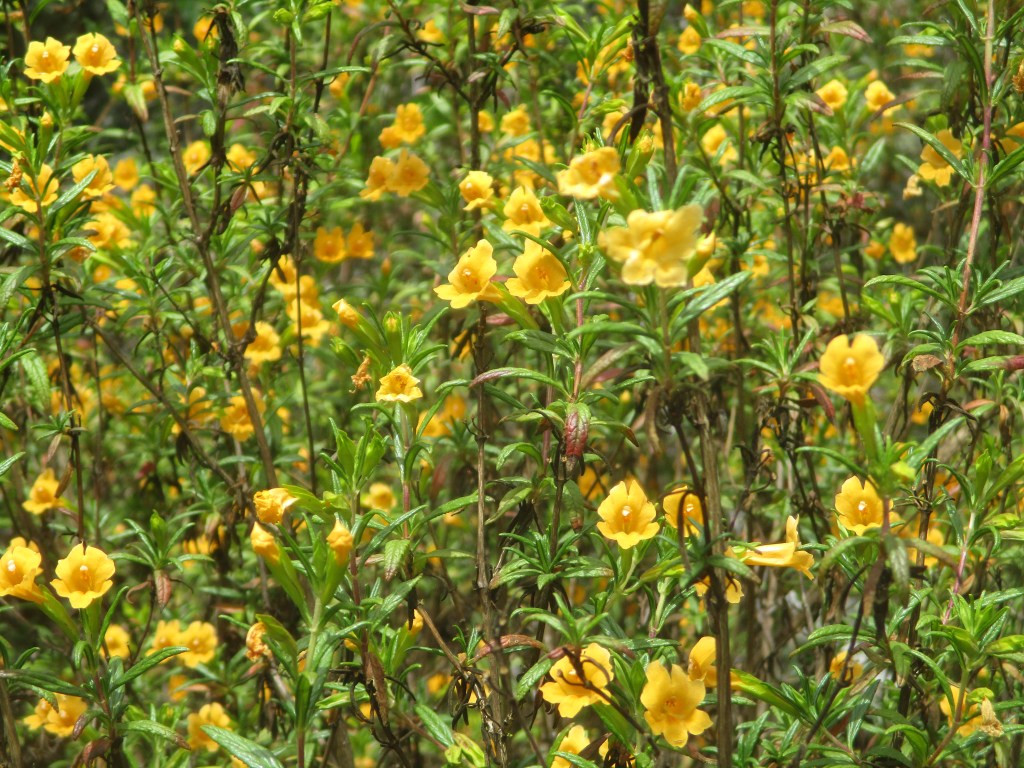
1. Sticky monkey flower is the ‘+1’. It is the only one of these six that is native rather than exotic. Its odd name leaves one pondering how a monkey is involved and why it is sticky.

2. Mock orange seems to be naturalized, but contrary to common belief, may actually be native. A single flowered variety and a double flowered variety may be different species.

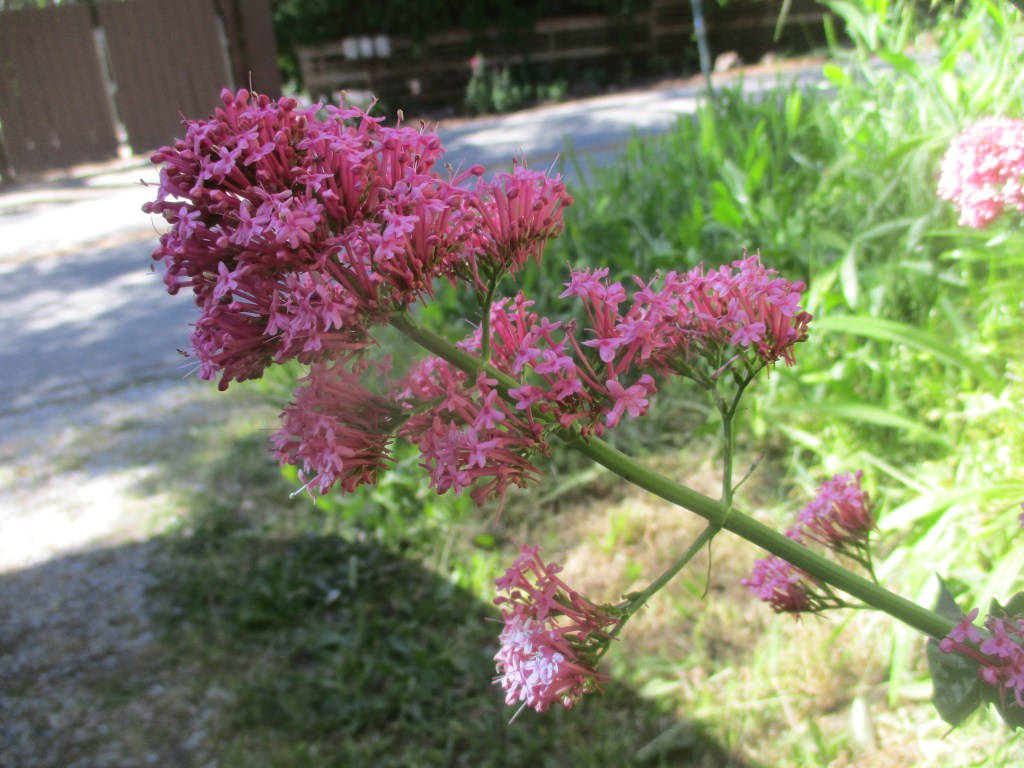
3. Jupiter’s beard is most certainly exotic and naturalized, but does not seem to be polite about it. It can get quite invasive. However, it does not get far from irrigated landscapes.

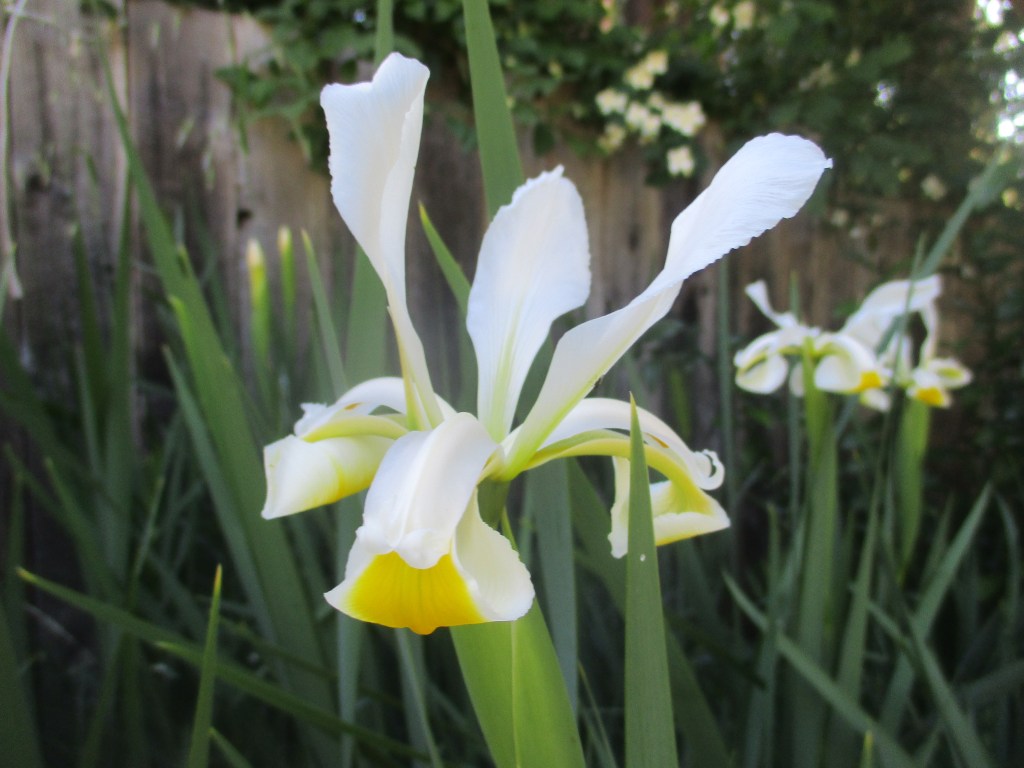
4. Iris remains a mystery to me. I grew this same seemingly simple species while in high school, but have never identified it. It naturalizes, but only where it gets sufficient water.

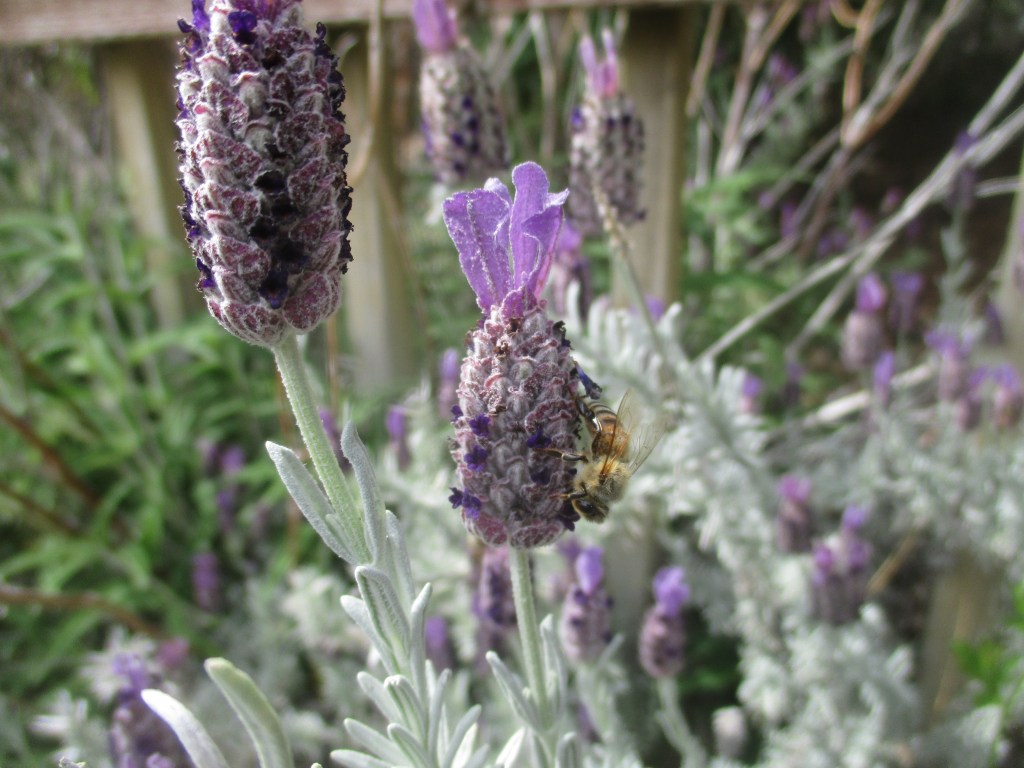
5. Spanish lavender is obviously not native since it is from, well, Spain. It can naturalize, but is not aggressive about it. The honeybee is much more aggressively naturalized here.

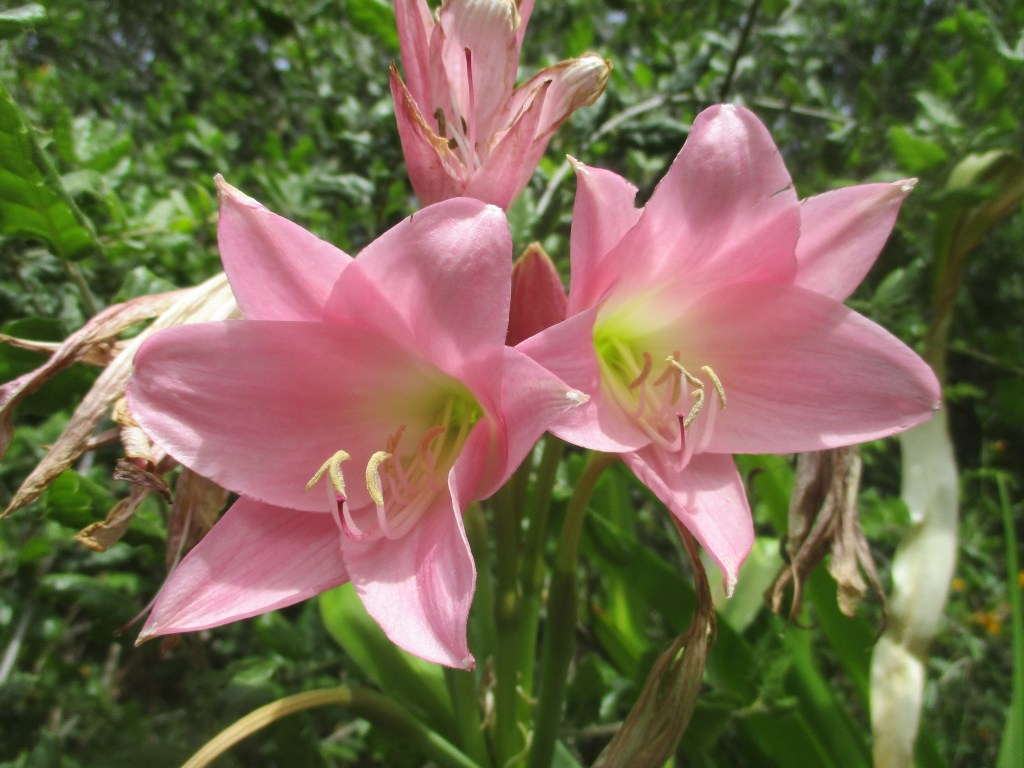
6. Crinum, like the Iris, is unidentified. I am not even sure if it is a Crinum. It grows wild with sticky monkey flower, in sandy soil that gets dusty, dry and warm through summer.

This is the link for Six on Saturday, for anyone else who would like to participate: https://thepropagatorblog.wordpress.com/2017/09/18/six-on-saturday-a-participant-guide/