Spring in Guadalupe Gardens

Spring is in the air.

(This article is recycled from many years ago, so contains outdated information.)

Spring in Guadalupe Gardens on April 23 is the big local gardening event of the Santa Clara Valley! Not only will it be within Guadalupe Park, surrounded by the various Guadalupe Gardens, but Spring in Guadalupe Gardens gathers together an impressive variety of local gardening clubs and vendors. There will be workshops, lectures, trail walks and garden tours, as well as fun activities for children, music and entertainment.

The Heritage Rose Garden, which is the most extensive public collection in the United States of America, designed for the preservation of the ancestors of modern roses, will be in full bloom. The Historic Orchard is a tree museum of the many fruit and nut trees that inhabited the vast orchards that once filled the Santa Clara Valley; many of which can be productive in modern suburban gardens.

Representatives of many local gardening clubs will be at Spring in Guadalupe Gardens, with information about their respective expertise, as well as membership. The John E. Stowell Dahlia Society, the American Fuchsia Society and the Master Gardeners of Santa Clara County will all be there, to name a few. I will be at the Gardening Advice Booth throughout the event, to discuss any gardening issues and questions.

When I can get away from the Gardening Advice Booth, I like to see what I can purchase from the many vendors. There will be more than forty. Most of my fuchsias, and some of my aloes and cacti were obtained at Spring in Guadalupe Gardens. It is common to find many uncommon tomato plants and roses.  There will also be garden art and paraphernalia. The Master Composters of Santa Clara County will be giving away free compost. One never knows what to expect at Spring in Guadalupe Gardens.

Earth Care Recycling will again host a free electronic waste drop off at the Visitor and Education Center, to collect all sorts of computer components, televisions, stereos, fax machines and telephones. Proceeds benefit the Guadalupe River Park Conservancy.

Spring in Guadalupe Gardens will be from 10:00 a.m. to 3:00 p.m. this April 23, just north of the Guadalupe Gardens Visitor and Education Center, which is located at 438 Coleman Avenue in San Jose.  Admission and parking are free. Just follow the signs from Coleman Avenue or East Taylor Street. More information about Spring in Guadalupe Gardens can be found at www.grpg.org or by telephoning 298 7657.


Horridculture – Vandalism

This would have been an ideal time for a seasonal update on the little Memorial Tree in Felton Covered Bridge Park. Until recently, it had been healthier and growing more vigorously than it had since it was installed a few years ago. It had survived major accidental damage, and was just beginning to thrive. Sadly […]

https://feltonleague.com/2020/06/28/vandalism/

via Vandalism — Felton League

Another Johnny Appleseed

P90330+++++

Just to be clear, I earned the title of Johnny Appleseed before my colleague Brent Green did. While Brent was secretive about our tree planting projects in Los Angeles, I was not so about our similar projects in Los Gatos. While Brent’s neighbors wondered where their new street trees were coming from, mine read about their new park trees in the Los Gatos Weekly Times.

In fact, the exposure from that article is how I started my weekly gardening column in the same newspaper just a few months later, in October of 1998. Los Gatos is a smaller town than Los Angeles is. Secrecy was not an option. Sadly, our projects in Los Gatos, and then in Scott’s Valley, did not continue. We concentrated our urban tree planting efforts in Mid City Los Angeles.

The tree planting projects that I am referring to are our Birthday Trees that I wrote about last January. As I explain in that article, Brent had been wanting to plant trees in the formerly blank and broad medians of San Vicente Boulevard in Los Angeles. I just happened to be able to supply such trees from those at the farm that got a bit too past their prime to be marketable.

I do not intend to be redundant to that article, but want to share this video, Johnny Appleseed. As much as I hate to admit it, Brent is much more entertaining than I am. (I should later share one of my old videos from Gardening By The Yard, so you can compare.) I should probably look through more of Brent’s old videos to see if there are others that would be interesting.

If I had more time, I would write more about Brent’s work to improve the urban forests of the Los Angeles Region.

GreenArt

p90120p90120+It seems that I have been negligent about writing about my colleague Brent Green and some of our crazy adventures in horticulture. I said I would do so when I started writing my articles here way back two Septembers ago. It is easy to get distracted from such topics, particularly since we do such different types of work. Brent is a renowned landscape designer and proprietor of GreenArt Landscape Design in Southern California. I am just a horticulturist and arborist who really should get back to growing horticultural commodities in Northern California. For all of our similarities, there just might be as many differences.

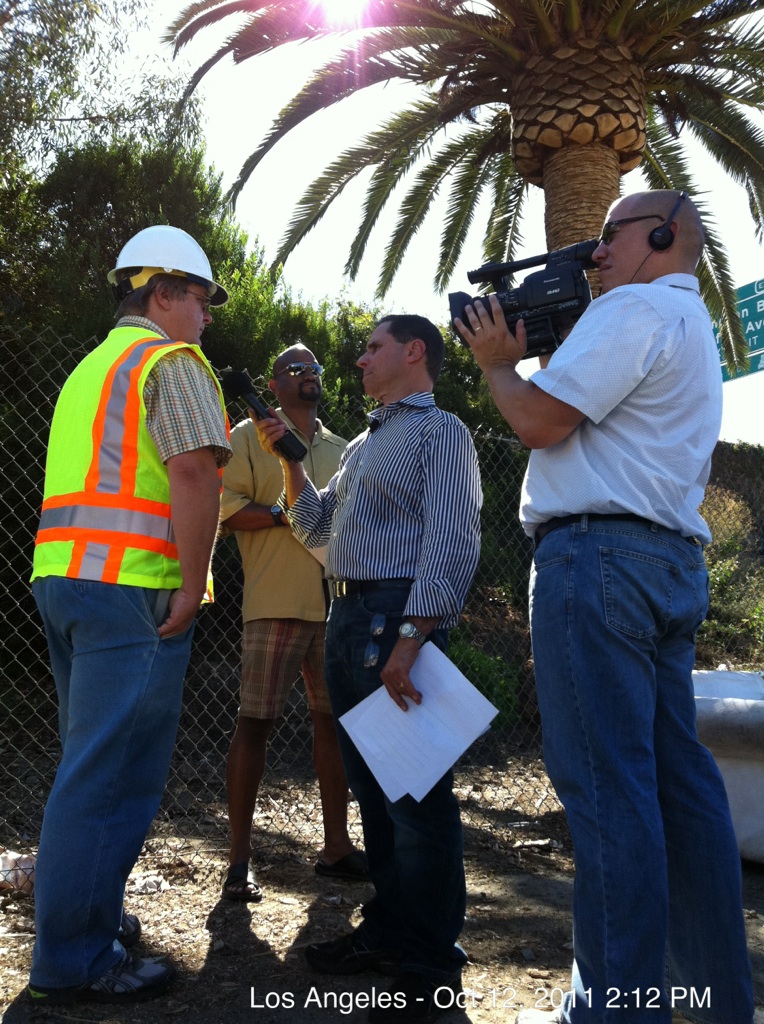
After posting that old video of the Birthday Trees yesterday https://tonytomeo.com/2019/01/19/birthday-trees/, I thought that I should also write more about what Brent does for the urban Forest of Los Angeles, which is probably more interesting than our crazy adventures. I really want to find the old news article about how he busted tree rustlers who were stealing mature Canary Island palms from the embankments of the Santa Monica Freeway, which is pictured above. It is still a sore subject because we know that it continues, and that the trees that were stolen were not returned as promised.

I could write a separate blog about the work that GreenArt does if I were more involved with it. I just do not enjoy design like Brent does. Actually, I am no good at it. I just work with the horticultural aspects of it, and growing material for it. In the future, I will probably be more involved with projects that are not directly affiliated with GreenArt, such as initiatives to maintain and protect trees in public spaces of Los Angeles.

For now I have only this brief and outdated video of the landscaping of Brent’s home, https://www.youtube.com/watch?v=v2IwcuU3KEo .

Litter

p90112kThose of us who work in public landscapes find litter in the strangest of places. It gets everywhere. It is not necessarily put everywhere. It just has a sneaky way of getting everywhere. By nature, litter blows about and gets washed into creeks and rivers that flow out to the bays and oceans.
Of course, there is much more litter in public spaces with the most traffic, such as city parks, than there is out in remote places where fewer people go, such as hiking trails in state parks. People are not necessarily slobs, and most put their trash into the appropriate receptacles. There just happens to be more litter where people are because that is where most of the trash that becomes litter happens to originate. Most litter that accumulates on the sides of roadways was blown there from the open beds of pickups. Not much is discarded out there intentionally.
One of the projects where I work is designing trash receptacles that wildlife can not get into. Racoons, which some of us know as ‘trash pandas’, are notorious for distributing large volumes of trash into the forest. Squirrels tend to be a bit more selective in taking mostly biodegradable bits of discarded fruit, and by unwrapping their finds before taking them away. Crows are actually worse than squirrels because they will take larger bits of trash merely because they find it to be amusing. Once out of the receptacles designed to contain it, trash gets blown about by the wind. In fact, wind alone can blow trash out of some types of trash receptacles, such as those fancy cylindrical steel mesh receptacles that suspend trash bags within, like those that are so common downtown in many cities. Litter is naturally an unnatural consequence of modern civilized society.

Tannenbaum

IMG_1983Many towns display a Town Christmas Tree in a prominent and centrally located public space.

The Town Christmas Tree in Los Gatos is a now mature but formerly feral deodar cedar that grew by chance next to the railroad tracks where they passed through downtown a very long time ago. As the railroad tracks were removed, and the rail yard was redeveloped into the Town Plaza, the maturing cedar tree survived the process to become the most prominent tree there. Because it just happened to be a symmetrically conical coniferous tree in the most prominent spot in town, it was a natural choice for the Town Christmas Tree. It gets lit up and decorated for Christmas, and is where children can meet up with Santa Claus.

The Town Christmas Tree in Felton is the Featherstone Tree, which is a mature coastal redwood tree that happened to be planted right on the edge of Highway 9 a very long time ago by Mr. Featherstone, simply because he admired the species so much, https://tonytomeo.com/2017/10/05/big-tree-in-a-small-town/ . Like the Town Christmas Tree of Los Gatos, it just happened to develop into the right sort of tree in the right spot to become the Town Christmas Tree. It too gets lit up and decorated, although it is not as conical as it used to be.

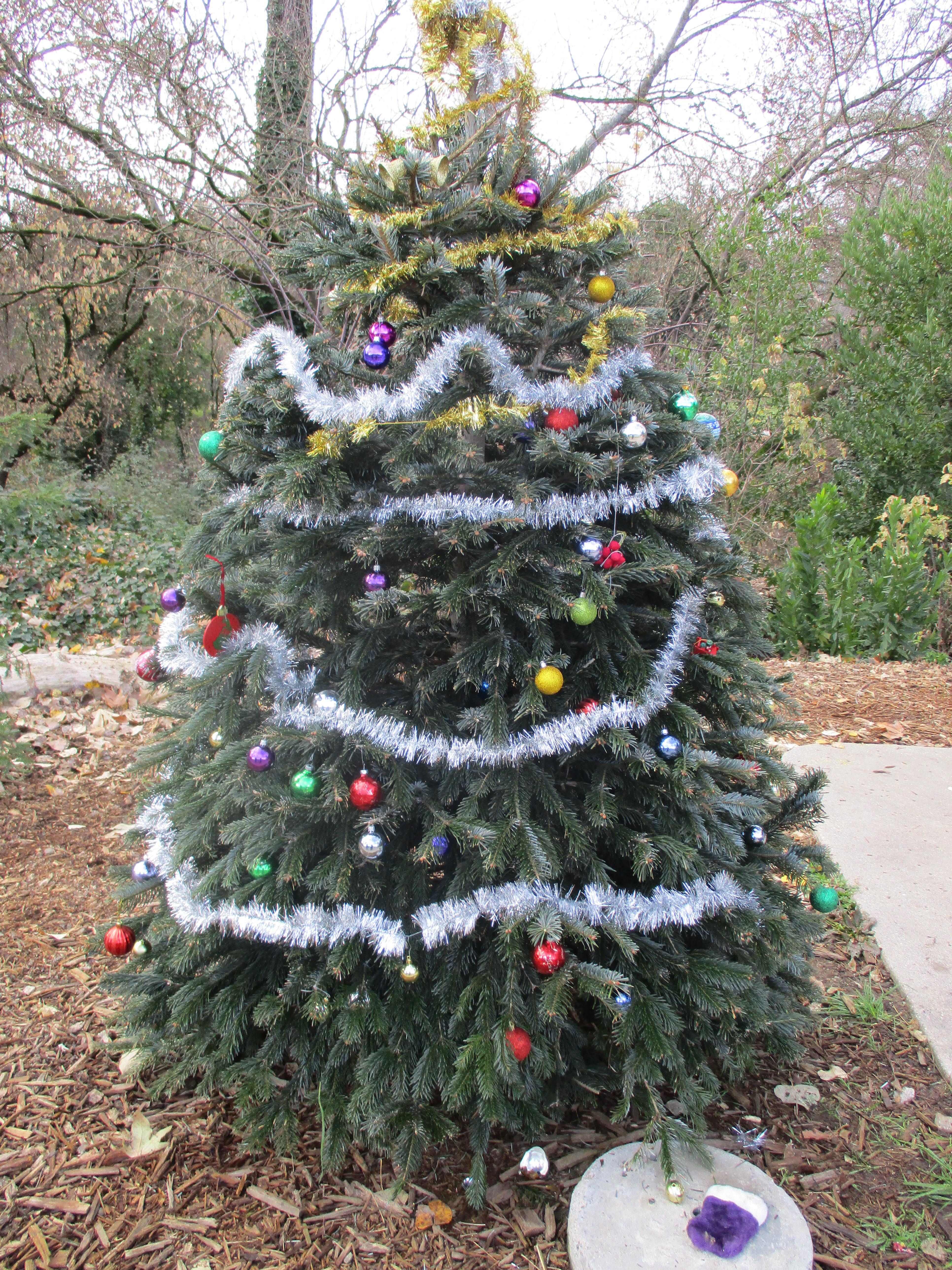
Last year, someone delivered a decorated cut Christmas tree to a picnic area in Felton Covered Bridge Park, where many of the Homeless Community congregate. No one knows who delivered it, or how he, she or they did so undetected. It was a rather fancy tannenbaum (fir) that was not cheap. Someone or a few someones put quite a bit of effort and expense into this unusual gesture, to share a bit of joy with others in the Community.

It was not like a Town Christmas Tree for the Homeless Community, as if the Homeless Community is somehow separate from the rest of Felton. It was more like a household Christmas tree for those who lack a house to live in. It certainly made the annual Christmas Luncheon for the Homeless Community there at the picnic area much homier.

Illegally Planting!

P80902K“ . . . others illegally planting whatever they wish . . . illegally.” Someone actually said that about the installation of our little Memorial Tree in Felton Covered Bridge Park. It was within the context of a review of the Park on Facebook, written by someone who has not stopped complaining about Felton since she moved here. It was forwarded to me quite some time ago by someone who documents and files such information that is relevant to hate crimes, and what is now known as ‘hate speech’, which is another completely different topic that we can not get involved with here.

Technically, it is accurate. The tree was planted without a permit, and does not comply with the standards of Santa Cruz County Parks. Compliance would have been quite an expensive imposition. It would have required an expensive #15 (15 gallon) tree, outfitted with lodgepole stakes and straps. The overworked gardener would have needed to take time from his busy schedule to install it. Because the irrigation system to the site is now defunct, the gardener would have needed to irrigate the tree until it got established. It was easier, much less expensive, more horticulturally correct, and socially responsible for us install the tree and maintain it on our own. Call 911 if you must.

There are of course reasons why we should not plant trees or other plant material in parks and public places. We do not want to make more work for gardeners, interfere with the landscape plan, or add plants that are inappropriate to the situation. This Memorial Tree happened to have been planted with the supervision of a horticulturist and arborist (me), on the exact spot where another oak that was installed with the original landscape had been knocked down by a car. Otherwise, in most places in Felton Covered Park, vegetation management, including the removal of large volumes of biomass and invasive exotic specie, should be the priority. (Unfortunately, the overgrowth of invasive exotics is mostly within a protected environmentally sensitive riparian zone.)

The little Memorial Tree has quite a history, even though it is still a baby. I do not want to post links to all the other updates about it, but I can post this link to another article that contains another link to others . . . Oh, you can figure it out if you like: https://tonytomeo.com/2018/04/15/memorial-tree-update-to-the-updated-update-etc-the-sequel-to-all-those-other-sequels/ .

Un-Update

P80902KThere is NO news regarding the tiny Memorial Tree in Felton Covered Bridge Park that I so frequently provide updates for. It did not do much this year. I probably already mentioned this when it was busy not doing much in spring. It is in a difficult situation, where too many dogs do what dogs do to tiny valley oaks that are busy not doing much more than trying to survive without regular watering, out in a harshly exposed island in a parking lot. Once it gets going, it should do fine. It is only slow now, but is not unhealthy. It is doing exactly what it should be doing this time of year. By late autumn, it will try to defoliate. Valley oaks are never in a rush for that.P80902K+
This angel’s trumpet is more interesting because it was seemingly deceased. As you can see, it is trying to recover . . . just in time for autumn. Unfortunately, there will not be sufficient time and warm weather for it to mature enough for the new stems to survive even a mild frost next winter. At least it will get a bit of time to recharge the roots so that it can regenerate a bit more vigorously next spring.
There is of course the possibility that it will not get frosted too severely in winter. It is somewhat sheltered by the canopies of nearby trees. We may even try to protect it under a box on the coldest nights.
Realistically though, the loss of such minor growth would not hurt it much. As it matures, it will likely lose much or most of its outer foliar growth annually each winter, and then replace it with new growth each spring. The priority for it now, or at least next spring, is to develop substantial stems that are above where ‘gardeners’ will cut it down with a weed whacker. Once it does that, it will have a relatively permanent framework of resilient trunks that it can get frosted back to.
The main problem since it was installed was not the frost, but unskilled labor with weed whackers. No matter how emphatically we explain to the ‘gardener’ that it is not a weed, his crew cuts it down a few times annually when no one is there to stop them.P80902K++
Naked ladies continue to bloom all over the region. These happen to be in the parking lot of Felton Covered Bridge Park. Several that were surplus in a neighbor’s garden were planted in the corners of the various islands. Unfortunately, because of their locations, most of their flower stalks get trampled and broken off. The picture below shows how exposed they are within an area of substantial traffic. The foliage that develops later does considerably better. It is too substantial to be trampled and ruined completely, and it gets a bit more substantial every year. However, the substantial foliage is not here yet to prevent the flower stalks from getting trampled.P80902K+++
By the way, if you think that I wrote this post because of the (former) lack of a horticulturally oriented topic for today, you are correct.

Big Trees

0

They are the biggest. Giant redwoods are revered for their age and size. It was not always like that.
Many of the biggest giant redwoods were killed merely for bragging rights. Whoever discovered the biggest got to arrange to get it cut down, and then pose on the stump for photographs. Some trees were cut down just so the rings could be counted. Many felled trees were just left to rot where they fell. It was not practical to transport the lumber out of the remote regions of the Sierra Nevada where the trees lived. That was at a time when ‘sportsmen’ shot from trains into herds of wild buffalo, only to pose with the biggest dead carcass they could find in the aftermath, and then leave all of the deceased to rot on the prairie.
So, at about the same time in history that the related coastal redwood was being harvested so indiscriminately for lumber, the biggest of the giant redwoods were killed primarily for sport. Even in regions from which lumber could have been transported from, no one could figure out how to get such massive giant redwoods onto the ground without fracturing the lumber within. Because their wood is so brittle, smaller giant redwoods that were harvestable were simply cut and split into shakes, grape stakes, and fence posts and rails. Young and healthy specimens of the biggest trees in the World were used for the smallest and most unglamorous forms of lumber.
The biggest of the giant redwoods are of course protected now, mostly within national parks. They are quite accessible to those who want to visit and admire them. I got this picture with one of my esteemed colleagues in front of the General Sherman tree in wintertime back in the early 2000s.

Memorial Day

P80527

Tomorrow is Memorial Day. Yesterday was the Felton Remembers Parade and Covered Bridge Festival, which is how Memorial Day is celebrated in Felton. It was a celebration worthy of Memorial Day, with plenty of music, crafts and expensive but unhealthful food to go with it. All that was lacking was that which is ‘memorial’. It seems that we have forgotten about that which we should never forget.

There were plenty of classic cars to provide memories of how stylish cars had been. There was a Boy Scout Troop to conduct the Flag Raising Ceremony at the main interchange of Highway 9 and Felton Empire Road to provide memories of when we still respected the American Flag and traditions associated with it. We were reminded of who our local politician are, and that we are still procuring funds for a new library, and that there are too many clubs for hateful women, and that the individual members of the motorcycle club get more done around here than everyone else combined (except for our local District Supervisor who provides the memories of what a public servant used to be.)

Felton Covered Bridge Park, the venue of the Covered Bridge Festival, is surrounded by memorial trees. All the redwood trees (which are of the cultivar ‘Soquel’, rather than wild trees) are memorial trees, sponsored by friends and families of the honored deceased. Some are outfitted with plaques. One was recently added. Another sweetgum tree is a memorial for Charlie, a very respected English bulldog. The small valley oak in an island in the parking lot is known simply as the Memorial Tree, to commemorate several who did not get their own tree. All the trees were there for the festivities, but only to provide shade and beauty.

Perhaps celebration is the best Memorial, or at least the best that such a large group can collectively participate in. Actually, the Covered Bridge Festival was exactly that, a ‘festival’ that merely coincided with the Felton Remembers Parade. It was not really a Memorial by design.

The big old Featherstone Tree at the center of town, and in the picture of the Felton Remembers Parade above, is not really a memorial tree, but does happen to be outfitted with a commemorative plaque for Mr. Featherstone who planted it, and has witnessed more parades on Highway 9 than anyone has.

https://tonytomeo.wordpress.com/2017/10/05/big-tree-in-a-small-town/

The little Memorial Tree in Felton Covered Bridge Park, and in the picture below, was easier to ignore in the parking lot behind the mobile kitchens. I have written a few articles about it, beginning with this one –

https://tonytomeo.wordpress.com/2017/10/06/small-tree-in-a-big-park/

and most recently this one –

https://tonytomeo.wordpress.com/2018/05/02/may-2/

P80527+