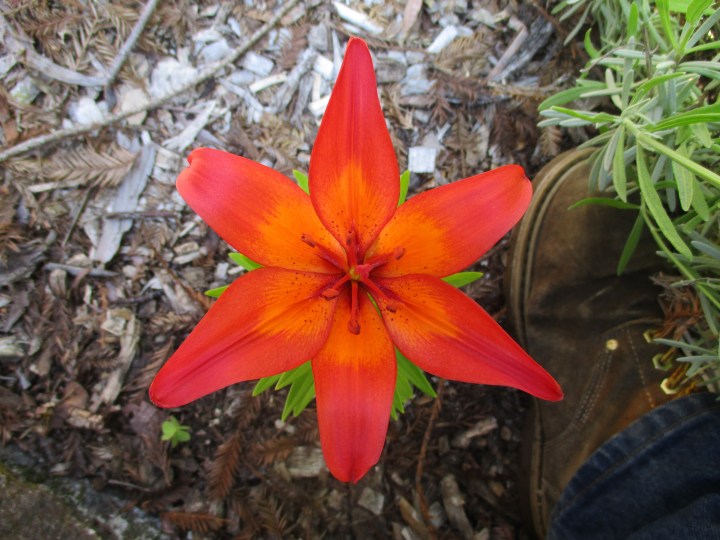
 What a delightful surprise! It happens sometimes here in the rose garden. It may not look like much, as a short stemmed single lily floret that is mostly overwhelmed by the English lavender that I held back with my boot for this picture. It should be three feet tall or so, with several florets. The surprise is that no one planted it. Well, at least no one planted it recently. This rose garden has more history than is obvious from what blooms here now.
Old pictures show that it was formerly an extravagant perennial bed, with an abundance of canna, dahlia, penstemon, pelargonium, Shasta daisy, Japanese anemone, various iris, and of course, various lilies. Lower annuals were cycled through the seasons at the front edge. Only a few roses bloomed against the low wall at the rear. Soil was likely regularly amended with compost and fertilizer. Someone put significant effort into maintaining it.
Nearby redwoods appreciated all the effort, and extended their roots into the fertilized, richly amended and regularly irrigated soil. Their growing canopies extended over and shaded the upper portion of the perennial bed so that all but daylilies and Japanese anemone were replaced with ferns. Perennials that got dug and stored for their dormant seasons were later installed elsewhere as it became obvious that they would not be happy here.
Because the few roses did not seem to mind the redwood roots, a few more, as well as English lavender, were added in informal rows to replace deteriorating perennials. Annuals require more effort than they did originally, but are still cycled through the seasons in a narrow row at the front edge. The rose garden now seems to have always been here, as if intentionally planned. Every once in a while, we find reminders of extravagant history.
Zonal Geranium
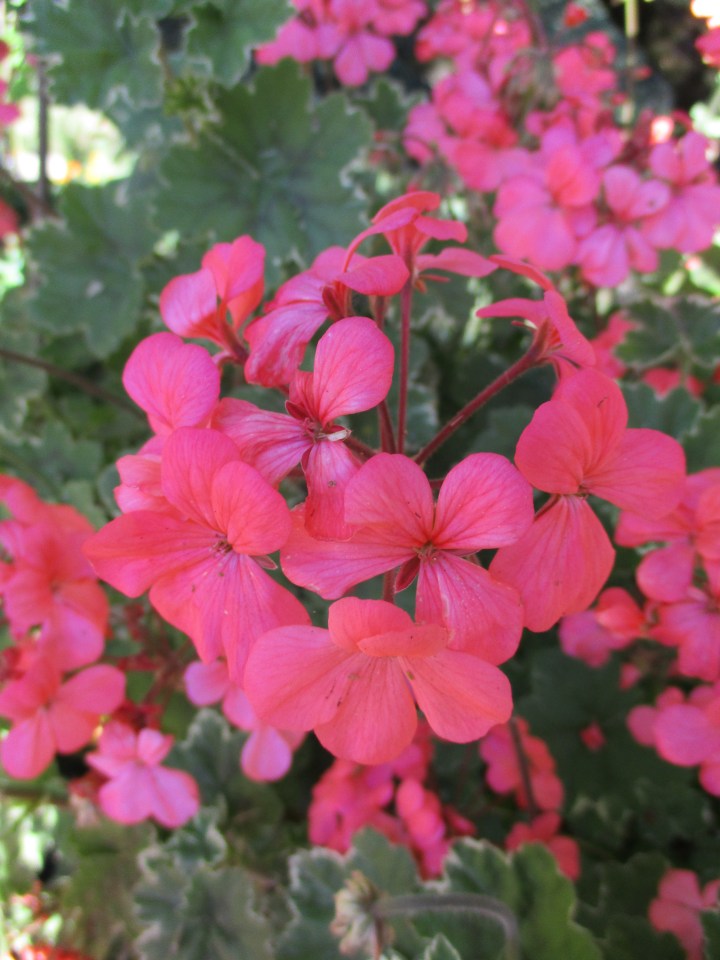 New and improved is not always better. Modern garden varieties of zonal geranium, Pelargonium X hortorum, with bigger, fuller and more profuse blooms, are more colorful than the relatively weedy classic varieties, but they are considerably more demanding. In fact, because they are so unhappy through winter, they are often grown as warm season annuals instead of as perennials.
They are certainly worth growing though, and are reasonably easy to propagate from cuttings. Flowers can be red, pink, white, peachy orange or almost purple. Bloom is almost continuous. Each rounded dark green leaf might be adorned with a darker halo about halfway between the center and the outer margin. Mature plants do not get much more than three feet tall, and not much wider.
Old varieties might get twice as tall, with smaller blooms, and lighter foliage.
Try Some Unconventional Cut Flowers
 There is nothing like growing our own; whether vegetables, fruit or cut flowers. Most fruit and vegetables are grown to be eaten, so are not missed too much when harvested. Even colorful citrus fruit is better harvested than left out in the garden. No one wants to waste it. Flowers are not so simple. They are so colorful and fragrant in the garden, that it is tempting to leave them all out there.
Cosmos and many kinds of daisies are so abundant that there are plenty for both the home and garden. Gladiolus are not so fortunate. They bloom only once. Cutting the flowers to bring into the home deprives the garden of their color. What is worse is that cut gladiolus, although excellent cut flowers, do not last quite as long as they would in the garden. Roses at least continue to bloom.
Daylily can be a good cut flower, but individual flowers last only a day (obviously). This is not a problem in the garden because new flowers bloom daily to replace those that that have finished. Cutting stems not only takes flowers in bloom, but also takes the flower buds behind them that are waiting for their turn to bloom. However, not many, if any, of the unbloomed buds bloom once cut.
Many types of iris, except for Dutch iris, have the same problem. Attentive garden enthusiasts might leave iris to bloom in the garden, and might even groom fading blooms from fresh blooms on the same stems, and then cut stems to bring into the home when the last bud on each stem is just beginning to bloom. The last flowers are not as excellent as the first, but it is a fair compromise.
Cannas are not so functional. They are great in the garden for both flowers and foliage, but fade too soon in the home. Bougainvillea and crape myrtle stems likewise start to wilt and drop flowers immediately after getting cut, but for those who do not mind cleaning up after them, there are plenty of papery flowers to last a few days. The wilted tips of bougainvillea stems can be pruned out.
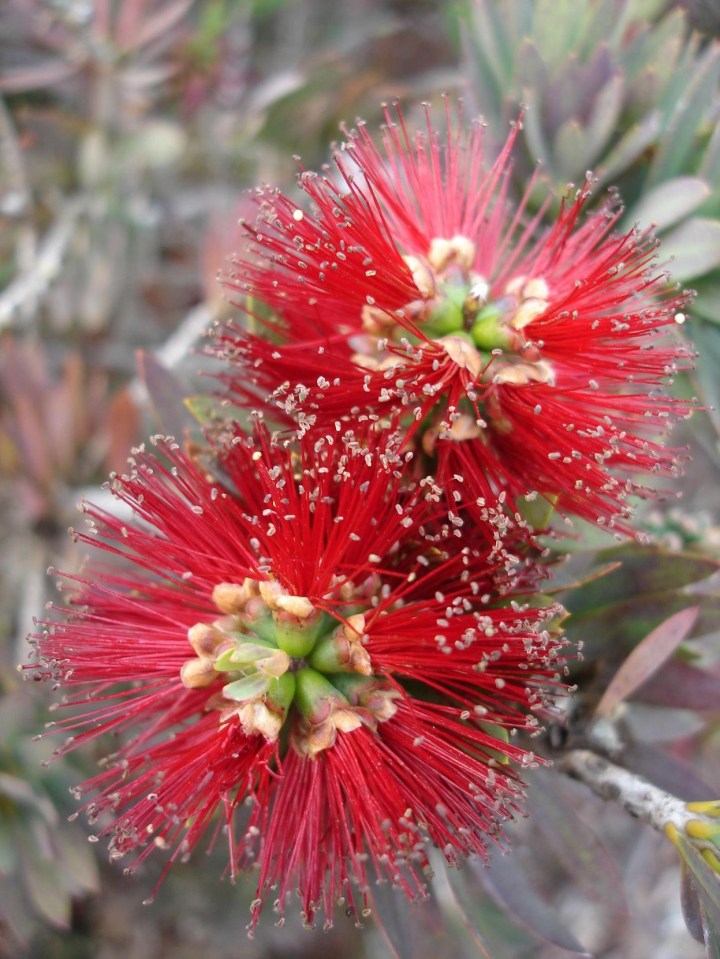
There are no rules to cut flowers. Lily-of-the-nile might seem like a silly choice, but works quite nicely for those who dare to try it. New Zealand flax flowers are not very colorful, but provide striking form. Zonal geranium and nasturtium work well with or without foliage attached. Lemon bottlebrush, photinia, New Zealand tea tree, bugle lily, various hebes, and all sorts of salvias are worth a try.
Some Annuals Are Really Perennials
 Annuals are plants that complete their entire life cycle from germination to death within a single year. Biennials complete their entire life cycle in two years, mostly by developing vegetative growth during their first year, and then blooming, producing seed and then dying after their second year. Perennials are the many herbaceous plants that survive longer than just a few years or indefinitely.
As simple as these definitions seem to be, the plants that they describe are a bit more complicated. Some biennials can regenerate from the roots of plants that have already bloomed and died. Stems of some annuals can root where they touch the ground, to form new plants that survive for another year. Some annuals seem perennial if they replace themselves with their own seedlings.
Of course, none of that matters for the many biennials, perennials and self perpetuating annuals that get grown as mere annuals. At a time when ‘sustainability’ is a fad and trendy buzz word, it is ironic that so many bedding plants that could contribute more if given the chance to do so, continue to get discarded as soon as their primary season finishes. Most have more potential than that.
Self perpetuating annuals like sweet alyssum and nasturtium might only need to be groomed of old plants as new ones take over. Young nasturtium are rather efficient at overwhelming their own parent plants to some degree. Of course, subsequent generations will revert to feral plants. Fancier nasturtium will eventually become basic orange and yellow. Sweet alyssum will be plain white.
Many annuals that are actually perennials might survive through their off season if just overplanted with more seasonal annuals, and then regenerate when the weather becomes more favorable. For example, primrose from last season might be left in the ground as petunias take over for summer, but when the petunias finish next autumn, the primrose can regenerate for another season.
Such perennials regenerate more randomly than they grew in their primary season, and will need some degree of grooming and perhaps mulching.
Wax Begonia
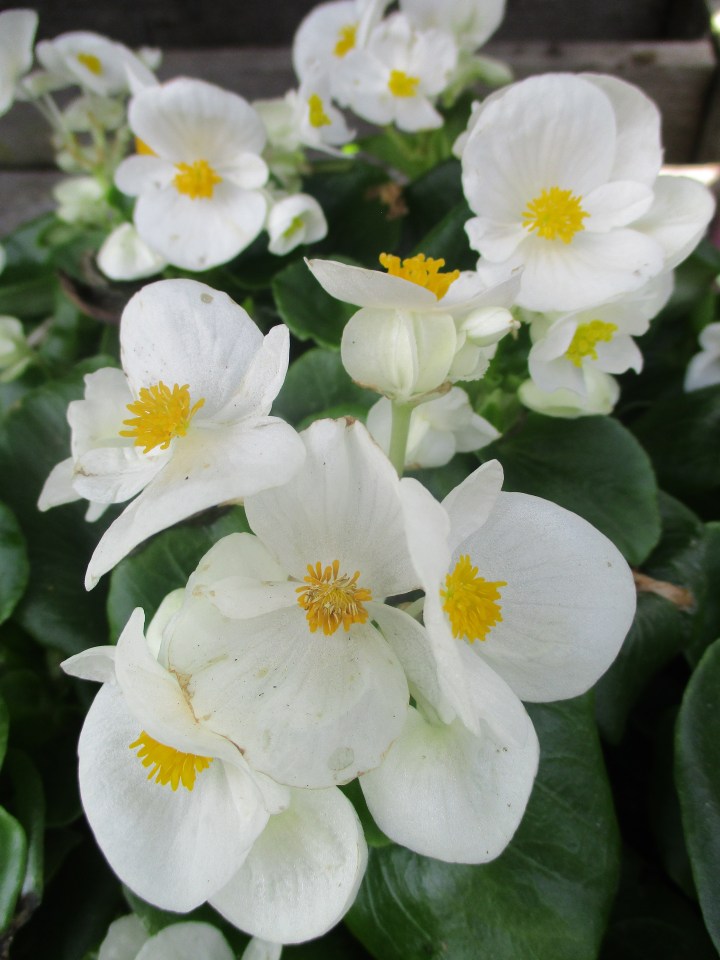 Oh, how breeding complicates things. Many years ago, there were only six basic types of wax begonia, Begonia semperflorens-cultorum, with three choices for floral color, and two choices for foliar color. Bloom was white, pink or red. Foliage was either green or dark bronze. Although these choices have not changed, some modern hybrids are difficult to distinguish from other species.
Wax begonia can be either a cool season annual or a warm season annual, depending on when it gets planted. It can be grown as a short term perennial if pruned back in both early spring and early autumn. By spring, winter growth is tired of the cold. By autumn, summer growth is worn out from warmth. Exposed plants can get lethally frosted in winter or roasted by sunlight in summer.
Therefore, wax begonia prefers to be somewhat sheltered. It is more tolerant of full sun exposure in summer if mixed with other annuals or perennials. Too much shade compromises bloom. Wax begonia expects richly amended soil and regular watering, and is just as happy in pots as other annuals are. Potted plants can be moved to sheltered spots when the weather gets too hot or cold.
Clustered Bellflower
 Do they seem to be early this year? Clustered bellflower, Campanula glomerata, typically waits until the end of spring to bloom. Once the initial and most prolific bloom phase finishes, sporadic bloom should continue almost through summer. Blue is their most popular and traditional color. White is their second most popular option. Bluish purple and purplish pink are still somewhat rare.
Vegetative growth stays relatively low and unassuming through autumn and winter, and then starts to stand up and get noticed just before spring bloom. Short varieties might bloom without getting even a foot tall, while tall varieties can get two feet tall or a bit taller in partial shade. Each blooming stem supports a dozen or so five-pointed flowers that are about thee quarters to an inch wide.
Clustered bellflower looks neater and probably blooms a bit better as the season progresses if stalks are pruned out as they finish bloom and start to deteriorate. However, a few stalks of some varieties might be retained after bloom to produce seed to scatter elsewhere. Some of the fancier or newer varieties do not produce many viable seed, and such seed may not be true to to type.
Spectacular Bloom Can Be Lethal
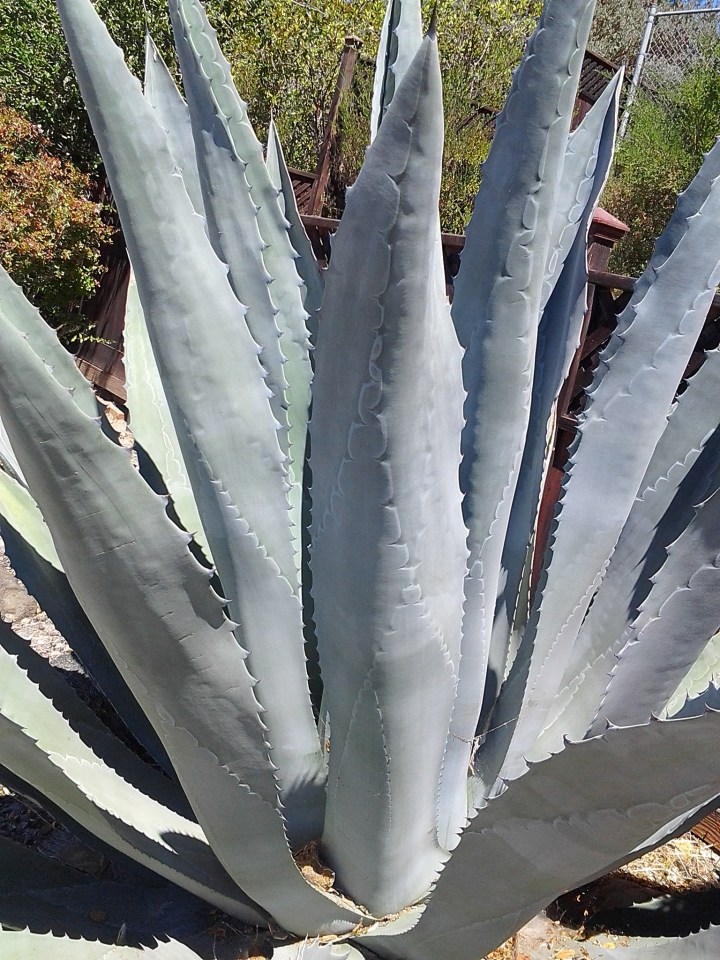 After providing remarkably striking foliage for many years, the biggest and boldest agaves bolt with spectacularly tall floral stalks that support horizontal pads of flowers. These stalks can bloom for months, and stand for months after bloom is finished. Then things get ugly. The foliage around each bloom folds back, desiccates and dies. There is no nice way to describe it. Bloom is death.
Plants that bloom only once and then die are ‘monocarpic’. Agaves are not truly monocarpic, since they do not really die completely. They survive by producing pups (offshoots) as their original rosettes of foliage die. Some agaves start to produce pups years prior to bloom, just to be ready. Most terrestrial yuccas (that do not form trunks) go through the same process shortly after bloom.
Pups can be so prolific that they get crowded. Because the larger agaves are so big, they can conquer a significant area with just a few pups. With all their dangerously nasty foliar spines, extra pups are not at all easy to remove. Once removed, pups can be planted elsewhere as new plants, but they will grow up into even more agaves that will eventually bloom and make more pups!
Removal of the carcasses of bloomed yuccas without getting stabbed by the sharply tipped leaves is challenging. Removal of the carcasses of big agaves is hellish! Spines of old foliage never go dull. Pups hiding below the old foliage are just as dangerous. Tall blooms must be cut down like small trees. The debris can not be recycled in green waste, so must be disposed of like trash.
Furcraeas, which are related to agaves and yuccas, produce fewer pups, or may not produce any pups at all. Of course, a bloomed plant without pups will die completely. However, the huge conical blooms (that resemble Christmas trees) produce bulbils, which are tiny new plants that can be plugged back into the garden to grow into new plants! Regardless of all the work, furcraeas, as well as yuccas and agaves (within reason), are worth growing for their dramatic foliage and impressive bloom.
Bleeding Heart
 There is something about the delicately intricate bloom and foliage of bleeding heart, Lamprocapnos spectabilis (formerly Dicentra spectabilis) that suits informal woodland gardens splendidly. Not only to they look like natural companions to small coniferous evergreens, but they are also quite tolerant of the acidic foliar debris, and to some extent, the shade that most conifers generate.
The small and distinctively heart shaped flowers hang vertically from arching limber stems in May or June. They can get as high as three feet if crowded, although they prefer to stay about two feet tall. The most popular varieties bloom with red or pink ‘hearts’ with white tails. ‘Alba’ blooms with white hearts. The palmately compound and lobed leaves are like soft light green anemone leaves.
Bleeding heart not only tolerates significant shade, but it prefers at least partial shade as the weather warms in spring. As the weather gets too warm and arid through late spring and summer, it is likely to defoliate and go dormant until the end of the following winter. Bleeding heart wants rich soil and regular watering too. The tender foliage is intolerant of traffic, so is best in the background.
The Overlooked Trillium
 Other species must be more interesting than what is native here. There are supposedly as many species of Trillium as there are of Yucca; forty-nine. All but ten are native to North America. The others are in eastern Asia. They are desirable and respected perennials to those who are familiar with them. White trillium is the official wildflower of Ohio, as well as the official floral emblem of Ontario. Ours would not likely qualify for such status.
The few around here appear only briefly about this time of year, and bloom with these small purplish burgundy flowers. They are only a few inches high, so are easy to miss. By the time they get noticed they are finished with their bloom. Their foliage lasts only until the weather starts to get warm in late spring or early summer. During their brief season, they somehow manage to store enough resources to repeat the process for many years.
This particular species is supposedly known as ‘giant wakerobin’, or Trillium chloropetalum. It is so diminutive, that I can not help but wonder about those that are not ‘giant’. Others that I see around here have more rusty red or ruddy brown flowers that stay closed most of the time. Western trillium, Trillium ovatum, lives here too; and I may have seen its foliage without distinguishing it from giant wakerobin, but I have never seen it bloom.
The trilliums that are native here live in partial shade out in forests, but away from more aggressive plants. They do not transplant easily, and do not like refined gardens.
Other trilliums in other regions bloom with bigger flowers in white, pink, red, purple, pale yellow or green. They must be more impressive than ours, and should at least be more adaptable to home gardens and landscapes.
What Bulbs Do After Bloom
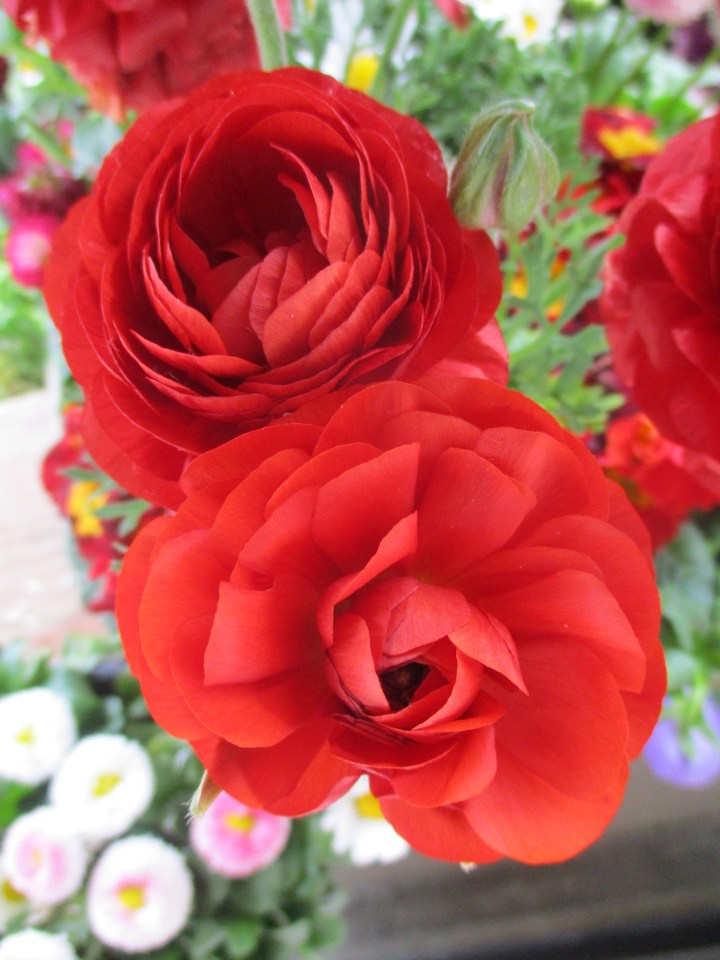 Narcissus, daffodil, freesia, snowdrop, snowflake, grape hyacinth, various iris and most other early spring blooming bulbs and bulb like plants should be perennials. We plant them with the hope that the will survive after bloom to bloom for another season, and perhaps for many seasons. Some should multiply to provide more bloom over the years. Bloom is just part of their annual cycle.
Lily, crocus, hyacinth, tulip, anemone and ranunculus are not nearly as likely to bloom more than one year for a variety of reasons. Some prefer more chill in winter. Some dislike the long and dry summers. Some survive as perennials, but do not bloom again. However, in some special situations, they also can bloom annually. After spring bulbs, there will be a different set of summer bulbs.
So, what happens after bloom? After exhausting much of their stored resources on production of bloom and foliage, bulbs try to recover and regenerate resources for the following season. Most work to replace their exhausted bulbs with comparable new bulbs. They need foliage to do this, but eventually shed their foliage as their new bulbs go dormant for the following autumn and winter.
Of course, they all do this at different rates. Some smaller bulbs are surprisingly efficient, and shed their foliage as soon as the weather gets warm later in spring. It is amazing that they can store up so much in such a minimal time. Other bulbs shed slowly, as their deteriorating foliage lingers for a few weeks into summer. Foliage of summer bulbs that bloom later is likely to linger until frost.
Because it is essential to the regenerative process, deteriorating foliage can not be cut back prematurely. It is not always easy to hide either. In mixed plantings, it might be obscured by ground cover or other plants. Alternatively, warm season annuals can be planted over the area. Some of us braid daffodil leaves, but others believe that braids draw attention to the deteriorating foliage.
Those of us who still dig and store and perhaps chill marginal bulbs, must wait for complete dormancy.
 Tony Tomeo