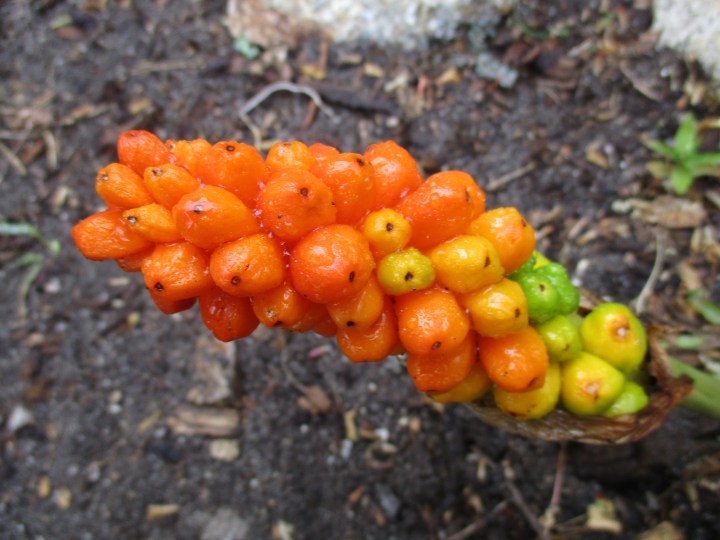
 Just a short distance from the corn dog orchard, I found this candy corn dog growing wild. I really had no idea that candy corn grew in a corn dog form like this. These particular candy corn seem to have turned from green to yellow to orange as they ripened. It will be interesting to see if the outer ends eventually ripen to yellow like conventional candy corn, or if they are a fancier cultivar. They sort of look like tiny persimmons.
Perhaps it is ‘Cupid Corn’, which is red at the outer end and pink in the middle, for Saint Valentine’s Day. If so, it will be quite stale long before next February.
Even if it is ‘Reindeer Corn’, which is red at the outer end and green in the middle, for Christmas, it will not likely be fresh by late December.
Heck, just expecting it to last until Halloween is a stretch. There are actually a few different cultivars for a variety of holidays, so this one could be for any of the obscure holidays before Halloween that few know about; or it could be very out of season.
I do not know how this candy corn dog got here. I did not plant it. I am pleased that snails, slugs, squirrels or insects have not eaten it so far.
Something came into this part of the landscape earlier, and ate all the foliage off of the Arum italicum. Even though it is a naturalized exotic weed, the Arum italicum was rather appealing, with its intricately lacy foliar variegation. It is completely gone now, but should regenerate once rain resumes in autumn or winter.
For now, the candy corn dog is more colorful than the Arum italicum was. How odd that it has no foliage. hmmmm . . .
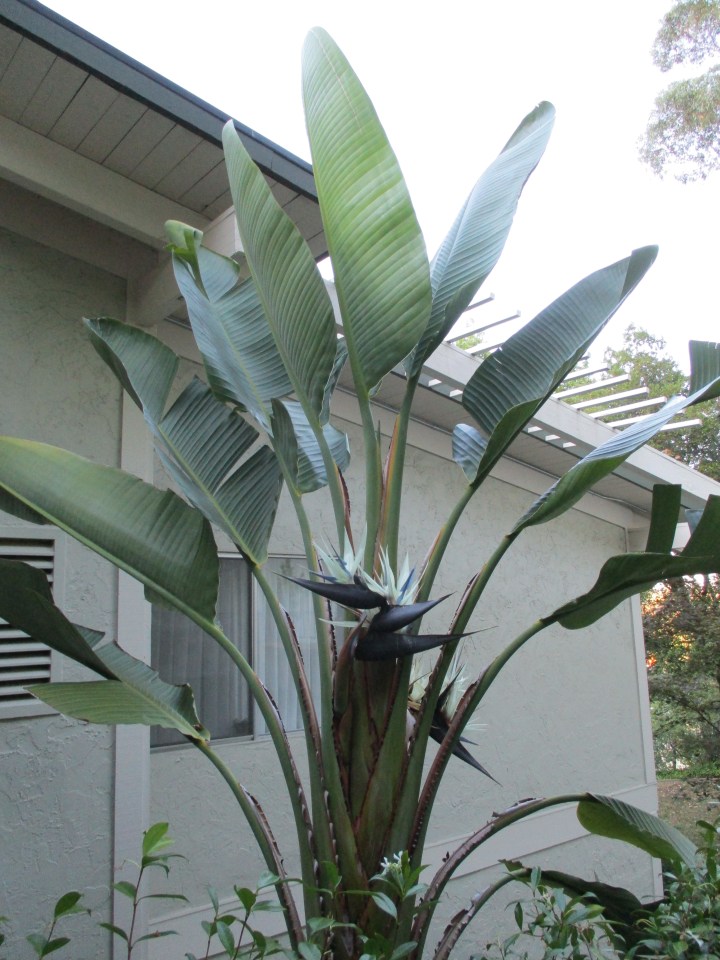
 Unlike the common bird of Paradise that is grown for striking bright orange flowers, the giant bird of Paradise, Strelitzia nicolai, is grown for strikingly lush foliage. The big rich green leaves get nearly six feet long, and flare outward from leaning trunks that can eventually reach upstairs eaves. Foliage is healthiest if sheltered from harsh sunlight (such as hot reflected glare), wind and frost.
 Just like anything else that gets planted in the garden, new perennials seem to be so cute and innocent. They get even better as they mature. Some grow and spread to impressive proportions. Then . . . some perennials get to be too large. Some get overgrown enough to obscure their own appealing characteristics or other plants. Others get crowded enough to inhibit their own bloom.
 The Nile River floods annually, inundating everything in its floodplain. Lily of the Nile, Agapanthus africanus, survives by hanging on firmly with a thick network of rubbery roots. It grows and blooms in warm weather as floodwater recedes, and then survives through a long, warm and dry season until the river floods again. It tolerates both drought and flooding, although it prefers more stability.
 Whether it is grown intentionally, or considered to be a common roadside weed, there is no denying that perennial pea, Lathyrus latifolius, knows how to brighten some of the wilder parts of the garden with brilliant purplish pink bloom. Some garden varieties bloom either pale pink or white, just like a few random feral plants do. Bloom resembles that of sweet pea, but without fragrance.
 If California poppy had not been designated as the California state flower, Matilija poppy, Romneya coulteri, might have been. It was nominated, but was less popular at the time, partly because it was familiar only to those near its native range in Southern California. Some of us know it as ‘fried egg flower’, because the big and floppy white flowers with yellow centers look like fried eggs.
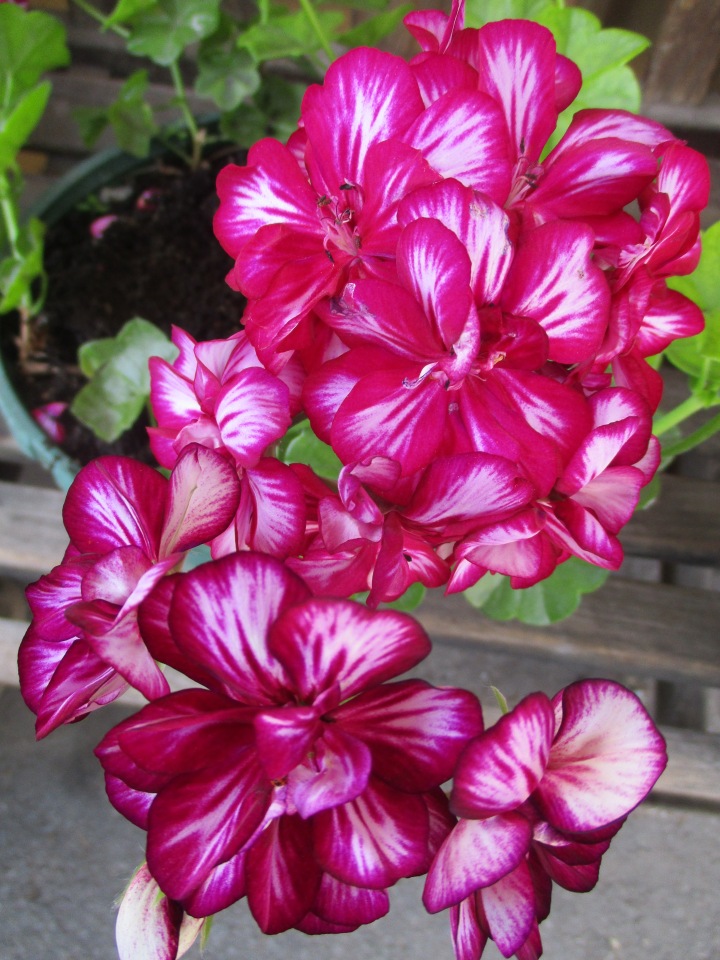 This is one of the more traditional perennials for old fashioned window boxes, not only because it cascades downward to avoid obstructing associated windows, but also because, back before window screens were commonly available, the aromatic foliage was purported to repel mosquitoes. Ivy geranium, Pelargonium peltatum, is splendid for hanging pots and retaining walls as well.
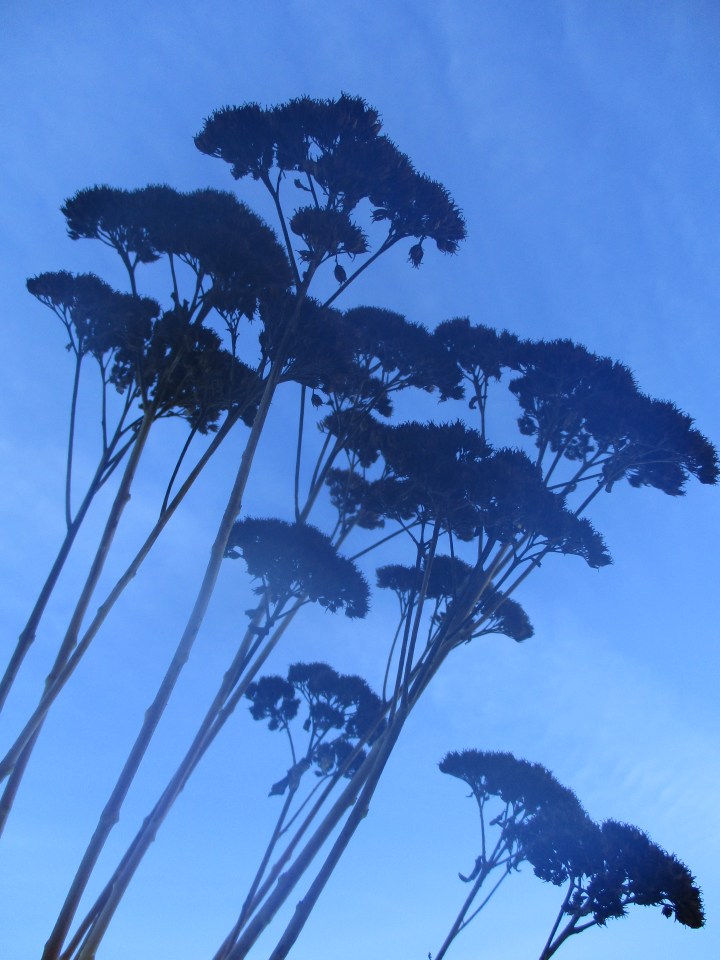 April showers bring May flowers. May flowers make a mess. Well, some of them do. Most simply disintegrate and fall from the trees, shrubs and vines that produced them, and decompose into the soil below. Some might have needed to be swept off of pavement and decks. Regardless, most of us do not notice the very minor consequences for the majority of spectacular spring bloom.
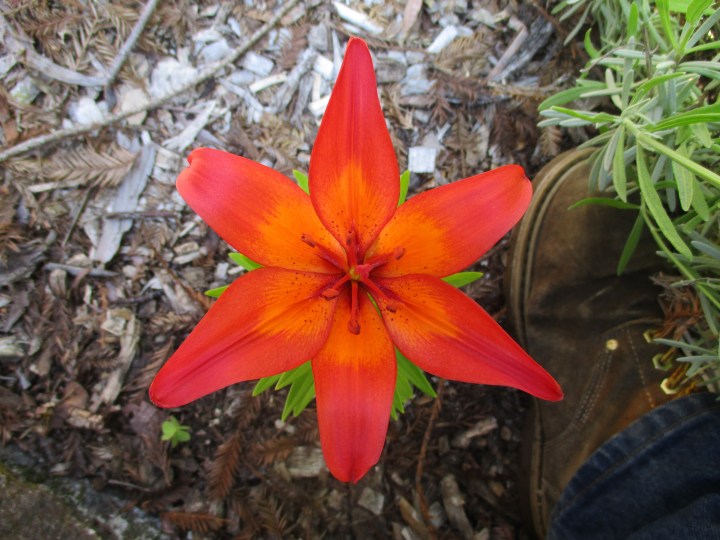 What a delightful surprise! It happens sometimes here in the rose garden. It may not look like much, as a short stemmed single lily floret that is mostly overwhelmed by the English lavender that I held back with my boot for this picture. It should be three feet tall or so, with several florets. The surprise is that no one planted it. Well, at least no one planted it recently. This rose garden has more history than is obvious from what blooms here now.
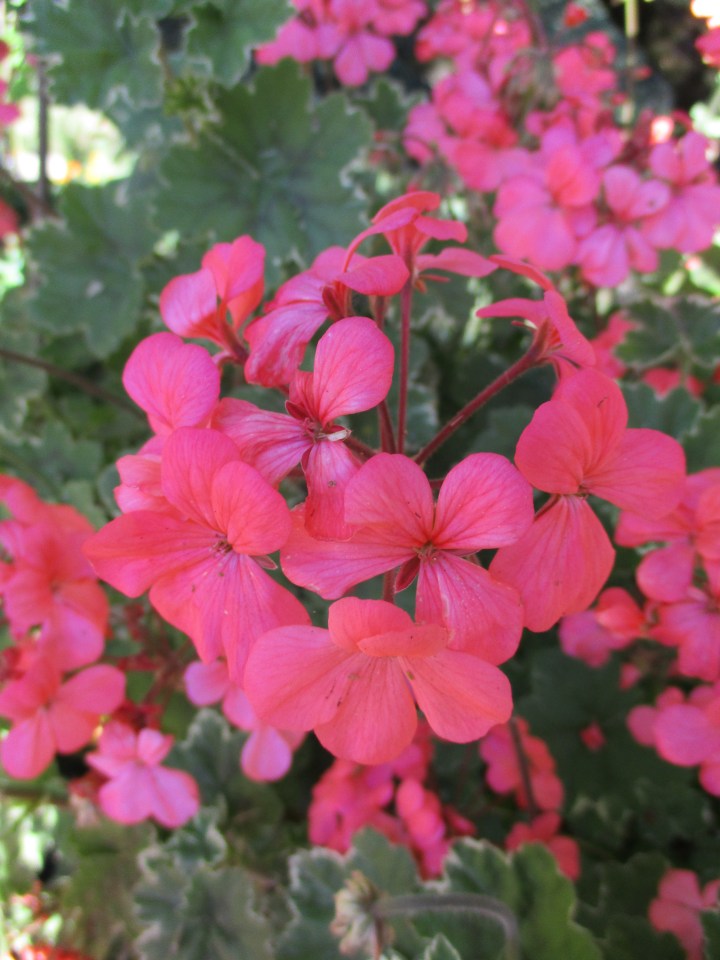 New and improved is not always better. Modern garden varieties of zonal geranium, Pelargonium X hortorum, with bigger, fuller and more profuse blooms, are more colorful than the relatively weedy classic varieties, but they are considerably more demanding. In fact, because they are so unhappy through winter, they are often grown as warm season annuals instead of as perennials.
