Six on Saturday: Shrooms


It is unlikely than any of these are related to ‘shrooms’ or ‘magic mushrooms’, the psychedelic mushrooms Psilocybe cubensis; but this is Santa Cruz County. I would not know one if I saw one. I think that #4 looks like pancake; and #6 looks like a strawberry. All except #1 were found within only a few feet of each other. They showed up immediately after the rain, in spot that had been dry all summer.

If #1 looks familiar, it is because it is the dreaded oak root rot fungus, Armillaria mellea. It was was at an adjacent building where another less developed colony of the same was featured in ‘The Humungous Fungus Among Us’, https://tonytomeo.com/2018/12/02/the-humongous-fungus-among-us/ . The colony that was featured earlier developed into mushrooms just like those shown here, but by the time these pictures were taken, had deteriorated into a sloppy puddle of chunky goo from a bad 1980s horror movie. It looked like someone ate a bucket of chocolate covered olives, and threw up. To make matters worse, the whole mess was shimmering with the squirming of maggots, and exuded an aroma that was appropriate to visual aspects of the situation. Wow! I am grossing myself out, and I experienced it already.

When I compare picture #1 of the more developed colony of oak root rot to the earlier picture of the less developed colony. I sort of wonder if some of these other pictures are redundant to each other. Could #4 be a more developed form of #3? Could #5 be the deteriorating phase of #2? Well, I don’t know. I am just a horticulturist, not a mycologist.

1.)81229

2.)81229+

3.)81229++

4.)81229+++

5.)81229++++

6.)81229+++++

This is the link for Six on Saturday, for anyone else who would like to participate:

https://thepropagatorblog.wordpress.com/2017/09/18/six-on-saturday-a-participant-guide/
Six on Saturday: Bits and Pieces

There were no major projects this week that were interesting enough to get six pictures of. The best that I could do was get six random pictures of random features of the landscapes. I do not actually do much to cultivate flowers, but they happen to be components of the landscapes. Most are perennials that bloom on their own. Of course, I do not mind taking credit for them.

Some blooms started late while the weather was mild, but were then accelerated as the weather suddenly warmed. It seemed that several different types of flowers needed to be deadheaded at the same time. Zonal geraniums and lily-of-the-Nile are two of the most reliable perennials that bloom on schedule no matter what. Zonal geraniums bloom sporadically most of the time, and only bloom more while the weather is warm. Lily-of-the-Nile may start a bit early or a bit late, but is always in full bloom on the fourth of July. The blooms even look like exploding fireworks. More than two weeks later, their flowers are still in full color but will slowly start to fade. Phlox was a surprise for us.

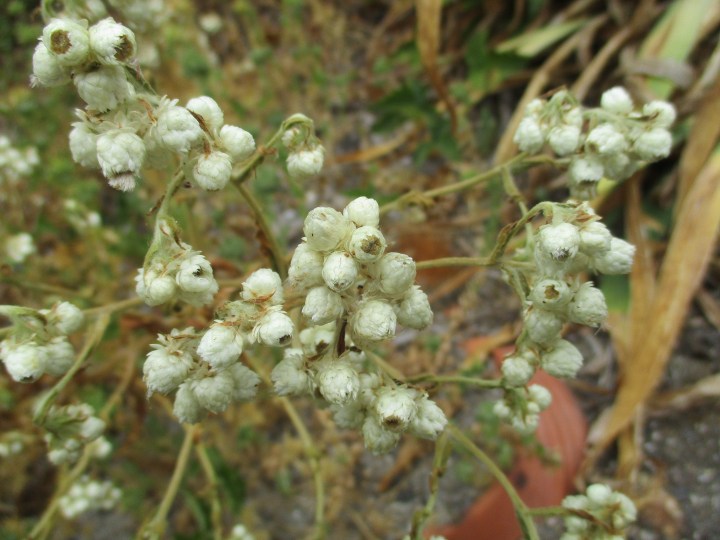
1. Can you guess what this bloom is?P80728

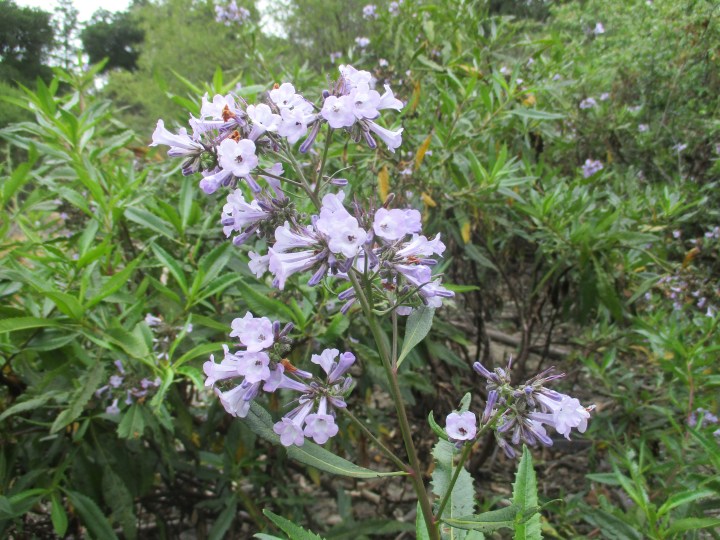
2. You can probably guess that this is phlox. It sure had my colleagues and I perplexed. We had never seen anything like it. Phlox is uncommon here. I would even say it is rare. No one knows why. It just is. I got a picture of it a few years ago only because I was intrigued by it in a neighboring landscape. It took a bit of effort to identify it, although I sort of suspected that it was phlox. It did not look quite like this phlox, and was lower to the ground. No one knows how this one got into the landscape. We suspect it arrived with the ‘fertilizer’ that the horses make for us.P80728+

3. Lily-of-the-Nile is still one of my all time favorite summer blooming perennials. I do not care how cheap and common it is. It is one of the first perennials I divided while I was in junior high school. I grew more than eighty new plants from a single old plant that needed to be removed. It was the old fashioned sort, with big blue flowers and big flabby leaves, perhaps bigger than these. I also like the white ones with the same big flowers and leaves, of course, because they are white. All the fancy modern cultivars are nice too, but not as excellent as the originals. I do like seeing the very pale blue ones in other gardens.P80728++

4. This zonal geranium has these small but cheery cherry red flowers, but it is really grown for the weirdly variegated foliage that is blurry in the background. I think that these flowers would look better against simple green foliage. There is another zonal geranium in another part of the landscape, with small peachy pink flowers and foliage that is variegated only with white. I am none too keen on the flower color, and I am not often too keen on variegation, but the foliage of that particular zonal geranium really looks sharp.P80728+++

5. Himalayan blackberry is one of the worst and most invasive of the exotics weeds here. It develops huge canes that arch over and drop on top of other plants in the landscape. The wickedly sharp prickles (technical term for their thorns) are tortuous when trying to remove the canes. Even picking their berries is nasty business! There are a few berries ripening now, and they happen to be pretty good, but they are sooooooo not worth it.P80728++++

6. Chips needed to be dispersed into the newly landscaped areas that are partially visible in the background of this picture. These chips were free. They are made of recycled wood waste. For our purposes, they are sufficient. However, they include a few large chunks of wood and bits of metal. The chunk of metal in this picture is a short section of rebar. Some of the chips have paint on them. Some seem to be bits of old furniture. It makes one wonder where some of this material came from.P80728+++++

By the way, the bloom in the first picture #1 is merely a fist full of deadheaded white zonal geranium flowers all pressed together. White zonal geraniums do not readily drop their faded blooms like other zonal geraniums do, so they need to be deadheaded.

This is the link for Six on Saturday, for anyone else who would like to participate:

https://thepropagatorblog.wordpress.com/2017/09/18/six-on-saturday-a-participant-guide/

Horridculture – Rose Colored Glasses

P80711

This article reminded me of a sore subject from back in about 1986 that continues today: https://wordpress.com/read/blogs/7890212/posts/4888 You should probably take a look at it before you continue.

Back when my colleague and I were roommates in the dorms at Cal Poly in San Luis Obispo, we noticed how badly the photographs in bare root catalogs had been modified to enhance color. Years before modern digital editing, colored film was cut out to any desired shape and placed over a photograph to produce a new photograph with enhanced color. We looked at pictures of flowering crabapples with canopies that were entirely bright pink, including the stems, leaves and everything associated with the canopy of the tree. We could easily see the outline of the bright pink film that had been placed over the original photograph. It was done with blue fescue, hydrangeas, azaleas, callas and really just about anything that could benefit from a bit of enhanced color.

It certainly did not dissuade us from our interest in the plants that had been photographically enhanced. We liked them anyway. The poor quality of the enhancements that would be laughable by modern standards seemed to be more acceptable back then; like the idealistic pictures of the food available from popular fast food establishments. I mean, we all know that the food does not look like ‘that’ but it probably tastes like ‘that’ looks.

Three decades later, modern technology of digital editing of photographs (if they are still known as ‘photographs’) has improved the technique of color enhancement significantly. Most pictures in catalogs are now enhanced to some degree, not to be deceptive, but to eliminate minor glitches that might distract from the rest of the image, and perhaps to enhance color that is slightly compromised by the exposure at the time the picture was taken.

But of course, there are some images that are blatantly inaccurate and deceptive.

My colleague down south tells me that pink pampas grass can be about as peachy pink as cantaloupe is. It could possibly be more pink in other regions. I have never seen it more than simple pinkish tan here. I know of no one who has confirmed that it can be as bright cotton-candy pink as it is in the picture above. Is it inaccurate and deceptive? I do not know. I do not really care. If I wanted pink pampas grass, I would purchase it anyway, and just try to not be too disappointed when it blooms tan.P80711+This picture above is certainly interesting as well. It is such an appealing color. What is more interesting it that it is the exact same picture as the picture on top, but is merely a different color. I have never heard of a pampas grass doing that! It must be quite common though. Online, there are a few pictures of other pampas grass doing the exact same thing. These two below, for example, are the exact same picture in two different colors, and with slightly different proportional modification.P80711++P80711+++As amusing as these pictures are, they are not as downright KRAZY as the rainbow rose in the article that I posted a link to above is. It is certainly worth taking a look at.

Six on Saturday: Nursery Rhyme


I wish we had one. There is no rhyme and only a few disjointed reasons for what happens at the small storage nursery at the maintenance shops. This is nothing like acres of production nursery full of rhododendrons, azaleas, camellias and such. Nor is it like the retain nurseries that sell the rhododendrons, azaleas, camellias and such. This is merely a small yard where we store a few plants that get removed from landscapes, and plants that were recently procured from a nursery but have not yet been planted.

It is like the nursery version of the wood shop, with its collection of new lumber and old recycled lumber that gets used on the historic buildings. The plumbing shop contains all sorts of new plumbing and fixtures, as well as many old fixtures that might someday be useful. The landscape shop, which is separate from the nursery, is #7 of about twelve specialized shops used by the maintenance staff. The nursery might seem to be the most dysfunctional of the several shops, but only because plants are dynamic and need maintenance . . . and because, without necessary maintenance, a few have deteriorated, died or conversely thrived and made themselves at home.

Newly procured plants like #5 and #6 are easy to work with. They come in with a plan, and generally leave within a week or two as they get installed out somewhere in the various landscapes. Recycled plants like #1 and #2 were removed from the landscapes either because they were in the way of something, or because they proliferated too much, but could someday go back into other landscaped areas. Then there are a few plants like #3 and #4 that stay long enough to disperse roots through the bottoms of their cans and into the ground, essentially planting themselves on the spot because they got tired of waiting for a new home.

1. Peruvian lily was so prolific at the Post Office that many needed to be pulled. They were canned to be installed elsewhere, but no one wants to put them into a situation where they might proliferate like they did at the Post Office. Besides this pink, there is also peachy pink and yellow. All are the tall types that were originally grown fro cut flowers, rather than the lower mounding home garden varieties. Consequently, they need to be staked or caged like tomatoes so that they do not lay on the ground.P80623
2. Chrysanthemum was grown as annuals in a few various locations, but when they were removed to relinquish their space for more seasonable annuals, a few were canned. It is not always easy to discard certain perennials just because their time is up. The problem is that, although they look so good in the nursery, and bloom in spring instead of autumn, they do not get cycled back into the landscape. When new color is needed, it is often purchased and planted before the old stock is considered.P80623+
3. Potato vine has been growing like a weed on the cyclone fence and shade structure for so long that no one knows where it came from. I do not even know where the vines originate from. I would guess that somewhere under the overgrowth, the main canes emerge from the remains of a #1 can that the roots split apart years ago. This vine lives here now. Even if we had a spot for it, relocation is not practical. If it gets too overgrown, it might get cut back.P80623++
4. Campanula was probably in a 4” pot that got set into the #15 can of a ‘Black Lace’ elderberry and forgotten about. It might have been recycled, or it might have been something new that never got installed. Before the elderberry was relocated, the campanula had spread into the cans of other trees, so like the potato vine, it lives here now.P80623+++
5. Cone flower is easy. I just arrived from a nursery, and will be installed into a landscape in just a few days.P80623++++
6. Yarrow came with the cone flower, and will be planted nearby in the same landscape at about the same time.P80623+++++

This is the link for Six on Saturday, for anyone else who would like to participate:

https://thepropagatorblog.wordpress.com/2017/09/18/six-on-saturday-a-participant-guide/
Six on Saturday: New Leaf


New foliage develops immediately after the earliest spring flowers. All six specie shown here are locally native to the San Lorenzo Valley in Santa Cruz County of California. With the exception of #4 (California) black oak, these specie are riparian specie found near the San Lorenzo River, which is the wet thing in the background behind #3 red willow. #4 (California) black oak naturally prefers drier situations a mile or so away, but happens to be in the area. #6 gooseberry is unidentified, and could have a color in the name like most of the others. #1 box elder has no color in the name, and is not related to #5 blue elderberry. Nor are #2 black cottonwood and #4 (California) black oak related to each other. #5 blue elderberry really is blue, unlike the black elderberries of eastern North America and elsewhere, which incidentally, are related to neither #2 nor #4. This is getting confusing. #3 red willow is also known by a few other names.

1. box elderP80331
2. black cottonwoodP80331+
3. red willowP80331++
4. (California) black oakP80331+++
5. blue elderberryP80331++++
6. gooseberryP80331+++++
This is the link for Six on Saturday, for anyone else who would like to participate:

https://thepropagatorblog.wordpress.com/2017/09/18/six-on-saturday-a-participant-guide/

Six on Saturday: Infirmary


Some of the plants that get recycled at work go to a small nursery next door to the shop until they find a new home. Many are out of season annuals that are really perennials. Some were not performing adequately, so got replaced. Some just needed to get out of the way for something else. Because most plants must recover from transplant, or whatever happened to them out in the landscape, the nursery is more of an infirmary. Only a few plants were recently purchased at a nursery for installation into a new project.

1. Primrose blooms in many colors besides white – the sequel to the sequel – https://tonytomeo.wordpress.com/2018/03/03/six-on-saturday-my-favorite-color-ii-the-sequel/P80317
2. African daisy works well in the sunnier parts of our unrefined landscapes.P80317+
3. ‘Sunset Gold’ breath of Heaven is a new acquisition for a newly landscaped area; but was not my choice. This picture makes it look even worse than it really is.P80317++
4. Wallflower will go with the ‘Sunset Gold’ breath of Heaven.P80317+++
5. Forsythia is rare here. Besides this one, there is only one other in the landscape. This picture was taken earlier, while the forsythia were still blooming.P80317++++
6. ‘Black Lace’ elderberry is starting to foliate. I really want to try the berries from this ornamental cultivar, if it fruits, to see how they compare to the native blue elderberry.P80317+++++
This is the link for Six on Saturday, for anyone else who would like to participate:

https://thepropagatorblog.wordpress.com/2017/09/18/six-on-saturday-a-participant-guide/

Felton Covered Bridge

04Now that I have been watching a few other blogs for three months, I notice that some people write some very interesting or at least entertaining articles about topic that are not directly related to the main topic of their respective blogs. Most are just like old fashioned slide shows (remember those?) with cool pictures from around the neighborhood, travels, home projects, or whatever might be interesting. I have not done this yet; but I happen to have a bit of free time at the moment, so thought that I would post these three pictures of the historic Felton Covered Bridge. Although I am technically from Los Gatos, my home is in the Santa Cruz Mountains between Los Gatos and Felton. I also have history in Felton, since my grandparents and my Pa used to live here.

In an attempt to keep this post relevant to horticulture, I should mention that the trees to the right of the Felton Covered Bridge are a colony of the common box elders that suddenly died this past year. ( https://tonytomeo.wordpress.com/2017/10/04/what-is-killing-the-box-elders/ )We still do not know what killed them so suddenly. Perhaps later I can post pictures of this same area when it was flooded. I just do not have that file here right now.05This is the southwestern of the four sidelight windows on the Felton Covered Bridge. If crossing from the end in the upper picture, it would be on the left side toward the far end. It is the best window in the house. Rhody to the lower right might be mistaken for a rodent ( https://tonytomeo.wordpress.com/2017/10/14/rhody/ ). My parents have a picture from about 1970 of my older sister (from War of the Worlds – https://tonytomeo.wordpress.com/2017/10/03/war-of-the-worlds/ ), my younger brother and and I looking out of this window. My brother and I were just tykes at the time, and were to short to see out of the window, so we were standing on the lower rail. Our sister was pointing at something in the distance.06This is the view from that same window. That wet thing below is the San Lorenzo River. The black spots in that wet thing below are ducks. Once the rain starts, the San Lorenzo River really looks more like river than a creek. This last spring, in the San Lorenzo River right below the Bridge, we scattered the ashes of a good friend, Steven Ralls, with whom I went to Oklahoma (to the right in the illustration – https://tonytomeo.wordpress.com/2017/11/19/oklahoma/ ). Most of the vegetation out there is native. The trees straight ahead are common cottonwoods. However, the tree to the left is a weeping willow. No one knows how it got there.

Hey, this was fun. Maybe I will post more pictures on those memes later. I don’t know what a meme is, but I suppose I could figure it out.