There is just too much blooming this time of year to fit it all into one Saturday. These azaleas were blooming quite some time ago, and these pictures are at least a week old. Some might be almost two weeks old. I just could not use them last week because there were still camellias to show off.
1. What this one lacks in profusion, it compensates for with large flower size. We used to grow one that looked like this but perhaps with slightly richer color. It was known as ‘Phoenicia’. It was a bit too garish for my taste.
2. These flowers are smaller, but seriously more profuse. In fact, they are so profuse that, like #4, #5 and #6, the foliage is barely visible behind so many flowers. It is garish too, but I rather like this particular flavor of color.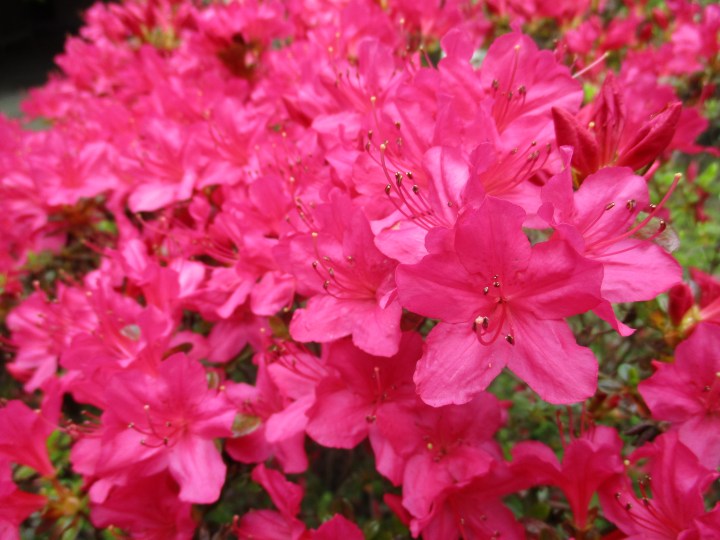
3. Okay, so they are not as profuse, but they are such an excellently bright red. It looks like ‘Ward’s Ruby’ to be, but I can not be certain. All these azaleas look so different in this landscape than in production on the farm.
4. Not much foliage could be seen through these glowing flowers. They are more profuse than they look. They just do not seem so profuse because they are not dense. I do not know which cultivar to compare this one to.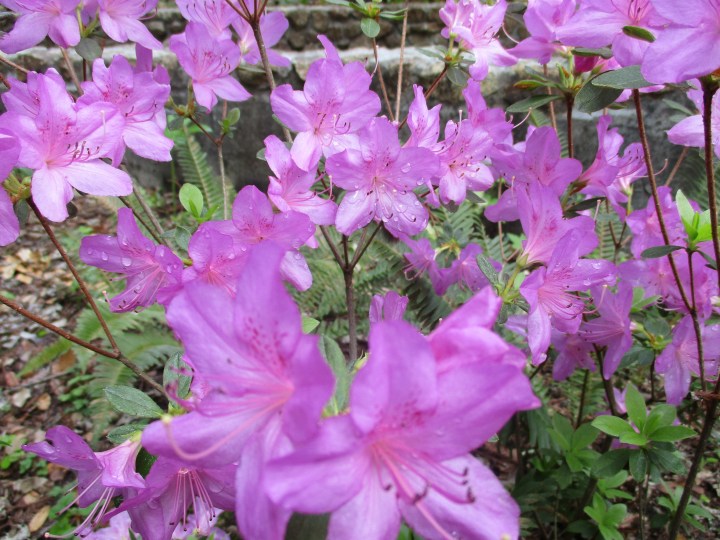
5. ‘Coral Bells’ has very profuse and very densely arranged tiny flowers. They form a layer over the exterior of the plant. Although I would say that these are more pink than coral, this cultivar is unmistakably ‘Coral Bells’.
6. ‘Fielders White’ is the best that I saved for last. They are perfectly white medium sized flowers that are profuse enough to almost obscure the foliage, but not so profuse that the perfect form of the flowers is obscured.
This is the link for Six on Saturday, for anyone else who would like to participate:
https://thepropagatorblog.wordpress.com/2017/09/18/six-on-saturday-a-participant-guide/
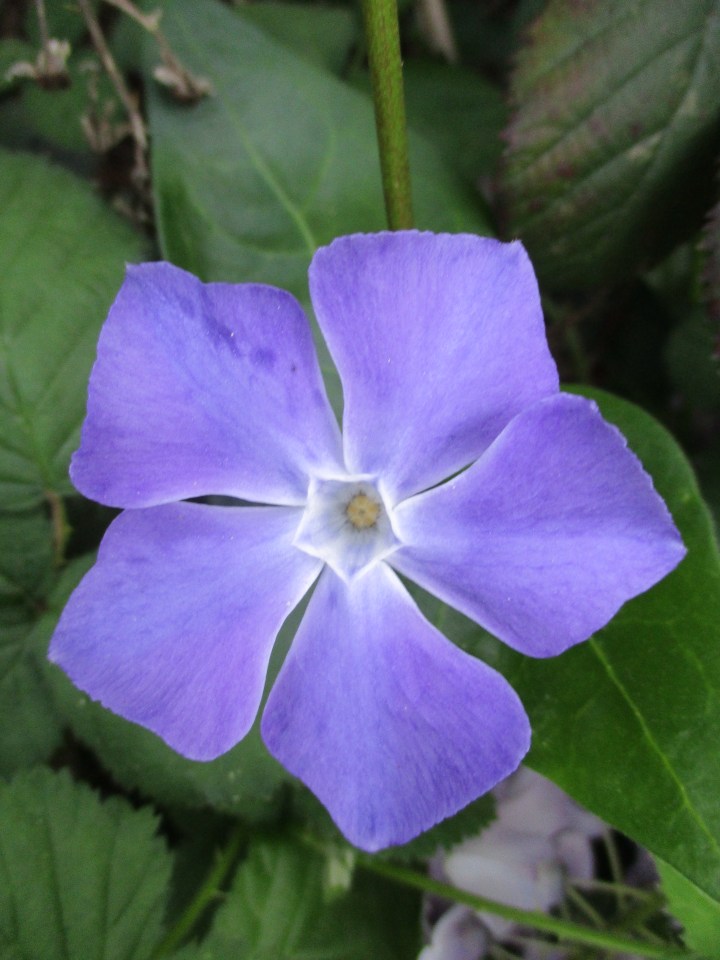 Like so many of the easiest to grow plants, periwinkle, Vinca major, is too easy to grow. It has become an invasive exotic (nonnative) weed in many moist riparian environments. It can get rather weedy in home gardens as well. This can be an advantage if it happens to fill in for bald spots in areas of other ground cover. It is a disadvantage if it overwhelms or competes with other plants.
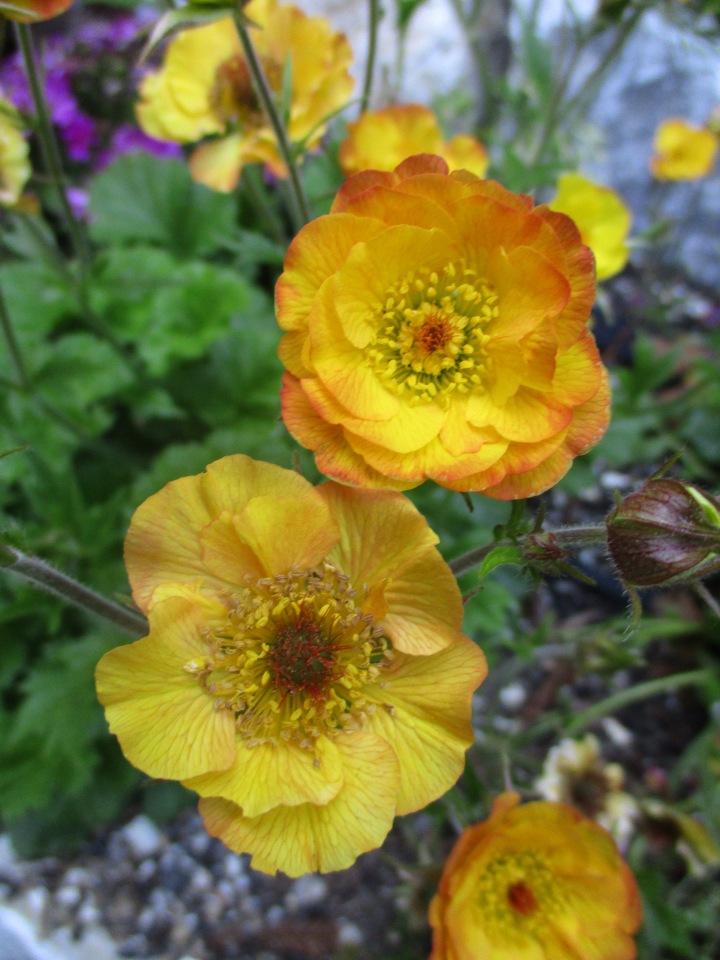 Wow, this is quite old school. Is it making a comeback? That would be nice. Avens, which is also known as Chilean avens, Geum quellyon, is an old fashioned perennial relative of the strawberry. Instead of producing fruit, it provides handsome yellow, red or coppery orange flowers that look something like small single, semi-double or double anemones, but can bloom through most of May.
 The popular wisterias that bloom so profusely before their new foliage appears in spring are Chinese wisteria, Wisteria sinensis. Others specie are rare. The impressively longer floral trusses of Japanese wisteria are not as abundant, and bloom late amongst developing foliage. American and Kentucky wisteria are more docile small vines, but their floral trusses are both short and late.
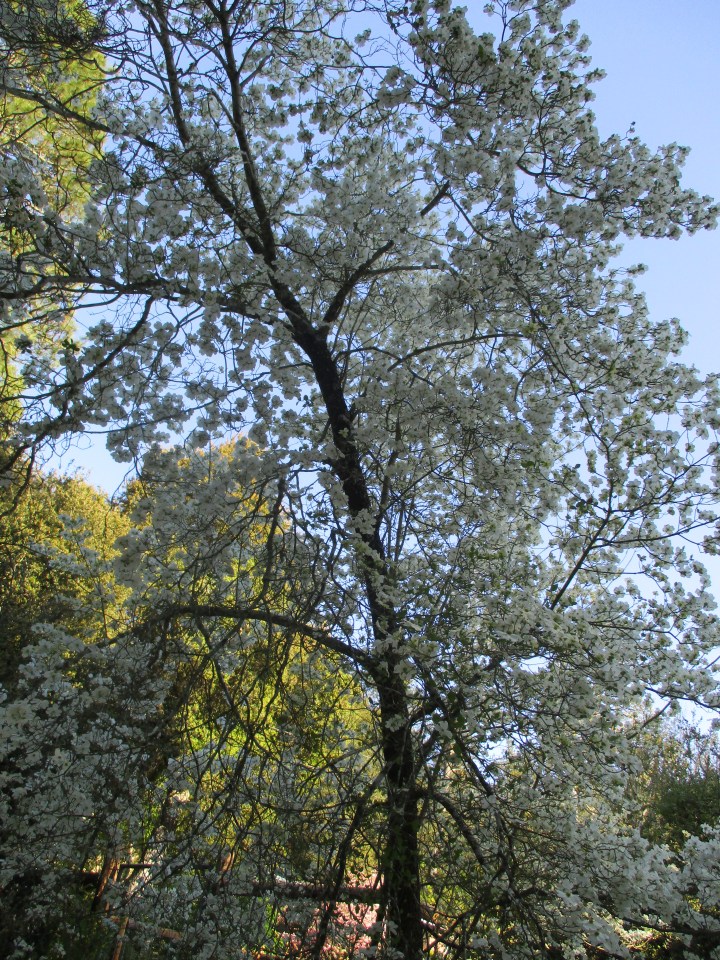
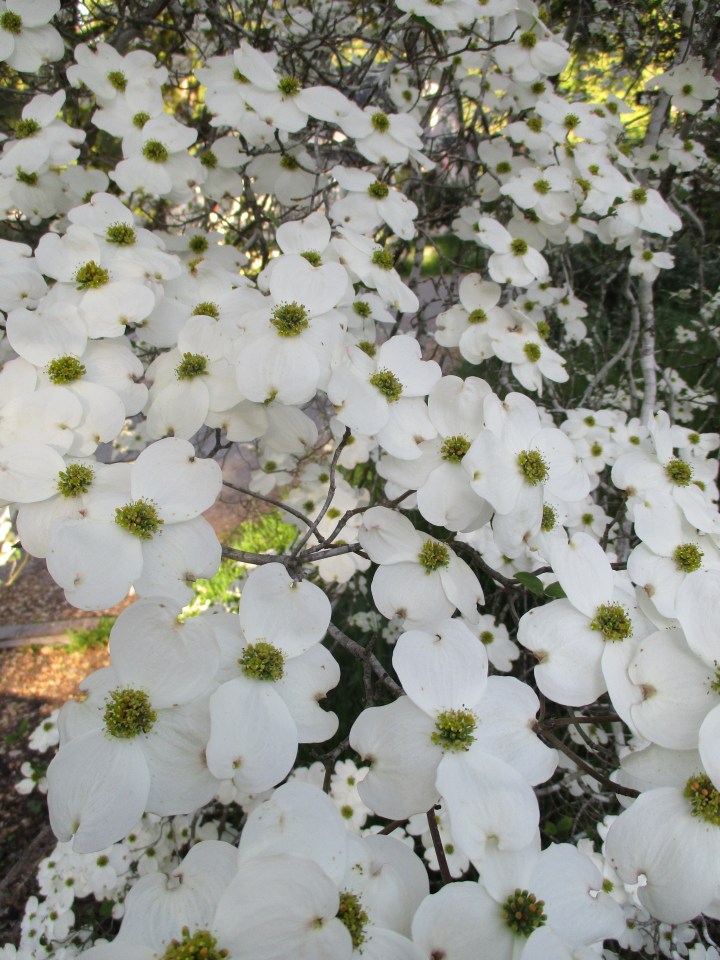 Flowering dogwood, Cornus florida, seems like it should be more popular here than it is. It blooms spectacularly in April. The foliage can color nicely in autumn. Mature trees are proportionate to medium sized or smaller suburban gardens. However, the limiting factor to their popularity in the local climate is that they are understory trees that prefer to be in the partial shade of larger trees.
 Once it gets into a lawn, English daisy, Bellis perennis, can be very difficult to get rid of without leaving bald spots. The thin but tough rhizomes creep along the ground, producing rounded leaves that get no longer than two inches. Mowers barely scratch the surface. English daisy seems to prefer partly shaded areas to drier sunny spots. Although invasive, it can be pretty in informal lawns.
 My weekly gardening column does not have much space for everything that should be said about the various topics and featured specie. I just try to fit the most basic of information into the space available, but usually would like to fit more in.
 Although a relatively small agave, the Queen Victoria agave, Agave victoriae-reginae, is also one of the most striking. Mature plants form dense foliar rosettes that are between only a foot, and a foot and a half tall and wide. What is so striking about them is the abundance of stout succulent leaves that can be so densely set that some older plants look like big, round and green pine cones.
 Staghorn ferns are epiphytes. They cling to tree trunks, rocks or whatever they happen to grab onto. They can root into decayed wood if it is porous enough, but they are satisfied to just cling to the exterior. They do not need soil. They sort of make their own soil by collecting debris that falls from the canopies of trees above. In the jungles where they live, they get all the water they need from rain. They often live in the crotches of branches because that is where they happen to land. (The epiphyte I wrote about earlier was just a palm that landed in the wrong place, but is not really an epiphyte.
  What an unappealing name! That is probably why so many of us know it simply as ‘wild onion’ or ‘allium’. Few of us bother to get sufficiently acquainted with it to know it by the species name of Allium triquetrum, which is actually not much more appealing than ‘onion weed’. It is not really wild, but has naturalized as an invasive exotic, or in other words, ‘weed’. At least it is a pretty weed.
