
Most arborists insist that pollarding is horticulturally incorrect. However, most of us who pollard trees in our home gardens are not arborists. Pollarding is technically detrimentally disfiguring to trees. However, some trees that are naturally short lived can live much longer if pollarded properly. That is the trick; doing it properly. Pollarding is certainly a distinctive pruning style that is not for everyone, but can be both practical and sustainable in certain situations.
Pollarding is an extreme pruning technique that involves the removal of all or almost all of the stems that grew since the last time the technique was done. The new growth gets cut back cleanly to distended ‘knuckles’ that develop at the ends of the original stems. Traditionally, one or two strategically aimed stubs from the removed new growth are left on each knuckle to form a new knuckle a bit beyond knuckles of the previous year. Locally though, stubs are typically omitted.
New growth must get cut back cleanly so that the wounds can get compartmentalized (healed over) as efficiently as possibly. Stubs interfere with this process. If one or two stubs are left on knuckles to form new knuckles, they should be long enough to get some distance from the original stubs, but short enough to not be too awkward. Knuckles should not get cut off! Such large wounds do not compartmentalize fast enough to avoid rotting.
Pollarding can only be done in winter, both because plants are dormant, and also because the weather is not so dangerous. New growth starts to shade exposed bark before it gets scalded by intensifying sunlight and heat in summer. Once they come out of dormancy, plants would be seriously distressed by such severe pruning. Because new growth is so vigorous after pollarding, it can become sloppy if pollarded less than annually. Some plants that grow slowly or produce stout stems may get pollarded less frequently.
London plane (sycamore) and fruitless mulberry are the most commonly pollarded trees. Silver maple, silk tree and various elms, willows and poplars adapt well to pollarding as well. Locust and purple leaf plum can be pollarded, but will be deprived of bloom. Bottlebrush can bloom later in the same year after getting pollarded, and probably will not need annual pollarding anyway. Pollarded bay trees can be kept small, and will provide better herbal foliage. Certain eucalyptus can be kept juvenile if their juvenile foliage is more appealing than their adult foliage.



 The internet makes it possible to communicate with people who enjoy gardening all over the World. It can be amusing to hear what garden enthusiasts in Australia are doing now in early summer. Is it always summer in Ecuador? A common theme in much of America is that there is not much gardening to do right now. It might be more accurate to say that no one wants to go out in the cold.
 Roots hold up trees. That is part of their job. They grow along with the trees they support, and disperse as necessary to maintain stability. Trees grown within the confinement of cans (pots) or boxes, and then installed into a landscape, are typically staked temporarily until their roots adequately disperse and stabilize. Once unnecessary,

 Grafting compound is a thick sealant applied to a fresh graft union to limit desiccation while the graft knits. A bit more typically gets applied to the cut distal end of the scion. There are various formulations of grafting compound, ranging from something resembling roof patch to a something with the consistency of thick paint.
 The trees know what time of year it is. Even evergreen trees have shed some of their older foliage through late summer. Deciduous trees generally start later, but will be more blatant about their process as they defoliate completely through autumn to winter. Some get strikingly colorful first, as if to brag about it. Foliage is not so important during shorter days and dimmed sunlight anyway.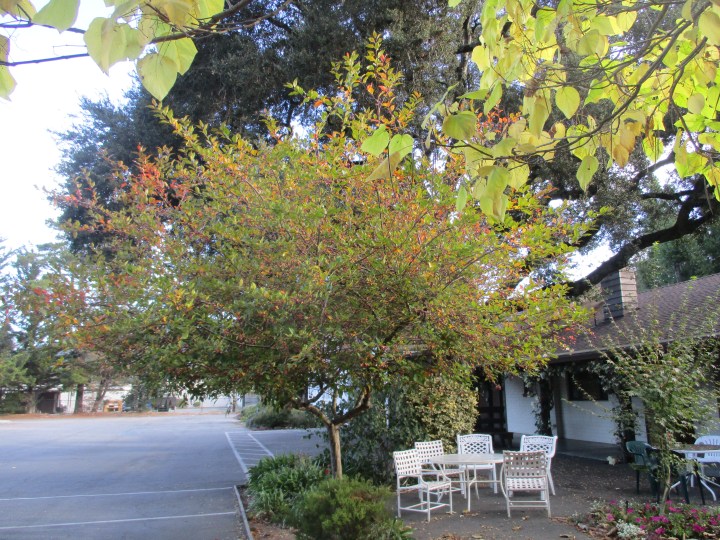
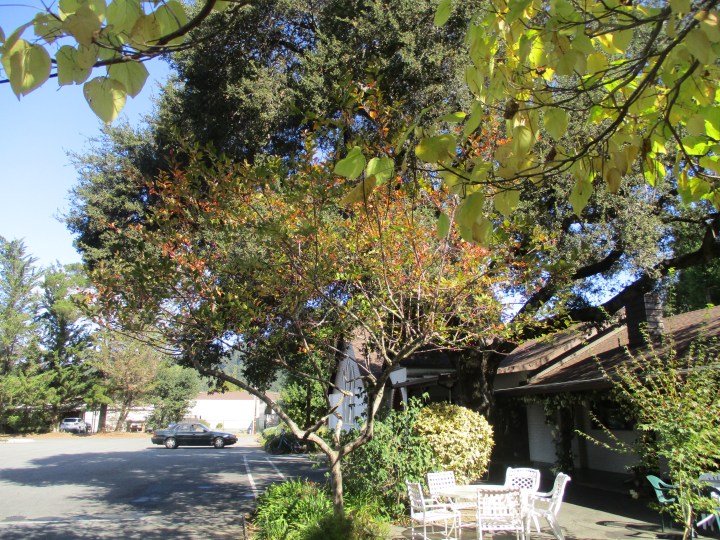 It is amazing what just a few parishioners and friends can accomplish in just a few hours from about nine to noon on Saturday morning. It is only happens a few times through the year, so we make the most of it to catch up on all sorts of maintenance and projects at Felton Presbyterian Church. (My parish should do this sort of thing.) I was there to work in the minimal landscape.
 Tony Tomeo