 It sounds like science fiction, but it is not. Every spring and during particular summer weather, limbs can fall from trees without warning, and seemingly for no reason at all. It happens when least expected, while the weather is warm and perhaps humid, but notably without wind. The lack of wind is what makes it so unexpected. It is a phenomenon known simply as spontaneous limb failure.
Those who witness it might think that the arborists they call to clean up the mess will not believe their descriptions of what happened. Yet, arborists are familiar with it. Quite a few species of trees are notorious for it, especially in urban landscapes where they get watered regularly. Most of such trees are either chaparral trees that do not expect much water, or riparian trees that do expect it.
Spontaneous limb failure occurs as warmth accelerates vascular activity, but humidity inhibits evapotranspiration, which is evaporation from the foliage. Accelerated vascular activity increases the weight of the foliage. Inhibition of evapotranspiration limits the ability of the foliage to eliminate some of the excess weight. Limbs break if unable to support the increasing weight of the foliage.
Spontaneous limb failure is not as easy to predict as the more familiar sort of limb failure that is caused by wind. Limbs that get blown down typically exhibit some sort of structural deficiency or disfigurement prior to failure. Some limbs that succumb to spontaneous limb failure do so as well, but most do not. They just happen to be the healthiest and most densely foliated parts of a tree.
Native coast live oak and valley oak are the two most familiar of the chaparral trees that are notorious for spontaneous limb failure. Native cottonwood, willow, box elder and sycamore are riparian trees that are perhaps even more susceptible to spontaneous limb failure. Sweetgum, carob, stone pine and various eucalypti are some of the exotic trees that might drop limbs spontaneously.
In summer, spontaneous limb failure is less likely as growth slows and limbs strengthen.
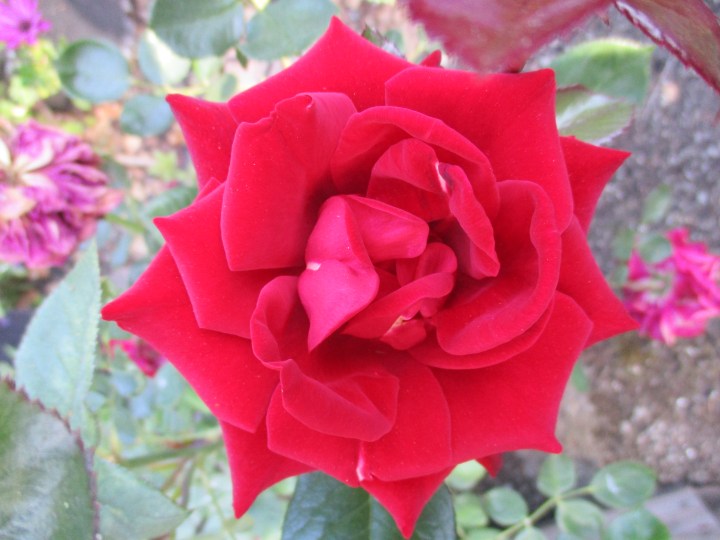 Roses are not for the meek. They are too demanding, too sensitive, too thorny, and without their flowers, they are not even very attractive. They have no business in a low-maintenance landscape, or in a landscape maintained by mow, blow and go gardeners. Those who want to grow rose plants for their flowers should be ready to give them what they want, and to prune them aggressively.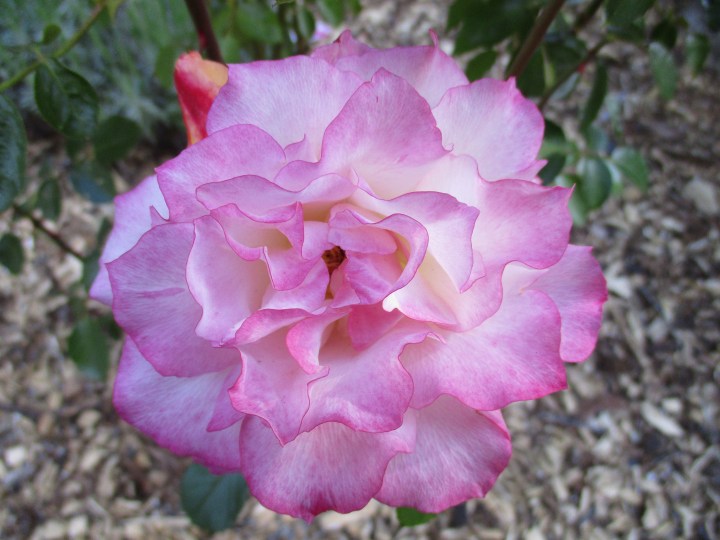
 Pollarding and coppicing are proper pruning techniques. If you think you are an arborist who believes otherwise, do not waste my time arguing about it. More than likely, you are neither as educated nor as experienced as I am with such matters, or you work exclusively with trees for which such procedures would be very inappropriate.
 This is the beginning of one of several new knuckles on a pollarded crape myrtle tree that was pollareded for the first time just this past winter. It was quite a mess of thicket growth that was too congested to bloom well. It is also located in a confined situation where it could not just be groomed, pruned up for clearance, and then just left to develop a larger canopy higher up. Pollarding will both contain it, as well as invigorate healthier growth.
 Scheduling of gardening chores is as important now as it ever was. We plant warm season vegetables and annuals in time for spring and summer. We plant cool season vegetables and annuals for autumn and winter. We pick flowers as they bloom. We harvest fruits and vegetables as they ripen. We watch the seasons change on our calendars, as well as in the locally specific weather.
 There is no sugaring season here. Spring comes on too suddenly. By the time sap starts to flow, buds are already swelling.
 There may not be exceptions to every rule, but there are a few exceptions to the rule that winter is the best time for pruning. It is generally true that most plants are the most dormant through the coolest part of winter. It is also true that while they are the most dormant, most plants are less sensitive to pruning, as well as other horticultural techniques that interfere with their normal function.
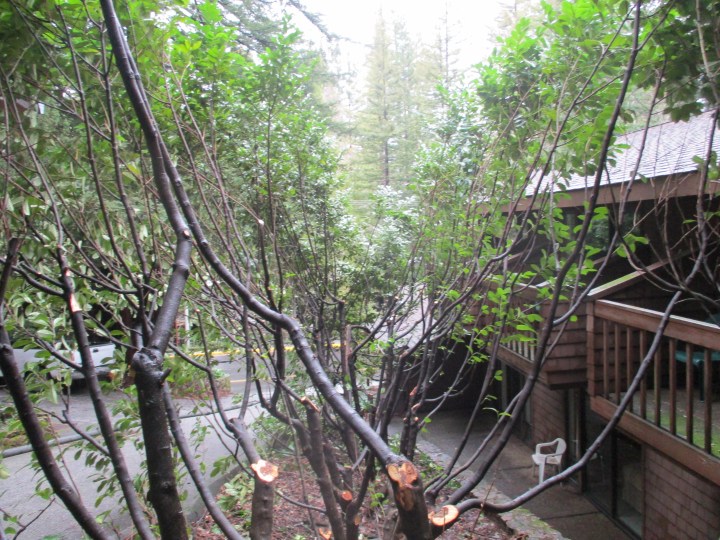 What makes this Bullwinkle worse than most is that I pruned it like this myself. What makes it worse than worse is that it did not need to be pruned in this disfiguring manner for clearance from utility cables like the last one I wrote about was.
  This theme may be getting a bit redundant about now. There is just so much that needs to be done in the garden through winter for what will bloom in spring and summer. We plant new fruit trees, and prune mature ones. When we finish planting spring bulbs, we can start planting summer bulbs. Berries, rhubarb and grapes all get planted. With all this going on, it is also time to prune roses.
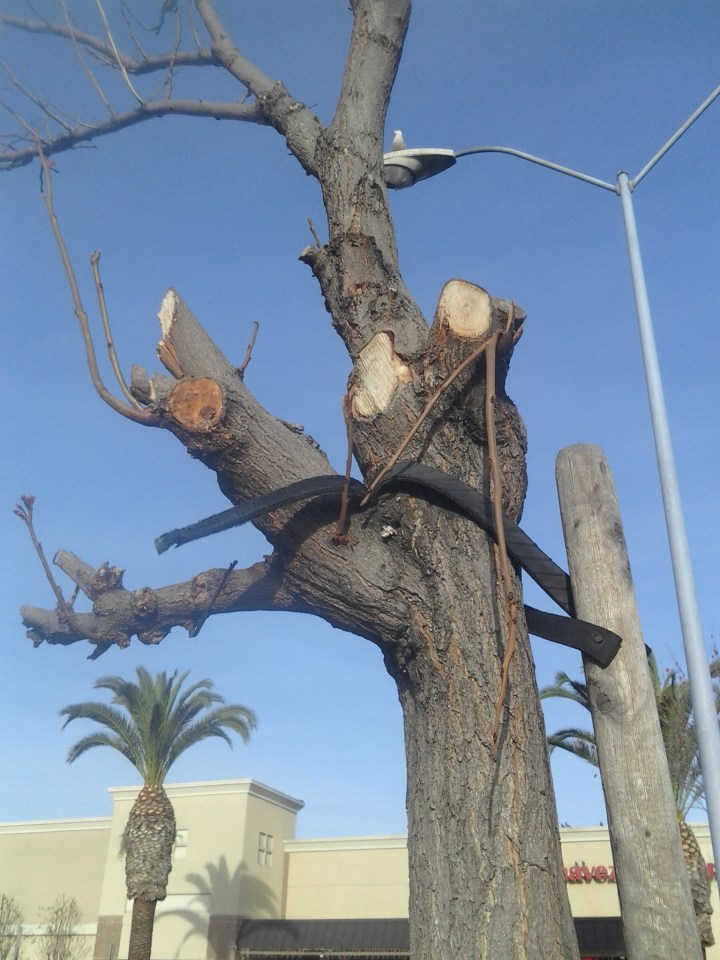 Okay, we get it; someone really hates trees. That’s fine. Trees are not for everyone. Just cut it down. Put it out of it’s misery. Take away the useless lodgepole stake and strap along with it. Maybe those Canary Island date palms that look like the home of SpongeBob SquarePants in the background will recover from their own form of abuse to compensate for the loss of this seemingly unwanted goldenrain tree.
 Tony Tomeo