 This rant may not go in the direction you expect it to. The pictures suggest that this would be about the bad vegetation management crews who severely disfigure trees that get too close to utility cables. It is not.
This is about horticultural ‘professionals’ who plant trees where they will encroach into utility cables, with no regard to what might eventually be done to them in order to keep electrical service reliable and safe. The native oak in these pictures likely grew from seed, so unless someone knows the squirrel who buried the acorn, there is no one to blame. Many of us who enjoy home gardening are sometimes not aware of how tall and wide particular trees can get when we plant them. Horticultural ‘professionals’ should know better! That is what they charge so much money for when they design a landscape.
Palm trees are the worst! They grow only upward, with only a single terminal bud. Once that terminal bud encroaches into a utility easement, there is no option to prune back to another branch that might direct growth around the easement. ‘Pruning’ the only terminal bud back kills the entire tree. Yet, some landscape ‘designers’ continue to prescribe the all too trendy queen palm for the backsides of urban landscapes, even if utility cables are back there like they so typically are.
The oak in these pictures got a Bullwinkle cut, with big ‘antlers’ reaching upward and to the left and right of cables that are directly above. The lower picture sort of shows a ‘step back’ cut into the top for clearance from other perpendicular cables that pass over that edge rather than directly above. The tree is in surprisingly good condition, and gets pruned as properly as possible for the difficult circumstances. This brief article from a few days ago discusses a few more details about easements. https://tonytomeo.com/2018/08/02/easements-really-should-be-easier/
Horridculture – Neapolitan
 Baldness was not yet cool while Brent and I were studying horticulture at Cal Poly in San Luis Obispo back in the late 1980s. Nor were hairpieces yet tacky. Consequently, some middle aged men work toupees. As these men aged and grayed, their formerly well matched topees did not.
Hedges of Pittosporum tobira ‘Variegata’ are notorious for developing green sports (unvariegated mutant growth). https://tonytomeo.com/2018/07/04/horridculture-mutants/ Because gardeners do not prune these sports out, they become prominent green blotches in otherwise nicely variegated hedges. Pruning large blotches out would only leave big bald spots. That is why such hedges, as well as similarly blotched hedges of other variegated plants, are known as ‘bad toupee’ hedges.
‘Neapolitan’ hedges are a variant of that concept. They are not composed of formerly identical plants that later challenged their respective identities. ‘Neapolitan’ hedges are actually composed of different plant material that has been shorn together. They sometimes develop as feral plants grow up and into formerly uniform hedges. They are often composed of what should have been distinct plants within a well designed landscape, that were merely shorn collectively by ‘gardeners’ who simply did not care.
This hedge in a median of a driveway into a mall in town is a classic example of the latter. The landscape designer likely intended the deep green Burford holly, Ilex cornuta, to develop naturally as dense and low mounds between the more upright variegated holly olive, Osmanthus heterophyllus ‘Variegatus’. Apparently, it is too much to expect a well paid ‘gardener’ to figure that out. Fortunately, this particular ‘Neapolitan’ hedge happens to look good in this particular application, but would look better if the ‘gardener’ would replace the variegated holly olive that has been missing for years from the gap between two Burford hollies to the left.
Horridculture – Reputation

I earned it. For several years, back when newspapers were composed of a rather ingenious combination of both news and paper, I was a respected garden columnist, as well as a respected horticulturist and arborist. Of course, I was an a horticulturist and arborist first. I later started writing my garden column because I wanted to do better than what the professional columnists who lacked practical experience with horticulture were doing.
For someone who would have preferred to simply grow horticultural commodities back on the farm, the notoriety was an odd fit. I was often asked to be a guest speaker for all sorts of garden clubs, and to write about their events. For a few years, I was a guest of honor and staffed a gardening question booth at Spring In Guadalupe Gardens in San Jose. It was awkward to walk from where I parked to the booth, past a dozen or so posters with my picture and various quotes on them.
People read my gardening column because they wanted accurate and relevant information. Although I was not proficient at writing, I managed to maintain my integrity as a horticulturist and arborist. My expertise was respected.
Then, a ‘colleague’ who wanted to capitalize on my notoriety convinced me to work for him while he established a website for me. I agreed, along with the stipulation that the website conform to my discriminating standards.
That stipulation was ignored. The website was embarrassingly flashy, with pictures of tropical plants that would not survive as more than houseplants in California. The grammar and spelling were deplorable. Articles were modified to be relevant in any season, just in case, for example, someone was worried about frost in the middle of summer. My ‘manager’ was not at all concerned with horticulture, but was instead more interested in installing advertisement for his products into the website.
About that time, I was invited to install a landscape into the 2009 San Francisco Flower and Garden Show. I would have declined, but was encouraged to compose a landscape to promote the new website. The landscape was ‘adequate’, and did happen to feature an excellent reproduction of an old windmill that my ‘manager’ happened to procure. However, the real priority was showcasing the products that my ‘manager’ was marketing, including a rainwater harvesting system. Within our limited space, we had a big black vinyl water tank! Instead of getting a vendor booth at the show, he used the landscape to pimp his products and services! It was mortifying! The fact that my modified design won awards seemed to make it even worse, as if to justify out extreme gaucheness!
It took a few years and the assistance of an attorney to get the ‘manager’ to close down and delete what was supposed to be my website, but was merely a collection of links back to websites and advertisements for what the ‘manager’ wanted to sell. Otherwise, anyone searching for me online would still be directed to products and services that I want nothing to do with, but seemingly endorse. Even now, these two images above and below would be at the top of the list of a search for images of Tony Tomeo on Google. They are from the 2009 San Francisco Flower and Garden Show, and are now associated with a website with which I have absolutely no affiliation. I want nothing to do with such unethical standards.
The picture above was taken within the landscape just before the Show opened to the public. The black vinyl tank is visible in the background. The picture below was taken during the assembly of the landscape, before I had shaven and gotten appropriately dressed.

Horridculture – Ethics
 Before I continue, I should mention that I have worked for some of the BEST horticultural professionals in the entire Universe! Seriously! I have worked for the single most excellent nurseryman EVER, and not one, but a FEW of the most excellent arborists EVER! YES, I am bragging! I can write about some of them another time.
I have also worked for some of the worst, including those who were involved with the maintenance of landscapes associated with various residential sites that were in the process of being renovated or demolished and redeveloped at the old Fort Ord. They engaged in more unethical activity at Fort Ord than I can write about in just a few articles. For now, I will just rant about one such incident.
Back in about 2007 or 2008, I was asked to go out to investigated a distressed ‘Marina’ madrone on Abrams Drive. The subject was easy to find because is was the only nearly dead tree within a remarkably uniform row of very healthy ‘Marina’ madrones. It had been too severely ravaged by a severe infestation of aphid to be salvaged. I prescribed removal and replacement with a new specimen of the same cultivar.
I was annoyed that the removal of this single tree would ruin the otherwise perfect uniformity and spacing of the row of trees that had been so well maintained for many years. I was even more annoyed that the people whom I worked with had not noticed that the tree was distressed before it succumbed to the aphid infestation. Aphid is not normally much of a problem for ‘Marina’ madron. It was obvious that the subject had been deteriorating for a few years before it finally succumbed, and would have exhibited very obvious symptoms of distress for at least the previous few months. Someone should have noticed a problem during that time. That is part of what the clients had been paying us significant amounts of money to do.
All that I could do was write my report to recommend removal of the subject so that the client could justify the expense.
The following week, on my way down Abrams Drive to investigate another problem, I noticed that the subject had not yet been removed. However, one of the trees next to it was missing. I stopped to investigate and found a stump with fresh sawdust. I called the project manager, but before I could ask about the missing tree, was informed that the subject had been removed. Well, one can guess what happened. The ‘tree crew’ removed the wrong specimen!
My report was very specific about the location of the subject, and cited the subject’s identification number. Now, even without that information, it should have been EXTREMELY obvious which tree needed to be removed. As I said earlier, I had no problem identifying it as the only nearly dead tree within a very uniform group of very healthy trees. Someone on the crew who removed it, or the project manager who was supposed to ‘manage’ the project, or ANYONE involved with this removal should have noticed that the wrong tree was getting cut down. Even if no one bothered to notice the dead tree that really needed to be cut down, someone . . . ANYONE of the so called ‘horticultural professionals’ should have wondered why such a remarkably healthy tree was being cut down.
So, the ‘tree crew’ returned and cut down the original subject, and actually did so with their second attempt.
Then the two trees needed to be replaced. It sounds simple enough. The problem was that these particular ‘professionals’ knew of only a few trees, and ‘Marina’ madrone was not one of them. They replaced the removed trees with the ubiquitous crape myrtle, which completely ruined the conformity of the otherwise uniform row of ‘Marina’ madrone.
The client was billed for it all.
They payed for the removal and replacement of a tree that they had already payed a significant amount of money for, to be maintained properly so that this sort of thing would not happen.
They payed for the removal and replacement of a tree for no justifiable reason . . . just because NO ONE involved could identify the difference between a healthy tree and a nearly dead tree.
In the end, the client payed a lot of money to get their formerly exemplary trees replaced with the wrong trees.
Horridculture – Rose Colored Glasses
This article reminded me of a sore subject from back in about 1986 that continues today: https://wordpress.com/read/blogs/7890212/posts/4888 You should probably take a look at it before you continue.
Back when my colleague and I were roommates in the dorms at Cal Poly in San Luis Obispo, we noticed how badly the photographs in bare root catalogs had been modified to enhance color. Years before modern digital editing, colored film was cut out to any desired shape and placed over a photograph to produce a new photograph with enhanced color. We looked at pictures of flowering crabapples with canopies that were entirely bright pink, including the stems, leaves and everything associated with the canopy of the tree. We could easily see the outline of the bright pink film that had been placed over the original photograph. It was done with blue fescue, hydrangeas, azaleas, callas and really just about anything that could benefit from a bit of enhanced color.
It certainly did not dissuade us from our interest in the plants that had been photographically enhanced. We liked them anyway. The poor quality of the enhancements that would be laughable by modern standards seemed to be more acceptable back then; like the idealistic pictures of the food available from popular fast food establishments. I mean, we all know that the food does not look like ‘that’ but it probably tastes like ‘that’ looks.
Three decades later, modern technology of digital editing of photographs (if they are still known as ‘photographs’) has improved the technique of color enhancement significantly. Most pictures in catalogs are now enhanced to some degree, not to be deceptive, but to eliminate minor glitches that might distract from the rest of the image, and perhaps to enhance color that is slightly compromised by the exposure at the time the picture was taken.
But of course, there are some images that are blatantly inaccurate and deceptive.
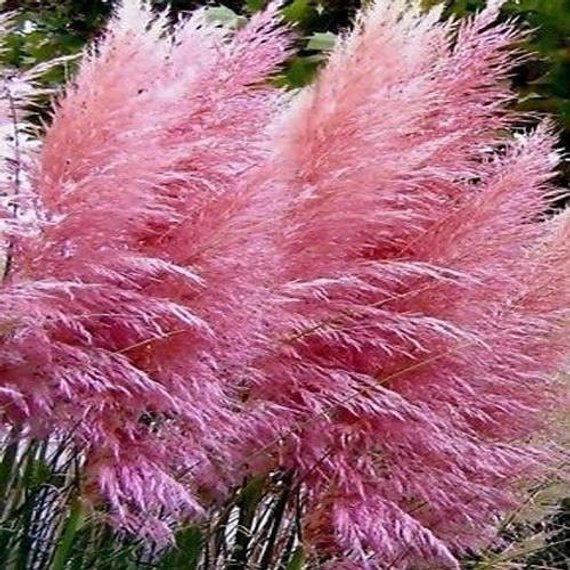
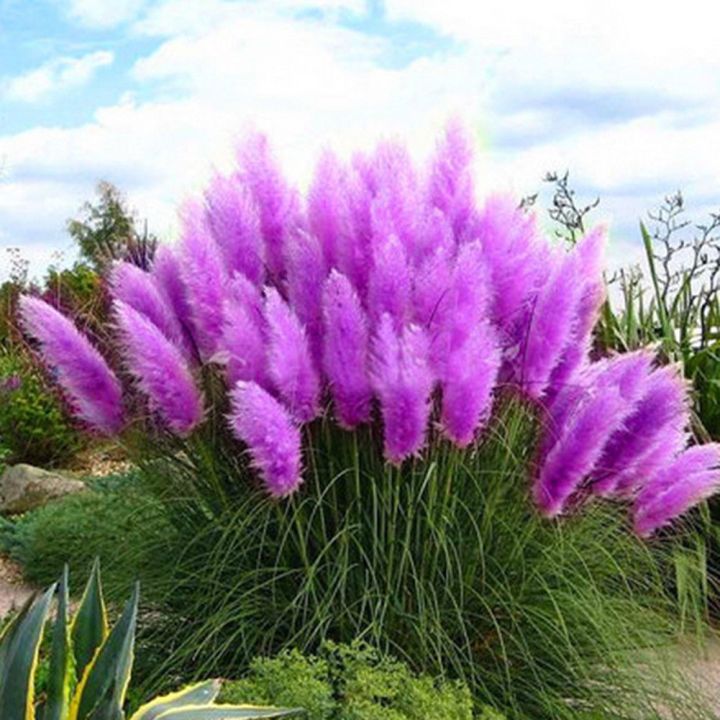
My colleague down south tells me that pink pampas grass can be about as peachy pink as cantaloupe is. It could possibly be more pink in other regions. I have never seen it more than simple pinkish tan here. I know of no one who has confirmed that it can be as bright cotton-candy pink as it is in the picture above. Is it inaccurate and deceptive? I do not know. I do not really care. If I wanted pink pampas grass, I would purchase it anyway, and just try to not be too disappointed when it blooms tan.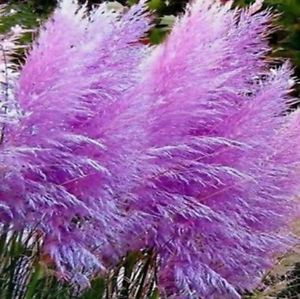 This picture above is certainly interesting as well. It is such an appealing color. What is more interesting it that it is the exact same picture as the picture on top, but is merely a different color. I have never heard of a pampas grass doing that! It must be quite common though. Online, there are a few pictures of other pampas grass doing the exact same thing. These two below, for example, are the exact same picture in two different colors, and with slightly different proportional modification.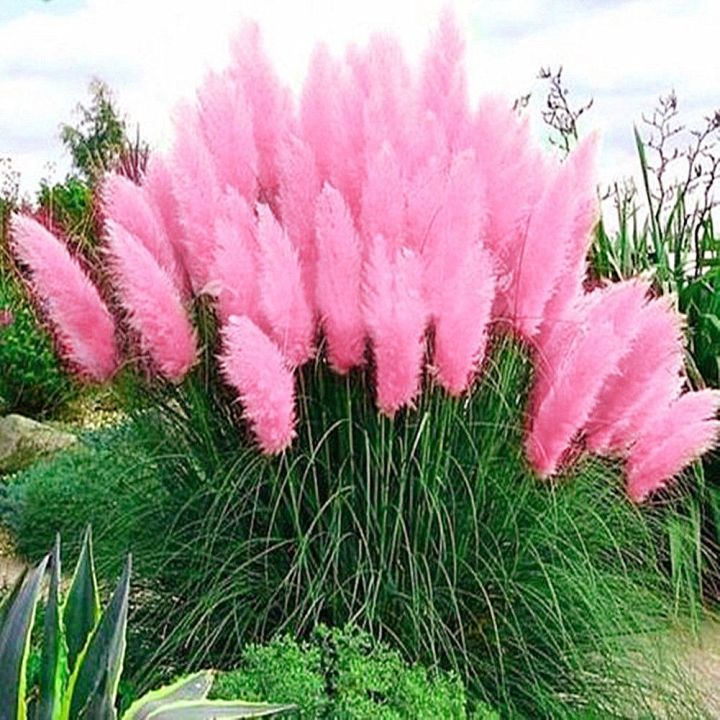
 As amusing as these pictures are, they are not as downright KRAZY as the rainbow rose in the article that I posted a link to above is. It is certainly worth taking a look at.
Horridculture – Mutants
 Mutants are the source of many of our favorite cultivars of otherwise simpler specie. Many cultivars of plants with compact, pendulous or fastigiate (strictly vertical) growth, or variegated, bronzed, golden or otherwise abnormally colored foliage, were derived from ‘sports’, which are mutant stems that appear on otherwise normal plants. Thornless blackberries were sports of thorny cultivars. Fruitless mulberry is a sport of white mulberry. There is no shortage of mutants.
https://tonytomeo.wordpress.com/2018/05/07/cultivars-are-the-real-cloned-mutants/
https://tonytomeo.wordpress.com/2018/05/06/sport/
By nature, mutants are genetically unstable. A few can easily mutate back to their original and more genetically stable characteristics. Variegated plants are notorious for developing simple green unvariegated foliage. Because it has more chlorophyll, the unvariegated foliage grows faster, and has the potential to eventually overwhelm and replace the variegated foliage. That is why green sports should get pruned out of variegated plants.
‘President Roosevelt’ is the most popular of the few variegated rhododendrons. In nursery production, it gets pruned somewhat regularly to remove green sports. Variegated specimens are rare in landscapes because almost all revert to unvariegated foliage within only a few years.
‘Yellow Wave’ is a cultivar of New Zealand flax with pendulous yellow striped foliage. It can be seen in front of the upright greener foliage in the background. These are not two separate plants stuck together. The more vigorous green foliage is a reverting sport that should have been removed by the ‘gardener’ who is supposed to be ‘maintaining’ this landscape. The green sport is now so developed that it can not be removed without damaging the rest of the ‘Yellow Wave’ growth. It will undoubtedly be left to overwhelm and replace it. Fortunately, the upright green foliage is about as appealing as the ‘Yellow Wave’, so no one will notice the inadequacy of the maintenance. No one ever does.
Horridculture – The Wrong Plant In The Wrong Place
 This is the opposite of the ‘right plant in the right place’. It is something that horticultural professionals should neither promote nor tolerate when feral plants appear in landscapes that they are getting payed to maintain. This example looks like it is more relevant to the topic of ‘Fat Hedges’ from https://tonytomeo.wordpress.com/2018/06/06/horridculture-fat-hedges/ , but there is more to this feral pyracantha than that. Yes, it is shorn too frequently to bloom or produce colorful berries. Yes, it looks like an upside-down and halfway buried Christmas tree. Yes, it contributes nothing to the landscape. What is worst of all is that it does not even belong there. It was certainly not planted there on the edge of the curb. There are others nearby, but they happened to appear in spots where they could have actually been assets to the landscape if they had not also been shorn into this weird upside-down and halfway buried Christmas tree shape.
Pulling or at least cutting weeds is generally one of the responsibilities of maintenance ‘gardeners’. It might be acceptable or even preferred to leave a few feral plants if they happen to appear where they might be useful. Those that appear where they would be a problem must be removed. It really would not have been much work to pull this particular pyracantha if it had been done when it first appeared. Even if it had not been pulled right away, and gotten cut down by a weed whacker long enough to develop strongly attached roots, it could have been dug out while young with only a bit of effort.
Okay, so that is in the past now, just like all the other days, weeks, months and years that this feral pyracantha was not removed. Okay, so if for some reason known only the maintenance ‘gardener’ who likely charges significant fees for the maintenance of this landscape, this specimen is to be salvaged, should it not have been pruned back away from the curb? Of course! Although it is right on the curb, much of the growth could have been directed back away from the curb and over the bare embankment. That area is not used for anything anyway. The emptiness of the embankment is certainly no asset to the landscape. Empty pavement is an asset here.
A chain is only as strong as the weakest link. A driveway is only as wide as the narrowest part. All this asphalt pavement and concrete curb is expensive. It was probably worth it to get a nice wide driveway. However, the usable area is not as wide now as it was originally. The feral pyracantha that looks like an upside-down and halfway buried Christmas tree extends nearly four feet into it. That means that the usable space of the expensive driveway is nearly four feet narrower in that spot than it should be. Just think of all the expense that could have been saved if the driveway had been constructed four feet narrower than it had been!
Horridculture – Stub
 How can a professional ‘gardener’ leave such a stub on the little California black oak in Felton Covered Bridge Park. It is not as if it is high in the canopy of a large tree, and out of reach to an arborist. This one is right at eye level, exactly where someone getting out of a car parked in the adjacent parking space would run into it. The entire tree needs some major corrective pruning, which would include the removal of significant limbs and portions of the canopy, but that is only because of years of neglect, and is another story. Right now, we are focusing on the eye-level stub.
It is not easy to see in these pictures because the lower branches are so congested. The stub extends from the lower left to the upper right in the first picture. It is right in the center of the second picture, protruding upward and to the left of the trunk, and then kinking back to the right. The last picture shows how easy it would be to reach from the ground. This particular tree is located right across from the Memorial Tree. https://tonytomeo.wordpress.com/2018/04/15/memorial-tree-update-to-the-updated-update-etc-the-sequel-to-all-those-other-sequels/
We are always taught to not leave stubs. They interfere with compartmentalization of the pruning wound, or in this case, grow back into a disfigured wad of useless growth that will just need to be removed later. This poor tree already has plenty structural problems. Even if it were not unhealthy for the tree, it is just plain unsightly. Seriously, this looks ridiculous.
‘Gardeners’ do it all the time, as if they all take the same class on ‘how to leave stubs’. What was the advantage to cutting the limb right there instead of two feet closer to the trunk to eliminate the entire stub?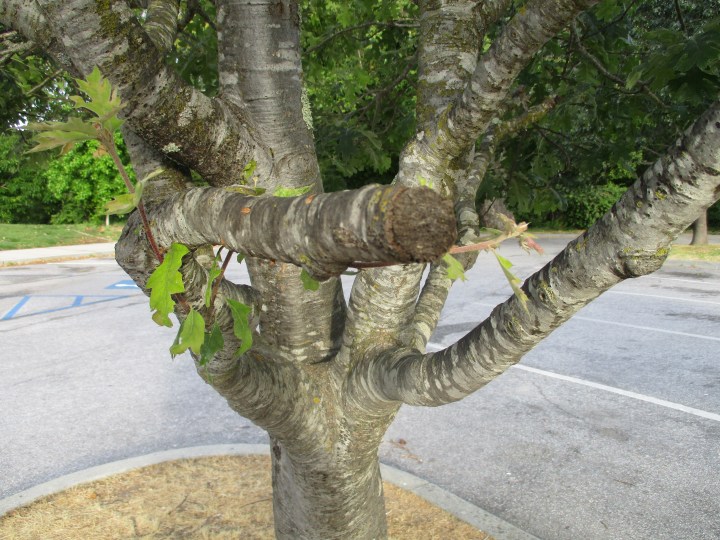

Horridculture – Satellite Dish

Satellite dishes, tater tots, fish sticks, soldiers, flat tops, gobstoppers, corks, oil tanks and trip hazards are just some of the many but less objectionable names that my colleague down south and I have developed for what should be good shrubbery, trees, vines or whatever that so-called gardeners got to with their hedge shears. Tater tots are usually Heavenly bamboo shorn into stout cylinders. Fish sticks are the same, but taller, narrower, and often composed of Podocarpus macrophyllus. Corks are commonly breath of Heaven, but could be just about anything shorn to be somewhat cylindrical, but narrower down low, and wider on top. Trip hazards are ground cover plants like creeping California lilac or creeping cotoneaster, shorn into absurd low hedges next to sidewalks. Gobstoppers could be just about anything, but tend to hang over the curbs in parking lots, ready to impale a radiator grill with a gnarly stub. You can use your imagination for soldiers, flat tops and oil tanks. You probably can not conceive anything more absurd than what my colleague and I see on our job sites.
‘Garage sales’ are probably the worst. They are a variety of plants that were probably intended to function as a practical landscape, but instead got shorn collectively into a large thicket of mixed foliage that rarely gets the chance to bloom. Bougainvillea, New Zealand flax, jade plant, pampas grass, wisteria, fruit trees and even the occasional century plant; anything goes! If the so-called gardeners can reach it, they will shear it.
The original satellite dish was a carob tree in Westchester. I first saw it in the early 1990s, when some homes that had a bit of space to spare were still outfitted with huge parabolic satellite dishes, before the much smaller ones that can be mounted on roofs were invented. This tree had a normal trunk that went up into a remarkably flat ceiling under which no foliage was allowed to hang. This ceiling was only about seven feet above the lawn below. Above that, there was a remarkably symmetrical but low dome of very tightly shorn foliage that looked something like a downward facing satellite dish. This dome was perhaps twenty feet wide, but less than four feet from top to bottom. So, with seven feet of clearance above the lawn, the entire tree was no more than twelve feet tall, barely higher than the eaves of the home behind it. I really wish I had a picture to share. Who puts so much work into ruining a tree?! Maintaining it properly would have been much less effort.
Earlier, we discussed renovating overgrown shrubbery as small trees. https://tonytomeo.wordpress.com/2018/05/21/overgrown-shrubbery-becomes-small-trees/ . The satellite dish was the exact opposite of such useful procedures. What is the point of planting trees and then not allowing them to develop as anything more than abused shrubbery?
The pair of satellite dishes in the picture above are Japanese maples. Their canopies are about the same depth as that of the carob tree in Westchester, but are only about half as broad. What is the point of planting Japanese maples if they are not allowed to look like Japanese maples? They look ridiculous. What is worse is that someone puts significant effort into making them look so ridiculous. They would be so much prettier if pruned only very rarely, and only for clearance above the driveway and away from the building behind. Such pruning would have been less work than shearing these disgraced trees just once.
Even more effort goes into humiliating the plants in the picture below. The fish stick to the upper right is a wisteria vine that is not allowed to bloom or climb onto the trellis that was built for it (which is not visible in the picture). The trip hazard to the lower left is some sort of lavender that is not allowed to spread out over the bare soil as it was intended to do. The cork in the middle is a New Zealand tea tree that can never develop the gracefully irregular canopy and sculptural trunks that it would be pleased to display. It is just a cork.
Horridculture – Fat Hedges

This is the first article within the designated ‘rant’ format, that will continue each Wednesday. Articles for the other six days of the week will be more cheerful, or at least less objectionable. These articles may not always be rants, so might alternatively include discussions of particular fad, trends, gimmicks and so on. Perhaps some topics will remain just that; discussions in which the advantages and disadvantages of a particular subject are compared. Categories may develop, so besides ‘Horriduclture’, there could be a category for discussions of fads, for example. This is a new format for me, so I will keep it open to modification, and see how it goes.
Fat hedges are one of my serious peeves!
Hedges done properly are very useful landscape features, that provide privacy, obscure undesirable views, muffle outside sound or simply divide a large garden space into smaller garden rooms. Landscape designers know how to use them, and are good at planning their locations and orientations, as well as designating the plant material to be used for particular hedges. Some informal hedges or screens are outside of useful space, where they have plenty of room to grow plump and wild without becoming obtrusive. Formal hedges are those that require shearing for confinement within limited space.
Fat hedges are those that are designed to be contained, typically by formal shearing, but are instead allowed to encroach into the usable space within the landscape that they are designed to enclose. They can be a serious problem in confined garden space, and sometimes occupy most of the space themselves.
Seriously, they are very often several feet deep (from front to rear). Fat hedges on either side of a small garden room that is only about twelve feet wide can easily occupy more than half of the area. Think about it. If each hedge is just three feet deep, and there are two hedges, that means that six feet of the width of the twelve foot wide space is occupied by fat hedge! That is half of the area available! Some fat hedges are even deeper! A fat hedge does nothing more than a properly maintained hedge. Really, a three foot hedge accomplishes no more than the same sort of hedge that is only one foot deep. The interior is only bare twigs.
Fat hedges are mostly the result of inept gardeners who allow the hedges to gain a bit more width with each shearing, without ever renovating overgrown hedges. To make matters worse, they allow the tops of the hedges to get wider, which shades out lower foliage, which becomes sparse. Then the fat hedge becomes a top heavy hedge, leaning into usable space where it should be leaning slightly away. Ends of top heavy hedges often protrude a bit more than the sides of the hedges. If these hedges flank a driveway or walkway that is perpendicular to the sidewalk or a patio, the distended end is particularly obnoxious.
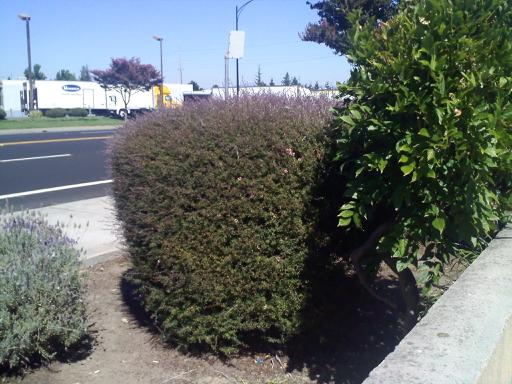
In the picture above, the low hedge seems to be well maintained. If it is a fat hedge, it is in a situation where it is not really crowding much. However, notice the width of the sidewalk. It is quite broad. Then there is a significant constriction where the hedge protrudes over the sidewalk. What is the point of so much concrete and such a wide sidewalk if almost a quarter of the width of it is overwhelmed by vegetation? It is like four lanes of freeway that merge into three, only to merge back into four.
 Tony Tomeo