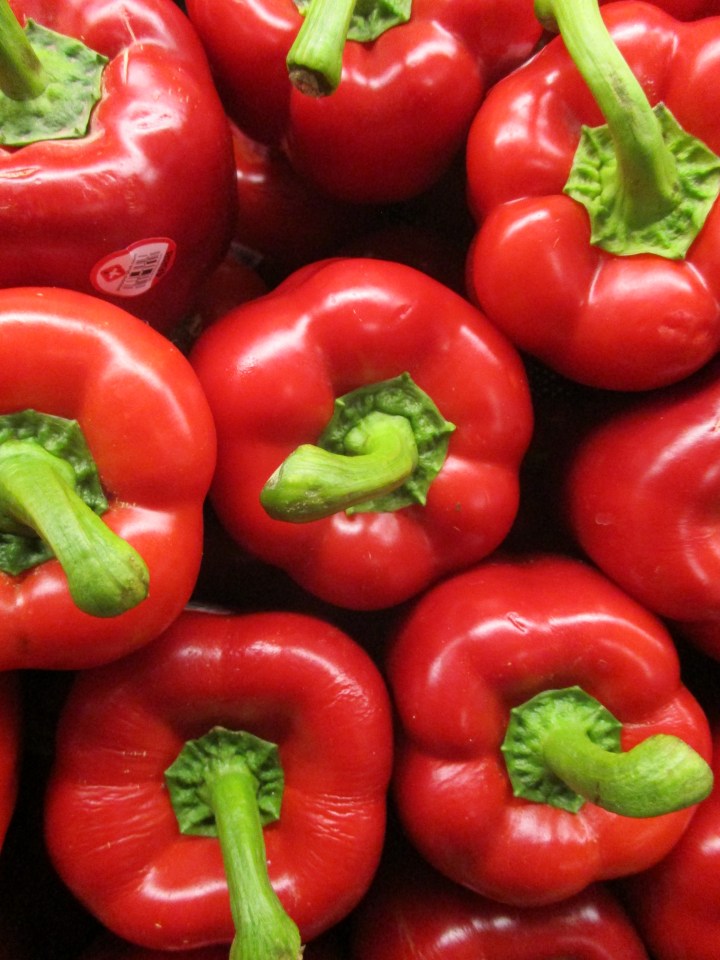
Sweet bell peppers are actually more of a challenge to grow.
This illustration is relevant neither to the topic, nor to that really creepy rock band of the same name. Even though the band has been popular since I was in high school, all that I know about them is that I am none too keen on their music. Embarrassingly, I do not know much more about the topic, and it has been a hot topic much longer than I have been growing my vegetables.
Vegetables make no music of course. I just mean that I am no more familiar with contemporary cultivars of hot pepper than I am with music that I do not appreciate. I happen to appreciate some types of peppers, and some of them happen to be hot peppers. However, I have not bothered to get acquainted with those that are so ridiculously hot that I do not want to grow them.
Why should I? What are they good for? Why waste my time, limited garden space and other resources on something that no one wants to eat or add to any recipe? They are not particularly productive. If they were, they would only make more of something that is just as useless as the few that each plant produces. I can not even justify putting effort into finding a picture of one.
Those who indulge in this fad brag about it profusely. They post pictures of their few tiny hot peppers online, with sensational claims that there is nothing hotter. Some post selfies with their free hand dangling one of their weird peppers over their extended Gene Simmons tongue. Some even post videos of their drunken friends tasting their peppers, as if it can not be done sober.
I suppose that, regardless of how pointless it seems to me, it is one way to enjoy gardening.
Almost all of the fruit trees that I encounter are or were neglected to some degree.
Many were planted a long time ago by someone who was able to maintain them at the time, and perhaps for many years, but then relocated, passed away, or just got too elderly as the trees grew and required more work.
Many were planted by those who simply enjoy gardening around their homes, and wanted to grow some fresh fruit, but were not aware of how intensive the maintenance of most of the fruit trees is, or how to execute such maintenance properly.
Many were planted by so-called ‘gardeners’ or so-called ‘landscapers’ who had no intention of actually ‘maintaining’ them, or believed that they could ‘maintain’ them with motorized hedge shears and a blower . . . just like they ‘maintain’ everything else.
There is a young but nicely productive ‘Eureka’ lemon tree at work. I would not say that it is neglected. Someone has been maintaining it well since it was installed. However, I remind others at work to take some of the lemons because the tree gets overloaded with otherwise unappreciated and unused fruit.
The tree is strategically located right outside of one of the big cafeteria kitchens, so that those who work in the kitchen could use the fruit. The kitchen probably uses more lemons that the still young tree could produce, but does not seem to use any from the tree.
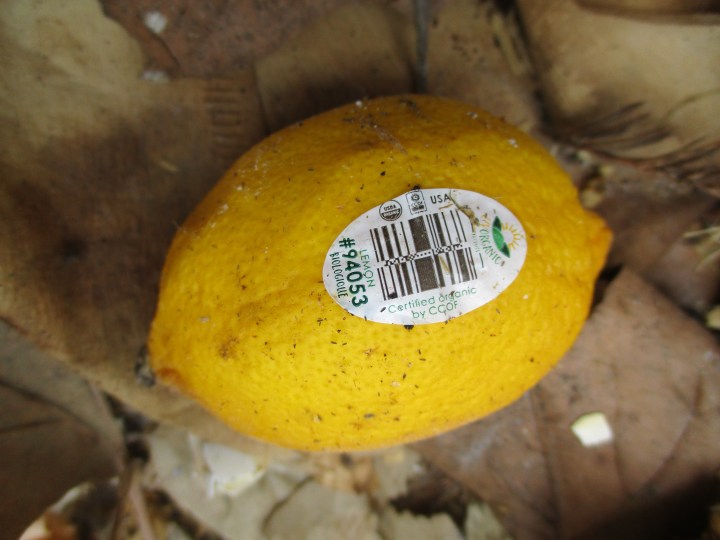
While dumping greenwaste from the kitchen onto the big compost piles, I noticed this labeled but unused lemon. I can not help but wonder why lemons from my tree aren’t good enough, and why this particular lemon wasn’t good enough either. How many of us nowadays would even recognize a lemon tree, or appreciate the fruit that it produces?
This lemon tree right outside of one of the kitchens is loaded with fruit.
I seriously can not think of a title for this one. All that comes to mind is too objectionable. Writing about it will not be much easier.
It began with a few mature camellias that were in need of grooming a few months ago. They were sufficiently shabby that I did not mind pruning them at the wrong time. Ultimately, almost all of what was groomed out was necrotic anyway, so did not compromise bloom significantly. I was pleased that the eventual bloom would be better presented against a neater background.
Then, I was informed that several of the same camellias would need to be removed to facilitate the installation of a new sidewalk. That would have been useful information before I put such meticulous effort into grooming them. It was briefly annoying; but I did not fret long. I planned to recycle the camellias, and realized that I would have groomed them in the process anyway.
At the time, there was no rush. I thought that the camellias would get to bloom prior to relocation. In the meantime, someone else removed a rotting madrone stump nearby. I thinned and groomed a sloppy filbert into an impressively tailored specimen. Immediate relocation of the camellias was not yet a priority. We had not even identified the precise location of the sidewalk.
Then, there was another disappointment. The project was unexpectedly scheduled immediately after another nearby project that would be completed in only a few days. It would have been more expensive for the crew to leave after finishing the primary project, and then return for the secondary project. I might salvage the camellias, but I knew I could not salvage their bloom.
That is not the worst of it. After planning to relocate the five or so offending camellias on Wednesday or Thursday, I was informed on Tuesday morning that three had already been removed by the backhoe operator who had removed old concrete pavement from the other nearby project. By removed, I mean they got torn mercilessly from the ground and completely destroyed.
One of two relocated camellias demonstrates how mature the three that were needlessly destroyed were, although they were not so broad. That is a shovel handle in front.
No other excavation was done. Asphalt pavement and a curb that need to be removed remain intact. The unwanted ivy is just as unwanted and intact as it was before this weird incident, as if nothing happened. The craters where the camellias got gouged out are barely visible. The only other damage was the mutilation of my well groomed filbert, which was not even in the way.
It was as if the camellias were targeted. Two survived only because someone arrived on site to stop the backhoe operator from destroying them also. There was no regard for any associated subterranean infrastructure, such as an irrigation system and electrical landscape lighting. I suspect that the filbert was mangled just because it was too close to one of the targeted camellias.
I tried to conceal my anger as I frantically relocated the two surviving camellias, while the backhoe operator who so needlessly and blatantly destroyed the other three worked with the crew at the other project just a few yards away. I tried to convince myself that the incident was merely an honest mistake. I doubt that the backhoe operator intentionally targeted the camellias.
As I finished, and was calmly leaving the site, something happened that made me realize that perhaps some of my anger was not completely unfounded. I still do not believe that the backhoe operator was intentionally malicious. I realized instead that the backhoe operator, regardless of his intentions, should most certainly not be operating such potentially dangerous machinery.
From where the crew was taking a break, and the backhoe operator seemed to be enjoying a cigarette, a voluminous and aromatic cloud of marijuana smoke drifted to where I could smell it.
What these guys do prior to or after work is none of my business, as long as it does not compromise their safety or rationality. If someone wants to go off and use their so-called medication in private during the day, he should do so discretely and moderately. Someone who can generate such a voluminous cloud of smoke with no regard to what others think about it has a problem.
Someone took the initiative to destroy my formerly well tailored filbert, but not to remove the carcass. I could have left it to regenerate, but I do not want to look at it anymore.
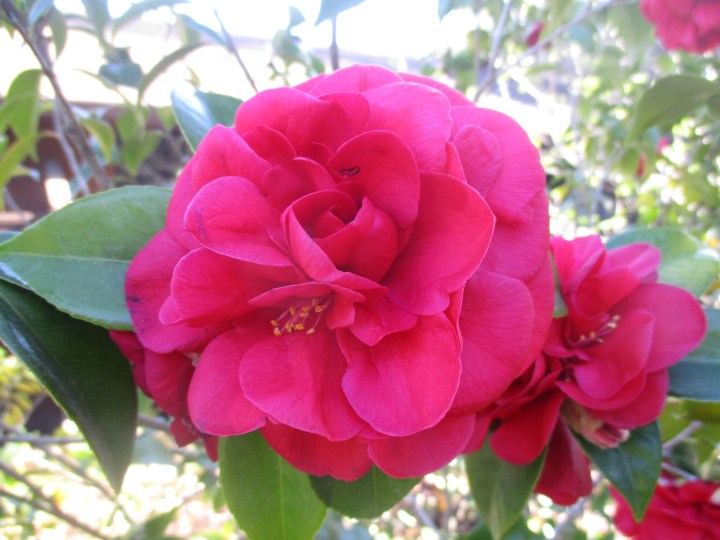
Camellias have been blooming for a while now. I typically get rather good pictures of them. The pictures are nothing too artistic, of course, and are intended to merely exhibit the floral color and form. A bit of the glossy foliage in the background is nice.
The picture above is not so useful for exhibiting much of the floral characteristics. Even the pink color is muted by the sloppy background and gray sky above. Zooming in would not have corrected the positioning of the flowers. I simply could not get close enough to do any better.
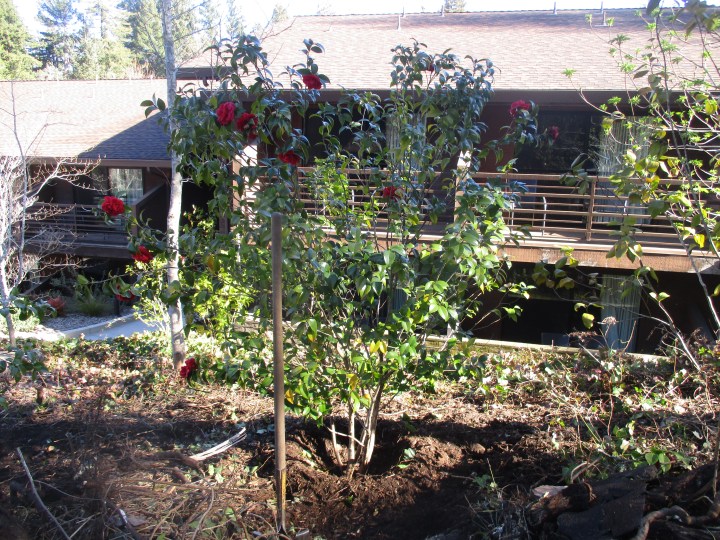
That eave in the lower right corner of the picture is above a two story building. That is where all the blooms of this particular camellia shrub are located. With so much of the lower growth shaded out and gone, this shrub is more like a small tree. The bloom is too high up to be appreciated. The picture below demonstrates what it all looks like without zooming in.
If there were windows facing this big camellia shrub or tree, I would likely prune it only a bit lower, just to keep it below the eave and within view of the windows. Without windows, I know that I really should prune the tall trunks back to what little lower growth remains, in order to promote more growth and bloom closer to ground level where it can be appreciated.
The difficulty I have with pruning it back is that this big camellia shrub or tree is so impressively big and sculptural, and all the glossy foliage looks so good in the foreground of the rich dark brown wall. I do not know what is more important here, the sculptural limbs and rich green foliage that lasts throughout the year, or the colorful but seasonal bloom.
No, that is not backward. It refers to a legendarily disastrous incident with artificial turf at the Morgan Hill Outdoor Sports Center. Prior to about 2010, while I was the only horticulturist on a big staff of a big so-called ‘landscape’ company that expressed almost no interest in horticulture, I was summoned to the site to investigate an ‘issue’. I was told nothing about artificial turf.
Upon arrival, it became immediately obvious that this was no horticultural issue. Wind was generating waves in the recently installed artificial turf that were taller than the unfortunate guy who was scurrying about in an futile attempt to nail the turf surf to the ground. I was dismayed. I know nothing about artificial turf. Why was a so-called ‘landscape’ company even involved?
I suppose I should not have been too surprised. It was not as if many of the rest of our collective staff knew any more about horticulture than artificial turf. They seemed to take me way too seriously when I joked about the special farm that grows the artificial seed for the yellow and white stripes and yard line numbers. Otherwise, I would have told them about blue Smurf Turf.
As much as I dislike it, I know that artificial turf is quite practical for particular applications. However, it is most certainly not a horticultural commodity. It is a synthetic turf substitute that works like carpeting for landscapes and athletic fields. So-called ‘landscape’ companies that maintain it should be qualified to do so, with at least some sort of relevant and practical expertise.
That being said, why is it all green? We all know it is fake, so why not have some fun with the color, like the colorful fake snow on flocked Christmas trees in the 1970s? Some of us might like penalty line yellow. Yard line number white would be my favorite color, but would look like snow, and be difficult to keep clean. I think iron oxide red might be nice, or perhaps simple brown.
Heck, why not mix it up a bit? Sky blue with white clouds might be fun. Black and white checkerboard? Purple swirled with orange? Why not make it resemble a made-in-China Persian rug, with patterns of all sorts of colors?! What about a Gothic cathedral labyrinth? Oh, a road map of Route 66! A map of Kansas might work nicely for a small space. The possibilities are endless!
Artificial seems to be no worse than the real deal.
There is no right answer. For lawns that is. Horticulturists who actually enjoy horticulture . . . and are not specialists of turf . . . loath them. (Yes, there are horticulturists who are specialists of turf.) We merely tolerate them because they are so useful for so many applications, and they do happen to be very visually appealing within or in the foreground of interesting landscapes.
After all, lawns are the vegetative green carpeting that covers otherwise bare ground without interfering with the flow of pedestrian traffic. For parks and other public paces, it is better than other types of ground cover, mulch, pavement or lowly mown naturalized weeds that would grow if nothing else were there to occupy the space. For athletic fields, there are no alternatives.
They are just so unnatural. Most plants in our garden are selected for their natural attributes, and because they appreciate our respective climates and soils. Lawns must be mown regularly because they would otherwise get too deep and sloppy. They must be irrigated very regularly and generously because they can not survive on seasonal rainfall or even moderate irrigation.
In fact, lawns are so unnatural that, to many horticulturists, they are no worse than artificial turf. All the plasticky infrastructure of elaborate irrigation systems, all the chemical pesticides and fertilizers, all the fuel consumed by mowers, all the water, and all the labor that goes into the maintenance of lawns is no closer to nature than artificial turf is. Strange but strangely true.
Artificial turf is no fun either. The plasticky texture is so blatant and unavoidable. Although it needs only minimal maintenance and last for many years, it does not last forever, and slowly deteriorates like carpet. Once replaced with more of the same sort of plasticky artificial turf, it must be disposed of like so much other used up plastic that the World should be using less of.
January 17 is as far as I have gotten with the backlog of articles from blogs that I follow. I am now two and a half weeks behind schedule. Articles are old news by the time I see them. I have been trying to catch up for weeks or maybe months, but have instead been getting farther behind. The video above is from the article I posted back then. There has been no rain since then.
The video also looks like what I feel I am doing to that backlog of article while I skip ahead to current articles beginning with February 5. Flushing them like this seems so negligent. I feel so obligated to read the articles of blogs that I follow. That is why I follow them. However, if I do not flush the backlog, articles that are current now will also be old news by the time I get them.
I have been reading some of these blogs so regularly that those who write them sometimes include notes to me within the contexts of their articles. Sometimes they comment on something that they think I would be particularly interested in. Sometimes they ask questions that they think I might know the answers to, or just ask for a bit of advice. Flushing all that is just wrong.
I have no choice. I have no time for it all. I write my brief gardening articles for more small newspapers than I can keep track of. I still work at a part-time and temporary job that involves maintenance of landscapes and small scale arboriculture because I can not bear to leave! I intend to eventually return to work at nursery production, but have been too overworked to do so.
Meanwhile, former clients and clients of former clients continue to contact me in need of services that I can no longer provide. I can find no one to refer them to for comparable services. All of the best arborists and horticulturists are retired, deceased or too busy (compensating for the lack of those of us who are retired or deceased) to accommodate more work. It is saddening.
On top of all that, I am supposed to be canning cedar trees and plugging sycamore cuttings for street trees in Los Angeles a few years from now . . . and maybe working in the garden?!?!
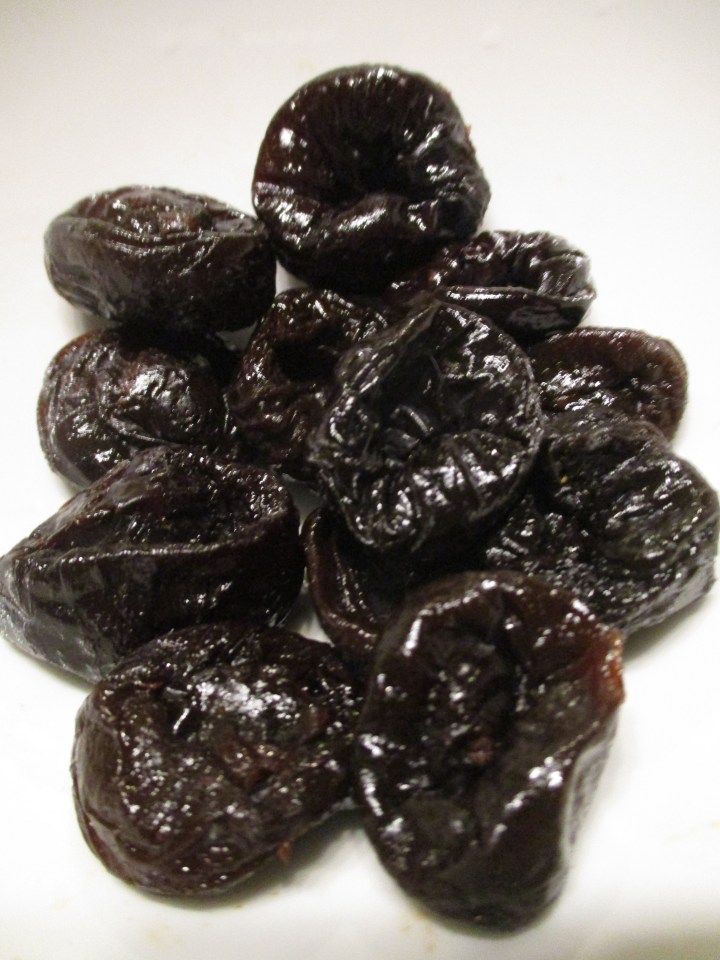
Dried prunes are experiencing something of an identity crisis.
Nomenclature used to be more predictably standardized than it is now. When I write about how it works, I compare it to the names of cars. For example, ‘General Motors’ is just a family. ‘Buick’ is a genus. ‘Electra’ is a species. ‘Limited’ is a variety. Well, my Sebring was labeled as a Chyrsler but made by Mercedes Benz. Modern horticultural nomenclature is no more accurate.
With all the promiscuity going on nowadays, it is impossible to know who the parent of some of our favorite plants are. Many are interspecific hybrids. Some are intergeneric hybrids. Some are so complicated that their species names are merely omitted; and no one seems to notice! That is like driving a Mercury LS without knowing or caring if it is a Grand Marquis or a Lynx.
So, now we can grow such aberrations of traditional stone fruit as as aprium, apriplum, pluot, plumcot, nectaplum, pluerry and peacotum. The first half of the names supposedly indicate who the promiscuous maternal parent is. The second half refers to the male pollinator. Parents who contributed fewer letters to the name were supposedly already hybridized prior to breeding.
For example, an apricot pollinated by a plum creates an aprium; and an aprium pollinated by a plum creates an apriplum. The apriplum gets an extra letter from plum ancestry because it is %75 plum and %25 apricot. A plum pollinated by an apricot creates a pluot; and a plum pollinated by a pluot creates a plumcot. There are, of course, many other complicating combinations.
Sure, the resulting fruit is very good; but is it any better than what it was bred from? If everyone could have tasted the simple, traditional and exemplary stone fruits that formerly grew in the vast orchards of the Santa Clara Valley, there would be no need for all this hooey. Besides, why is there all this interest in creating new and weird fruit while eliminating some of the old?
Prunes and plums, as I explained earlier, are two distinct types of fruits. Japanese plums are the richly flavored and typically more brightly colored fruits that were more popular in home gardens than in orchards, since they are not easy to transport. European prunes are the sweeter but mildly flavored freestone fruits that grew in orchards, generally for drying and canning.
Apparently, the name of ‘prunes’ was not appealing enough . . . or was actually considered to be unappealing. Almost twenty years ago, prunes were consequently reclassified as plums. Dried prunes are now known as dried plums, as if they are dried versions of the classic ‘Santa Rosa’ plums that so many of us grow in our home gardens. Some of them just might be! Who knows?!
Plum juice could be extracted from Japanese plums, which actually make excellently rich juice, but is more likely from fresh (not dried) French or Italian prunes. However, there is still such a beverage that is known as prune juice. It is extracted from, of all things, rehydrated dried plums . . . or dried prunes. These unfortunate fruits get dehydrated, rehydrated, and then juiced!
The juice of rehydraded dehydrated plums or prunes might be the only remaining application of the word ‘prune’. At least it is useful for that; in the sense that it designates the source of the juice as rehydrated dehydrated fruit of some sort, rather than fresh fruit of some sort. Whether such fruit is a plum or what was formerly known as a prune remains something of a mystery.
Growing fruit takes a bit of effort. Trees that produce the fruit must be planted and maintained for all the many years that they produce. They might need to be irrigated through summer. Most need specialized pruning every winter.
Canning surplus fruit takes a bit of effort too. All the jars must be cleaned. All the fruit must be collected, processed and cooked. The jars must be packed and boiled and so on.
Drying fruit is less work than canning, but takes a bit of effort nonetheless.
Where I lived in town, I grew a peach tree closer to the apartment building to the north, and a fig tree closer to the apartment building to the south. I maintained both trees meticulously. Many of the neighbors appreciated the fresh fruit. At the end of their season, there was (almost) always surplus peaches for canning. Sometimes, there were surplus figs for drying.
I really would not have minded if there had not been surplus fruit. It would have been better to have it consumed by the neighbors while fresh, than after it had been canned. Besides, it would have been less work for me.
One summer, there was a major surplus of peaches. We wanted to can them as efficiently as possible because we know how perishable they are. We planned to do all the canning on a Saturday, so got all the jars from the attic and washed them on Friday afternoon. The canning pots and utensils were ready to go. We had purchased lids and several pounds of sugar.
Also on Friday afternoon, the so-called ‘gardeners’ came to the apartment building next door to the north.
The major surplus of peaches, every last peach, was completely gone when we went to collect early Saturday morning.
Now, really, I don’t mind sharing. That is what the tree is there for. I really don’t even mind if a few people want to take all the surplus fruit. I just want to be told about it before I make plans and prepare to do something else with it. What really angered me was the complete disregard for those of us who put the effort into growing all those excellent peaches.
The fig tree to the south produced an early crop of figs before the peaches, and a late crop of figs after the peaches. Each crop lasted a long time, so there were not often too many figs at any one time that needed to be dried. Most were eaten fresh.
I often noticed an annoying absence of figs each day after the so-called ‘gardeners’ came to the apartment building next door to the south. It was not as bothersome as the missing peaches, since I got quite a bit of figs in between. What angered me was that every fig that could be harvested at the appointed time was taken, leaving none for anyone else.
Bare root fruit trees will be available in about a month. It is probably my favorite time of year for going to nurseries. (Since I grow just about everything I want from bits of landscape debris, I do not often go to retail nurseries.) It is also rather frustrating to see what sorts of bare root material are popular nowadays, and what sorts are not. Horticulture has gotten so ridiculous!
Most of the formerly common cultivars of fruit trees that I remember are no longer available. They were common for a reason. They perform well here. Retailers used to select cultivars for their respective regions, instead of pimping out weird new but unproven cultivars, or just taking the same faddish cultivars that get sent to other stores within a vast chain of big box stores.
One of the weirdest of fads are multi-grafted fruit trees and roses.
Multi-grafts are certainly not new technology. Back when horticulture was taken more seriously, fruit trees for home gardens (which might be the only ones of their kind in their respective gardens) were sometimes, if needed, outfitted with a secondary scion of a pollinating cultivar. The pollinator could be pruned low and subordinated, as long as it bloomed with a few flowers.
Most of us preferred to simply plant two separate trees that could pollinate each other. If one was less desirable than the other, it was just maintained as a smaller tree so that it would not occupy so much space that could be utilized by more desirable types. Each tree had its own uncrowded area. If one succumbed to disease, it did not necessarily affect those associated with it.
Multi-graft trees are not so easy. If the trunk of a multi-graft pear tree gets infested with fire blight, all the scions grafted to it succumb. Because almost no one prunes them properly, the most vigorous cultivars dominate and crowd the less vigorous. Even well pruned trees are always asymmetrical because each cultivar exhibits a different growth rate and branch structure.
Multi-graft rose standards (trees) just look weird and freakishly unnatural. Pruning must ensure that one cultivar does not crowd out the other, just like for fruit trees. The multi-graft rose in the picture above was planted with three others just like it. Two of them crowded out one of their two scions. It would have been easier to simply plant two in white and two in burgundy.
Multi-graft plants are useful only if ground space is very limited, but air space is not. For example, such a tree planted in a hole in a deck can extend limbs over the deck where other trees can not live. If maintained properly and separately, each part can produce its share of fruit in season. I once did this with a pear tree that was espaliered on a fence over a concrete driveway.




 Bare root fruit trees will be available in about a month. It is probably my favorite time of year for going to nurseries. (Since I grow just about everything I want from bits of landscape debris, I do not often go to retail nurseries.) It is also rather frustrating to see what sorts of bare root material are popular nowadays, and what sorts are not. Horticulture has gotten so ridiculous!
 Tony Tomeo