 Pluots, plumcots, apriums and peacharines! Who comes up with this stuff?! Aren’t good old fashioned plums, apricots, peaches and nectarines good enough? Who decides that these weird hybrids are somehow better than their parents? Some of them are actually quite weird, or downright ugly. Several do not even look like they would taste good. It may be an acquired taste; but I have all the good taste that I need without acquiring any more.
Some old classic cultivars (cultivated varieties) of fruit were develop centuries ago. More have been evolving from those ancestors since then. Some were intentionally bred from parents with desirable qualities. Others just grew incidentally where their seed fell, and were found to be somehow better than their parents. Some were merely discovered as natural occurring mutants, and perpetuated for their superior qualities. It is a slow process.
So, putting two different kinds of fruits together, or finding an aberration of a single type of fruit, is nothing new. Tangelos were created by hybridizing Mandarin oranges with pomelos or grapefruits. Ever-bearing ‘Eureka’ lemon was perpetuated from a mutant of the seasonally bearing ‘Lisbon’ lemon. This is how cultivars evolve and develop. Generally, newer cultivars become popular because they are somehow superior to their ancestors.
Yes, somehow ‘superior’ to their ancestors. Who decided that a hideous hybrid of a plum and an apricot was somehow better than either a perfectly good plum or apricot? Furthermore, what evidence was there for such a weird claim? Even farthermore (if that is a word) how and why do so many people believe this evidence?
I was still growing citrus (trees not fruit) back in the early 1990s when the ‘Cara Cara’ pink orange was popularized. Yeah, a ‘pink’ ‘orange’. It is really just a pink mutant of the formerly more popular ‘Washington’ navel orange. We could not grow enough of it. It was just too popular. Some people really seem to believe that it is somehow better than ‘Washington’ and other navel oranges. I can’t argue. They certainly know what they like.
To me, it has a milder flavor than ‘Washington’. Yes, it tastes about as bland as it looks; pink.
Horridculture – Unpruned Fruit Trees
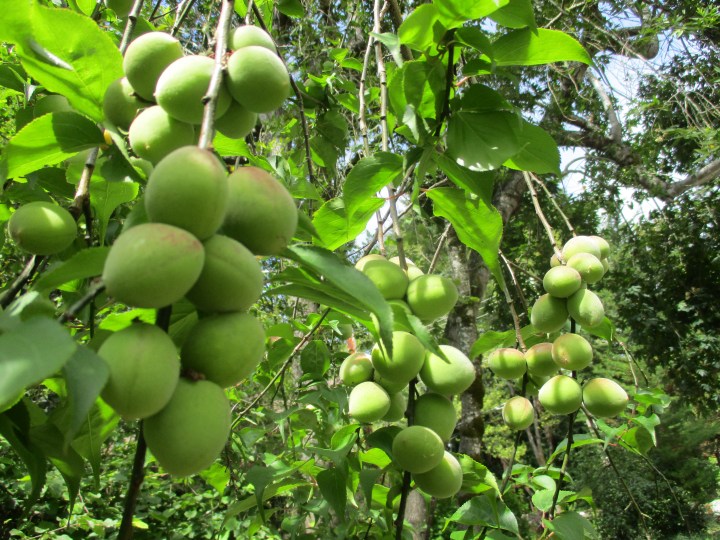 They do not come with instructions for their maintenance. Deciduous fruit trees, particularly the stone fruit trees (such as cherry, plum, prune, apricot nectarine and peach) and pomme fruit trees (such as apple and pear), can be procured as easily as nasturtium seed or petunias. Whether bare-root in winter or canned (potted), they very often get planted into gardens where they are expected to produce their fruit as easily as daisies bloom.
Instructions for planting that come with bare root stock are useful for getting those particular trees started, but mention nothing about how even brand new trees need to be pruned after installation, and will need specialized pruning annually every winter thereafter. The same applies to rose, raspberry, blackberry (all varieties), grape, and to a lesser extent, fig, pomegranate, persimmon and several other fruit producing trees, vines and shrubs.
The problem with the stone fruit and pomme fruit trees is that they were bred to produce an unnatural abundance of unnaturally large fruits that are too overwhelming to sustain as they ripen, and too heavy to support. The others are in a similar situation, but are somehow able to continue to produce and generally support their own weight as they get overgrown and congested. Roses deteriorate and succumb to disease as they get congested.
This is why annual winter pruning is so important. Such pruning concentrates resources into fewer but superior fruits, rather than too many inferior fruits. It also limits and contains (closer to the main trunk and limbs) the weight of the fruit, so that limbs are not so likely to break as fruit develops.
These wimpy stems hanging vertically from the weight of the maturing apricots might be able to support the weight of the fruit, but the excessive fruit will be of inferior quality.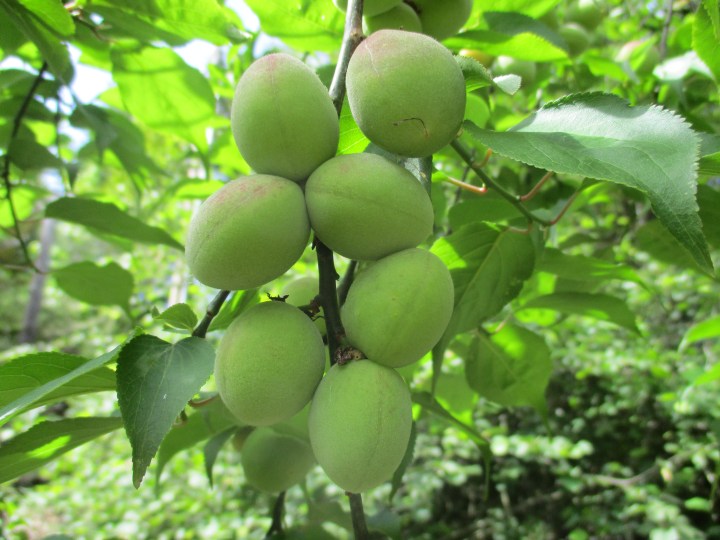
Horridculture – High Fences
 There is no doubt that fences are useful for a variety of functions. They exclude deer from the garden. They confine livestock. For suburban homes, they enclose a relatively safe space for children and pets. Fences should be designed according to their intended functions. Those designed to exclude deer might be as simple as coarse mesh on posts. Those enclosing backyards might be more refined and compatible with the landscape.
Over the years, conformity to modern suburban and urban landscapes, as well as modern architecture and lifestyles, has changed the standards of how fences are designed. Low picket fences do not adequately obscure the scenery that adjacent and often dissimilar landscapes contribute to a view. Where common vegetable gardens might have been, most of us want private outdoor rooms, with a distinct style of landscape.
It seems that everyone wants privacy nowadays. Those who have no need for privacy will get it anyway because no one will build fences that will not provide it. In the 1950, fences were commonly four feet high, and not every backyard had them. By the 1970s, they were more commonly six feet high, and standard for almost every backyard. Now, fences are expected, and many are seven feet high or higher, with lattice on top!
Modern architecture and lifestyles are part of the justification for such tall fences. Low profile older homes on formerly suburban lots are commonly replaced with two or more larger homes on smaller subdivided city lots. They are much closer to each other than the older homes were, with only narrow spaces between upstairs windows, where even eight foot high fences will not provide privacy.
So, not only do much larger homes on much smaller parcels mean that there is much less space for gardening, but taller two story (or taller) homes with weirdly high fences mean that more of the very limited space available for gardening is shaded!
Horridculture – Fake Environmentalism
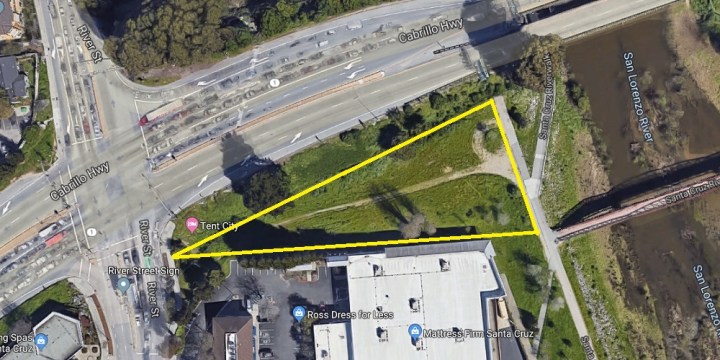 Fake environmentalism is a HUGE topic, so for now, will be limited to fake environmentalism as justification for the eviction of homeless encampments.
The yellow triangle in the picture above was the site of the Hero’s Camp, which was more commonly known as Ross Camp, and located behind Ross Dress For Less in Gateway Plaza in Santa Cruz. It is gone now. This satellite image was taken by Google Maps prior to the development of the Camp. I did not get pictures of the camp while inhabited, but you have likely seen enough other camps in the news to imagine what it looked like.
It really was as big as it looks, and really did exhibit all the problems that you hear about in the news, although not to such an exaggerated degree. Not everyone there used syringes to inject illicit narcotics. Not everyone there was an alcoholic. Not everyone was violent, from somewhere else, or a criminal. This is not about such issues anyway. It is about how the two hundred or so unhoused people who lived here affected the environment.
Was there trash? Of course there was. Was it more than what two hundred people who live in homes generate? No. Houseless people do not generate as much trash as the housed, simply because they lack resources to purchase the commodities from which so much trash is generated. The houseless certainly do not waste as much as the housed. Their trash just happens to be more visible for outsiders who do not know any better to see.
Furthermore, what is so typically described and perceived as trash is actually the belongings of those who live in such camps. Without closets, cabinets or furniture, our belongings would look about the same, except much more voluminous. When we take just some of the belongings that we don’t want or need and put them out in front of our homes, it is a garage sale, and likely amounts to much more than individual homeless people own.
The satellite image from Google Maps below shows the neighborhood where my grandparents lived in Felton, less than seven miles north of where the picture above was taken. Their old home is right in the middle of the picture. There were not so many other homes there when they arrived, just as World War II was ending. They lived a relatively modest lifestyle, on a small suburban parcel. They were not concerned about the environment.
Why should they have been? Even now, the people who live in homes here can generate as much trash as they want to, and no one will complain about it. They can fill their homes with their belongings, and put them neatly away in closets, cabinets and drawers. There are alcoholics in this neighborhood, as well as a few who are addicted to illicit narcotics. Some are criminals. Some are violent. Few are native. Again, this is off the main topic.
None of that is visible in this satellite image anyway. What it shows instead is how the lifestyles of those who live in homes are more detrimental to the environment than the lifestyles of those who lack homes. This picture is the same scale as the picture above, so you can see that only a few homes would fit into an area comparable to that in which about two hundred unhoused people lived. Only a few people live in each of these few homes.
What that means is that two hundred people like those who lived at the Hero’s Camp live dispersed over a much larger area, on land from which trees and vegetation needed to be removed. They all live in homes that are made of wood derived from trees that grew in forests. These homes are furnished with synthetic plaster, carpet, paint, glass, vinyl, metals and all sorts of materials that needed to be quarried, processed or manufactured.
It doesn’t end there. These homes consume energy for heating, lighting and whatever else that gas and electricity are used for. Cars driven by those who live in homes are also constructed from raw materials, and then need fuel to function. Water is consumed as if it were not a very limited resource. Much of it gets mixed with soaps and detergents before going back into the environment. Chlorine volatilizes from chlorinated swimming pools.
Then there are the landscapes and gardens, the parts of domestic lifestyles that we actually believe to be beneficial to the environment. They contain exotic (non-native) plants that compete with native species, and interfere with natural ecological processes. Irrigation of the landscapes stimulates redwoods and accelerated decay of oaks. Soil amendments, fertilizers and some of the pesticides change the chemistry of the soil and ground water.
Just compare these two pictures. As bad as the mess at Hero’s Camp was, the two hundred people who lived there were less detrimental to the environment and the local ecosystem than those who live in just a few of the homes visible in the picture below. Those who claim to be concerned about the environment should be more concerned about the ecologically detrimental lifestyles of those who live in homes than those who lack homes.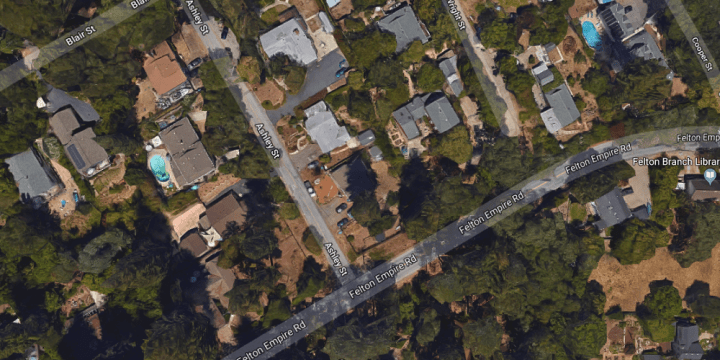
Horridculture – That’s Just Swale
 Building and environmental codes are so ridiculous. So much of what I would want in my home is now illegal. So much modern technology that I do not want is now required. Fireplaces and wood stoves are not allowed. Overly elaborate electrical systems to serve every room are necessary. I would prefer a technologically simple home comparable to those built more than a century ago, but am prohibited by law from ever constructing one.
The area outside of a home is no easier to work with. Dead trees inhabited by the wrong sorts of woodpeckers can not be cut down. Excavation can be prohibited if a particular beetle happens to be in the way. Even some of the increasingly combustible trees and overgrown vegetation have more rights on my land than I do. Now, I am a horticulturist; so I know more about vegetation management than the treehuggers formulating these laws.
Even some of the weather has more rights than people do. In some municipalities, rain that falls onto a property has the right to percolate into the soil. Rain water that drains from roofs and pavement must be provided with ‘swales’ or basins where it can do so. It can not be evicted into old drainage systems that drain into local creeks and rivers. However, such rain water must not be detained in tanks for use in the landscape through summer.
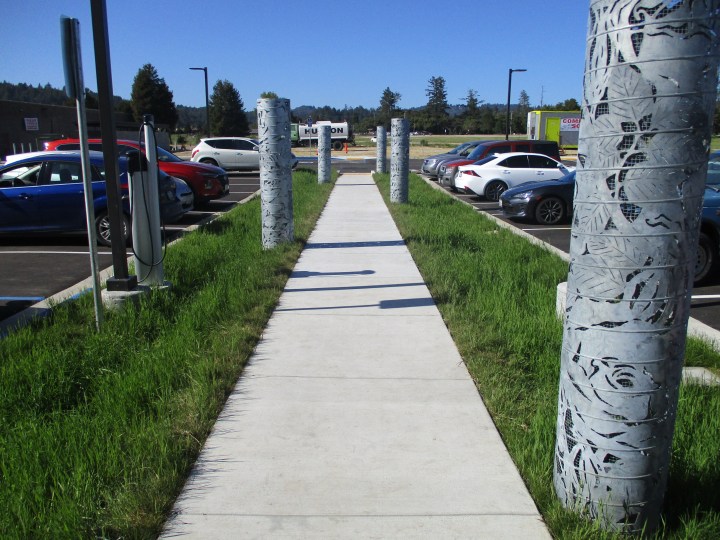
The picture above shows part of a new landscape in the middle of a new parking lot at a newly constructed building. It looks simple for a reason. It is a pair of swales. The meadow grasses conceal a pair of surprisingly deep ditches on either side of the central walkway. Rain water drains here to percolate into the ground. The soil below the walkway might have been replaced with coarse gravel to promote drainage into that area as well.
Do not park a car at the curb and try to step from the curb into a swale to get to the walkway! You could get hurt. As I mentioned, that grass is concealing ditches that are deeper than they look. It is safer to walk through the parking lot to a large paved patio like area that is out of view behind where the picture was taken from. The other option is to walk away from the building to the far end of the walkway, but really, who would do that?
Why is the walkway even there? I really don’t know. There are no curbs on it, so anyone in a wheelchair who feels so compelled to go to the far end to use it could get seriously hurt by tumbling off the edge while trying to get out of way of someone going the opposite direction! The swales are snares for walkers and baby buggies too. Perhaps the walkway is merely bait. What are the surveillance cameras really for? What sick entertainment!
Horridculture – Pale Clivia Syndrome
 Back in the good old days, Kaffir lily, Clivia miniata, which is probably most popularly known simply as ‘clivia’, bloomed with big round trusses of exclusively bright reddish orange flowers. It was such an excellent color that no one thought to change it. Flowers of feral plants that sometimes grew from seed were potentially more orange and less red, but were flashy nonetheless. There was no need, and minimal potential, for ‘improvement’.
Then the allure of the ‘rare’ happened. Yellow Kaffir lilies had previously been so rare that very few had seen them. Once the rest of us became aware of their existence, many of us wanted them, only because they were so rare. However, after seeing them, some of us came to the conclusion that they were rare because no one wanted them when the species was first introduced, and cultivars with the best color were selected and perpetuated.
Regardless, yellow Kaffir lily suddenly became a fad. Traditional bright reddish orange Kaffir lilies became passe. All the while, those subscribing to the fad seriously believed that yellow was better and more desirable than reddish orange simply because it was so very rare. All the while, yellow became increasingly popular, increasingly available . . . and no longer rare. All the while, reddish orange became unpopular, uncommon . . . and rare.
So now what? Why is yellow more popular than reddish orange now? Yellow is insipid and pale. Reddish orange is vibrant and bright. Furthermore, yellow is so dreadfully common. Reddish orange is quite rare. According to the previous justification for the popularity of insipid pale yellow Kaffir lily, bright reddish orange Kaffir lily should be popular now, not because they are so much more colorful and appealing, but because they are RARE!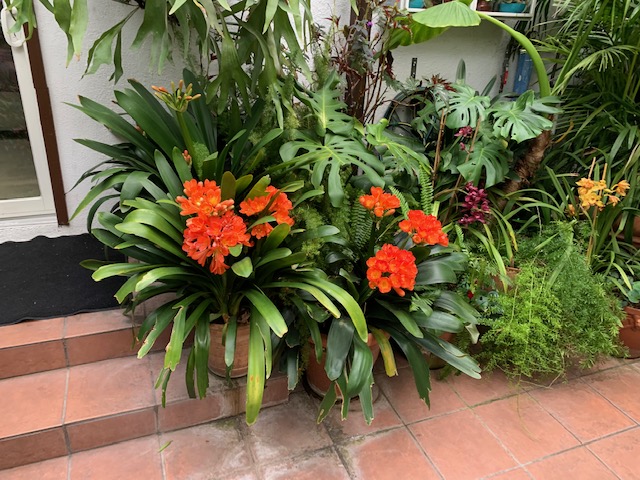
These are in Brent’s garden.
Horridculture – What’s The Point?
 In this situation, the point is that all those pointed tips of the leaves of this awkwardly floppy century plant, Agave americana, are extremely sharp, extremely rigid and EXTREMELY dangerous. Those shorter teeth on the margins of the leaves are just as sharp and rigid, and are curved inward to maximize injury to anyone trying to get away from an initial jab. With tips that impale, and marginal teeth that slash, this is one very hateful perennial!
Another point is that this big and awkwardly obtrusive century plant is on a patio at a Mexican restaurant. Yes, it is in a public place where people get dangerously close to it. On Friday and Saturday nights, this restaurant can get quite crowded. Some within such crowds are inebriated, so are more likely to stumble about and bump into things that are best avoided. Those concrete slabs to the left are benches where people are often seated.
The third point is that the only remedy for this ridiculously bad situation is to remove the century plant. Chopping the leaves like those that were over the bench on the left only removes a few tips and teeth, but does not make the rest of the foliage significantly safer. Nor does folding the leaves inward, like those that are next to those that were chopped. Such abuse only makes the whole mess uglier. Now it is both dangerous AND ugly.
Now, who thought that putting the most dangerous of all perennials available into this public situation was a good idea?! (Cacti with inward curving spines and other plants that are more dangerous are not even available in nurseries.) Century plants are dangerously nasty even when small and young, so even someone who knows nothing about landscape design should have known better than this!
Horridculture – All Wet
 Regardless of their individual innate requirements for water, new plants need to be watered very regularly immediately after they are installed into a landscape. As they mature and disperse their roots, the regularity of supplemental watering becomes less important, and ‘drought tolerant’ plants may not need to be watered at all. Maturing larger trees generally get what they need from the landscape around them.
Automated irrigation systems that are designed for new landscapes are designed for what the plants need while the landscapes are new. As the landscapes mature, the irrigation systems may need to be adjusted accordingly. Drip irrigation or bubblers that were needed to water new trees while they were young and confined should be moved farther from the trunks of the trees as roots disperse, and should eventually be removed and capped.
This is very important, since water applied directly to the trunks of some maturing trees will promote rot and other disease. For some, it promotes buttressing of roots that can displace concrete or other landscape features. If nothing else, it is just a waste of water.
Whoever installed the irrigation to this young London plane tree knew how to do so properly. The bubbler was likely over the confined root systems of the formerly canned tree just after it was installed. It is installed in such a manner that it could have been moved over as the tree grew, replaced with some sort of drip irritation hose to curve around the tree (if such a device had become necessary), or simply removed.
Now that the tree is as mature as it is, the bubbler should simply be removed, and the riser (where the white ‘L’ is) should simply be capped. The tree gets what it needs from the rest of the landscape around it, and really does not need much water anyway. It could probably survive without any supplemental irrigation at all. The bubbler is really just wasting water.
However, because so-called ‘gardeners’ are what they are, the bubbler remains, attached to an unsightly bit of exposed pipe, and wasting water on the base of the trunk of the sycamore. Because this tree and associated bubbler are right next to a parking spot in a parking lot, the pipe is very likely to get stepped on and broken every once in a while. In fact, the fresh Teflon tape on both ends of the pipe suggest that it was repaired quite recently, rather than removed.
Fortunately, the sycamore will not likely be damaged by water applied directly to the base of the trunk.
Nature For Sale
 Gardening is unnatural. Yes; quite unnatural. So is landscaping. It all involves planting exotic plants from all over the World that would not otherwise be here, including many that are too extensively and unnaturally bred and hybridized to survive for long even in the natural ecosystems from which their ancestors were derived.
Unless they grow on their own, even native plants are not natural. Those that are native to the region may not be native to the specific site. Many that are grown in nurseries are unnaturally selected varieties or cultivars. To complicate matters, much of what seems to be natural out in forests and wild lands are invasive naturalized exotics.
The weather above and most of the soil below are natural, but both are commonly enhanced for our gardens. We water our gardens and landscapes as if the weather is insufficient. Soil amendments and fertilizers compensate for what we perceive to be inadequacies of the natural soil. Insects, deer, raccoons and disease are all natural too, but we put quite a bit of effort into excluding them from our gardens.
Bees and other pollinators are all the rage now, even though many are not native or natural here. We provide them with weird and confusing new cultivars of flowers that likely produce nutritionally deficient pollen, and that distract them from naturally native plants that rely on them for pollination. It all gets so confusing!
These potted annuals and flowering perennials at the supermarket are pretty and might provide the illusion of bringing a little bit of nature closer to the home. Yet, there is nothing natural about them. They are all unnaturally bred and hybridized from unnaturally exotic plants, and were provided with synthetic fertilizers and artificial irrigation, while they were grown in synthetic medium, contained withing synthetic pots.
Horridculture – B & B
 B & B, formally known as ‘balled and burlapped’ nursery stock, was expected to be the next big ‘thing’ in nursery commodities here in California back in the late 1980s. As those outside of California know, it is field grown plant material that gets dug and marketed with its roots wrapped in burlap. It was more common in other regions, so was expected to become more common here as more nursery stock was to be imported from Oregon.
However, growers in Oregon started growing more of their stock in cans like we do in California, and then did not send as much of their B & B stock to California as predicted. Only certain slow growing commodities and large items are still field grown, and then dug and ‘balled and burlapped’ for export. Of these, arborvitaes, rhododendrons and various deciduous shade trees are the more commonly available locally.
B & B stock from Oregon is typically of exceptional quality. Horticulture is taken more seriously there.
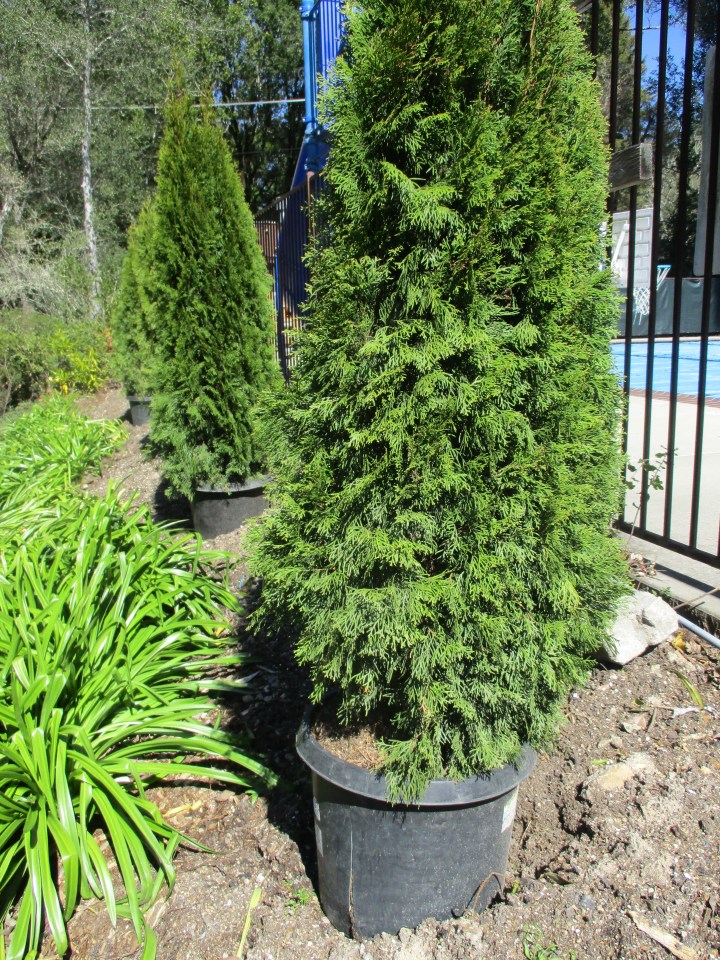
Because B & B is still a foreign concept in California, it is typically canned to be more familiar to local consumers. It does not take long for it to root into the little bit of extra potting medium and fill out the cans. There is no need for the roots to be unwrapped, since the burlap decays as fast as the root disperse and expand. The now canned but formerly B & B arborvitaes in the picture above are exemplary.
Yet, they are not perfect. The problem with B & B stock here is that there are not many horticultural professionals here who know how to work with it, or even care to do so properly.
The picture below shows how shallow the B & B root systems of the arborvitaes are relative to the squat #15 (15 gallon) cans that they were purchased in. They obviously did not get enough time to root into their potting medium after they were canned. This is not due to a lack of horticultural expertise. This is either (and hopefully) a mistake in scheduling, or merely a lack of concern. But hey, no bother. They are still excellent specimens.
At least they seemed to be. A potentially serious problem was revealed when they were installed and the loose potting medium fell away from the burlap.
Many years ago, the burlap containing the balled root systems of B & B stock was bound with biodegradable jute twine. It rotted away before it could do any damage. Since then, nylon twine became more commonly used. Those who are familiar with B & B know to simply cut and remove the nylon twine before planting.
Whomever processed and canned these arborvitaes are either (and hopefully) not familiar with B & B, or just do not care. The nylon twine was still tightly bound and tied. If these arborvitaes had rooted into their potting medium and held it intact, this twine would not have been visible. Because it is wrapped a few times around the main trunks as well as wadded up burlap, it could have girdled the main trunks as they grew and expanded!
In a way, it was fortuitous that the potting medium fell away to expose the nylon twine, which was cut to allow for expansion of the main trunks. These exemplary B & B arborvitaes from Oregon should live happily ever after.
 Tony Tomeo