 There are many different types of horticulturists. We are all unique, both individually as well as collectively within our respective professional group classifications. For some of us, individuality interferes with conformity to the collective generalizations that are so commonly associated with our collective groups. For some of us, the stereotypes are a perfect fit.
‘Primarily’, I am a nurseryman. We are the intellectual ones. Well, at least we get most of the credit for being the intellectual ones. Most of us really are quite intellectual. Most of us are rather humble about it.
My excuse for nonconformity to the latter is that I am ‘secondarily’ an arborist. Arboriculture is something that I have never been able to get away from. I did an internship with the most excellent arborists in the entire universe in the summer of 1988. After all these years of mostly growing horticultural commodities, I still sometimes conduct inspections and compile reports for trees that other arborists and their clients are concerned about.
You see, arborists are the passionate ones. One might say that we are enthusiastic, fanatical and zealous. Nurseryman might say that we lack restraint and cultural refinement. It is not such a simple task to distinguish between exuberant dedication and primitive efficiency. Regardless, most arborists do not like to write reports. It is easier to get a nurseryman to do it.
In fact, arborists do not like to write much of anything. There are several elaborate blogs that are written by nurserymen; but blogs written by arborists are rare, with brief and infrequently posted articles.
The irony of this is that it is more important for arborists to express professionalism with clients than it is for nurserymen. Arborists are out in the real world, working directly with clients. Nurserymen work on the farm, isolated from those who purchase the horticultural commodities that are grown there.
Arborists are horticulturists who specialize in the horticulture of trees. The best are just as educated and experienced as nurserymen are. In fact, much of my education was derived from arborists. Yet, arborists are so often regarded as mere gardeners who go up trees.
That is where I get offended. Yes, I am aware that there are hackers out there. I am also aware of what clearance pruning of utility cables entails. I also know how serious my arborist colleagues are about their profession. They are not to be compared to gardeners.
There are many gardeners who are just as educated, experienced and proficient with horticulture as arborists and nurserymen. However, the majority of gardeners are not. I will not elaborate on this presently. It will be the subject of other rants. I have written articles about my professional experience with gardeners already, and none of them go well. (I lack experience with good gardeners simply because they have no need for my expertise.)
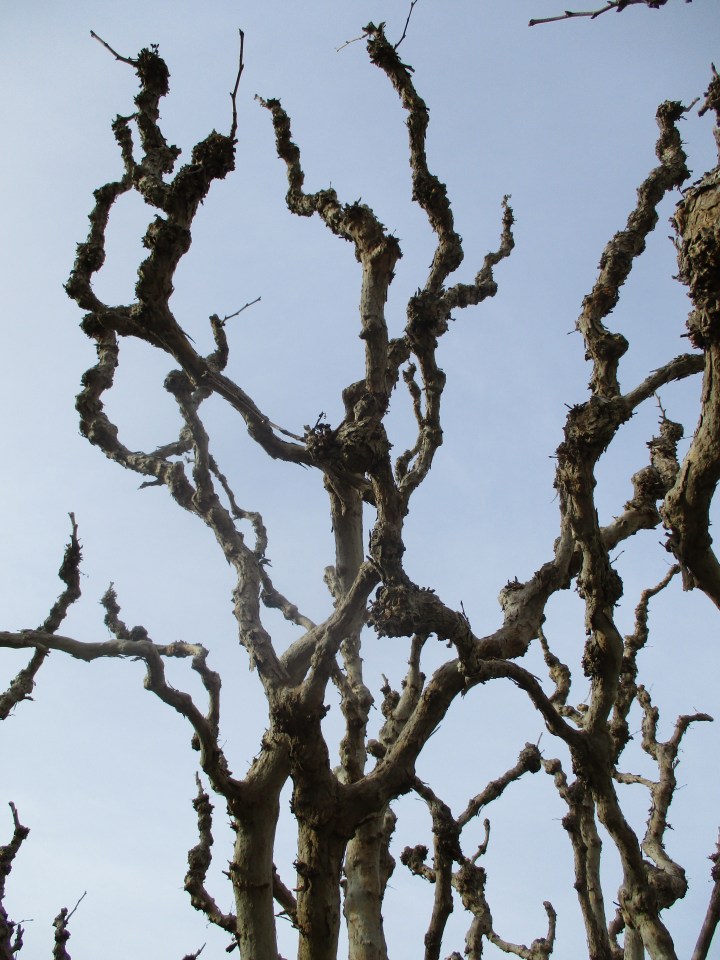
The picture above is an example of a sycamore that is pollarded in the traditional English style. The work is exemplary, and is repeated annually every winter. It is no simple task. I certainly would not want to do it. I can not think of any other nurseryman who would know how to do it properly. It is the work of a very skilled and very experienced arborist.
Horridculture – Lessons From Motivational Posters
 I work for the best. I do not intend to be too terribly pompous about it. I am just being honest.
This is not first time I have worked for the best. I have worked for at least three of the best arborists in the Santa Clara Valley, and two legendary horticulturists. I intend to eventually return to work for one of those legendary horticulturists back on the farm.
The main work I do now is part time and temporary. That means that I work less than four days each week, and will not be working there forever. I try to not think about leaving because it is saddening. I enjoy those whom I work for so much.
I work for only one other horticulturist, and one who is studying to be an arborist. Neither of them grow any significant quantity of nursery stock like I intend to spend the rest of my career doing. They maintain landscapes and facilities. The others of our elite group are very specialized professionals who work with everything else that is not relevant to horticulture. One is a carpenter. One is an electrician. One is a plumber; and so on. Although impeccably specialized, any one of us would do what he must to accomplish whatever needs to be done, even if it is beyond his respective specialty. Collectively, we are the ‘maintenance staff’.
How is this relevant to horticulture? I suppose it is not very relevant. However, everyone else on the maintenance staff respects what the other horticulturist, the other arborist, and I do. Anyone who needs vegetation pruned for clearance from a project contacts us to get it done properly. Anyone who sees obvious problems in the landscape informs us about them. Everyone on the maintenance staff respects everyone else and their respective professions.
To describe what makes the maintenance staff the best, I could use any combination of those inspirational words that are so ungraciously followed by an overly simplified dictionary definition on those insultingly inane motivational posters that so many other employers display prominently in the workplace. They are all relevant. However, we have nothing to prove.
Besides, this is not about the best. It is Wednesday, when I write within the context of my ‘Horridculture’ theme.
I have also worked for the worst. One of these worst was portrayed to be a very professional landscape maintenance company. We had a much larger staff, spread out over nine counties. We had a good variety of those motivational posters in our main office. Unfortunately, I did not realize when I went to work there, that those posters merely defined what we lacked.
Integrity – Dedication – Perseverance – Discipline – Teamwork – Excellence – Strength – Endurance – Accountability – We had none of that. I was the only horticulturist in the big staff of a big landscape maintenance company that simply did not care. I do not know how to describe it more accurately. We simply did not care. We were there to make a buck any way we could. We swindled, cheated and lied. I was only there as their token horticulturist and arborist, to help them get away with more of their illicit activity, and to make a good impression for their victims.
It is so backward. The big and seemingly reputable landscape maintenance company has less regard for horticulture than a maintenance staff who has other completely different priorities.
Horridculture – Ignoring Arboriculture
 There are too many different types of horticultural professionals to count. There are nurserymen who grow horticultural commodities. There are landscape architects and landscape designers who design the landscapes into which some of these horticultural commodities will go. There are landscapers who install such landscapes. Of course, there are gardeners who maintain the landscapes after they are installed. These are just a few of the more familiar horticultural professionals.
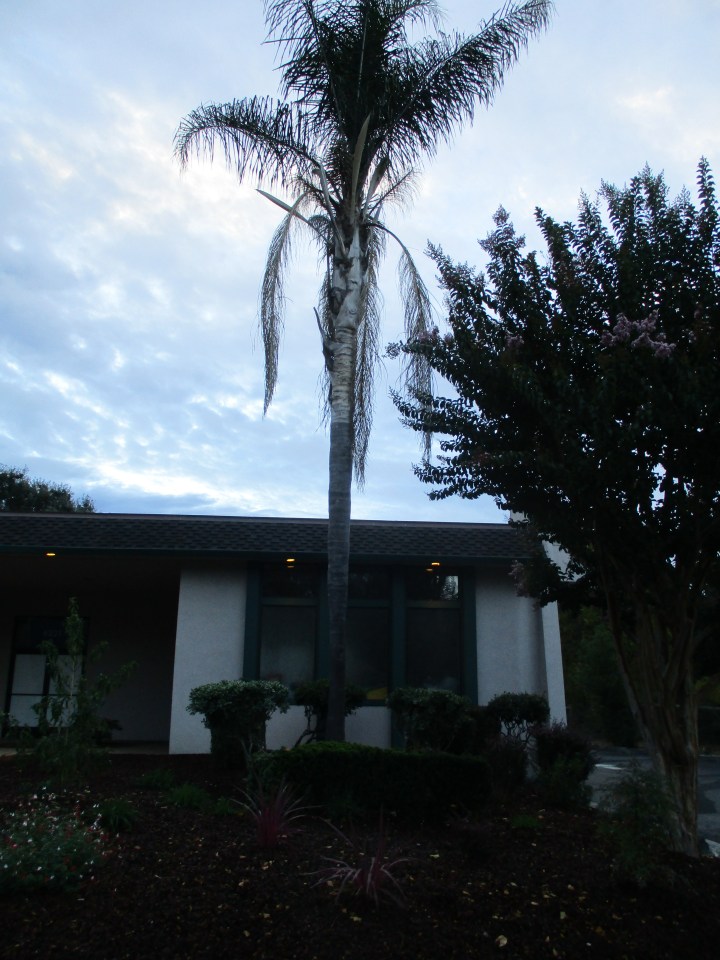
I will refrain from my typical ranting about the extreme lack of professionalism among almost all horticultural professionals who are not nurserymen or arborists (okay, and one landscape designer), but must point out something in the picture above. Do you see it?
It is not the fact that this once very well designed landscape was dismantled and mostly replaced with a cheap slapped together assemblage of cliché plants by someone who just needed work.
Nor is it the pointlessly disfigured shrubbery from the original landscape that was salvaged while the best features that could have been salvaged were removed.
Nor is it the fact that this process has been repeated a few times since the building was originally landscaped back in the 1980s, leaving a nicely maturing but weirdly non conforming crape myrtle in front of the queen palm that should be the focal point, as well as a new dogwood that will compete with both focal points.
It is the fact that despite all the effort that went into the installation of this garage sale style landscape, no one bothered to procure the services of an arborist to groom the queen palm. Do you see it now; all those dead fronds hanging from the canopy of the queen palm? It is like taking a pick up through a car wash while it is loaded with garbage.
Horridculture – Vandals
 It wasn’t even two days. The article about the ‘Illegal Planting’ of the Memorial Tree in Felton Covered Bridge Park posted at noon on Saturday, and then on Sunday night or early Monday morning, the Memorial Tree was vandalized. Fortunately, it is nothing serious. A small bag of trash was impaled onto the binding stake that is there to keep the trunk straight, which pushed the top of the small tree aside. It needed to be bound to a new stake anyway.
(I do not often condone the use of binding stakes, but this particular tree contends with considerable abuse that causes structural distortion. The article from noon last Saturday is https://tonytomeo.com/2018/09/22/illegally-planting/ .)
Was it done by the haters who snivel about the Memorial Tree just being there? Probably not. The timing is suspicious. The technique is consistent with their style. However, they have been behaving for quite a while, and have not yet posted pictures of the vandalism to blame those they dislike, as they typically do. They are predictably vain in regard to gloating about such ‘community’ activism, particularly if they can also blame their victims for any incidental damages. ( https://tonytomeo.com/2017/12/09/hate-destroys/ )
As annoying as it is, this particular vandalism was most likely executed by someone who just did not put much thought into how bothersome it would be. It might have been done because of the lack of receptacles in which to deposit trash. Perhaps the bag of trash was impaled onto the stake so that it would be easier to retrieve and dispose of when the trash receptacles were returned to the site. The option of dropping it onto the ground might have been been perceived to be more like littering.
Perhaps I am being too optimistic and too generous with excuses.
Horridculture – Needle Mania!
 Throughout my career as a horticulturist, I have worked in more public landscapes than most. Some of these landscapes were in some of the most notorious neighborhoods of the San Francisco Bay Area and the Monterey Bay Area. Yes, I have found some rather strange items strewn about, including a few that necessitated telephone calls to local law enforcement. Yet, I have never once found a single used syringe.
Syringes are more commonly known as ‘needles’ by those who fear them. We are sometimes warned about them, particularly in areas where the sorts of people whom we are supposed to fear might have left them strewn about, whether or not these fearsome people actually use syringes. If found, such syringes are dangerous because they are used to inject illicit narcotics, and are consequently contaminated with the blood of those who use them. Such blood is always assumed to be infected with any variety of the communicable diseases that afflict all fearsome people, and is assumed to stay infectious for all eternity.
When I consider some of the situations that I have worked in, I believe that I am fortunate to have never found a syringe. On rare occasion, I have been presented with pouches and ‘sharps’ containment boxes containing syringes so that I can dispose of them properly. I actually expect to find a few at a site that I will be inspecting this next week or so, which will be a new experience for me. Caution is justified.
I know that syringes are out there, and that they are dangerous. So are rattlesnakes. I have seen and killed many rattlesnakes. They used to be quite common at the farm, and are still somewhat common at home. I know people who have been bitten by rattlesnakes, even though we all know to be careful out in regions where we expect them to be. Signs warning those who might not be familiar with rattlesnakes are posted in county and state parks inhabited by rattlesnakes. People are bitten by rattlesnakes much more commonly than people are accidentally pricked by used syringes. Accidental ‘needle pricks’ are actually extremely rare. For those unfortunate enough to experience such an injury, infection with any one of the communicable diseases that we all fear is very rare. Contrary to popular belief, infectious blood does not stay infections forever.
Needle Mania is really the most infectious affliction associated with used syringes. In a nearby Community, several people are so obsessed with discarded syringes that they have developed a ‘needle watch’ online, in order to monitor the number of syringes found, and the locations of where they were found. Some like to post pictures of the syringes that they find, sort of like trophies. Some people have found several syringes; which is quite commendable for those who live and work mostly inside. (I spent my entire career outside, but have never found a single syringe.) The numbers of syringes found is disturbing. So are the many pictures of syringes laying out in public spaces.
A few pictures are perplexing as well. One locally found syringe was pictured laying out neatly on a serpentinite outcropping. Another that was found in spring on the bank of the San Lorenzo River was laying on top of fallen autumn leaves of quaking aspen, Populus tremuloides. Neither serpentinite nor quaking aspen are endemic to this region.
A syringe was recently found in my neighborhood! As unfortunate and disturbing as this news was, it is not completely unexpected. Syringes can be discarded anywhere, and are probably likely to be discarded on isolated rural roads.
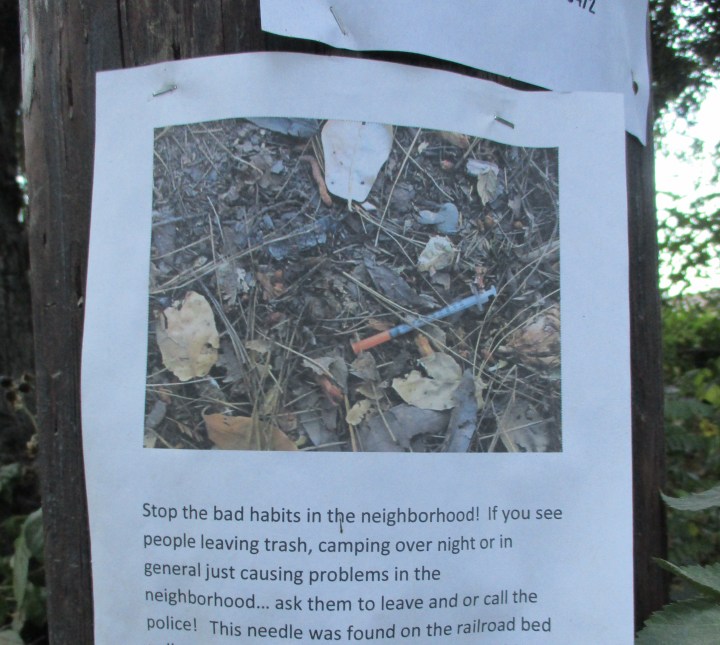
The neighbor who found the syringe believes that it is a problem that is serious enough to justify posting pictures of it all over the neighborhood! These pictures include a description of where the syringe was found, and instructions of what to do to curtail suspicious activity. They are everywhere! They were originally just stapled to trees, utility poles, mail boxes, fences, barns . . . and anything that a staple would stick into. Now that they have been out in the weather for a while, some are blowing about in the roadway and collecting in ditches. When they were first posted, a few were within view from every point on the road. More posters were added to replace those that blew away. These posters are now a prominent feature of our Community landscape.
I do not doubt that the discarded syringe is a problem for the Community. However, the pictures of it posted so prominently and abundantly throughout the neighborhood landscape are unsightly, trashy and unbecoming of such a safe and idyllic neighborhood.
Horridculture – Think Outside The Box
 Straight out of college, I worked briefly for a wholesale nursery that grew landscape stock, which included boxed trees. We also recycled a few trees, particularly from the abandoned homes in the neighborhood around the nursery. (The neighborhood, including the nursery, were in the easement of the Norman Mineta Freeway, which in the process of being constructed at the time.) I had believed that the boxed and recycled trees were for ‘instant’ landscapes, the sort that were for clients who did not want to wait for things to grow. It made sense, particularly in our region where so few stay in the same home long enough for trees to mature.
Many trees were good candidates for growing in boxes. Some were naturally small trees. Others had fibrous root systems that did not mind the confinement. Japanese maple, crape myrtle, purple leaf plum, flowering cherry, flowering crabapple, magnolia and various specie of podocarpus all grew well for us, and probably adapted well to their new landscape homes.
Other trees were not such good candidates. We also grew a few specie of oak, pine and eucalyptus that did not want their roots to be confined to boxes. They wanted to disperse their roots as soon as they could. They had no problem doing so while young. However, mature boxed trees needed so many years to recover from their confinement that by the time they recovered, if they ever recovered at all, small trees that were planted at the same time had grown larger. Yet, people paid tens of thousands of dollars for some of the larger boxed trees.
Some clients did not care if the trees died. Some just wanted them to live long enough for their home to sell. Those who purchased the homes often did not care either. Many purchasers just demolished such homes and landscapes to build new monster homes on the sites. Many landscapers only needed such trees to live long enough for their client’s cheque to clear.
For example, the same ‘landscape company’ that was involved with the ‘Shady’ incident ( https://tonytomeo.com/2018/03/18/shady/ ) installed several boxed Italian stone pines nearby, on General Stillwell Drive, also in Marina. The client presented us with a picture of a very mature Italian Stone pine, and instructed us to install the exact same ‘native’ pines. I tried to explain that ‘Italian’ meant that they were not native. I tried to explain that they would take at least half a century to look like the old tree in the picture. I tried to explain that after only twenty years, the trunks of the trees could be wider than the two foot wide parkstrips that they were to be installed into. The client was an idiot; a demeaning and spoiled rotten idiot. We should have walked off the job (after giving him a good spanking and sending him to his room) when he insisted that we “do it”.
We did not walk off the job of course. There was too much money involved. However, I was conveniently not invited to subsequent meeting, and did not return to the site until after the trees had been installed and were developing some very serious problems.
The biggest trees that were available in 36” boxes were procured. No grower wanted to be liable for larger pines. Because of the innately shrubby structure of the species, the trees were not very tall at all, but were quite plump. They were a special cultivar of Italian stone pine that is native to the central coast of California. (?!)
You can imagine what needed to be done to get each 36” wide root system into a 24” wide parkstrip. Yes, the ‘landscapers’ sliced about half a foot off of opposite sides of the already distressed and unhappily confined root systems of each tree. Because the fluffy canopies obstructed the sidewalks and extended out over the curbs, each tree was severely disfigured by clearance pruning that removed about a third of the branch structure and foliage. In the end, only about two thirds of each of the trees that cost $500 each remained, and the client was furious that they were not as big as that half century old tree in the picture that he found online.
Each tree was outfitted with a pair of root barriers, one for the curb and one for the sidewalk, not to prevent the roots from elevating the pavement, but because the ‘landscaper company’ could earn a bit more money by adding them to the bill. If the trees were to survive, their big trunks would push the curb and sidewalk laterally before the roots elevated them vertically.
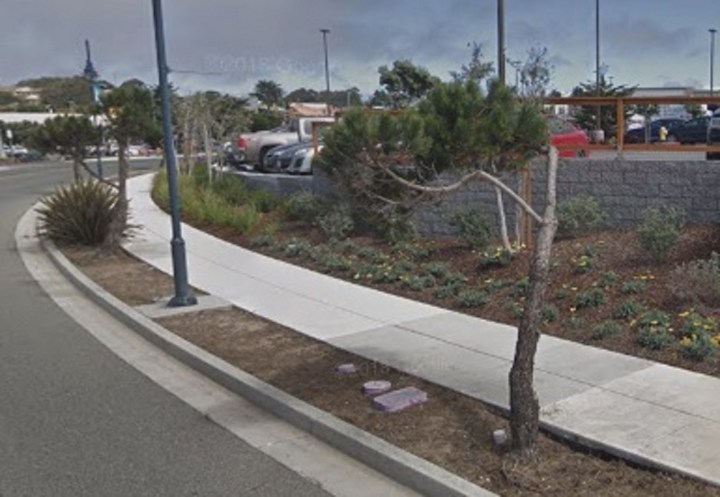
That was in about 2008, about ten years ago. Miraculously, several of the trees survived! I found their pictures online. (These two pictures look the same, but are actually in two different locations.) The trees have not yet damaged the curbs or sidewalks, but only because they are not much bigger than they were ten years ago.
Horridculture – Drought
 It is a way of life in much of California. Many of us grew up with it, or at least believing in it. Many of us never heard the end of it. That is how it lost its meaning.
Drought is a weather condition. It might last one year or a few. Drought can even continue for several years. For us, it entails less than normal rainfall through winter, only because winter is when rain is supposed to fall here.
As a weather condition, drought is not permanent. There have been a many during the past few centuries of recorded history here, and a few of those have been in just the last half century that I can remember. They happen frequently enough that I can not remember the exact years that were drought years, although I can remember a significant drought in the middle of the 1970s. No drought lasts forever.
If drought lasts forever, or at least as long as anyone can remember, then it is not a weather condition, so is therefore not really a drought. It is ‘climate’.
The climate of much of California is naturally arid. San Jose and the entire Santa Clara Valley have a ‘chaparral’ climate, which is classified as ‘semi-arid’. Some areas near the base of the Santa Cruz Mountains get only about a foot of rainfall annually. Los Angles and the region around it in Southern California have a ‘desert’ climate, which is ‘arid’. Parts of the Mojave Desert get less annual rainfall than other climates get from a single storm.
Although droughts happen here, the limited availability of water is due to the natural climate, not weather. Those who came to California a long time ago knew how to use what was available. The problem now is that there are simply too many people wanting too much of a naturally limited supply of water. Way too many expect way too much.
Horridculture – CH CH CH CHIA!
 Skyscrapers are already very efficient. They fit more usable floorspace into their ‘footprint’ than any other type of building does. They conserve energy that gets used for heating and cooling by exposing less of that floorspace to the outside weather. For all that usable floorspace, they need only a single roof.
Think about it. A relatively short ten story building contains as much floorspace as ten single story buildings that occupy the same area individually, but collectively occupy ten times as much area! Nine of those stories loose heat during cold weather, and collect heat during hot weather, only around the exterior walls. Only the top floor loses and collects heat through the roof, and only if there is not an upper utility ‘attic’ floor that insulates it. Ten single story buildings of the same area are all exposed on top, as well as all the way around. Of course, ten single story buildings of the same area need ten roofs comparable to the single roof of the ten story skyscraper.
Skyscrapers certainly need more infrastructure to support all of their floors, and they lose a bit of their floorspace to that infrastructure, as well as to the elevators needed for access to the upper floors. It also takes significant energy to pump water up to upper floors. Regardless, skyscrapers are still the most efficient of buildings. They have nothing to prove to the treehuggers who dislike them so.
‘Green roofs’ on top of skyscrapers are a fun concept. They utilize space that is otherwise useless, and they really do help to insulate the top and most exposed floor of big buildings. However, they are no more ‘green’ than landscapes that are at ground level. In fact, they necessitate the incorporation of extra infrastructure into their respective buildings in order to sustain their synthetic environments, and to support the extra weight of the soil, water and flora. Pumping water to irrigate green roofs takes more energy than irrigating landscapes at ground level. Generally though, they are probably worth the effort, as long as they are not too elaborate,
Chia Pet Skyscrapers are what happens when they get too elaborate. The vertical landscapes incorporated into the facades of these buildings consume more resources and energy than they conserve. Although less energy is needed for cooling the buildings during warm weather, more energy is used to pump water for irrigation. Not only must the buildings be constructed to sustain these landscapes, but they require much more specialized maintenance than conventional skyscrapers need. Because the flora in these vertical landscapes can not disperse roots into real soil, the growing medium must be fertilized very regularly with more synthetic fertilizer than conventional landscapes in the ground need, and all this fertilizer eventually leaches into the drainage systems of the landscape. Insects might enjoy these vertical landscapes, but the necessary regular maintenance would prevent much other fauna from getting established like they could in conventional landscapes at ground level.
Although the skyscraper within this spectacular Chia Pet Skyscraper benefits the environment, the vertical landscape that adorns the exterior only benefits those who live and work in and around it.
Horridculture – Agave
 When they became a fad in the 2000s, it was one of the very few fads that was actually sensible for California. Agaves certainly are not for every landscape, and certainly do not suit everyone’s taste, but they are ideal for the climate here. In some regards, they are more practical than the more popular of the native specie that tend to be scrubby looking and short lived. Agaves really should have become trendy a long time ago.
The problem with the fad, like so many other fads, is that it caused the object of desire to be overly popular for a while. Many agaves consequently got planted into situations where they did not belong. Landscape designers often forced them into the gardens of clients who did not know what they were, or did not even like their bold style. To show them off most prominently, designers often put the agaves next to walkways, driveways and doorways, rather in the background.
Those who know agaves know that they belong in the background because of their nasty foliar teeth! Technically, they are neither thorns not spines, but they are so wicked that they are known by both terms. These teeth are remarkably sharp and stout. Next to walkways and doorways, they can inflict significant injury to anyone unfortunate enough to bump into them. Next to a driveway, they can puncture tires! The foliar teeth of agaves are so dangerous that they do not belong anywhere in the gardens of homes where children or dogs live.
What is worse about those that are too close to walkways and such is that they grow! Landscape designers are notorious for installing small agaves that grow large in tight spots, merely because they were so cute and innocent when they were small.
Horridculture – DEATH
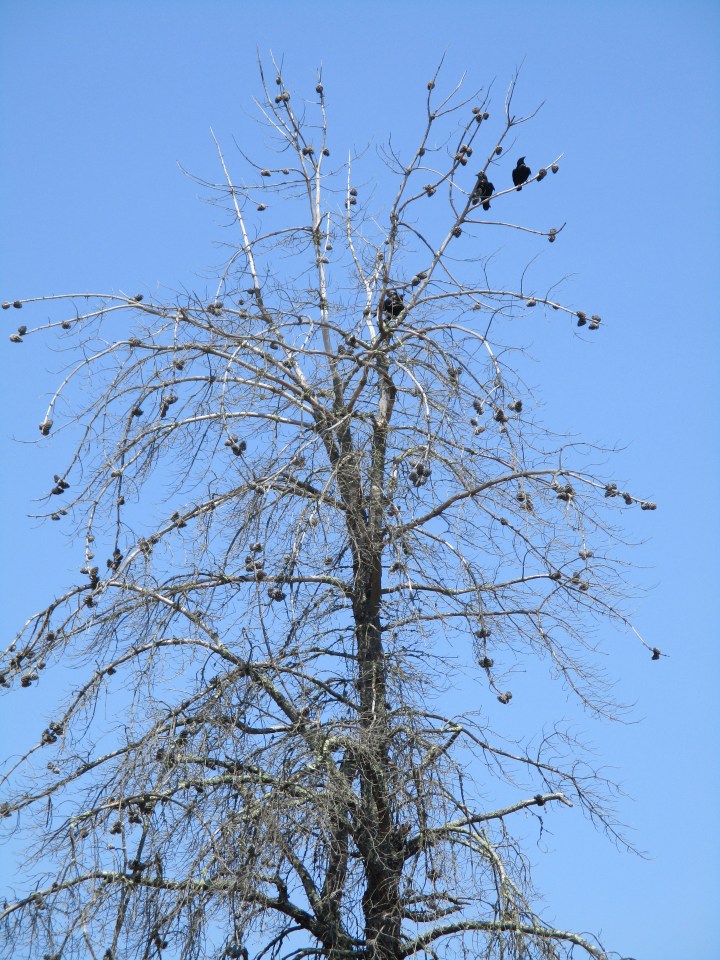 It is quite natural. Death, I mean. Every living thing does it at one time or another. Even the oldest bristlecone pines that live for thousands of years eventually do it. The Monterey pine in this picture did it quite efficiently. The three crows perched on top make it look extra dead. You know, not merely dead, but very dead. If this tree were in my own garden, I would be totally saddened by its death, but there is nothing that I could do about it.
The smaller dark objects suspended in the now dead limbs are pine cones. Monterey pine starts to produce pine cones at a young age, and of course, produces more with age and increasing size. As mature trees begin to deteriorate, they produce even more cones as they concentrate their resources into seed production for the next generation. This elderly tree knew that death was imminent. After all, death is natural.
Compared to other trees that are native to the neighborhood, such as valley oaks that live for centuries, and coastal redwoods that live for thousands of years, Monterey pines are ‘short-lived’. They live only a century or so, and may not live half that long in urban situations, particularly in more arid climates. They are endemic to the Monterey Peninsula, where they live within an ecosystem that, prior to urban development, naturally burned at least every century or so, before they got to be too old. In fact, their natural life cycle was directly relevant to how combustible the forests were, and how efficiently fires spread through them; but that is another topic.
The main concern here is that death is natural. The tree in this picture died a natural death. It can not be blamed on global warming, climate change, big industry, the President that we all seem to hate even though enough of us voted for him to become president, or my old car that, after almost half a century, is still not a hybrid. We can complain about death all we want, but we can never stop it.
 Tony Tomeo