There are too many bridges to count here. Several roads and trails, and a historic narrow gauge railroad cross over two creeks and two streams within a relatively confined area. This particular suspension bridge is for a hiking trail that crosses over Zayante Creek at the downstream edge of its confluence with Bean Creek. Bean Creek, which is to the upper right in the picture below, flows through the farm on the outskirts of Scotts Valley. Zayante Creek, which is to the left in the picture below, flows through my neighborhood on the outskirts of Los Gatos. Ferndell Creek, which is just a stream from a nearby spring, also flows into this same confluence, but is not visible to the right of the picture below.
All of these creeks and streams sustain even more diverse ecosystems than those of the redwood forests above, and the chaparral pine forests a bit father above. Redwoods grow like weeds here. The redwood in the picture below is what is known as a ‘virgin’ because it was not harvested for lumber when most others were clear cut harvested to sustain development of the San Francisco Bay Area, and to rebuild San Francisco after the Great Earthquake and Fire in 1906. It was most likely rejected because it was too small to bother with at the time. Only a century later, it is massive! The cables that are now embedded into its bark formerly supported an older suspension that the newer bridge replaced many years ago. Although redwoods are not necessarily a riparian species, and can actually be resilient to drought, they do enjoy this abundance of moisture. The many other trees that inhabit these ecosystems with them grow very tall to compete for sunlight, and in some situations are excluded by their dense growth.
Sequoia sempervirens, coastal redwood is the Official State Tree of California, and the tallest species of tree in the World. One large specimen can contain more lumber than many acres of Douglas fir (really). While some trees ensnare kites, redwoods collect satellites. Redwood lumber can be delivered anywhere in western North America simply by aiming a tree in the direction of delivery while cutting it down. Redwood shadows reach Japan at dawn and New England at dusk. The moon is covered with craters because it could not dodge the growing redwoods while orbiting over California. You can see for yourself how tall redwoods are just by looking in this direction from wherever you are in the World. Unfortunately though, not all of the debris that falls from the huge canopies of redwoods burns up in the atmosphere on its way down. Such huge canopies generate a lot of debris. Almost all of it is finely textured foliar debris. Some is twiggy detritus. The worst of it are significant branches. The descent of most of such branches is slowed by lower branches and foliage that they encounter on their way down. However, the lowest branches of some canopies are very high up, and falling branches resume acceleration after falling past them. Also, some falling branches fall outside of their canopies. Even branches that weigh only a few pounds can be extremely dangerous. Many falling branches weigh many pounds, and some are as big as trees. The fallen branch in the picture above is only several feet long and about three inches wide, (and happened to fall through the only three inch wide plank in a pedestrian bridge. The replacement plank needed to be custom cut.) I am annoyed by this relatively minor damage, but also relieved that it was not worse.
These coastal redwoods are very distinct from giant redwoods.
“Hidden giants: how the UK’s 500,000 redwoods put California in the shade” was published in the Guardian more than a month ago. It was amended to specify that it is about giant redwoods rather than all redwoods, as if that is a distinction that is easily omitted. Incidentally, it later mentions that, “For millions of years, the world’s tallest trees have graced California peaks and coastlines,” which is a reference to coastal redwoods, which are a different genus from giant redwoods.
What is worse is the claim that, “Researchers found that the Victorians brought so many seeds and saplings to Britain that experts say the giant redwoods now outnumber those in their US homeland.” More specifically, it continues to explain that, “The Victorians were so impressed that they brought seeds and seedlings from the US in such large numbers that there are now approximately 500,000 in Britain, according to a Forestry Commission estimate that includes coastal redwoods and dawn redwoods (a separate Chinese species) as well as the giant redwoods. Experts at Kew think most of the UK trees are giant sequoias, the official name for giant redwoods. California has about 80,000 giant redwoods, as well as also having coastal redwoods and a few ornamental dawn redwoods imported from China.”
Essentially, the article claims that this data demonstrates that there are more redwoods in the United Kingdom than there are here. Apparently, approximately half a million redwoods live there, and “experts” “think” that most are giant redwoods. Also apparently, only about eighty thousand giant redwoods live here.
Response to this is no easy task. It is a comparison of all redwoods in the United Kingdom to a very slim minority of redwoods here. About eighty thousand mature specimens of giant redwood live in the wild alone. Countless more immature specimens, including abundant seedlings that are only a few years old, live with them. Countless more giant redwoods have been installed into landscapes throughout areas of California that are collectively almost as large as all of Britain. Such trees have been getting planted here at least as long as they have been getting planted there. It is impossible to estimate how many giant redwoods are here, but there are many more than merely half a million. Furthermore, regardless of how the article was revised, the half a million redwoods of the United Kingdom includes coastal redwoods and dawn redwoods. There may be as many dawn redwoods here as there are there. More importantly, there are more than two million acres of wild coastal redwood forest here. In other words, for every redwood of any species there, there are at least four acres of wild coastal redwoods here. Many redwoods inhabit each acre of redwood forest. Also, many millions of coastal redwoods are planted into landscapes here.
Incidentally, the three species of redwood are actually three distinct genera, and the official name of giant redwood really is giant redwood. It is Sequoidendron, not Sequoia.
The article continues to say with complicated grammar, “Spurred by the climate crisis, devastating droughts and scorching temperatures have added new stressors for the redwood, particularly the famous giant sequoias, which now struggle to bounce back after big wildfires.” However, there is no climate crisis with devastating droughts or scorching temperatures here. Summers here are naturally dry and warm. That is simply how the climate here is. Most forests here burn at least every century or so. Therefore, redwoods that are thousands of years old have survived many fires. Now that some forests are allowed to burn as they naturally should, fires will not likely be so unusually lethal to younger redwoods in the future. Another claim that, “Vulnerable trees are also increasingly under attack from native bark beetles, insects that feed on their spongy red trunks until they topple.” is likewise inaccurate. Bark beetles rarely damage redwoods, and are no more likely to damage them now that they ever had been.
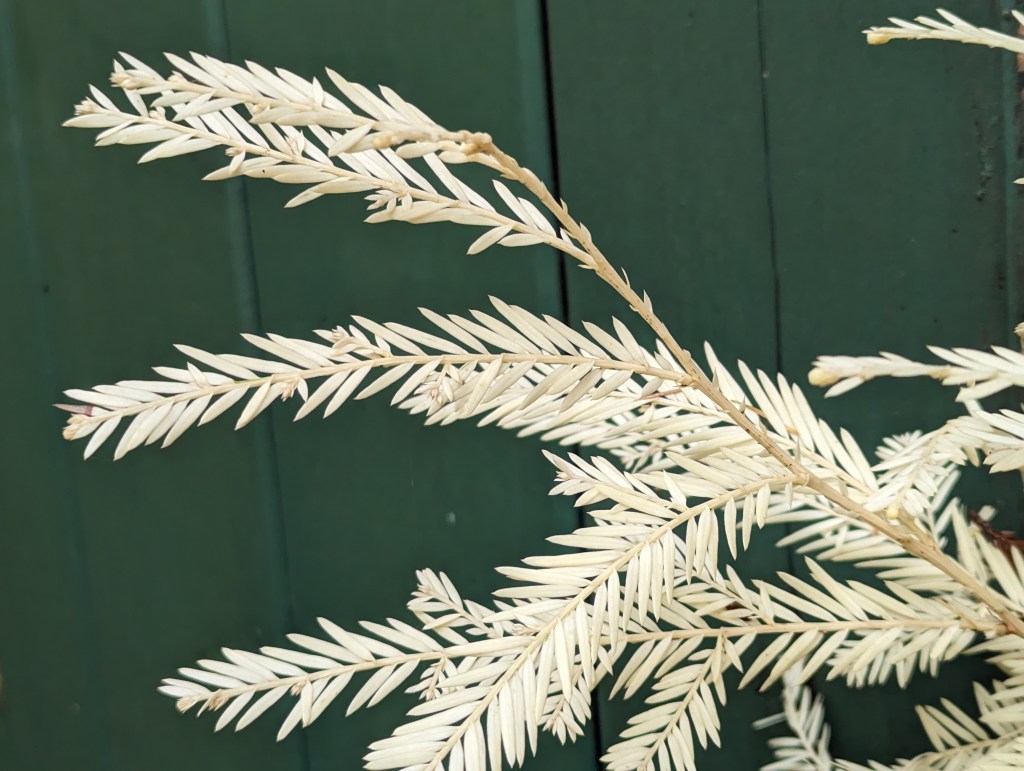
North Fourteenth Street is about as close as I have ever been to Italy; but amongst all the Green foliage here, I can find a bit of White albino Redwood foliage. It is a ‘sport’, which is a silly word for mutant growth. Because it lacks chlorophyll, and is consequently unable to photosynthesize, it is reliant on resources that it draws from the tree that generated it, which has a canopy of normal green foliage. Because of this reliance, copies of this mutant growth can not be grown as cuttings. Such cuttings simply could not sustain their own growth. I have made a few unsuccessful attempts to graft this mutant growth onto normal trees. The scions deteriorate before they can graft. I should try again. This foliage really is as strikingly white as it looks in pictures. I am certainly no expert on floral design, and I know that this foliage does not last for long once cut, but I suspect that it would look striking with black bearded iris or black hollyhock, or on a smaller scale, with black pansies or black petunias. Heck, it might likewise be striking with white flowers. In the early 1970s, albino redwoods, which are merely albino sports of normal redwoods, were considered to be very rare, with only a few documented specimens. Although they really are quite rare, many more have been documented since then, and many more, such as this specimen, remain undocumented. I wrote about this albino redwood foliage a few years ago, and was reminded of it by the wildlife photographer of Portraits of Wildflowers near Austin. Except for a few trees that are barely north of the border with Oregon, coastal redwood is exclusively native to the West Coast of California. It is the tallest tree in the World.
No, not ‘the’ Palm Springs. It is merely a concept for a new garden. It may not begin to develop for quite a while, and certainly will not begin prior to when the rainy season begins this autumn.
Palms and redwoods do not mix. Technically, they can, but they look silly together. However, there are a few young palms here, and there will be more in the future. Some are very important to me. The pair of Mexican fan palm seedlings came from the mature specimen that Brent scattered some of his brother’s ashes under in front of his home at the Jungalow. The windmill palm came from the childhood home of two of my best friends from the fourth grade. The rare hesper palm was a gift from a now deceased friend. It was stolen and then recovered.
Palm Springs may be developed to accommodate the various palms within their own space, away from the redwoods. The preferred location is a small and relatively mildly sloped plateau on an otherwise steep hillside, where oaks and chaparral species grow wild. A natural spring, if tapped, may be able to provide adequate irrigation. Otherwise, water is available reasonably nearby. Other lush or jungly species can also inhabit this garden. This includes heliconia, giant bird of Paradise, canna, calla, blue ginger, cup of gold vine, Philodendron selloum, four cultivars of angel’s trumpet and three distinct species of bamboo palm that are already here. The garden would not be visible from either of the nearby roads until some of the palms get very tall a few decades later. I doubt that anyone would mind if they could see such odd vegetation anyway.
Ultimately, Palm Springs could be like a bit of Southern California within its own confined oasis almost hidden above the redwoods.
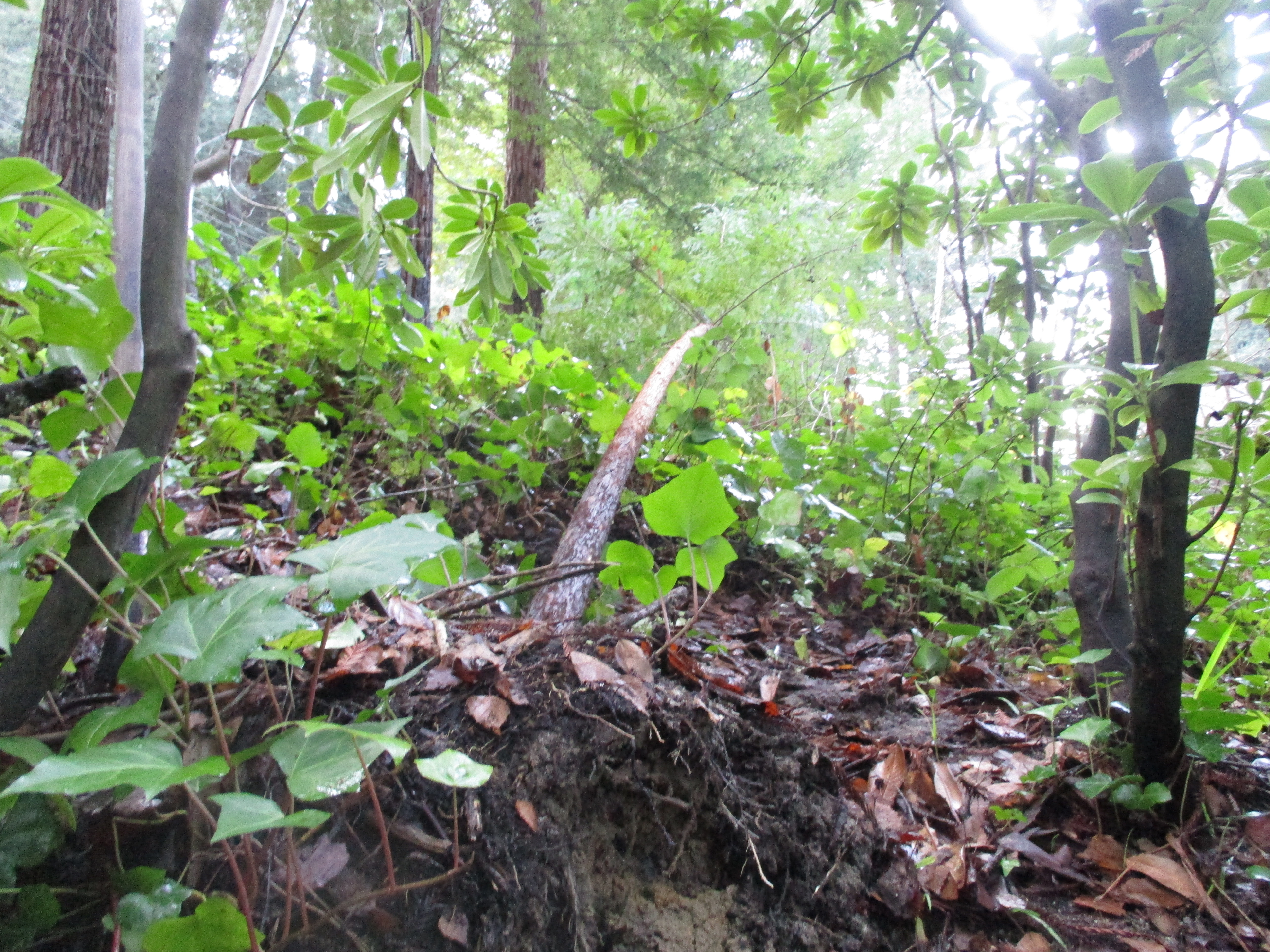
If a tree falls in a forest of the tallest species of tree in the World, things might get messy. Understory trees often fall without much commotion, but the demise of this particular redwood was observed from all over the neighborhood. The forest that it inhabited is too crowded for good pictures of where it landed. I got what I could. Falling trees is one of the unpleasant and hazardous results of the recent epically abundant rain.
About twenty feet of trail dislodged with the massive root system that nearly inverted as it fell into the canyon below. The gap was less than fifteen feet long on the left and uphill side of the trail when this picture was taken, but widened as more soil collapsed into the muddy void below. Obviously, the trail is now closed. Repair is not a priority until after winter at the soonest.
The dislodged root system is about thirty feet wide. I did not estimate how far into the canyon it slid. Since I can not see the base of the trunk, I did not estimate how wide it is. The trunk extends diagonally to the right, where it is obscured by vegetation in the foreground. It broke many other trees as it fell, leaving the shattered trunks and limbs that are visible to the upper right and left. Some of the debris near the water was deposited by earlier flooding.
The trunk fell upstream into a curve in Bean Creek below, so almost crossed the creek twice. From this distance, it is difficult to estimate the width of the trunk. Because the top is not visible, it is impossible to estimate the height. If it did not burn up in the atmosphere, someone in Nevada might have received an unexpected delivery of lumber.
Brent, my colleague down south, plants street trees. He has been doing so for decades. Some of the older trees are quite mature now. Brent telephones me to tell me whenever the first trees on opposite sides of a street meet in the middle. It is like a graduation for that particular colony of trees. The various species mature at different rates, so they ‘meet’ over their particular street on their own distinct schedule. Brent watches them all, and attends all of their ‘graduations’. Anyway, that is what the first picture reminded me of.
1. Redwoods meeting friends over a road is not uncommon here. For compact street trees that got planted at the same time on opposite sides of an urban street, it is an indication of maturity.
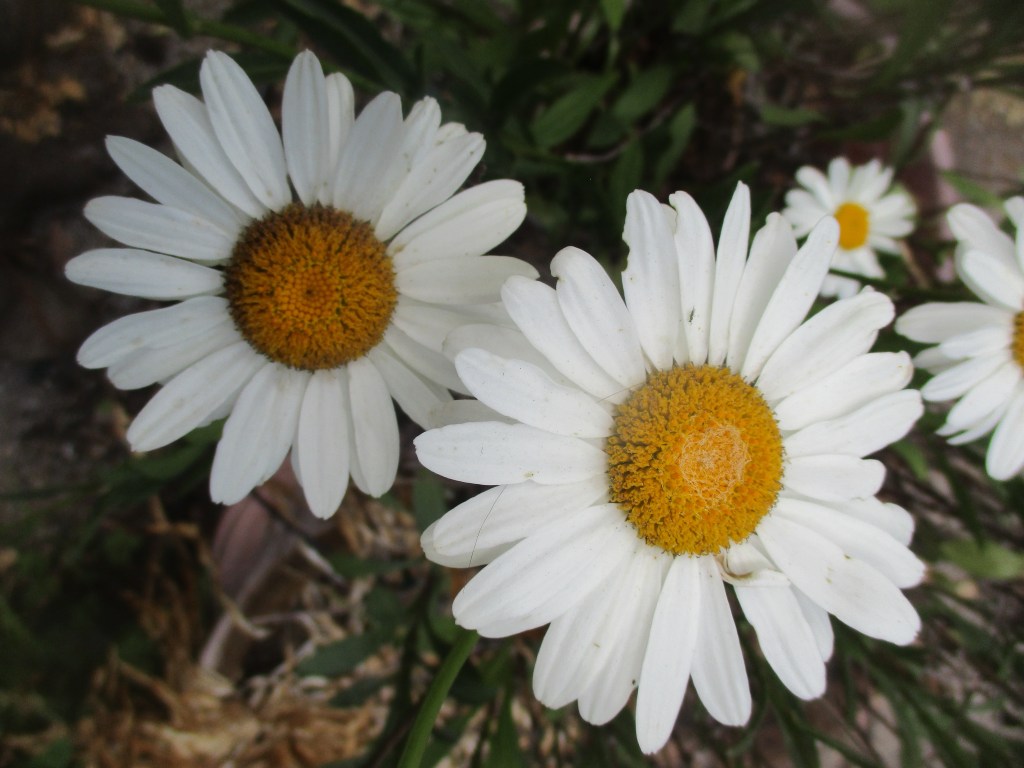
2. Shasta daisies are not exactly friends. They are just two of many separate flowers on the same mature plant. They are composite flowers, so each one contains many tiny but distinct flowers.
3. Lily of the Nile, while piled with many friends, waiting to get groomed and moved to another garden, looks like Sigmund the Sea Monster should stay away from the Pacific Coast Highway.
4. Deodar cedar seedlings that grew where they could not live in an industrial yard were relocated to be with friends in a landscape a few years ago. Some, although not all, are now doing well.
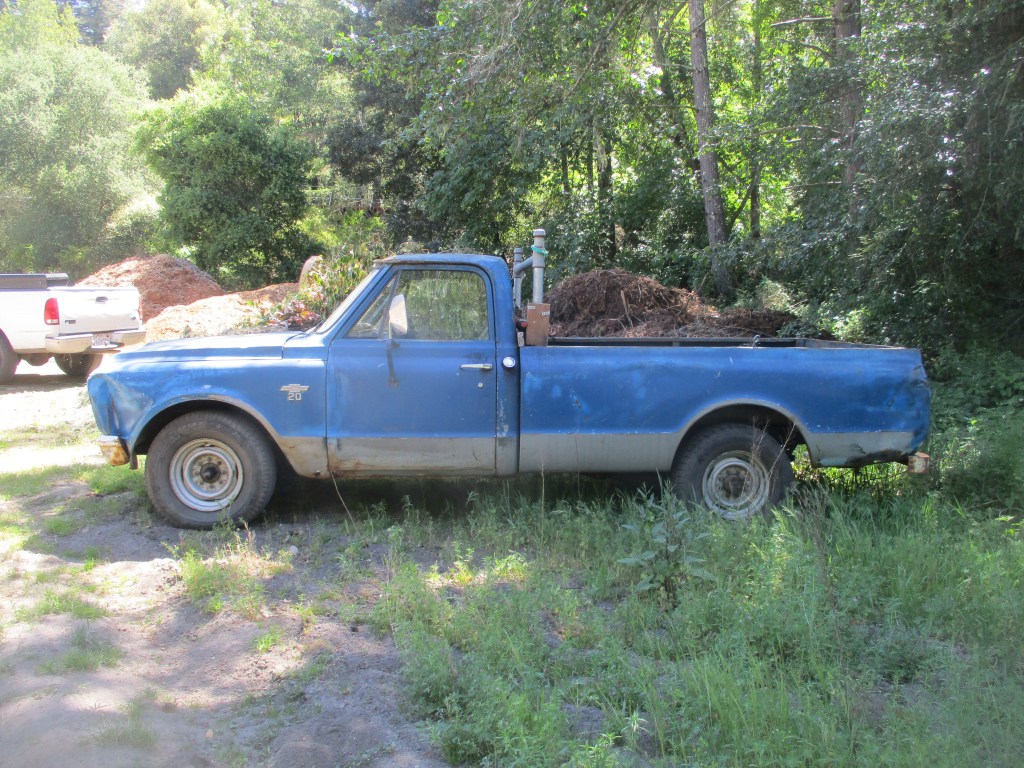
5. Beau, the 1967 C10, has a friend also, named Bo, and he is a 1967 C20. Beau helped me bring so much of my old plant material from the Santa Clara Valley. Bo does not get around so much.
6. Rhody is man’s best friend. Like all of his colleagues, he is very committed to his career, which is, of course, his commitment to his colleagues. In this picture, he happily awaits their arrival.
This is the link for Six on Saturday, for anyone else who would like to participate:
While strong Santa Anna Winds were blowing through Los Angeles four hundred miles to the south, and Storm Ciara was arriving in Scotland and Norway, we were getting some remarkably strong winds of our own. They were not nearly as strong as winds that were causing so much damage in Europe, and involved no flooding rain, but they were dangerously messy nonetheless.
We live and work among dense forests of coastal redwood, the tallest tree species in the World. Beyond the upper edge of the redwood forests are more forests of huge Ponderosa pine. Huge Douglas fir are mixed throughout. Their understory includes trees that would be considered to be massive anywhere else, such as coast live oak, tanoak, Shreve oak, bay laurel and madrone.
Such big trees drop big limb, and in abundance. Furthermore, limbs that fall from such great heights are significantly more dangerous than those that fall from smaller trees that are closer to the ground. They gather major inertia on the way down. They do not necessarily fall straight down either, but can get blown significant distances to where falling limbs may not be expected.
While the winds were blowing through, I could hear crashing of falling limbs and entire trees from the mostly deciduous riparian forest outside. I know that many of the big cottonwoods, box elders, willows, alders and sycamores are deteriorating, but did not expect so many to be blown down while bare. I suspected damage would be worse among the bigger and evergreen trees.
The pile to the left in the picture above is just the debris that was collected last Monday (while I was conveniently not here to help). It is more spread out but at least twice as voluminous as the pile on the right, which is pruning debris that took me several days prior to the wind to collect. The green cargo containers in the background demonstrate how big the piles of debris are.
More debris was collected on Tuesday (while I was still doing other work). The mess was not the worst of it. The roofs of a few buildings were impaled by falling limbs. Some of the damage is significant. Fortunately, the only big trees that fell did so into forested areas where there are no buildings, and electrical service was disrupted for less than a day. No injuries were reported.
It has been two year since I started my ‘part-time temporary’ job. I work here only three days weekly, and only if I can. That is what makes it ‘part-time’. After two years, I am not sure if it still qualifies as ‘temporary’. I do intend to eventually return to my normal work. However, this part-time temporary job will not be easy to leave. It is so excellent in so many ways! Besides, there are so many incredible perks!
1. Scenery is incredible. The redwoods in the background to the left are on the other side of a deep ravine where Bean Creek flows through. All the scenery here could not fit into one picture.
2. Native flora in the forest is incredible. Most of what is in the landscapes is native flora too, or garden varieties of native flora. There is no transition between the forests and the landscapes.
3. Redwoods are incredible. What is not obvious in the picture is that these grand wild redwoods with wild bay laurels to the right, are just beyond the landscaped perimeter of a vast lawn.
4. Exotic flora is incredible too, but compatible with native flora. The simple landscapes are both horticulturally correct and environmentally sensible. Daffodil naturalize but are not invasive.
5. Redwoods are incredible. Did I mention that yet? They really are grand. That is why they are the Official State Tree of California. They never get old, but they live for thousands of years.
6. The crew that I work with is the most incredible perk. I should write an article about them. Oh, I already did. I have no picture of them. There are too many for Six on Saturday anyway.
This is the link for Six on Saturday, for anyone else who would like to participate:
Redwoods are such admirable trees that no one wants to cut any of them down. On rare occasion, it becomes necessary to do so. Seedlings sometimes grow in situations where they can not stay. They might be too close to buildings or other infrastructure. Sometimes, they are merely in the process of crowding other important plants in the landscape. That was the problem with the young redwood pictured here, and another just like it.
1. There it is, an exemplary specimen barely left of center. The problem was that it would have crowded other trees if left to grow. The dogwood to the left is feral too, but will not get too big.
2. This juvenile tree had been cut off at the ground, and regenerated. This meant that I expected it to be more firmly rooted than it would have been if it had not experienced such trauma.
3. What a surprise! Roots on one side had already been severed by earlier excavation for a drainage pipe. As I cut a few more roots on other sides, this unfortunate young tree just fell over.
4. There were enough roots remaining for this tree to survive if there had been someplace to put it where it could have been irrigated and guyed until it recovered and dispersed new roots.
5. Guying would have been difficult though. The young and slender tree was just too tall and flimsy for any downward tension applied by guys. Sadly, this young redwood was not salvaged.
6. This is really why I was here. Besides removing two feral redwoods, I dug two Japanese maples that had been stagnating in the landscape for years, and canned them to hopefully recover.
This is the link for Six on Saturday, for anyone else who would like to participate:












 Tony Tomeo