Horridculture – Deferred Road Maintenance

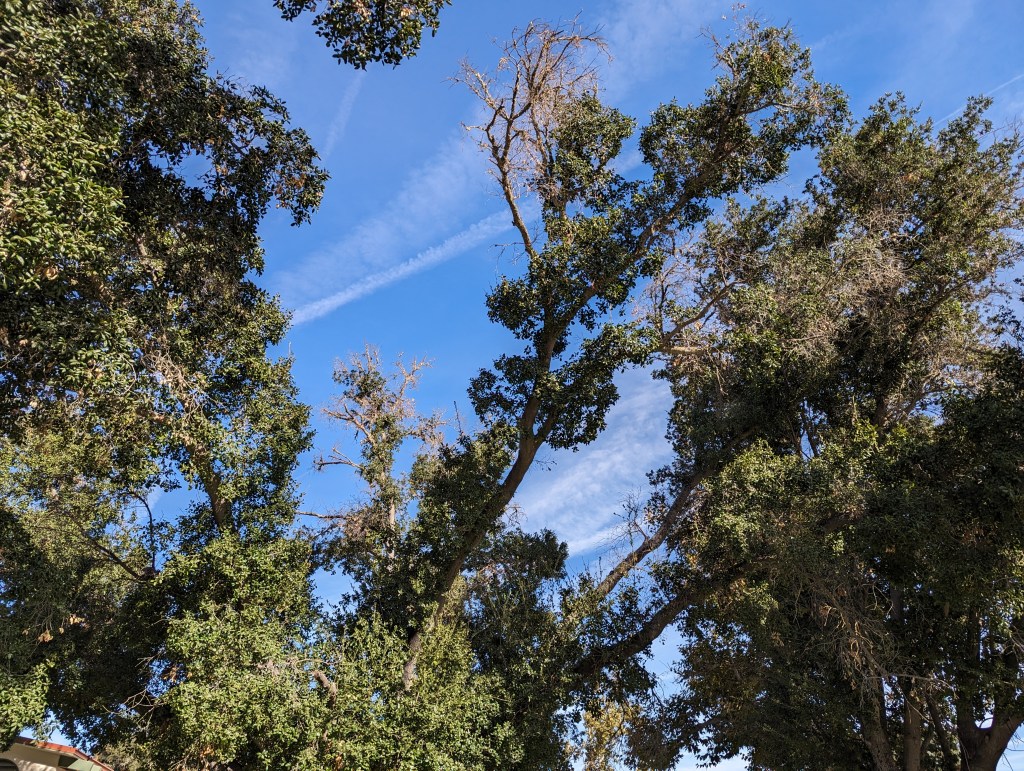
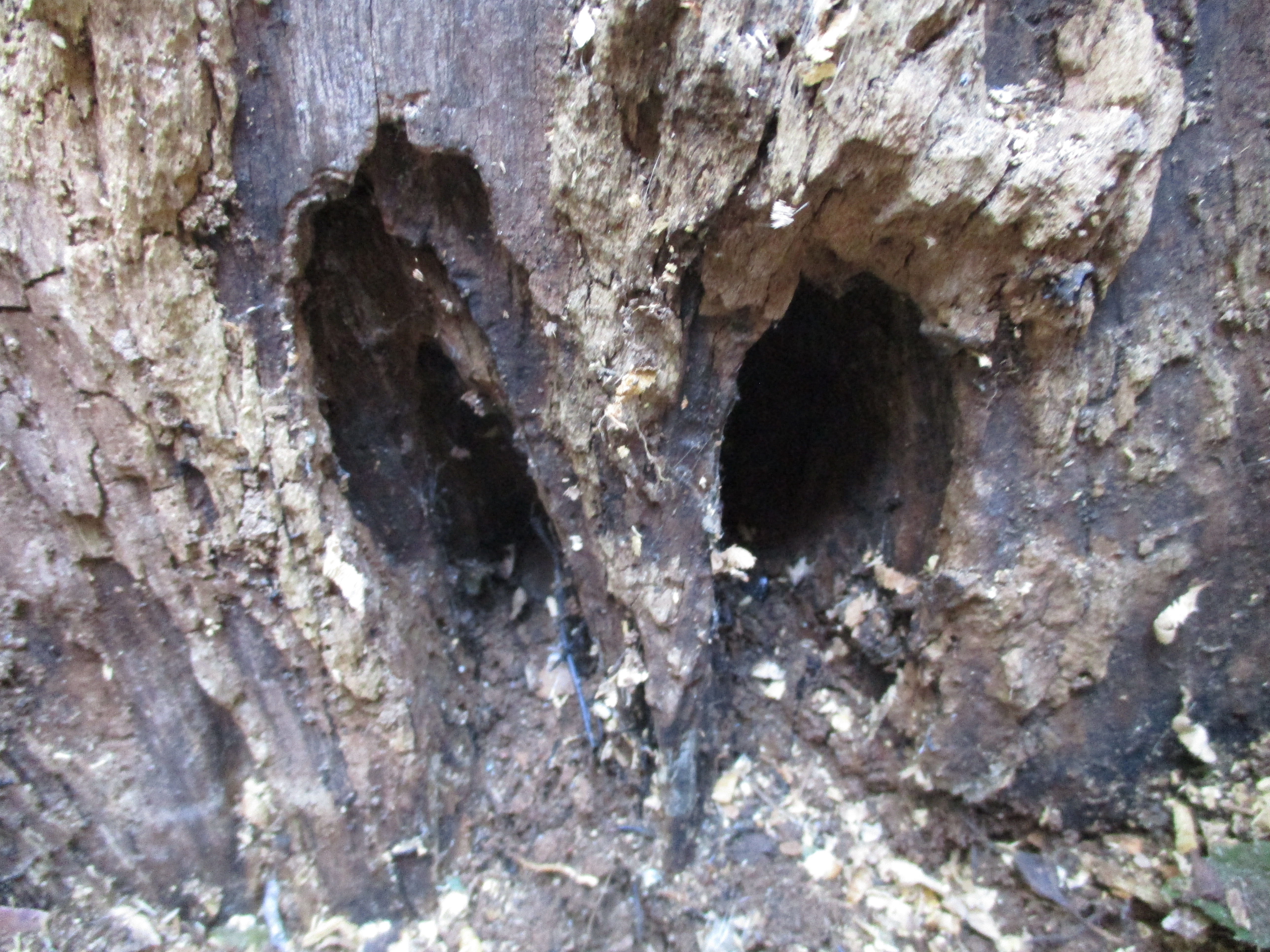
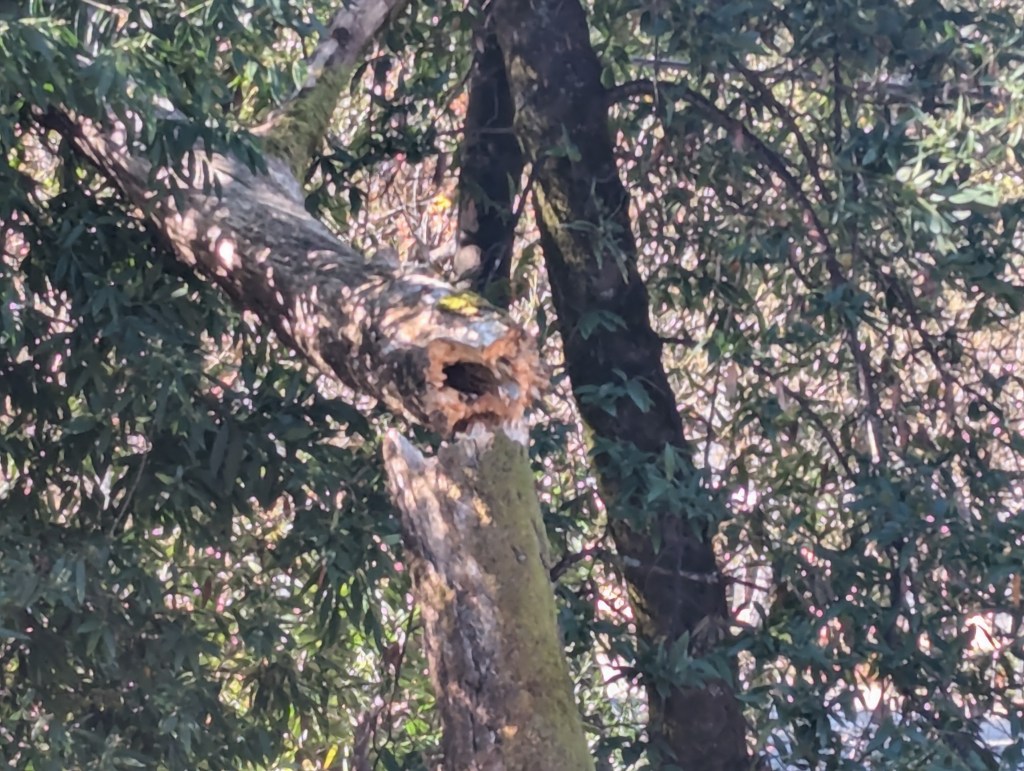
It is not on the road yet, but will be soon. This box elder has been deteriorating for several years. Only a few viable watersprouts remain within about ten feet of the ground. All limbs above are gone, leaving only this decomposing trunk. Several more similarly deteriorating trunks, with more or even less of their associated canopies remaining, are barely standing nearby. Most succumbed to an unidentified pathogen a few years ago. Some were dead prior to that. This one is special because such a significant portion of its upper trunk has broken off, and now remains suspended by the unbroken portion of the same trunk and the collective canopy of adjacent bay trees. This would not be such a concern if this broken portion of the trunk was not suspended so closely to the busy road below. (The picture above shows where the trunk broke. The picture below shows its proximity to the road below.) I suspect that when the broken portion of trunk eventually falls through the canopy of bay trees, the heavier basal end will fall first, and guide the lighter upper portion to land closer to the base of the remaining trunk, and safely away from the road, but I can not be certain until it actually happens. Those who maintain the road will not remove the broken portion of trunk until this does not actually happen, and the debris instead falls into the road. I can do nothing about it because I can not direct how the broken portion of trunk will fall once it is dislodged, and the traffic on the road is nearly constant during the day. It would be safer with a crew to stop traffic while the trunk is removed, and even better if they remove all of the several decaying trunks.

Ocotillo Cuttings

Fouquieria splendens, ocotillo

Fouquieria splendens, ocotillo has been an elusive species that I would like to try to grow, even if only to determine that it will not survive for long in my climate. I suspect that there are a few reasons why I have never observed it outside of desert or warm chaparral climates. I know that it is very susceptible to rot if irrigated even slightly excessively, and within some climates, any irrigation may be excessive. If I can grow cuttings, I will put them in stony and very well drained soil on an exposed ridgetop above my garden, where they will get no irrigation. The piece of cane that was given to me a few days ago, and that I mentioned this morning, is about three feet long, with a single offshoot that is a few inches long. Cuttings should supposedly be between four and six inches long. I tend to make short rather than long cuttings, so would be inclined to cut them four inches long, for a total of about ten cuttings, including the offshoot. I am tempted to cut thirteen cuttings, three inches long, but will try to confirm with the recommended four inch minimum. I do not leave many cuttings out for their ends to dry, but will make an exception for these, since that is what is recommended. I will refrain from scarifying the sides of the proximal ends of the cuttings, just because the stems are somewhat wide, with correspondingly wide basal cuts. Rooting hormone powder will be applied, also as recommended. Fortunately, winter is the best time for starting such cuttings. However, they develop roots slowly, so may not be ready for plugging for two years. I can wait. I will continue to maintain these ocotillo cuttings until they either root or rot.

Horridculture – New Lawn for Old Trees

These mature oaks can not adapt to the irrigation that the new lawn requires.

Californian climates are impressively diverse. However, most climates here are chaparral or desert climates, or similar to such climates. That means that almost all rain occurs during the rainy winter season, and that almost no rain occurs during the dry summer season. Vegetation that is native to California is very familiar with the climates here. Therefore, it does not expect rain during summer. This should be obvious.

Some native species can adapt to irrigation during summer. Some may grow faster than they normally would without irrigation, but compromise their natural life span in the process. This is acceptable within some landscapes. Many riparian species are not bothered by irrigation.

However, some species adapt less efficiently. Some do not adapt at all. Some that can adapt while young can not do so while mature. Oaks are a common example of this.

These coast live oaks with a few blue oaks were installed as shade trees within a formerly minimalistic landscape that did not include turf. They were happy with annual rainfall for half a century or so. Then, this generously irrigated lawn was installed around them. They can not adapt to the frequent irritation that the lawn requires. Their roots are succumbing to decay, so will eventually be unable to sustain their foliar canopies. As they deteriorate, decay may eventually compromise their structural integrity and stability. Dieback is already evident within their upper canopies, with lower watersprouts attempting to compensate.

I suspect that the trees will be removed before they deteriorate enough to become hazardous. I also suspect that new trees will systematically replace them prior to their systematic removal. Their eventual demise is likely an acceptable loss, and perhaps expected. Turf with adapted shade trees is likely more important within this particular situation than preservation of these middle aged oaks.

Dieback is evident within the upper canopy. Watersprouts are evident with the lower canopy.

Rest Stop

Quercus douglasii, blue oak

Rhody, Carson and I took Highway 101 for most of our recent trip from here to the Los Angeles region. We typically drive on more of a variety of highways between here and there, but for this trip, I wanted to drive on Highway 101, as was more typical when I was in college in the late 1980s.

Rhody enjoys rest stops, perhaps as much as our destinations. Because the rest stops near Gaviota remain defunct, only the Camp Roberts Southbound Rest Area was in service on our route. We stopped there, of course.

The old facilities that I remember were replaced years ago. I would prefer the old original buildings. I can not imagine why replacement was necessary. Nor can I understand why the more elaborate associated landscape was necessary. This new landscape, with its cliche crape myrtles, carpet roses and a bit of lawn, is irrigated so generously that the old coast live oaks are deteriorating and succumbing to rot. Most are now surrounded by irrigated lawn, after surviving with only annual rainfall for half a century or so. Like so much about California, not much of the familiar remains.

However, besides the deteriorating mature coast live oaks and a few seemingly younger California sycamores that are also within the landscaped areas, a few familiar native oaks remain beyond the landscaped area. Some seem to be older than those within the landscaped area, and if so, were there prior to the development of the rest stop. Most are coast live oaks, and a few are blue oaks.

I met the blue oak in the picture above in 1985. Although it has not grown much since then, the disproportionately large cavity within its trunk has. I am impressed that the trunk can still suspend the healthy foliar canopy above.

Alien

P00308-1
It really looks like something erupted from within!

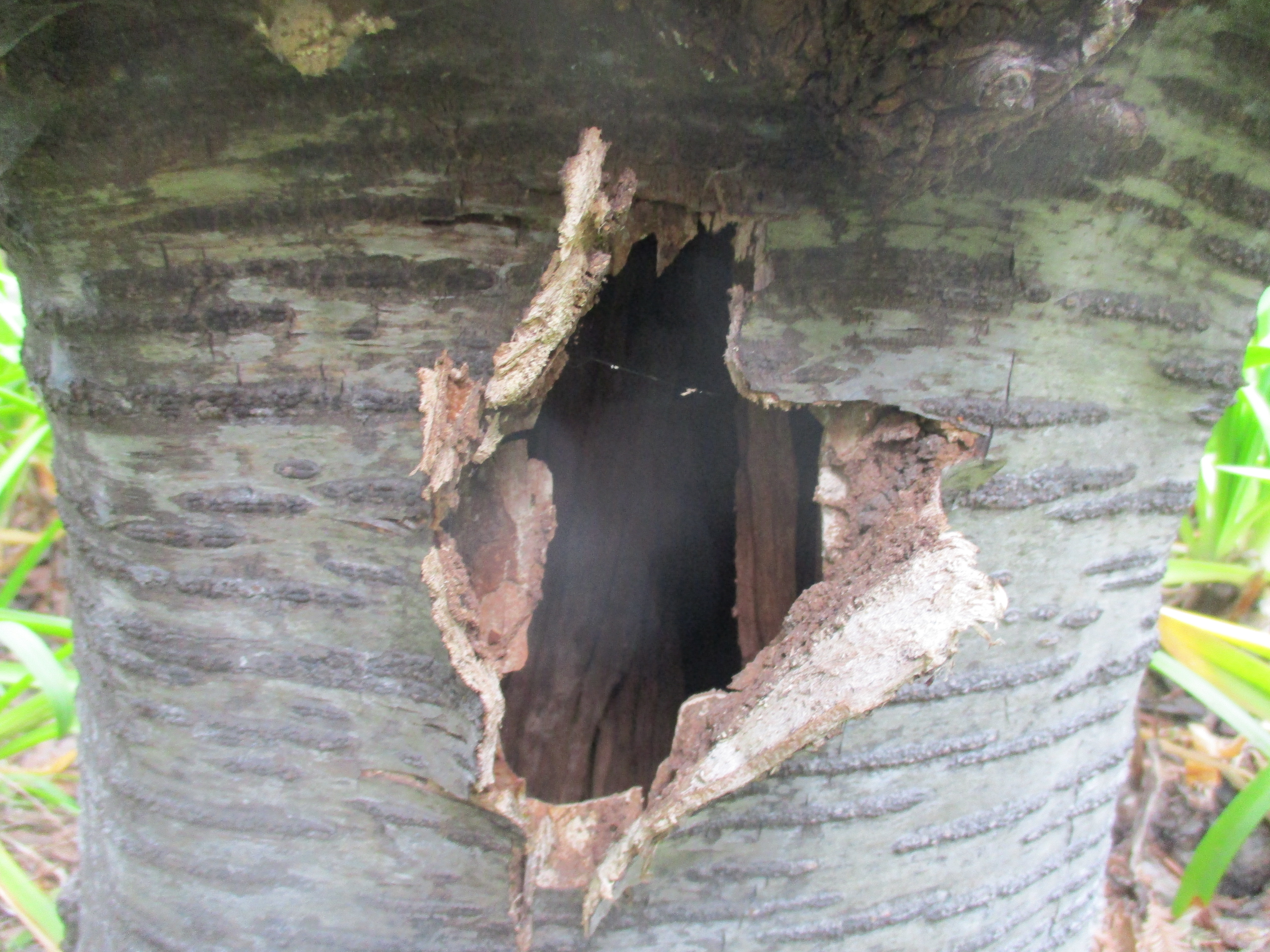
That was a scary movie back when horror movies really were scary! The first appearance of the baby alien was the creepiest part and one of the scariest scenes! It is too disturbing and gory to describe here. Those who have seen it may have noticed how it might seem to be weirdly relevant to the cavity that opened in the rotting trunk of this deteriorating flowering cherry tree.

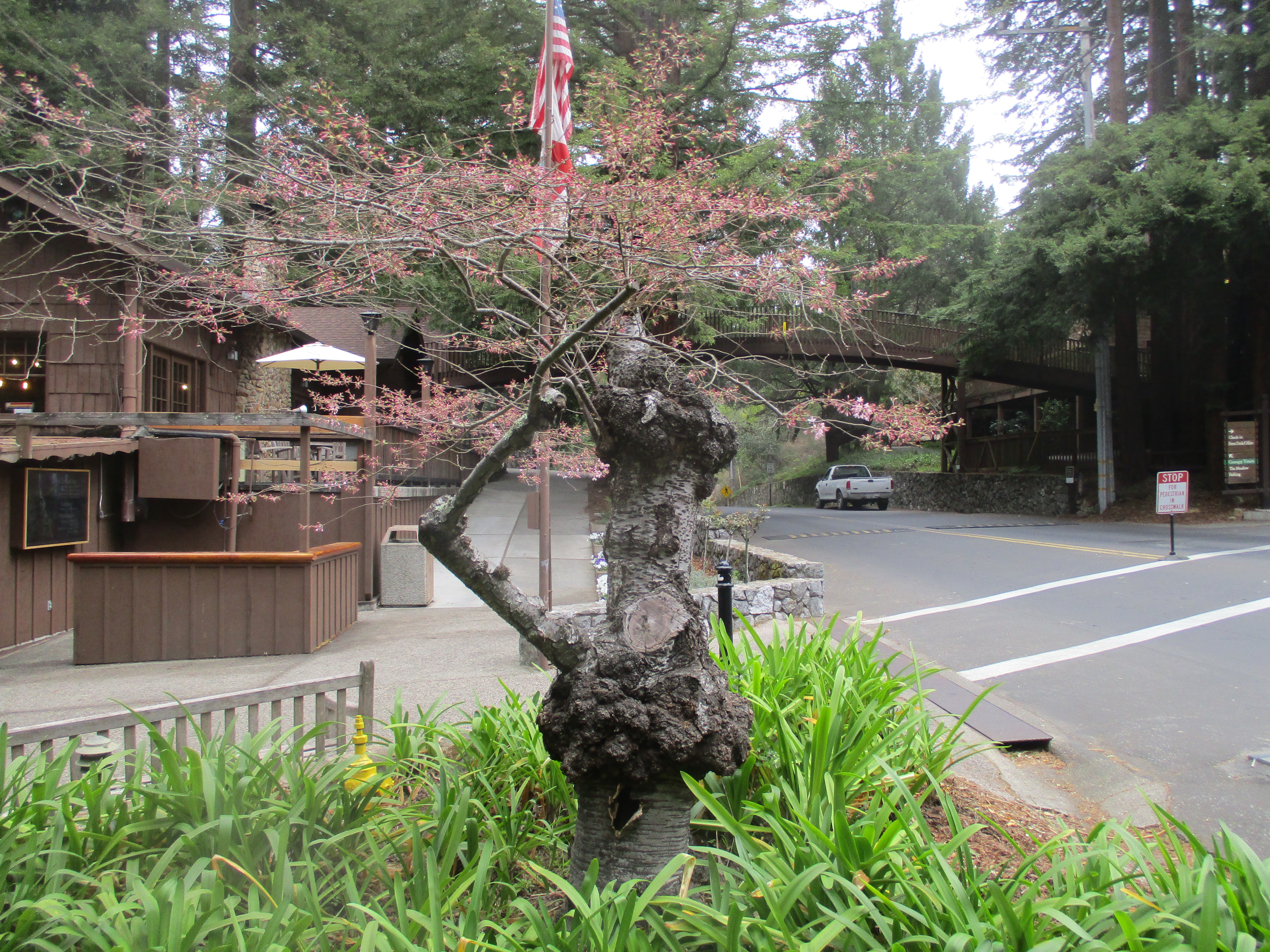
With a bit more distance, the rotting trunk looks sort of like an associate of ‘H. R. Pufnstuf’ after an interaction with a baby alien. If you can remember who H. R. Pufnstuf was, you probably shouldn’t. He starred in his own television show for children on Saturday morning in the 1970s. It was disturbingly weird and perhaps even inappropriate for the children it was intended for.

P00308-2
So, it is both rotten and unsightly.

With even more distance, it is obvious that this is nothing to joke about. This is one of two flowering cherry trees that I have been so protective of, and put so much work into temporarily salvaging. Both should have been removed and replaced years ago. This project was scheduled for after bloom in 2018, postponed until after bloom in 2019, and has yet to be done even now.

The problem is that these trees are so popular and so appreciated by the Community. They have been here in the most prominent spot in the neighborhood for several decades. There are not many who remember when the trees were young. No one seems to remember before the trees were here. They are as historical as the older buildings. I can not bear to cut them down.

As you can see, there is no choice now, at least for this particular tree. It is already so decayed that it can barely support its own weight.

P00308-3
As pretty as the bloom is, the disfigured branch structure and trunk are no longer appealing.

Six on Saturday: Stumped


Stumps are mostly left to rot after a tree gets cut down in our unrefined landscapes. Only those that are in the way get ground out. Some that remain probably would have been ground out if they were accessible to a stump grinder, because they are so unbecoming. Burning them out in winter is impractical for those that are close to buildings, and is no longer socially acceptable.

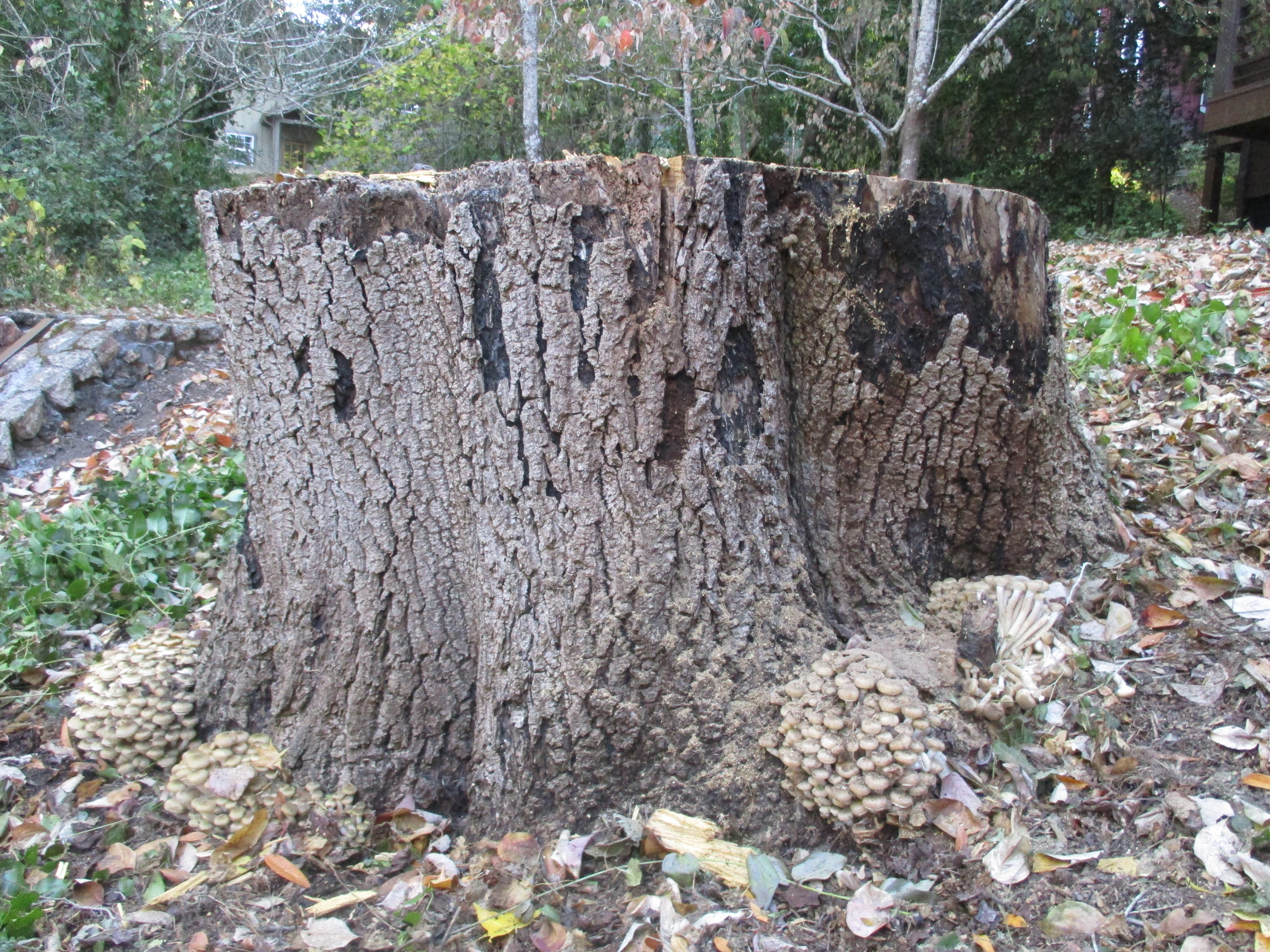
1. This one was nearly four feet high and nearly five feet wide! No one knows why it was not cut lower to grade. It was an unappealingly prominent feature of its landscape for several years.P91123

2. Mushrooms around the base indicated that it was quite rotten. A lack of stubble or stumps from secondary growth indicated that the tree was likely dead before it was cut down years ago.P91123+

3. It was rotten enough to be inhabited by rodents. It looked like a duplex. Alternatively, the holes could have been excavated by skunks pursuing grubs. They did not seem to be very deep.P91123++

4. As big as it was, the stump was not quite big enough to become a hot tub as the rotten guts were removed. Besides, it was already an unsightly focal point without steam coming out of it.P91123+++

5. What remains is a low pile of pulverized rotten wood with leaves from nearby dogwoods and a sweetgum tossed about on top to make it look less like a low pile of pulverized rotten wood.P91123++++

6. There was a slice part way into the stump near grade, as if someone tried to cut it properly when the tree was cut down. This old bent horseshoe was found about where the slice stopped.P91123+++++

This is the link for Six on Saturday, for anyone else who would like to participate:

https://thepropagatorblog.wordpress.com/2017/09/18/six-on-saturday-a-participant-guide/

If Mushrooms Could Fly

P90420K

If mushrooms could fly, they might look like this. Doesn’t it look like it is ready for take off? Maybe it looks like it is dressed up as a ghost for Halloween. I thought it looks something like the flying nun. Regardless of what it looks like, it was so weird that I took its picture.

I can not explain why it is in this weird position. It appeared just as the weather was warming up, and most of the earlier mushrooms were already gone or deteriorating. Perhaps the upper surface dried out a bit in the sunlight, and tightened up on the lower surface that remained more hydrated. Since I did not go back after getting this picture, I do not know what it did afterward, or how long it lasted. Perhaps it really did fly away!

This mushroom was just a few yards from where I got the picture of those associated with oak root rot fungus, Armillaria mellea,which many of us know as honey fungus. https://tonytomeo.com/2018/12/02/the-humongous-fungus-among-us/ Those mushrooms grew and deteriorated back in December. The other five types of mushrooms that I got pictures of to post along with a later picture of the oak root rot fungus mushrooms for a ‘Six on Saturday’ post were found just a few more yards away in another direction. https://tonytomeo.com/2018/12/29/six-on-saturday-shrooms/ They did their thing later in December, but still a few months ago.

There are always some sort of mushrooms out and about in riparian environments closer to the creeks and streams. They are just not as abundant now as they were during the rainy weather late in winter. Those out in drier and warmer spots that do not get watered regularly do not often develop so late into spring. They seem to know how to exploit the favorable weather.

The Humongous Fungus Among Us

04Is this Armillaria mellea, the dreaded oak root rot fungus? I really do not know. All the elements are here. The stump is that of a coast live oak. Bellow the stump there are the remains of roots. Those necrotic roots are undoubtedly decomposing as a result of rot. That rot is undoubtedly associated with this fungus. Furthermore, it fits the description of oak root rot fungus. The toasted spots were probably caused by weathering as the mushrooms started to develop while the weather was still warm and dry.

Now that the soil and rotting wood are damp from rain, this fungus is really proliferating. The individual mushrooms within the soccer ball sized mass were only about as big as those at the lower left margin of the picture just prior to the rain. They do not last long, and might become gooey black slop after only a few sunny days. The stump may continue to rot for a few more years. It is out of the way, so there is not need to get rid of it.

It annoys me when landscape professionals tell me that a particular spot in the region has oak root rot fungus. Of course it does. It is everywhere. It is quite natural here.

Oak root rot fungus is justifiably dreaded. It can easily kill the most majestic oaks that have survived for centuries.

However, most of the problems with oak root rot fungus in landscape situations are caused by supplemental irrigation and other gardening techniques. Oaks that have survived on natural seasonal rainfall for centuries are much more susceptible to rot if their roots are kept continually moist by the irrigation needed to sustain other plants added around them. Roots that get severed for the installation of pavement or building foundations are likewise much more susceptible to rot, particularly in spots where drainage from roofs or paved surfaces enhances soil moisture.

For this particular pathogen, gardening is more often the problem.

A Tree Falls In The Forest

70412thumbThe Great Basin bristlecone pine of the eastern Sierra Nevada can live more than five thousand years. The giant sequoia of the western Sierra Nevada can live more than three thousand years. The familiar coastal redwood from the Coastal Ranges can live more than two thousand years. Besides impressive longevity, one thing that they all have in common is that they all eventually die.

Most trees in home gardens do not live much more than a century. Some oaks can last a long time. Willows, poplars and acacias do not. Trees typically do not live as long in landscape situations as they do naturally in the wild because their life cycles are accelerated by watering and fertilizing, and also because watering promotes rot. Some trees get removed because they grow too big.

While trees are young and growing, they sometimes need help with structural problems. They might need pruning to eliminate limbs that are likely to break away and fall. On rare occasion, trees might need pruning to reduce weight and resistance to wind if stability becomes a concern. Falling limbs or falling trees are very natural in the wild, but can be serious problems around the home.

As trees age, they develop more structural deficiencies, which are increasingly difficult to repair or accommodate. Most big old hardwood trees have some degree of decay within their main trunks, even if no such damage is visible from the outside. Although perfectly natural, this decay eventually compromises structural integrity. Stability is slowly compromised as aging roots decay.

It is true that most trees that fall or drop limbs are more likely to do so while getting thrashed by winter storms. However, there are other factors that can bring down limbs or entire trees. Warming spring weather promotes growth of new foliage, which significantly increases the weight and wind resistance of structurally deficient limbs and destabilized trees. Warmth also accelerates decay. Even after winter storms, there are many other reasons to be aware of the health of trees.