
Columbine does not do well here. I do no know why. It does well enough in Colorado to be the Official State Flower there. Yet, the mildest of climates is Colorado are harsher than the climate here. It does not get too terribly warm in summer here. Humidity is minimal, but not as minimal as in much of Colorado. Nor does it exceed that of other regions where columbine does well.
We have certainly tried to grow columbine. It just does not work. Some of it succumbs to powdery mildew. Some succumbs to rust. The last batch just succumbed. Because it was expected, I did not bother to investigate. I got the impression that it was taken out by both powdery mildew and rust. Flowers that bloomed so delightfully when planted went to seed on their way out.
That should have been the end of it. I would not mind if someone tries again to grow columbine for next spring, even if it last for only a short while. I just do not expect to see it ever perform well here. None was planted this year. Even if someone had considered it, there was no need to add any prior to furlough, while cool season annuals for winter continued to bloom so happily.
What I certainly did not consider was the few seed that the last batch of columbine tossed almost a year ago. Apparently, at least one of those seed fell from the ledge where its parent plants lived briefly in now absent planter boxes, and into the edge of a small landscape below. It grew into an exemplary specimen of columbine, which is happily blooming as if it were in Colorado!
It is surrounded by a concrete retaining wall, a perpendicular granite wall and a big granite boulder!

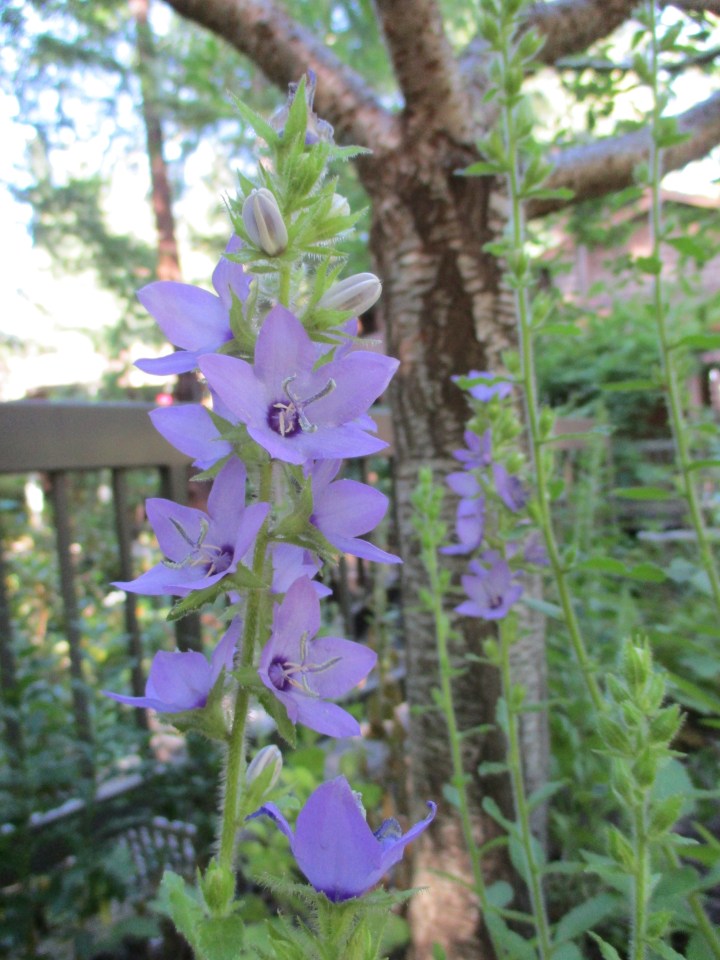 The seed is not really bad. At least I do not think that it is. It is merely misunderstood. Perhaps it would be more accurate to say that it is simply unidentified. I really do not know what it is. I do not say that very often, especially about seed that I bother to collect to sow elsewhere. I believe that it is of American bellflower, Campanula americana. If not, it is very closely related.
 Generally, that is how they are. Almost all perennial pea flowers bloom with the same bright purplish pink color of the bloom in the picture below. That is, of course, before their pods develop, but you get the point. We sort of know what to expect from them.
 Pampas grass, blue gum eucalyptus, giant reed, broom and Acacia dealbata are some of the best examples of the worst naturalized exotic species. They were imported for a variety of reasons or by accident, and now proliferate aggressively in the wild. With few of the pathogens they contend with in their respective native homelands, they have unfair advantages over locally native flora.
 Rarely planted but often found where the wildflowers grow, rose campion, Silene coronaria, has a way of sneaking in like California poppy or sweet alyssum do. It is so rarely planted that young plants are rarely available in nurseries. Seed is somewhat more available in nurseries, and quite available online. Although they self sow freely if allowed to go to seed, they are not really invasive.
 Of course, to the plants who do it, naturalizing is an advantage. To the rest of us, it is often a problem. The advantage to the plants who do it is that they move into new territory, make themselves at home, and probably do quite well with the new place. The disadvantage to everyone else is that naturalizing plants may not play well with others, and consequently interfere with the ecosystem.
 Tony Tomeo