Trees Naturally Dominate Their Gardens

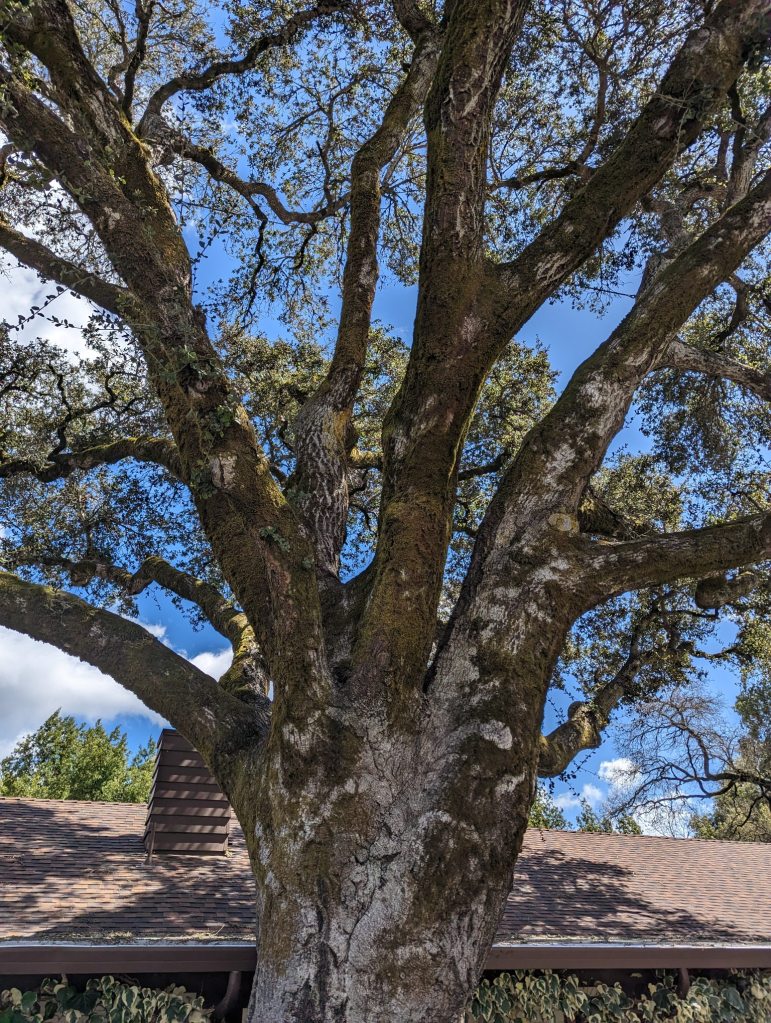
Oaks slowly become grand and sculptural.

Trees are generally the most significant living components within a home garden. Even treeless gardens benefit from nearby trees. Some old redwoods contain more wood than the homes that they shade. Some old oaks inhabited their gardens centuries before their gardens did. With few exceptions, nothing in a garden is as big or permanent as a tree.

Japanese maples, citrus trees and other small trees can be among the exceptions. They might be smaller than some of the shrubbery they share their gardens with. Papayas and other herbaceous trees can also be exceptions. Some live for only a few brief years. The definition of what a tree is can be vague. Variable interpretations complicate this matter.

A tree is a woody perennial plant with a single tall trunk and branches. However, banana trees develop several unbranched herbaceous trunks. Palms and tree ferns are neither woody nor branched. Arboriform yuccas are no woodier than palms. Many trees develop many trunks. Banyans use roots as trunks. This definition does not even describe ‘tall’.

Ultimately, the characteristics of a tree are more important than its definition. Shade trees near homes should be deciduous to let warm sunshine through in winter. Evergreens are better for obscuring unwanted scenery throughout the year. Evergreens are messier than most deciduous vegetation though. Their shedding is not so limited to distinct seasons.

Fruit trees are some of the most misunderstood inhabitants of home gardens. Not many grow big enough to function as shade trees. Fruit is difficult to harvest from those that do. Almost all require intensive and specialized pruning and maintenance. Few get it. Most eventually succumb to neglect. Citrus and avocados are some of the least demanding.

Palms, whether or not they qualify as a type of tree, are also misunderstood. They lack branches, so are not conducive to pruning away from utility cables. Their single terminal buds grow only upward. Removal is the only option for palms that encroach too closely to high voltage cables. Even the best palms need grooming from professional arborists. Most quickly grow beyond reach from the ground or even a ladder, and are dangerous to climb.

Fruitless Mulberry

Fruitless mulberry is conducive to pollarding.

Even though silk never became a major commodity in North America, it indirectly made an impression on American gardening. The tree that was developed to most efficiently feed silkworms is now among the most popular of shade trees. The fruitless mulberry, Morus alba, wastes no resources producing fruit while providing only abundant foliage, which is the only sustenance for silkworms.

Young trees grow at a good rate to nearly thirty feet tall, and can eventually reach fifty feet. They are often pollarded (pruned severely back to the same burly ‘knuckles’ every winter), which causes them to regenerate stems at an alarming rate during summer. Shoots from mature pollarded knuckles have no problem reaching fifteen feet in all directions! Mulberries incidentally have the distinction of the fastest motion known to the plant kingdom, because they launch their pollen at more than half the speed of sound!

The serrate leaves are quite variable. Those of vigorous young shoots of pollarded trees are mostly about six inches long with rounded wide lobes, but can be nearly a foot long! They turn bright yellow and typically fall neatly from the tree within a limited time in autumn, facilitating raking. Leaves on slower growing stems of lightly pruned mature trees are mostly unlobed and less than six inches long. They begin to fall earlier in autumn and linger over a longer time, sometimes with slightly subdued autumn color.

Black Locust

Black locust resembles white wisteria up a tree.

If only it were not such an invasive weed, black locust, Robinia pseudoacacia, might be appreciate for remarkably fragrant and abundant white bloom that resembles that of wisteria. The pinnately compound leaves are about five to ten inches long with rounded leaflets that individually are about one half to three quarters of an inch wide and twice as long. Autumn color is soft yellow. Trees can grow fast to more than fifty feet tall. Furrowed and fissured gray bark makes middle aged trees seem older and more distinguished than they really are. The wood is excellent firewood. All parts are toxic so should be kept out of reach of horses.

Black locust is native to a big area between Pennsylvania, Georgia and Kansas. It was brought to California both to produce firewood quickly, and because it is so appealing in gardens. Modern cultivars and other specie with purplish pink or pinkish purple flowers lack fragrance, but  are not invasive.

Silk Tree

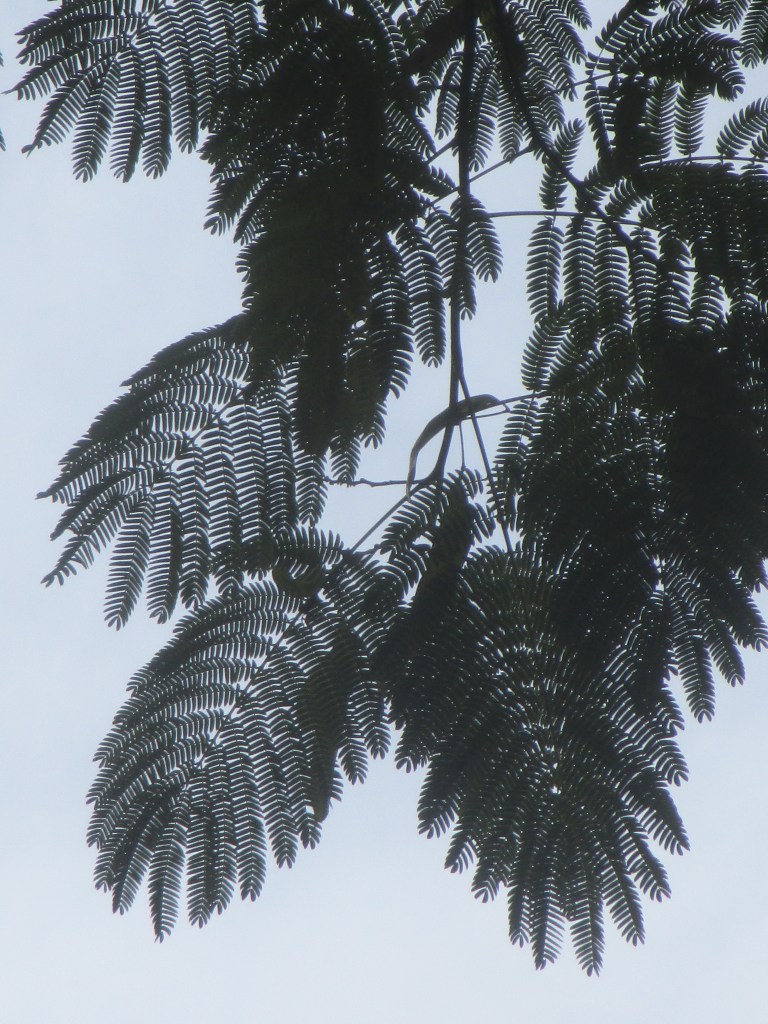
Silk tree leaves are bipinnately compound.

Resiliency is typically an attribute. It is how silk tree, Albizia julibrissin, adapts to various urban landscapes. Unfortunately, it is also how it naturalized within a few ecosystems of North America. It grows easily from seed, whether or not it is appropriate to where it does so. Many naturalized specimens somehow find good situations in which to grow though.

With good exposure, most mature silk trees develop rather low but broad canopies. They have potential to grow taller than forty feet, but if not competing with taller trees, may stay half as tall. Their arching limbs flare elegantly outward in low mounding form. Their finely textured foliage provides appealingly uniform shade that is neither too dark nor too light.

The lacy and bipinnately compound leaves of silk tree are between half a foot and a foot long. Each leaf divides into as many as a dozen pairs of pinnae (leaflets). These pinnae divide into about twice as many pairs of pinnulae (leaflets of leaflets). Such minute foliar components disintegrate during autumn defoliation, and can disappear into groundcover.

The pink and fluffy summer bloom can actually be messier than the deciduous foliage. It does not disintegrate as it falls, so may accumulate on top of vegetation below. Cultivars generally bloom with richer pink color, although at least one blooms with white. ‘Summer Chocolate’ exhibits richly bronzed foliage that contrasts strikingly with pastel pink bloom.

London Plane

London plane might resemble Norway maple.

The parents of this unintentional hybrid are supposedly American sycamore and Oriental sycamore. No one really knows. London plane, Platanus X acerifolia, appeared within a private collection in London at the middle of the Seventeenth Century. It became popular there two centuries later, through the Victorian Era, because of its resilience to pollution.

Mature London plane trees might be taller than a hundred feet. Few here are old enough to be much taller than sixty feet though. Regardless, defoliation of such grand deciduous trees might be overwhelming through autumn. Foliar tomentum (fuzz) can be surprisingly irritating while raking too much foliage. Autumn color is unimpressively brownish yellow. The specific epithet ‘acerifolia’ translates to ‘maple foliage’, because the foliage resembles that of Norway maple.

London plane remains among the most common of street trees. It really is commendably adaptable to inhospitable urban situations. However, it is not perfect. Its roots eventually displace pavement. The foliar canopies can eventually grow disproportionately broad for compact urban parkstrips. For some people, the foliar tomentum can be a major allergen.

Chinese Elm

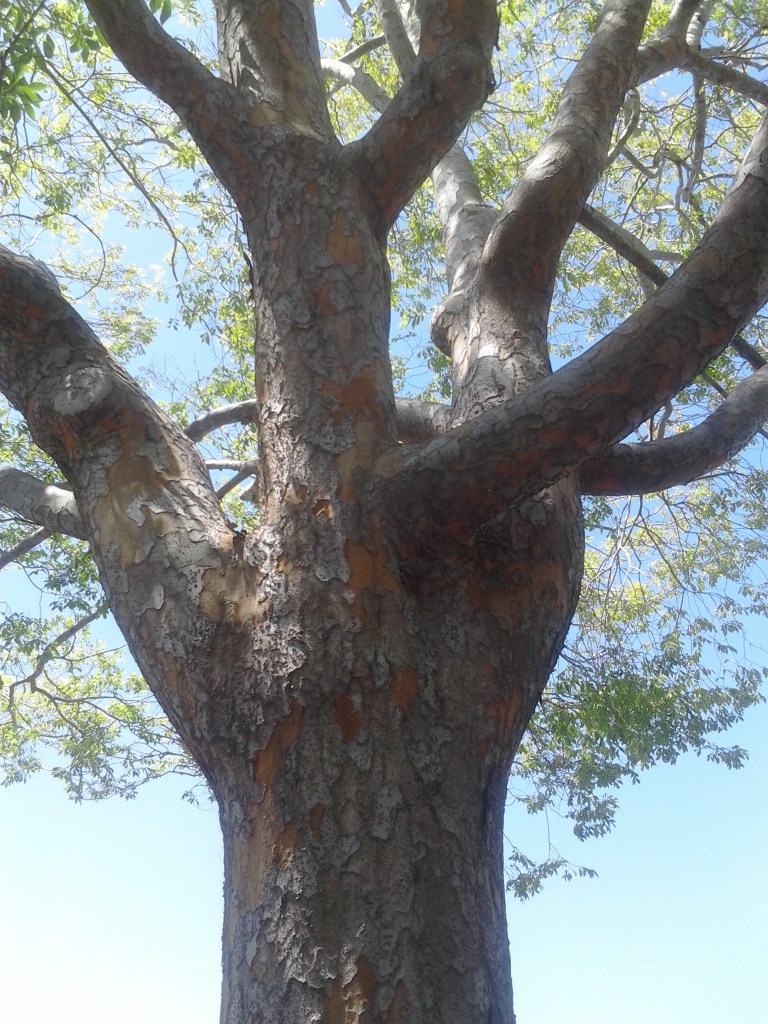
Intricately blotched bark distinguishes Chinese elm.

Since the Dutch Elm Disease (DED) epidemic that killed so many old and stately American elm trees so many years ago, the old fashioned Chinese elm, Ulmus parvifolia, has been unavailable in nurseries. That is why there are only old and middle aged trees, and maybe a few feral seed grown trees. Chinese elm is not bothered much by the disease, but is a vector. ‘Drake’ is a modern DED resistant cultivar, but it has a very different personality, with a more upright and symmetrical structure.

The elegantly lanky trunk and main limbs can be quite curvacious, with distinctively blotched gray and tan bark. The deciduous foliage can be messy in autumn as it falls slowly and may linger through December. The neatly serrate leaves are only about an inch or two long, and half as wide. Mature trees can be more than fifty feet tall.

Too Much Of A Good Thing

Healthy growth can overburden tree limbs.

It was probably the extra chill this last winter that made some deciduous fruit trees bloom more profusely early in spring than they typically do. Unusually busy bees in some regions improved pollination and subsequent fruit set, although some was dislodged by late rain. The sudden warmth this last spring not only improved the flavor of fruit, but also made some grow larger than typical.

More and better fruit is usually what those who grow fruit strive for. The problem with some trees now is excess. After pruning our fruit trees every winter for a few years, we get to know how much to prune them to maximize productions without overloading the trees. When the trees produce more than expected, they may not be able to support the weight of their own fruit.

Many plum and peach trees have already dropped limbs that were overburdened with the weight of fruit. Nectarine, apricot, pluot (and aprium, plumcot and all those weird hybrids), and prune trees can potentially drop limbs as well. Even without breaking, heavy limbs can get disfigured simply by sagging downward. Broken or sagging limbs expose inner bark to sun scald.

Broken limbs obviously can not be salvaged, so can only be removed. They should be cut cleanly away without leaving stubs. Sagging limbs can be propped with notched stakes tucked under side branches that will keep them from sliding upward. The notches keep such stakes from sliding off to either side. Much of the excessive fruit can be removed from severely sagging limbs. However, if the fruit is so ripe that it will not be getting any heavier, there is no advantage to removal.

Formerly shaded bark that suddenly becomes exposed to direct sunlight should be shaded. If partly shaded though much of the day, it should be safe. If expected to be shaded next year by new growth, bark can be protected temporarily with duct tape or stapled cardboard, or even foliated bits of the limb that broke, tied over the bark. Light colored paint is unsightly, but can be applied to reflect sunlight from bark that is expected to remain exposed permanently.

Excessive weight is not only a problem for fruit trees. Some sweetgum, fruitless mulberry and old fashioned Chinese elm trees can produce so much healthy foliage that limbs hang lower than they should. Some shade trees can even drop limbs ‘very’ unexpectedly, when the weather is warm and humid, but without wind.

Norway Maple

Few maples perform as well here.

Japanese maples get all the notoriety. They have such delightful texture and form. Many are proportionate to small spaces, such as atriums. Realistically though, they are overrated and overused. Meanwhile, other maples that work as larger shade trees remain obscure. Norway maple, Acer platanoides, gets broad enough to shade much of an urban garden, but rarely gets to forty feet tall.

Of course, Norway maple has innate limitations. It dislikes arid and harshly warm desert climates. Nor does it like to be too close to the coast. Los Angeles is about as far south as it wants to live. In the Pacific Northwest, it gets much bigger, and develops greedy roots. The non-cultivar species is invasive there. Norway maple defoliates neatly for winter, but then refoliates late in about April.

Almost all local Norway maples are cultivars. ‘Schwedleri’ has richly bronzed foliage. It is rare now, but was a popular street tree in the 1950s. ‘Crimson King’ has richer purplish foliage, but is less vigorous. ‘Drummondii’ displays delightful variegation. The deciduous foliage of Norway maple turns soft brownish yellow or gold for autumn. The palmately lobed leaves may be five inches wide.

Freeman Maple

Freeman maple colors with minimal chill.

It is a hybrid. It is naturally occurring. Yet, most cultivars (garden varieties) resulted from intentional hybridization and selection. It is not as strange as it seems. Freeman maple, Acer X freemanii, is a naturally occurring hybrid of silver maple and red maple. It grows wild where the natural ranges of the parents overlap. From their example, breeders learned to selectively breed the cultivars.

These cultivars combine the fast growth rate of silver maple with the structural integrity of red maple. None get to be as imposing as the silver maple. Some get to be about forty feet tall and wide, which is a bit bigger than red maple gets in local climates. Foliage is lacy like that of silver maple, but more substantial, like that of red maple. It develops brilliant orange and red color for autumn.

Freeman maple, although locally uncommon, is one of the more practical maples here. Like silver maple, it does not require much chill in winter. Like red maple, it develops a symmetrical canopy with reasonably high branches. Roots should be complaisant with concrete. Because it is a hybrid, it is mostly sterile. It does not produce enough seed to be invasive in more conducive climates.

Camphor Tree

00819
Camphor trees have stout branch structure.

The best camphor trees, Cinnamomum camphora, are in parks and other spacious landscapes. Such trees have sufficient room for their broad canopies. Although they do not grow rapidly, they eventually get quite large, and perhaps too massive for confined urban gardens. Some of the older local trees are nearly fifty feet tall, and nearly as broad. They have potential to get much bigger.

Camphor trees excel as shade trees. Their light green or perhaps yellowish evergreen foliage is quite dense. Shade of groups of trees or large trees with low canopies inhibits the growth of lawn grass. Also, roots are likely to eventually elevate lawn or other features that are close to the trunks. Foliar canopies are billowy, but can be lopsided, especially in windy or partly shaded situations.

Trunks and main limbs of camphor trees are rather stout, and can be rather sculptural. Trees should be pruned for clearance while young. Otherwise, obtrusively low limbs can become prominent components of the canopies. The tan bark is distinctively checkered. It darkens handsomely with rain. All parts of camphor tree are quite aromatic. Frass from spring bloom can be slightly messy.