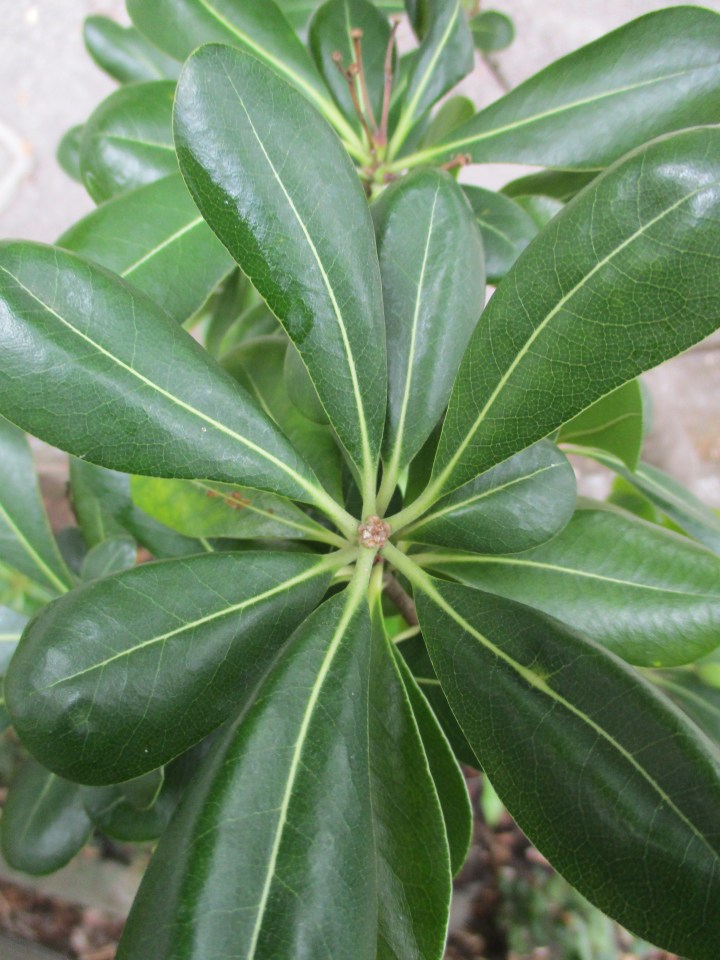
 A surplus of common names seems to be a common theme for many plants that we thought we knew the names of. The simple Pittosporum tobira, which might be known here by its Latin name, might instead be known as mock orange, Australian laurel, Japanese pittosporum, and Japanese cheesewood. Its native range is about as diverse, including Greece, Japan, Korea and China.
Back in the 1990s, the compact cultivar known as ‘Wheeler’s Dwarf’ was common enough to be as cliché as tam junipers were in the 1950s. There are actually a few other dwarf and variegated cultivars that do not share that reputation. Most are low, dense and mounding. ‘Variegata’, although not a compact dwarf, grows slower and stays smaller than the unvariegated straight species.
Otherwise, Pittosporum tobira gets about ten feet tall and wide. It can eventually get significantly taller, especially if lower growth is pruned away to expose the sculptural trunks within. If shorn as a hedge, it should not be shorn so frequently that the dense foliage is always tattered. Leaves are delightfully glossy and convex. Small trusses of modest pale white flowers are sometimes fragrant.
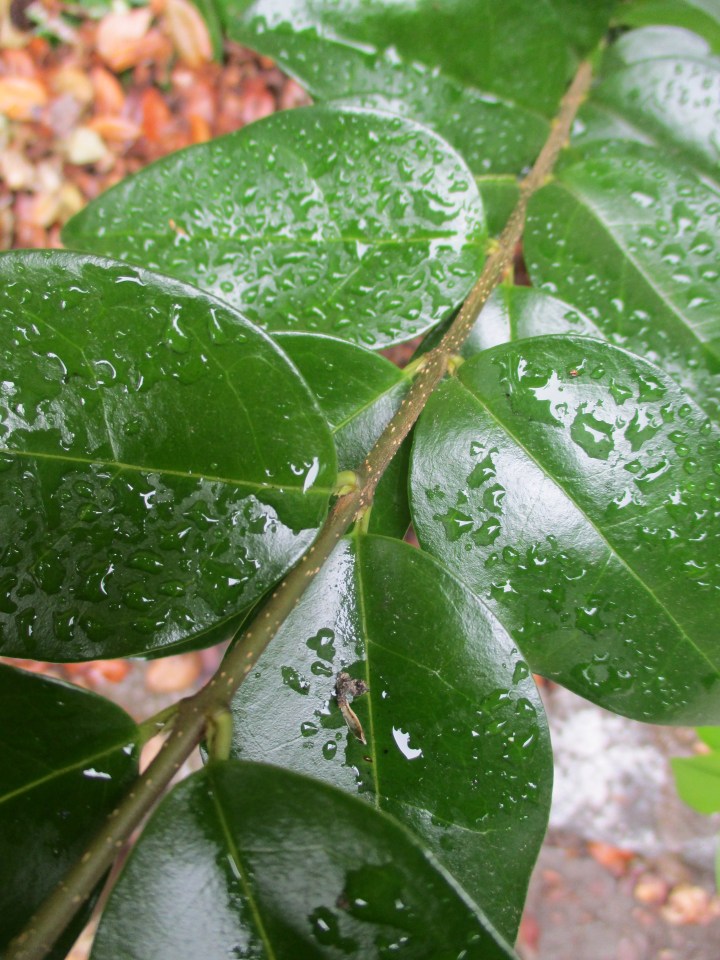 Here on the West Coast, privets had traditionally functioned like hollies had in the East. They are conducive to shearing into the big formal hedges that were popular during the Victorian period. Since then, as gardening space became more limited, the common glossy privet became less popular than the more compact and complaisant waxleaf privet, Ligustrum japonicum ‘Texanum’.
 ‘Shrubbery’ sounds so unflattering for a pine; but mugo pine, Pinus mugo, is not really much of a tree. The tallest trees do not reach eaves. Most old trees are only a few feet tall and about twice as broad, with strictly rounded form, and dense forest green foliage. The stout paired needles are only about one or two inches long. The plump cones, which are rarely seen, are not much longer.
 As a shorn evergreen hedge or simple shorn shrubbery, photinia, Photinia X fraseri, produces handsomely glossy bronzy red foliage without bloom. It is best if shorn as weather warms at the end of winter, and then allowed to grow out for a while. It can be shorn again through summer as bronzy foliage fades to green, but should not be shorn so often that it is always deprived of red foliage.
 Those of us who appreciate olive trees for their fruit production or distinctively gnarly trunks probably would not understand the popularity of the Little Ollie olive, Olea europaea ‘Little Ollie’. Not only is is completely fruitless, but it lacks sculptural trunks and limbs. It is instead a short and and shrubby plant that gets only about three or four feet tall, with very dense grayish green foliage. Only the narrow evergreen leaves are recognizable as those of an olive tree.
 Between New England and the Pacific Northwest, the boulevard cypress, Chamaecyparis pisifera ‘Cyano-viridis’, is classified as a small tree, even though it gets no bigger than large shrubbery. Locally, only very mature specimens reach the eaves, without getting much more than half as broad. Trunks and limbs remain concealed by fluffy evergreen foliage. Warm and dry air limit growth.
 The first half of the name sound appealing enough. The second half, not so much. Do the seeds grow into snails? Do they just look like snails? Not many have seen them. Tiny pale white flowers that are supposed to bloom in spring, as well as small black berries that develop after bloom, are rare. Laurel-leaf snailseed, Cocculus laurifolius, is grown just for its glossy evergreen foliage.
 With indiscriminate pruning, glossy abelia, Abelia X grandiflora, will never develop its natural form, with elegantly long and thin stems that arch gracefully outward. Sadly, almost all get shorn into tight shrubbery or hedges that rarely bloom. If only old stems get selectively pruned out as they get replaced by fresh new stems, mature shrubs can get eight feet tall and twelve feet wide.
 Heavenly bamboo, or simply ‘nandina’, is one of those many plants that almost never performs like it should. The intricately lacy foliage is so appealing while plants are young, and changes color with the seasons. The red berries can be comparable to those of holly. Unfortunately, healthy plants grow, and then ultimately get shorn into globs of disfigured leaves and stems.
 Those of us with ‘maintenance gardeners’ are likely aware of how rare it is to find someone who knows how to maintain hedges properly. It seemed so simple years ago. Several identical plants could simply be planted in a row, and then somewhat regularly shorn for confinement to a prescribed space. They were not allowed to exceed a specific height or width for long between shearing.
