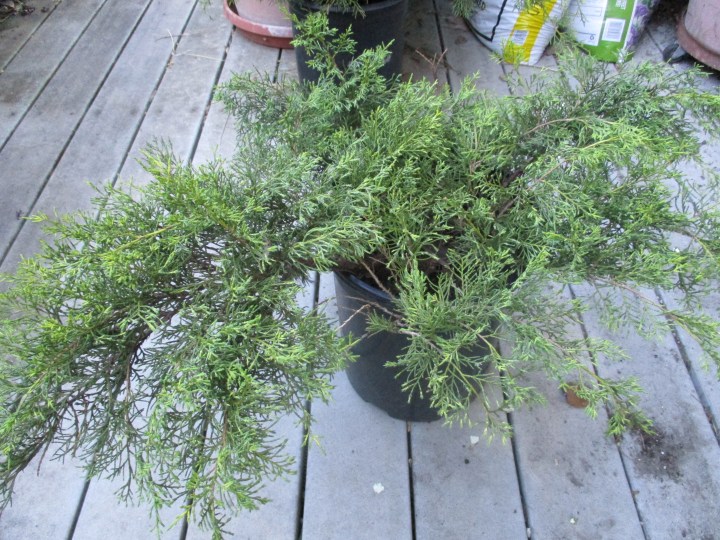
 Oh, the stigma of juniper never gets old! No matter how many cool new cultivars get introduced, and how many specie get rediscovered, they are still though of as those nastily prickly ‘tams’ that were too common in the 1950s. Even some of us who really like junipers dislike tams, not only because they share their stigma with all other members of the genus, but also because they really are nasty and prickly, and not as useful as their overuse would suggest. Are they deep ground cover or shallow shrubbery? They might work for a few years, or maybe many years, but they eventually crash into each other or other plants and pile up into a dense thicket that can not be pruned without being deprived of all dignity.
In the neighborhood where I primarily work, we have a ‘do not plant’ list. Such lists typically cite specie that are notoriously invasive, such as pampas grass, blue gum eucalyptus, Acacia dealbata and English ivy. In regions where fire is a concern, specie that are notoriously combustible, such as cedar, cypress, rosemary and manzanita, are also cited. Almost all of the specie on our list are there for good reason. I mean, we can figure out why they are undesirable in the neighborhood. Then there is juniper. No specie are cited; just the entire genus. Juniper.
Perhaps the eastern red cedar, Juniperus virginiana, is too likely to become an invasive exotic here, so the entire species was condemned. Perhaps junipers in abundance are just too combustible. The ‘do not plant’ list provides no explanation.
There are a few mature junipers in the landscapes that were installed before the list was compiled. A hedge of such junipers was recently removed because it was in the construction zone of buildings being renovated. It was no loss really. They were quite disfigured after decades of reliable service. However, at one end of the hedge, there were two much younger junipers that were added relatively recently to replace one that had been removed to facilitate access to subterranean utilities. They might have been added after the ‘do not plant list’ was compiled. No one really remembers. The list was compiled a few years ago, but distributed only recently.
Before the landscape was demolished, we took a few plants that could be dug up, and canned them back at the nursery for use elsewhere in other landscaped areas. We could not just leave the two small junipers to die. We dug and canned them too. Now they are back in the nursery, with no hope of finding a home back in the landscape from which they came. They happen to be nice specimens, and are certainly NOT tams. No one remembers what species or cultivar they are. They happened to match the original hedge remarkably well, which is rather impressive considering how modern cultivars have replaced most older cultivars.
I happen to have three canned junipers already. They are North American natives. Two are eastern red cedar, Juniperus virginiana, with two very distinct personalities. The other is the Juniperus communis ‘Compressa’, which is a compact cultivar and the closest I could get to the common juniper. Apparently, the common juniper is not so common in the natural form. I already do not know what to do with these three, although the common juniper can stay canned indefinitely.
These other two displaced junipers will probably go into a landscape pretty soon, while they are not yet root-bound. They just can not go any place close to where they came from.
 It may not always bloom profusely, but sweet pea shrub, Polygala fruticosa, blooms sporadically through most of the year. Even when not much color is evident from a distance, a few flowers can likely be found on closer inspection. For some reason, bloom seems to be quite colorful now. Bloom phases should be more profuse in spring and summer. The pea flowers are soft purplish pink.
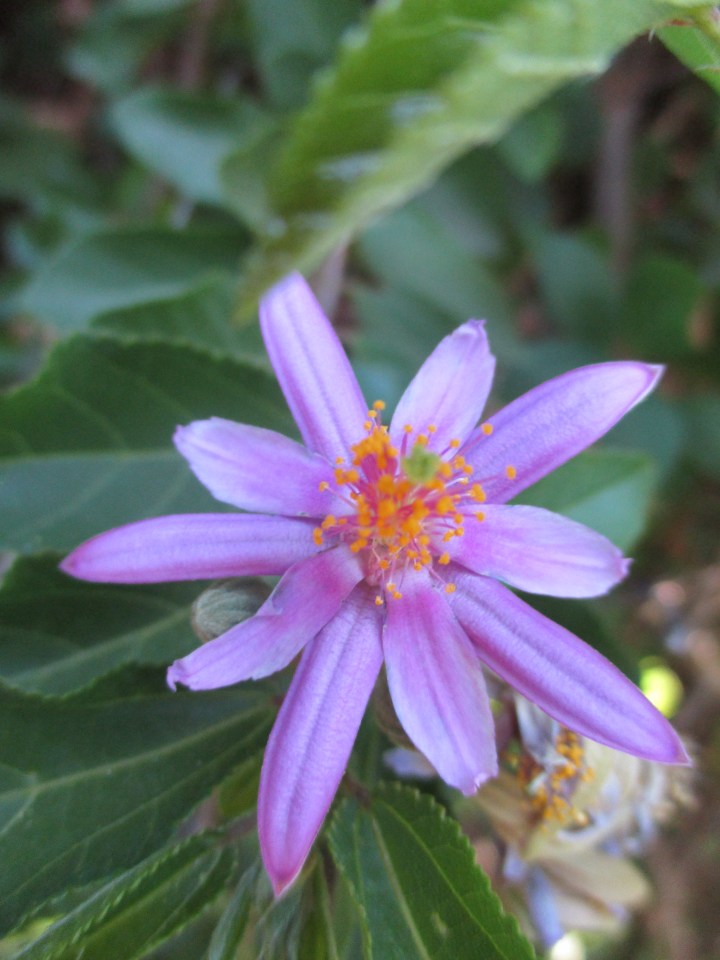 It is really an evergreen shrub with limber stems; but lavender starflower, Grewia caffra, can work almost like a rambling vine. It does not actually climb or grip anything. Like the canes of a climbing rose, it can be tied onto a trellis or fence as an espalier. As a free standing shrub, the arching stems should be pruned selectively. Shearing deprives them of their natural form, and inhibits bloom.
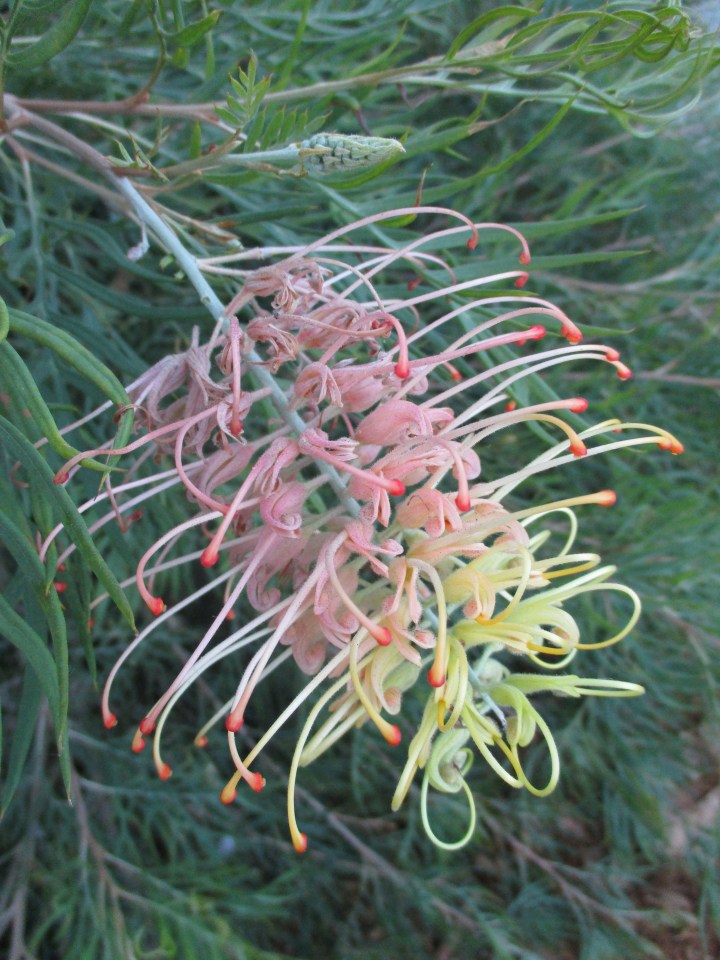 No one knows for certain who the parents were, so the hybrid Grevillea ‘Peaches and Cream’ lacks a species designation. (If it is important, the parent are most likely Grevillea banksii and Grevillea bipinnatifida.) It is an evergreen shrub that gets about four feet high and wide, with intricately lobed light green foliage. Individual leaves are about four inches long and two inches wide.
