Six on Saturday: Finally Flowers


After posting so many inter pictures of soil, stone, road signs, plumbing, empty wine barrels and mockery of French culture, I suppose I should share some pictures of actual flowers for a change. I mean, this is about gardening after all. Unfortunately though, I do not work with many flowers. The landscapes are designed to be compatible with the surrounding forests, so flowers are minimal. I already shared pictures of most of the best. Some of these are from gardens that I do not work with. I just thought that they were pretty.

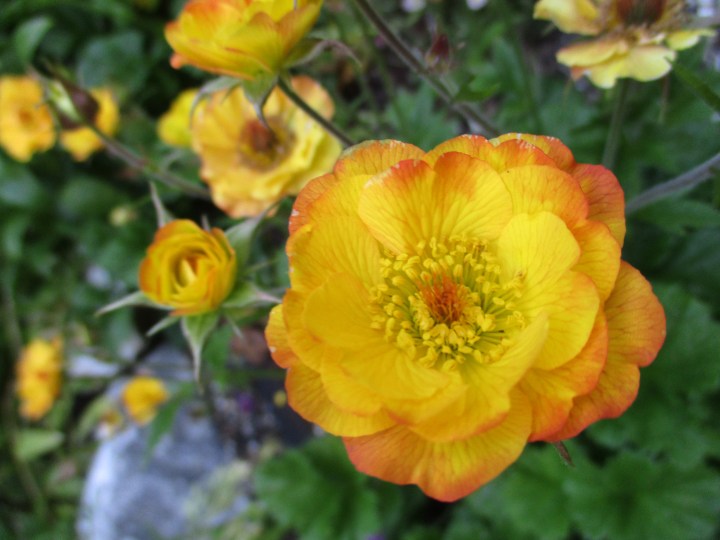
1. Avens finished blooming more than a week ago. I just really liked this picture because it is such a nice swirly orange color. Until I found these, I had not seen avens in many years, and did not expect to see it anytime soon. Since featuring it in the gardening column, I have found that others in other regions are quite familiar with it, and this it more popular than I would have guessed. http://www.canyon-news.com/ph-has-ups-and-downs/80473P80707
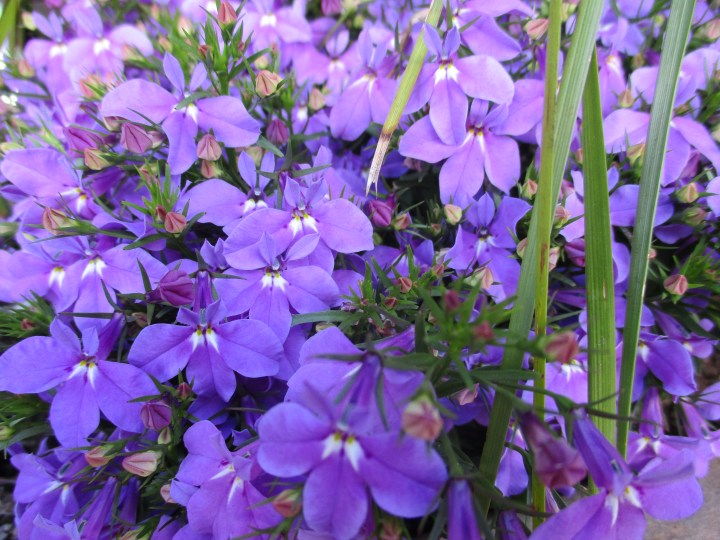
2. Lobelia is one of the more common warm season annuals. This is not from one of the landscapes that I work with, but looked good enough in a planter box in town for me to get a picture of it. I do not know what variety it is. There are many varieties nowadays that I am not familiar with anyway. Back in the 1980s, bright blue lobelia was popular alternated with white alyssum. I thought it looked rather silly at the time, but would not mind seeing it now. It was such an 80s look.P80707+
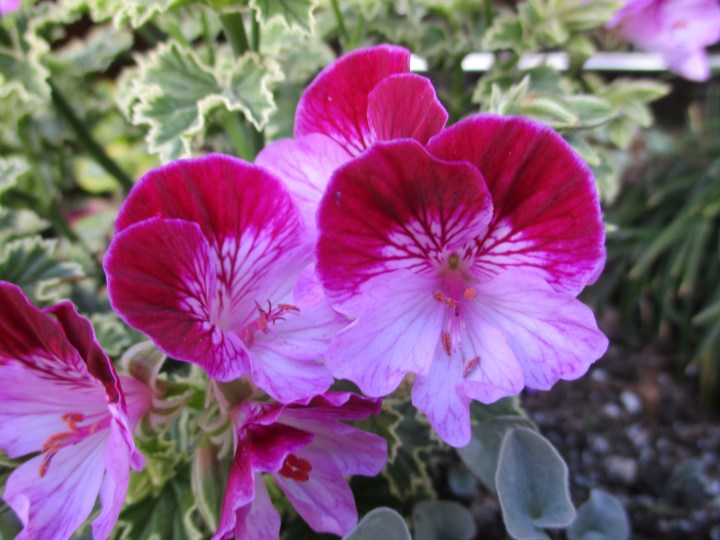
3. Pelargonium was in the same planter box as the lobelia. I know neither the species nor the cultivar. Again, it was just too pretty to pass up without getting a picture. It is more diminutive than the sorts of pelargoniums that I am familiar with. The plants are very compact. The variegated leaves and flowers are quite small.P80707++
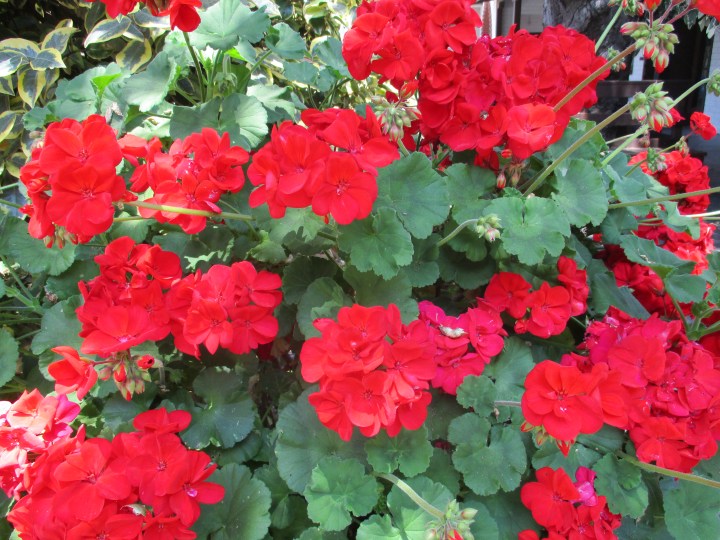
4. Zonal Geranium happens to be one of my favorite perennials because it was one of my first. Although I grew my first for only a short while when I was very young, I still grow one that I found in a trash pile when I was in junior high school, and another that I found naturalized in a creek near San Martin shortly after I graduated from college. I bring pieces of them everywhere I go. Both are the big and weedy types that are probably very closely related to the straight species. The first one is the very common bright pink with leaves that lack halos. The second is the very common bright orange red with only slight halos on the leaves. Getting back to this remarkably bright red zonal geranium; it is not one of mine. The leaves have only very light halos. The growth seems to be almost as vigorous and weedy as my bright orange red one, but not quite. It is more tame, and more prolific with bloom. The bright red color is prettier too.P80707+++
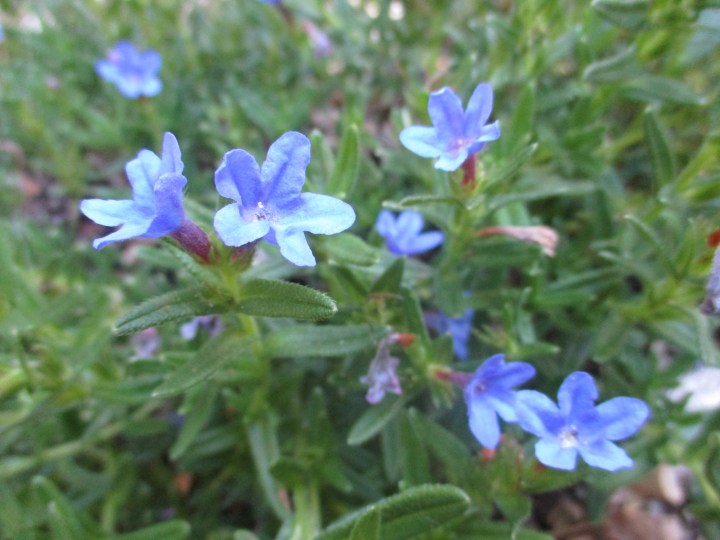
5. Lithodora looks prettier close up that it really looks in the landscape. It was planted into one of the newer small landscapes, but is not growing very well. I found the name to be amusing because it seems to mean that it smells like a rock. However, someone recently explained to me that the name means that it adores rocks, since it naturally grows in soil that is too rocky for other plants.P80707++++
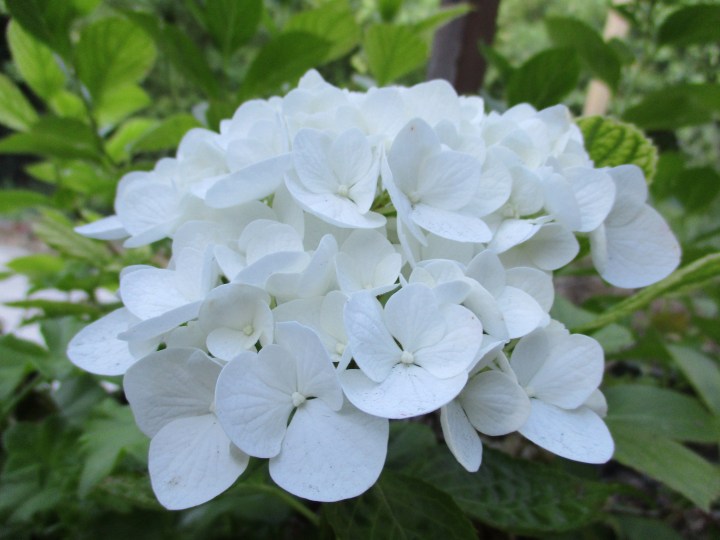
6. White Hydrangea is a nonconformist among all the hydrangeas that I fertilized to be either pink or blue. So far, the pink ones are still pink, and the blue ones are still blue. The few white ones are always white. http://www.canyon-news.com/ph-has-ups-and-downs/80473P80707+++++
This is the link for Six on Saturday, for anyone else who would like to participate:

https://thepropagatorblog.wordpress.com/2017/09/18/six-on-saturday-a-participant-guide/

Six on Saturday: Infrastructure


There is so much more to horticulture than plant material. There is a lot of hard work, which is hard to get in pictures. There are a lot of materials. There is a lot in infrastructure.

Well, I do not have pictures from the farm to show how our horticultural commodities are grown. That would not be very interesting anyway. These pictures are merely odds and ends of what we work with in regard to landscape maintenance.

1. Incarcerated stone. Yes, it is quite obvious that this prison is overcrowded. This is where they do ‘hard’ time. Incidentally, ‘Pet Rock’ was invented in Los Gatos.P80630
2. Half barrel. Back when there were more real wineries in the Santa Clara Valley, barrels such as this were cheap, and could sometimes be found left on the sides of roads for anyone who wanted to take them for kindling. At nurseries and lumber yards, they could be purchased already cut in half, perforated with a few drainage holes on the bottom, and painted with wax on the inside, for use as planters. They are more expensive now. This particular barrel came from France, so is not even made of local valley oak. See the fancy label at the top of the picture? The drainage hole on the left was not drilled through because the drill bit encountered something metallic in the wood. Check out the tips of my stylish boots at the bottom of the picture.P80630+
3. ErmitagE France. This metallic label on the wine barrel is so comically contradictory! The lack of an ‘H’ at the beginning, and the capitalized ‘E” at the end of ‘ErmitagE’ implies that the former contents of the barrel was something fancy, but is then followed by ‘France’.P80630++
4. NO DUMPING ALLOWED. This is a classic example of ‘Do as I say, not as I do’. We dump debris from landscape maintenance all the time. When we prune for road clearance, much of the debris gets thrown back out into the forest behind what was pruned. In some spots, it works like mulch to keep some of the weeds down. Larger bits must get taken away of course. This sign will be posted on a wide spot on one of the roadways where dumping had apparently been a problem. By the way, it is just coincidence that the two words ‘CHILD DUMPING’ lined up like that.P80630+++
5. White star magnolia. This was just moved to the new landscape of a newly renovated building. https://tonytomeo.wordpress.com/2018/06/16/six-on-saturday-rock-on/ We would have preferred to wait for it to defoliate in autumn before relocating it, but it was in the way within another recently landscaped area, and we really wanted to install it here in the new landscape before other material gets installed around it. https://tonytomeo.wordpress.com/2018/04/07/six-on-saturday-rock-concert/ It does not seem to know that it has been moved. I happened to grow these along with many other magnolias back in the late 1990s, and really did not like working with them in the nursery. We just were not set up for them. However, I really like them in the landscape. This particular magnolia grows like a large shrub, so will not get big enough to drop flowers onto all that pavement. That would have been a concern with larger magnolia trees that bloom with larger flowers that can be a slipping hazard when they fall onto pavement.P80630++++
6. Epiphyllum. This just happens to be in bloom at the shop. It belongs to the horticulturist who maintains all the landscapes here, so has nothing do do with the landscapes. With all the pictures of inert items and only one white star magnolia, I thought I should include something a bit more colorful. It does not get much more colorful than this.P80630+++++
This is the link for Six on Saturday, for anyone else who would like to participate:

https://thepropagatorblog.wordpress.com/2017/09/18/six-on-saturday-a-participant-guide/

Six on Saturday: Nursery Rhyme


I wish we had one. There is no rhyme and only a few disjointed reasons for what happens at the small storage nursery at the maintenance shops. This is nothing like acres of production nursery full of rhododendrons, azaleas, camellias and such. Nor is it like the retain nurseries that sell the rhododendrons, azaleas, camellias and such. This is merely a small yard where we store a few plants that get removed from landscapes, and plants that were recently procured from a nursery but have not yet been planted.

It is like the nursery version of the wood shop, with its collection of new lumber and old recycled lumber that gets used on the historic buildings. The plumbing shop contains all sorts of new plumbing and fixtures, as well as many old fixtures that might someday be useful. The landscape shop, which is separate from the nursery, is #7 of about twelve specialized shops used by the maintenance staff. The nursery might seem to be the most dysfunctional of the several shops, but only because plants are dynamic and need maintenance . . . and because, without necessary maintenance, a few have deteriorated, died or conversely thrived and made themselves at home.

Newly procured plants like #5 and #6 are easy to work with. They come in with a plan, and generally leave within a week or two as they get installed out somewhere in the various landscapes. Recycled plants like #1 and #2 were removed from the landscapes either because they were in the way of something, or because they proliferated too much, but could someday go back into other landscaped areas. Then there are a few plants like #3 and #4 that stay long enough to disperse roots through the bottoms of their cans and into the ground, essentially planting themselves on the spot because they got tired of waiting for a new home.

1. Peruvian lily was so prolific at the Post Office that many needed to be pulled. They were canned to be installed elsewhere, but no one wants to put them into a situation where they might proliferate like they did at the Post Office. Besides this pink, there is also peachy pink and yellow. All are the tall types that were originally grown fro cut flowers, rather than the lower mounding home garden varieties. Consequently, they need to be staked or caged like tomatoes so that they do not lay on the ground.P80623
2. Chrysanthemum was grown as annuals in a few various locations, but when they were removed to relinquish their space for more seasonable annuals, a few were canned. It is not always easy to discard certain perennials just because their time is up. The problem is that, although they look so good in the nursery, and bloom in spring instead of autumn, they do not get cycled back into the landscape. When new color is needed, it is often purchased and planted before the old stock is considered.P80623+
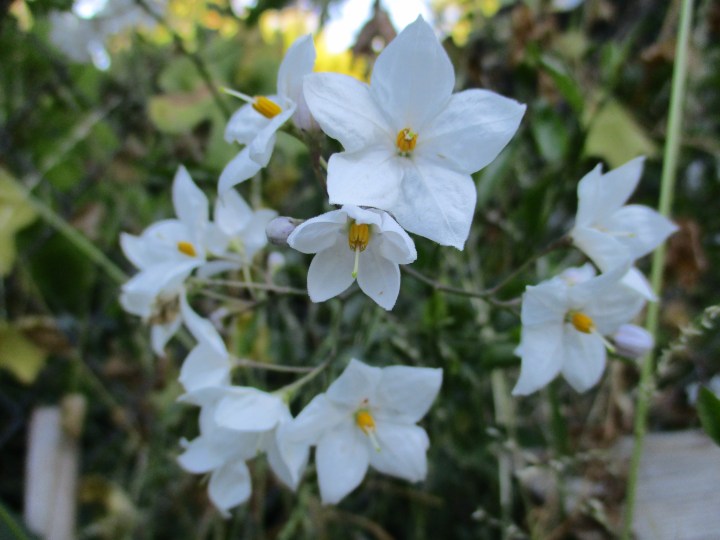
3. Potato vine has been growing like a weed on the cyclone fence and shade structure for so long that no one knows where it came from. I do not even know where the vines originate from. I would guess that somewhere under the overgrowth, the main canes emerge from the remains of a #1 can that the roots split apart years ago. This vine lives here now. Even if we had a spot for it, relocation is not practical. If it gets too overgrown, it might get cut back.P80623++
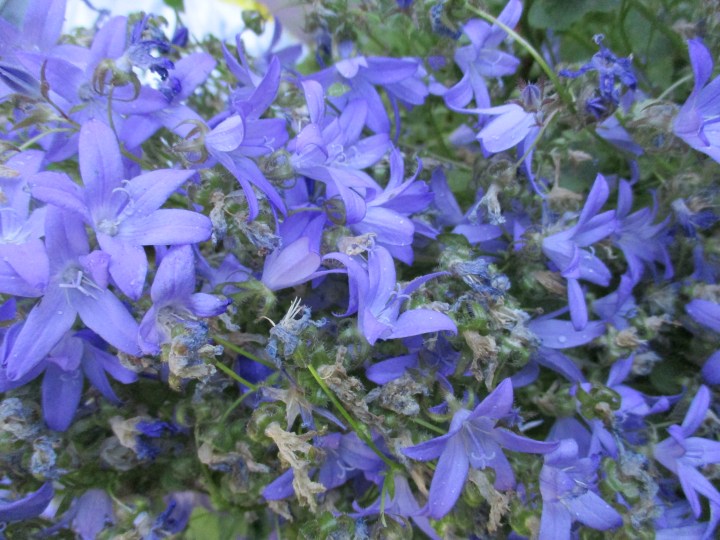
4. Campanula was probably in a 4” pot that got set into the #15 can of a ‘Black Lace’ elderberry and forgotten about. It might have been recycled, or it might have been something new that never got installed. Before the elderberry was relocated, the campanula had spread into the cans of other trees, so like the potato vine, it lives here now.P80623+++
5. Cone flower is easy. I just arrived from a nursery, and will be installed into a landscape in just a few days.P80623++++
6. Yarrow came with the cone flower, and will be planted nearby in the same landscape at about the same time.P80623+++++

This is the link for Six on Saturday, for anyone else who would like to participate:

https://thepropagatorblog.wordpress.com/2017/09/18/six-on-saturday-a-participant-guide/

Six on Saturday: ROCK ON!


This might be the very first post in the history of Six on Saturday that lacks any plant material! There are certainly plenty of flowers blooming out there, but that was not what I was working with this week. The first two pictures were at a site where I was working earlier in the week. The other four pictures were at a larger landscape that is in the process of being renovated. Until this week, I had not seen much of the site, but heard about it daily. The work is behind schedule, so a whole bunch of us went to the site to help. Although we were very grateful for the help, and everyone was genuinely pleased to be of service, I can not help feeling guilty about my esteemed colleagues engaged in the unpleasantries of such dusty and dirty work, especially when they have so much of their own work to tend to.

1. The soil at the first job site is of exceptional quality, but is only about a foot deep! This now broken mudstone is what lurks below, but it is not broken down under. It is only broken in the picture because it needed to be pried up so that larger plants could go into the ground. It took all morning just to install a few #5 plants. The smaller #1 plants were planted much more easily on top of the mudstone.P806162. This sometimes happens when prying up mudstone.P80616+3. At the second and much larger landscape, the irrigation system and lighting needed to be installed before the rest of the landscape. There is now irrigation pipe and electrical conduit everywhere! It took some serious digging. Because so much excavation had already been done at the site for the installation of big wide walkways, much of the soil was being moved a second time. The soil is so loose and sandy that much of it needed to be dug a few more times from the ditches as the irrigation system was installed.P80616++4. A few big boulders were installed on the site. To avoid driving the heavy machinery on the new concrete, the boulders were installed early in the renovation process, before the new concrete was installed. Consequently, they were buried by the soil that came from all the ditches for the irrigation and lighting systems. They reappeared as the ditches were filled. I still do not understand the appeal of stone and boulders in landscapes. The mudstone that was encountered earlier in the week was not much fun.P80616+++5. Plant material has not yet been installed, so the landscape features only a few dogwood trees that were already there, and these few boulders scattered about in the dusty soil. It really is dusty! I cannot figure out why the dogwoods are so happy there. I can not figure out why the boulders are so happy either, . . . or if they are happy . . . or if they really care at all. I just do not know.P80616++++6. One of our soil science professors at school was emphatic about soil being ‘soil’. We were not allowed to refer to soil as ‘dirt’. Well, this soil happens to be better than it looks, and it is good enough for dogwoods, but it really is very dirty soil.P80616+++++This is the link for Six on Saturday, for anyone else who would like to participate:

https://thepropagatorblog.wordpress.com/2017/09/18/six-on-saturday-a-participant-guide/

Six on Saturday: Petunias


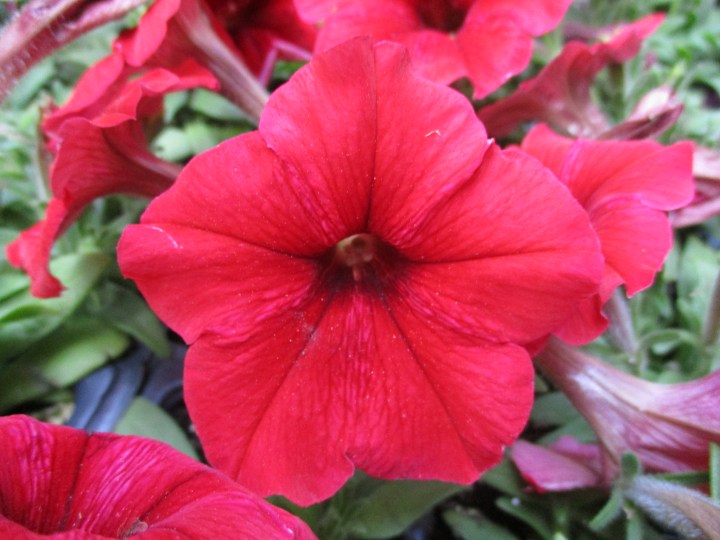
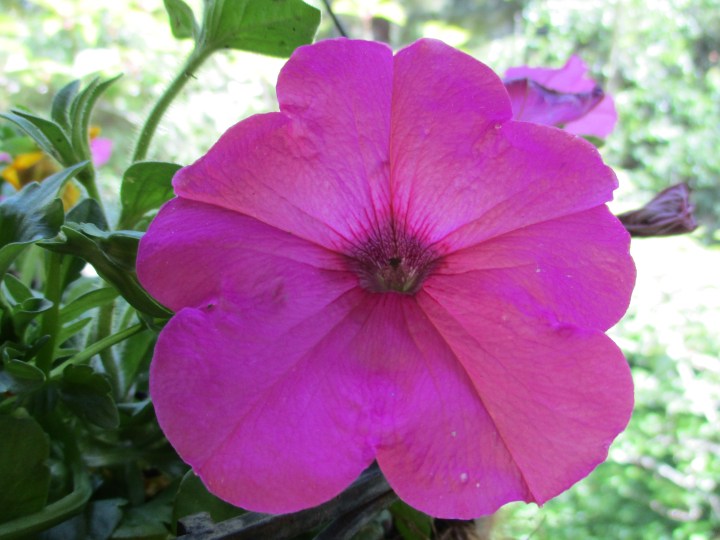
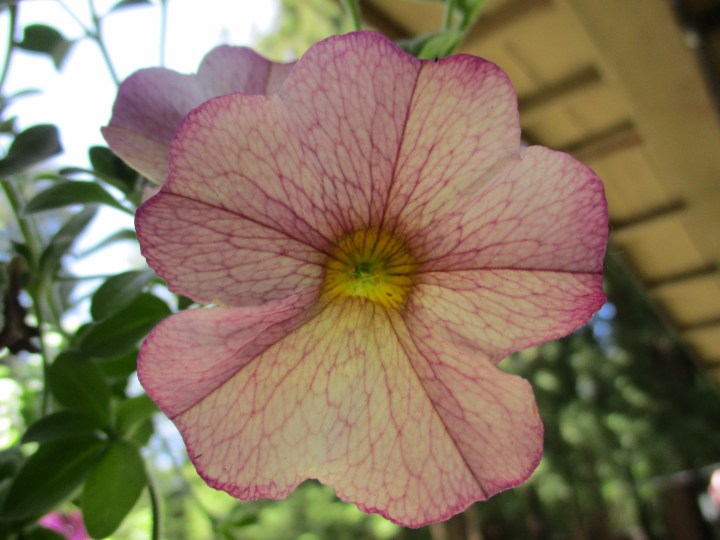
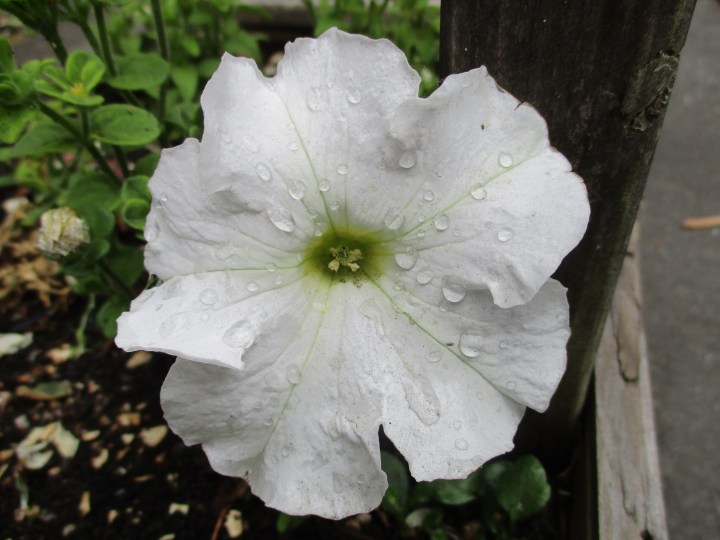
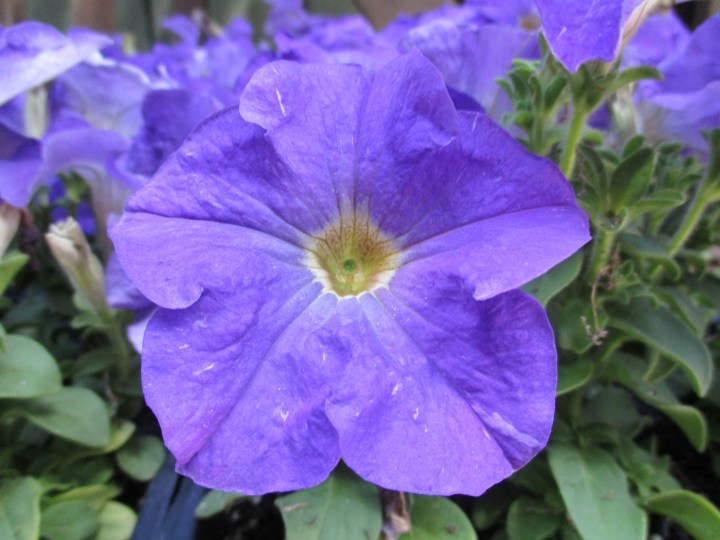
These were only recently planted, within the past few weeks, so are not completely filled in. That of course is unimportant for pictures of only the flowers close up. I have not grown petunias for many years, but I am getting to like these because they are so colorful in the sunnier spots. There are busy Lizzy in the shadier spots. (I can explain that later.) It is not easy to select a favorite. Although the white petunia should be my favorite, I really like how brightly colorful the first one ‘Dreams Sky Blue’ is on the side of the road. ‘Blue Madness’ and ‘Red Madness’, the second and third pictures, are so reminiscent of petunias that we grew many years ago, and might even be the same. The unknown petunia in the fifth picture is the only one here that I do not like much, and it did not work out as well as hoped anyway. It is planted in hanging pots, but does not cascade. That is why a few ‘Wave Lavender’ in the fourth picture were added in with them. The white petunia happens to be only one of a mix of various colors.

The first three were planted in beds at ground level. The fourth was planted both in an elevated planting bed, and added to hanging baskets with the fifth. The fifth was the first to be planted in the hanging baskets, but is not cascading as expected. The sixth, along with a variety of other colors, is in a few large planter boxes, so will hopefully cascade somewhat, but does not need to.

1. Dreams Sky BlueP80609
2. Midnight MadnessP80609+
3. Red MadnessP80609++
4. Wave LavenderP80609+++
5. This variety is unknownP80609++++
6. This variety is unknown and includes a mix of colors.P80609+++++
This is the link for Six on Saturday, for anyone else who would like to participate:

https://thepropagatorblog.wordpress.com/2017/09/18/six-on-saturday-a-participant-guide/

Six on Saturday: Rose Parade


There is way too much blooming for me to keep up with. Because I know there will be less blooming through summer, I get pictures while I can, even if I can not use them right away. Consequently, these pictures are not exactly from this last week. Some were from the second phase of bloom, and the first picture is from the first and only phase of bloom of a rose that blooms only once annually. I suppose I could have gotten pictures of the other five this last week, but I wanted to get them earlier than later, just in case they were between phases when I wanted to get the pictures.

Roses do very well here, and are even happier in the warmer and more arid weather of the Santa Clara Valley, just a few miles away. The Santa Clara Valley is one of the best places in the world for roses, which is why the Heritage Rose Garden is located there. Sadly, that collection is presently not in very good condition.

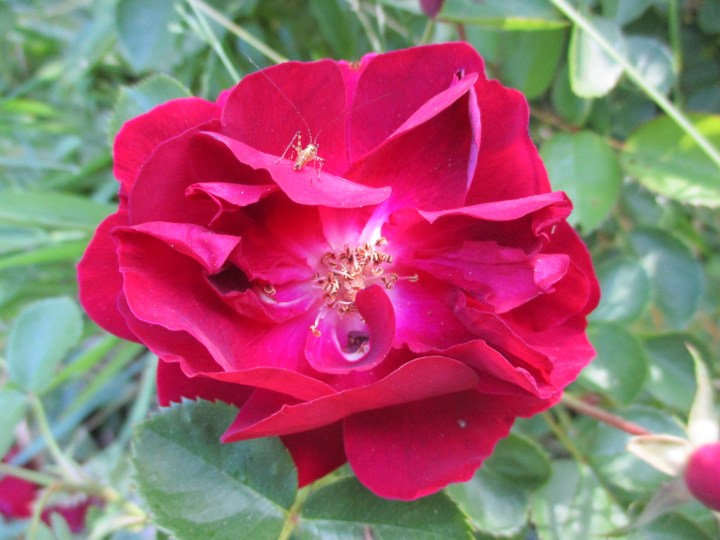
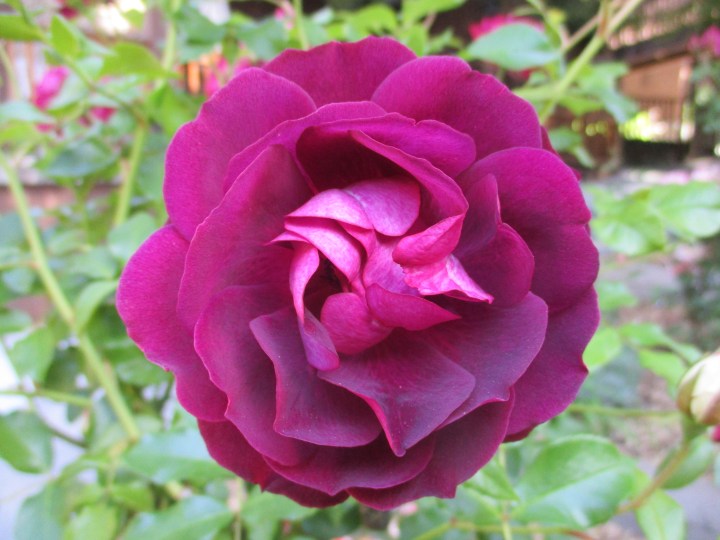
1. ‘Doctor Huey’ is the only cultivar of these six that I can positively identify. It has been the common understock for grafted roses longer than I can remember. Because it is only used as understock, it is not often seen blooming out in the garden. These are only blooming because the original scion died, and was replaced with sucker growth from below the graft. ‘Doctor Huey’ blooms profusely but only once in spring. It grows as a bramble, and can form small thickets if neglected long enough.P80602
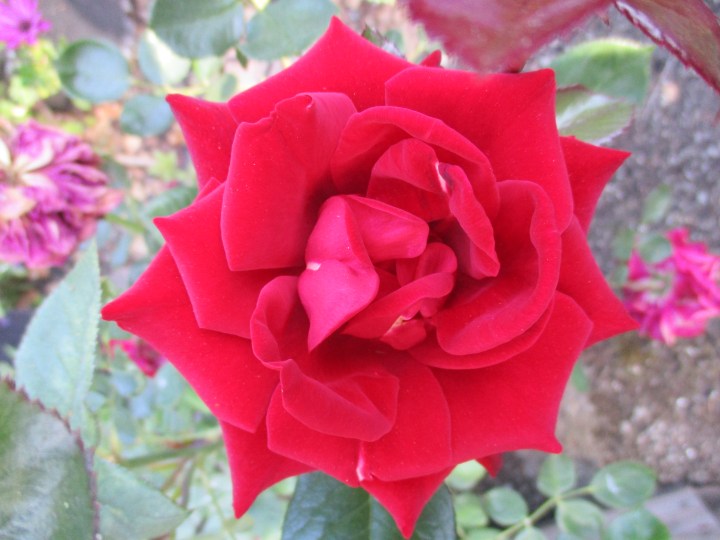
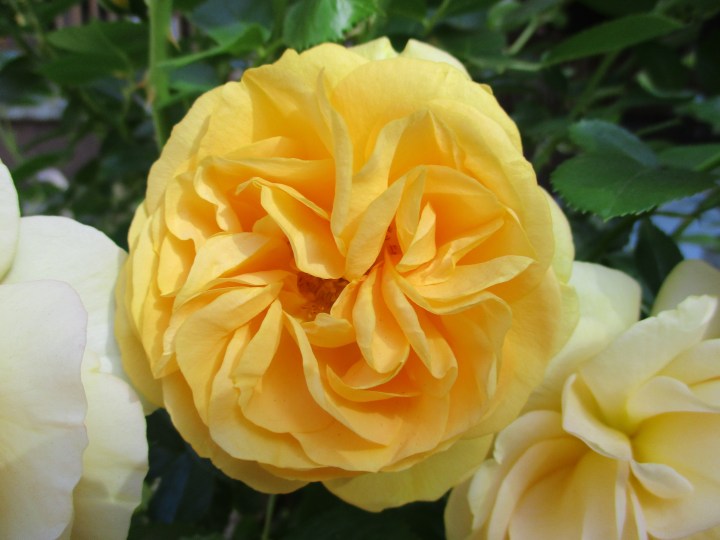
2. Although not white, this pretty hybrid tea rose is probably my favorite of the six just because it is so perfect. I do not know the cultivar. It is not in the landscape, but is in the nursery, waiting to be installed into the landscape. Hybrid teas are the roses that I grew up with, so are my favorites.P80602+
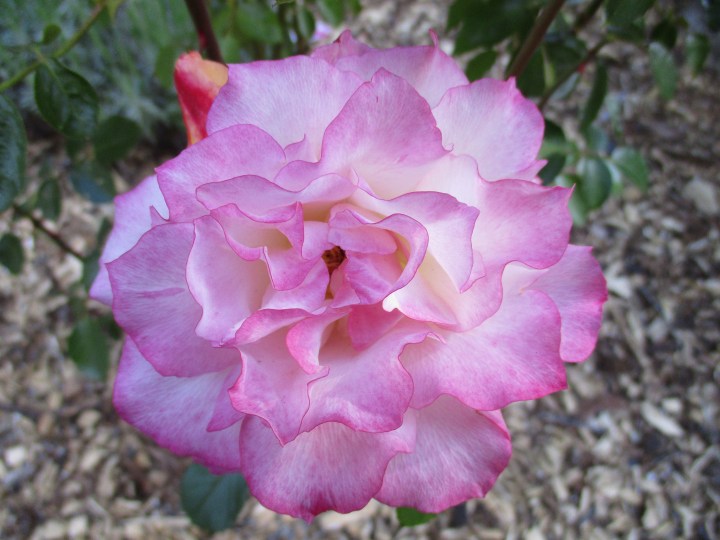
3. I am not sure if this bicolored rose is a hybrid tea or a floribunda. I am guessing that it is a floribunda because there are groups of flowers blooming where I earlier deadhead the first phase of single blooms. It is out in the landscape, in the same garden with 4, 5 and 6 below. It is grown as a shrub. The others are grown as standard or tree roses.P80602++
4. This is my least favorite of the six because it looks like one of those trendy David Austin roses. The color is nice, but the form is weird. I will never understand fads. I know that hybrid tea roses were a trend or maybe even a fad at one time, but it was the trend that I grew up with, which is why they are what I compare all other roses to. This rose does not compare to them too well. It is grown as a standard or tree rose.P80602+++
5. This is also grown as a standard or tree rose, but in conjunction with 6 below. I mean that they are grafted together on the same trees. Individually, they are nicely formed roses with excellent color, but they look silly stuck together with the white roses. I could probably identify this rose if I wanted to, but I do not want to misidentify it. Except for the color, the rest of it grows just like ‘Iceberg’.P80602++++
6. This one looks just like ‘Iceberg’, and except for the color, grows just like 5 above, which it is grafted onto the same trees with (as I mentioned above). The white is perfect. If it were a hybrid tea, it would be my favorite of these six. I just prefer 2 above because it is such a perfectly formed rose on good stems.P80602+++++
This is the link for Six on Saturday, for anyone else who would like to participate:

https://thepropagatorblog.wordpress.com/2017/09/18/six-on-saturday-a-participant-guide/

Six on Saturday: Elderberry +


It is only coincidence that all of the bloom for today happens to be white. Again, these are old pictures, from two weeks ago or so. The mock orange, Philadelphus lewisii, and black locust, Robinia pseudoacacia, finished bloom a while ago. Both were very fragrant.

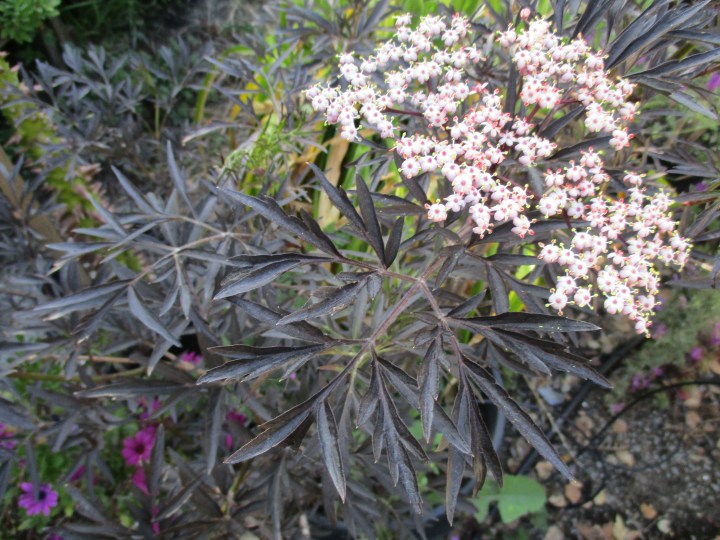
I wanted to get these pictures of the ‘Black Lace’ elderberry, Sambucus nigra ‘Black Lace’, and the native blue elderberry, Sambucus cerulea, in bloom, not because they are remarkably pretty, but for comparison. Their more recent bloom has been more impressive, with wider floral trusses. The blue elderberry is very common here, and because common black elderberry are uncommon here, it is our standard elderberry. ‘Black lace’ is only rarely available in nurseries, and grown primarily for the dark foliage and nice bloom. However, some mail order catalogs describe it at a productive fruit ‘tree’, as if it is comparable to other elderberries. It came here as an ornamental. Fruit would be an added bonus. I am very interested to see how it compares to the native blue elderberry, which is excellently productive, particularly if cultivated. It is ideal for award winning jelly, even if it does not win the blue ribbon: https://tonytomeo.wordpress.com/2017/10/01/blue-ribbon/

Elderberry bloom is useful as well, although we have not used it for anything here. I prefer to leave the bloom to make more fruit. However, because there are so many around here, we could easily get a significant volume of bloom without significantly compromising the availability of fruit later on. Bloom can be battered and fried like fritters, or used in beverages. I will leave that work to someone else.

1. ‘Black Lace’ elderberry bloomP80526
2. blue elderberry bloomP80526+
3. ‘Black Lace’ elderberry foliageP80526++
4. blue elderberry foliageP80526+++
5. mock orangeP80526++++
6. black locustP80526+++++
This is the link for Six on Saturday, for anyone else who would like to participate:

https://thepropagatorblog.wordpress.com/2017/09/18/six-on-saturday-a-participant-guide/

Six on Saturday: Rhody


Not the terrier!

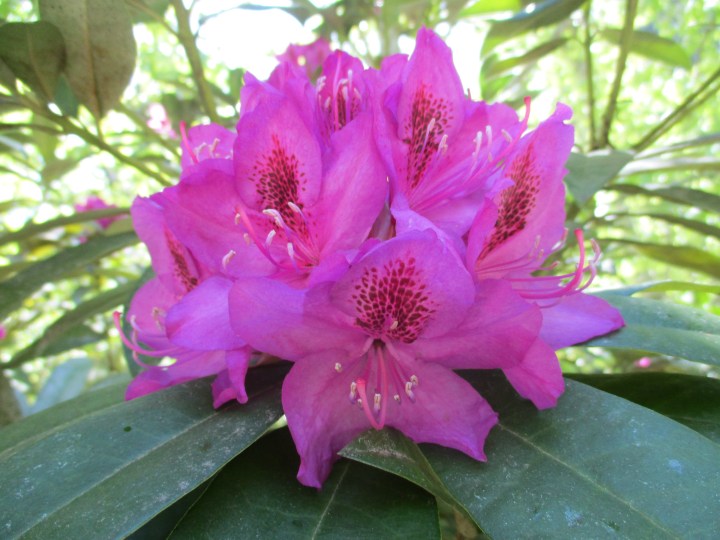
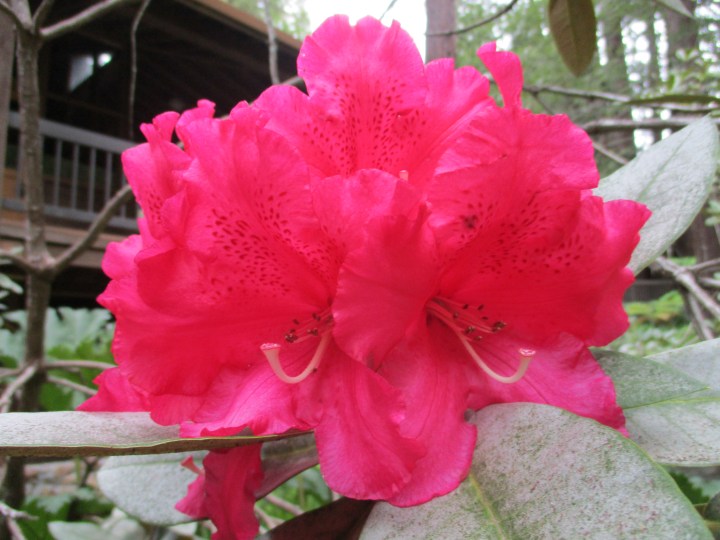
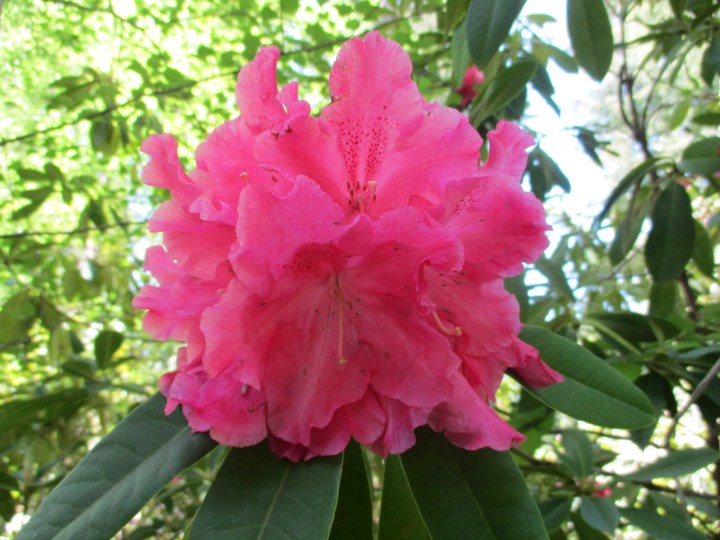
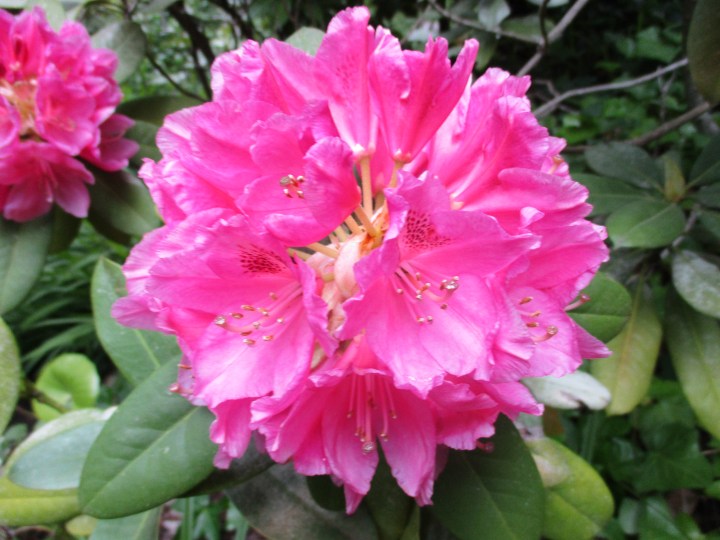
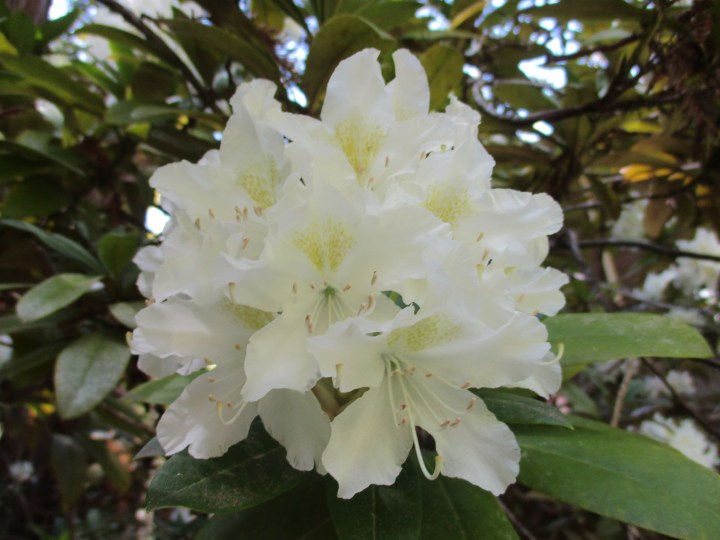
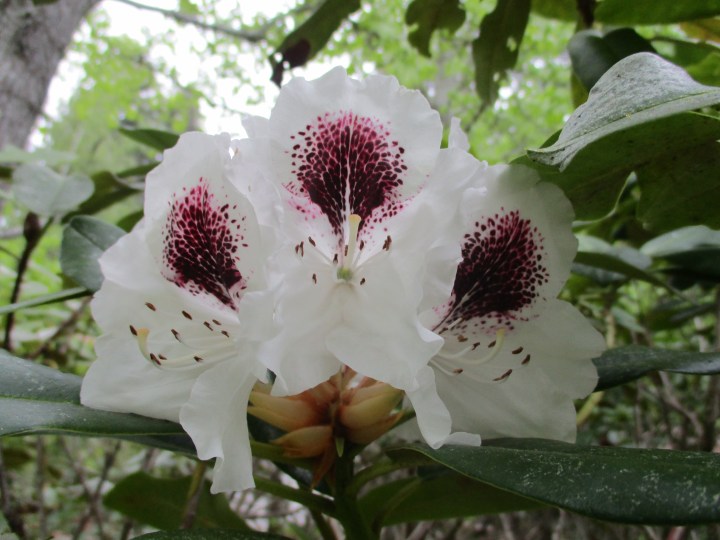
These are six of the many rhododendrons that have been blooming in the landscape for a while now. Some of the pictures are a week or so old. I do not remember when I took them. The rhododendrons did well this year, and their bloom has been lasting quite nicely. I should be pruning them next week, but can not get started until they finish. Some are very big, and some are sloppily overgrown. As much as I enjoy them in this landscape, I miss working with them on the farm. I can remember delivering the smaller rhododendrons in this landscape several years ago. Some of the bigger specimens are about as old as I am. I think I recognize a few of them, but can only positively identify the one in the first picture. ‘Annah Kruschke’ is the most popular cultivar, not only because it is so reliable, but also because it is not too bothered too much by the arid climate of the Santa Clara Valley and other regions that are somewhat farther inland.

1. Annah Kruschke is not the best purple, but is the easiest to grow. The foliage is is very nice dark green and somewhat glossy. It has a nice stout form that does not get too sloppy. Thrip do not bother it too much.P80519
2. This one looks like Taurus, and is just as popular with thrip, but I can not positively identify it. Branch structure is not only open, but has gotten quite sloppy with age. These will be a challenge to prune back.P80519+
3. I will not even guess what this watermelon red rhododendron is. There are several of them here. Although the branch structure is somewhat open, it is not a sloppy mess.P80519++
4. This one looks more like a cultivar that belongs in the Northwest. It has a nice stout branch structure, and nice round trusses of bright pink bloom. Although happy here, these types are not so happy in chaparral climates.P80519+++
5. This is probably my favorite rhododendron here because it looks so much like one of my favorite whites, “Helen Schiffner’. I could do without the yellow blotches. The foliage and branch structure are somewhat shabby.P80519++++
6. Like #3, I will not even guess what this one is. Although I typically prefer plain white, I happen to like these sorts of flowers because the blackberry stains in each floret makes the white look whiter.P90519+++++
This is the link for Six on Saturday, for anyone else who would like to participate:

https://thepropagatorblog.wordpress.com/2017/09/18/six-on-saturday-a-participant-guide/

Six on Saturday: Tree Ring Circus


When a tree falls in a forest and there is no one around to hear, it makes a big noise, as well as a mess, and it leaves some if its root in the ground. If a redwood tree falls in a forest, and there is no one around to hear, it is probably better that way. It wold be dangerous to be too close to a redwood when it comes down! They are so big and tall, and are typically so crowded amongst other trees, that they bring down tons of debris with them.

Falling redwoods are rare. They live for centuries or thousands of years. Yet, sooner or later it happens. In more modern history, after the ecology of the redwood groves was disrupted by extensive harvesting, redwoods sometimes get killed by forest fires. (Redwoods are some of the few trees in California that survive forest fires by being fire retardant, but can be killed if enough of the more combustible trees around them burn hotly enough. Extensive harvesting allowed more of the other combustible trees to mix into redwood forests than would normally be there.)

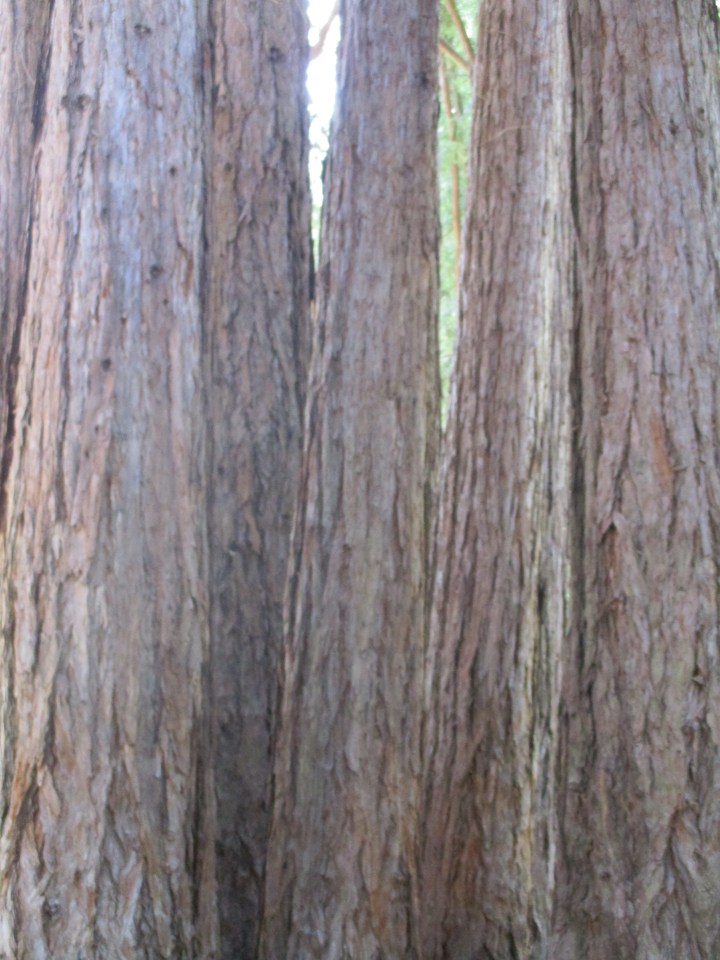
The one thing that redwoods do even less frequently than fall is die. Even after they fall, burn to ‘death’ or get cut down, they regenerate from their stump or roots. Sometimes, several or many genetically identical new trees that are all attached to the same root system develop around a dying parent before it falls. They sometimes do so after a parent burns or gets cut down. Eventually, the original tree decays, leaving a circle of new trees around where it once was. Outsiders often refer to them as ‘fairy rings’. To us, they are just tree circles or rings. Larger and more impressive circles might be known as ‘chapels’ or better yet, ‘cathedrals’.

They are impressive features in the forests. When the area nearby gets landscaped, they are typically ignored because they are so excellent that they can not be improved. There are not many plants that live in the debris of redwoods anyway.

1. This is a nice small but crowded chapel where I work.P80512
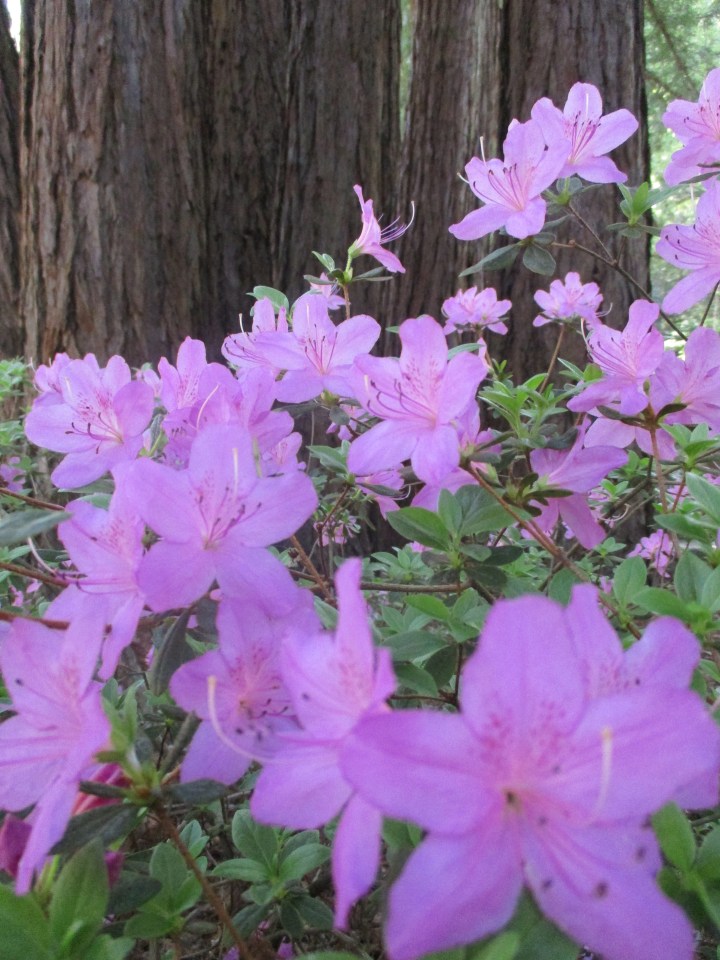
2. How does such a chapel get landscaped? It doesn’t. Ours happens to have a nice patch of azaleas nearby. This picture was taken earlier. Bloom finished a while ago.P80512+
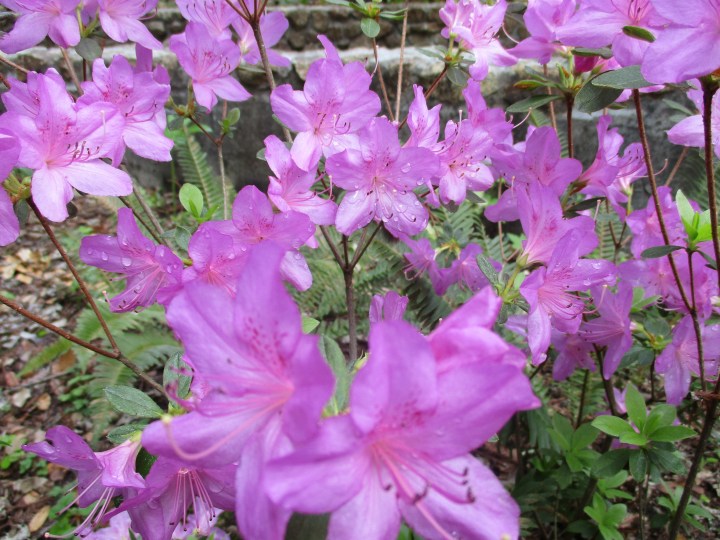
3. These azaleas are just so excellent that I had to get a better picture to show them off.P80512++
4. Forget-me-not happens to be one of those few plants that does not mind light redwood litter, so we often let it grow and bloom if it shows up in a good spot.P80512+++
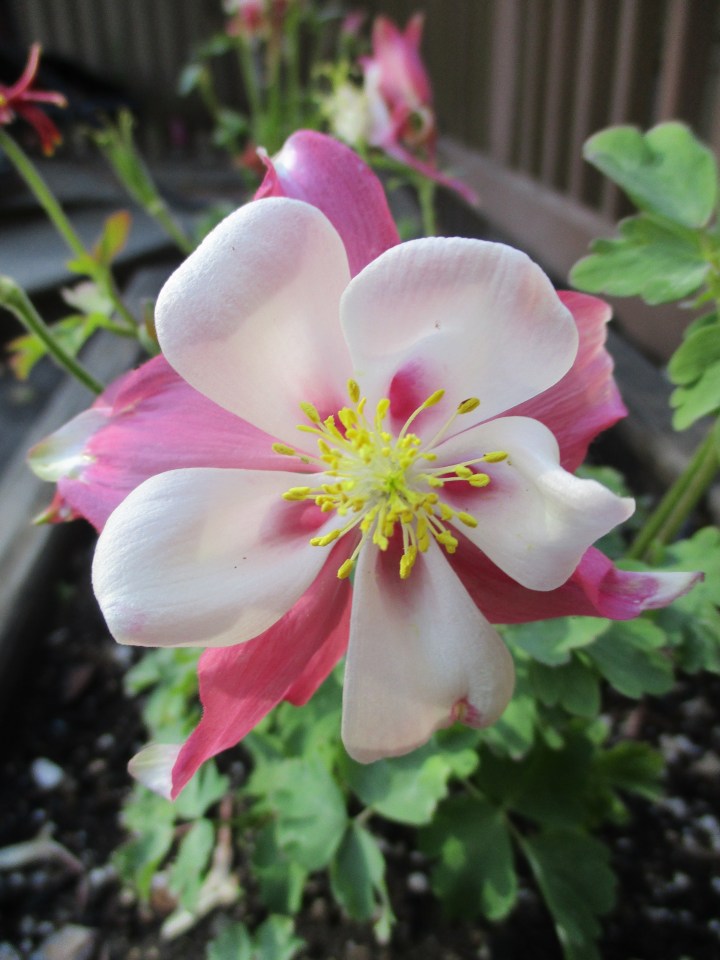
5. Columbine just seems to look good with redwoods for some reason, but it dislikes the litter. This columbine is in a nearby planter that does not get much litter.P80512++++
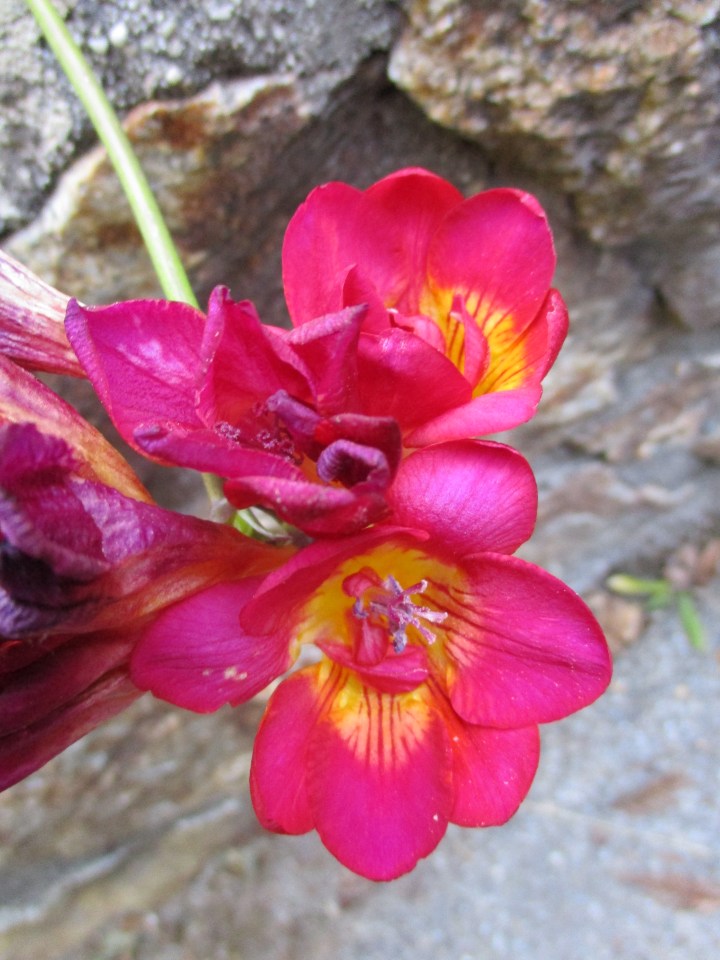
6. I can not explain the red freesias that bloom earlier in spring. There are yellow and purple ones too. No one knows where they came from, but they do not seem to be bothered by a bit of redwood litter.P80512+++++This is the link for Six on Saturday, for anyone else who would like to participate:

https://thepropagatorblog.wordpress.com/2017/09/18/six-on-saturday-a-participant-guide/
Six on Saturday: Azaleas


There is just too much blooming this time of year to fit it all into one Saturday. These azaleas were blooming quite some time ago, and these pictures are at least a week old. Some might be almost two weeks old. I just could not use them last week because there were still camellias to show off.

1. What this one lacks in profusion, it compensates for with large flower size. We used to grow one that looked like this but perhaps with slightly richer color. It was known as ‘Phoenicia’. It was a bit too garish for my taste.P80505
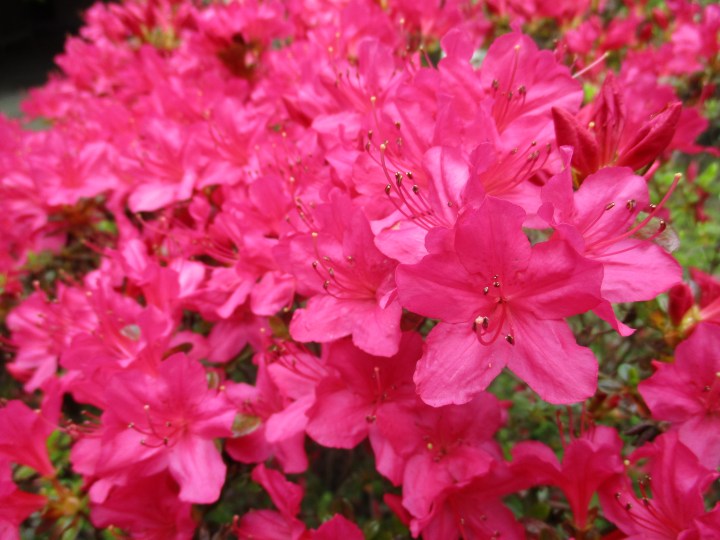
2. These flowers are smaller, but seriously more profuse. In fact, they are so profuse that, like #4, #5 and #6, the foliage is barely visible behind so many flowers. It is garish too, but I rather like this particular flavor of color.P80505+
3. Okay, so they are not as profuse, but they are such an excellently bright red. It looks like ‘Ward’s Ruby’ to be, but I can not be certain. All these azaleas look so different in this landscape than in production on the farm.P80505++
4. Not much foliage could be seen through these glowing flowers. They are more profuse than they look. They just do not seem so profuse because they are not dense. I do not know which cultivar to compare this one to.P80505+++
5. ‘Coral Bells’ has very profuse and very densely arranged tiny flowers. They form a layer over the exterior of the plant. Although I would say that these are more pink than coral, this cultivar is unmistakably ‘Coral Bells’.P80505++++
6. ‘Fielders White’ is the best that I saved for last. They are perfectly white medium sized flowers that are profuse enough to almost obscure the foliage, but not so profuse that the perfect form of the flowers is obscured.P80505+++++
This is the link for Six on Saturday, for anyone else who would like to participate:
https://thepropagatorblog.wordpress.com/2017/09/18/six-on-saturday-a-participant-guide/