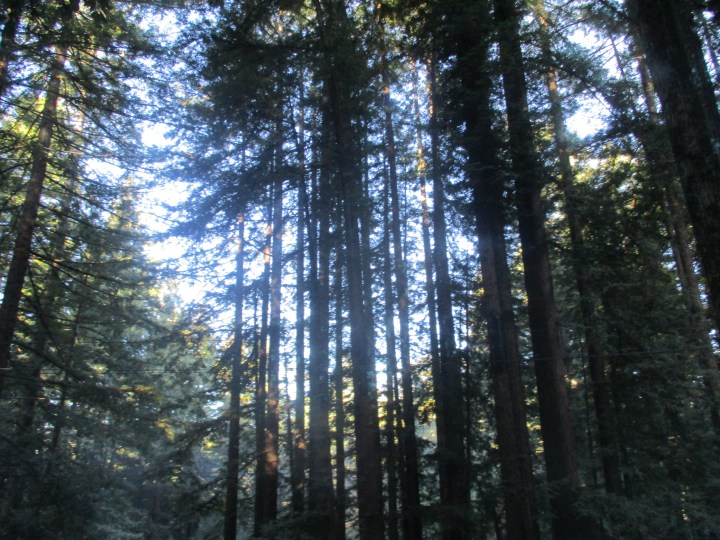
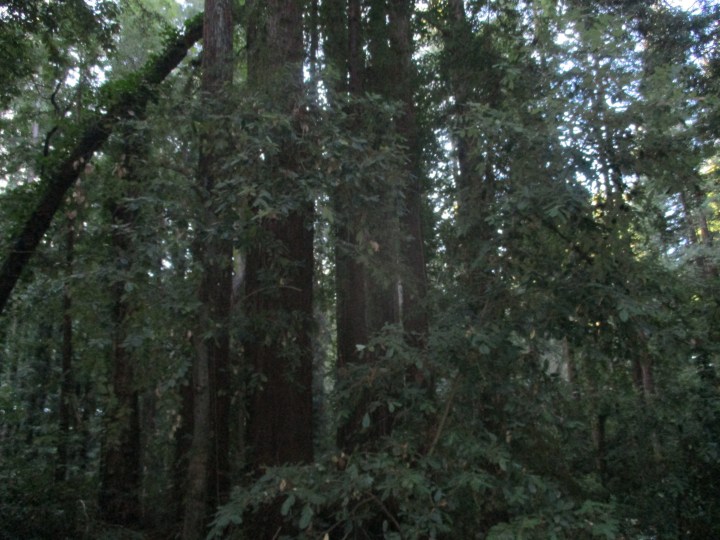
Six on Saturday: Tequila


If one of these six different agaves happens to be the blue agave from which tequila is made, I would not know. I only know that all six are various specie or cultivars of the Agave genus. The sixth picture is that of the common century plant, Agave americana, which is not used for tequila. I have no idea what the other five are. The fifth looks like it could possibly be a picture of Agave victoriae, but if I remember correctly, I was specifically told that it is not.

All six of these agaves were procured by my colleague. The first specimen is still potted at the shops where we work. The second specimen was relocated into a new landscape early last spring. The other four are within minimal proximity of each other, in a more established part of the landscape. There happens to be two agave pups in the Infirmary Nursery. At least one is from the agave in the second picture. I believe that the second pup is the same as well, but it seems to be developing teeth.

The wickedly sharp teeth and spines of most specie of agave are the main reason that agaves are not more practical in home gardens or small landscapes. It is not practical to try to snip the terminal spines off, because more develop with every new leaf. If they get enough space out of the way, agaves are bold and remarkably striking big perennials that are very resilient to arid climates.

There are no captions this week, because I do not know what to say about agaves that I know nothing about.

1.P81027

2.P81027+

3.P81027++

4.P81027+++

5.P81027++++

6.P81027+++++

This is the link for Six on Saturday, for anyone else who would like to participate:

https://thepropagatorblog.wordpress.com/2017/09/18/six-on-saturday-a-participant-guide/
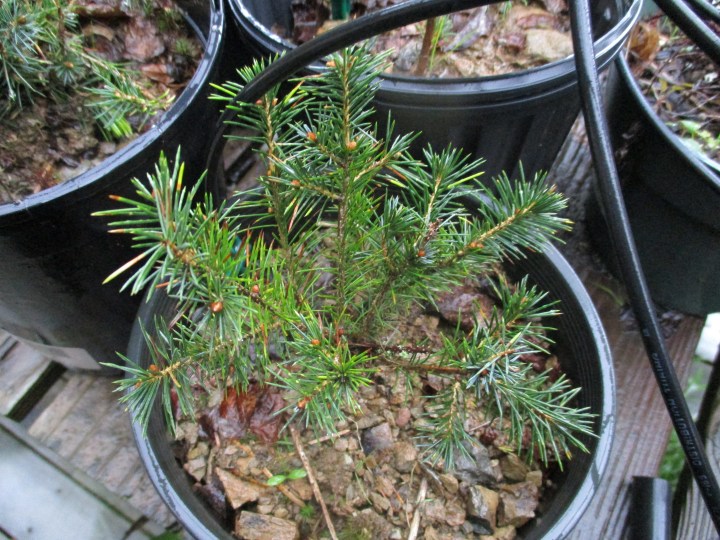
Six on Saturday: Expect The Unexpected


There will be no more bragging about how late the nice summer weather continued into autumn here. Foliage and berries are already coloring for autumn. During this past week, there were a few other unexpected discoveries in the garden, and one that was not in the garden.

1. Pampas grass is an old fashioned cut flower that was popular when I was a kid in the early 1970s. It lost popularity as the style of floral design became less informal and more refined. The pampas grass plants that produce the blooms were beginning to be recognized as seriously invasive exotic specie at about the same time. Those that produce the biggest and most billowy white blooms are not as invasive as those that produce the leaner pinkish tan blooms. Well, I could write another article about pampas grass; but presently, I only need to say is that I did not expect to see these big billowy pampas grass flowers up above and in the background of this big floral display that was left at work from a wedding there last Saturday.P81020

2. Red hydrangea is too modern for my taste. Deep blue or deep purple are no better. I believe that hydrangeas should be white or pastel hues of pink or blue, or perhaps lavender. You can’t improve on perfection. I did not expect to take a liking to this rich maroon hydrangea.P81020+

3. Dogwood foliage, as well as other foliage that colors in autumn, should develop color later here in our mild climate that in most of America. I did not expect to find such bright red foliage on a dogwood tree already.P81020++

4. Cotoneaster berries should likewise develop color as they ripen a bit later than they do elsewhere. I did not expect to find such ripe red cotoneaster berries already.P81020+++

5. Star magnolia was in rough condition after being relocated over summer. It was in an area that was in the process of being landscaped, so the relocation could not have been delayed until after defoliation in autumn or winter. The little magnolia initially seemed to tolerate the process rather well, but about two weeks later, started to wilt and discolor in warm weather. Subsequent defoliation was a slow process that continued into the end of summer. Axillary buds swelled slightly, as if the tree was getting ready for premature autumn dormancy. That was what I was hoping for. I did not expect the now seemingly happy little star magnolia to develop a second phase of new foliage that it will now need to shed later in autumn.P81020++++

6. Apples ripen at various times. Some cultivars finish as early as late July. Others are just finishing now, and might hang on the trees until early November! These apples are from an old tree on a vacant parcel that I do not get to very often. I intend to prune the tree over winter so that it can be renovated and cultivated as such a distinguished old tree should be. I will be recycling this picture tomorrow, and writing more about it. You will understand why if you read that article. Because I do not know what cultivar this tree is, I did know what to expect from it, but after ignoring it for a while, I did not expect that there would be so many apples remaining.P81020+++++

This is the link for Six on Saturday, for anyone else who would like to participate:

https://thepropagatorblog.wordpress.com/2017/09/18/six-on-saturday-a-participant-guide/

Six on Saturday: Clearance


Clearance can get one into some interesting situations. Yes, with the necessary clearance, one can get into penitentiaries, protected military facilities, sensitive areas of the White House, or even Area 51.

The sort of clearance that I was concerned with this past week and the week prior was not so interesting. Now that roofs and gutters of the buildings at work are in the process of being cleaned before wintry weather, trees must also be pruned for clearance. As they grew through summer, some got detrimentally close to the roofs and gutters that are getting cleaned, as well as chimneys, windows, outdoor lighting and walkways. Such clearance is a concern throughout the year, but becomes more of a priority as we get ready for winter. No one wants to go back onto the roofs any more than necessary.

1. Before. The redwoods must be pruned for adequate clearance from the roof, chimney, lamppost, and even the umbrella on the patio that can not be opened without pushing a bit of foliage aside.P81013

2. After.P81013+

3. Soot on the tip of one of the redwood limbs demonstrates why clearance from chimneys is so important. Foliage that gets too close to chimneys can ignite and fall back onto the roof below, where it has the potential to ignite any foliar debris that might have accumulated behind the chimney since last year.P81013++

4. The belfry of the chapel next door really bothered me. Clearance was barely adequate. Although I am not worried about the shingles or painted surfaced getting damaged as wind starts to blow during winter, I think that the chapel would look better with more clearance from the encroaching redwood limbs. The problem was that I could not reach the limbs. Because this clearance was not a priority, the pruning here was postponed. A colleague who is not as plump as I am suggested that I get onto the roof through that gap between the top of the louvered sides of the belfry, and the underside of the roof above. Now, even if I could somehow get through that little gap, where would I go on the outside?! Let Quasimodo do it!P81013+++

5. The chapel was built among the redwoods, very literally. Expanding trunks are beginning to displace the foundation and utilities. I can not prune for the sort of clearance that is needed here. Because the chapel is such an important building, and the redwoods are such important trees, it would be feasible to move the chapel over onto a new foundation. The problem with that idea is that the redwood trunks are pressing up against the building on three sides! There is no place to move the building without cutting something out!P81013++++

6. Phytophthora ramorum, which is commonly known as Sudden Oak Death Syndrome, or SODS, continues to kill tanoaks, (Notho)lithocarpus densiflorus, and coast live oaks, Quercus agrifolia. These trees do not need to be pruned for clearance, but must be removed before they start to deteriorate and drop limbs onto adjacent buildings or whatever happens to be below.P81013+++++

This is the link for Six on Saturday, for anyone else who would like to participate:

https://thepropagatorblog.wordpress.com/2017/09/18/six-on-saturday-a-participant-guide/
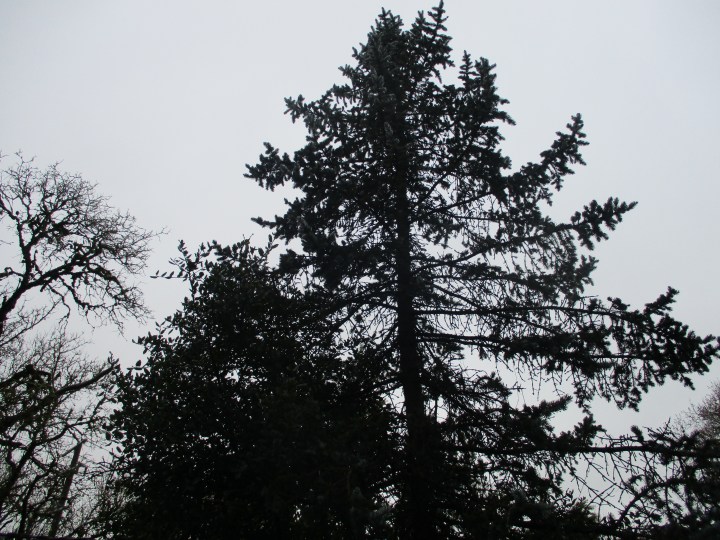
Six on Saturday: Zoning Out


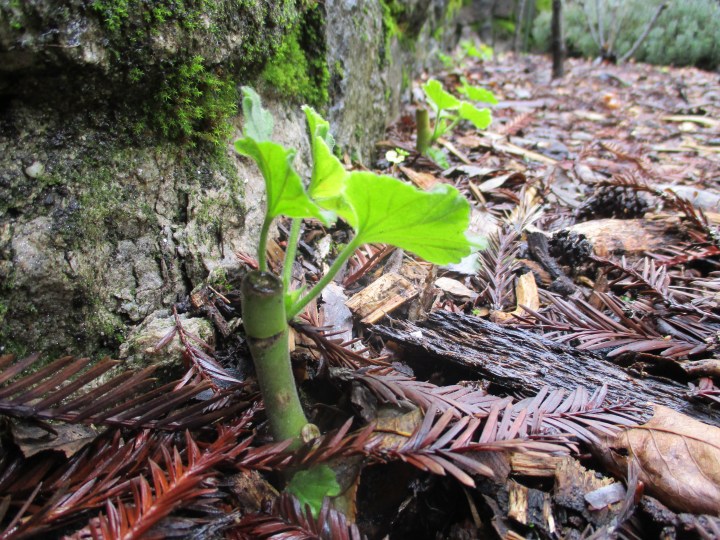
Zonal geraniums, Pelargonium hortorum, can bloom anytime it wants to here, but really does tend to slow down somewhat through autumn and winter. As growth slows, older foliage will deteriorate and become more susceptible to rust and decay. Where exposed, older grown might succumb to frost over winter. Zonal geraniums will soon be zoning out.

Such deterioration and winter frost damage is not as bad as it looks, unless of course, frost is severe enough to kill the entire affected plants. By the time old growth looks shabby enough to be removed, new growth is probably already starting to develop down near the roots. After the last frost date (when no more frost is likely), old growth can be cut back to expose new growth that will soon replace it. Even if new growth is very minimal, growth will accelerate once exposed by the removal of old foliage, and as weather warms into spring.

That is still a few months away. For now, zonal geraniums are just beginning the process of zoning out, which is why their floral trusses are neither as big nor as abundant as they had been through summer. While they are busy with that, autumn flowers are beginning to bloom, and some of the winter flowers are getting ready for their season. Winter flowers get started in autumn because growth is slower in cooler weather, even for plants that prefer cool weather.

1. Chrysanthemum is ‘the’ classic autumn flower. These are blooming well enough in the infirmary that they will soon be relocated out into prominent spots or pots out in landscaped areas.P81006

2. Cyclamen is a winter flower that is just now starting to grow after its long summer dormancy. These rudimentary first blooms are not much to brag about, but will likely be followed by enough for these plants to also be recycled back into the landscape from which they came last spring. These white flowers really are the best of the cyclamen for now. (I did not take this picture just because white is my favorite color.)P81006+

3. Reddish orange zonal geranium, and the magenta zonal geranium below, exhibit two more of those colors that I can not identify. I will just say that it is reddish orange. I happen to like it because the color resembles that of one of my two first zonal geraniums. Mine is not so well bred, so exhibits weedier growth and less prominent bloom. Nonetheless, I like mine because it is so resilient and predictable. I cut it to the ground at the end of winter, before new growth develops, and it grows right back. This prettier garden variety would probably prefer a gentler process.P81006++

4. Red zonal geranium seems to me to be the most elegant of those blooming here presently. Of course, I do not know for certain if it is. I do not know much about color. It just seems to me that this color is not as garish as the magenta sort of color below, or as unrefined as the common reddish orange above.P81006+++

5. Magenta zonal geranium, like the reddish orange zonal geranium above, is another color that I can not identify. It is a bit too flashy for my taste. However, the other one of my two first zonal geraniums blooms with a softer hue of a similar color. As much as I prefer to not admit it, my two first zonal geraniums are still my favorites, even though they bloom in colors that I am none too keen on.P81006++++

6. White zonal geranium happens to contrast well with the dark greens of landscapes in the redwood forests. Although it is my favorite of the four zonal geraniums that are blooming here now, my first two weedy zonal geraniums that bloom with unrefined reddish orange and garish magenta are still my two favorites.P81006+++++

This is the link for Six on Saturday, for anyone else who would like to participate:

https://thepropagatorblog.wordpress.com/2017/09/18/six-on-saturday-a-participant-guide/

Six on Saturday: Beat Box


It sounds more compelling that way, like the old song by Art of Noise in 1984. It was . . . unique for the time. I suppose it still it. Brent introduced me to that Beat Box when we lived in the dorms at Cal Poly in 1986. Otherwise, to me, the name would have suggested a shallow wooden box for storing root vegetables in a cellar, or a crisper drawer of a refrigerator – a box for beets.

Well, I am just beeting around the bush to avoid sharing the unsightly pictures of my beat-up and neglected planter box downtown, which, incidentally, features neither beets, nor bushes.

The last update was only six weeks ago. https://tonytomeo.com/2018/08/18/six-on-saturday-out-with-the-old/ There has not been much improvement. I manage to remove the litter that accumulates. The condition of most of the plants is unfortunately natural for this time of year. It will not last long. For now, it is what I have to share.

The main problem now is that the common houseleeks, which are the most prominent perennials, naturally looks very tired. I would have no problem with it in my own garden. I know that they look great for most of the year. They look like they do now only in late summer. They recover immediately as soon as the rain starts in autumn. I do not know what is so great about rain, or what rain does that the irrigation does not do. I think that it coincides with cool humidity. Warm aridity is probably what causes the houseleeks to fold up and shed much of their foliage the way they do.

1. Common houseleek was grown from two tiny cuttings that I acquired from the garden of a friend’s deceased mother as we were emptying her home in Monterey. They arrived with a bronze common houseleek, another unidentified houseleek, an unidentified aloe, and, of all things, a bearded iris. They grew like weeds, and are now the most prominent features in the planter box. They would not have been my first choice, but once they started to grow, everyone liked them. I sometimes consider cutting them back so that they regenerate as lower foliar plants; but most people like their height and sculptural stems. I will instead groom out some of the superfluous grown to display their stems better. Once the rain starts, and they regenerate new foliage, they will look exquisite! For now, they look like . . . this.P80929

2. Bronze common houseleek was planted between the two common houseleeks, and at the same time, but never gets going well. As soon as it tries to grow, someone takes the top off of it. It would be an excellent contrast if it gets the chance. It really looks bad right now, but like the others, it will fluff out with the rain. The third smaller houseleek is right below it.P80929+

3. One never knows what might be found in a roadside planter box or landscape. Besides the concrete slurry (that was dumped by a tile-setter working in the adjacent building) and big puddles of vomit (such as those commonly found outside of downtown bars), I have found discarded bicycle parts (that were replaced by the adjacent bicycle store), baggies of dog poop, loaded diapers, small bags of trash, and a variety of dishes, glasses and flatware from neighboring restaurants. This disfigured fender is certainly not the strangest item to appear in my planter box, but is one of the largest.P80929++

4. Two nice urns outside of the adjacent bicycle shop always look so much better than my planter box. They are filled with nice potting soil, and get watered more generously. The big houseleek in the closer of the two urns was removed from my planter box when it got too crowded. I would have planted a matching pair, but the farther of the two urns had been temporarily removed to make room for a sign. Now that it has returned, it is outfitted with a big aloe from the planter box. The aloe was cut back when the tile on the corner of the planter box where the aloe is located was repaired. I was not there when it happened, but I am very pleased that someone in the bicycle store salvaged the severed bits of aloe. I would have been annoyed if they had been wasted. They are quite large now. It would be excellent if they bloom soon. Most aloes bloom in summer, but this species has tried to bloom at really odd times . . . except in summer! The floral stalks in the planter box have always gotten broken off before they bloom, so I do not even know what the flowers look like. If they never get the chance to bloom, the foliage still looks great.P80929+++

5. The adjacent tree well really did not look this bad after I pulled up some of the debris that collected in it a month or so ago. It now looks as nasty as it did during my previous update. I know the bit of housleek looks really nasty, but it stays because I expect it to recover once the rain resumes. Nasturtiums grow here too. I will sow seed for ‘Jewels Mix’ nasturtiums in the planter box only because nasturtiums do not regenerate there as reliably.P80929++++

6. This second tree well that is just west of that in the #5 picture above had a nice magnolia tree in it a month ago. Only this pile of chipped stump remains. The sidewalk, curb and road pavement will be replaced soon. Street trees will be added later. The magnolias were so pretty, but were too impractical and messy. I am impressed that they did not do more damage than they did during the half century that they were there.P80929+++++

This is the link for Six on Saturday, for anyone else who would like to participate:

https://thepropagatorblog.wordpress.com/2017/09/18/six-on-saturday-a-participant-guide/
Six on Saturday: Gazania


Gazanias were not planned. The English daisies that were planted last spring as warm season annuals that might hopefully continue as perennials succumbed to rust. Seriously! This rust was nasty! I had no idea that English daisy was so susceptible to rust! They were so ugly that they needed to be removed. They were replaced with the gazanias a bit more than half way through.

Gazanias are not the flashiest of choices for the prominent planters that they went into, but they work. If they continue to bloom through winter, they can stay as long as they like. If they stay long enough to get bald spots, we can trim around the edges and plug the scraps back into the bald spots. I would rather put a bit of effort into maintaining them than replace them as the seasons change.

These pictures were taken about two weeks ago, along with the picture of the gazania that was posted last week. For some unknown reason, the gazanias are presently taking a break from blooming.

1. White is actually not my favorite color for gazanias. Yes, white is my favorite color. I just think that gazanias are at their best in brighter colors like yellow and orange. This white is not the best anyway. It looks like very pale yellow to me.P80922

2. Yellow, in conjunction with orange, is one of the two classic colors for gazanias, and is one of my two favorites . . . in conjunction with orange.P80922+

3. Orange is the other half of the caption to the picture above. (Just read the same caption, and switch ‘yellow’ for ‘orange’, and ‘orange’ for ‘yellow’.)P80922++

4. Pink might really be light burgundy. It was a bit darker when it first bloomed. This might be one of those colors that only girls can identify.P80922+++

5. Yellow with red stripes looks like something that blooms in the garden of Ronald McDonald.P80922++++

6. Cream with burgundy stripes looks like something that blooms in the garden of a clown with slightly more discriminating taste.P80922+++++

This is the link for Six on Saturday, for anyone else who would like to participate:

https://thepropagatorblog.wordpress.com/2017/09/18/six-on-saturday-a-participant-guide/

Six on Saturday: Mixed Bag


These are merely odds and ends that would not conform to any particular category. The first two are from my colleague’s garden that provided the pictures for last week. The third, fourth and fifth are from a nearby landscape that is comprised of native specie. The sixth is another landscape nearby, but is obviously not native.

1. Eucalyptus provides distinctively aromatic silvery foliage for young students of Outdoor Science. We keep this tree low and almost pollarded so that the students can reach the juvenile foliage. We plan to prune back any adult foliage, since it is neither as pretty, nor as aromatic. No matter how much gets cut from the tree, there is always more. We thought this tree was Eucalyptus cinerea, but we really do not know what it is.P80915

2. Lantana camara gets frosted to the ground where it is at. It might do better on a slope just a few yards away, or under the canopy of big trees nearby. It just happens to be in one of those cold spots where cold air settles on frosty nights. The dead stems get cut back at the end of every winter, and new growth regenerates just fine. However, by the time it starts to bloom nicely, it is already autumn!P80915+

3. Cornus stolonifera is the only locally native dogwood. These pathetic blooms demonstrate why it is not more popular than it is. There are more individual flowers than other dogwoods get in each of their clustered blooms, but they bloom late in summer without the flashy bracts behind them. This dogwood is commonly known as red twig dogwood, but the twigs are not as colorful as those of another species of the same name.P80915++

4. Rose, although planted, happens to be native to the region as well. I do not know the species of this particular rose. It is not much to look at, but it is worth growing in a landscape of natives. It does not get pruned like roses that are grown for their bloom. In fact, we do nothing to it. It just grows wild. Flowers are sporadic, starting late in spring, and continuing until frost.P80915+++

5. Rose hips take a while to ripen. These were probably from the first flowers that bloomed months ago. Flowers that are blooming now may not produce hips at all, or if they do, the hips may never ripen. They just do not have enough time. Fortunately, there are enough to provide a bit of color while many of the plants in this spot defoliate through winter. They do not have great flavor alone, but are fine with other herbal tea.P80915++++

6. Gazania is related to the African daisy from last week. More gazanias will be shared next week. These were planted somewhat recently to replace English daisy that succumbed to a really bad infestation of rust, so have not bloomed as much as they might have liked to if they had gotten established earlier. They will continue until frost, and can bloom sporadically through winter, before resuming bloom as weather warms next spring.P80915+++++

This is the link for Six on Saturday, for anyone else who would like to participate:

https://thepropagatorblog.wordpress.com/2017/09/18/six-on-saturday-a-participant-guide/

Six on Saturday: Again – Not My Garden


There are just too many cool things blooming in my colleague’s garden to not get some more pictures. Some may seem to be redundant to others that were shared earlier, as well as to some that have not been shared yet. The unknown salvia and lion’s tail are finishing their bloom, as it the know what time of year it is. The weather may not seem like that of late summer, but they know otherwise. I got these pictures while I could. African iris and African daisy are oblivious. They bloom whenever they want to, and African iris can even bloom a little bit through winter if it chooses to. Autumn sage, as the name implies blooms best about now. Of these six, only the four O’clock will deteriorate in autumn and die back through winter. The salvias will get pruned back anyway.

1. Four O’clock, Mirabilis jalapa, are the same as those featured last Saturday in Six on Saturday, and in the following brief article about the individual plants that bloom with flowers of different colors. This one looks like a blob of mustard with a bit of ketchup that squirted out of a hamburger as someone bit into it. The rich red flower in the background that looks more like plain ketchup is on the same stem.P80908

2. Autumn sage, Salvia gregii, is a different cultivar of the same species featured yesterday. The picture that was posted yesterday was from a specimen in the landscape at the library in town. This picture is that of a cultivar of smaller stature but with bigger flowers. The zonal geraniums of questionable (pink, salmon, peach or whatever) color that were featured last week can be seen in the background.P80908+

3. Black and blue salvia, Salvia guarantica, looks just like this. . . or this looks just like black and blue salvia. I really do not know what it is. It sure is an exquisite blue though. The base of the plant is rather scrawny, almost as if it intends to grow only as an annual. It will get cut back like other salvias, but not as aggressively. If it regenerates from the base like it should, the old growth can be cut back later.P80908++

4. Yellow African iris, Morea bicolor, is sort of cliché. However, this is the only one anywhere around. Seriously, with all the many acres of landscape that my colleague maintains out there, this is the only one. The more common white African iris, Dietes iridioides, is lacking completely. (‘Dietes‘ and ‘Morea‘ are synonyms, but ‘Dietes‘ is uses more for the ‘iridiodes, and ‘Morea‘ is used more for the ‘bicolor‘.)P80908+++

5. African daisy, Osteospermum ecklonsis, looks something like gazania. There are plenty pictures of gazania as well, but I will use them for the next two weeks. This species of African daisy is shrubbier and more colorful than the sprawling types that were popular as ground cover back in the 1980s. It blooms more profusely, and with more vivid colors. I probably should have gotten pictures of the other colors too.P80908++++

6. Lion’s tail, Leonotis leonurus, will be featured in my weekly gardening column this week, which shows up here on Tuesday. I am no fan of orange, but I can not dislike this bloom. The color is as flashy as that of California poppy. I will never understand why this perennial is not more popular than it it. It has been available longer than some of the less impressive salvias, but salvias are trendy. They are related of course.P80908+++++

This is the link for Six on Saturday, for anyone else who would like to participate:

https://thepropagatorblog.wordpress.com/2017/09/18/six-on-saturday-a-participant-guide/

Six on Saturday: Not My Garden


My garden really is not much to talk about. Really. It is just a bunch of redwoods with a bit of other native vegetation dominating the few items that I added into the mix. There are fourteen stock fig trees, but they are very small and mostly obscured by the underbrush. The elderberries, currants and huckleberries are the same as what grows wild, so they do not look like much either. Even the cane berries look very similar to the native blackberries. There is a quince tree, some rhubarb, and some small prickly pear, but they are barely visible amongst the other vegetation. Well, that is enough talk about why my garden is not much to talk about.

These pictures are from one of the gardens that one of my colleagues maintains.

1. Hibiscus is probably the flashiest bloom in this garden now. I have no idea what cultivar this hibiscus is; and I am not even certain about the species. It sure is impressive though. This flower is more than six inches wide!P80901

2. Red honeysuckle is something that I really want to grow, but can not justify it. I mean, it does not exactly ‘do’ anything more than look good. It is not fragrant like Japanese honeysuckle is. This one took a while to bloom.P80901+

3. Zonal geranium happens to be one of my favorite perennials, even if others consider it to be too cheap and common. I do not know if this one is pink, peach, salmon . . . or one of those odd colors that only girls can see.P80901++

4. Mandevilla is my best guess. Again, I do not know the species. Did I mention that this is not my garden? I do happen to like this one though, because it is so perfectly white. Otherwise, I am none too keen on mandevilla.P80901+++

5. Morning glory is quite happy here. This one is annual of course. There was a perennial white morning glory known as a moonflower nearby, but it succumbed to frost last winter. Hope for its recovery ran out months ago.P80901++++

6. 4:00 (four o’clock) is a prolific naturalized exotic species. I would not say that it is invasive, but merely prolific. I do not know if this one is 4:00 a.m. or 4:00 p.m., but I do know it will not be the last. More on that later.P80901+++++

This is the link for Six on Saturday, for anyone else who would like to participate:

https://thepropagatorblog.wordpress.com/2017/09/18/six-on-saturday-a-participant-guide/


Six on Saturday: Redwoods Again


Redwoods are such interesting trees. There is always something to write about them. I happen to live and work within the native range of the coastal redwood. I often work with very big redwoods, both in the wild, and in landscaped areas that were formerly wild. There are no other trees that are comparable. The giant redwoods in the Sierra Nevada are bigger, but they are also very different.

1. In most home gardens and landscapes, trees that get cut down get recycled into greenwaste and firewood. Not many are big enough to get recycled into lumber. Even fewer are big enough to get milled into big timbers. This milled redwood lumber is drying before getting milled again into timbers and smaller sizes of lumber that will get used to repair and remodel some of the historical old buildings. A bit of pine lumber is also obtained from the big ponderosa pines nearby.P80825

2. Limbs, foliage, bark and parts of the redwood trees that can not be milled into lumber get chipped. Chips get used as mulch in landscaped areas. After taking this picture, I realized that it is not really a pile of chipped redwood, but is instead chipped wood waste. Chipped redwood is typically green with foliage. Oh well, you get the idea.P80825+

3. The Ewok Village of ‘Star Wars IV – Return of the Jedi’ was in a redwood forest near Fortuna. This is not really an Ewok Village.P80825++

4. It is a Redwood Canopy Tour. People (not Ewoks) can be seen on a platform in the yellow rectangle just above and to the right of the center of the picture. Someone on a zip line can be seen in the white rectangle just below and barely to the left of the center. It looks crazy to me, but many of my colleagues do crazier things at work.P80825+++

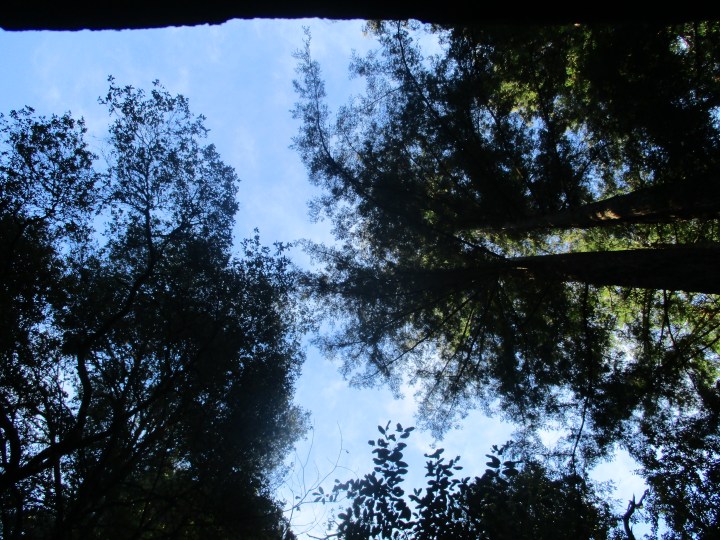
5. Most of us have seen pictures of massive redwood trunks. Most of us have seen pictures of redwood forests. Not so many of us have seen what the foliage looks like.P80825++++

6. This perennial pea has nothing to do with redwoods, but needed to be included as a token flower for this week. Besides it is cool. It is softer pink than the bright purplish pink that is so typical, and is blooming very late.P80825+++++

This is the link for Six on Saturday, for anyone else who would like to participate:

https://thepropagatorblog.wordpress.com/2017/09/18/six-on-saturday-a-participant-guide/

Here are a few links for some of my brief articles about redwood:

https://tonytomeo.com/2018/08/17/dawn-redwood/

https://tonytomeo.com/2018/08/12/general-sherman-tree/

https://tonytomeo.com/2018/08/04/albino/

https://tonytomeo.com/2018/08/04/six-on-saturday-bits-and-pieces-ii/

https://tonytomeo.com/2018/07/14/six-on-saturday-redwoods/

https://tonytomeo.com/2018/05/12/six-on-saturday-tree-ring-circus/

https://tonytomeo.com/2017/10/15/redwoods/

https://tonytomeo.com/2017/10/05/big-tree-in-a-small-town/