Redwoods are such interesting trees. There is always something to write about them. I happen to live and work within the native range of the coastal redwood. I often work with very big redwoods, both in the wild, and in landscaped areas that were formerly wild. There are no other trees that are comparable. The giant redwoods in the Sierra Nevada are bigger, but they are also very different.
1. In most home gardens and landscapes, trees that get cut down get recycled into greenwaste and firewood. Not many are big enough to get recycled into lumber. Even fewer are big enough to get milled into big timbers. This milled redwood lumber is drying before getting milled again into timbers and smaller sizes of lumber that will get used to repair and remodel some of the historical old buildings. A bit of pine lumber is also obtained from the big ponderosa pines nearby.
2. Limbs, foliage, bark and parts of the redwood trees that can not be milled into lumber get chipped. Chips get used as mulch in landscaped areas. After taking this picture, I realized that it is not really a pile of chipped redwood, but is instead chipped wood waste. Chipped redwood is typically green with foliage. Oh well, you get the idea.
3. The Ewok Village of ‘Star Wars IV – Return of the Jedi’ was in a redwood forest near Fortuna. This is not really an Ewok Village.
4. It is a Redwood Canopy Tour. People (not Ewoks) can be seen on a platform in the yellow rectangle just above and to the right of the center of the picture. Someone on a zip line can be seen in the white rectangle just below and barely to the left of the center. It looks crazy to me, but many of my colleagues do crazier things at work.
5. Most of us have seen pictures of massive redwood trunks. Most of us have seen pictures of redwood forests. Not so many of us have seen what the foliage looks like.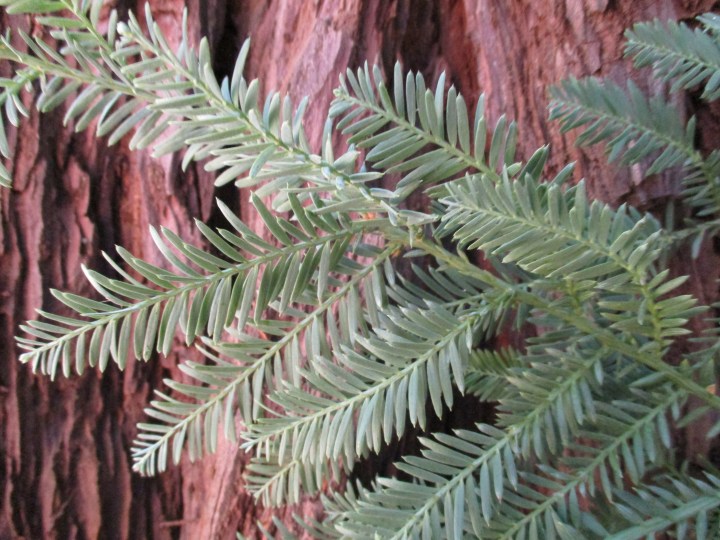
6. This perennial pea has nothing to do with redwoods, but needed to be included as a token flower for this week. Besides it is cool. It is softer pink than the bright purplish pink that is so typical, and is blooming very late.
This is the link for Six on Saturday, for anyone else who would like to participate:
https://thepropagatorblog.wordpress.com/2017/09/18/six-on-saturday-a-participant-guide/
Here are a few links for some of my brief articles about redwood:
https://tonytomeo.com/2018/08/17/dawn-redwood/
https://tonytomeo.com/2018/08/12/general-sherman-tree/
https://tonytomeo.com/2018/08/04/albino/
https://tonytomeo.com/2018/08/04/six-on-saturday-bits-and-pieces-ii/
https://tonytomeo.com/2018/07/14/six-on-saturday-redwoods/
https://tonytomeo.com/2018/05/12/six-on-saturday-tree-ring-circus/
https://tonytomeo.com/2017/10/15/redwoods/
https://tonytomeo.com/2017/10/05/big-tree-in-a-small-town/









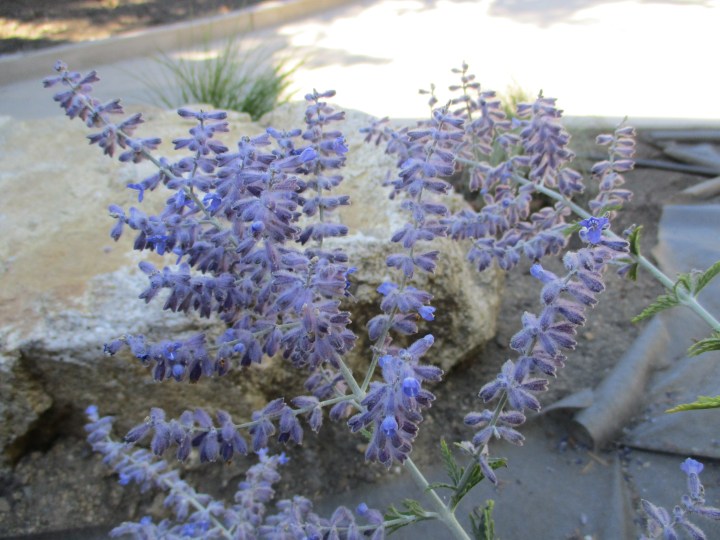
 2. Russian sage, Perovskia atriplicifolia, That sounds like ‘piroshki’. These and the rockrose #4 were 5 gallon plants, so are somewhat bigger than most other plants in the new landscape. They were not bothered by the change of the weather. Their faded denim blue flowers continue to bloom nicely. This is a plant that has been popular for a while, but that I have never grown. I tend to avoid trendy plants. However, my colleagues do not.
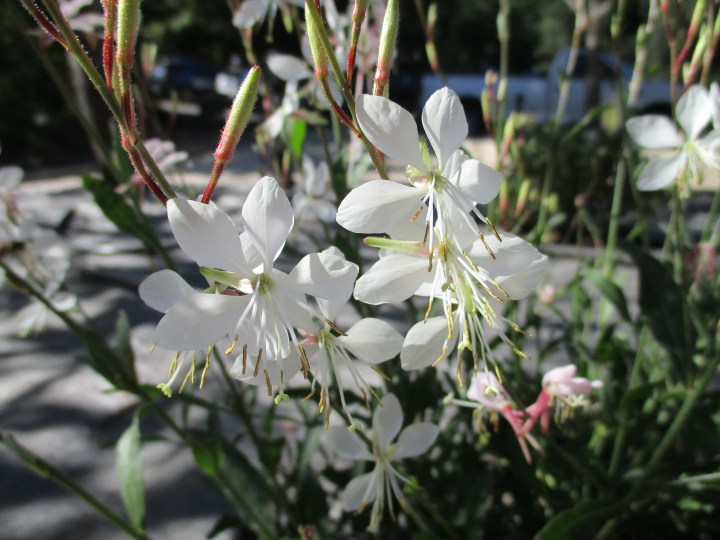
 3. gaura, Gaura lindheimeri, The common name is ‘white gaura’, but some are pink and some are darker pink that is almost red. I do not know if they are merely cultivars of ‘white’ gaura, or different specie. It seemed appropriate to omit ‘white’ from the name. Besides, that is how I learned it. This one can self sow enough to be an annoyance. Individual plants do not live very long, so a few feral seedlings can be selected to replace them.
 4. rockrose, Cistus cretisus, When I learned about rockrose back in the 1980s, we learned only two specie. One was white rockrose. The other was pink rockrose; and the pink rockrose did not look like this one. Now, there are too many to remember. Most do not have species name, but merely cultivar names. I really do not know if this really is Cistus cretisus. It just happens to look like it. I suppose I should have looked at the label.
 5. chocolate coreopsis, Coreopsis ‘Chocolate’, As I implied for #4, nomenclature is not what it used to be. It was standardized to simplify things, but is difficult to keep track of now with all the breeding and hybridizing, and botanists wanting to make a name for themselves by changing a name to something supposedly more accurate. I really do not know the species name of the chocolate coreopsis. It is known merely by the cultivar name.
 6. milkweed, Asclepias tuberosa, This one wilted rather badly in the warmth, but did not get roasted too much. The shriveled flowers in this picture are the worst of the damage. It is blooming more profusely now, and is developing strange seed pods. Milkweed is another trendy plant that caters to the butterfly gardening fad. I am not certain if I like the idea of planting something that is expected to get munched. It sure is colorful for now.
 This is the link for Six on Saturday, for anyone else who would like to participate:
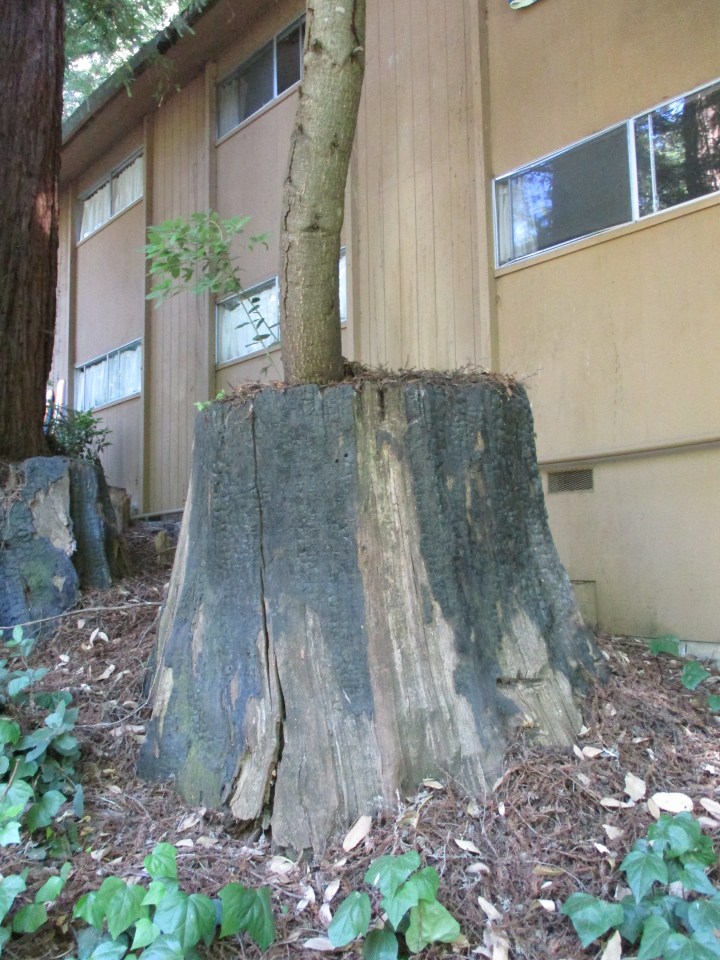
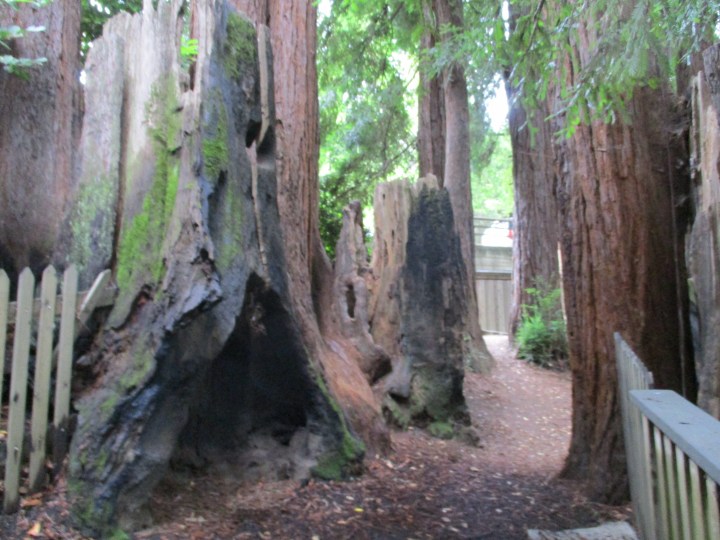
 2. These two bigger stumps are just a short distance uphill and across the small creek. Old stumps are more often single, but surrounded by multiple trunks that emerged from the roots. Because almost all of the trees here had been harvested about a century ago, there are now many more secondary trunks per area than there would naturally be. It is not much of a problem yet, but these trunks will likely become more crowded as they mature.
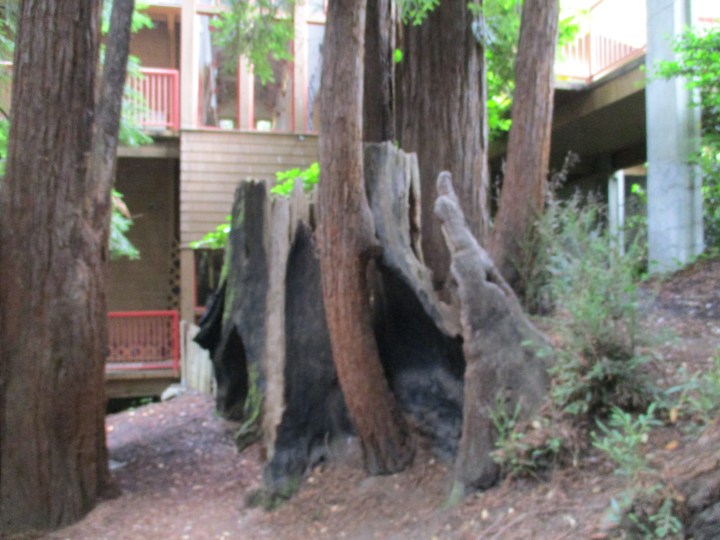
 3. These are the same two stumps from the other side. This trunk coming up from within is likely from the same original root system. All trunks that develop from the same root system are genetically identical, so they look very similar from a distance. Some genetically identical groves can be quite broad, and include many trunks.
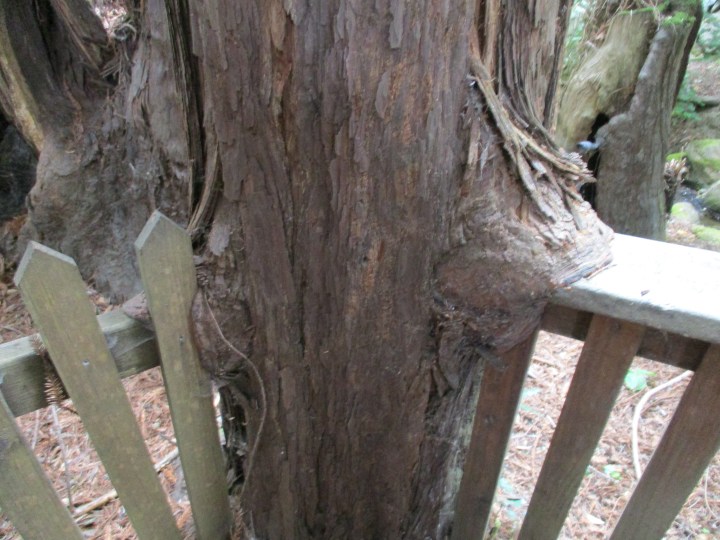
 4. This small coastal redwood trunk is not happy about the fence that is nailed to it.
 5. This is more what you expect coastal redwoods to look like. It is impossible to determine from this picture if these trunks are genetically identical secondary trees that emerged from the same root system, but their proximity to each other suggests that they likely are.
 6. This epiphyllum is the flower that I promised to those who expressed a concern than my Six on Saturday lacked adequate bloom. I shared a picture of this same epiphyllum earlier, but it has continued to bloom.