There Is Variety In Succulents

It is difficult to believe that this stout trunk outfitted with sharp spines is a euphorb, related to leafier poinsettias.

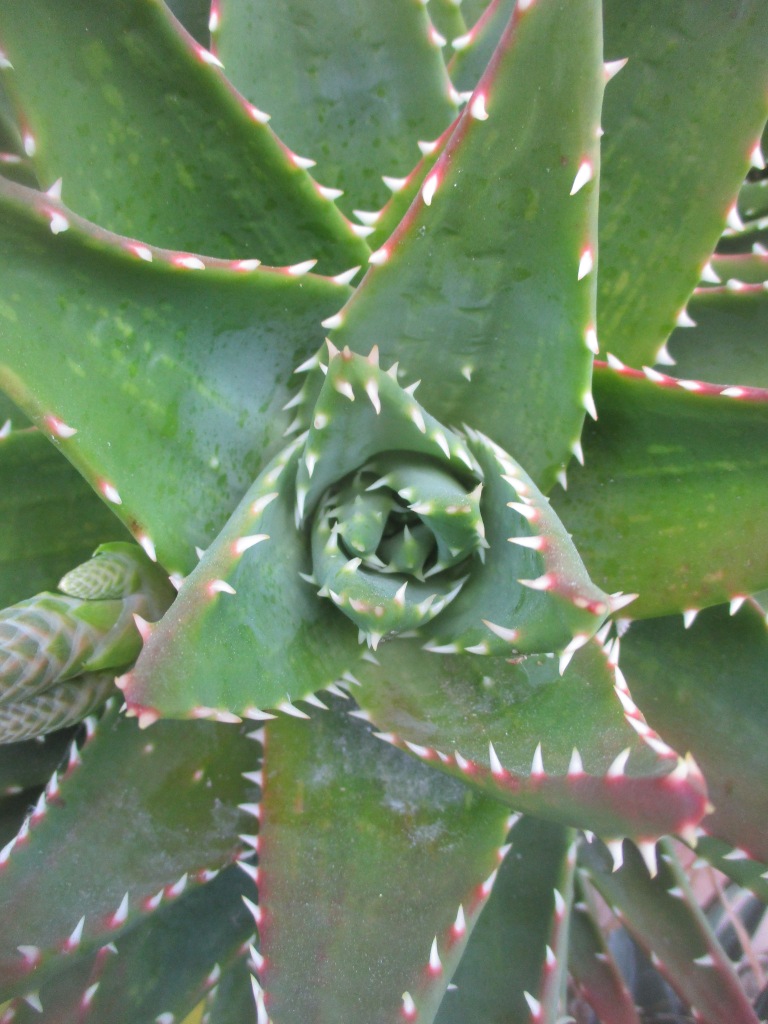
Cacti have thick, fleshy stems outfitted with nasty spines instead of leaves. Agaves and related aloes have stout, fibrous stems that are mostly obscured by thick, fleshy leaves. (Only a few somewhat rare aloes develop bare trunks and stems.) What they have in common is that they all are succulent plants, collectively known as succulents.

There are all sorts of other succulents. Humongous saguaro cactus have hefty trunks and limbs. Diminutive impatiens (like busy Lizzie) are grown as annuals for their colorful and very abundant flowers. Many succulents have succulent stems. Many have succulent leaves. Some, like the common jade plant, have both succulent leaves and stems. Trailing ice plants, leafy begonias, and sculptural euphorbs (related to poinsettias) are all succulents.

Many succulents store water in their succulent parts because they live in dry climates. Because moisture is such a commodity where they live, cacti protect their succulent stems with sharp spines. Agave protect their leaves with sharp teeth. Euphorbs are equipped with caustic sap, and many also have spines like cactus have. Fortunately, most succulents are not so unfriendly.

Almost all succulents are remarkably easy to propagate from cuttings or by division. In the wild, pieces of prickly pear cactus that fall onto the ground will begin to develop roots through the rainy weather of autumn and winter, and be ready to grow into new plants by spring. In the home garden, cactus cuttings should be left out for a week or more so that the cut ends will ‘cauterize’ (Actually, they just dry out a bit.) and be less susceptible to rot once they get plugged into the ground or pots to grow roots. Alternatively, clumping cactus that develop multiple main stems from the base can be divided, although the spines make handling them difficult.

Most aloes and some agaves produce basal shoots known as pups, that can be split from the main plants to grow into new separate plants. Agaves that do not produce pups while young typically start to produce pups after a few (or many) years, as they mature enough to bloom. Many of the larger types produce an abundance of pups after bloom, since the main shoot dies as flowers deteriorate. If desired, one or more of the pups can be left in place or planted back to replace the parent plant.

Most other succulents are even easier to propagate. Small cuttings can be plugged wherever new plants are desired. Some can even be grown from leaf cuttings!
Burro’s Tail

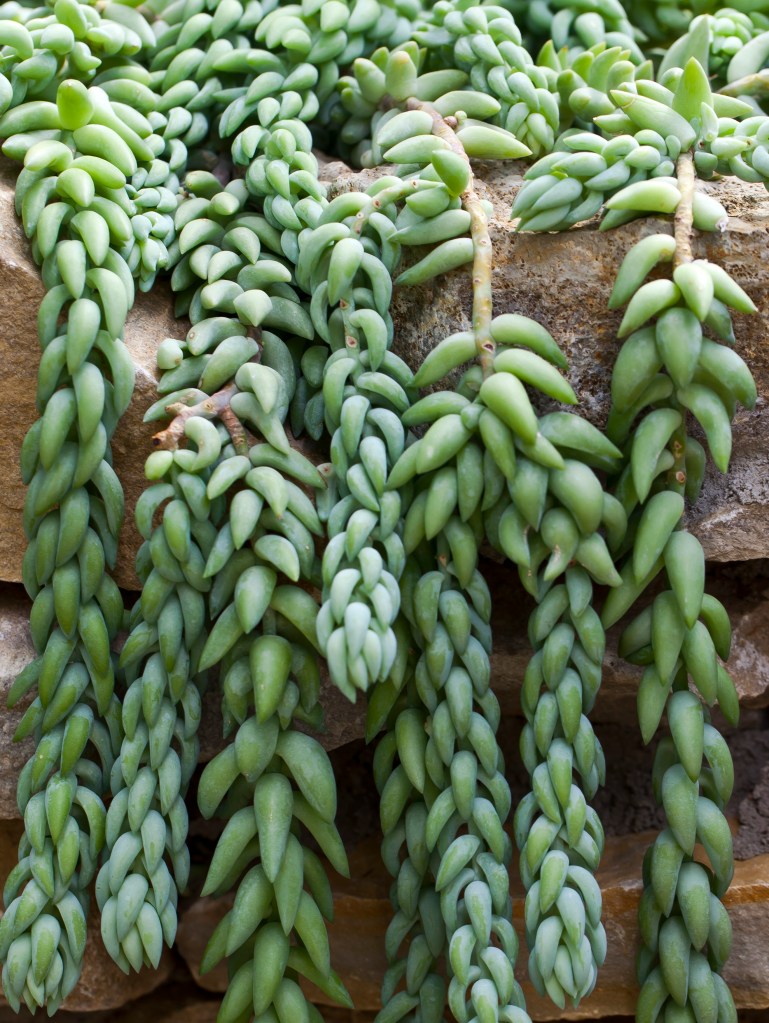
Burro’s Tail is old fashioned, but can also be contemporary.

Back when big spider plants or Boston ferns suspended in fancy beaded macrame were all the rage through the 1970’s, burrow’s tail, Sedum morganianum, was an unusual but also trendy succulent perennial for sunny spots in the home or sheltered and slightly shaded spots in the garden. The refined foliar texture and light bluish green color contrasted nicely with the big and deep green leaves of comparably trendy philodendrons. The thin stems are too limber to stand up, but cascade excellently. Plants in the garden that get pruned back while dormant in winter can easily get two feet long through summer. Without pruning, big plants can get longer than six feet. Pruning scraps and even the small but plump leaves can be rooted and grown into new plants. It is impossible to prune or even move burro’s tail without dislodging some of the leaves anyway. Watering should be regular but not excessive, but then minimal for plants in the garden through winter.

Six on Saturday: Recyclery

With only one exception (#6), everything that I added to my downtown planter box was recycled from somewhere else. Almost all of that which I added came from the garden of the mother of a now deceased old friend, so has major history with me. The original cuttings rode around for more than a month on the dashboard of the old station wagon prior to getting plugged. Yet, I do not know many of their names. Only #5 inhabited the planter box before I got there. Nowadays, bits and pieces generated from occasional grooming of the planter box get recycled elsewhere. Many are shared with neighbors.

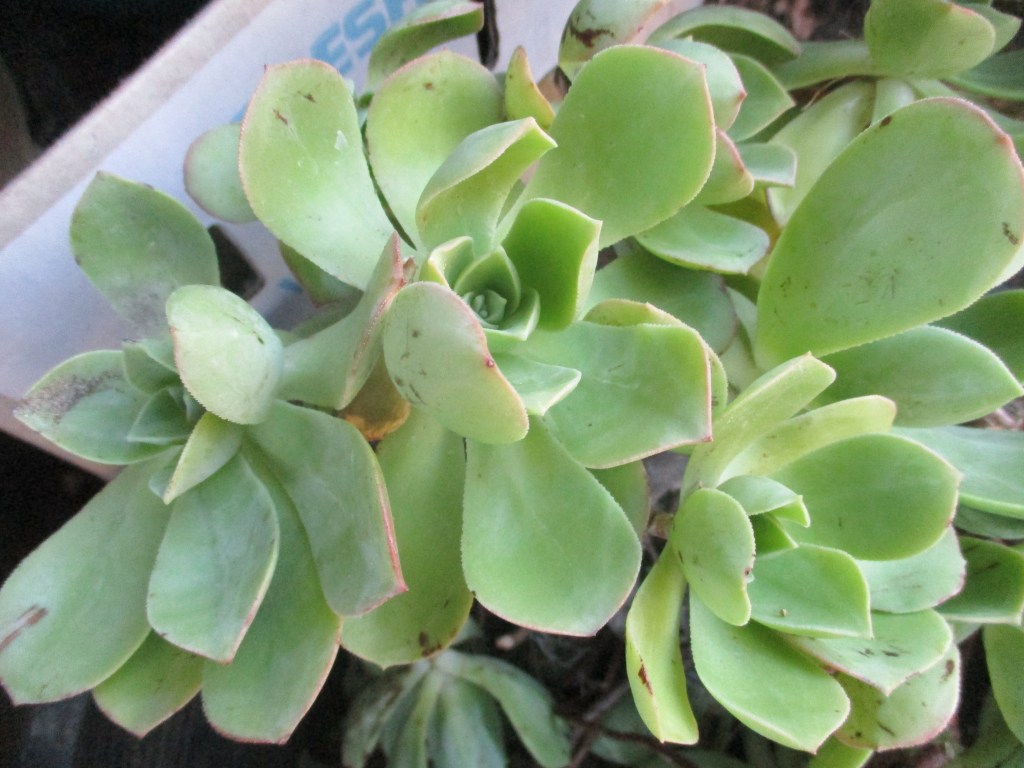
1. Tree houseleek grew almost as big as small tumbleweeds. Except for two Indian hawthorn trees that were installed when the planter boxes were built, they are the most prominent features.

2. Unknown succulent resembles tree houseleek, but stays much lower. A neighbor requested ‘Australia’ canna (#6) because this and tree houseleek produce so much pallid light green foliage.

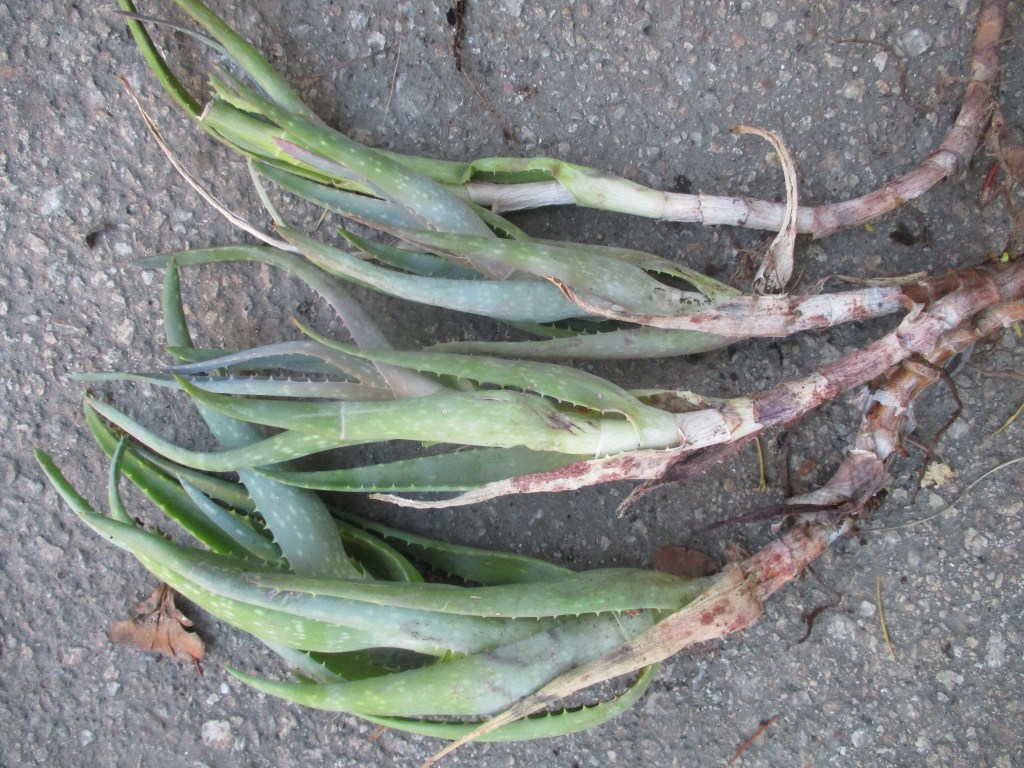
3. Unknown Aloe is more appealing in the planter box than these shriveled cuttings are. I think that it might be more appealing if it bloomed. After a few years, I have not seen a single flower.

4. Unknown bearded is not a good choice for a planter box downtown. It blooms only once annually, and the few flowers get picked. They are slightly grayish white, so are not even very pretty.

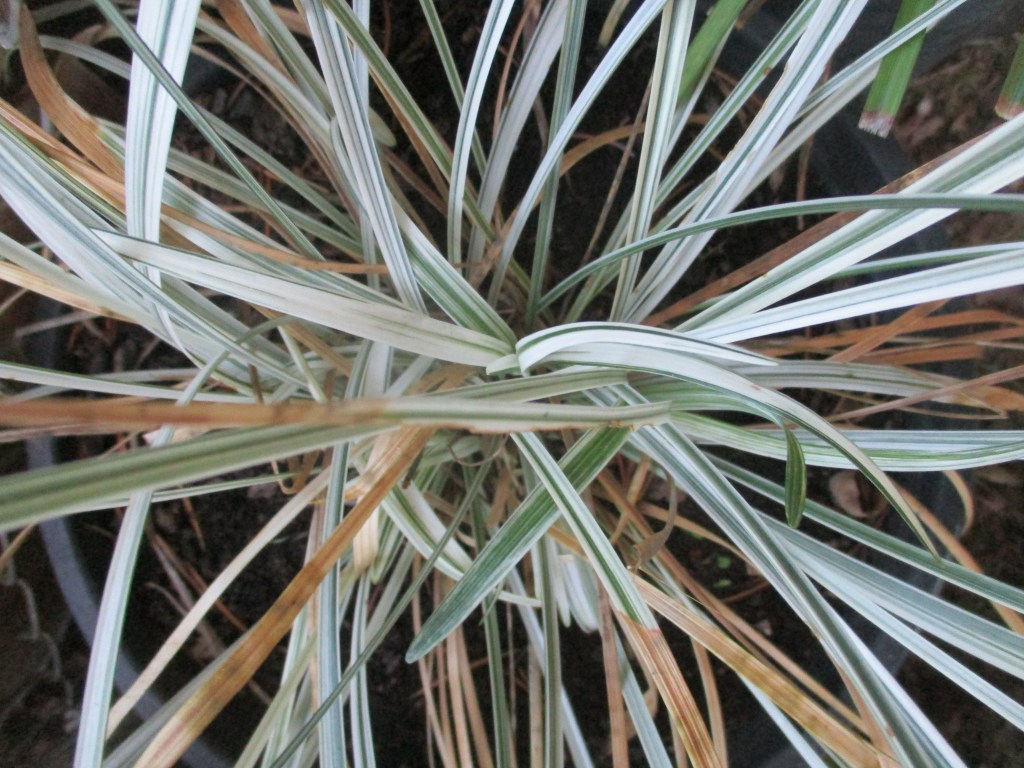
5. Variegated lily turf is one of the few plants that was already in the planter box when I go to it. Some of it reverted to unvariegated, and became even more invasive, and then more abundant.

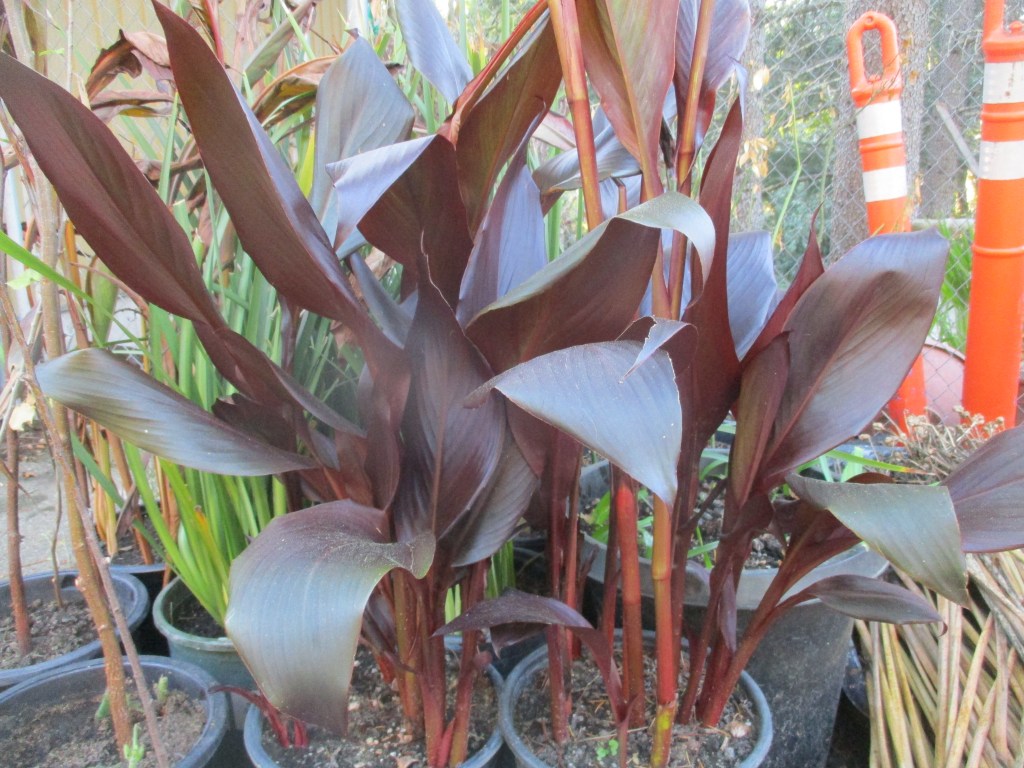
6. ‘Australia’ canna is the only item that I actually purchased for the planter box. I got it because a neighboring merchant expressed an appreciation for bronzed foliage. It does not disappoint!

This is the link for Six on Saturday, for anyone else who would like to participate:

‘Angelina’ Stonecrop

‘Angelina’ is a bright chartreuse stonecrop.

Until the patent expires, unauthorized vegetative propagation (cloning) of ‘Angelina’ stonecrop, Sedum rupestre ‘Angelina’, is still illegal. However, it regularly flaunts its own unlawful proliferation wherever dislodged bits of stem can find anything to take root into. It can be just as happy to root into cracked concrete as in bare soil. Yet, it is a surprisingly complaisant small scale ground cover that cascades only several inches over stones, low retaining walls or the edges of planters.

Without getting more than four inches deep, stems root as they creep indefinitely but slowly along the ground. The bright yellowish evergreen foliage and bright yellow flowers that bloom about now contrast nicely with darker green or bronze foliage. Exposed foliage can get blushed with orange in winter. Shabby plants regenerate vigorously after getting pruned back. Pruning scraps sprinkled over bare soil and lightly mulched with finely textured compost will happily but illegally grow into more of the same. ‘Angelina’ stonecrop likes somewhat regular watering, but can survive with less.

Mexican Snowball

Mexican snowball is strikingly pallid blue.

The silly common name actually suits its plump rosettes of pale bluish succulent leaves. Mexican snowball, Echeveria elegans, forms small colonies that might resemble stashes of snowballs. Individual rosettes are circular, and a bit wider than tall. The widest are four inches or so across. The evergreen leaves are as neatly radial as scales of a pine cone.

Some may know Mexican snowball, and various other species of Echeveria and related Sempervivum, as hen and chicks. Big rosettes can produce so many small pups around their edges that they are reminiscent of mother hens surrounded by their huddled chicks. These pups are quite easy to separate for plugging into pots or elsewhere in the garden.

Mexican snowball is happiest in sunny situations with rather regular watering, but should tolerate a bit of shade and lapses of watering. For small trees in big pots, it can cover the surface of the potting media nicely. Pups plugged into crevices of stone walls might grow into clinging colonies. Tiny pink flowers with yellow tips bloom on wiry stems about now.

Succulents For Better Or Worse

There are all sorts of succulents.

Succulents, both old and new, have been something of a fad for quite a while now. There are certainly many reasons for them to be popular. They add bold form, texture and color to the garden. Most adapt excellently to container gardening. Many types are resistant to pathogens. Succulents are generally easy to maintain and equally as easy to propagate. 

However, one of the primary premises of the increased popularity of succulents is simply untrue. Contrary to popular belief, not all succulents are drought tolerant. Only those that are naturally endemic to desert or chaparral climates can survive with minimal irrigation. They neither expect nor require any more moisture than the rain that falls through winter.

Many succulents are naturally endemic to climates that are not arid. Some are even from tropical rain forests. Such succulents rely on watering to compensate for the local lack of rain through the long and warm summers. Furthermore, many succulents from chaparral and desert climates also want water if their undispersed roots are confined to containers. 

Many popular succulents are cacti. They lack foliage, and are instead armed with spines and thorns. (Spines are modified leaves. Thorns are modified stems.) Their fat succulent stems are green to compensate for their lack of foliage, by conducting all photosynthesis. Generally, most cacti actually are tolerant of drought, although less so within containers.

However, many of the most popular and trendy succulents have succulent leaves as well as succulent stems. Some obscure their stout stems within densely set foliage. Although some are chaparral plants that are somewhat drought tolerant, many require watering for adequate hydration. Even Epiphyllum, which are tropical cacti, require regular watering.

Furthermore, many of the succulents that can survive through dry summers without water take drastic measures to do. Various species of Aeonium and Echeveria let much of their older foliage shrivel to conserve moisture for the younger foliage. Echeveria retain much of their shabby dry foliage as insulation. So many of the succulents that have potential to survive without watering are happier with it.

Pink Iceplant

Pink bloom is merely a bonus.

Lavender pink bloom in spring or early summer can be profuse in sunny situations. Individual flowers are like small daisies with yellow centers. They stay closed through most of the morning, then open by about noon. If the weather is conducive, they can be slightly fragrant. However, the evergreen foliage of pink iceplant, Oscularia deltoides, might be even more appealing than the bloom.

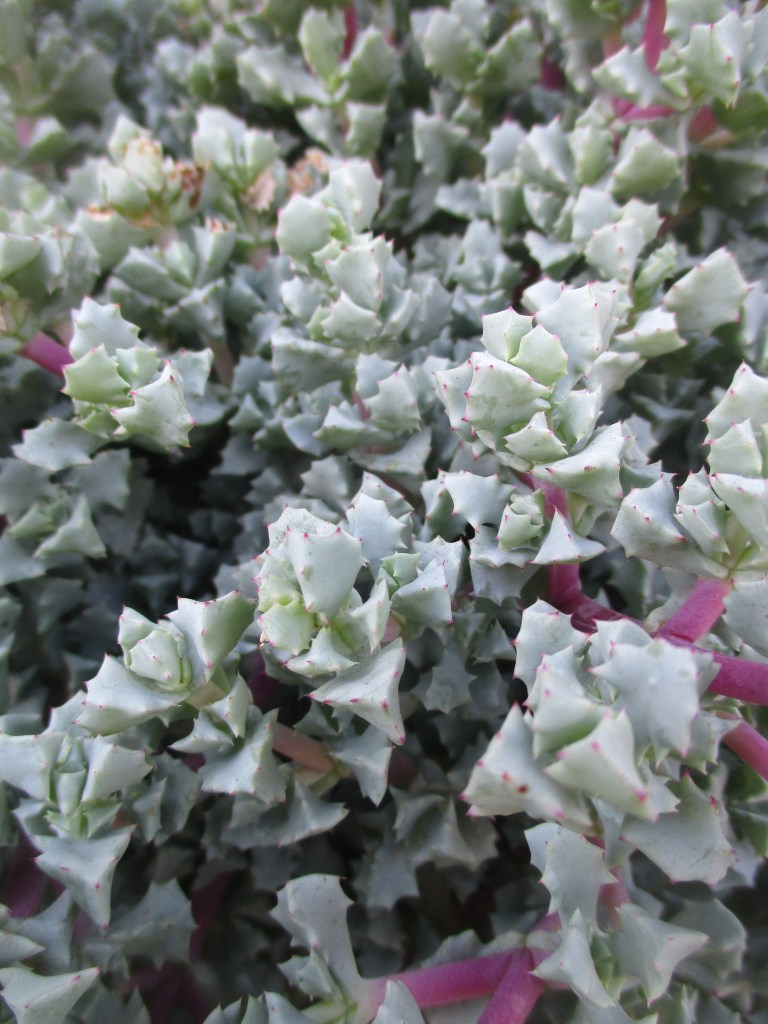
The plumply succulent leaves are a delightfully bluish hue of gray. With two sides and a flat upper surface, these leaves are triangular in cross section. Blunt foliar teeth provide a distinctive texture. Foliage is so dense that the relatively thin stems within are barely visible. Stems can blush with pink or purple. Bloom is better, and foliage is denser, with good exposure and occasional watering.

Mature growth gets at least half a foot deep, and can eventually get a foot deep. It slowly spreads about two or three feet wide. With age, outer stems develop roots where they lay on the soil, and spread even farther. New plants grow very easily from cutting. Pink iceplant cascades nicely from pots or over stone. It contrasts handsomely with richer or darker colors of other foliage or bloom.

Burro’s Tail

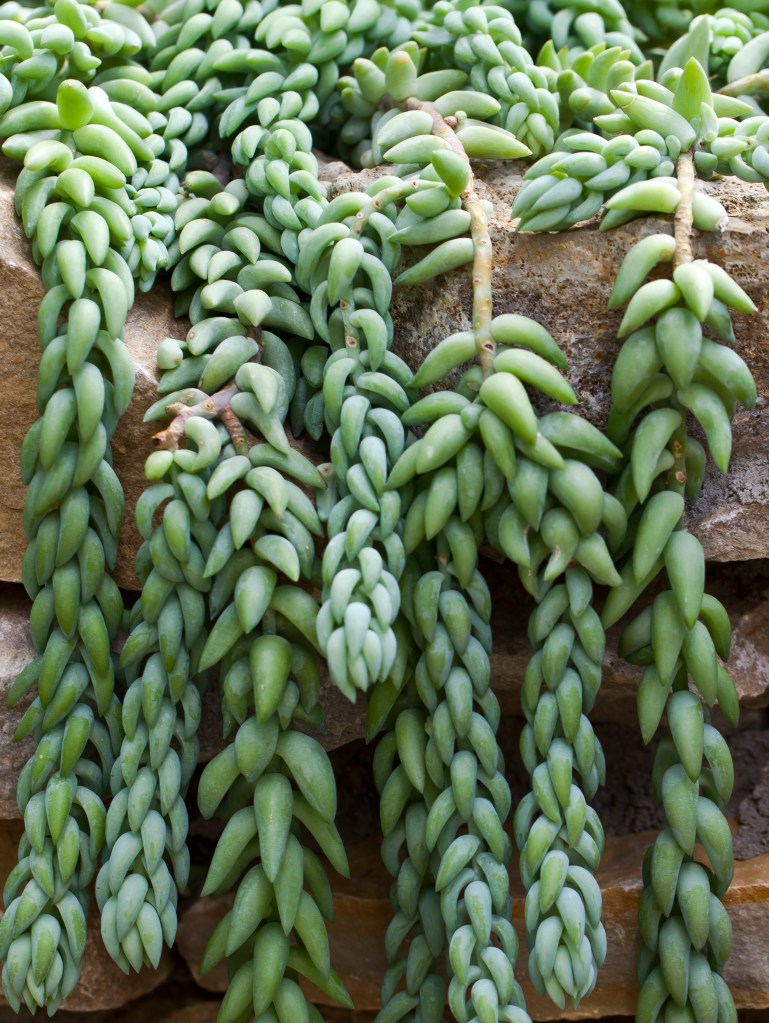
My pictures are missing, so I found this one online without copyright protection. It demonstrates the cascading habit of burro’s tail.

Back when big spider plants or Boston ferns suspended in fancy beaded macrame were all the rage through the 1970’s, burrow’s tail, Sedum morganianum, was an unusual but also trendy succulent perennial for sunny spots in the home or sheltered and slightly shaded spots in the garden. The refined foliar texture and light bluish green color contrasted nicely with the big and deep green leaves of comparably trendy philodendrons. The thin stems are too limber to stand up, but cascade excellently. Plants in the garden that get pruned back while dormant in winter can easily get two feet long through summer. Without pruning, big plants can get longer than six feet. Pruning scraps and even the small but plump leaves can be rooted and grown into new plants. It is impossible to prune or even move burro’s tail without dislodging some of the leaves anyway. Watering should be regular but not excessive, but then minimal for plants in the garden through winter.

Fan Aloe

50610
Some aloes should have more fans.

most aloes are tough perennials that do not need much water. Unfortunately, they do not have many fans. Maybe that is why fan aloe, Aloe plicatilis, makes it’s own. The plumply succulent leaves are distichously arranged, which is a fancy way of saying that they are either to the left or to the right, flaring out to form foliar fans.

Individual leaves are just as distinctive as their arrangement is. They are not tapered and pointed like those of other aloes. Instead, they are about an inch and a half wide from end to end, with weirdly blunt tips. They get almost a foot long. The soft gray color contrasts nicely with coral flower spikes that bloom at the end of winter.

It grows slowly, but fan aloe is one of the few aloes that eventually grows into a big shrub with several sculptural trunks on a flaring base. In their native habitat in South Africa, old specimens grow as small trees more than ten feet tall. Branches that need to be pruned away can be rooted as cuttings after the cut ends dry out a bit.

Blue Spruce Stonecrop

50415-
This stonecrop seems to be coniferous.

It may not be as useful as those marketing it say it is, but blue spruce stonecrop, Sedum reflexum ‘Blue Spruce’ is a nice grayish component to pots of mixed perennials. It contrasts nicely with golden foliage, and looks great with the chartreuse foliage of closely related ‘Angelina’ stonecrop. The limber stems cascade a few inches over the edges of tall urns and hanging pots.

The succulent leaves are quite small, and as the name implies, look like plump blue spruce needles. The succulent stems do not stand much higher than six inches before flopping over. They do not get much wider than high initially, but have a sneaky way of rooting where they touch the ground to cover more area. Yellow flowers bloom just above the foliage in summer.

What blue spruce stonecrop does not do well is uniformly cover large areas of hard or dry soil. It can spread nicely, but is patchy, with thin spots and thick spots. It is really only reliable as ground cover over small areas. It prefers to be watered occasionally, even though it does not need much water. It also likes relatively loose or friable soil, even though it does not need rich soil.